The healthcare trilemma, sometimes also referred to as the “Iron Triangle,” describes the inherent trade-off between three core goals: Cost, Quality, and Access, first coined by William Kissick, the late University of Pennsylvania Wharton School Professor of Economics. The decades long dilemma has been that while it can be relatively easy to improve one or two aspects, it often comes at the expense of the third. For example, increasing access or quality often raises costs, while cutting costs can reduce quality or access, making it difficult to achieve all three simultaneously in a perfect system. Modern variations also include a fourth goal like health outcomes making it a “Quadruple Aim.”
But no matter what you call it, on a recent episode of The Big Unlock podcast Matthew Blosl, CEO of DexCare, sat down with hosts Rohit Mahajan, Managing Partner and CEO at BigRio and Damo, and Ritu M. Uberoy, Managing Partner at BigRio and Damo to share his insights on how focus, co-innovation and AI can be used to finally address this age-old issue.
A Culture of Co-Innovation
Solving all three legs of the Iron Triangle requires a certain amount of “co-innovation” particular when it comes to developing IT solutions for healthcare, however, as Matt explained, that is something that over the course of his career he saw as somewhat lacking. As he told Ritu, “Customization was often seen as a negative, particularly when you were dealing with SaaS solutions for healthcare. You created something, and it was just supposed to a ‘set and forget it’ kind of solution. But I found that kind of one size fits all approach just really could not work for the large healthcare systems I was working with.” He went on to explain that you simply cannot adoption at scale nor reap the benefits that AI can bring, without customization and co-innovation.
“[Our job is to] innovate for a given health system. They all have different priorities. They all have different workflows. They all have different system and data capabilities, and so we look at innovation on an individual basis. We’re coming in and we’re helping innovate using obviously our core platform but making it specifically applicable to the environment in which we’re implementing it.
The Role of AI and the Challenge of Staying Focused
As our regular readers and listeners to our podcast know, healthcare is certainly at a nexus when it comes to AI, and Matt would certainly agree.
“We are at a technological inflection point regarding AI implementation in healthcare. It’s arguably the largest one we’ve seen. It’s the one that’s evolving at an unprecedented pace. Yet, what I find most interesting is that especially within healthcare, at first, there’s still a lot of apprehension around AI. Even though AI enables us to do things that we’ve never done before. It’s going to take a little bit of time to get health systems and healthcare in general comfortable with the risk associated with it.”
He then restated how “co-innovation,” again is the answer to overcoming such hesitations
“AI can deliver a lot of great things, but we really need to partner with our clients to help them understand how to do this. Getting healthcare to adopt new technologies has always been difficult and complex. There needs to be some level of empathy going beyond simply what the technology can provide.”
Yet, he admits that because AI has the power to do so many things well, it can cause companies like his to actually lose focus and try to use it to do too much.
“There is so much that we can do to innovate within the AI space that it’s very easy for us to go outside of our lane very quickly. What we’re really trying to do at DexCare is stay focused, to simply do what we do, but use AI to do it that much better and thereby take our core strength – care orchestration – to a level that we and our clients in the industry never thought was possible.”
Solving the Healthcare Trilemma
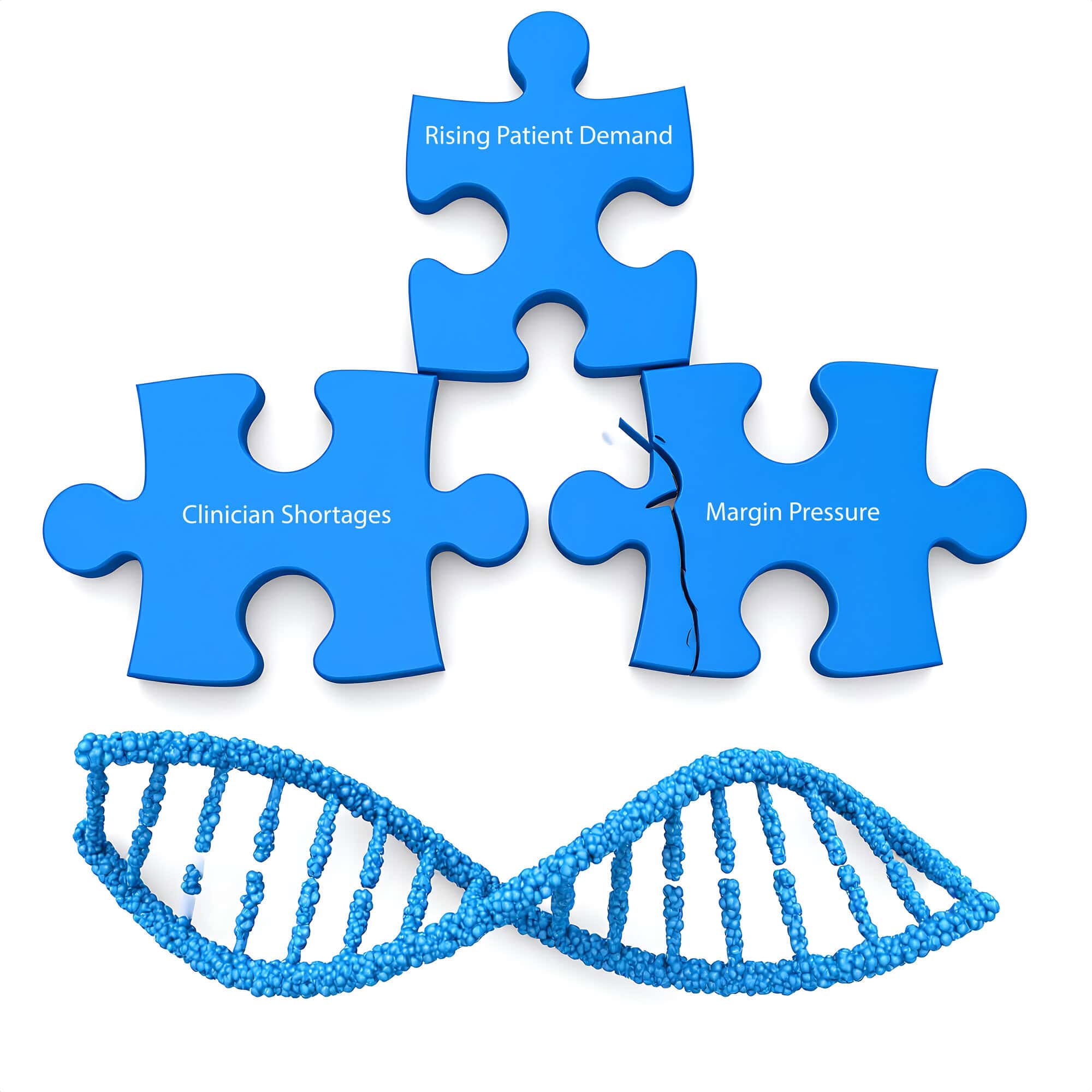
Though similar in its challenges, Matt’s description of the healthcare trilemma as DexCare perceives it departs somewhat from Professor Kissick’s classic definition. For him, the legs of the triangle are: more patients, fewer practitioners, and smaller margins.
Interestingly enough, Matt believes that it may take a combination of three things to solve the trilemma: co-innovation, AI and focus.
He explained how solving the trilemma, basically how to do more for more patients with less staff and lower revenue, is the starting point of every conversation they have with a client.
“It starts with that empathy I mentioned earlier. We understand you have a staffing issue, whether that be actual physicians, or nurses, and at the same time, we see you are strained economically, and from there it’s very easy to apply co-innovation to look at the Dex Care platform and focus on how we can help.”