Insights by Sally Ann Frank, Global Lead – Health & Life Sciences, Microsoft for Startups
Key Points
- The startups that scale don’t stop innovating with the product. They innovate business models, go-to-market strategies, and operating practices, and stay coachable through strong customer discovery.
- Pilot purgatory is avoidable if founders design for production from day one, build an ROI framework early, and keep urgency high through value-added interactions.
- 2026 becomes “show me the money” through four big bridges: global access via virtual care, women’s health beyond reproductive focus, AI-enabled precision medicine, and a shift from break-fix care to prevention and longevity.
“2026 is the show me the money year.”
Sally Ann Frank doesn’t say that as a slogan. She says it is a market reality. After a period of experimentation and pilots, the healthcare AI ecosystem is entering an era in which outcomes, ROI, and production readiness will determine who scales and who fails.
Sally leads the worldwide Health and Life Sciences strategy, programs, and portfolio for Microsoft for Startups, giving her a front row seat to what separates breakout companies from everyone else. She has also walked the founder’s path herself, built businesses, and authored two books aimed at helping digital health startups avoid predictable pitfalls: The Startup Protocol and The Unicorn Protocol. That combination, founder, advisor, and ecosystem builder, is what makes her guidance as unique as it is unusually practical.
In this episode, Sally sat down with Big Unlock hosts Ritu M. Uberoy and Rohit Mahajan, and it plays like a working session with a mentor who has seen hundreds of startup trajectories up close.
Listen to the full conversation
Separating Startups That Scale From the Ones That Stall
Sally begins with a simple observation. Even when startups start with similar access to cloud credits, infrastructure, and ecosystem connections, outcomes can diverge quickly.
She attributes that divergence to a few fundamentals.
First is stakeholder clarity. She highlights that startups operating within Microsoft’s ecosystem are effectively managing multiple audiences simultaneously. Including the startup itself, the end customer, and internal stakeholders such as account teams, product teams, and research groups. The best founders learn to message, align, and execute across all those contexts.
Second is innovation beyond technology. Sally is explicit that the most successful companies do not treat AI innovation as the finish line. They innovate business models, hiring practices, compensation approaches, and go-to-market strategies. In her words, the case studies in The Unicorn Protocol demonstrate that the innovation “didn’t stop right at innovative tech.”
That’s a useful reality check because the AI market encourages shortcuts. Many companies believe that adding generative AI is a form of differentiation. Sally argues differentiation is actually created by how you package value, how you sell it, how you support it, and how you evolve it as the market changes.
Third is coachability. Sally makes the point that no one innovates alone. The founders who scale are open to strategic mentorship, receptive to customer discovery, and willing to evolve based on what they learn. She emphasizes “strong customer discovery throughout the journey” so companies can build something that works today but also morphs as AI continues to change rapidly.
This becomes a key theme for the rest of the episode: the market is shifting so fast that founders need both conviction and adaptability. Coachability is the operating trait that connects those two.
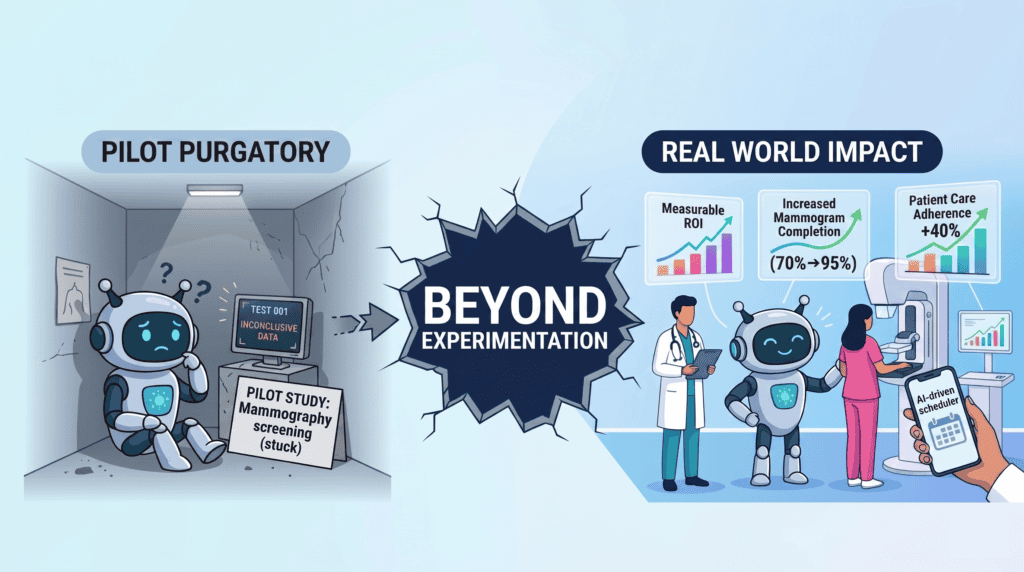
“Pilot Purgatory” Is a Design Flaw, Not a Rite of Passage
The episode then moves into one of the most common failure modes in healthcare innovation, pilots that never become production.
Sally’s take is blunt. When enterprise sales cycles drag on endlessly, it often reflects a lack of urgency. If the customer believes they can live without your solution, your value proposition is not compelling enough.
She also offers surprisingly tactical advice: “Add value at every interaction.”
Don’t end a pitch with “what do you think?” End with “was that helpful?” and explicitly ask what would make the solution more compelling. Don’t send follow-up emails that ask for next steps without substance. Be prescriptive. Offer the next recommended step, such as a strategy session to refine the solution to the customer’s unique situation.
Her point is not just about sales technique. It’s about positioning. Every interaction should move you from “vendor” to “trusted advisor.”
Then she introduces the shift that matters most for founders, explaining that 2024 was experimentation, 2025 was pilots, and 2026 is “show me the money.” That is where ROI becomes the forcing function.
She acknowledges early-stage companies may not be able to prove ROI immediately, but they must have an ROI framework. They should know which metrics matter, what they will track, and what targets they are aiming for. They should also validate those assumptions through customer discovery by asking customers if the chosen metrics are the right ones.
This leads directly to her most actionable warning about “pilot purgatory.” Founders must plan for success while in the pilot phase.
If a pilot goes well and the customer says, “We love it, now what?” and the startup has no production plan, momentum dies. Sally calls this the law of diminishing interest. The longer the gap between pilot and production planning, the more likely it is that the customer decides they didn’t need the solution as much in the first place.
This is a critical lesson for healthcare AI founders because pilots are easier than production. Production requires security, workflow integration, training, change management, and operational ownership. Sally’s message is that the production pathway must be designed from day one, not bolted on later.
She also emphasizes change management as a consistent blind spot. Even the best solution asks humans to do something different. Founders must account for that reality by removing steps, automating steps, and making it easier for the enterprise to adopt. Founders cannot run the enterprise’s change management, but they must support it in ways that make adoption feasible.
Rohit reinforces the idea with a simple reframing: a pilot is a pathway to production, not an end state, and you need a plan with customer buy-in to move quickly before interest fades.
Sally adds one more practical point that many founders overlook: make your champion look good. Let them take the glory. They will be much more inclined to participate in case studies and public validation if the narrative strengthens their professional success.
The “Show Me the Money” Era and the Four Bridges to Healthcare’s Next Chapter
When asked what she sees ahead, Sally resists pure prediction and instead offers aspirations for where she wants the ecosystem to go. What’s interesting is that her aspirations map directly to where investment and adoption pressure are already building.
She describes four bridges.
First is improved access globally. She points to virtual technology and mobile devices as pathways to democratize care, including scenarios in which remote expertise can support clinical care in underserved regions.
Second is women’s health. Sally highlights a structural investment gap. Women represent half the population, yet women’s health historically receives a small fraction of investment, often concentrated in reproductive health. She argues the opportunity is broader because women present differently across many conditions, and investment should reflect that reality.
Third is personalized medicine. She points to genetics and the use of AI to tailor treatment and medication based on individual characteristics, shifting from one-size-fits-all approaches to more individualized care.
Fourth is flipping the system from break-fix to prevention and longevity. She frames this as improving healthspan, not just lifespan, and emphasizes quality of life across a person’s full life arc.
Ritu connects this to a theme that has appeared in other Big Unlock episodes, the annual physical as an outdated model in a world of continuous health data, wearables, and more holistic health narratives.
What makes these four bridges valuable in this episode is that Sally ties them back to the founder’s strategy. If 2026 is the “show me the money” year, then founders will be judged not by the novelty of their AI, but by the measurable impact they create in areas that matter.
Digital Transformation Winners Become Trusted Advisors, Not “Tool Vendors”
Sally’s core argument is that healthcare AI is entering a more rigorous, disciplined era. The early phase rewarded novelty and experimentation. The next phase will reward ROI, production readiness, and the ability to scale within enterprise constraints.
Her guidance is operational.
Understand stakeholders. Innovate beyond the product. Stay coachable. Do customer discovery continuously. Build ROI frameworks early. Plan production during the pilot. Reduce change management burden. Add value at every interaction. Make your champion look good.
Taken together, these are not abstract principles. They form a practical playbook for escaping pilot purgatory and becoming the kind of company enterprises trust at scale.
The Takeaway
Sally Ann Frank’s message is both direct and timely. Healthcare AI is exiting the experimentation phase and entering a show-me-the-money era where enterprise impact is the only metric that matters. In her view, the startups that win won’t be the ones with the flashiest model demos. They’ll be the ones that innovate beyond the technology, stay coachable through relentless customer discovery, and design for production from day one so pilots naturally convert into scaled deployments.
Sitting at the intersection of hyperscale ecosystem enablement, startup mentorship, and real-world enterprise adoption patterns, Sally Ann Frank’s unique insights are especially valuable:
- Startups that scale innovate beyond the product, including business models, go-to-market design, and operating practices, not just technology.
- Coachability and continuous customer discovery are competitive advantages because the AI landscape is evolving too quickly for static assumptions.
- If sales cycles drag endlessly, urgency is missing. A strong value proposition makes customers feel they cannot live without the solution.
- Pilot purgatory is avoidable when founders plan production during the pilot and close the gap quickly before diminishing interest sets in.
- ROI frameworks should be defined early, with targets and metrics validated through customer discovery, because 2026 becomes the show-me-the-money year.
- The next growth bridges include global access, women’s health beyond reproductive focus, precision medicine through genetics, and prevention and longevity-focused healthspan.