How deep collaboration, AI, and purpose-built innovation can reshape children’s healthcare
Artificial intelligence is rapidly transforming healthcare. Hospitals are deploying ambient documentation, clinicians are using AI-powered decision support, and digital front doors are becoming increasingly intelligent. Yet amid this wave of innovation, one segment of healthcare continues to receive disproportionately little attention: pediatrics.
Children represent nearly 20% of the U.S. population, but pediatric digital health attracts less than 1% of total digital health investment. That imbalance isn’t simply about funding. It reflects a broader misconception that pediatric healthcare is merely a smaller version of adult healthcare, but it isn’t.
On a recent episode of The Big Unlock, Omkar Kulkarni, Vice President and Chief Transformation & Innovation Officer at Children’s Hospital Los Angeles (CHLA) and founder of the KidsX consortium, challenged many of the assumptions that drive healthcare innovation today. His message was clear: meaningful innovation for children requires an entirely different mindset, stronger institutional collaboration, and technologies purpose-built for pediatric care.
Rather than adapting adult solutions, healthcare organizations and startups need to rethink pediatric innovation from the ground up.
Listen to the full conversation
Key Learnings
- AI should help clinicians, not replace human connection
- Less than 1% of digital health investment goes toward pediatric innovation
- Mental health is one of pediatric healthcare’s biggest unmet needs
- Pediatric innovation must be designed for both children and caregivers
Pediatric Healthcare Is Fundamentally Different
One of Omkar’s most compelling observations is that many innovators underestimate how unique pediatric care truly is.
Unlike adult healthcare, where patients typically make their healthcare decisions, pediatric care revolves around parents and caregivers. Every digital experience, from appointment scheduling to patient engagement, must account for the fact that the primary user often isn’t the patient. But that’s only the beginning. Children move through dramatically different developmental stages, each bringing distinct physiological, behavioral, and clinical needs. A technology designed for a premature infant cannot simply scale to serve a teenager.
Privacy regulations add another layer of complexity. Adolescents gain increasing control over their health information, requiring digital platforms to carefully manage caregiver access while respecting legal protections. The diversity of pediatric populations also demands a more inclusive design. Children’s hospitals serve families across multiple languages, cultures, socioeconomic backgrounds, and care settings. Building effective digital health tools means designing for this diversity from day one and not as an afterthought.
As Omkar points out, pediatrics requires an entirely separate technological blueprint.
Solving the Investment Paradox Through Collaboration
The lack of investment in pediatric innovation creates a difficult cycle. As funding is limited, fewer startups focus on pediatric care. With fewer companies entering the space, children’s hospitals have fewer opportunities to evaluate innovative solutions. Limited deployments produce less clinical evidence, making future investment even harder to secure.
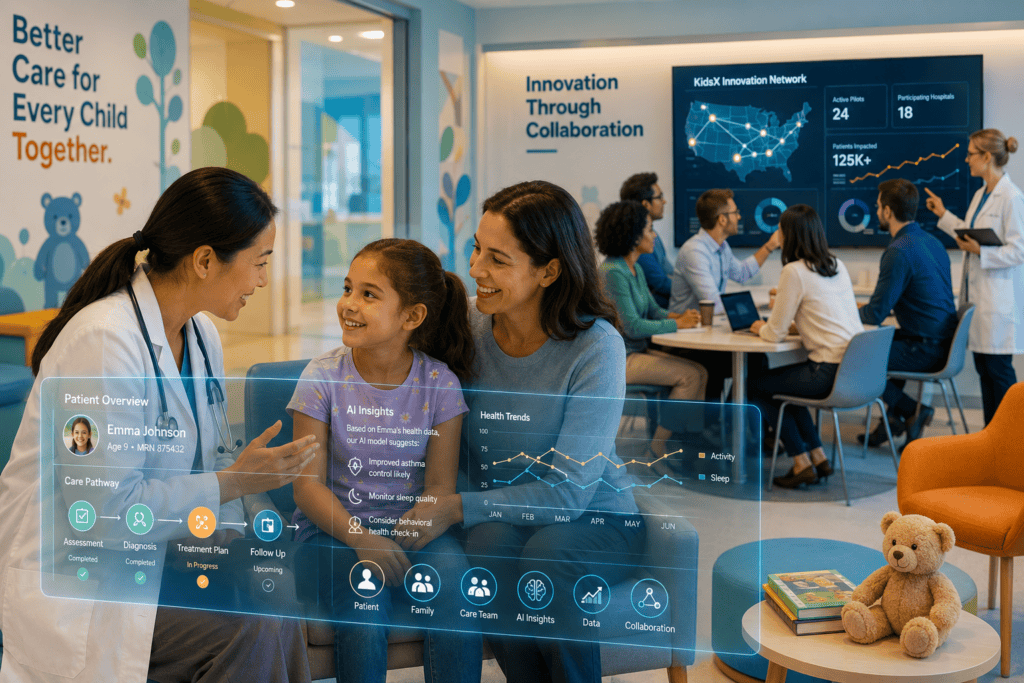
Omkar believes the solution isn’t competition among children’s hospitals; it is collaboration. Through KidsX, CHLA has helped build a consortium of children’s hospitals that work together to evaluate, validate, and scale promising digital health solutions. Instead of each hospital independently piloting early-stage technologies, participating organizations collaborate to generate broader evidence across multiple care settings. This model benefits everyone involved. Hospitals reduce duplication of effort. Startups gain access to diverse clinical environments.
Most importantly, pediatric patients benefit from innovations that can scale much faster than any single institution could achieve alone. In an industry often characterized by fragmented innovation efforts, KidsX demonstrates that collective action may be the fastest path toward meaningful transformation.
Three Areas Where AI Can Deliver Immediate Impact
While AI dominates healthcare conversations today, Omkar offers a refreshingly practical perspective on where it can create the greatest value in pediatric care.
1. Addressing the Pediatric Mental Health Crisis
Perhaps the most urgent opportunity lies in pediatric behavioral health. Demand for child mental health services has surged dramatically, while provider shortages continue to grow. Long wait times leave many families without timely support, particularly those relying on Medicaid. Omkar sees AI helping bridge this gap by expanding access through earlier screening, digital engagement, and scalable support tools.
Technology can help identify children at risk sooner, guide families toward appropriate care, and support clinicians managing overwhelming caseloads. Given the growing prevalence of anxiety, depression, and behavioral challenges among younger children, scalable digital interventions could have profound long-term impact.
2. Supporting Lifelong Chronic Care
Medical advances mean many children diagnosed with chronic illnesses now live healthy adult lives. Conditions such as Type 1 diabetes, asthma, congenital heart disease, and cystic fibrosis increasingly require decades of coordinated care rather than short-term treatment. Omkar envisions digital platforms that begin supporting patients during childhood and continue throughout adulthood.
Rather than repeatedly transitioning between disconnected systems, patients could maintain a continuous digital relationship that evolves alongside their health journey. This longitudinal approach represents one of the most promising and underexplored areas of pediatric digital health.
3. Giving Parents Trusted AI Guidance
Parents face countless health questions every day.
- Should I worry about this fever?
- Is this symptom normal?
- Does my child need urgent care?
Too often, families turn to search engines or social media, where information quality varies dramatically. Omkar believes healthcare organizations have an opportunity to provide clinically validated conversational AI that delivers trusted guidance around the clock. Instead of replacing pediatricians, these tools could answer common questions, reduce unnecessary visits, and help families make more informed decisions before concerns escalate.
In healthcare, trust is everything. Providing reliable, evidence-based answers exactly when parents need them may become one of AI’s most valuable contributions.
Building Trust Before Scaling
Having evaluated thousands of healthcare startups throughout his career, Omkar offers practical advice for innovators entering healthcare. Technology alone is never enough. Healthcare organizations expect evidence that reflects diverse patient populations, multiple clinical environments, and measurable outcomes. Small pilot studies may generate excitement, but broad adoption requires much stronger validation. Equally important is a sustainable business model. Many startups solve legitimate clinical problems yet struggle because reimbursement pathways or purchasing models remain unclear.
Innovation without economic viability rarely scales. Omkar’s most memorable advice centers on humility. Healthcare transformation depends on partnership and not disruption for disruption’s sake. Startups that acknowledge the complexity of clinical workflows, listen carefully to providers, and collaborate rather than dictate are far more likely to earn institutional trust. In an AI market filled with ambitious promises, that perspective stands out.
AI Should Elevate Human Care and Not Replace It
One of the strongest themes throughout the conversation is Omkar’s belief that healthcare will remain fundamentally human. Despite rapid advances in generative AI, he does not envision hospitals replacing clinicians with machines. Instead, he sees AI handling administrative work, synthesizing clinical information, reducing documentation burdens, and surfacing relevant insights. These efficiencies allow clinicians to spend more time doing what only humans can do – listening, explaining, comforting, and building relationships.
For pediatric care, especially, empathy matters. Parents navigating serious illness often need reassurance as much as information. Children need trusted caregivers who understand both medicine and emotion. Technology should strengthen these relationships. It’s a philosophy that echoes one of healthcare’s broader goals: enabling clinicians to practice at the top of their license while preserving the deeply human nature of care.
The Future of Pediatric Innovation Is Collaborative
Healthcare innovation often celebrates breakthrough technologies. Omkar’s vision is different. He emphasizes ecosystems over individual products, partnerships over competition, evidence over hype, and purpose-built design over adaptation.
Pediatric healthcare has long been underserved by the digital health ecosystem, but that also means enormous opportunities remain. Organizations willing to design specifically for children and collaborate across institutions to validate and scale innovation have the potential to reshape care for millions of families.
As AI continues transforming healthcare, the biggest breakthroughs may not come from building faster algorithms. They will come from asking better questions.
- How do we support parents?
- How do we improve lifelong outcomes for children?
- How do we ensure innovation reaches the populations that need it most?
Omkar Kulkarni’s perspective reminds us that the future of pediatric healthcare won’t simply be inherited from adult medicine. It will need to be built intentionally with collaboration, evidence, empathy, and technology working together to improve the lives of children and families everywhere.