Insights from Julie Demaree, VP, Chief Technology and Digital Innovation Officer, St. Mary’s Healthcare
Healthcare leaders today have more technology options than ever before. Every week brings another AI platform, automation tool, ambient documentation solution, or digital health application promising to transform care delivery. Yet for many health systems, especially rural and community hospitals operating with lean teams and constrained budgets, the challenge isn’t a shortage of technology. It’s deciding which problems are actually worth solving.
That is precisely the perspective Julie Demaree, Vice President, Chief Technology and Digital Innovation Officer at St. Mary’s Healthcare, brings to healthcare innovation. As a former physician assistant turned technology executive, Julie approaches digital transformation differently. Rather than asking “What new technology should we implement?”, she starts with a much more important question:
“Should this process even exist in the first place?”
That mindset has helped St. Mary’s Healthcare improve clinician experience, patient safety, operational efficiency, and financial performance, not by constantly adding new technology, but by making better use of what they already have while introducing AI only where it creates measurable value.
Listen to the full conversation
Key Learnings
- Clinician Engagement Drives Better Technology Adoption
- AI Should Support Judgment, Not Replace It
- Data Trust is the Foundation of Transformation
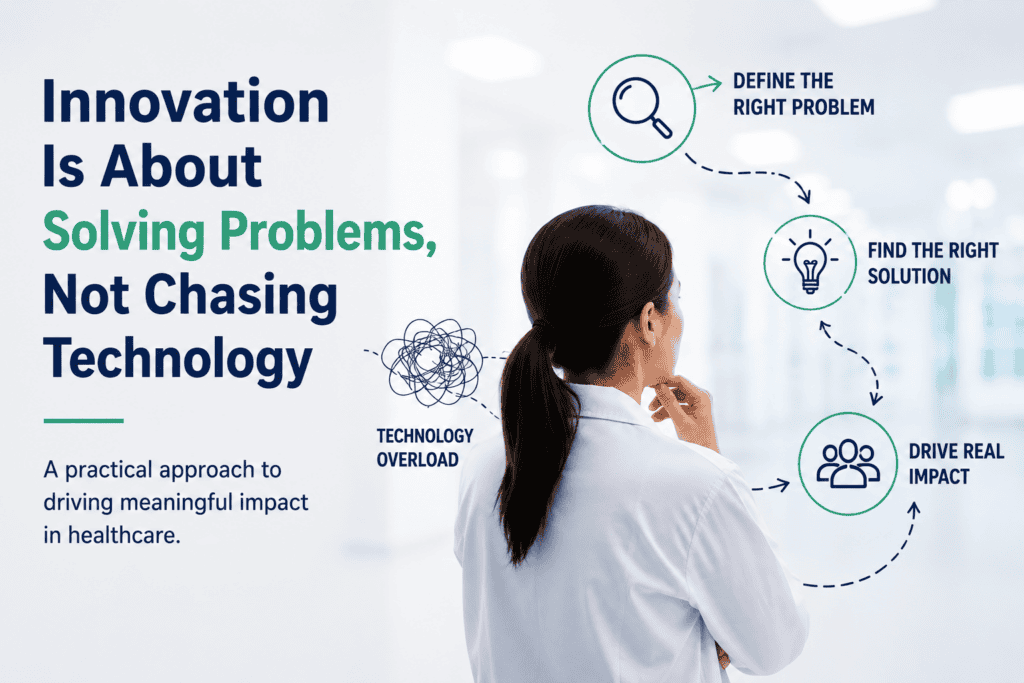
Innovation Starts with the Problem, Not the Technology
One of the strongest messages from Julie is that healthcare organizations often confuse innovation with purchasing new software. She argues that innovation frequently means improving existing workflows before introducing something new. When Julie joined St. Mary’s, much of her work focused on uncovering capabilities that already existed inside their electronic health record but had never been fully implemented. Instead of immediately investing in third-party applications, her team first examined:
- Which EHR capabilities remained unused?
- Which workflows could be optimized?
- Which operational bottlenecks were caused by process rather than technology?
This “optimize before you buy” philosophy is especially valuable for organizations facing financial pressures. Every additional application introduces implementation costs, interfaces, maintenance overhead, vendor management, and fragmented data. Maximizing existing investments often delivers faster and more sustainable results than expanding the technology stack.
Better Patient Safety Sometimes Means Fewer Alerts
Alert fatigue has become one of healthcare’s most persistent technology challenges. Many organizations respond by simply adding more alerts in hopes of improving patient safety. Julie’s team took the opposite approach. Instead of assuming more notifications would improve outcomes, they created a multidisciplinary governance process involving physicians, pharmacists, informatics specialists, and clinical leaders to evaluate every alert. Some alerts were introduced where genuine safety gaps existed. Others were eliminated because they created unnecessary interruptions. The result was counterintuitive: Physicians ultimately received fewer—but far more meaningful—alerts.
Even more importantly, clinicians became active participants in improving the system. Their feedback helped refine alerts while encouraging better maintenance of patient problem lists, increasing the accuracy of future clinical decision support. Rather than adding complexity, St. Mary’s improved patient safety through thoughtful curation and continuous clinician engagement.
Automation Should Never Hide a Broken Process
Julie’s most refreshing insight challenges a common assumption about AI. Just because a task can be automated doesn’t mean it should be. She offers a simple example: fax processing.
Modern AI could easily classify, route, and organize incoming faxes. But automating that workflow risks making organizations more comfortable with an outdated process that shouldn’t exist. If two hospitals use the same electronic health record, why should they exchange patient information by fax at all?
Rather than automating inefficiency, Demaree believes organizations should first eliminate unnecessary work wherever possible. Automation delivers its greatest value when applied to complex, cross-platform workflows that genuinely require coordination, not when it perpetuates outdated operating models.
AI Investments Must Deliver Measurable Value
Resource constraints force rural hospitals to make difficult technology decisions. For Julie, every investment begins with a practical question: Will this improve financial sustainability, clinician experience, or patient care?
At St. Mary’s, AI initiatives have focused on areas with clear returns, including:
- Revenue cycle automation
- Ambient clinical documentation
- Faster billing workflows
- Reduced claim denials
- Improved physician recruitment and retention
These investments weren’t driven by AI enthusiasm. They were selected because they addressed operational challenges while creating measurable organizational benefits.
This disciplined approach demonstrates that successful AI strategies are built on business priorities, not technology trends.
AI Governance Alone Isn’t Enough
Healthcare organizations have invested considerable effort developing AI governance frameworks. Julie believes another priority deserves equal attention: AI literacy among end users.
Clinicians must understand that AI outputs should be evaluated just as critically as laboratory results or diagnostic tests. If something appears incorrect, users need both the confidence and the mechanisms to question it.
AI should assist clinical judgment, not replace it. Organizations therefore need:
- Practical AI education
- Clear reporting pathways for unexpected outputs
- Ongoing user training
- A culture that encourages critical thinking
Responsible AI adoption ultimately depends on informed users as much as technical safeguards.
Strong Infrastructure Remains the Foundation of Innovation
Although conversations often focus on AI, Julie reminds healthcare leaders that innovation rests on a less glamorous foundation: modern IT infrastructure and disciplined technology management.
Reliable servers, resilient networks, scalable storage, and well-maintained systems form the backbone of every successful digital initiative. Equally important is addressing technical debt, outdated applications, legacy integrations, and deferred upgrades, that can slow innovation and increase operational risk.
Without a strong technology foundation, even the most advanced AI solutions cannot deliver sustainable value.
Her advice to healthcare executives is straightforward: don’t allow investments in core infrastructure or the modernization of legacy systems to fall behind while chasing emerging technologies. Modern AI capabilities require modern technology foundations, and maintaining those foundations is no longer just an IT responsibility, it’s a business continuity imperative.
Real Innovation Is Operational Discipline
Julie Demaree’s perspective offers an important counterbalance to today’s AI excitement. Innovation is not measured by the number of technologies deployed or the sophistication of an organization’s AI portfolio. Instead, it is reflected in an organization’s ability to remove unnecessary work, simplify clinical workflows, improve patient safety, support clinicians, and solve meaningful operational problems. Especially for rural and community health systems operating with limited resources, that mindset may be the most valuable innovation strategy of all.
As healthcare organizations continue exploring generative AI, automation, and agentic systems, Demaree’s approach serves as an important reminder: Technology creates value only when it solves the right problem. Otherwise, it simply adds another layer of complexity.