Insights from Greg O’Neill, Director of Patient & Family Health Education at ChristianaCare, on The Big Unlock Podcast
Healthcare is investing heavily in artificial intelligence, digital front doors, patient portals, virtual care, automation, and increasingly sophisticated tools designed to improve the patient experience.
But amid this rapid technology transformation, one of healthcare’s most fundamental challenges remains surprisingly simple: Do patients actually understand what is happening with their care and what they need to do next?
For Greg O’Neill, Director of Patient & Family Health Education at ChristianaCare, that question gets to the heart of health literacy.
Greg brings an unusual perspective to the conversation. He began his career at the bedside as a trauma and surgical ICU nurse before moving into advanced practice nursing and eventually system-level leadership. Today, he leads ChristianaCare’s strategic approach to patient education and health literacy, giving him a view that spans the individual patient encounter and the broader health system.
In a recent conversation on The Big Unlock Podcast, Greg argued that communication should not be treated as a “soft” component of healthcare. It is an essential part of delivering safe, effective care.
His perspective is particularly relevant as health systems adopt AI and digital technologies at an accelerating pace. Technology can make healthcare more efficient, but if patients leave an encounter confused, overwhelmed, or unsure about what comes next, digital transformation has not solved the underlying problem.
Key learnings of the episode:
- Health Literacy Drives Better Patient Outcomes
- Technology Should Strengthen, Not Disrupt, Clinical Workflows
- AI Can Reduce Patient Burden by Connecting Fragmented Care
- Better Communication Builds Trust and Improves Care
Listen to the full conversation
Health Literacy Is Really About Access
Healthcare often talks about access in terms of appointment availability, insurance coverage, transportation, geographic proximity, or digital connectivity. Greg introduces another dimension: communication itself can determine whether care is truly accessible. Patients may technically have access to a clinician, medication, treatment plan, or digital resource. But if the information surrounding that care is too complicated or overwhelming, meaningful access can quickly disappear.
This is particularly important because healthcare asks patients to process enormous amounts of information, often at moments when they are sick, frightened, stressed, or managing multiple conditions. Medication instructions. Test results. Discharge plans. Follow-up appointments. Referrals. Insurance requirements. Lifestyle changes. Each additional piece of information adds to the cognitive burden.
From Greg’s perspective, effective health communication starts with two principles: make healthcare easier and meet people where they are. That means using plain language, reducing unnecessary complexity, providing information in forms people can realistically use, and thinking carefully about how much information a patient is expected to absorb at once. The implication for healthcare leaders is significant. Health literacy should not sit on the periphery of patient experience strategy. It should be considered alongside access, equity, digital experience, quality, and safety. A digital front door is only truly accessible if the patient understands how to walk through it.
In an AI-Driven World, Trust Becomes Even More Important
Patients today have unprecedented access to health information. Search engines, social platforms, health websites, online communities, and generative AI tools can answer questions almost instantly. Patients may arrive at appointments having already researched their symptoms, medications, or possible diagnoses. For health systems, this creates both opportunity and risk.
Greg frames this through what he calls the attention economy. People have many places where they can seek information, but they tend to return to sources they trust. That makes the patient-caregiver relationship more important, not less important, in an AI-enabled healthcare environment. If patients leave a healthcare encounter unsure about what happened or confused about what they are supposed to do next, the information gap does not simply disappear. They will often look elsewhere to fill it.
The challenge for health systems, therefore, is not to compete with every external source of information. It is to become the source patients trust enough to return to. Technology has an important role to play, but Greg’s perspective is that digital resources should be wrapped around human relationships. AI might explain a medication. A digital tool might translate instructions. A patient portal might surface laboratory results. A voice agent might remind someone about an appointment. But the strongest foundation for all of those interactions remains trust between patients and their care teams. As healthcare becomes more digital, human connection becomes a strategic asset.
Standardize the Principles, Personalize the Relationship
A large health system faces an obvious challenge when trying to improve communication: healthcare is extraordinarily diverse. The way an oncology team communicates with a patient can be very different from how an emergency department, pediatric practice, surgical team, or primary care physician communicates. Trying to impose one rigid communication model across every specialty would be unrealistic.
Greg describes a more nuanced approach at ChristianaCare. At the enterprise level, the organization can establish broad standards and health-literacy best practices. Those standards create a common baseline for how patient education should work across the health system. But trust ultimately happens locally. It is built during the actual interaction between an individual patient and the nurse, physician, specialist, or other caregiver supporting them. This creates a useful model for health system transformation:
Standardize the principles. Localize the experience.
The organization can provide tools, governance, education, workflows, and communication standards. Individual clinicians and care teams then apply those resources within the context of their specific patient populations. This balance matters far beyond health literacy. As health systems scale AI and digital tools, enterprise standardization will increasingly be necessary for governance, safety, consistency, and efficiency. But standardization cannot come at the expense of the personal relationship that makes healthcare human.
AI Could Become the Connector Patients Have Been Missing
One of Greg’s most compelling observations concerns AI’s potential to address fragmentation. Patients experience healthcare as a journey. Healthcare organizations, however, often operate through individual systems, departments, specialties, applications, and encounters. The patient is frequently left responsible for connecting those pieces.
A specialist explains one part of the care plan. The primary care physician manages another. Medication information may live somewhere else. Test results appear in a portal. Follow-up instructions arrive through another channel. Patients then have to assemble those fragments into an understanding of three fundamental questions: What is happening? What is the plan? What do I need to do next?
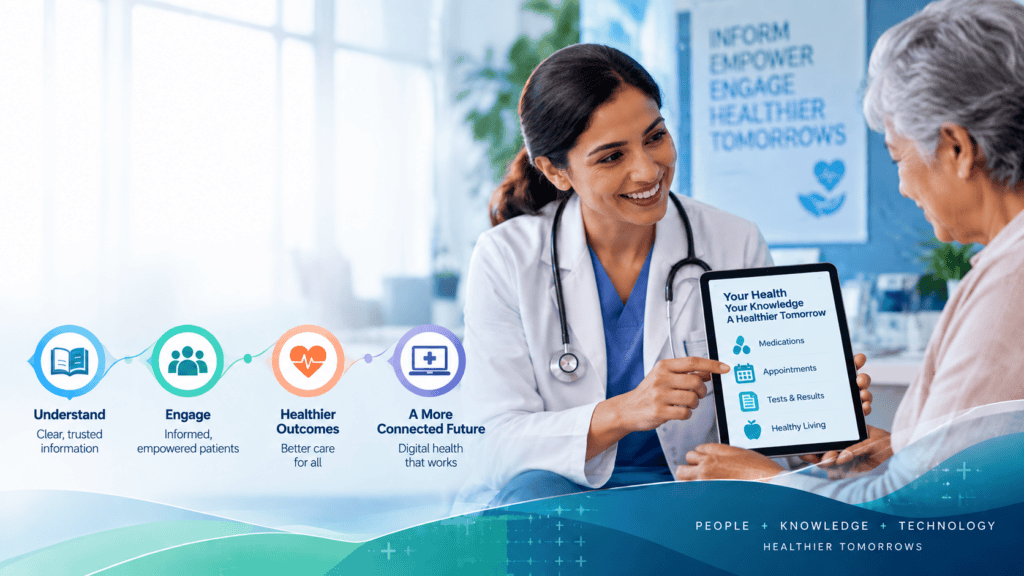
Greg sees significant potential for AI to reduce this cognitive burden. Rather than simply generating more information, AI could help organize and contextualize the information patients already receive. Imagine an intelligent layer that understands the patient’s journey across encounters and can explain, in clear language, what happened during the last visit, what medications need attention, what appointments are coming up, what instructions matter now, and when the patient should contact their care team.
The transformational opportunity is not another chatbot sitting alongside an already fragmented healthcare experience. It is using AI to connect the fragments. That distinction is important. Healthcare does not necessarily need more information. Patients often already have too much of it. What they need is greater clarity. AI’s greatest contribution to the patient experience may therefore be its ability to transform fragmented information into understandable guidance.
The Best Patient Technology Is Technology Clinicians Will Actually Use
Health systems can purchase sophisticated patient education platforms, but technology creates little value if caregivers find it cumbersome. Greg’s nursing background strongly shapes his view here. When ChristianaCare evaluates and implements patient education technology, one of the priorities is ensuring that it fits into clinicians’ existing workflows rather than pulling them away from the work they are already doing. That sounds straightforward, but it addresses one of digital health’s most persistent challenges.
A solution can be designed beautifully for patients while creating additional clicks, screens, logins, documentation requirements, or workflow steps for clinicians. When that happens, adoption becomes difficult. Greg describes a different design principle: patient benefit and caregiver usability should reinforce each other. If clinicians can easily incorporate an education tool into their normal process, they are more likely to use it consistently. Patients, in turn, are more likely to receive information that is timely and relevant.
The lesson for health systems evaluating digital tools is to apply a health-literacy lens not only to the final patient-facing content but also to the entire workflow. Is the information understandable? Is the experience intuitive? Can caregivers use it naturally? Does it reduce complexity—or add another layer? And does the technology make the interaction between clinician and patient better?
For healthcare AI in particular, this may become an increasingly important test. The most sophisticated technology is not necessarily the most valuable. The technology that disappears naturally into the workflow may ultimately have the greatest impact.
Measuring Health Literacy Requires Looking Beyond Financial ROI
Healthcare executives understandably want measurable returns from technology and transformation investments. Health literacy presents an interesting challenge because some of its most important effects are difficult to capture in a single metric. ChristianaCare looks toward established health system outcomes such as quality, safety, readmissions, and patient and family feedback, while continuing to develop stronger connections between patient education tools and measurable outcomes.
But Greg also emphasizes something that dashboards may not fully capture: whether the person receiving care genuinely understands it. This is where practices such as teach-back become powerful. Instead of assuming a patient understood an explanation, a caregiver asks the patient to describe the information or instructions back in their own words. That simple interaction can reveal misunderstandings before the patient leaves. It can also give clinicians something deeply important: confidence that their communication worked.
For Greg, those moments matter.
Healthcare professionals do not come to work thinking only about quarterly metrics. They want to know that the care they provided made a difference. This suggests that the business case for health literacy should combine multiple dimensions:
- Patient outcomes and safety.
- Patient experience and trust.
- Clinician experience.
- Operational efficiency.
- Avoidable utilization.
- And, critically, the patient’s ability to understand and act on the care they receive.
The strongest ROI story may emerge when health systems connect these human measures with traditional quality and operational metrics.
The Health Literacy Lens Should Extend to Every Digital Transformation Decision
Perhaps the most actionable idea from Greg’s conversation is also one of the simplest: Apply a health-literacy lens to technology decisions. Before implementing another digital health or AI solution, healthcare leaders can ask:
- Will this make healthcare easier to understand?
- Will it reduce or increase cognitive burden?
- Does it use language patients can understand?
- Does it meet people where they are?
- Does it integrate naturally into caregiver workflows?
- Does it strengthen the relationship between patients and their care teams?
- And, ultimately, will patients know what they need to do next?
These questions shift the conversation from what technology can do to what patients actually need. That distinction will become increasingly important as AI capabilities expand. Healthcare organizations will soon be able to generate more information, automate more interactions, personalize more content, and deploy more intelligent patient-facing experiences than ever before. The challenge will be ensuring that all of that intelligence actually creates clarity.
From Better Communication to Better Outcomes
Greg O’Neill’s perspective is grounded in an insight that can easily be overlooked amid healthcare’s technology transformation: communication is part of the care itself. A treatment plan cannot deliver its full value if the patient does not understand it. Medication instructions cannot improve adherence if they are too complicated to follow. A digital health tool cannot improve engagement if it adds another layer of complexity. And AI cannot transform the patient experience if it simply generates more information for patients to navigate.
The opportunity is to use technology differently, to simplify healthcare, connect fragmented information, reduce cognitive burden, support caregivers, and help patients confidently understand what comes next. For healthcare leaders, this reframes health literacy from a patient education initiative into something much broader. It becomes a design principle for digital transformation.
As AI takes on a larger role in healthcare, the organizations that succeed may not be those that simply provide patients with more sophisticated technology. They may be those that use technology to make healthcare simpler, clearer, more connected, and ultimately more human. That is the real promise of health literacy: not merely better-informed patients, but patients who are better equipped to participate in their care and achieve better outcomes.
Listen to the Full Conversation
Listen to Greg O’Neill, Director of Patient & Family Health Education at ChristianaCare, discuss health literacy, patient education, AI, trust, clinical workflows, and the future of the digital patient experience in Episode 219 of The Big Unlock Podcast: “Health Literacy is Key to Better Patient Outcomes.”