Co-Host, The Big Unlock Podcast
Over the last three years, healthcare has gone through an extraordinary shift.
First, we were trying to understand AI. Then we became fascinated by Generative AI. Today, a different question is emerging in conversations with health system leaders, digital health innovators, and life sciences executives:
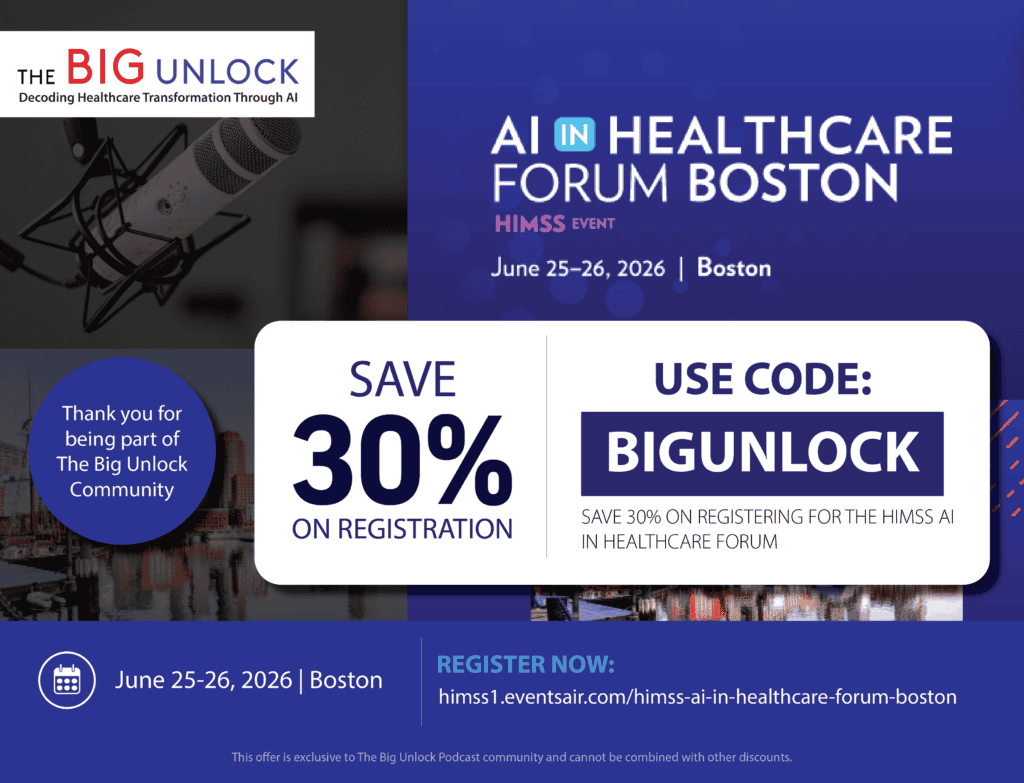
That’s one of the reasons I’m looking forward to attending the HIMSS AI in Healthcare Forum in Boston. Not because AI needs more hype. But because healthcare needs more clarity.
When ChatGPT arrived, many organizations understandably focused on experimentation. Every leadership team wanted to understand what Generative AI could do. Today, the mood is different. Healthcare leaders are asking tougher questions.
In many ways, we’re witnessing the transition from curiosity to capability. And I believe that transition may be more important than the technology itself.
Historically, healthcare adopted technologies in waves. Electronic health records, cloud, data platforms: all became infrastructure. I believe AI is heading in the same direction.
In a few years, organizations may no longer talk about “AI strategy” any more than they talk about “internet strategy.” AI will simply become part of how healthcare operates. Patient access, revenue cycle, clinical documentation, population health, drug development, diagnostics, and consumer engagement, intelligent workflows will increasingly become embedded into the fabric of healthcare. And perhaps the most interesting question is not where AI will be used. It’s where it won’t.
Another trend I am watching closely is the emergence of AI-native thinking. Many organizations are trying to insert AI into existing processes. But some are beginning to ask a fundamentally different question – If we were building this workflow from scratch today, how would we design it?
That’s a powerful shift! Because AI transformation isn’t about putting a faster engine into yesterday’s car. Sometimes it requires reimagining the road itself. The organizations that gain the greatest advantage may not be those with the largest AI budgets. They may be the ones willing to rethink assumptions.
On The Big Unlock Podcast, we’ve had the privilege of speaking with leaders implementing AI across clinical, operational, and research environments. One theme continues to stand out. Technology is advancing faster than organizational models. As AI agents become capable of orchestrating workflows and completing tasks, leadership questions become more important than technical questions.
These questions don’t have simple answers. But they are exactly the kinds of discussions that healthcare leaders need to be having.
Ironically, the more intelligent our systems become, the more valuable uniquely human capabilities may become.
Healthcare has always been a profoundly human enterprise. AI won’t change that. If anything, I believe it has the potential to strengthen it. By reducing friction, automating administrative burden, and augmenting decision-making, AI can give clinicians and staff something increasingly scarce:
Time.
And time is one of the greatest gifts technology can provide.
I suspect that when we look back ten years from now, we’ll realize that Generative AI was only the beginning. The bigger story may be how healthcare organizations reinvented themselves around intelligence, automation, and human-centered design.
That’s why I’m excited about the HIMSS AI in Healthcare Forum. Not because I expect all the answers. But because gatherings like these help us ask better questions. And in healthcare transformation, better questions often lead to better outcomes.
If you’ll be attending the forum, I look forward to exchanging perspectives on what comes next. The future of healthcare AI won’t be defined by who adopts AI first. It will be defined by who learns to work alongside it best.
“HLTH brings together the brightest minds in healthcare to drive real-world transformation through AI, data, and workflow innovation. The energy, collaboration, and actionable insights here are truly reshaping the future of care at scale.”
– Rohit Mahajan, Co-host of The Big Unlock Podcast
Recent Events
Stay informed on the latest in digital health innovation and digital transformation