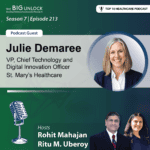
Season 7
In this episode, Julie Demaree, Vice President and Chief Technology and Digital Innovation Officer at St. Mary’s Healthcare, shares a pragmatic approach to digital transformation in rural healthcare, where innovation is driven by operational realities rather than technology hype. A former physician assistant turned technology executive, Julie argues that successful innovation begins with culture, governance, and clinician engagement, not new tools.
She discusses how St. Mary’s has improved patient safety and clinician experience by rethinking clinical decision support, reducing alert fatigue through careful curation, and involving frontline clinicians in governance decisions. Julie also highlights the importance of optimizing existing technology before investing in new solutions, noting that many organizations overlook capabilities already available within their EHRs.
Julie sees significant potential for automation and agentic AI to reduce administrative burden, improve patient access, and help lean teams operate more effectively. She emphasizes that AI adoption must be accompanied by strong governance, user education, and critical thinking. Her message is clear: innovation is not about adding more technology, it’s about solving the right problems, eliminating unnecessary work, and building systems that better support patients, clinicians, and communities. Take a listen.
About Our Guest
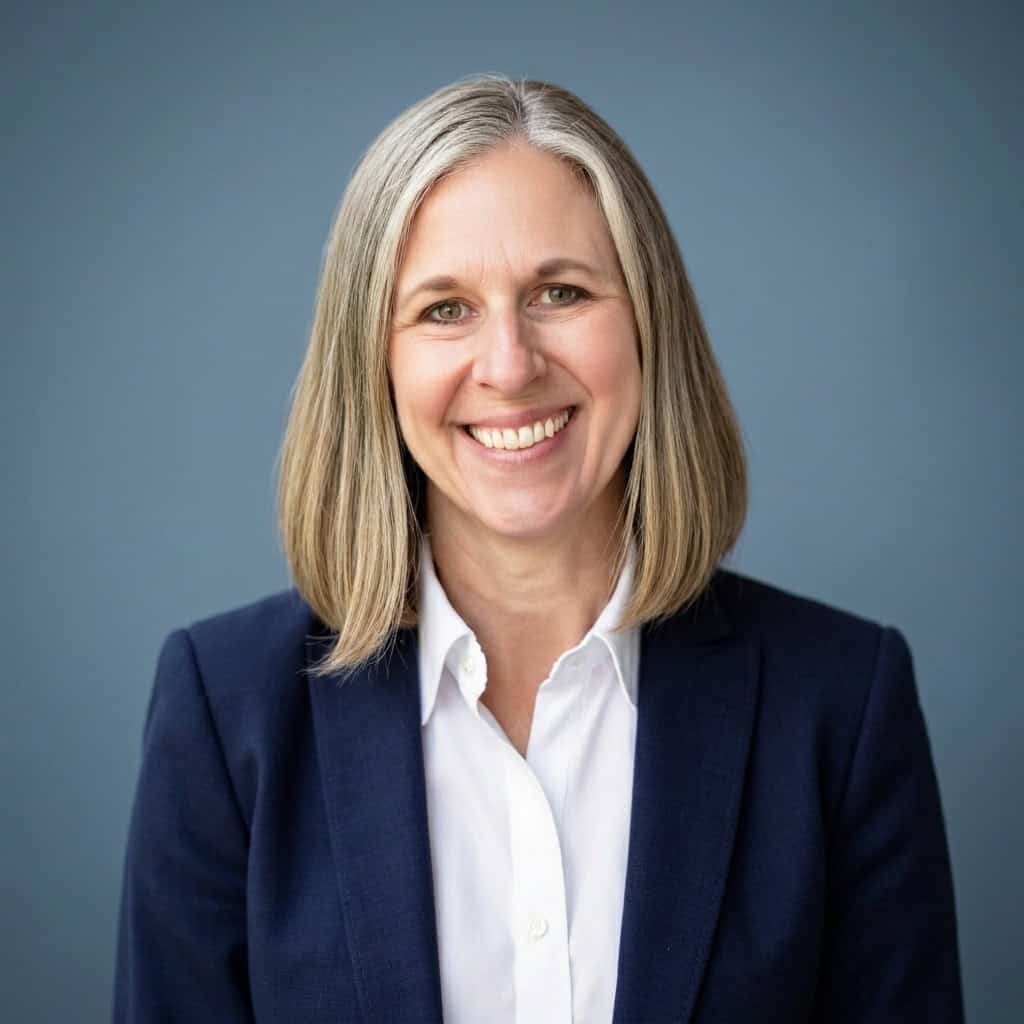
Julie Demaree, PA, serves as vice president, chief technology and digital innovation officer at St. Mary’s Healthcare in Amsterdam, New York. She leads in developing St. Mary’s digital strategy, integrating technology across the organization, and ensuring that digital initiatives meet the needs of providers, patients, and the organization as a whole.
A physician assistant, Demaree has extensive experience designing programs that streamline and improve the patient experience and reduce the administrative burden on providers. Most recently, she was director of clinical informatics and data integrity at Saratoga Hospital, a member of the Albany Med Health System. She also chaired a key workgroup charged with building a systemwide electronic medical record.
During her 25 years in healthcare, Demaree has earned a reputation for anticipating and responding to patients’ needs. She has launched telehealth services, implemented electronic self-registration in busy physician practices, and centralized patient navigation services—all of which enhance patient satisfaction and retention.
Demaree has a Master of Health Administration from the University of Phoenix and a post-graduate certificate in occupational medicine from Duke University. She also has a bachelor’s degree in physician assistant science from St. Francis University in Loretto, Pennsylvania, and a bachelor’s degree in life sciences from Penn State University. A Certified Professional in Healthcare Information and Management Systems, Demaree is a fellow of the American Academy of Physician Assistants and is board certified by the National Commission on Certification of Physician Assistants.
Recent Episodes
Ritu: Hi, everyone. Welcome to Season Seven of The Big Unlock Podcast. A very warm welcome to all our listeners. My name is Ritu Oberoi, and I’m the managing partner at Damo Consulting and your host today. We’re very excited to welcome Julie Demaree to our podcast. Julie is the VP and Chief Technology and Digital Innovation Officer at St. Mary’s Healthcare, where she’s leading one of the more thoughtful and pragmatic digital transformation efforts in rural healthcare. A former physician assistant turned informatics and innovation executive, she brings a uniquely clinician-centered perspective to technology adoption — focused less on hype and more on solving real workflow, safety, and patient access problems. What makes her perspective especially compelling is her belief that innovation in healthcare is ultimately about culture, governance, and community, not just technology. A very warm welcome to you, Julie, and we’re really happy to have you here with us today.
Julie: I’m excited to be here. Thank you so much for having me.
Ritu: Thank you. Let’s start by having you tell us a little more about St. Mary’s Healthcare, the communities you serve, the patient population, and what makes your organization distinct as an independent rural safety net system.
Julie: St. Mary’s is a rural hospital in Amsterdam, New York. We serve patients across two counties and have about 400,000 patient visits a year. St. Mary’s has a really special mission — we were founded by the Sisters of St. Joseph of Carondelet in 1905, and our mission is printed on our walls and felt by every patient and employee. There is a very strong commitment to serving the poor and vulnerable. That’s something you feel from the moment you’re hired here, and it felt very personal when I joined. We have inpatient and outpatient services, a number of practices, surgery, an ER, and a nursing home. It’s a great place to work.
Ritu: Thank you. Tell us a little more about the technology arm — how big is your team, and what are some of the strategic initiatives you’ve been driving? I know you’ve implemented ambient documentation, automation, and advanced alerting systems, but we’ll get to those shortly.
Julie: Our IT department includes both our technology and informatics teams, which includes physician and nursing educators who train our staff on our electronic health record, Meditech Expanse. We have a pretty lean team — essentially one person for networking, one for telecom. But I’m very fortunate to have a strong clinical analytics and clinical informatics team that supports and builds our EHR alongside very engaged clinicians. We hold a weekly IT governance meeting with a cross-sectional team from across the organization to review change requests to the EHR, identify the best tools, and route requests to the appropriate committees. We have a really engaged group of people here. In the last few years we’ve introduced AI documentation, automation, and other tools that have helped us optimize not only our EMR but our workflows and become more efficient — which is especially important with a lean team.
Ritu: That’s a lot to accomplish with such a small team — amazing. I’d like to ask you about something you’ve spoken about before: alert fatigue and workflow disruption. As AI becomes embedded everywhere in healthcare, how do you as a leader help prevent clinicians from becoming cognitively overwhelmed? Walk us through what your alert landscape looked like before you started this work, what clinicians told you they needed, and how you reworked the whole landscape.
Julie: When we launched our EHR in 2022, alerts were turned on in a very limited way. The intent was to avoid over-alerting, but what happened instead was essentially no curation — only the most severe alerts were on, and with no lookback period. The plan had been to review them later, but two years passed and that review never happened. There was no analysis of the value of those alerts, and no analysis of where additional alerts might actually be beneficial. So we took stock of what was available. We used the Leapfrog guidelines to identify gaps — we had allergy alerts on, drug-drug and drug-dose alerts on, but we hadn’t catalogued which severity levels were active and which weren’t. We also had no age-based alerts. For elderly patients, for example, we weren’t leveraging the Beers List at all. The tools were there, but nobody wanted to own the decision to turn alerts on or off — there was real fear of upsetting people. By forming a committee that included pharmacy, our Chief Medical Officer, our informatics team, and inpatient and outpatient physicians, we were able to review the categories, make recommendations, test with a small group of physicians, and then go live. What was remarkable is that the impact was more positive than negative. While we did initially turn on more alerts, we also went around and actively solicited feedback — you can’t wait for clinicians to call you because they don’t have time. And the feedback we got allowed us to turn things off. Some of the alerts we turned off weren’t even new ones — they were alerts that had been on for two years that nobody had ever complained about, but that were simply nuisance. As we turned things off, we were able to turn more meaningful things on. The engagement with physicians had a secondary benefit: they started telling us things like, “I prescribed this medication and it didn’t warn me about this condition.” That gave us buy-in for something else entirely — the problem list, which is a perennial challenge in electronic health records because nobody feels responsible for it. Physicians began either removing outdated entries that were generating false alerts, or adding entries to ensure that clinically important drug-condition and drug-disease alerts would fire correctly. Over time, we turned on more safety triggers while actually reducing the total number of alerts physicians receive — and we gained better buy-in and management of the problem list. It’s really a story of optimization through subtraction. You can’t keep adding. You have to curate. And the engagement that came out of the process was genuinely fun.
Ritu: Thank you, Julie, for sharing that — it’s a really instructive story. Sometimes you need to take things away rather than keep adding, and we’ve heard that from other leaders too. Rohit, would you like to ask a question?
Rohit: Thanks, Ritu. Hi, Julie. I always think about innovation and how startups disrupt the status quo by thinking outside the box. Doing innovation inside a health system is usually difficult, but many systems are now building infrastructure for it. Any thoughts on how you approach innovation at St. Mary’s, or what you’ve seen work well elsewhere?
Julie: Innovation means so many things to so many people. I often say innovation isn’t always technology. The first two years here — my title was Director of Innovation and Transformation — a lot of what I did didn’t involve buying anything new. It was really about mining for opportunities: revisiting what we were already doing and cataloguing all the tools and features in our electronic health record that we had but hadn’t yet leveraged or hadn’t implemented at go-live. We hear a lot about EHR optimization, but I continue to see organizations turn to third-party add-ons rather than utilize what they already have. The cost of losing structured data within the EHR, the cost of maintaining interfaces, the implementation burden — those can’t be overstated. I’m always looking to leverage what we have internally first. For AI and automation specifically, my first question is always: before we build it, should we even be doing it at all? A lot of repetitive workflows seem like perfect automation candidates — but some of them shouldn’t exist in the first place. Automating faxes is a good example. I could automate the reading and cataloguing of faxes, and technically it would work. But I’ve deliberately chosen not to, because automating it removes the urgency to solve the real problem: interoperability. We receive faxes from a neighboring hospital that runs the exact same EHR we do. There is no good reason we shouldn’t be exchanging data via HL7 or our health information exchange instead of faxing each other. Automating the fax just makes us comfortable with something that shouldn’t exist. Instead, I focus on complex cross-platform automation where no single vendor is going to solve it for us. In the last nine months we’ve done a significant amount of automation in our revenue cycle, and it’s been very successful. Not replacing people, but in a lean workforce any vacancy is magnified — and automation helps our staff focus on the exceptions, the denials, the specialized work that genuinely requires human judgment. We’re now moving automation into IT provisioning workflows, which I’m excited about. Our database engineer has built an impressive workflow in Access that pulls HR data into IT and maps what system access a new employee needs — Active Directory, Meditech, Pyxis, and so on. Right now a human still has to go in and execute it. We’re building automation on top of that foundation so our IT team can focus on direct customer care and more complex tasks. And we’re working toward agentic AI for patient care. We’ve been a little cautious about this because of concerns about how patients would respond to agents — but I don’t think patients really care whether it’s a human or a bot. What they care about is getting their needs met. No response is not acceptable. I love that agentic AI can respond to patients in the language they need, route them to the right person immediately, and eliminate phone trees. I’m genuinely excited about that.
Ritu: That leads right into the next question. Rural hospitals face extraordinary financial and operational pressure, yet St. Mary’s has continued investing in innovation and patient safety. How do you decide which technologies are truly strategic versus just interesting, especially with constrained resources?
Julie: That has probably been the biggest challenge — being good stewards of limited resources. Regulatory requirements always come first, then operational needs where a failure would be paralyzing. But we’ve also accumulated significant technical debt over the years, and we’re working hard to catch up. Some of the AI we’ve invested in over the last few years was specifically chosen because it could generate savings we could then redirect elsewhere — not replacing people, but accelerating AR, decreasing denials, and getting bills out the door more quickly. Ambient documentation for providers is a good example: it helped us improve billing speed. We’ve focused on technology with clear, demonstrable ROI — and on technology that helps us recruit and retain physicians. We’re nimble enough to implement things quickly, which matters. We’re now beginning to explore AI that helps with clinical documentation and coding in the inpatient setting, which should have meaningful impact on length of stay and DRG assignment. Again, keeping the focus on financial sustainability. Where we’ve really struggled is keeping our infrastructure current. It’s very hard to get grant funding for servers, edge switches, and top-of-rack switches — those aren’t the things a senator wants to announce at a press conference. But IT and clinical care are no longer separate things. They’re foundational. Our business continuity depends on stable infrastructure, and that’s what we’re focused on catching up on now.
Ritu: One success story that stood out in our research was your CPOE rate of more than 95%, which surpassed the Leapfrog average for safe medication ordering — a meaningful milestone for any health system, let alone an independent rural one. What does that look like in practice, and what one or two changes — cultural or technical — moved the needle most?
Julie: I’m a firm believer in data. We have one data guru — our senior analytic engineer, Tina O’Hanlon. She pulls from our Meditech data repository and creates meaningful dashboards in our analytics tool, BCA, that allow us to present information in ways that actually transform care. For CPOE specifically, we were able to look at physician ordering behavior by physician and by time of day. We could see which nurses were entering orders on behalf of physicians and why, which made it easy to identify outliers and intervene directly — sending that data to medical directors, nursing directors, and contractor leadership. We were already performing reasonably well when we started the Leapfrog journey, but bumping the rate up was straightforward because the outliers were easy to spot and easy to bring into alignment. We also contract with a national group for our ER and inpatient services, and we aligned with them on these goals so their leadership and ours are tracking the same metrics. That data foundation also made it easier to explain the importance of CPOE when we introduced alerts — because for an alert to be meaningful, the ordering physician needs to be the one receiving it. When a nurse enters an order, the alert has no value. Having good data made that conversation much easier.
Rohit: This data-driven approach is really impressive, Julie. Can you describe how you set up your data infrastructure to be able to leverage it in this way? Many organizations are still struggling with that foundation.
Julie: The analytics tool is part of Meditech, so there are preexisting datasets. But Tina can only pull data if our clinical analytics staff has built the right fields — and that requires asking early and often, even when creating new documents or interventions: “What are you going to need to track later?” We also have a strong quality department that sets measures every July. Before they finalize what they’re going to measure, we ask them to meet with us first — so they don’t commit to tracking something we can’t actually capture. Then we work through together where and how that data will be captured: is it a structured field, a grouped response, or free text? Is it consistent across all documentation? When we first went live in 2022, there were twenty different places where someone might record a PHQ-9 score. Standardizing that was an early priority. We’ve worked hard to capture data not just for CMS reporting but for internal use, and to ensure data integrity. About eighteen months ago we formed a data integrity committee to document the source of truth for each metric — because occasionally the right source isn’t BCA. A readmission rate coming from Medicare, for example, needs to be pulled the same way, on the same day each month, by the same person. We define those parameters clearly so that no matter who’s collecting it, the result is consistent. When data is collected consistently, people trust it. When it’s not, even good data becomes meaningless — and that erosion of trust was one of the first things I had to address when I arrived.
Rohit: That’s excellent.
Ritu: For a CIO or CDIO at another rural or independent health system who’s listening right now, what are one or two pieces of advice you’d offer from this journey? And where does the next chapter of digital innovation lead for St. Mary’s?
Julie: The first piece of advice is: don’t let your infrastructure fall behind. Technical debt compounds very quickly, and it’s very hard to catch up. That’s a lesson I’ve learned firsthand. Everything is growing faster and demanding more — memory, compute, bandwidth — and hardware lead times and costs are increasing. It’s a strategic imperative that infrastructure stay current, and that message needs to be understood from the board down. It’s not an IT problem; it’s a business continuity problem. The second is about AI education for end users. Everybody’s working on policies and governance, which is important — but I think we need to focus equally on educating clinicians and staff about their own role in AI oversight. Too many people treat AI as an IT problem or an IT responsibility. I’m trying to reframe it: just like a lab result is a tool that you look at critically — if it looks wrong, you redraw it, you don’t medicate based on a result you don’t trust — AI output has to be approached the same way. An EKG is a tool; you don’t defibrillate someone who’s talking to you just because the tracing looks abnormal. AI is wonderful for automation, for surfacing data, for aggregating what we can’t consume on our own. But I’m seeing users who are over-reliant on it and don’t fully understand the source, the risk, or what to do when something looks wrong. We need clearer pathways for reporting unusual AI behavior, unusual data, or unexpected outputs. Once a problem is out of control, it’s very hard to rein back in.
Rohit: Julie, any closing remarks for our listeners?
Julie: We’re a small hospital, and today we’ve only touched on a few of the things we’re doing here. But even with constrained resources, you can do a lot of powerful and meaningful work. I’m very appreciative of our vendor partners who don’t give up on us — they know we operate at a smaller scale, but they continue to invest in the partnership. Small hospitals are critical to their communities, and we can deliver amazing quality care. And on that note — the new Leapfrog scores come out tomorrow, so we’re really excited.
Rohit: All the best.
Ritu: Thank you so much, Julie, for coming on our podcast. Thank you.
Julie: Thank you so much.
—
Subscribe to our podcast series at www.thebigunlock.com and write us at info@thebigunlock.com
Disclaimer: This Q&A has been derived from the podcast transcript and has been edited for readability and clarity.
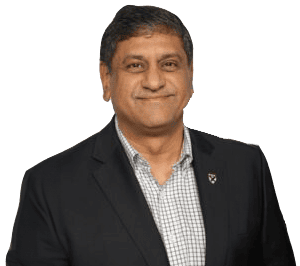
Rohit Mahajan is an entrepreneur and a leader in the information technology and software industry. His focus lies in the field of artificial intelligence and digital transformation. He has also written a book on Quantum Care, A Deep Dive into AI for Health Delivery and Research that has been published and has been trending #1 in several categories on Amazon.
Rohit is skilled in business and IT strategy, M&A, Sales & Marketing and Global Delivery. He holds a bachelor’s degree in Electronics and Communications Engineering, is a Wharton School Fellow and a graduate from the Harvard Business School.
Rohit is the CEO of Damo, Managing Partner and CEO of BigRio, the President at Citadel Discovery, Advisor at CarTwin, Managing Partner at C2R Tech, and Founder at BetterLungs. He has completed executive education programs in AI in Business and Healthcare from MIT Sloan, MIT CSAIL and Harvard School of Public Health. He has completed the Global Healthcare Leaders Program from Harvard Medical School.
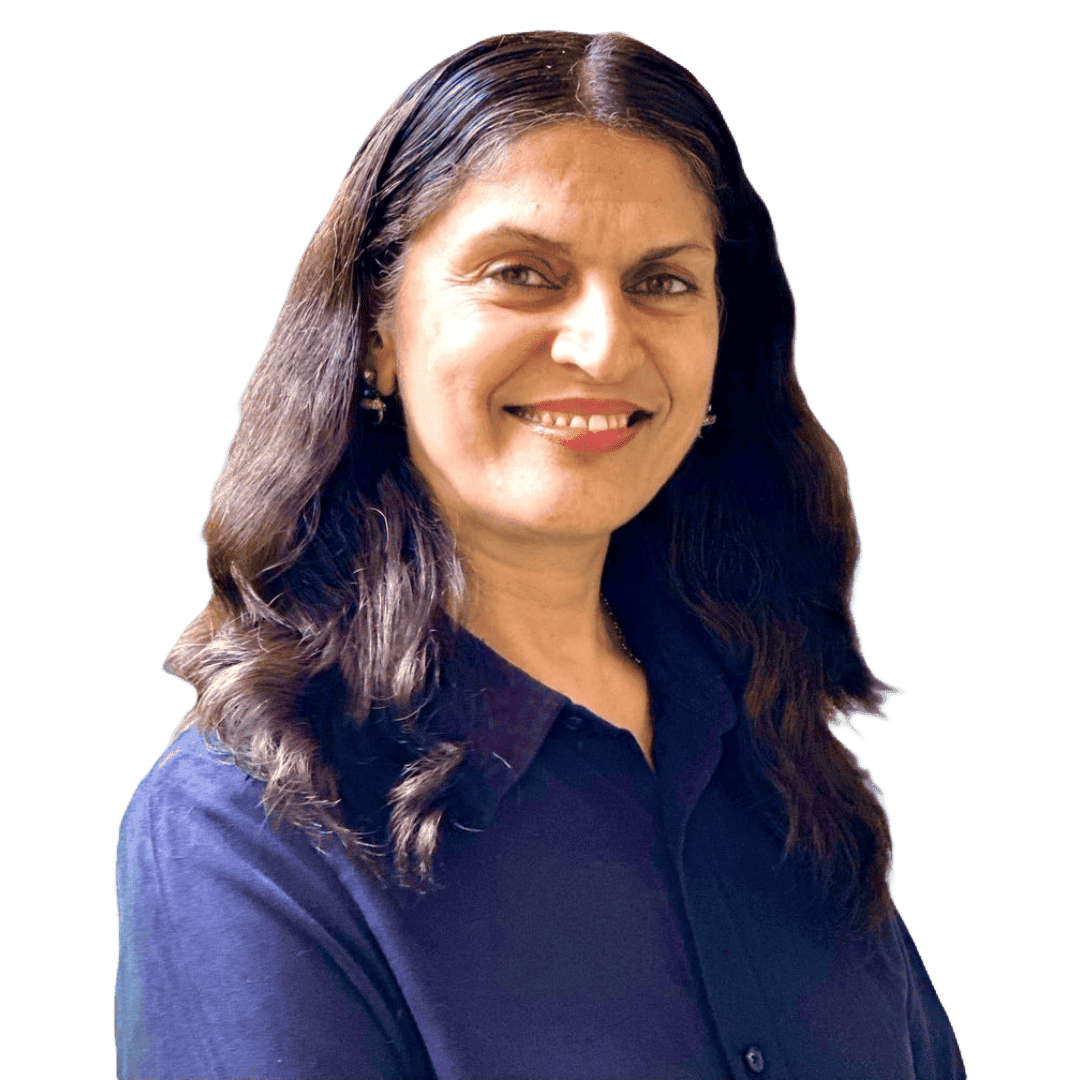
Ritu M. Uberoy is a healthcare AI strategist, technology executive, educator, and author dedicated to advancing the responsible adoption of Artificial Intelligence across healthcare delivery, digital health, and life sciences. With more than twenty-five years of leadership experience spanning the United States and India, she is recognized for helping healthcare organizations move beyond experimentation to achieve scalable clinical, operational, and business transformation through AI.
She leads AI innovation initiatives, including the AI Center of Excellence at BigRio, where she works with health systems, healthcare technology companies, and life sciences organizations to operationalize Generative and Agentic AI solutions responsibly. Her work focuses on aligning AI innovation with clinical workflows, governance frameworks, workforce readiness, and patient trust—ensuring technology augments human judgment in high-consequence healthcare environments.
Ritu is the co-author of Generative AI: Unlocking the Next Chapter in Healthcare, a practical guide for healthcare executives navigating enterprise AI adoption. She also hosts The Big Unlock podcast, engaging global healthcare leaders on AI transformation and digital innovation. An active educator and speaker, she conducts executive workshops and participates in global forums like HIMSS, ViVE, Women in Tech, AI-Powered Women, RAISE, and more, shaping the future of AI-driven healthcare. Ritu holds advanced degrees in Computer Science and completed specialized AI programs at Harvard and MIT.
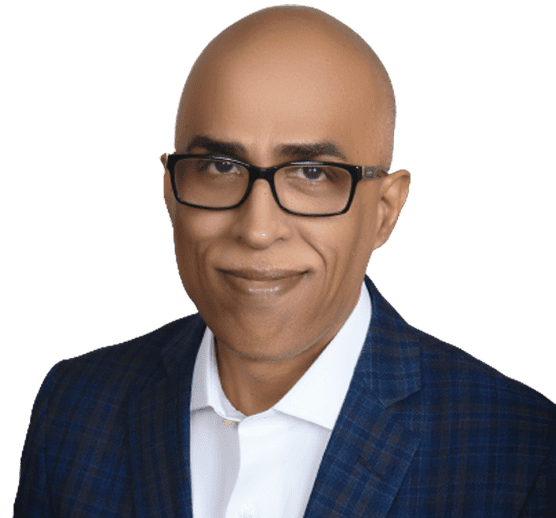
Paddy was the co-author of Healthcare Digital Transformation – How Consumerism, Technology and Pandemic are Accelerating the Future (Taylor & Francis, Aug 2020), along with Edward W. Marx. Paddy was also the author of the best-selling book The Big Unlock – Harnessing Data and Growing Digital Health Businesses in a Value-based Care Era (Archway Publishing, 2017). He was the host of the highly subscribed The Big Unlock podcast on digital transformation in healthcare featuring C-level executives from the healthcare and technology sectors. He was widely published and had a by-lined column in CIO Magazine and other respected industry publications.
Stay informed on the latest in digital health innovation and digital transformation