Co-Host, The Big Unlock Podcast
I’ve attended countless technology conferences over the years, but there’s something different about AI4.
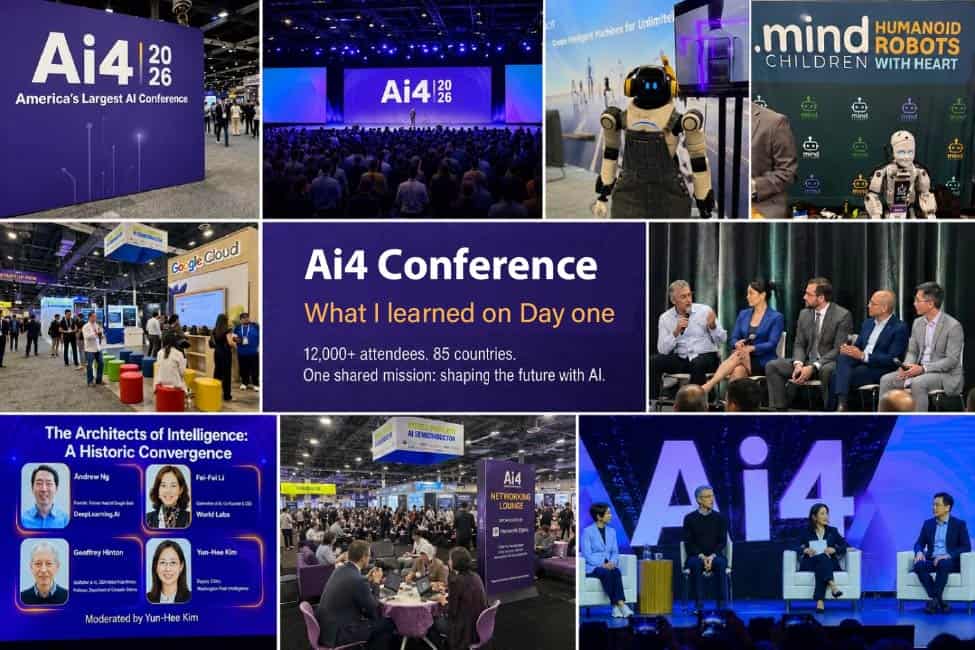
Walking into a venue with more than 12,000 attendees from 85 countries, you immediately realize this isn’t just another industry event. It’s a gathering of people trying to answer one of the defining questions of our time:
I expected to see exciting product launches and hear from some of the brightest minds in AI, what struck me most was something much simpler.
AI is no longer a technology discussion. It has become a business discussion. Every conversation, from healthcare and manufacturing to finance, government, retail, cybersecurity, and life sciences, centered around one common objective: moving beyond experimentation to real-world impact.
A few years ago, conferences were dominated by conversations around possibilities: “What could AI do?”
Today, the question has changed to “How do we deploy AI successfully at scale?”
That shift was evident everywhere, from keynote presentations to hallway conversations. Organizations are no longer asking whether AI will transform their business. They’re asking:
Those are fundamentally different conversations. They’re also much more interesting.
One keynote I was especially looking forward to was “AI’s Race to Reinvent Medicine.”
The discussion featured Alex Zhavoronkov, Founder and CEO of Insilico Medicine, alongside Eric Nguyen, CEO of Radical Numerics, moderated by Alice Park of TIME.
Healthcare has always been close to my heart, and listening to leaders discuss how AI is accelerating drug discovery, transforming clinical research, and supporting better patient care reinforced something we’ve believed for years at BigRio and through The Big Unlock podcast:
It needs AI that improves clinical outcomes, reduces administrative burden, expands access to care, and gives clinicians more time to focus on patients.
The opportunity isn’t simply to make healthcare faster.
It’s to make it better.
Another standout session was “The One Decision That Separates AI Winners from AI Casualties,” featuring Mark Abramowitz and Jed Dougherty from Dataiku.
The title alone captures one of the biggest misconceptions in enterprise AI. Success isn’t determined by who adopts the newest model first. It’s determined by who makes better strategic decisions. The organizations creating lasting competitive advantage aren’t chasing every new announcement. They’re building governance. Creating repeatable processes. Developing AI literacy. Selecting the right use cases.
Embedding AI into workflows to create measurable business value. Technology evolves quickly. Execution wins over time.
Generative AI has understandably captured most of the headlines over the past two years. But beneath every breakthrough lies an enormous amount of infrastructure.
One of the most fascinating discussions on Day One was “The AI Reckoning: Chips, Constraints and the Next Generation of Compute.” Former Intel CEO Pat Gelsinger joined Sachin Katti, Head of Compute at OpenAI, in a conversation moderated by Gideon Lewis-Kraus of The New Yorker.
As enterprises race to deploy increasingly sophisticated AI systems, compute is becoming one of the defining strategic challenges. Model performance often grabs attention. Infrastructure determines scalability. The future of AI won’t only be shaped by algorithms. It will also be shaped by the platforms, hardware, and architectures capable of supporting them.
Another fascinating keynote explored Mistral AI’s vision for frontier models. One theme continued to emerge throughout the day:
As AI becomes embedded into critical business processes and healthcare decision support, trust becomes every bit as important as intelligence. Without trust, adoption slows. Without governance, innovation stalls. The companies that recognize this early will be in a much stronger position over the next decade.
Some of the most valuable moments at conferences never happen on stage. They happen over coffee. Walking through Startup Alley. Visiting exhibitors. Meeting founders. Talking with healthcare executives. Speaking with enterprise technology leaders. At the podcast pavilion, listening to conversations about problems that don’t yet have obvious solutions.
Nearly 400 exhibitors and sponsors showcased AI technologies spanning enterprise software, infrastructure, cybersecurity, healthcare, manufacturing, finance, robotics, and agentic AI. What impressed me wasn’t simply the number of companies. It was the maturity of the discussions. The conversation has moved beyond demonstrations. Customers want outcomes.
As exciting as Day One was, one session stood above everything else on Wednesday’s agenda.
“The Architects of Intelligence: A Historic Convergence.”
Bringing together Geoffrey Hinton, Fei-Fei Li, and Andrew Ng on one stage is something few AI conferences could accomplish. Each has fundamentally shaped how the world understands artificial intelligence. Together, they represent decades of research, innovation, and thoughtful leadership.
I’m particularly looking forward to hearing their perspectives on balancing rapid innovation with responsibility—an issue every enterprise leader must now navigate. The day also includes executive presentations from Srini Venkatesan, CTO of PayPal, and Kevin Cochrane, CMO at Vultr, alongside enterprise AI case studies, live demonstrations, and hundreds of technical and business sessions.
If Day One is any indication, there will be no shortage of ideas to bring back.
One of the greatest privileges of hosting The Big Unlock podcast is the opportunity to continue these conversations long after conferences end.
Over the coming months, we’ll be speaking with many of the innovators, healthcare leaders, researchers, entrepreneurs, and enterprise executives shaping the future of AI. Because while conferences provide inspiration, meaningful progress comes from understanding how ideas become implementation. How organizations move from pilots to production. How trust is built. How adoption happens. And ultimately, how AI creates measurable value for people, businesses, and society.
My Day 1 at the AI4 conference has already provided countless ideas, new perspectives, and meaningful connections. More importantly, it reinforced something I’ve believed for a long time:
The future of AI won’t be determined by who builds the smartest models. It will be determined by who applies them thoughtfully, responsibly, and in ways that genuinely improve people’s lives.
I’m excited to continue that conversation.
“HLTH brings together the brightest minds in healthcare to drive real-world transformation through AI, data, and workflow innovation. The energy, collaboration, and actionable insights here are truly reshaping the future of care at scale.”
– Rohit Mahajan, Co-host of The Big Unlock Podcast
Recent Events
Stay informed on the latest in digital health innovation and digital transformation