Six insights from Roberta L. Schwartz, PhD, Executive Vice President of Houston Methodist Hospital and Chief Innovation Officer at Houston Methodist
Healthcare has moved beyond asking whether artificial intelligence has the potential to transform care delivery. The more pressing question is whether health systems are prepared to make the operational changes required to realize that potential.
Across the industry, hospitals are deploying AI-powered scheduling assistants, virtual care platforms, clinical decision-support tools, and intelligent automation solutions. Yet many organizations continue to approach AI adoption as a technology implementation exercise rather than an opportunity to fundamentally rethink how healthcare operates.
For Roberta L. Schwartz, PhD, Executive Vice President of Houston Methodist Hospital and Chief Innovation Officer at Houston Methodist, that distinction is critical.
In a recent episode of The Big Unlock Podcast, Roberta joined co-hosts Rohit Mahajan and Ritu M. Uberoy to discuss why healthcare AI must move beyond experimentation and deliver measurable improvements in care, workforce experience, and operational efficiency.
Her perspective is particularly valuable because she operates at the intersection of hospital administration and technology innovation. With 25 years at Houston Methodist and a career spanning healthcare policy, consulting, and hospital operations, Roberta understands both the promise of emerging technologies and the practical complexities of implementing them in clinical environments.
Key Learnings from the episode:
- Companies’ ‘Swim Lanes’ Have Now Become the Entire Swimming Pool
- Success Isn’t About Ratios, Numbers, or Benchmarks. It’s About How People Can Do Their Jobs Well Without Leaving Work Undone
- AI Agents Have the Potential Both for Nirvana and to Break the Bank
Listen to the full conversation
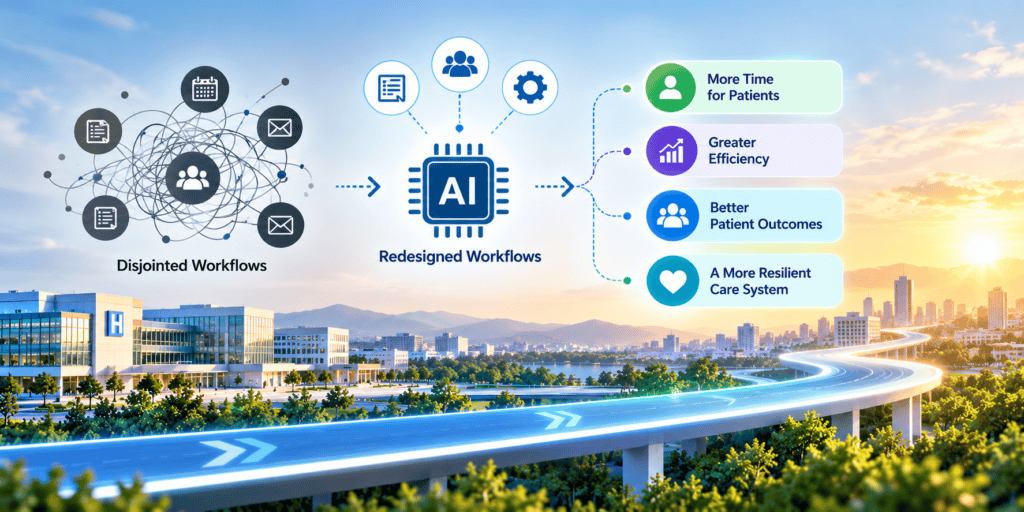
Roberta’s central message is clear: AI transformation requires changing how healthcare works, not simply adding new technology to existing processes.
Here are six insights from the conversation that offer a practical roadmap for healthcare leaders navigating the next phase of AI adoption.
1. Healthcare AI Is Moving From Experimentation to Strategic Maturity
For years, healthcare organizations approached digital innovation by finding specialized technology vendors to solve specific problems. One vendor might handle patient engagement, another scheduling, another clinical documentation, and another virtual care. Roberta believes that model is becoming increasingly difficult to sustain. As AI capabilities expand, technology companies are moving beyond their traditional areas of specialization. Platforms that once addressed a narrow use case can now support multiple functions across the healthcare enterprise.
This creates both opportunity and complexity. Health systems must evaluate not only what a technology company can deliver today but also how its capabilities may evolve. Roberta describes a shift away from keeping technology companies within clearly defined boundaries. Those boundaries are disappearing as AI allows vendors to expand across previously separate functions.
For healthcare executives, this changes the nature of technology strategy. Rather than assembling an increasingly fragmented collection of point solutions, organizations need to identify platforms capable of addressing multiple operational needs while remaining adaptable as the technology landscape evolves.
However, broader vendor capabilities also make evaluation more challenging. Technology companies may promise expansive functionality that has not yet been demonstrated in real-world healthcare environments. The leadership challenge is therefore twofold: consolidate where appropriate while remaining disciplined about what each platform can actually deliver.
The next phase of healthcare AI maturity will be defined less by the number of tools deployed and more by how effectively those tools support an integrated operating model.
2. AI ROI Begins With Workflow Transformation, Not Automation
One of the strongest insights from Roberta’s conversation is that layering AI onto existing workflows rarely produces transformational results. In fact, it can make operations more expensive. Consider a traditional physician scheduling model in which individual schedulers support a small number of physicians.
Introducing an AI scheduling assistant without changing staffing arrangements, scheduling templates, or call-handling responsibilities may improve certain interactions. But the underlying operating model remains largely unchanged. The organization continues paying for the existing process while adding the cost of new technology.
Houston Methodist approached scheduling differently. Instead of treating AI as an isolated solution, the organization reconsidered how scheduling work should be organized. The transformation involved making physician schedules available online, maintaining accurate appointment templates, consolidating scheduling resources, and introducing automation for appropriate patient interactions.
Houston Methodist also deployed Zoe, an AI-enabled scheduling assistant, to manage defined interactions and route more complex requests to human staff. The results illustrate the value of combining technology with operational redesign. According to Roberta, one scheduler can now support approximately ten physicians compared with four previously, while a substantially greater volume of scheduling activity takes place online.
The significance is not simply that AI handles calls. It is that Houston Methodist redesigned the scheduling model so technology and staff could work together more efficiently. This distinction has implications across healthcare. AI-powered documentation, patient outreach, referral management, revenue cycle operations, and care coordination all present opportunities for automation. But meaningful returns depend on whether organizations are willing to reconsider the processes surrounding those activities.
The real question is not which tasks AI can automate, but how work should be organized when AI becomes part of the operating model.
3. Successful Innovation Requires IT and Operations to Work as One Team
Roberta’s career offers an important perspective on why healthcare technology initiatives often struggle. Unlike innovation leaders whose experience is primarily technical, she comes from a deep operational background. She understands hospital staffing, clinical workflows, administrative complexity, and the challenges of implementing change in environments where even small disruptions can have significant consequences. That experience shapes Houston Methodist’s approach to innovation.
The organization’s Center for Innovation brings together a team composed of approximately equal parts IT and operations professionals. Rather than evaluating technology solely through technical feasibility, the team examines how a solution affects patients, clinicians, frontline staff, and institutional performance. This integrated model addresses a common weakness in healthcare transformation.
Technology teams may understand what a solution can do but underestimate how difficult it is to integrate into clinical operations. Operational leaders may recognize important problems but lack visibility into emerging technological capabilities. Bringing both perspectives together helps ensure that innovation is grounded in practical realities.
Roberta also emphasizes that technology should improve the experience of healthcare professionals. Nurses and clinicians enter healthcare to care for patients, not to spend their days navigating administrative systems or completing repetitive digital tasks. The objective of innovation should therefore extend beyond traditional productivity benchmarks.
Can technology give clinicians more time for meaningful patient interactions? Can it reduce the anxiety of unfinished work? Can it make healthcare professionals feel more effective and supported? These questions are increasingly important as organizations confront workforce shortages, burnout, and rising patient demand.
Roberta challenges leaders to reconsider benchmarks developed around older technologies and historical staffing models. As AI changes how work is performed, some traditional measures of productivity may no longer capture the full picture. The opportunity is not simply to improve performance within existing constraints. It is to reconsider what effective care delivery can look like.
4. Agentic AI Works Best When Human Handoffs Are Designed Into the Process
Agentic AI is generating significant interest because it can move beyond answering questions to coordinating and completing tasks. But healthcare organizations must carefully define what these systems should handle independently and when human intervention is necessary.
Houston Methodist’s experience with Zoe offers a practical example. The scheduling assistant handles appropriate interactions while directing clinical questions and other complex requests to human staff. Roberta shared an important implementation lesson: when calls were transferred from Zoe to clinic teams, some users initially believed the AI system was malfunctioning. The problem, however, was not necessarily the technology. In certain cases, the assistant had correctly routed the interaction, but the receiving staff were not available to answer.
This highlights a frequently overlooked aspect of AI deployment. An AI agent is only one component of a larger workflow. If the downstream process is not prepared to receive the work, the entire experience can fail even when the technology performs as intended. Houston Methodist addressed this through defined escalation rules, including specific triggers for transferring interactions to human staff. The broader lesson applies to many emerging AI use cases. A patient engagement agent may identify a clinical concern, but someone must be responsible for responding. A care coordination agent may detect a missing follow-up, but the organization needs a process for resolving it. A revenue cycle agent may identify an exception, but a human team must be equipped to handle cases requiring judgment.
The effectiveness of agentic AI depends as much on the workflow surrounding the agent as on the intelligence of the agent itself.
For healthcare leaders, successful implementation requires clear accountability, escalation pathways, staff readiness, and ongoing monitoring. Automation should create capacity for people to focus on higher-value activities, not introduce new points of failure.
5. Virtual Care Can Redesign Access to Specialty Services
Roberta also sees substantial opportunity in expanding virtual care beyond conventional telehealth appointments. Healthcare faces a growing mismatch between demand for specialized services and the availability of clinicians. An aging population requires increasingly complex care, while shortages of physicians and specialists create access challenges across both rural and urban settings. Traditional care models often require patients to travel or be transferred to facilities where specialized expertise is available.
But Roberta questions whether that approach is always necessary. Why should a patient need to be transferred to a flagship hospital simply to access an ophthalmology consultation when the required expertise could potentially be delivered remotely? Houston Methodist is exploring models that centralize specialty resources and make them available across multiple care settings through virtual technology. This approach allows hospitals to share expertise rather than duplicating specialized resources at every location.
Roberta describes the use of centralized or contracted specialty services, including genetic counseling, as part of this strategy. The underlying model is straightforward: make scarce expertise available wherever patients need it. Houston Methodist has also invested extensively in virtual care infrastructure, with cameras available across patient rooms, operating rooms, emergency departments, and clinics. The benefits extend beyond patient access. Virtual care can also give clinicians greater flexibility.
Roberta shared an example of a hospitalist who was able to conduct an admission assessment remotely rather than returning to the hospital after leaving. The physician could initiate the patient’s care without an unnecessary trip back to the facility. This illustrates how virtual care can improve both clinical responsiveness and workforce experience. More broadly, centralized specialty services offer health systems an opportunity to rethink how expertise is distributed. Rather than assuming every location must maintain every capability on-site, organizations can create connected networks of care supported by virtual consultations and coordinated workflows.
For specialties facing workforce shortages, this could become an increasingly important component of care delivery. The strategic opportunity is to move from a location-dependent model of healthcare toward one in which specialized expertise can reach patients without requiring patients to travel to the expertise.
6. Healthcare AI Leaders Must Be Optimistic and Skeptical at the Same Time
Roberta’s final message challenges healthcare leaders to approach AI with both enthusiasm and discipline. She is deeply optimistic about technology’s potential to improve healthcare. At the same time, she is cautious about ambitious vendor claims, uncertain implementation costs, and projected returns that depend on extensive organizational change.
That combination of optimism and skepticism is particularly important as health systems consider increasingly sophisticated AI agents. An agent may demonstrate impressive technical capabilities during a pilot but still fail to deliver sustainable value at scale. Costs can increase when organizations add AI systems without eliminating unnecessary processes or changing how work is performed. Implementation may require significant investments in integration, training, governance, monitoring, and operational redesign.
Roberta argues that healthcare organizations should define trials carefully and measure whether solutions actually produce the expected outcomes. Her evaluation framework centers on three questions:
- Does the technology improve patient care?
- Does it improve the workforce experience?
- Does it reduce costs?
These questions offer a practical foundation for enterprise AI governance. Rather than adopting technology because it is new or because competitors are investing in it, health systems should evaluate whether it advances measurable organizational priorities. This also requires technology vendors to understand the operational and financial realities of healthcare. A compelling demonstration is not enough. Vendors need to show how their solutions integrate into existing environments, what organizational changes are required, and where measurable value can realistically be achieved.
Roberta’s perspective is especially relevant for AI companies entering healthcare from other industries. Healthcare workflows are interconnected, heavily regulated, and sensitive to disruption. Changing one process can create consequences elsewhere. Successful innovation therefore requires an understanding of how the entire system operates.
Healthcare leaders should embrace AI’s possibilities while remaining rigorous about evidence, implementation complexity, and financial sustainability.
What Roberta Schwartz’s Perspective Means for Healthcare Leaders
What makes Roberta’s perspective distinctive is that she does not view innovation as separate from hospital operations. Her career has been built around understanding how healthcare organizations function and how they can improve. That operational foundation allows her to evaluate technology through a different lens. She is not simply asking whether AI can perform a task. She is asking whether deploying AI changes the way care is delivered, how clinicians work, and how effectively the organization uses its resources. This is a crucial distinction for health systems moving from pilot programs to enterprise-wide AI adoption.
The next generation of successful healthcare AI initiatives will likely require closer collaboration between technology executives, clinical leaders, operational teams, and frontline staff. They will also require a willingness to challenge assumptions about staffing, productivity, care delivery locations, and traditional performance measures. Roberta’s experience at Houston Methodist suggests that AI maturity is not defined by technological sophistication alone. It is reflected in an organization’s ability to integrate innovation into everyday operations and demonstrate meaningful improvements.
The Future of Healthcare AI Is an Operating Model Transformation
Healthcare AI has reached an important inflection point. The industry has demonstrated that intelligent technologies can automate interactions, support clinical workflows, improve scheduling, and extend access to specialized services. The challenge now is translating those capabilities into sustainable organizational transformation. Roberta Schwartz’s insights offer a clear direction.
Health systems must move beyond fragmented technology adoption and focus on integrated platforms, redesigned workflows, human-centered automation, and measurable outcomes. They must recognize that AI cannot create lasting value when the underlying operating model remains unchanged. And they must be willing to rethink how healthcare professionals, digital tools, and virtual services work together to deliver care.
Ultimately, the future of healthcare AI will not be determined by how many agents, platforms, or automation tools a hospital deploys. It will be determined by whether those investments improve care delivery, give healthcare professionals more time for meaningful work, expand access, and create sustainable financial value.
The organizations that lead the next phase of healthcare AI will be those that treat technology as the catalyst for transformation, not the transformation itself.
Listen to the Full Conversation
To hear Roberta L. Schwartz discuss AI maturity, agentic AI, scheduling transformation, virtual specialty care, and Houston Methodist’s approach to innovation, listen to Episode 226 of The Big Unlock Podcast.
Episode: Healthcare AI Requires Workflow Transformation, Not Just Technology
Guest: Roberta L. Schwartz, PhD, Executive Vice President, Houston Methodist Hospital, and Chief Innovation Officer, Houston Methodist.
Hosts: Rohit Mahajan and Ritu M. Uberoy