
Six insights from Daniel Barchi, Senior Executive Vice President and Chief Information Officer at CommonSpirit Health, on scaling AI responsibly and delivering measurable results
Healthcare organizations are rapidly expanding their investments in artificial intelligence. From clinical decision support and ambient documentation to revenue cycle automation and enterprise productivity tools, AI is becoming an increasingly important part of healthcare operations. But as health systems accelerate adoption, an important question is emerging: Does deploying more AI actually mean delivering more value?
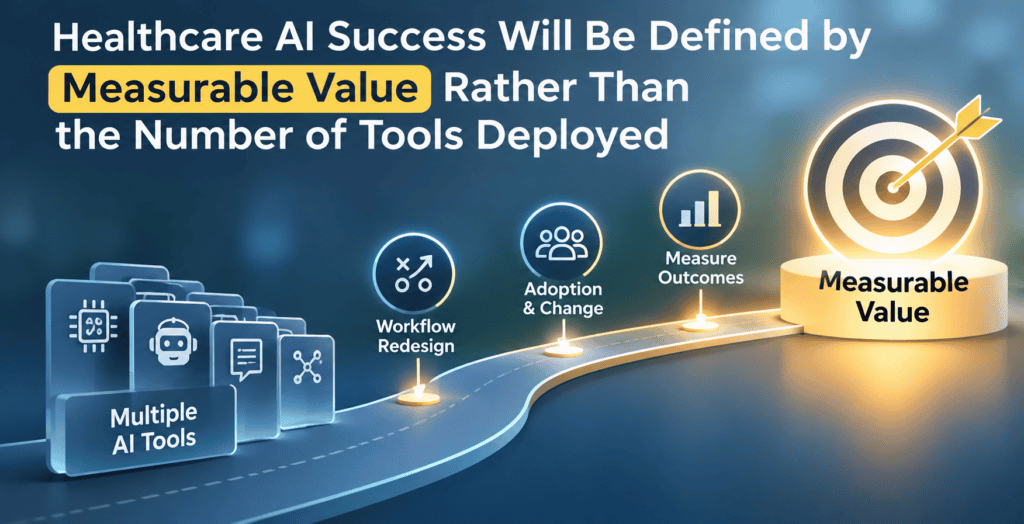
For Daniel Barchi, Senior Executive Vice President and Chief Information Officer at CommonSpirit Health, the answer is clear. The number of AI applications an organization deploys is not an indicator of success. What matters is whether those applications improve patient care, support clinicians, strengthen operations, and generate measurable returns.
Key learnings of the episode:
- AI Success is Not About How Many Tools You Deploy
- Measure AI by Realized Value, Not Projected ROI
- Healthcare Technology Is 80% People, 15% Process, and 5% Technology
Listen to the full conversation
In a recent episode of The Big Unlock Podcast, Daniel joined hosts Rohit Mahajan and Ritu M. Uberoy to discuss CommonSpirit Health’s approach to scaling AI across a complex healthcare enterprise. CommonSpirit operates across 24 states, with more than 150 hospitals and approximately 150,000 employees. Its AI portfolio has grown from around 60 applications in 2023 to approximately 260 today. Yet Daniel is particularly proud of another number: the 20 AI applications the organization has retired. That observation captures his philosophy of AI transformation. Successful adoption is not about accumulating technology. It is about making disciplined decisions, measuring actual outcomes, and knowing when to stop investing in solutions that no longer serve their intended purpose.
Drawing on more than two decades of healthcare technology leadership, including previous CIO roles at NewYork-Presbyterian, Yale New Haven Health System, and Carilion Clinic, Daniel offers a practical perspective on what enterprise AI maturity looks like.
Here are six insights from his conversation that healthcare executives can apply as they move from AI experimentation to sustainable enterprise transformation.
1. AI Maturity Is About Knowing What to Retire, Not Just What to Deploy
Many healthcare organizations describe their AI progress through the number of applications deployed, pilots launched, or departments using intelligent automation. Daniel challenges this approach.
CommonSpirit has significantly expanded its AI portfolio over the past three years, deploying applications across clinical operations, human resources, revenue cycle management, and technology functions. However, Daniel argues that reaching 300, 500, or even 800 AI applications should not be an organizational objective. Instead, he emphasizes the importance of selecting applications that align with CommonSpirit’s mission and demonstrate positive clinical, financial, or patient-experience outcomes.
The organization has retired approximately 20 applications and declined to proceed with roughly 20 others. Those decisions reflect an important aspect of AI maturity that is frequently overlooked. As AI capabilities evolve, previously valuable applications may become redundant. A function that once required a specialized vendor might become available within an enterprise platform. Other applications may no longer meet evolving security expectations or performance standards. Continuing to maintain such tools creates unnecessary complexity and cost.
For large health systems, this challenge is particularly significant. Every additional application introduces potential requirements for integration, vendor management, cybersecurity, user training, support, and governance. An expanding portfolio can therefore increase operational burden even when individual applications appear beneficial. Daniel’s approach suggests that AI governance should include continuous portfolio optimization, not simply approval of new technologies. Organizations need to understand which tools employees are using, what benefits they generate, what risks they introduce, and whether they remain necessary.
The strongest AI portfolios may not be the largest. They may be the ones that are continuously evaluated, simplified, and aligned with organizational priorities.
2. Strong AI Governance Creates Better Innovation Decisions
As healthcare organizations accelerate AI adoption, governance is sometimes viewed as an obstacle. Technology teams may want to deploy applications quickly, while clinical, compliance, security, and operational leaders require additional review.
Daniel sees this tension differently. He argues that speed should never become the primary objective of healthcare innovation. A technology team might be capable of building and deploying an application in 48 hours, but that does not automatically mean the application should be deployed. The more important questions concern its purpose, integration requirements, expected benefits, and organizational impact. Daniel offers a memorable framework for understanding healthcare technology transformation:
80% people, 15% process, and 5% technology.
This perspective reflects his belief that successful implementation depends far more on organizational readiness than technical capability alone. Healthcare organizations must prepare employees, establish appropriate workflows, standardize processes, manage information responsibly, and create the conditions for technology to deliver value.
At CommonSpirit, AI governance involves stakeholders from nursing, physician leadership, finance, operations, mission, IT, compliance, and ethics. This multidisciplinary approach ensures that decisions are not made exclusively by technology and finance teams. Each stakeholder brings a different perspective. Clinicians assess whether an application supports patient care. Operational leaders evaluate workflow implications. Finance teams examine the business case. Security and compliance teams consider risks. Ethics and mission representatives help ensure alignment with organizational values.
Together, these perspectives produce more informed decisions. Daniel’s argument is particularly relevant as health systems explore agentic AI and increasingly autonomous applications. As AI systems move beyond generating information toward initiating actions, organizations need clear accountability, defined responsibilities, and appropriate safeguards. Governance should therefore be embedded in the innovation process rather than treated as a final administrative hurdle.
Responsible governance does not slow meaningful innovation. It helps organizations avoid investing in technology that cannot deliver sustainable value.
3. Healthcare AI ROI Must Be Measured Through Actual Value Captured
One of the most distinctive aspects of Daniel’s approach is his insistence on separating anticipated benefits from realized financial returns. Healthcare technology discussions frequently feature impressive ROI projections. An AI application may promise millions of dollars in savings through improved productivity, reduced administrative burden, or more efficient clinical operations. But projected savings do not always translate into measurable financial outcomes.
Daniel believes healthcare leaders must be more rigorous about this distinction. CommonSpirit uses a five-gate process to evaluate and track the value of AI investments. The process begins with an opportunity identified by a clinician or operational leader and follows that opportunity through business planning, financial validation, implementation, and actual performance measurement.
Daniel illustrates this through a hypothetical example involving an AI opportunity initially estimated to deliver $10 million in savings.
Evaluation stage | Estimated value |
Initial opportunity identified | $10 million |
Detailed business plan | $8 million |
Finance-validated estimate | $5 million |
Value feasible within implementation constraints | $2.5 million |
Actual value captured | $1.5 million |
The example demonstrates how an initially compelling opportunity can become significantly smaller once assumptions, implementation limitations, and actual results are considered. Rather than claiming the original $10 million opportunity as an achievement, CommonSpirit would recognize the $1.5 million actually realized.
This discipline matters because healthcare organizations operate under substantial financial pressure. AI investments must compete with other priorities, including staffing, infrastructure, clinical equipment, cybersecurity, and patient services. Daniel explains that CommonSpirit can substantiate approximately $100 million in realized AI value because the organization tracks benefits at the application level. He also acknowledges that not every important benefit is easily converted into dollars.
Ambient documentation, for example, may reduce clinician burden, improve work-life balance, and create a better care experience without producing immediately quantifiable financial savings. These outcomes remain valuable. The challenge is to develop measurement approaches that recognize both financial and nonfinancial benefits without confusing estimates with actual results. For healthcare executives, this offers an important lesson.
AI ROI should be measured through demonstrated improvements, not optimistic business cases or vendor projections.
4. Enterprise AI Strategy Requires a Thoughtful Balance Between Building and Buying
The traditional technology strategy question of whether to build or buy has become more complex in the age of AI. Healthcare organizations can purchase specialized applications, develop solutions internally, or activate AI capabilities already embedded in enterprise systems. Daniel’s experience at CommonSpirit illustrates why no single approach is appropriate for every use case.
Approximately 47% of CommonSpirit’s AI tools are internally developed, 31% are embedded within core enterprise platforms, and 22% are purchased from external vendors. These figures are notable because they challenge the assumption that large healthcare organizations must rely primarily on commercial AI products.
Daniel explains that internal development has become more practical as teams gain the ability to build lightweight applications that address specific operational needs. He describes an example involving nursing leaders who needed a specialized dataset and workflow to support length-of-stay management. An external solution would have cost approximately $5 million over three years, excluding additional integration requirements. Instead, CommonSpirit’s internal team determined that it could develop a solution in approximately three to four weeks.
The objective was not to create a permanent enterprise product. It was to address an immediate operational requirement while the organization evaluated longer-term platform decisions. This reflects a pragmatic approach to internal development. Not every application needs to become a decade-long technology investment. Some tools can serve as temporary solutions that fill operational gaps and create value while larger modernization initiatives continue. At the same time, Daniel sees significant opportunities in embedded enterprise AI.
CommonSpirit is consolidating major technology platforms, including moving from 19 electronic health record systems toward one and from nine ERP systems toward one. The organization is also standardizing other enterprise platforms. As these systems expand their AI capabilities, enabling embedded functionality may provide a faster and more economical path to value than introducing additional standalone vendors.
However, Daniel does not advocate building everything internally. For capabilities such as ambient documentation, commercially available solutions may offer stronger functionality and a more practical implementation path. The decision should depend on business requirements, integration complexity, cost, implementation timelines, and long-term strategic fit.
The most effective enterprise AI strategy is not simply build versus buy. It is determining which capabilities should be built, purchased, or enabled within existing platforms.
5. AI Transformation Depends on Workforce Education and Secure Access
Technology adoption across a workforce of more than 150,000 people presents a different challenge from implementing AI within a small team or department. Employees have different responsibilities, levels of technical familiarity, and expectations about how AI should support their work. Some may already use generative AI regularly in their personal lives. Others may have limited exposure or concerns about whether automation could threaten their jobs.
Daniel believes healthcare organizations must address these concerns directly. He emphasizes that AI should be positioned as a tool that supports employees rather than a replacement for the people delivering care. At CommonSpirit, this philosophy has shaped both technology access and workforce education. The organization developed an internal platform called Insightly, which provides employees with access to multiple large language models within a controlled environment. Rather than directing employees to public AI applications, CommonSpirit offers a centralized platform through which authorized users can interact with models from providers including OpenAI, Anthropic, and Google.
This approach supports secure access to AI capabilities while allowing the organization to manage model availability and usage costs. Daniel describes how CommonSpirit removed one model from the available catalog after identifying higher-than-desired usage costs. This illustrates another dimension of enterprise AI management. As employees increasingly use large language models, organizations need visibility into consumption, security, and financial sustainability.
Providing access is only the first step. Employees also need the skills and confidence to use AI appropriately. To address this, CommonSpirit established an AI Learning Academy. The academy offers 11 classes, with employees having completed more than 16,000 course enrollments at the time of the conversation. Importantly, the training is not limited to physicians, executives, or technology professionals. It is available to employees across the organization, including caregivers, custodial teams, food service workers, support staff, and IT professionals.
This broad approach reflects Daniel’s belief that AI literacy should be an enterprise capability. Every employee should have an opportunity to understand how intelligent technologies can support their responsibilities. For healthcare leaders, the implication is significant. AI transformation requires investment in employee education, communication, and organizational culture alongside technology infrastructure. Without these investments, even sophisticated tools may experience limited adoption or inconsistent use.
AI literacy is not simply a training initiative. It is part of the foundation required for sustainable enterprise transformation.
6. The Ultimate Purpose of Healthcare AI is to Strengthen Human Care
Despite CommonSpirit’s substantial investments in AI, Daniel consistently returns to a central principle: healthcare remains fundamentally human. Clinicians do not begin their day thinking about how many AI applications they will use. They focus on their patients, the quality of care they provide, and the demands of their clinical responsibilities. Technology should make that work easier and more effective.
Daniel describes CommonSpirit’s approach through a framework established by CEO Wright Lassiter. The organization evaluates AI through four priorities, in a deliberate order. First comes patient safety and quality. Second is the caregiver experience. Third is creating a more frictionless patient experience. Fourth is reducing costs. This ordering is important. It positions financial efficiency as an outcome of improving care and operations rather than the primary purpose of AI adoption.
Daniel provides several examples of how this philosophy influences implementation. Ambient documentation is being evaluated not only for physicians but also for its potential to support nurses. CommonSpirit has also introduced Predict PE at one of its Texas hospitals. Developed through clinical leadership, the tool automates calculation of the Wells score to support evaluation of patients who may have a pulmonary embolism.
Based on clinical information, the tool supports decisions about whether further testing, such as a D-dimer blood test or CT scan, is appropriate. The objective is to help clinicians make efficient, evidence-informed decisions while reducing unnecessary testing and radiation exposure. This example illustrates a broader principle.
The most valuable AI opportunities may emerge from clinicians who understand everyday care delivery challenges. Rather than introducing technology in search of a problem, organizations can empower frontline professionals to identify where intelligent tools could improve patient care.
Daniel’s perspective is shaped by a career that began outside healthcare. He served as a U.S. naval officer before moving into telecommunications, business turnaround initiatives, and eventually healthcare technology leadership. That background has given him experience managing complex operations, aligning teams, and making strategic decisions under demanding circumstances. Today, he applies those lessons to healthcare transformation. For Daniel, the objective is not to make healthcare less dependent on people. It is to ensure that technology supports the professionals whose expertise, judgment, and compassion define the patient experience.
The future of healthcare AI should be measured by how effectively it enables people to deliver better care, not by how extensively it replaces human activity.
Key Principles for Healthcare AI Adoption from Daniel Barchi’s Approach
Daniel’s experience at CommonSpirit offers an important perspective on the next phase of healthcare AI adoption. The industry has moved beyond demonstrating that AI can perform useful tasks. The challenge now is determining how to deploy these capabilities responsibly across complex organizations while producing sustainable results.
Several principles emerge from his approach. First, healthcare organizations need disciplined AI portfolio management. Applications should be evaluated continuously, and tools that no longer deliver value should be retired. Second, governance must involve the people responsible for delivering care and operating the organization. AI cannot be managed as an isolated technology initiative. Third, ROI measurement needs to distinguish projected opportunities from actual outcomes. Fourth, organizations should consider internal development and embedded enterprise capabilities alongside commercial solutions. Finally, workforce education and human-centered implementation must remain central to AI strategy.
These principles are particularly relevant as agentic AI expands across healthcare. More autonomous applications will introduce new opportunities to coordinate tasks, streamline operations, and support decision-making. But they will also increase the importance of governance, accountability, integration, and measurable value.
Daniel’s approach suggests that enterprise AI maturity will depend less on technological sophistication and more on the organizational discipline required to translate AI capabilities into better performance.
The Future of Healthcare AI Will Be Measured by Outcomes, Not Adoption Numbers
Healthcare AI is entering a more demanding phase. Early experimentation demonstrated what intelligent technologies could accomplish. Now healthcare organizations must demonstrate what those technologies actually achieve. The distinction between potential value and realized value will become increasingly important as AI investments grow.
Daniel Barchi’s experience at CommonSpirit demonstrates that scaling AI successfully requires more than technical capability. It requires disciplined governance, financial accountability, enterprise architecture, workforce readiness, and a clear commitment to patient care.
Perhaps the most important lesson from his conversation is that AI success should never be reduced to the number of applications deployed. A health system with hundreds of tools is not necessarily more advanced than one with a smaller, carefully selected portfolio. What matters is whether those tools improve safety and quality, support clinicians, simplify patient experiences, and generate sustainable operational value.
As healthcare organizations move toward increasingly intelligent and autonomous systems, the leaders who succeed will be those who remain focused on these fundamentals.
The next chapter of healthcare AI will not be defined by how much technology organizations deploy, but by how much meaningful value they can demonstrate.
Listen to the Full Conversation
To hear Daniel Barchi discuss enterprise AI governance, realized ROI, internal AI development, workforce education, and CommonSpirit Health’s approach to responsible AI adoption, listen to Episode 232 of The Big Unlock Podcast.
Episode: The Real Measure of Healthcare AI Is Value, Not Volume
Guest: Daniel Barchi, Senior Executive Vice President and Chief Information Officer, CommonSpirit Health
Hosts: Rohit Mahajan and Ritu M. Uberoy