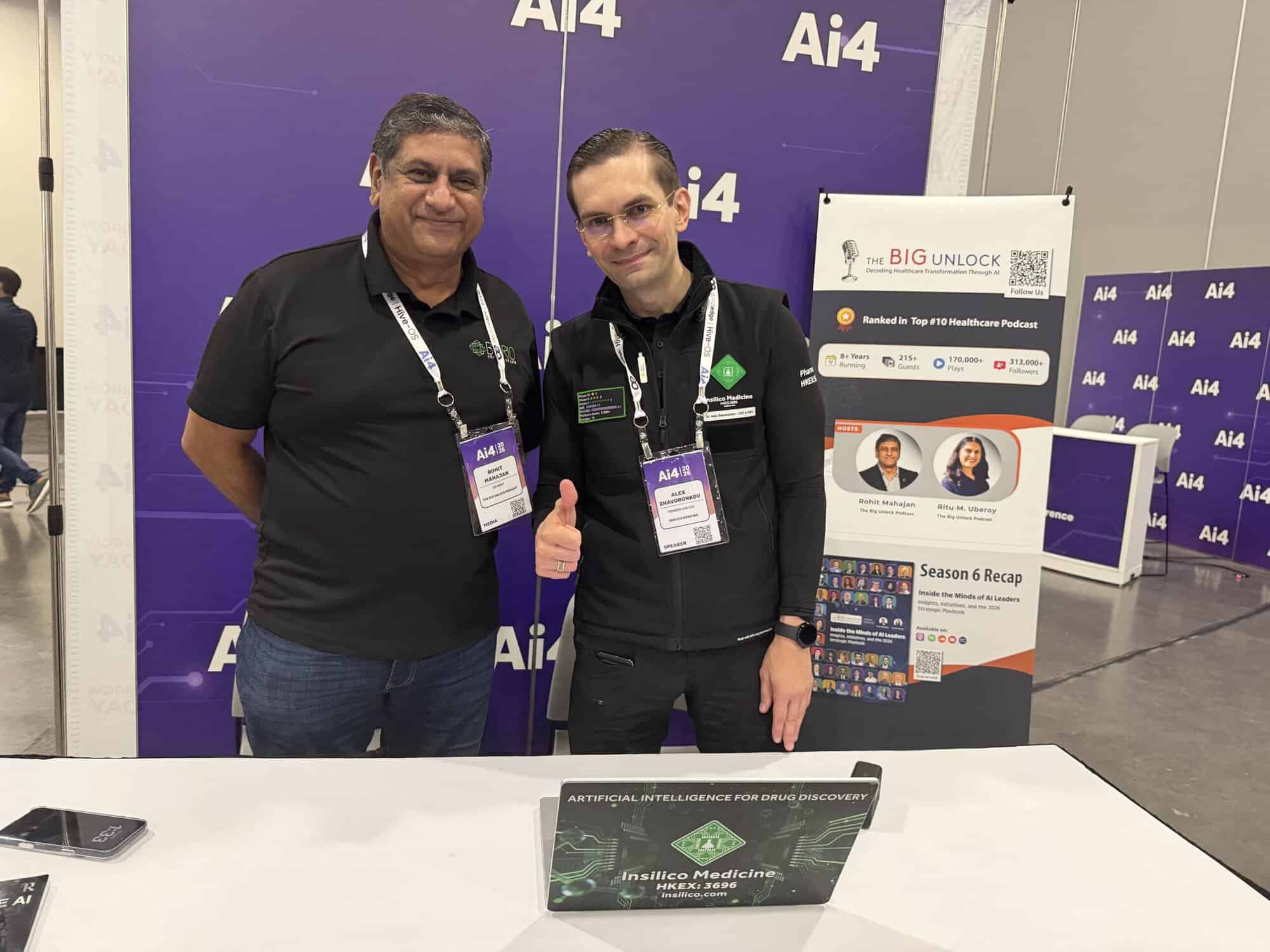
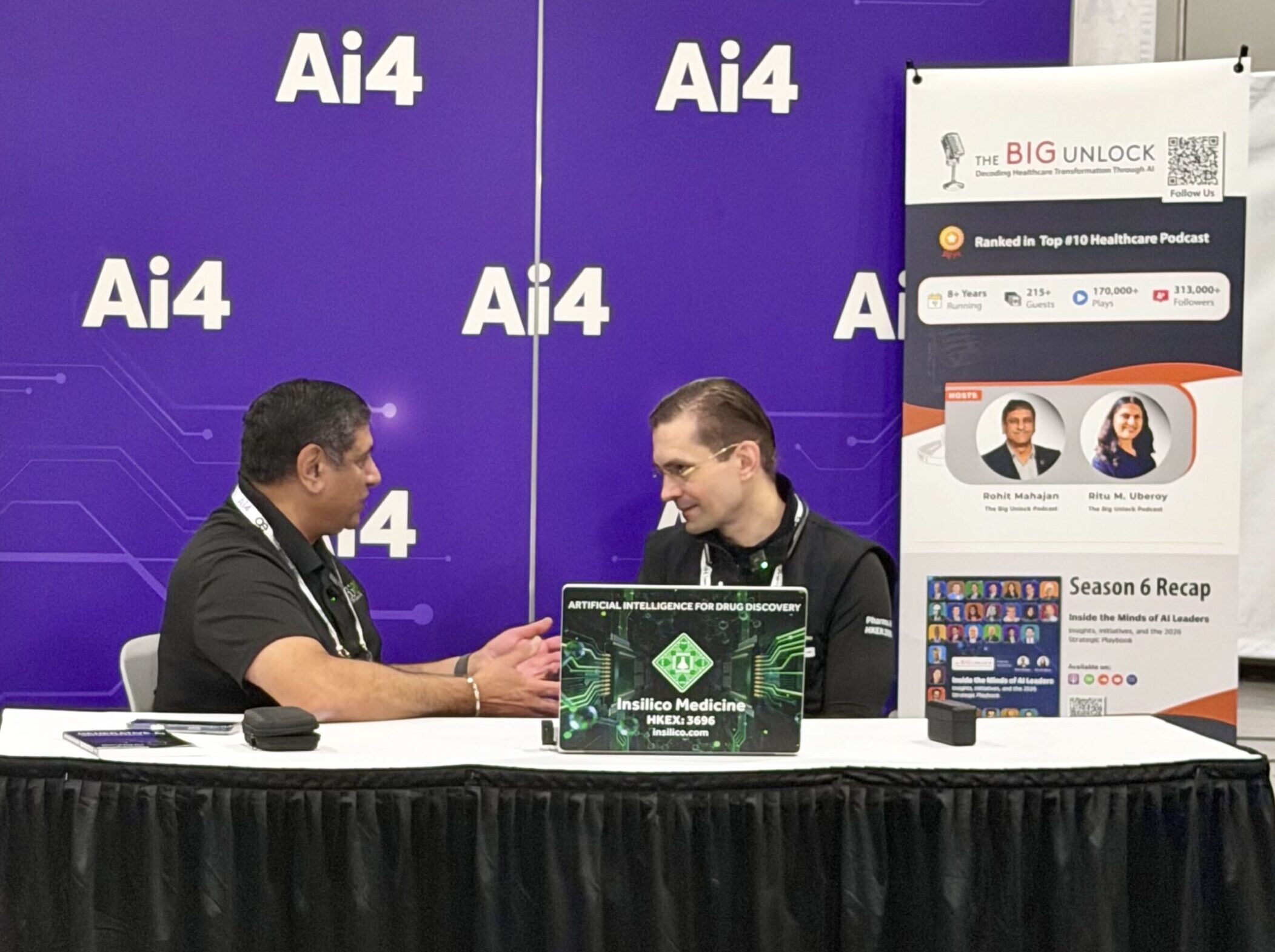
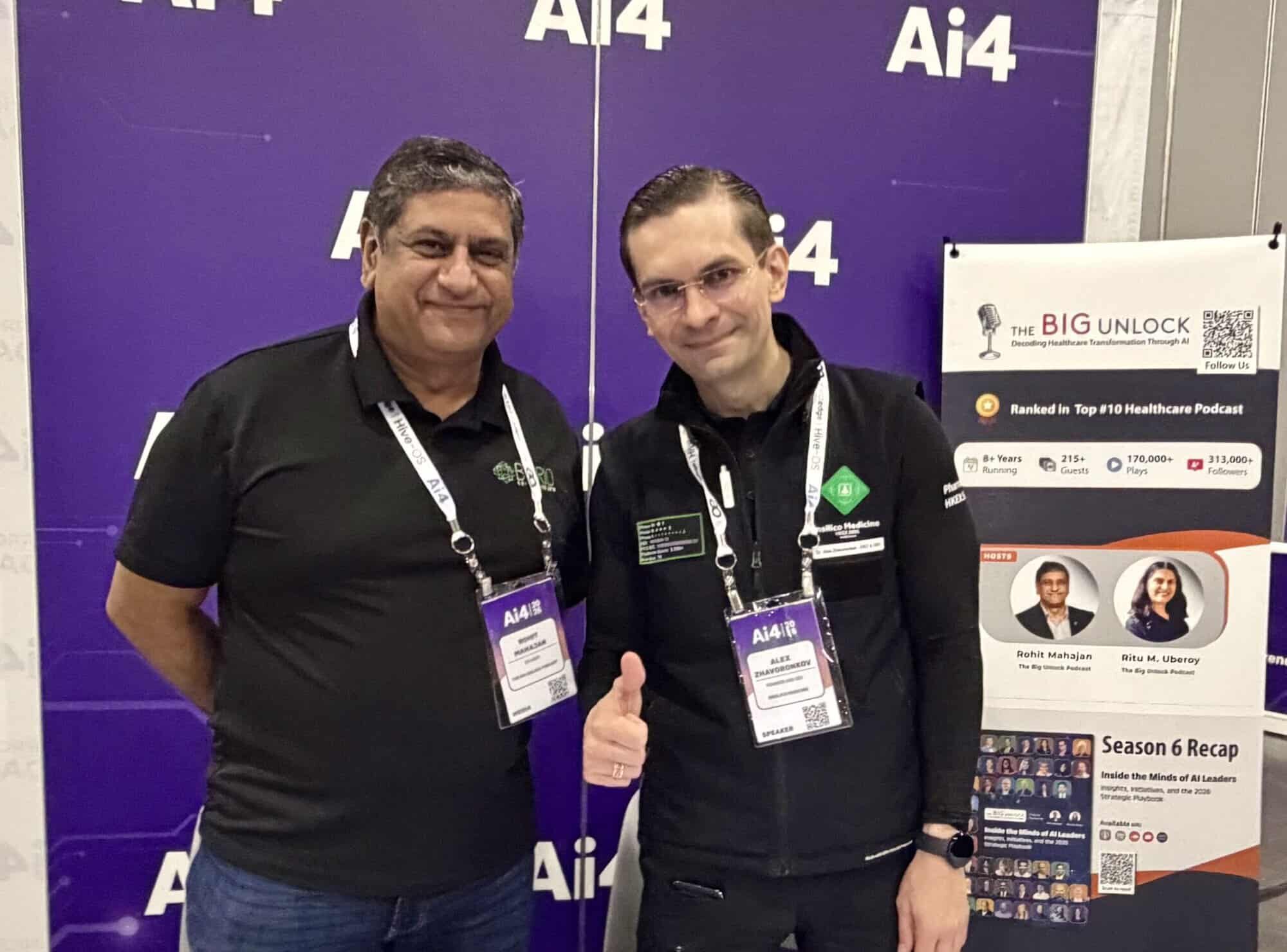
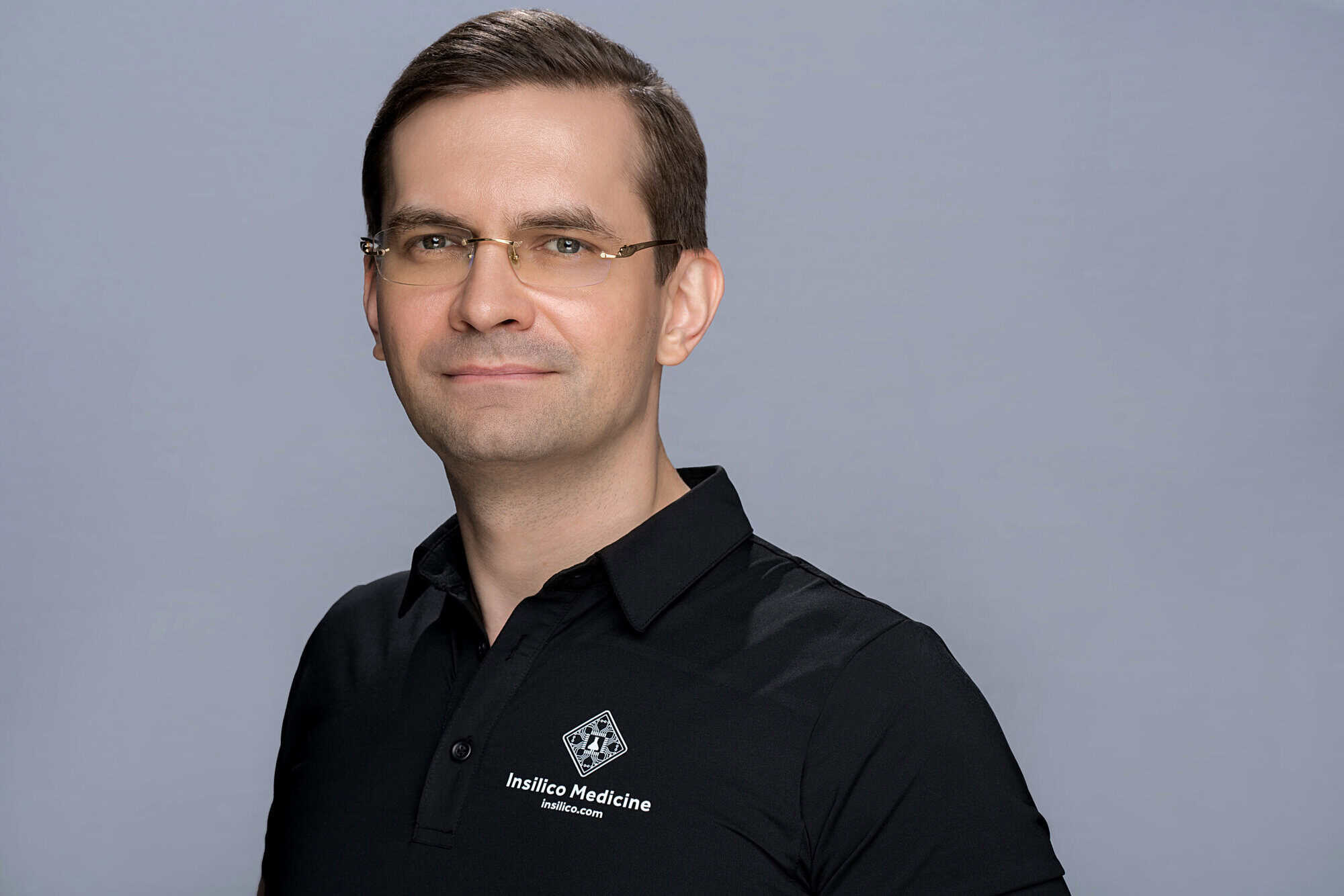
Rohit: Hi, Alex. I’m Rohit Mahajan, co-host of The Big Unlock Podcast and CEO and managing partner at Damo Consulting. It is great to have you as our guest, especially at this fantastic event, AI4. I would love you to give your introduction to our listeners.
Alex: Thank you very much for hosting me — I’m a big fan of the podcast and when we connected I immediately decided we had to do this. I’m Alex Zhavoronkov, founder and co-CEO of Insilico Medicine. We are a generative AI company that is clinical stage, meaning we actually have real drugs in clinical trials. We are publicly traded — we went public in Hong Kong last year under the ticker symbol 3696, so I need to be careful about forward-looking statements. My background is in computer science, and I started my career in GPU computing. I made some money in my early twenties and decided to spend the rest of my life on aging research, because I believe that’s the most important problem everyone has — it is the major cause and source of suffering in the world. I did my graduate work at Johns Hopkins, was a professor here and there, and in 2014 came back to my roots in GPU computing and started Insilico at the NVIDIA GTC conference. We had a presentation called “Can NVIDIA Solve Aging?” Fast-forward twelve years, we’ve managed to get a few drugs into human clinical trials, and I’ve raised a considerable amount of funding — though it wasn’t easy in the beginning. There were times when I had to sell everything and put it into the company. When you’re rich you invest everything, then you’re poor, then you get it back — and then you don’t want to be rich, so you invest even more. It’s an interesting journey. I’m still far from solving aging, but we’ve made some good progress.
Rohit: That is a very interesting area. Everyone talks about the silver tsunami — 10,000 Americans aging every day, going into senior care or rehabilitation facilities. When you say you’re working on longevity, there is health span and there is lifespan. Tell us how you think about that, which drugs are in the pipeline, and how you chose them.
Alex: I actually focus on lifespan — for me that is more important than health span, and I’ll explain why. Health span is a very vogue definition of longevity, basically used by people who don’t want to push the boundaries of actual lifespan. I don’t know of any drug that can give you ten years of life without also giving you additional years of healthy life. If your goal is to push that boundary, you’re also going to increase health span no matter what — the question is just the size of the delta. If that delta is six months of suffering, that’s not something we’d want to focus our entire company on. That said, we still develop drugs that may help in certain conditions, because very often diseases are diagnosed too late. I would still give six months to a mother of two suffering from terminal cancer to have more time with her children — especially if it doesn’t cost much, and it has to be her choice. But we need to provide people with the freedom to live even six months longer. People who say they don’t want lifespan, only health span, are actually doing damage to the field, because we want lifespan too. And if you want to be truly ambitious, think about peak span — how long you spend within ten percent of your maximum performance. All of those spans matter and there shouldn’t be a debate about which one to extend. Life is a fundamental human right. If we can give one quality-adjusted life year to everybody on the planet, that is 8.3 billion life years — 110 million lifetimes. A couple of years would be 220 million lifetimes, which is more than were lost in all the wars fought in the history of humanity. The way to get there is to work within the traditional pharmaceutical drug discovery and development paradigm — going after a disease, getting a drug approved — but if the root of that drug was actually aging research, you’re developing a longevity therapeutic with AI. The AI tells you this is an anti-aging drug but it should work on this cancer, so you approve it for the cancer. The patient gets additional months or years. And then once the drug is approved and safety and efficacy are established, you can experiment with it, gather real-world data, and see if it also improves aging biomarkers — potentially beneficial for others at a different dose or mechanism of administration. That’s the idea.
Rohit: I heard you say longevity and cancer. Are most of the drugs in your pipeline targeting different cancers, or something else as well? What’s the breadth and depth of what you’re going after?
Alex: We are very different in the context of AI drug discovery. Most companies go after cancer or neuroscience. We are the MMA fighter — we decided to go very broad spectrum. Our core ideology is that we go after aging. Many of the protein targets that drive disease are implicated in both aging and cancer at the same time, just used differently. For aging, for example, you want to eliminate senescent cells — cells that have stopped functioning and are just sitting there excreting toxins into the microenvironment. Some cancer drugs do exactly that. About half of my pipeline is related to cancer and half to chronic disease. My lead program, currently in phase three, targets idiopathic pulmonary fibrosis — a chronic lung disease with no good treatment at this point, where everything available just slows the decline rather than reversing it. In our phase two trial we demonstrated very promising reversal of the loss of forced vital capacity, the essential measure of lung function. We also go after IBD, inflammatory bowel disease, neuroinflammation including Parkinson’s and potentially Alzheimer’s, ocular diseases including dry AMD and uveitis, and the most exciting recent breakthrough is in pain. Pain is very difficult — identifying a new mechanism that isn’t opioid-based or an ion channel or anti-inflammatory is extremely hard. Most pharmaceutical companies historically started as painkiller companies, and that’s how we got heroin, morphine, and fentanyl. We identified a new target originally purposed for aging, and through sheer scale of experimentation — while testing a pain drug on animals, we had the ability to put more compounds in the assay. In one experiment we rescued an animal in terrible pain with something that might not have worked, and it worked better than morphine and epidural. We tested it against every standard of care, even against NAV 1.8 orally, and it performed significantly better. We took it all the way to a development candidate — one step before human clinical trials — and it went great. We now have 32 development candidates, eight phase ones, three phase twos, and one phase three. The pain drug alone is extremely exciting, because imagine if at high dose it kills pain and at low dose it addresses aging.
Rohit: That’s a great combination. We’re at an AI conference, so tell us more about how you’ve combined the different AI approaches. AI was once predictive analytics, now it’s generative — and you’ve been finding targets and small molecules for drug discovery for a long time. What’s novel about how you’re approaching AI?
Alex: Insilico originally started as a deep learning company and closely followed DeepMind — when we hired people, we tried to do hackathons where we’d take one of their papers and hire people who could perform similarly. We started as a biology company with an AI biologist focused mostly on understanding how you live from birth to death using different biological data types. Those were originally predictive systems. In 2016 we started publishing on generative adversarial networks — early days of generative AI — and we also purposed those algorithms for chemistry for the first time. My first paper on GANs for multi-parameter optimization and molecular generation came out in 2016: instead of searching for a needle in a haystack, you generate perfect needles — molecules with desired properties. In 2017 we published papers showing experimental validation of the technology: we actually synthesized and tested the molecules. In 2018 we published in Nature Biotechnology on generative tensorial reinforcement learning — right before ChatGPT — showing we could synthesize and test molecules all the way into mice in 46 days. That was a big deal. From the early 2020s we started working on transformers and diffusion models, but essentially built a Lego system of different models that can do biology and chemistry. Some do generation, some do synthetic data generation — because in biology you often don’t have much public data for specific problems, so you can actually generate high-quality data using generative approaches. Some models do predictive analytics, some predict clinical trial outcomes. We orchestrate all of them using frontier models. We now have over 1,200 tasks in drug discovery — think of 1,200 experts you can clone and spawn into many different agents to achieve the grand task of reasoning across an entire program from target identification to approval, working backwards. Essentially: from prompt to drug.
Rohit: “Prompt to drug” — that’s a great phrase. I’ve been following this space and I think our listeners would also ask: how do you position yourself relative to Flagship Pioneering, Moderna, or other companies doing pioneering work in this space?
Alex: Flagship Pioneering is a great platform for company creation. What they do is essentially have capital, a pool of experts, and they identify trends — for each trend they build a company, offer it to investors, raise funding, and utilize the same people incubating many companies. In generative AI they have Memong Mini, incubated by the same team for different trends and investor bases. I’m not entirely sure how to establish the success of those companies. One called Generate Biomedicines is listed publicly and has a drug in phase three, though it would be nice to see peer-reviewed publication of how much the generative approach actually contributed. Others I’m less certain about, because when you create a company for a purpose it’s very difficult to get people to work together toward a specific goal. Companies that tend to be more successful in our field are those where people came together, worked on a problem, solved it, and only then raised money to scale. Forced invention is very difficult — genuine invention works better. That said, Flagship is a great platform, and one win like Moderna pays for the entire party. Moderna is actually a Flagship company, which is why they’re famous. And if it hadn’t been for COVID, it would be an open question where Moderna would be now. But the companies I’m actually more concerned about are Anthropic, OpenAI, Google, and many Chinese players like Tencent and Alibaba. They are developing foundation models that can reason really well in the context of biology. Some of the more primitive tasks — like target discovery — are already completely demonetized. More complex tasks are being demonetized as we speak. All of those companies are also putting resources into biology. My hope is they don’t make the mistake of buying low-quality companies just for the data or for kudos — those are computer scientists who don’t know what works in biology. But once they get proficient in our field, they will be real competitors. What I’ve started doing is developing tools that actually accelerate this transition — tools like MMI Gym that help frontier models train on what we do. If in some tasks they are advancing and can be better than me, I’d rather help them do that, because they can help us back. I’m going to be always at the frontier with a new algorithm or approach. In the future, the real moat in my field are the drugs — they are like diamonds, they’re forever. AI comes and goes every six months. The future moats will be capital — which you can convert into energy or compute — infrastructure including labs, robotics, and networks of contract research organizations, and third: good intent, good ideas, and being in the right place at the right time. We have more ideas than we have capital or infrastructure, but with increased intelligence we can more rapidly convert ideas into real products that save lives.
Rohit: That’s a great insight. What are some of your biggest challenges at the point in the journey where you are now?
Alex: One fundamental challenge that everybody faces is the complexity of biology. You need to try a lot of things to see what works, even with perfect AI. I can now go from prompt to drug for a given target — if it’s low or moderate novelty, I’ll win. But if I’m going into truly new terrain, there’s a very good chance I’ll fail. You need a very sustainable business model to allow yourself to fail. The real great challenge I see is geopolitics. Right now it’s absolute nonsense. I don’t understand it and don’t want to understand it, but I have to. The US is fighting with China, countries have become very nationalistic. To do really good work in our field, you need international reach. If you want to synthesize molecules at scale, there are only two places you can do that — India and China. You can’t do it in the US; the infrastructure simply doesn’t exist, and it’s also a low-value task. Some animal experiments, like primate studies, can’t be done at scale in India either. Most of the hardcore competition is in China, so if you want to compete you actually want to compete there. The US is making it difficult for American companies to do that, and there are regulatory complications everywhere. My job isn’t to pick any side — I don’t care where you live, as long as you can live longer. If a mother of two is dying somewhere in Africa or in China, you need to help her. We’ve had to establish infrastructure that allows us to be global — we’re in Montreal, Abu Dhabi, Hong Kong, Taipei, Shanghai, and Yixing. Right now it’s just very difficult to operate globally, and that difficulty is a real challenge for what we’re trying to do.
Rohit: Any upcoming announcements or plans you’d like to share, including any plans to list in the US?
Alex: We would of course love to explore additional capital markets and are constantly on the lookout, timing the markets carefully. The US biotech industry is going back up but it’s still in a winter — it hasn’t fully processed the excess from companies that listed and raised a lot of capital in the early pandemic days, didn’t deliver, and lost investor trust. The AI hype also needs to settle somewhat, because right now people are chasing trillion-dollar companies and forgetting about smaller biotech, even though it’s very important. What we have on the horizon are massive scientific breakthroughs we’re constantly working on — but as a publicly traded company I can’t talk about them specifically, so watch for peer-reviewed publications. We usually don’t make big claims until we publish. What excites me most are the clinical trials. Once you’re in the clinic, you’re worried all the time — with many programs running, you must fail statistically at some point. So far we haven’t, but given our current rate of success I think in many cases we should succeed, and when we do it pays for everything. On the AI front, our most important initiative is benchmarking — we just released a set of benchmarks where we can test frontier models and specialist models across over 1,000 drug discovery tasks. Many of them perform poorly; some are reasonable. The large foundation model developers don’t even know drug discovery yet. I’m very happy to see that Anthropic is actually going into their own drug discovery — you need to discover a drug to know how to discover a drug; it’s the chicken and the egg. The most exciting thing for me remains aging research. I don’t think there are greater enemies that humans have other than aging — it will kill you with one hundred percent certainty and takes everything away. There’s a good chance we can give everyone an additional ten or even twenty years. We have drugs in development that hopefully will get us there. That’s what will consume a large part of my life, and I’m willing to fight for it.
Rohit: That’s beautiful — pushing the envelope on longevity. Thank you so much, Alex. Really appreciate you being our guest on The Big Unlock Podcast.
Alex: Great to be on the podcast. Let’s unlock longevity.
Rohit: Yes. Thank you.
—
Subscribe to our podcast series at www.thebigunlock.com and write us at info@thebigunlock.com
Disclaimer: This Q&A has been derived from the podcast transcript and has been edited for readability and clarity.