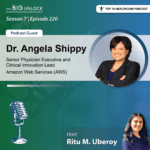
Season 7
In this episode, Dr. Angela Shippy, Senior Physician Executive and Clinical Innovation Lead at Amazon Web Services (AWS), shares how cloud and AI are reshaping healthcare by helping organizations move from experimentation to enterprise-scale transformation. She explains that successful AI adoption requires more than powerful models – it demands secure cloud infrastructure, responsible governance, workforce upskilling, and trusted partnerships.
Dr. Shippy explains how leading health systems are moving beyond isolated AI pilots by solving well-defined organizational and clinical challenges first. Through purpose-built services like Amazon Connect Health, institutions are streamlining patient engagement, reducing administrative burden, and improving access to care. From antimicrobial resistance surveillance to genomics research and health equity programs, she illustrates how cloud-based platforms are helping healthcare organizations generate insights faster and improve patient outcomes at scale.
Dr. Shippy believes that scaling enterprise AI requires upskilling healthcare workforces, establishing strong security guardrails, and embracing agentic workflows. She envisions a future driven by multimodal AI, ambient listening, and automated task execution that accelerates drug discovery, reduces burnout, and enables clinicians to focus on direct patient care. Dr. Shippy encourages health systems to start small, think big, and never lose sight of improving patient and workforce experiences. She believes agentic technologies will augment clinicians, accelerate innovation, and help build a more connected, efficient, and patient-centered healthcare ecosystem. Take a listen.
This guest appearance was facilitated through conversations initiated at ViVE.
About Our Guest
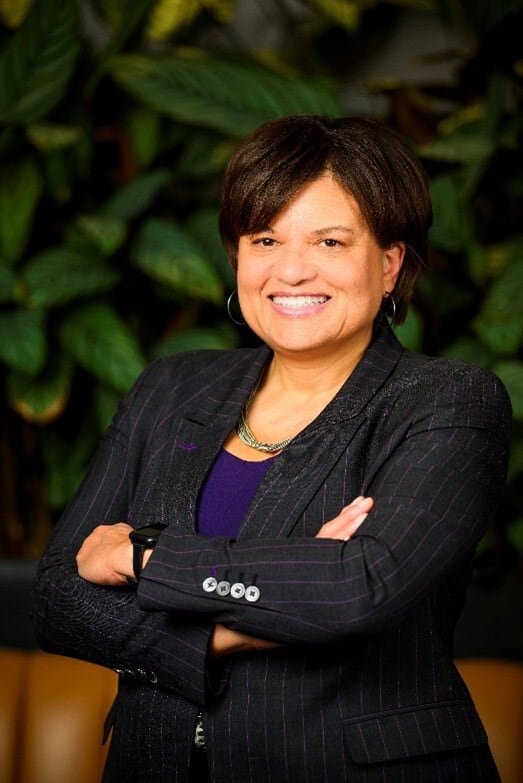
Angela A. Shippy, MD, MHA, FACP, FHM is Amazon Web Services' Senior Physician Executive and Clinical Innovation Lead for Healthcare and Life Sciences. A board-certified internist and respected healthcare executive, she brings over two decades of healthcare leadership experience, combining clinical expertise with strategic vision to drive healthcare transformation by accelerating cloud technology adoption to support the healthcare and life sciences ecosystem.
Before joining AWS, Dr. Shippy served as Senior Vice President and Chief Medical & Quality Officer at Memorial Hermann Health System, one of Texas's largest not-for-profit health systems. There, she orchestrated system-wide initiatives spanning clinical quality, patient safety, laboratory services, pharmacy operations, accreditation, and regulatory compliance across 17 hospitals and 300+ care delivery sites.
Her executive healthcare experience includes leadership positions at HCA Healthcare's Gulf Coast Division Chief Medical Officer and at St. Luke's Episcopal Hospital in the Texas Medical Center as Vice President of Medical Affairs. At St. Luke's, she maintained an active practice as a hospitalist while driving operational excellence.
Dr. Shippy earned a B.S. in biology from Texas A&M University and an M.D. from the University of Texas Medical Branch in Galveston, where she also completed her residency in internal medicine. Her academic credentials are complemented by a Master's in Healthcare Administration and recognition as a Fellow of The American College of Physicians (FACP) and the Society of Hospital Medicine (FHM).
Dr. Shippy's influence extends beyond individual institutions through her service on healthcare councils and committees at local, state, and national levels and her inclusion on the inaugural list of CNBC Changemakers in 2024 and Fierce Healthcare's 2023 Women of Influence. Her commitment to medical education is reflected in her prior volunteer faculty appointments at Baylor College of Medicine, UTHealth Houston, and The Institute for Healthcare Improvement.
Recent Episodes
Ritu: Hello, listeners. Welcome to Season Seven of the Big Unlock Podcast. My name is Ritu Oberoi, and I’m managing partner at Damo Consulting and your host today. We are looking forward to a conversation with Dr. Angela Shippy, and we warmly welcome her to the podcast. Dr. Shippy has been a director and senior physician executive and clinical innovation lead at Amazon Web Services for over five years. She leads executive engagement for healthcare and life sciences. Her work focuses on bridging operations and technology to enable and accelerate transformation for providers, payers, pharma, biotech, health tech, and device organizations. We’re really looking forward to a very engaging conversation with Dr. Shippy, so welcome to the podcast once again.
Angela: Thank you, Ritu. It’s great to be here, and thank you for having me.
Ritu: Dr. Shippy, would you like to add anything to that introduction?
Angela: I think the one thing I would add is that people often ask how I ended up at Amazon Web Services. Truly, it was because I have been an end user of technology my entire career. I started my residency a few days early because we were all mandated to use a very early version of CPOE — computerized physician order entry. All along the way I’ve continued to use technology, whether it was being a physician champion for PalmPilot, electronic documentation, or putting together templates with the informatics team. It’s always been part of my career. And like so many of my colleagues, the COVID pandemic was really an opportunity to bring data together. For the first time ever in my previous organization, we brought together clinical and operational data in a dashboard that we were using on a regular basis. Seeing in real time how having all the right data in the right place allowed us to treat a patient population that was in need — and know exactly what they needed — really spurred me to join this team and help my colleagues across the country, and across the world, be able to do this.
Ritu: Thank you for sharing that. We would love to hear your origin story — how did you decide to become a physician?
Angela: It’s a funny story if you think about a nine-year-old girl who had a teacher who told her she was really good at science. My fourth grade teacher said, “You’re really smart and you’re really good at science.” I translated that to mean that if you’re really good at science and you’re smart, you should be a doctor. And then I decided that if I was going to be a doctor, I should be a neurosurgeon because the brain is the hardest thing and the most important part of the body. For many years through elementary school, I was focused on becoming a doctor and a neurosurgeon — I used the term brain surgeon at the time. In high school and college I shifted to thinking I would love to be an OB-GYN and deliver babies. When I got to medical school, it was my very first rotation, and I loved it — a six-week rotation starting in labor and delivery, so much fun. Then I got to the surgical part: bladder repairs, hysterectomies, and oncologic patients, and I realized that wasn’t the part I was excited about. My next rotation was internal medicine, and I loved it. Internal medicine is the gateway to so many specialties, and I ended up as an internal medicine physician, practicing as a hospitalist for many years.
Ritu: Thank you for sharing that story, and a big shout-out to any teachers out there who are listening — those words set you on this path. So Dr. Shippy, you bring together the perspective of a practicing physician, a former health system executive, and a technology leader to help organizations think about what’s possible in this new era of cloud computing and generative AI. In your experience working with so many health systems, what separates the organizations that are truly transforming with AI from those that are just trying pilots and deploying isolated use cases?
Angela: Right now so many of our customers are thinking about their biggest pain points — what their clinical operations look like, what throughput looks like, whether they have enough nurses, enough allied health professionals, and what they need across physician specialties. They’re looking at the entire picture, and that’s leading them to ask: what do I want to do with generative AI and agentic AI to take things to the next step? The organizations doing the best work are those asking two things. First, which particular problem am I working backwards from to solve? Second, what am I doing to scale beyond just that initial pilot? I’ll give you an example. UCSD is using one of our purpose-built solutions for healthcare — Amazon Connect Health — allowing them to engage with patients in a meaningfully different way. Being able to verify the patient when they first call the contact center, direct the call to the right part of the organization, use all the data they have related to that patient to direct them appropriately or provide a quick, accurate answer. For them, this has meant 3.2 million contacts with patients, a reduction in hours that call center staff spend on those calls, and a thirty to sixty percent reduction in abandoned calls depending on the department. That translates to patients getting to preventative care, managed care, prescriptions — whatever they need — faster and more accurately, which produces a better patient experience. And we know that patients who have a better experience have better health outcomes. When you see that level of engagement with patients and their ability to access the parts of the healthcare continuum they need, you also know those are patients who continue with that same health system — which addresses the operational efficiency goals as well. The systems really advancing beyond pilots are those focused on what matters most.
Ritu: Thank you for telling us about Amazon Connect Health and how you’re using autonomous agents for patient navigation, appointments, rescheduling, and ambient capabilities. That leads into the next question: AWS has invested heavily in helping organizations build scalable data foundations before deploying AI. But so many executives want to jump straight to the next shiny new AI application. How do you help healthcare leaders resist that temptation and understand they first need to build foundational capabilities?
Angela: One of the things I really enjoy about my work is the opportunity to talk to colleagues across the country about what they’re doing. In those discussions, we talk about the end goal — but keeping in mind that to meet those goals, they first have to think about their data. Do they have clean, available data as their foundation? We know that right now 97% of the data in healthcare does not get used, largely because it’s unstructured and from so many disparate sources. Part of that initial conversation is about how to bring all that together — how to take that disparate data and turn it into real information that becomes insights. Then being able to use agentic AI to take that data and information and turn it into actionable insights, whether that’s for the patient experience, the clinician’s experience, or for research. For a payer organization it can help with member and population management. For a pharma company it can help get to drug discovery faster. That’s what we talk about — the foundation of clean data in the format that allows you to use these agentic tools.
Ritu: You mentioned that you started with technology training even before your residency. Today’s CIOs, CMIOs, and digital leaders need to understand cloud architecture, AI, and cybersecurity — all changing at a rapid pace, sometimes weekly. What is your advice to CIOs and CMIOs on how they stay abreast and relevant when the pace of change is so rapid?
Angela: Our customers share a curiosity about what’s happening from a technology standpoint — they’re standing side by side with us wanting to learn. We have thousands of customers running workloads on AWS, and we’ve earned their trust over time, so they see us as a source of information. We feel a commitment to help them continue to learn in this rapidly changing environment. We do that a few ways. One is through summits — I’m at the DC Summit right now, which gives customers the opportunity to come and learn, hear from their peers, and see what others are doing. We also have training and certification available for leaders and their teams to use — much of it free. We have a fellowship program where up-and-coming leaders from health systems can come through and learn more about technology and, as they advance in their careers, how they’ll think about working with technology and specifically with AWS. We’re also dedicated to upskilling, because every worker within healthcare and life sciences will see their day-to-day job change because of the tools that are available. We want to make sure they have an understanding of that. The reason this is so important for CIOs and CTOs is that we know there’s significant administrative burden across the workforce they’re responsible for, and these tools can help decrease that. When you’re at a summit like this, the energy is remarkable — especially across public-sector customers who are mission-driven, highly regulated, and are really looking to AWS to be the partner that helps them in secure environments, with managed AI layers that allow them to deploy quickly without having to dig into every single aspect of the technology, and with purpose-built services that have guardrails in place for another level of security. All of that is what we’re doing to ensure CIOs and CTOs have knowledgeable teams, that we’re supporting those teams, and that we’re supporting their organizations and goals.
Ritu: So you’re saying this technology can really be an enabler and help them do their job better.
Angela: Absolutely — it’s an enabler and an accelerator. It allows them to start with a proof of concept and then truly scale it across the entire organization. Right now we’re working side by side with customers to help them meet these goals, and we want them to look to AWS and know we have solutions ready for them. I’ll give you another example — Amazon Bio Discovery. This is a new technology that allows our pharma customers to move so much faster. The time it takes to research, take all the data from that research, and get to the discovery of a new drug takes years. With Amazon Bio Discovery, being able to put all the components together and help them get to the answers and insights they need so much faster is going to decrease the time it takes to develop the next drug. That might mean the next drug we need in the oncology space is developed much faster — more lives saved. It’s exciting to think about, and we really look forward to continuing to take this drug discovery work and ask: what can we do next, what can we learn, and what can we iterate and innovate on in this space?
Ritu: Healthcare leaders often talk about moving from data to insights, but increasingly the conversation is shifting toward moving from insights to autonomous action. As cloud platforms evolve to support AI agents and intelligent workflows like Amazon Connect, how do you envision the role of health systems changing over the next few years? Will we still be thinking in terms of software applications, or will patients see seamless, almost invisible technology that just helps them — without passwords, thousands of clicks, and getting stuck at every point?
Angela: I think right now we will see an evolution — technology will become easier to access, and more and more of the processes that are currently very manual and require multiple people and steps will become automated. Our customers will be right there with us as we help make those changes and see what that looks like. That can really change where health systems spend their time and do their work. I’ll give you an example. We announced this week what we’re doing with the Fleming Initiative, specifically around antimicrobial resistance. Every provider organization understands they have infections in their community, some of which are resistant to antimicrobial therapy, and they have whole departments of infection preventionists following surveillance and reporting. We’re now partnering with this initiative — antimicrobial resistance is extremely important. Right now, every eleven seconds someone is being diagnosed with a resistant infection, and every fifteen seconds someone dies from it. Being able to have a global platform connecting 150 countries, bringing together all of this information to minimize resistance — that’s going to change how they practice, how patients receive antimicrobial therapy, and those mortality numbers. When you automate practices that infection preventionists are currently doing perhaps on a spreadsheet, you free up that expertise to be deployed elsewhere, take away administrative burden, and help patients have better outcomes — not being treated with an antimicrobial therapy that isn’t working, or having to have a second course because the first didn’t cure the infection. Those are really significant leaps that are all about technology, automation, and using agentic tools to get to insights faster and change clinical care.
Ritu: That truly scales and multiplies impact to save lives. Thank you for sharing that, Dr. Shippy. I also wanted to ask about the Children’s Health Innovation Awards — I was reading about that and it sounded remarkable. Tell us more about those awards and what you’ve seen with the health systems you’ve worked with.
Angela: The CHIA — Children’s Health Innovation Awards — was an opportunity to say: here we have a population of children with rare diseases and genetic diseases, and children’s hospitals are standalone entities, often associated with academic institutions but smaller in scale than adult hospitals. Putting these awards in place was about helping them bring their information together — accelerating the genomic testing and genomic research they’re doing, accelerating work in rare diseases, and helping them come together on platforms where data from different parts of the children’s disease ecosystem — research institutions, children’s hospitals — could be aggregated. When you take all these smaller populations and aggregate them, you have more data that can get you to insights faster. We wanted to help them get to those insights faster, make an impact on providers taking care of children right now, and also shed light on the importance of rare disease research and genomics and what that can lead to in the future. We have a purpose-built service, HealthOmics, that helps get to insights faster from gene therapy and research. I’ll share another example. Over five years our health equity initiative helped organizations look at underserved communities, access to care, and ensuring that patients — no matter where they lived, whether in a rural or underserved community — had access to technology. Over five years that was a $90 million commitment helping 600 organizations. Babyscripts, for instance, was able to diagnose pre-eclampsia faster — eclampsia is one of those true medical emergencies in a pregnant patient, so getting to diagnosis faster is huge. We were able to help a company in Uganda take care of at-risk babies for the six weeks after delivery, ensuring they were able to attend their postnatal visit — a 275% increase in postnatal visit completion, and a decrease in mortality as well. These are really significant impacts from funds we’re excited to give and support, either with technology embedded to improve the application or with technical support for applications being built on AWS.
Ritu: I hope listeners learn about the CHIA program and it reaches a bigger audience to help other health systems apply. Thank you for sharing that. As usual, the time has flown by, Dr. Shippy. Any closing thoughts you’d like to share? Where do you think technology is heading? We used to ask about the next three years, then the next year — now it’s almost the next three months because it’s moving so fast.
Angela: One of the most exciting things in our work with customers is watching them start small but think big, never losing sight of where they’re trying to get to. They’re trying to get to better patient experiences, better experiences for their workers, and ensuring that administrative burden is taken away so folks can work at the top of their license. Researchers really able to go fast, accelerate, and get to insights that move them from bench to bedside faster. Nurses and physicians at the bedside really able to interact with patients face to face, eye to eye — not looking down at a keyboard — because of ambient listening. Getting to the discovery of new drugs and new applications of devices faster. It’s really exciting to work side by side with customers as they do that. And the other thing becoming very clear — and our customers are starting to see it too — is that in healthcare, you want to be at the forefront of utilizing this technology. In being at the forefront, understanding that the next big discoveries are most likely going to happen with someone — whether an individual researcher, clinician, or an organization — that either has an agent by their side or agentic technology deployed across the organization. Whether it’s coming from the bottom up from frontline staff or top down from leadership, really embracing this technology and putting it to use to improve the experiences of everyone across the continuum of care is going to make a difference — both in the experience and in the overall health of all the populations being served. That’s really exciting as we look forward.
Ritu: Thank you so much for sharing all those insights with us, Dr. Shippy, and thank you for bringing this transformational change to so many people. It’s exciting to see you doing that. Thank you for being on our podcast today.
Angela: Thank you so much for having me, Ritu. It was great to be here.
—
Subscribe to our podcast series at www.thebigunlock.com and write us at info@thebigunlock.com
Disclaimer: This Q&A has been derived from the podcast transcript and has been edited for readability and clarity.

Ritu M. Uberoy is a healthcare AI strategist, technology executive, educator, and author dedicated to advancing the responsible adoption of Artificial Intelligence across healthcare delivery, digital health, and life sciences. With more than twenty-five years of leadership experience spanning the United States and India, she is recognized for helping healthcare organizations move beyond experimentation to achieve scalable clinical, operational, and business transformation through AI.
She leads AI innovation initiatives, including the AI Center of Excellence at BigRio, where she works with health systems, healthcare technology companies, and life sciences organizations to operationalize Generative and Agentic AI solutions responsibly. Her work focuses on aligning AI innovation with clinical workflows, governance frameworks, workforce readiness, and patient trust—ensuring technology augments human judgment in high-consequence healthcare environments.
Ritu is the co-author of Generative AI: Unlocking the Next Chapter in Healthcare, a practical guide for healthcare executives navigating enterprise AI adoption. She also hosts The Big Unlock podcast, engaging global healthcare leaders on AI transformation and digital innovation. An active educator and speaker, she conducts executive workshops and participates in global forums like HIMSS, ViVE, Women in Tech, AI-Powered Women, RAISE, and more, shaping the future of AI-driven healthcare. Ritu holds advanced degrees in Computer Science and completed specialized AI programs at Harvard and MIT.

Paddy was the co-author of Healthcare Digital Transformation – How Consumerism, Technology and Pandemic are Accelerating the Future (Taylor & Francis, Aug 2020), along with Edward W. Marx. Paddy was also the author of the best-selling book The Big Unlock – Harnessing Data and Growing Digital Health Businesses in a Value-based Care Era (Archway Publishing, 2017). He was the host of the highly subscribed The Big Unlock podcast on digital transformation in healthcare featuring C-level executives from the healthcare and technology sectors. He was widely published and had a by-lined column in CIO Magazine and other respected industry publications.
Stay informed on the latest in digital health innovation and digital transformation