Season 7
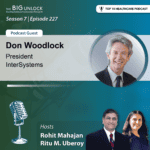
In this episode, Don Woodlock, President of InterSystems, discusses what it takes to make AI work effectively in healthcare. He emphasizes that organizations need to look beyond models and focus equally on use cases, ROI, change management, data, and integration. AI needs to be connected to the right data, context, procedures, and skills to deliver value within an organization.
Don emphasizes that healthcare remains a human endeavor. AI can summarize complex patient information and help clinicians consider additional possibilities, but it should support human decision-making rather than replace it. He sees agentic AI helping with administrative tasks, reducing burden, and improving access, with human oversight remaining essential.
Don believes AI-native healthcare requires AI to be embedded directly into products and workflows. Rather than bolting AI onto existing software, the opportunity is to rethink how users interact with systems, allowing them to state what they want accomplished while the technology handles the underlying work. Take a listen.
This guest appearance was facilitated through conversations initiated at HIMSS.
About Our Guest

Don Woodlock joined InterSystems in 2017 to oversee HealthShare, the company’s interoperability platform. In 2020, he expanded his responsibilities to include TrakCare, InterSystems’ comprehensive healthcare information system, along with overall responsibility for the company’s global healthcare strategy and vision. Woodlock was appointed President of InterSystems in 2026.
Prior to joining InterSystems, Woodlock was vice president and general manager of the Enterprise Imaging division at GE Healthcare. He brings nearly 30 years of experience in IT, beginning his career at IDX Systems Corporation and spending more than 15 years at GE Healthcare, where he led multiple divisions and oversaw the integration of acquired technologies.
Woodlock is a founding advisory board member of the MIT Generative AI Impact Consortium, contributing to efforts focused on responsible AI adoption and real-world implementation in healthcare. He also hosts Code to Care, an educational video series focused on practical applications of AI and data technologies. He holds a Bachelor of Science in Electrical Engineering from the Massachusetts Institute of Technology.
Recent Episodes
Ritu: Hello, listeners. Welcome to Season Seven of the Big Unlock Podcast. My name is Ritu Oberoi, and I’m managing partner at Damo Consulting and your host today along with Rohit. We are thrilled to be welcoming Don Woodlock to our podcast. Don is the President of InterSystems, where he leads the company’s day-to-day operations after spending eight years leading its healthcare business and global healthcare strategy. Prior to InterSystems, Don spent a long time at GE Healthcare. He is also a founding advisory board member of the MIT Generative AI Impact Consortium and hosts Code to Care, a series focused on practical applications of AI and data technologies in healthcare. We’re sure this will be a really interesting conversation — Don brings a unique perspective on how data interoperability, AI, and trusted technology infrastructure will shape the next era of healthcare. Looking forward to it, Don. With that I’ll hand it to Rohit, and then we’ll get started.
Rohit: Welcome, Don, to the podcast. I’m Rohit Mahajan, CEO and managing partner at Damo Consulting and co-host of this podcast. Looking forward to an engaging conversation.
Don: I’m glad to be here. It’s such an exciting era that we’re in — we really need each other in the community to figure out best practices, what’s working and what’s not, so we can direct our energy into what’s best for patients and clinicians everywhere.
Ritu: Let’s get started. You stepped into the president role at InterSystems after spending so much of your career deeply immersed in healthcare technology. As you look across the technology landscape now, what do you think healthcare leaders are still underestimating about the transformation AI is bringing? And what do they really need to do? We’re seeing time horizons shrink from years to months to weeks — it’s almost daily with new models and new headlines. How does anyone keep up, and what should CIOs be thinking about?
Don: In terms of AI, there’s the center everyone talks about — the models, the safety, the applications coming out of the frontier model companies. But there’s a front end and a back end that I think we need to spend more time on. The front end is the use cases, the ROI, the change management. We’re kind of kids in a candy store, and there’s a real danger of eating too much candy — of not being judicious about where we invest our time and everyone else’s. The back end is the data and integration requirements that actually make AI work. It’s not just ChatGPT or Claude applied to healthcare. You need to wire it up, give it data and context, procedures and skills and all kinds of things to make it really perform for your organization. All three legs of that stool need to be attended to for AI to work really well.
Ritu: Great answer. People are really underestimating that. I heard a term recently on LinkedIn — “AI wishing,” as opposed to AI washing — where most people think they can wave a magic wand and AI will just solve all their problems. That leads directly to my next question: healthcare is fundamentally different from other industries where AI agents can simply execute tasks and correct mistakes afterward. In healthcare that simply doesn’t work. Where is the boundary between AI that recommends and AI that acts, when the accountable party always has to be the clinician?
Don: Healthcare is serious business, and AI can’t just be let loose. There are areas — revenue cycle management, administrative scheduling — where you might treat it more like other industries. But for core physician and patient decision-making, AI has to play an empowering role: making sure facts are clear, opening the aperture of what else should be considered. There’s a lot AI can do to support those conversations, but it still has to be human-led. I heard a physician speak recently about a patient who asked what AI thought about their case — but what they really wanted to know was what the physician thought. Patients can figure out AI’s opinion on everything at home. When they come to a healthcare organization, they’re there for human expertise and human touch. Human in the loop is the obvious thing to say, but we need to make it work in a way that truly empowers people. In the end, it’s clinicians and patients who make the choices.
Ritu: I think that’s a great distinction — AI is helping patients prepare for visits and be better informed. But when they get to the doctor, they’re really looking for expertise and reassurance.
Don: From the doctor’s point of view, AI is very good at gathering facts — summarizing a giant chart, surfacing any cardiac history buried in the record, those kinds of things. AI can quickly read a big chart and tell you what’s pertinent. What’s also valuable is the “what else should I be considering?” function — before a clinician zeros in on a diagnosis and treatment plan, AI can open the aperture. What else should I be looking at? The human still makes the choice, but AI is a great input into that choice. It has a lot of positive benefits even from a clinical practice standpoint. But in the end, it has to be used in support of human decision-making.
Rohit: You’re captain of a very large ship that has been sailing for a very long time. From your vantage point, what are some of the things you’re navigating from the AI perspective to ensure your customers and users get the best possible experience?
Don: InterSystems is a software company that supports healthcare as well as other industries, and the software industry itself is going through massive transformation because of AI. So a big part of this is internal — how should AI be used in our own processes to build software, implement it, support it, sell it, market it? We’ve gone through a few transitions. Step one was basically giving everybody a license to OpenAI or Claude. That gets the wheels turning — people have a personal tool they didn’t have before and can discover how it helps them in whatever role they’re in. Step two, which is where we’re focused now, is embedding generative AI systemically into how we work. It’s no longer a personal choice about whether to use it right now — it’s cemented into the way we operate. For example, when you check in code, it automatically does a code review and posts the results in our system. Nobody is choosing to ask AI to review the code — it’s just built in. Or take our EHR implementation process outside the US — a year-long program. We’ve built 42 different agents to help employees get their implementation jobs done. One simple example: the first step in an implementation is to read the sales contract and identify what matters to you as an implementer — penalties, specific dates, service level agreements, unusual requirements. We wrote a contract summarization agent. As soon as you post the contract, it automatically summarizes the document — not a generic summary, but one tailored for the implementation person, pulling out implementation-specific items and posting the summary where the rest of the team can benefit from it. That’s embedded right into the work process. The idea is to make the company AI-infused in the way it does its work — that’s the phase we’re in right now.
Rohit: What are you hearing from clients? They’re becoming more well-versed with AI and generative AI, running their own experiments and pilots. You must have a great listening machine over there. What are the common themes bubbling up from the customer side?
Don: There are developer customers and end-user customers. Developer customers are going through a similar transition to ours — generally a little behind us since many are smaller companies or startups. They’re mostly interested in best practices: how should they set up their development environments to best leverage AI on our technology? How do they get our documentation into the context so Claude Code can see it and read it? It’s really about helping them build the best generative AI-assisted development environment with our technology as one of their key platforms. On the end-user front, it’s use cases, ROI, safety, and governance — all the right issues around how to adopt AI in a way that actually works. And every month the conversation shifts. Right now a big topic is token cost — how do I predict and manage the cost of AI? The implicit question is: will I get an ROI for this use case, or am I spending money without a proportionate benefit? It’s a little like cloud computing a few years ago when cloud costs got out of control. Now people’s token costs are doing the same thing, and they’re trying to figure out how to manage it. The lesson is the same: don’t max tokens — max benefits.
Rohit: The parallel to cloud computing is very pertinent. The same runaway cost dynamic, the same need to get strategic about it.
Don: Both cloud and AI are transformative — but that’s not the same as just letting loose. There’s value in a period of exploration at the beginning, because it’s hard to think of everything when you’re facing a genuinely new transformative technology. But at some point you have to take a strategic view of it, and I think we’re getting into those more strategic views now. The other big trend, of course, is agentic AI and how it changes the equation for use cases. Healthcare is a little conservative from a technology adoption standpoint, and I think we appreciate that as patients — we want things thought through. In software development, agentic AI is here and now; in healthcare it’s more of a “what could this bring?” question. But I think agentic AI has a bright future in healthcare, particularly for administrative tasks. Imagine telling an agent: “Set up this patient for surgery — get the prior auth, schedule the surgery, check for any transportation needs.” The key is that the agent presents a plan, and the human approves or adjusts before hitting go. That ramps up the importance of human-in-the-loop design and user experience even further. We’re at the beginning of what’s going to be a multi-year era on that front.
Rohit: We’re seeing that directly with one of the startups we work with in AI ophthalmology — the physician is in the loop while the agents work in the background. That’s exactly the model that scales, especially for anything patient-facing.
Don: Healthcare isn’t purely scientific. It involves ethical issues, personal goals and preferences, family considerations — it’s not like software development, which is more straightforward and less wrapped up in medical ethics. AI has a lot to contribute, but it doesn’t carry the risk of wanting to remove humans from the equation. Healthcare is a very human endeavor. The other dimension specific to healthcare is staffing shortages. Unlike other industries where people are worried about job elimination, healthcare has a genuine shortage of clinicians — physicians, nurses, social workers, physical therapists. People are already waiting too long for appointments. If AI can lower the administrative burden, speed up access to care, and let physicians and nurses go home when their shift ends — those are all very positive things for the industry.
Ritu: Don, would love to hear your thoughts on the AI-native EHR, since InterSystems is also positioning in that direction. With generative AI, ambient interfaces, and agents that can take action — where do you think the EHR is heading in an AI-native world?
Don: Let me take you back to the concept of AI-native for a moment. When generative AI first arrived, some EMR vendors were simply partnering with third parties — bringing in ambient listening technology or chart summarization through partnerships. You partner when something isn’t core to what you’re trying to accomplish. When we looked at it, we said: AI is going to have a huge impact on healthcare, and the last thing we want to do is make it a non-core activity. AI needs to be our competence — built right into the product. Partnering would have cost us six months to market, but what you get when you build it yourself is that it’s yours, it’s core, it’s in the middle of your value proposition. That was the original idea behind AI-native. The rest of the industry has since moved in the same direction, because that’s the right approach. The goal is always to simplify the workflow for the user. It’s already clunky to use computers when you’re trying to take care of a patient. If you have to jump between multiple software programs, alt-tab, re-log in, and transfer information — that’s clunky. Getting AI right within the workflow, making it a natural part of a unified clinical experience, was important. I’ll share a story. We implemented a chart summarization assistant — a button at the top of the EMR that opens up the right third of the screen as a chatbot. We visited our first customer who had used it, an ED doctor. I was over his shoulder as he opened a patient, asked four questions of the assistant, then went to see the patient. When he came back, I asked, “Do you ever use the left two-thirds of the screen anymore — the thing we spent fifteen years building?” He said, “No, I never use that.” It had only been live for two weeks. That’s how quickly the world changes. The primary way someone used to learn about a patient was to open the chart, click through the tabs, review the last visit. Now that’s gone. That’s a read-only use case. But imagine agentic AI delivering more impactful use cases: “Get this patient ready for surgery — do all the steps.” “Work up this patient for this situation.” “Negotiate with the payer’s AI on getting these claims paid.” You state a higher-level intent, and the system figures out what you mean and goes and does it. Software in five years — or less — is going to look completely different. All the user interaction patterns we built over the past twenty years may give way to a new model. That’s what AI-native really means: not bolted on to the last twenty years, but a fundamental rethinking of how end users interact with systems.
Ritu: Great story — I’m sure our listeners loved that. Time has flown by and we’re almost at the end. We usually love to close with an origin story — how did you get into this field, and particularly into healthcare and technology?
Don: When I graduated college I was a math person — I went to MIT, where computer science and electrical engineering were in the same department. I interviewed for both electrical engineering and software jobs. For electrical engineering I pictured myself in a basement with an oscilloscope, wiring things together, and that little circuit would eventually end up in a speakerphone at some hospital — but I would never meet anyone who got value out of what I did. I’d just be part of a long chain. With software, I always imagined I’d be talking directly to end users and building things directly for them. So I took a software job at a healthcare software company — actually an InterSystems customer at the time. It all turned out exactly as I’d imagined. I remember one of my first projects, in Albany, New York at a healthcare system. I would gather all the users in the morning and ask, “What do you want the software to do?” They’d tell me what enhancements they wanted, I’d code all afternoon, and at 4:00 I’d gather them again to show what I’d built. That direct touch with end users — delivering what they need and seeing them find value in it — has been a core part of my whole career. Fast-forward a few decades, and InterSystems is still a very customer-focused company. I still get to do that all the time, even if I’m not writing production code anymore.
Rohit: Great story. Don, you mentioned the Code to Care series in your introduction — would you like to tell listeners a little more about that?
Don: It’s a video series of five-to-ten-minute videos explaining AI concepts in simple terms for this audience. I enjoy teaching, and I find that AI can be confusing and full of buzzwords. So I started the series to explain things clearly — a recent one covered the shift from prompt engineering to context engineering to harness engineering. Those are terms people hear and don’t quite know what they mean, and I take five minutes to explain them. I have a nice little audience that appreciates learning in bite-sized segments.
Ritu: Thank you so much, Don. Really appreciate you joining us today.
Don: Thank you both. This was a very engaging conversation. I appreciate it.
—
Subscribe to our podcast series at https://thebigunlock.com/ and write us at info@thebigunlock.com
Disclaimer: This Q&A has been derived from the podcast transcript and has been edited for readability and clarity.

Rohit Mahajan is an entrepreneur and a leader in the information technology and software industry. His focus lies in the field of artificial intelligence and digital transformation. He has also written a book on Quantum Care, A Deep Dive into AI for Health Delivery and Research that has been published and has been trending #1 in several categories on Amazon.
Rohit is skilled in business and IT strategy, M&A, Sales & Marketing and Global Delivery. He holds a bachelor’s degree in Electronics and Communications Engineering, is a Wharton School Fellow and a graduate from the Harvard Business School.
Rohit is the CEO of Damo, Managing Partner and CEO of BigRio, the President at Citadel Discovery, Advisor at CarTwin, Managing Partner at C2R Tech, and Founder at BetterLungs. He has completed executive education programs in AI in Business and Healthcare from MIT Sloan, MIT CSAIL and Harvard School of Public Health. He has completed the Global Healthcare Leaders Program from Harvard Medical School.

Ritu M. Uberoy is a healthcare AI strategist, technology executive, educator, and author dedicated to advancing the responsible adoption of Artificial Intelligence across healthcare delivery, digital health, and life sciences. With more than twenty-five years of leadership experience spanning the United States and India, she is recognized for helping healthcare organizations move beyond experimentation to achieve scalable clinical, operational, and business transformation through AI.
She leads AI innovation initiatives, including the AI Center of Excellence at BigRio, where she works with health systems, healthcare technology companies, and life sciences organizations to operationalize Generative and Agentic AI solutions responsibly. Her work focuses on aligning AI innovation with clinical workflows, governance frameworks, workforce readiness, and patient trust—ensuring technology augments human judgment in high-consequence healthcare environments.
Ritu is the co-author of Generative AI: Unlocking the Next Chapter in Healthcare, a practical guide for healthcare executives navigating enterprise AI adoption. She also hosts The Big Unlock podcast, engaging global healthcare leaders on AI transformation and digital innovation. An active educator and speaker, she conducts executive workshops and participates in global forums like HIMSS, ViVE, Women in Tech, AI-Powered Women, RAISE, and more, shaping the future of AI-driven healthcare. Ritu holds advanced degrees in Computer Science and completed specialized AI programs at Harvard and MIT.

Paddy was the co-author of Healthcare Digital Transformation – How Consumerism, Technology and Pandemic are Accelerating the Future (Taylor & Francis, Aug 2020), along with Edward W. Marx. Paddy was also the author of the best-selling book The Big Unlock – Harnessing Data and Growing Digital Health Businesses in a Value-based Care Era (Archway Publishing, 2017). He was the host of the highly subscribed The Big Unlock podcast on digital transformation in healthcare featuring C-level executives from the healthcare and technology sectors. He was widely published and had a by-lined column in CIO Magazine and other respected industry publications.
Stay informed on the latest in digital health innovation and digital transformation