Month: January 2026

AI Succeeds Through Seamless Workflow Integration and Clinician Empowerment

Season 7

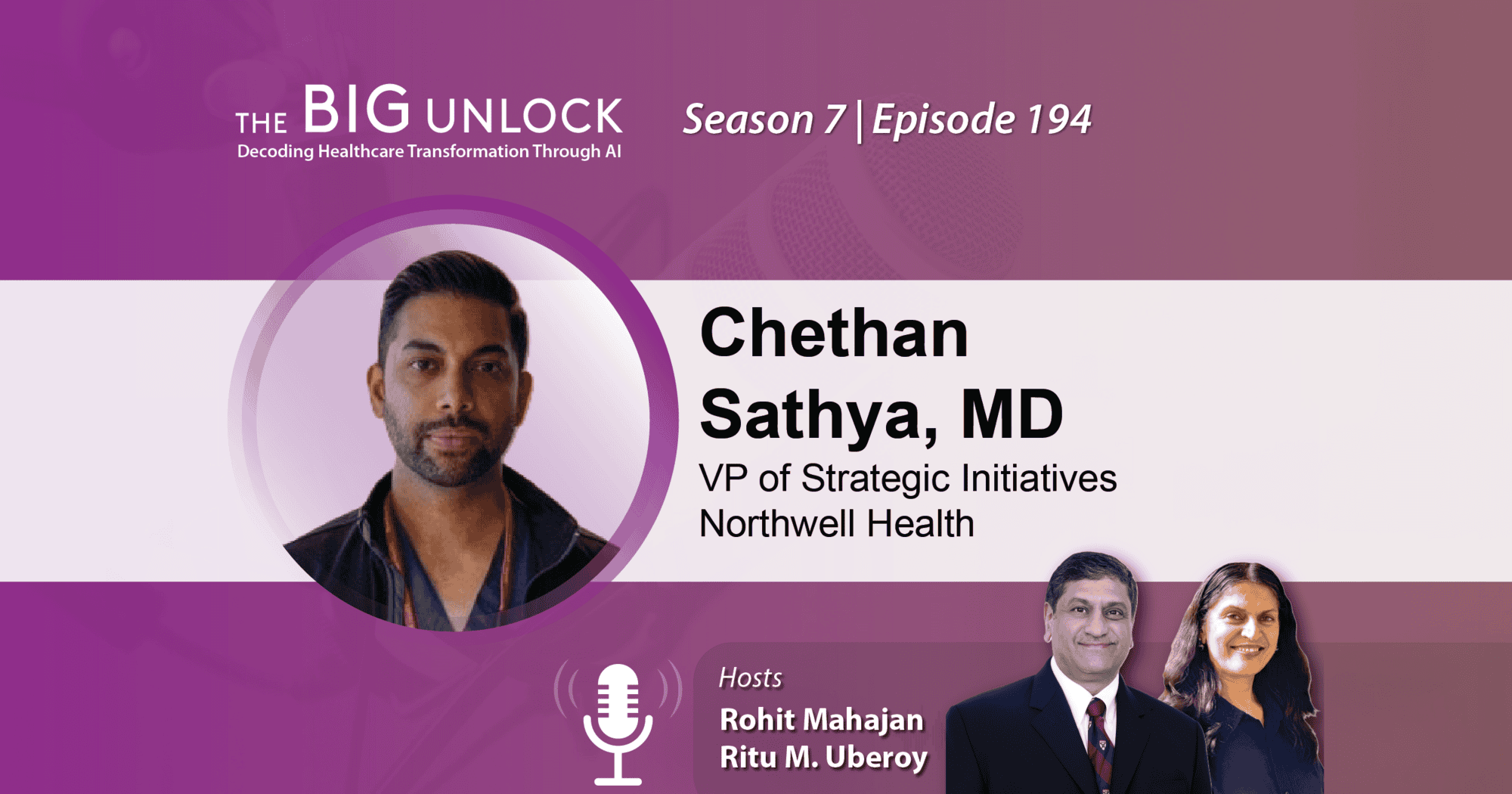
Episode 194 - Podcast with Chethan Sathya, MD., Vice President of Strategic Initiatives, Northwell Health - AI Succeeds Through Seamless Workflow Integration and Clinician Empowerment
The Big Unlock
The Big Unlock
AI Succeeds Through Seamless Workflow Integration and Clinician Empowerment
Loading
/

In this episode, Dr. Chethan Sathya, Vice President of Strategic Initiatives at Northwell Health, unpacks why healthcare innovation only scales when clinicians, public health, and AI are designed to work together.

Dr. Sathya shares his journey from surgery to journalism to public health advocacy, including leading gun violence prevention efforts. He explains why most AI pilots fail, because of poor workflow integration and clinician burden, and why ambient intelligence, tele-specialty care, and agentic AI are poised to scale. His message is clear: build technology alongside clinicians, not around them. Take a listen.

About Our Guest
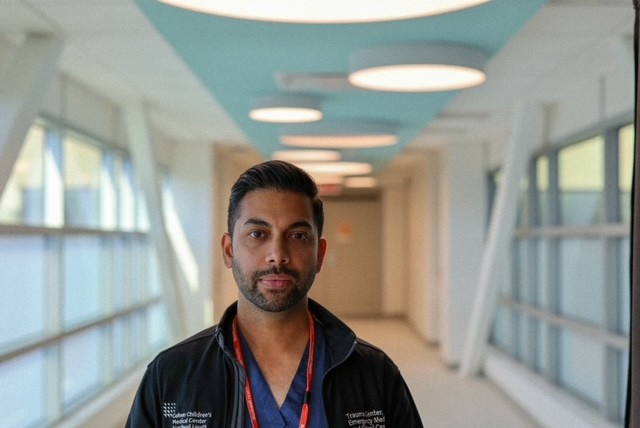
Chethan Sathya, MD, MSc is a pediatric surgeon, public health leader, journalist, and Vice President of Strategic Initiatives Northwell Health. He has received numerous awards and recognitions, including top 40 under 40 by Modern Healthcare, the Community Health Leadership award from the United Hospital Fund, and Top Rising Healthcare Leaders Under 40 by Becker’s Hospital Review. As Director of Northwell’s Center for Gun Violence Prevention, he spearheads an innovative, health system-wide approach to firearm injury prevention, integrating research, clinical screening, advocacy, and public health interventions. Dr. Sathya has received grants totaling more than $5 million and has published numerous peer reviewed papers that have helped significantly advance the fields of injury prevention, pediatrics, implementation science, and public health.

A National Institutes of Health (NIH)-funded researcher and reviewer, Dr. Sathya led the development of a pioneering universal screening protocol for firearm injury risk, through which over 100,000 families have been screened. He also founded the National Gun Violence Prevention Learning Collaborative, engaging over 600 healthcare institutions in evidence-based firearm injury prevention strategies. His leadership extends to national partnerships, including the Milken Institute (Senior Advisor), the Clinton Foundation, Sandy Hook Promise (Board of Directors), and White House-led health system convenings on gun violence prevention.

Beyond firearm injury prevention, Dr. Sathya has been at the forefront of public health and healthcare innovation. He has led system wide initiatives in health disparities, childhood disease prevention, social innovation, and value-based care, and has also worked closely with state and federal agencies and lawmakers to improve public health infrastructure, re-think private-public partnerships, and leverage unique aspects of social innovation to improve health outcomes. He also advises startups and major health tech firms on AI in medicine, digital health, and data-driven solutions. With expertise in implementation science, he focuses on scaling and sustaining innovative healthcare strategies.

A sought-after thought leader and surgeon-journalist, Dr. Sathya has contributed to CNN, Scientific American, The Washington Post,and TIME and has delivered keynotes at major forums including the World Economic Forum, Clinton Global Initiative, Milken Global, the White House, American Hospital Association and the National Academies of Sciences, Engineering, and Medicine. He also serves as Trauma Director at Cohen Children’s Medical Center, Associate Professor of Surgery and Pediatrics at the Zucker School of Medicine, and Affiliate Scientist at the University of Toronto. Dr. Sathya completed his undergraduate degree at McGill University, medical school and general surgery training at the University of Toronto, followed by a Pediatric Surgery Fellowship at Northwestern Medicine in Chicago. He holds a Master’s in Clinical Epidemiology from the University of Toronto and completed a Fellowship in Global Journalism at the Munk School of Global Affairs. Additionally, he pursued a Public Health program at the Dalla Lana School of Public Health and completed the Health Policy and Executive Leadership program at the Heller School for Social Policy and Management at Brandeis University.


Charles: I am Chuck Christian. I’m the Vice President of Technology and CTO for Franciscan Health. Franciscan is a 12 or 13 hospital system, depending on how you count them. We cover a swath of the Midwest from just south of Indianapolis all the way to Chicago, basically following the I-65 corridor.

We have between 350 and 400 locations, including physician practices, imaging centers, lab draws, urgent cares, and oncology centers. It’s a pretty large organization. We have about 29,000 team members, both employees and contractors, at Franciscan Health.

We are truly mission focused. We are a Catholic healthcare system with a big C. We are owned by the Sisters of St. Francis of Perpetual Adoration. That means there are two sisters in the chapel praying for whatever they deem important and anything we ask them to pray for, 24 hours a day, seven days a week, 365 days a year. That’s where the “perpetual adoration” comes in.

We are a mission-driven organization. I believe in that. A lot of our hospitals are smaller and in underserved places, and we take care of that patient population. I think we’re really good at it.

I’ve known this organization almost 40 years. The CIO previous to Charles, who is our current COO, was a good friend of mine. I was CIO of a hospital in Southern Indiana for 24 years, and Bill and I ran a similar software stack. I watched Bill and learned a lot from him as far as how he ran this large organization.

I’ve been here for six years. I joined in April of 2019, so in dog years that’s like 35 years or more. We are very busy. I’m very blessed to have an outstanding team that manages all this, and I get to stand in awe and watch everything we accomplish every day.

Rohit: That’s fabulous. Thank you, Chuck for that intro.

Ritu: My name is Ritu Roy, and I’m the Managing Partner here at Damo and BigRio, and also the co-host of The Big Unlock podcast with Rohit. Thank you for being our guest today, Chuck. We are looking forward to an engaging and insightful conversation. With that, we can dive right in and get started.

Charles: Thank you.

Rohit: Hi Chuck. I’m Rohit Mahajan. I’m the Managing Partner and CEO at BigRio and Damo Consulting. It’s great to have you on the podcast. Like Ritu said, we’re looking forward to an engaging discussion. I’d like to start with the first thought on my mind. You’re in a mission-driven organization, and you’ve been a healthcare leader for many years. What started you on this journey? Tell us how you got started in healthcare, what attracted you, and what you’re passionate about.

Charles: Well, it depends on how far back you want to go. I’m an X-ray tech, radiologic technologist if you want to use the term. The first 14 years of my career were in radiology.

I stepped out of high school on June sixth in 1971, and on June seventh I stepped into the hospital, and I haven’t left since. Interesting enough, I did a lot of things in the radiology department and became part of the management team of that department. I guess if the chief tech had not been just a few years older than me, I’d still be there, because that was the role I wanted. But Roy just retired a few years ago, and I wasn’t going to wait that long.

I’m a geek, I’m a nerd. I was a nerd in high school. It wasn’t cool to be a nerd in high school back then, but it’s cool to be a nerd now. I did a lot of programming classes on the old System Threes with punch cards. Then I learned how to code for Z80 processors.

When we started automating hospitals back in the mid-eighties, I got chosen to run the ambulatory implementation of order management after we had put in patient management. I realized I liked it, and I knew that was where healthcare was going. Radiology has been a high-tech department in hospitals for a long time. I was trying to automate the patient record in radiology, but it was so expensive I couldn’t get any funding for it.

So I jumped ship and moved over to the vendors for about five years. Eventually I was asked to move to either an implementation manager role or the director of an outsourced IT department in southern Indiana. I did that. I had four daughters at the time, and it was the right thing to do because it was a great place to raise my girls.

I spent 24 years there. It was during the time the role of a healthcare CIO was defined. When I left that job, I was Vice President and CIO. I moved to Georgia to a health system there as Vice President and Chief Information Officer. Then I came back to Indiana and worked at the Indiana Health Information Exchange, which is now the only exchange in Indiana. I had been involved with it since 2005. I worked there for a little over four years, and then I took this role here. That’s my stint in healthcare, which has spanned over 50 years.

Rohit: That’s awesome, Chuck. You’ve been there, done it, and seen it as well. I was curious because a few days ago, when we were chatting, you were talking about being either back from UGM or about to go there.

We all know it’s a week-long affair, people go deep, and there are so many things to cover. We were wondering if you could share some of your experiences or a heads-up on topics you see coming our way.

Charles: Sure. I came home with a great deal of anxiety because of trying to figure out how we’re going to do everything and where healthcare is going. The nice thing about Epic is they now cover the entire gambit. I remember when Epic started; they were only in the ambulatory space and then only in large academic medical centers. They cover quite a scope of product these days.

Now that they have grown the applications, they have de-identified shared data, which I think is going to be a plus. The two-letter acronym was everywhere, AI, and how it’s going to be leveraged and used. They did a nice job showing scenarios of how it could be used and how organizations are using it.

We’re a risk-averse organization. We’re taking a more moderated approach. We’re getting our governance in place first. We already have a few things going through the AI mill, and we will have more. We split it into two pieces, one on the clinical side and one on the operational side. Epic has both, and I think they’re well positioned to do that work. They partner with Microsoft, and they continue to do so.

They announced they are working on their own ambient listening. They have business partners already, but they are creating their own product. I assume it will be predicated on the Microsoft stack, but they didn’t say, so I don’t know.

They also mentioned they are working on their own ERP and starting with workforce management. That makes sense because the workforce is in Epic all the time. Nursing staffing, scheduling, shifts, and how all that ties together. It’s an interesting leap.

Years ago, when Lawson, before being purchased by Infor, said they would create a patient accounting platform, I was in a CHIME focus group. When they mentioned that, a bunch of CIOs in the room asked why they would do that. You need to get your ERP right first. But I think the way Epic is approaching it makes sense.

It was great. I was there for about four days and spent most of the time listening to presentations. Judy did a great job with a big screen about what’s next and what’s coming. The rest of her team did a great job showing what you can do now and what’s coming. They do a good job setting expectations around timelines. They release quarterly. We do two a year, so we’re current from their perspective but behind. We don’t have the wherewithal to immediately adopt everything when they release it, so we have to plan accordingly.

Ritu: Yeah. So Chuck, when I was reading about the UGM, it was interesting because they said their unique proposition with AI is the de-identified patient records they have in Epic Cosmos, which is more than 15 billion patient records. They said that for the first time, it can actually move toward healthcare rather than sick care because doctors can predict trends. And I think they released two new things called Emmy and Penny, which will help doctors see the trajectory of what is going to happen with patients.

So I was curious about your thoughts because you’ve been in this industry for such a long time. Do you think that this USP—this huge bank of patient records—is really going to set them on a differentiating path compared to all the other AI startups trying to do the same thing?

Charles: I think that having the data is huge, honestly. It reminded me a lot of—if you remember years ago—they had a thing called PatientsLikeMe, where people with unique and rare diseases could find others and compare notes and treatment approaches. Working at the Indiana Health Information Exchange, I know they have about 30 years of data. Not all of it is discrete, but the majority is.

One question I asked the CEO, who is a friend of mine—and a lot of researchers use that de-identified data—is that when you create an AI model and just let it learn, there are all kinds of interesting determinations you can make once you have the data. So I think it’s going to be a game changer. Epic is also trying to outdo themselves. Given the market of EHR vendors, there aren’t many left standing. There are three or four. Others are creating similar repositories, but I’m not sure they have the long-term vision or the wherewithal to get it done. Knowing the talent Judy has pulled together, I think it will be very interesting to see what comes down the pike.

Ritu: Thank you.

Rohit: Chuck, you mentioned you’re taking a conservative approach to AI adoption and setting governance before taking major steps. How do you think about innovation or typical problem-solving—for example, reducing cognitive load across the organization? How do you balance this conservative approach with the fast-paced changes happening in the marketplace?

Charles: I think we have to be very clear about what problem we’re trying to solve. There are so many solutions being thrown at us—“Hey, we can do this, we can do that”—but often it’s not a problem we actually have. So we’re trying to pick and choose which targets to shoot at.

I’m married to a critical care nurse, so I’m very careful about getting in the way of the nursing staff. She’s retired, but for me, technology needs to be invisible. If it gets in the way of people being able to do their job, then it’s a problem.

If you think about it for a minute—and I’ll give you Chuck’s opinion—we don’t really have electronic medical record systems for documenting the care of the patient. What we have are electronic systems that capture information required for billing. That’s part of the problem. We have all these required elements clinicians have to document—physicians have to dot all the i’s and cross all the t’s—to get the appropriate words in so it can be translated into billing codes, ICD-10 codes, HPS codes, and so on. It truly gets in the way of taking care of patients.

But once we get that discrete data, we can use AI and other tools to help determine a better course of treatment. You’re never going to hear me say that we should depend solely upon AI. It has to be moderated and reviewed by someone with clinical training. Physicians have shown me I’ve been wrong more times than you can imagine. Working together and having good data aggregation is important.

One thing I learned early on when implementing the first physician order entry and clinical documentation systems was that physicians said: “Don’t tell me what I already know. Tell me what I don’t know. Better yet, tell me what I need to know about the patient in front of me right now.” There are things they don’t know. That’s where data aggregation from health information exchanges helps, because patients don’t get care in one location or from one physician.

I’m living proof of that. I get care in two—actually three—health systems because that’s where my specialists are. My primary care doctor wants to know what my orthopedist did or what my cardiologist’s course of treatment is, because he’s managing my diabetes and a few other things. Having access to information—recent labs, imaging studies—is extremely important.

We talked about interoperability, and that’s where it comes into play. Most hospitals in Indianapolis are on Epic, so you can get data easily. From non-Epic systems, there are mechanisms too. When I see my cardiologist—who uses a different system—and he already knows what my medications are because they were recently changed by another physician, that’s positive. I don’t have to list everything. When they know my latest labs, that’s positive too, because we’re not hunting for information.

It’s about providing information that is important to the treatment at that moment.

I had the privilege of sitting in a presentation—maybe eight or nine years ago—at Scripps Institute. They showed a demo of what a patient encounter could be. It was very Star Trek–like. The computer or AI interacted with the physician and patient appropriately. It listened in the background and captured information about the encounter. When the physician said, “We need to order a CT scan of your lower abdomen,” it was already getting that scheduled. When the patient was ready to leave, everything was set. It was also checking for recent labs and reminding the physician if the patient—say a diabetic—was due for an eye exam or foot check.

I think it’s about having access to the information so we can inform—not determine but inform—the physicians. Because at the end of the day, physicians are accountable for the outcomes. They have to be in control, not the AI.

Ritu: Yeah,

Charles: we’re not ready for Skynet yet.

Ritu: I think you described a multi-agent system where the agents are off doing things and then bringing it all back for the physician to review. With that being said, we all know that AgTech is one of the top trends everyone’s talking about these days. What are your thoughts on voice agents? Where is Franciscan with that? Have you had exposure to or tried voice agents in the hospital?

Charles: Yeah, we’ve got a trial. We’ve got over 200 physicians working on those. Is it going to be the end-all, be-all? I don’t know. The physicians seem to like it. It assists them; it helps with their pajama time.

I’ve listened to conversations from other health systems that were early adopters, and I have to go back in time to when we were looking at automating physician practices in Southern Indiana. We visited a group of 14 family practice doctors. The husband and wife who started the practice mostly did OB and family medicine. Their use of computers was minimal—they were still mostly on paper. But they had other physicians who, I think, slept with their laptops.

The interesting thing was that depending on how well a physician adopted the computer system and molded it to how they practiced, they got to take advantage of it. I think it’s going to be the same with AI and voice agents. If they allow it to help and figure out how to incorporate it into how they think and practice, they’ll see the benefit. The systems are pliable enough now that it’s easier to do.

When I was in Georgia, we needed to automate a lot of OB practices on the same platform. One OB had been practicing almost 30 years and already had a solution he had customized. He told me I would tear it out of his cold, dead fingers. So we worked with him. The new system was more flexible and pliable than his old one, and he became a champion because he was willing to take the time to understand how he could use the technology to help him practice.

I think that’s the key. If you’re resistant to it, that’s fine—that’s perfectly okay. But people who write software often think all physicians think the same way. They’re absolutely wrong. It depends on where they trained. I learned that when implementing emergency room electronic medical records. The physicians who helped design the software were trained with a very different approach to critical thinking than our physicians. We had to relearn and figure out ways to adjust, because once clinicians are trained a certain way, it’s hard to change those habits and the way they gather and maintain information.

Ritu: Thank you. Great answer.

Rohit: Chuck, I’d like to ask your thoughts about the innovation process. How do you approach it, and what are some of the things you do to foster innovation?

Charles: One of the things we did was stand up a Tech Innovation Lab. Honestly, it was a selfish move because people were just bringing technology into the organization. All the enterprise architects report to me, and we work together to understand what will work in our environment and what won’t. We try to standardize as much as we can.

So I created the Innovation Lab to bring these innovations into a controlled environment and try them there. It’s a walled garden. It’s not connected to the rest of the network. It has its own connections to the internet. So if we blow something up, it only blows up in the lab. That’s why we did it.

What we’re able to do is bring ideas in and fail fast—figure out what works and what doesn’t. We’ve done that several times. Virtual nursing is something we’ve worked on a lot. There were all kinds of interesting opportunities brought to us. One facility went ahead and put a solution into a live patient population, and we found out quickly that’s not how you do it. You don’t test that kind of thing in a live environment. It frustrates the staff and patients, and it leaves leadership thinking, “We already tried that—it doesn’t work.”

Well, you tried what doesn’t work. Let me show you what will work.

We needed the opportunity to rapidly figure out what would work. One issue with that failed experiment was that the people who built the carts didn’t understand our environment. They put a wireless access point in the cart that was incompatible with our network. Once we got the cart, we figured it out quickly. We re-engineered it, and it works fine now—but we’re not using that cart because it was over-engineered and very expensive.

We’re trying to use standard components that can be supported and replaced quickly. The idea is to generate a lot of ideas and figure out how to use them appropriately without getting in the way.

You also have to think about the aesthetics of the equipment you’re bringing in. The first cart had a big five-wheel base—kind of a star shape. In some patient rooms, it was in the way. Nursing quickly said, “That’s not going to work.”

So we found an iPad holder that hangs on the patient’s bedroom wall when not in use. It’s out of the way, easy to access, and uses magnetic connectors so if someone snags it, it just comes apart. No trip hazard.

You must consider not only the technology but how it fits in patient rooms.

Originally, the idea was that the Innovation Lab would review the technology, understand how it fits together, and then install it in our SIM labs. We have two—one north, one south. Then the simulation teams would put it in a physician office or patient room and see how it fits before we use it in live care. That’s our next step with virtual nursing.

We also have a lot of conversations with organizations that have fully rolled out these solutions. We learn from their experiences. A mistake is only a mistake if you don’t learn from it. If you do, then it’s experience. We leverage their experience so we don’t repeat the same things, and so we can move quicker.

Rohit: That’s awesome. As we are approaching the end of the podcast, I would like to ask if you would touch on the mentorship program.

Ritu: Yes, I would really like to hear more about that, Chuck, because it’s something unique and I think it would be interesting for our listeners as well.

Charles: Just making sure we’re talking about the virtual mentoring program. After COVID, we were bringing on a lot of new nurse graduates. When you bring someone into that role, they need a more experienced nurse for a procedure they may have never done before. That usually means waiting for that nurse to come to them.

We had a couple of nursing staff in the mentorship program who came up with a way to use technology for an on-screen virtual visit with the new nurse. The experienced nurse could walk them through the procedure and be there with them, or if the new nurse had a question, they could step out into the hall, ask it, and go back in. It improved speed to delivery of care more than anything else.

It also gave seasoned nurses a chance to step away from what they were doing instead of traveling to another location. If they need to go in person, they still do, but this gave us another option. We got great feedback from both the new nurses and our more mature nursing staff, and we rolled it out through the enterprise. I haven’t checked in on it recently, but I assume it’s still running. I only hear when things break, and if it’s not broken, I’m not going to fix it. I assume the technology is still working and paying dividends.

Ritu: Thank you so much.

Rohit: So, Chuck, as we come to the end of the podcast, any closing remarks or thoughts you’d like to share before we finish?

Charles: I’ve been in healthcare a long time. Healthcare is a target rich environment for creativity and innovation. But we’re still taking care of patients the same way we did, and it’s about the human touch and caring for people.

When I first started in radiology years ago, I was taken aback that people weren’t always treated as people. They were exams. Do this gallbladder in this room, do this hip nailing in that room. I was reminded they’re people. They could be my family. They could be my children. That’s why I’m passionate about making sure the technology works and doesn’t get in the way.

Have we reached the pinnacle? No. Is it better? I think it is. But we’re still trying to figure it out every day. As long as we have great people passionate about providing outstanding care and we understand where that ability comes from, we’ll keep moving forward.

We’re a Catholic healthcare system, and our rule is we start most meetings with prayer. We are called to love one another as God loves us, and we need to remember that every day. That’s why I keep doing what I’m doing.

Rohit: Awesome.

Ritu: Thank you so much, Chuck.

Rohit: Really appreciate it.

Charles: Okay. Thanks for the opportunity to share.

————

Subscribe to our podcast series at www.thebigunlock.com and write us at [email protected]   

Disclaimer: This Q&A has been derived from the podcast transcript and has been edited for readability and clarity.

About the Hosts
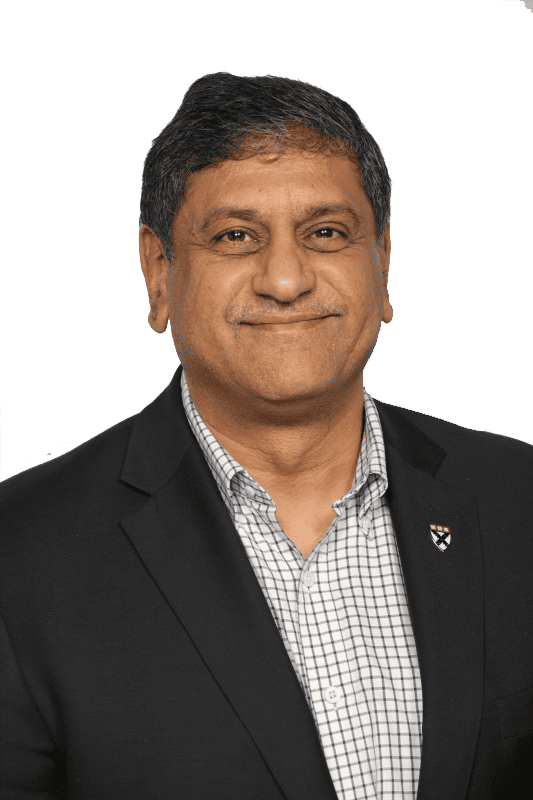
Rohit Mahajan is an entrepreneur and a leader in the information technology and software industry. His focus lies in the field of artificial intelligence and digital transformation. He has also written a book on Quantum Care, A Deep Dive into AI for Health Delivery and Research that has been published and has been trending #1 in several categories on Amazon.

Rohit is skilled in business and IT  strategy, M&A, Sales & Marketing and Global Delivery. He holds a bachelor’s degree in Electronics and Communications Engineering, is a  Wharton School Fellow and a graduate from the Harvard Business School. 

Rohit is the CEO of Damo, Managing Partner and CEO of BigRio, the President at Citadel Discovery, Advisor at CarTwin, Managing Partner at C2R Tech, and Founder at BetterLungs. He has previously also worked with IBM and Wipro. He completed his executive education programs in AI in Business and Healthcare from MIT Sloan, MIT CSAIL and Harvard School of Public Health. He has completed  the Global Healthcare Leaders Program from Harvard Medical School.
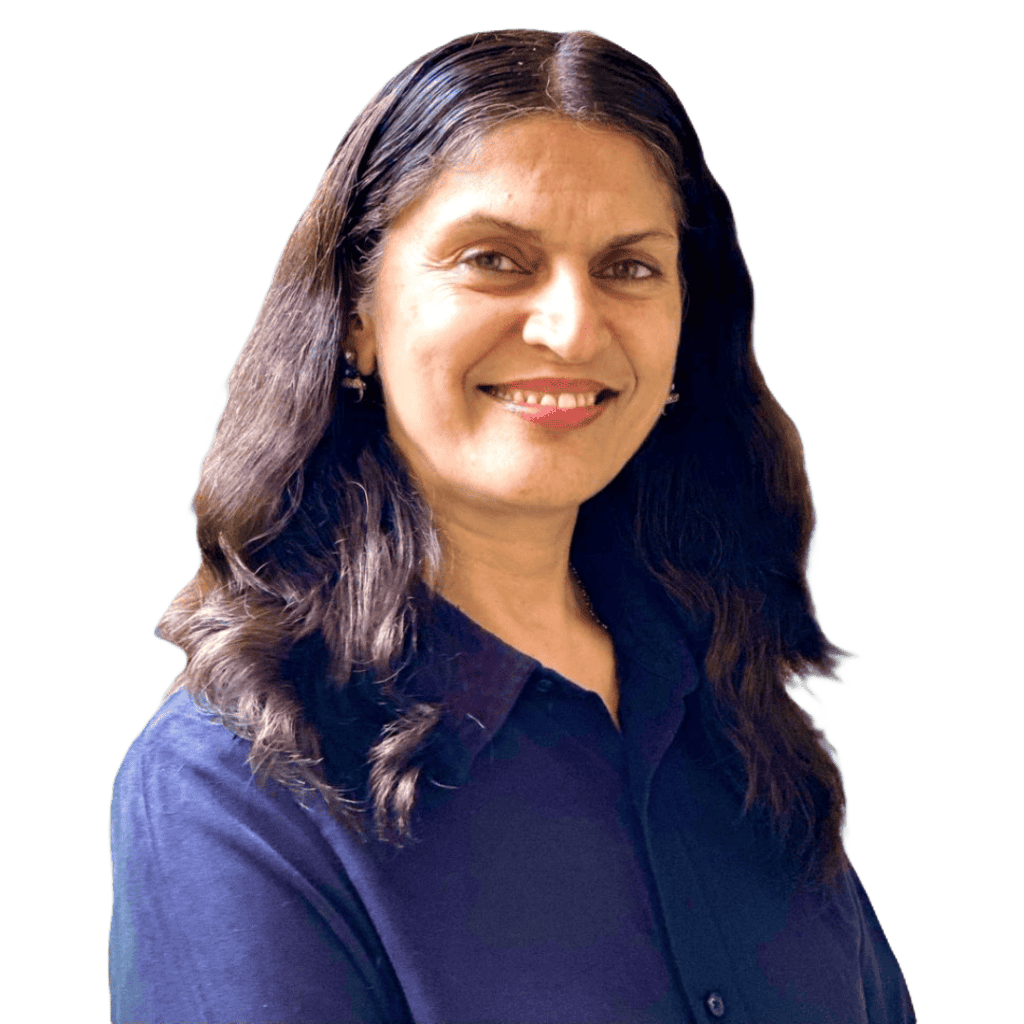
Ritu M. Uberoy has over twenty-five years of experience in the software and information technology industry in the United States and in India. She established Saviance Technologies in India and has been involved in the delivery of several successful software projects and products to clients in various industry segments.

Ritu completed AI for Health Care: Concepts and Applications from the Harvard T.H. Chan School of Public Health and Applied Generative AI for Digital Transformation from MIT Professional Education. She has successfully taught Gen AI concepts in a classroom setting in Houston and in workshop settings to C-Suite leaders in Boston and Cleveland. She attended HIMSS in March 2024 at Orlando and the Imagination in Action AI Summit at MIT in April 2024. She is also responsible for the GenAI Center of Excellence at BigRio and DigiMTM Digital Maturity Model and Assessment at Damo.

Ritu earned her Bachelor’s degree in Computer Science from Delhi Institute of Technology (now NSIT) and a Master’s degree in Computer Science from Santa Clara University in California. She has participated in the Fellow’s program at The Wharton School, University of Pennsylvania.

About the Legend
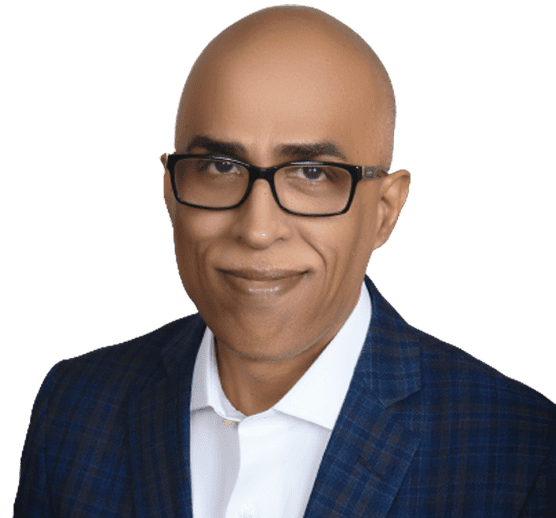
Paddy was the co-author of Healthcare Digital Transformation – How Consumerism, Technology and Pandemic are Accelerating the Future (Taylor &  Francis, Aug 2020), along with Edward W. Marx. Paddy was also the author of the best-selling book The Big Unlock – Harnessing Data and Growing Digital Health Businesses in a Value-based Care Era (Archway Publishing, 2017). He was the host of the highly subscribed The Big Unlock podcast on digital transformation in healthcare featuring C-level executives from the healthcare and technology sectors. He was widely published and had a by-lined column in CIO Magazine and other respected industry publications.

Fixing Healthcare’s “Blind Men and the Elephant” Data Problem

Season 7

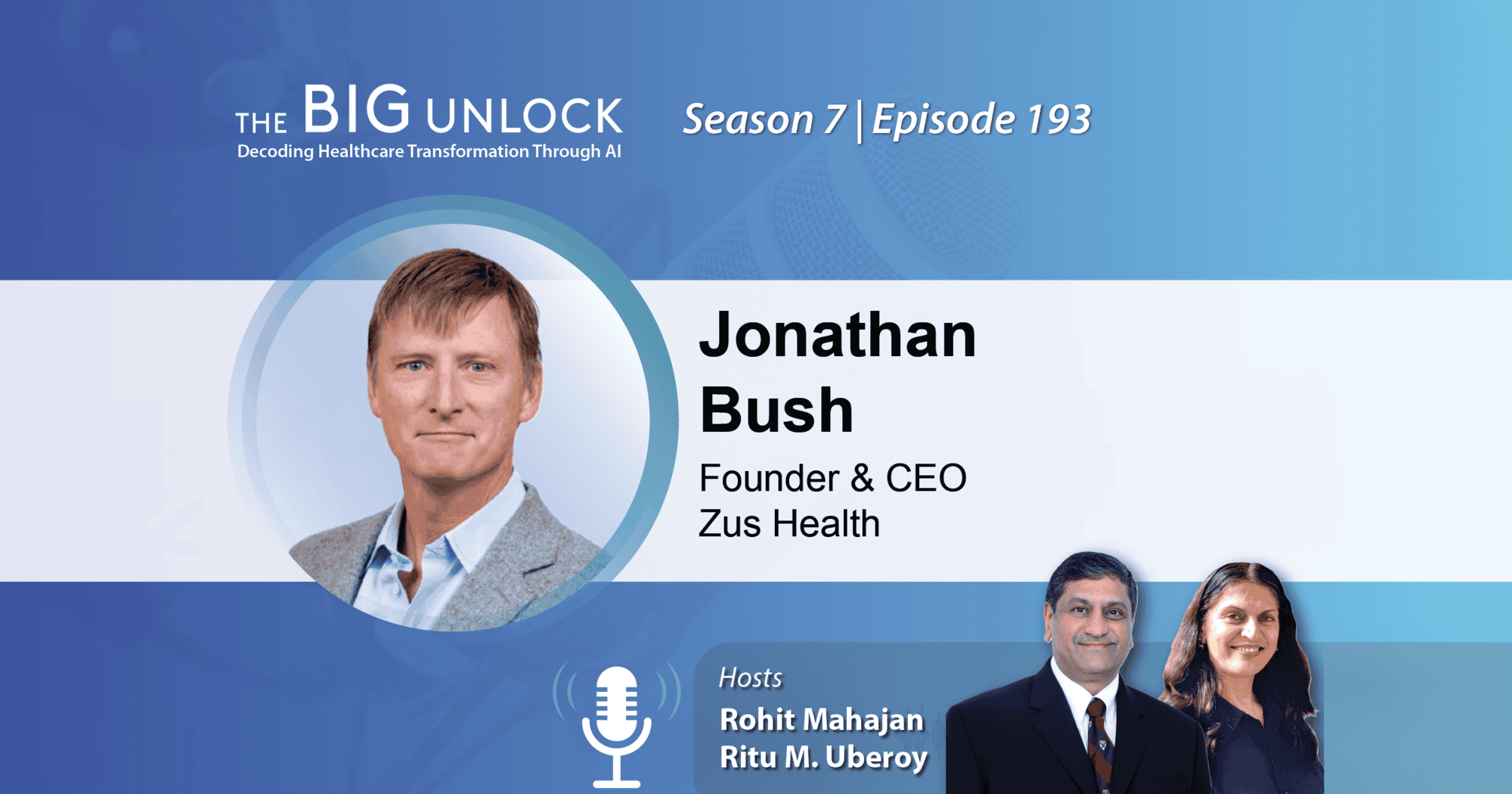
Episode 193 - Podcast with Jonathan Bush, Founder & CEO, Zus Health - Fixing Healthcare’s “Blind Men and the Elephant” Data Problem

The Big Unlock
The Big Unlock
Fixing Healthcare’s “Blind Men and the Elephant” Data Problem
Loading
/

In this episode, Jonathan Bush, Founder & CEO of Zus Health, shares a bold vision for the next phase of healthcare transformation. Drawing on decades of experience, Jonathan argues that while EHR adoption is largely complete, today’s systems remain fee-for-service–oriented, creating fragmented views of patients – what he describes as the “blind men and the elephant” problem. The result: clinicians still lack a complete, longitudinal picture of the patient and rely on repeated tests and “bags full of records.”

Jonathan explains how Zus Health is re-architecting healthcare data by creating a longitudinal, always-on common patient record. Zus is an API-first platform built on an AI-enabled backbone that aggregates, structures, and continuously updates data across multiple EMRs. He emphasizes the power of network effects, where shared intelligence can eliminate redundant tests and unnecessary care.

The conversation also explores why interoperability must move beyond regulatory compliance to become core infrastructure for value-based care, and how AI-driven summarization and agentic workflows can reduce clinician burden while enabling proactive, patient-centered care. Take a listen.

About Our Guest

Jonathan Bush is founder and CEO of Zus Health, a company building the first shared health data platform designed to accelerate healthcare data interoperability by providing easy-to-use patient data at the point of care. He sits on the board of Innovaccer, and is the co-founder and former CEO of athenahealth and former Executive Chairman of Firefly Health.


Charles: I am Chuck Christian. I’m the Vice President of Technology and CTO for Franciscan Health. Franciscan is a 12 or 13 hospital system, depending on how you count them. We cover a swath of the Midwest from just south of Indianapolis all the way to Chicago, basically following the I-65 corridor.

We have between 350 and 400 locations, including physician practices, imaging centers, lab draws, urgent cares, and oncology centers. It’s a pretty large organization. We have about 29,000 team members, both employees and contractors, at Franciscan Health.

We are truly mission focused. We are a Catholic healthcare system with a big C. We are owned by the Sisters of St. Francis of Perpetual Adoration. That means there are two sisters in the chapel praying for whatever they deem important and anything we ask them to pray for, 24 hours a day, seven days a week, 365 days a year. That’s where the “perpetual adoration” comes in.

We are a mission-driven organization. I believe in that. A lot of our hospitals are smaller and in underserved places, and we take care of that patient population. I think we’re really good at it.

I’ve known this organization almost 40 years. The CIO previous to Charles, who is our current COO, was a good friend of mine. I was CIO of a hospital in Southern Indiana for 24 years, and Bill and I ran a similar software stack. I watched Bill and learned a lot from him as far as how he ran this large organization.

I’ve been here for six years. I joined in April of 2019, so in dog years that’s like 35 years or more. We are very busy. I’m very blessed to have an outstanding team that manages all this, and I get to stand in awe and watch everything we accomplish every day.

Rohit: That’s fabulous. Thank you, Chuck for that intro.

Ritu: My name is Ritu Roy, and I’m the Managing Partner here at Damo and BigRio, and also the co-host of The Big Unlock podcast with Rohit. Thank you for being our guest today, Chuck. We are looking forward to an engaging and insightful conversation. With that, we can dive right in and get started.

Charles: Thank you.

Rohit: Hi Chuck. I’m Rohit Mahajan. I’m the Managing Partner and CEO at BigRio and Damo Consulting. It’s great to have you on the podcast. Like Ritu said, we’re looking forward to an engaging discussion. I’d like to start with the first thought on my mind. You’re in a mission-driven organization, and you’ve been a healthcare leader for many years. What started you on this journey? Tell us how you got started in healthcare, what attracted you, and what you’re passionate about.

Charles: Well, it depends on how far back you want to go. I’m an X-ray tech, radiologic technologist if you want to use the term. The first 14 years of my career were in radiology.

I stepped out of high school on June sixth in 1971, and on June seventh I stepped into the hospital, and I haven’t left since. Interesting enough, I did a lot of things in the radiology department and became part of the management team of that department. I guess if the chief tech had not been just a few years older than me, I’d still be there, because that was the role I wanted. But Roy just retired a few years ago, and I wasn’t going to wait that long.

I’m a geek, I’m a nerd. I was a nerd in high school. It wasn’t cool to be a nerd in high school back then, but it’s cool to be a nerd now. I did a lot of programming classes on the old System Threes with punch cards. Then I learned how to code for Z80 processors.

When we started automating hospitals back in the mid-eighties, I got chosen to run the ambulatory implementation of order management after we had put in patient management. I realized I liked it, and I knew that was where healthcare was going. Radiology has been a high-tech department in hospitals for a long time. I was trying to automate the patient record in radiology, but it was so expensive I couldn’t get any funding for it.

So I jumped ship and moved over to the vendors for about five years. Eventually I was asked to move to either an implementation manager role or the director of an outsourced IT department in southern Indiana. I did that. I had four daughters at the time, and it was the right thing to do because it was a great place to raise my girls.

I spent 24 years there. It was during the time the role of a healthcare CIO was defined. When I left that job, I was Vice President and CIO. I moved to Georgia to a health system there as Vice President and Chief Information Officer. Then I came back to Indiana and worked at the Indiana Health Information Exchange, which is now the only exchange in Indiana. I had been involved with it since 2005. I worked there for a little over four years, and then I took this role here. That’s my stint in healthcare, which has spanned over 50 years.

Rohit: That’s awesome, Chuck. You’ve been there, done it, and seen it as well. I was curious because a few days ago, when we were chatting, you were talking about being either back from UGM or about to go there.

We all know it’s a week-long affair, people go deep, and there are so many things to cover. We were wondering if you could share some of your experiences or a heads-up on topics you see coming our way.

Charles: Sure. I came home with a great deal of anxiety because of trying to figure out how we’re going to do everything and where healthcare is going. The nice thing about Epic is they now cover the entire gambit. I remember when Epic started; they were only in the ambulatory space and then only in large academic medical centers. They cover quite a scope of product these days.

Now that they have grown the applications, they have de-identified shared data, which I think is going to be a plus. The two-letter acronym was everywhere, AI, and how it’s going to be leveraged and used. They did a nice job showing scenarios of how it could be used and how organizations are using it.

We’re a risk-averse organization. We’re taking a more moderated approach. We’re getting our governance in place first. We already have a few things going through the AI mill, and we will have more. We split it into two pieces, one on the clinical side and one on the operational side. Epic has both, and I think they’re well positioned to do that work. They partner with Microsoft, and they continue to do so.

They announced they are working on their own ambient listening. They have business partners already, but they are creating their own product. I assume it will be predicated on the Microsoft stack, but they didn’t say, so I don’t know.

They also mentioned they are working on their own ERP and starting with workforce management. That makes sense because the workforce is in Epic all the time. Nursing staffing, scheduling, shifts, and how all that ties together. It’s an interesting leap.

Years ago, when Lawson, before being purchased by Infor, said they would create a patient accounting platform, I was in a CHIME focus group. When they mentioned that, a bunch of CIOs in the room asked why they would do that. You need to get your ERP right first. But I think the way Epic is approaching it makes sense.

It was great. I was there for about four days and spent most of the time listening to presentations. Judy did a great job with a big screen about what’s next and what’s coming. The rest of her team did a great job showing what you can do now and what’s coming. They do a good job setting expectations around timelines. They release quarterly. We do two a year, so we’re current from their perspective but behind. We don’t have the wherewithal to immediately adopt everything when they release it, so we have to plan accordingly.

Ritu: Yeah. So Chuck, when I was reading about the UGM, it was interesting because they said their unique proposition with AI is the de-identified patient records they have in Epic Cosmos, which is more than 15 billion patient records. They said that for the first time, it can actually move toward healthcare rather than sick care because doctors can predict trends. And I think they released two new things called Emmy and Penny, which will help doctors see the trajectory of what is going to happen with patients.

So I was curious about your thoughts because you’ve been in this industry for such a long time. Do you think that this USP—this huge bank of patient records—is really going to set them on a differentiating path compared to all the other AI startups trying to do the same thing?

Charles: I think that having the data is huge, honestly. It reminded me a lot of—if you remember years ago—they had a thing called PatientsLikeMe, where people with unique and rare diseases could find others and compare notes and treatment approaches. Working at the Indiana Health Information Exchange, I know they have about 30 years of data. Not all of it is discrete, but the majority is.

One question I asked the CEO, who is a friend of mine—and a lot of researchers use that de-identified data—is that when you create an AI model and just let it learn, there are all kinds of interesting determinations you can make once you have the data. So I think it’s going to be a game changer. Epic is also trying to outdo themselves. Given the market of EHR vendors, there aren’t many left standing. There are three or four. Others are creating similar repositories, but I’m not sure they have the long-term vision or the wherewithal to get it done. Knowing the talent Judy has pulled together, I think it will be very interesting to see what comes down the pike.

Ritu: Thank you.

Rohit: Chuck, you mentioned you’re taking a conservative approach to AI adoption and setting governance before taking major steps. How do you think about innovation or typical problem-solving—for example, reducing cognitive load across the organization? How do you balance this conservative approach with the fast-paced changes happening in the marketplace?

Charles: I think we have to be very clear about what problem we’re trying to solve. There are so many solutions being thrown at us—“Hey, we can do this, we can do that”—but often it’s not a problem we actually have. So we’re trying to pick and choose which targets to shoot at.

I’m married to a critical care nurse, so I’m very careful about getting in the way of the nursing staff. She’s retired, but for me, technology needs to be invisible. If it gets in the way of people being able to do their job, then it’s a problem.

If you think about it for a minute—and I’ll give you Chuck’s opinion—we don’t really have electronic medical record systems for documenting the care of the patient. What we have are electronic systems that capture information required for billing. That’s part of the problem. We have all these required elements clinicians have to document—physicians have to dot all the i’s and cross all the t’s—to get the appropriate words in so it can be translated into billing codes, ICD-10 codes, HPS codes, and so on. It truly gets in the way of taking care of patients.

But once we get that discrete data, we can use AI and other tools to help determine a better course of treatment. You’re never going to hear me say that we should depend solely upon AI. It has to be moderated and reviewed by someone with clinical training. Physicians have shown me I’ve been wrong more times than you can imagine. Working together and having good data aggregation is important.

One thing I learned early on when implementing the first physician order entry and clinical documentation systems was that physicians said: “Don’t tell me what I already know. Tell me what I don’t know. Better yet, tell me what I need to know about the patient in front of me right now.” There are things they don’t know. That’s where data aggregation from health information exchanges helps, because patients don’t get care in one location or from one physician.

I’m living proof of that. I get care in two—actually three—health systems because that’s where my specialists are. My primary care doctor wants to know what my orthopedist did or what my cardiologist’s course of treatment is, because he’s managing my diabetes and a few other things. Having access to information—recent labs, imaging studies—is extremely important.

We talked about interoperability, and that’s where it comes into play. Most hospitals in Indianapolis are on Epic, so you can get data easily. From non-Epic systems, there are mechanisms too. When I see my cardiologist—who uses a different system—and he already knows what my medications are because they were recently changed by another physician, that’s positive. I don’t have to list everything. When they know my latest labs, that’s positive too, because we’re not hunting for information.

It’s about providing information that is important to the treatment at that moment.

I had the privilege of sitting in a presentation—maybe eight or nine years ago—at Scripps Institute. They showed a demo of what a patient encounter could be. It was very Star Trek–like. The computer or AI interacted with the physician and patient appropriately. It listened in the background and captured information about the encounter. When the physician said, “We need to order a CT scan of your lower abdomen,” it was already getting that scheduled. When the patient was ready to leave, everything was set. It was also checking for recent labs and reminding the physician if the patient—say a diabetic—was due for an eye exam or foot check.

I think it’s about having access to the information so we can inform—not determine but inform—the physicians. Because at the end of the day, physicians are accountable for the outcomes. They have to be in control, not the AI.

Ritu: Yeah,

Charles: we’re not ready for Skynet yet.

Ritu: I think you described a multi-agent system where the agents are off doing things and then bringing it all back for the physician to review. With that being said, we all know that AgTech is one of the top trends everyone’s talking about these days. What are your thoughts on voice agents? Where is Franciscan with that? Have you had exposure to or tried voice agents in the hospital?

Charles: Yeah, we’ve got a trial. We’ve got over 200 physicians working on those. Is it going to be the end-all, be-all? I don’t know. The physicians seem to like it. It assists them; it helps with their pajama time.

I’ve listened to conversations from other health systems that were early adopters, and I have to go back in time to when we were looking at automating physician practices in Southern Indiana. We visited a group of 14 family practice doctors. The husband and wife who started the practice mostly did OB and family medicine. Their use of computers was minimal—they were still mostly on paper. But they had other physicians who, I think, slept with their laptops.

The interesting thing was that depending on how well a physician adopted the computer system and molded it to how they practiced, they got to take advantage of it. I think it’s going to be the same with AI and voice agents. If they allow it to help and figure out how to incorporate it into how they think and practice, they’ll see the benefit. The systems are pliable enough now that it’s easier to do.

When I was in Georgia, we needed to automate a lot of OB practices on the same platform. One OB had been practicing almost 30 years and already had a solution he had customized. He told me I would tear it out of his cold, dead fingers. So we worked with him. The new system was more flexible and pliable than his old one, and he became a champion because he was willing to take the time to understand how he could use the technology to help him practice.

I think that’s the key. If you’re resistant to it, that’s fine—that’s perfectly okay. But people who write software often think all physicians think the same way. They’re absolutely wrong. It depends on where they trained. I learned that when implementing emergency room electronic medical records. The physicians who helped design the software were trained with a very different approach to critical thinking than our physicians. We had to relearn and figure out ways to adjust, because once clinicians are trained a certain way, it’s hard to change those habits and the way they gather and maintain information.

Ritu: Thank you. Great answer.

Rohit: Chuck, I’d like to ask your thoughts about the innovation process. How do you approach it, and what are some of the things you do to foster innovation?

Charles: One of the things we did was stand up a Tech Innovation Lab. Honestly, it was a selfish move because people were just bringing technology into the organization. All the enterprise architects report to me, and we work together to understand what will work in our environment and what won’t. We try to standardize as much as we can.

So I created the Innovation Lab to bring these innovations into a controlled environment and try them there. It’s a walled garden. It’s not connected to the rest of the network. It has its own connections to the internet. So if we blow something up, it only blows up in the lab. That’s why we did it.

What we’re able to do is bring ideas in and fail fast—figure out what works and what doesn’t. We’ve done that several times. Virtual nursing is something we’ve worked on a lot. There were all kinds of interesting opportunities brought to us. One facility went ahead and put a solution into a live patient population, and we found out quickly that’s not how you do it. You don’t test that kind of thing in a live environment. It frustrates the staff and patients, and it leaves leadership thinking, “We already tried that—it doesn’t work.”

Well, you tried what doesn’t work. Let me show you what will work.

We needed the opportunity to rapidly figure out what would work. One issue with that failed experiment was that the people who built the carts didn’t understand our environment. They put a wireless access point in the cart that was incompatible with our network. Once we got the cart, we figured it out quickly. We re-engineered it, and it works fine now—but we’re not using that cart because it was over-engineered and very expensive.

We’re trying to use standard components that can be supported and replaced quickly. The idea is to generate a lot of ideas and figure out how to use them appropriately without getting in the way.

You also have to think about the aesthetics of the equipment you’re bringing in. The first cart had a big five-wheel base—kind of a star shape. In some patient rooms, it was in the way. Nursing quickly said, “That’s not going to work.”

So we found an iPad holder that hangs on the patient’s bedroom wall when not in use. It’s out of the way, easy to access, and uses magnetic connectors so if someone snags it, it just comes apart. No trip hazard.

You must consider not only the technology but how it fits in patient rooms.

Originally, the idea was that the Innovation Lab would review the technology, understand how it fits together, and then install it in our SIM labs. We have two—one north, one south. Then the simulation teams would put it in a physician office or patient room and see how it fits before we use it in live care. That’s our next step with virtual nursing.

We also have a lot of conversations with organizations that have fully rolled out these solutions. We learn from their experiences. A mistake is only a mistake if you don’t learn from it. If you do, then it’s experience. We leverage their experience so we don’t repeat the same things, and so we can move quicker.

Rohit: That’s awesome. As we are approaching the end of the podcast, I would like to ask if you would touch on the mentorship program.

Ritu: Yes, I would really like to hear more about that, Chuck, because it’s something unique and I think it would be interesting for our listeners as well.

Charles: Just making sure we’re talking about the virtual mentoring program. After COVID, we were bringing on a lot of new nurse graduates. When you bring someone into that role, they need a more experienced nurse for a procedure they may have never done before. That usually means waiting for that nurse to come to them.

We had a couple of nursing staff in the mentorship program who came up with a way to use technology for an on-screen virtual visit with the new nurse. The experienced nurse could walk them through the procedure and be there with them, or if the new nurse had a question, they could step out into the hall, ask it, and go back in. It improved speed to delivery of care more than anything else.

It also gave seasoned nurses a chance to step away from what they were doing instead of traveling to another location. If they need to go in person, they still do, but this gave us another option. We got great feedback from both the new nurses and our more mature nursing staff, and we rolled it out through the enterprise. I haven’t checked in on it recently, but I assume it’s still running. I only hear when things break, and if it’s not broken, I’m not going to fix it. I assume the technology is still working and paying dividends.

Ritu: Thank you so much.

Rohit: So, Chuck, as we come to the end of the podcast, any closing remarks or thoughts you’d like to share before we finish?

Charles: I’ve been in healthcare a long time. Healthcare is a target rich environment for creativity and innovation. But we’re still taking care of patients the same way we did, and it’s about the human touch and caring for people.

When I first started in radiology years ago, I was taken aback that people weren’t always treated as people. They were exams. Do this gallbladder in this room, do this hip nailing in that room. I was reminded they’re people. They could be my family. They could be my children. That’s why I’m passionate about making sure the technology works and doesn’t get in the way.

Have we reached the pinnacle? No. Is it better? I think it is. But we’re still trying to figure it out every day. As long as we have great people passionate about providing outstanding care and we understand where that ability comes from, we’ll keep moving forward.

We’re a Catholic healthcare system, and our rule is we start most meetings with prayer. We are called to love one another as God loves us, and we need to remember that every day. That’s why I keep doing what I’m doing.

Rohit: Awesome.

Ritu: Thank you so much, Chuck.

Rohit: Really appreciate it.

Charles: Okay. Thanks for the opportunity to share.

————

Subscribe to our podcast series at www.thebigunlock.com and write us at [email protected]   

Disclaimer: This Q&A has been derived from the podcast transcript and has been edited for readability and clarity.

About the Hosts

Rohit Mahajan is an entrepreneur and a leader in the information technology and software industry. His focus lies in the field of artificial intelligence and digital transformation. He has also written a book on Quantum Care, A Deep Dive into AI for Health Delivery and Research that has been published and has been trending #1 in several categories on Amazon.

Rohit is skilled in business and IT  strategy, M&A, Sales & Marketing and Global Delivery. He holds a bachelor’s degree in Electronics and Communications Engineering, is a  Wharton School Fellow and a graduate from the Harvard Business School. 

Rohit is the CEO of Damo, Managing Partner and CEO of BigRio, the President at Citadel Discovery, Advisor at CarTwin, Managing Partner at C2R Tech, and Founder at BetterLungs. He has previously also worked with IBM and Wipro. He completed his executive education programs in AI in Business and Healthcare from MIT Sloan, MIT CSAIL and Harvard School of Public Health. He has completed  the Global Healthcare Leaders Program from Harvard Medical School.

Ritu M. Uberoy has over twenty-five years of experience in the software and information technology industry in the United States and in India. She established Saviance Technologies in India and has been involved in the delivery of several successful software projects and products to clients in various industry segments.

Ritu completed AI for Health Care: Concepts and Applications from the Harvard T.H. Chan School of Public Health and Applied Generative AI for Digital Transformation from MIT Professional Education. She has successfully taught Gen AI concepts in a classroom setting in Houston and in workshop settings to C-Suite leaders in Boston and Cleveland. She attended HIMSS in March 2024 at Orlando and the Imagination in Action AI Summit at MIT in April 2024. She is also responsible for the GenAI Center of Excellence at BigRio and DigiMTM Digital Maturity Model and Assessment at Damo.

Ritu earned her Bachelor’s degree in Computer Science from Delhi Institute of Technology (now NSIT) and a Master’s degree in Computer Science from Santa Clara University in California. She has participated in the Fellow’s program at The Wharton School, University of Pennsylvania.

About the Legend

Paddy was the co-author of Healthcare Digital Transformation – How Consumerism, Technology and Pandemic are Accelerating the Future (Taylor &  Francis, Aug 2020), along with Edward W. Marx. Paddy was also the author of the best-selling book The Big Unlock – Harnessing Data and Growing Digital Health Businesses in a Value-based Care Era (Archway Publishing, 2017). He was the host of the highly subscribed The Big Unlock podcast on digital transformation in healthcare featuring C-level executives from the healthcare and technology sectors. He was widely published and had a by-lined column in CIO Magazine and other respected industry publications.

AI May Improve Healthcare Access, But Will Rural and Underserved Communities Trust It?

AI May Improve Healthcare Access, But Will Rural and Underserved Communities Trust It

AI is having a transformative impact on healthcare. The innovation AI has brought to diagnostics and advanced therapeutics cannot be understated. Another area that bears mentioning is the many ways that AI could improve access to quality healthcare, particularly in rural and underserved communities; however, many challenges remain.

Certainly, AI holds immense potential to bridge rural healthcare gaps via telehealth, faster diagnostics, and better resource management, tackling shortages and isolation. Nevertheless, significant hurdles remain, including poor broadband, low digital literacy, data privacy concerns, biased algorithms, and the high cost of implementation, demanding careful, inclusive strategies to avoid worsening disparities.

On a recent episode of The Big Unlock podcast Lisa Hunter, Senior Director of Federal Policy and Advocacy at United States of Care, sat down with host Ritu M. Uberoy, Managing Partner at BigRio and Damo to share her insights on how her organization, and the federal government is addressing these issues.

For Underserved Communities it’s a Matter of Trust

Lisa noted that patients, particularly in rural areas are very used to “hands on” interaction with healthcare providers — when they can get to see one! Therefore, they are more comfortable with AI in back-office and diagnostic use cases compared to roles that feel like they are “replacing” clinicians.

As she told Ritu, “Our organization is really looking at improving the healthcare system and transforming it so that at the end of the day it works for everyday people in the United States.”

She went on to stress the need for rigorous listening, research, and language that resonates with people, so that the “patient’s voice” remains a big part of any program to bring healthcare AI into underserved communities.

“We’re following AI as sort of an issue from the patient and the everyday person’s perspective, and I think one of the things that’s occurred to us in the advocacy community is that the voice of patients and the voice of people is somewhat missing from the table right now.”

She went on to explain that when it comes to AI, her organization’s focus is not so much on technological innovation, but more on advocating for the patient in overcoming those trust issues, particularly in rural and underserved communities.


AI and Rural Health Transformation

Health inequities have long been a problem in America. Lisa discussed how the federal government’s Rural Health Transformation Program, introduced in July, 2025 is trying to change that.

The Rural Health Transformation Fund is something that I think many people are looking at as a real opportunity for doing something big to really bring solutions to the rural health infrastructure and make improvements so that rural health across the America can certainly live out its potential to address the needs of rural America.”

She went on to explain that the program represents a “real opportunity to inject new life in rural America when it comes to healthcare.” Continuing that the initiative is huge investment – $50 billion over the span of five years – and a good portion of that budget is allocated for infrastructure and AI.


Bridging the AI Trust Gap

Despite the investment and support of the current administration for rural health transformation, Lisa still sees bridging the trust gap as the greatest challenge rural communities face in leveraging the benefits AI can bring. She told Ritu that when it comes to AI, her organization’s research has found patients in rural communities are comfortable with back-office areas, or diagnostics, but have a fear of it replacing doctors.

Our initial research found that the closer that you get to introducing AI into situations where it seems it may be subverting or supplanting the actual physician in the room, that is when people [in these communities] become very uncomfortable.”

When asked by Ritu “what is the best way to address that gap?” Lisa said that she thinks it is going to require a lot more research. Stating that the goal is to look at specific positive use cases, ones that not only demonstrate the technological advances that AI brings to healthcare, but the cases that successfully integrate AI on behalf of patients, consumers and people.

What Does 2026 Hold for AI and Healthcare? A Look at the Year Ahead

What Does 2026 Hold for AI and Healthcare? A Look at the Year Ahead

Rohit Mahajan

“In the rapidly evolving landscape of healthcare, the integration of artificial intelligence (AI) is not just a possibility; it is an inevitability. As we stand on the brink of a new era, the potential of AI to revolutionize medicine is both exhilarating and daunting — and necessary!” says Edward Marx, CEO, Marx Advisory, in the Forward of my recently released new book, Generative AI Unlocking the Next Chapter in Healthcare.

Ed went on to say, “… the advent of AI represents a paradigm shift unlike any other. It promises not only to enhance existing practices but to redefine the very fabric of healthcare delivery and research. While some technologies of the past never lived up to their hype, AI is likely to exceed the hype as we continue to execute on its promises.”

As we close the calendar on 2025, let’s peer into that future and take a look at the trends we will be watching in AI in healthcare for 2026, all of which I myself and my co-author Ritu M Uberoy discuss extensively in the book.


Increased Adoption of GenAI

The transformative potential of Generative AI (GenAI) is becoming increasingly apparent across many sectors, but its impact on healthcare stands out as particularly revolutionary. GenAI refers to the use of machine learning models, such as Large Language Models (LLMs), which are designed to generate new data, including text, images, and even molecular structures, that can mimic or build upon existing information. These technologies are not only redefining how we think about artificial intelligence but are also paving the way for unprecedented advancements in medical care.

In healthcare, GenAI holds the promise of transforming everything from diagnostics and personalized treatment plans to drug discovery and patient care management. LLMs excel in natural language understanding and generation, allowing them to process vast amounts of unstructured data, such as medical records, research papers, and clinical trial results. This capability has already begun to change how healthcare professionals access and interpret complex medical information, leading to faster, more accurate decision-making.

The importance of GenAI in healthcare cannot be overstated. As the demands on healthcare systems continue to grow, driven by aging populations, rising healthcare costs, and the increasing complexity of diseases, GenAI offers scalable solutions that enhance both the efficiency and quality of care. GenAI models, for example, can analyse medical images, pathology slides, and genomic data with unmatched accuracy, enabling earlier detection of conditions such as cancer. Furthermore, they can simulate chemical interactions and design novel molecules, dramatically reducing the time and cost associated with drug development.

From interpreting medical images to discovering new drug compounds, GenAI is at the forefront of innovation, offering powerful tools that can significantly improve patient outcomes.


The Rise of Agentic AI

The next big trend to watch for in 2026 will be the increased deployment and implementation of “Agentic AI” solutions. The next “big thing” that is liable to go the same route as ambient listening is “Agentic-AI.” An AI Agent is a software system powered by artificial intelligence that can perform specific tasks autonomously, making decisions based on data and learning over time; in healthcare, AI agents are utilized to analyze patient data, automate administrative tasks, assist with diagnosis, recommend treatment plans, and generally streamline clinical workflows, allowing healthcare providers to focus on patient care by handling repetitive tasks.

The extraordinary aspect of AI Agents is autonomy. Rather than merely responding to inputs with canned answers, these agents can make incremental decisions, refine their reasoning as more data comes in, and even proactively identify potential issues that require human intervention. They also demonstrate deeper contextual awareness. An AI Agent assisting in a clinical decision-support scenario can pull a patient’s history, current vital signs, and relevant medical literature, then synthesize all of this information to propose diagnostic steps or treatment adjustments.


AI Voice Agents in Healthcare

A subset of Agentic AI is AI Voice Agents. Conversational voice agents are intelligent software systems that use GenAI to have natural, human-like conversations over the phone or via chat. However, do not confuse voice agents with “chatbots.” They are far more sophisticated, capable of handling complex dialogue, maintaining context, and providing personalized support 24/7.

Healthcare is not solely about clinical diagnostics and treatments; it is equally about effective communication, education, and patient adherence. This is where conversational voice agents are already making a substantial impact. They can bridge the gap between clinical encounters by responding to patient inquiries at any time, sending personalized medication reminders, or providing explanations of lab results in accessible language. When integrated with wearable devices, agents can track daily vital signs or activity levels, recognizing worrisome trends and alerting both the patient and healthcare professionals accordingly. Patients appreciate having round-the-clock access to a reliable, knowledgeable interface that offers consistent support and reassurance. By “speaking” multiple languages or adapting content to diverse cultural contexts, AI agents can also cater to patients who might otherwise struggle with traditional, English-only healthcare resources. In doing so, these systems bolster patient engagement and can lead to better adherence to treatment plans, which is increasingly important in value-based healthcare models.

What should we expect to see trending in Agentic AI and healthcare in the year ahead? Although many current AI agents remain primarily reactive, the shift toward proactive interventions seems inevitable. Instead of waiting for a patient’s call to flag worrisome symptoms or for a clinician to initiate a data query, next-generation agents will detect patterns in real time and alert stakeholders before a crisis unfolds. An agent might discern an emerging infection trend within a hospital unit by analyzing lab orders and patient vitals, then recommend proactive precautions or resource allocation. By predicting potential bottlenecks or imminent disease outbreaks, these systems could help healthcare organizations save valuable time and potentially even lives.


Where Will This All Take Us in 2026 and Beyond?

Generative Artificial Intelligence has emerged as a revolutionary force across healthcare, reshaping diagnostic tools, therapeutic pathways, administrative workflows, and drug discovery. As we peer into the horizon, the trajectory of GenAI in healthcare appears both exhilarating and complex.

The longevity of GenAI’s impact on medicine ultimately hinges on the sustained commitment of multiple stakeholders. Clinicians who interact with AI-driven systems must maintain a critical mindset, asking hard questions about algorithmic limitations. Healthcare administrators and policy leaders should continue refining frameworks that balance innovation with patient well-being. Researchers, whether in academia or industry, will push the boundaries of what is possible with generative models, from advanced protein folding to personalized vaccine development. Each of these efforts requires long-term funding, robust data infrastructures, and progressive educational initiatives that cultivate AI literacy among medical professionals.

Given the global scope of healthcare, international collaborations and data-sharing initiatives may prove decisive in accelerating advancements. By pooling resources, expertise, and diverse patient data sets, multinational coalitions could turbocharge the learning cycles of GenAI systems. Cross-border consortia have already begun forming around topics like cancer genomics and rare disease research. Incorporating GenAI into these collaborations will likely amplify the pace and scale of discoveries, especially if ethical considerations and equitable benefits remain part of the guiding principles.

One look at today’s headlines and it is easy to see that many Americans feel frustrated with a healthcare system that seems broken and plagued by systemic inefficiencies. The government, the private sector, and medical consumers themselves are spending so much on healthcare, and yet, average people are not reaping the benefits in better outcomes. Is generative AI a cure-all for all that is broken? No. But it can provide a lot of fixes in both the near and long term.


Want to Learn More?

You can also learn a lot more about GenAI and its impact on health care by reading the book in its entirety.

Co-authored with my colleague, Ritu M Uberoy, it explores the GenAI revolution in medicine and what it means for clinicians, researchers, innovators, and policymakers worldwide. Published by Taylor & Francis Group, the book is available NOW, in print and eBook formats through Amazon, Barnes & Noble, Taylor & Francis (ebook only) and other online retailers. For more information or to order your copy directly, visit the official authors’ webpage.

The Healthcare Digital Transformation Leader

Stay informed on the latest in digital health innovation and digital transformation.

The Healthcare Digital Transformation Leader

Stay informed on the latest in digital health innovation and digital transformation

The Healthcare Digital Transformation Leader

Stay informed on the latest in digital health innovation and digital transformation.