Author: Gaurav Mhetre

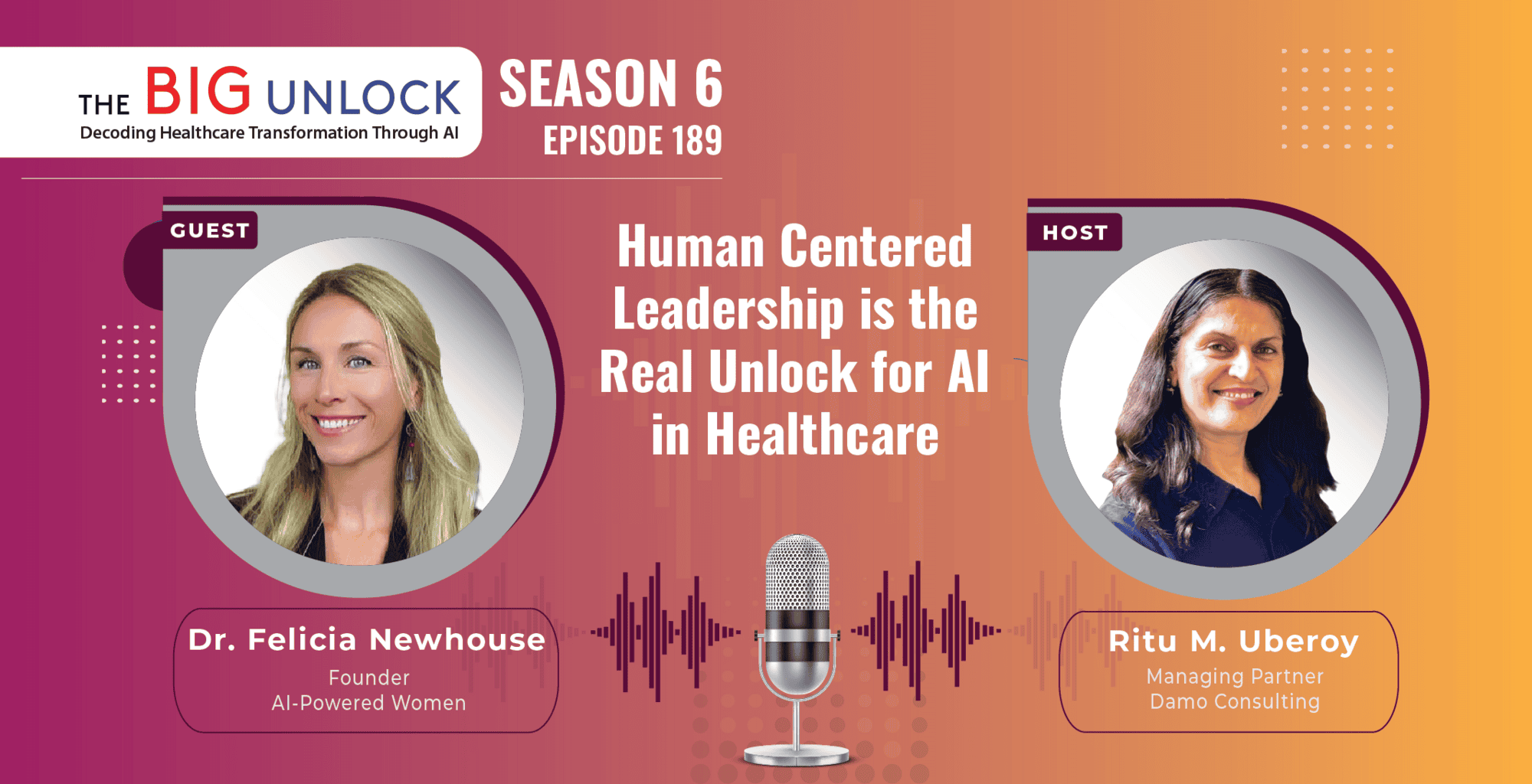
Human Centered Leadership is the Real Unlock for AI in Healthcare

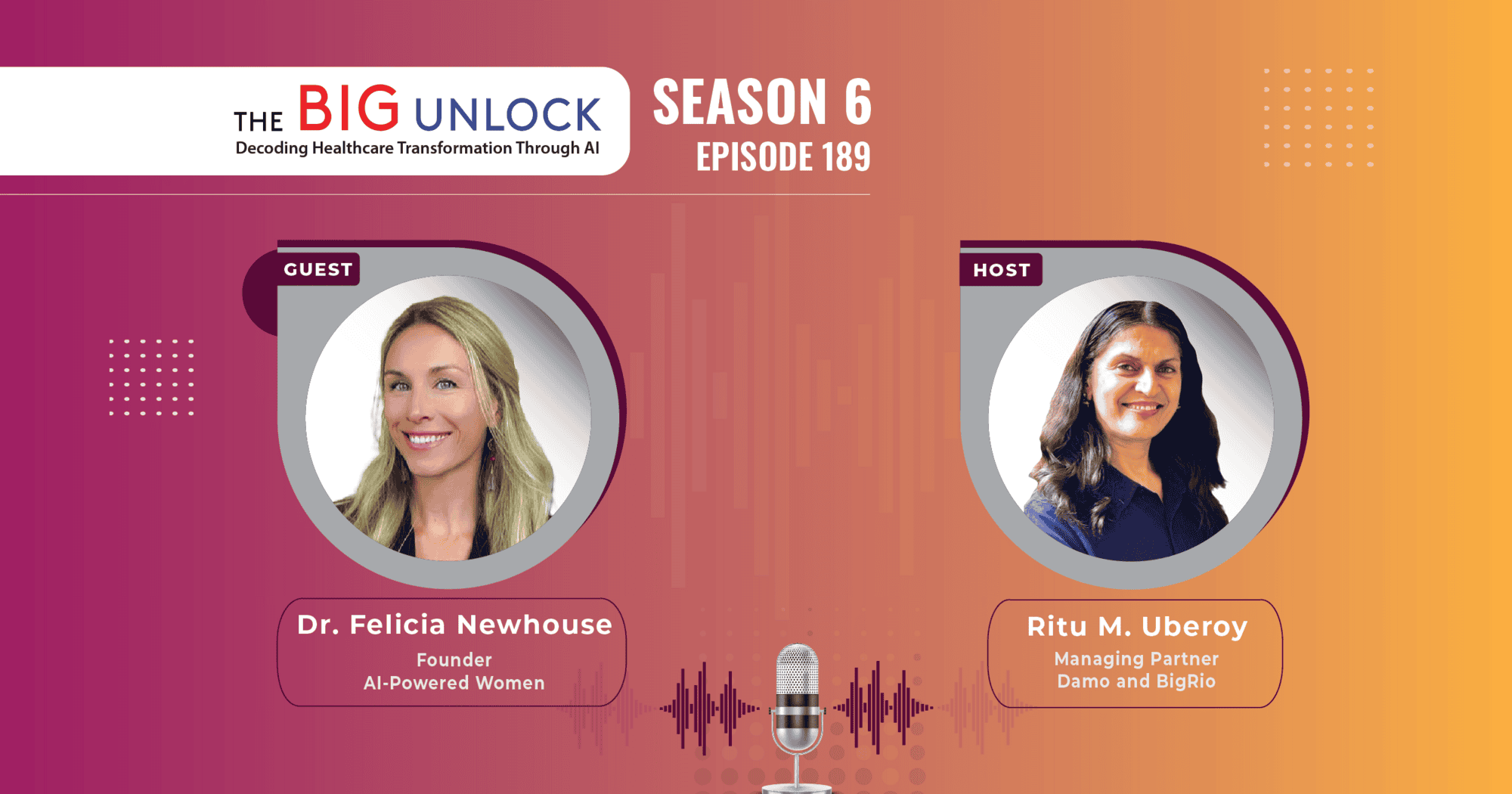
Season 6: Episode #189

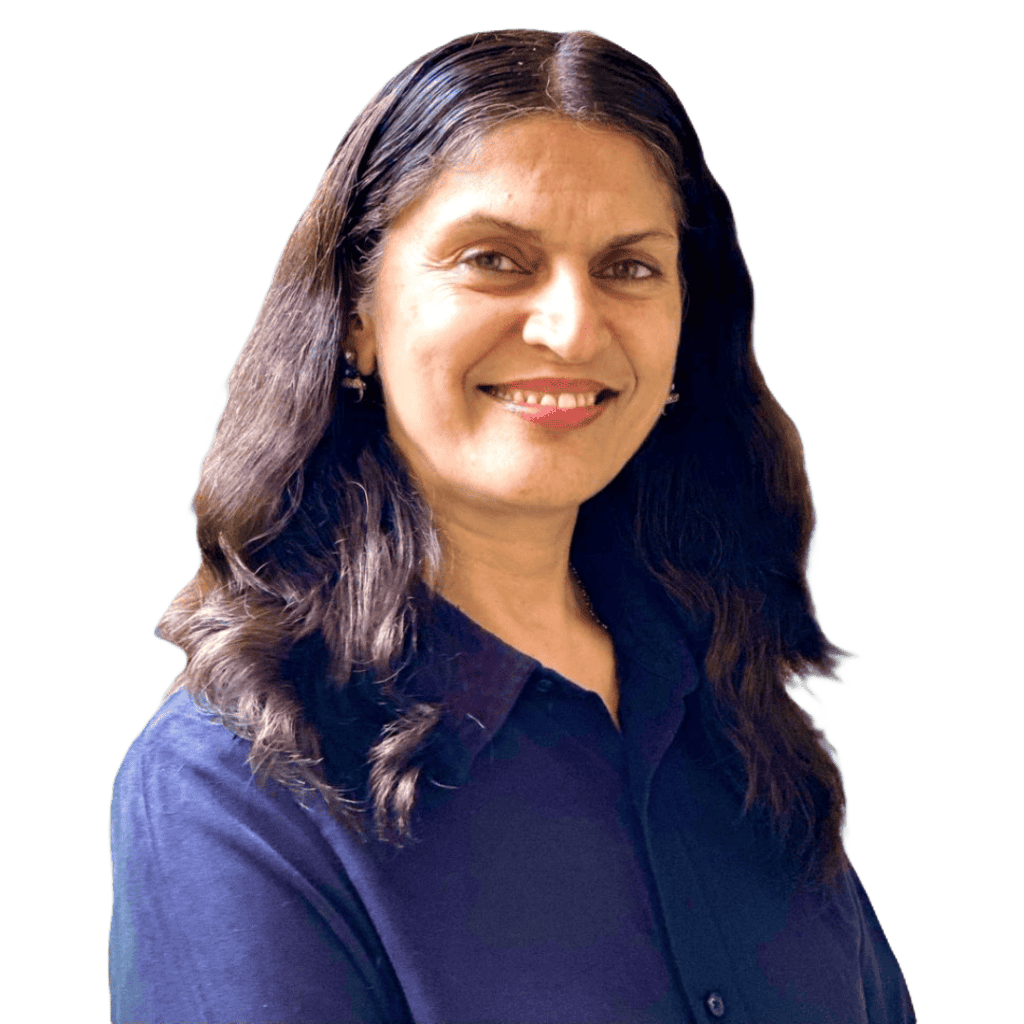
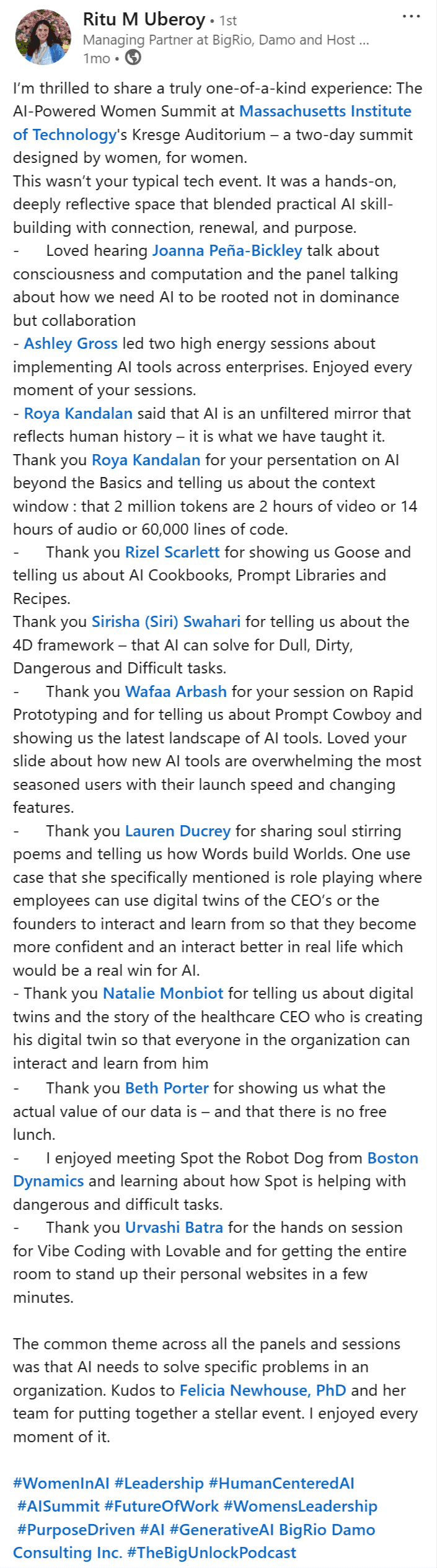
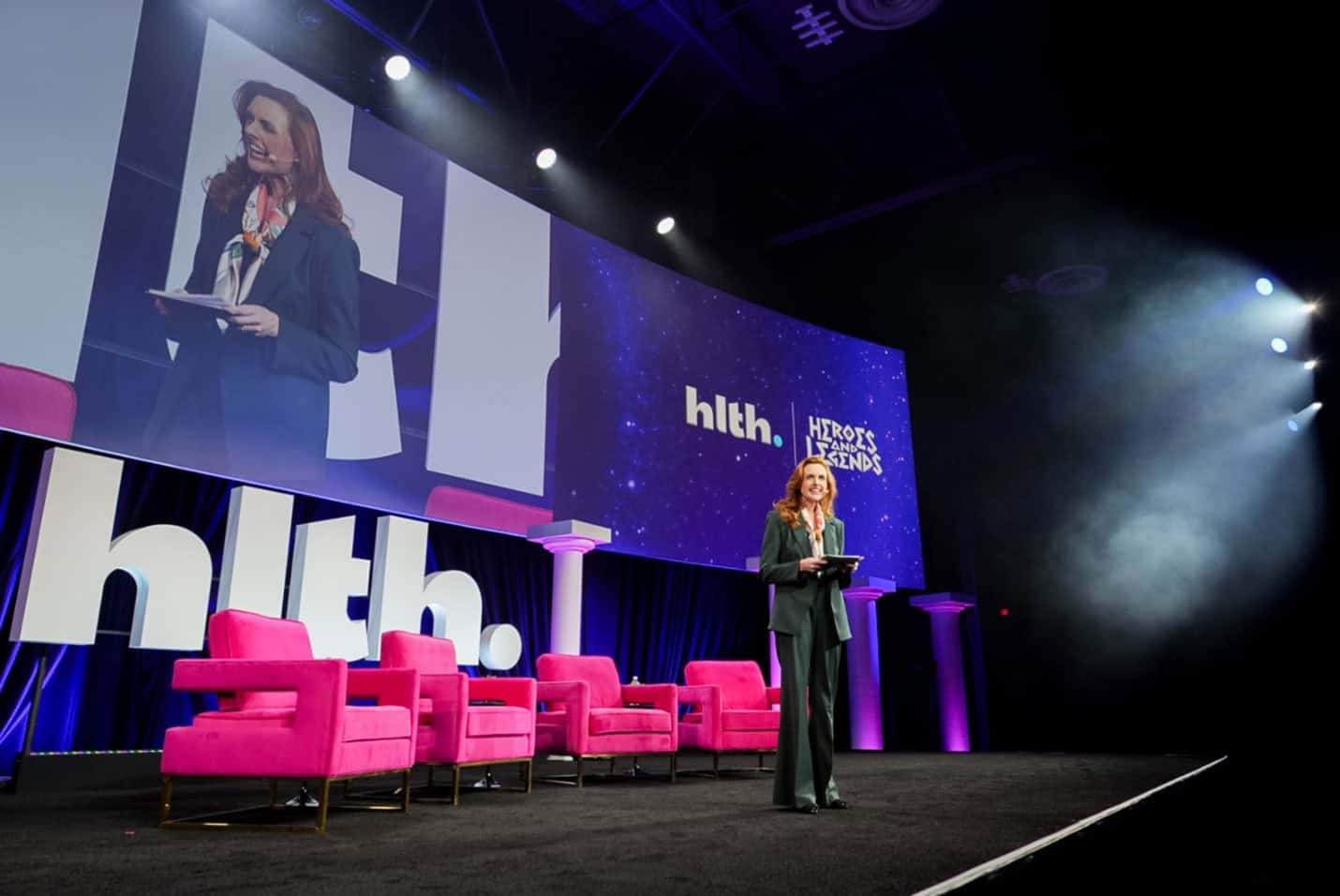
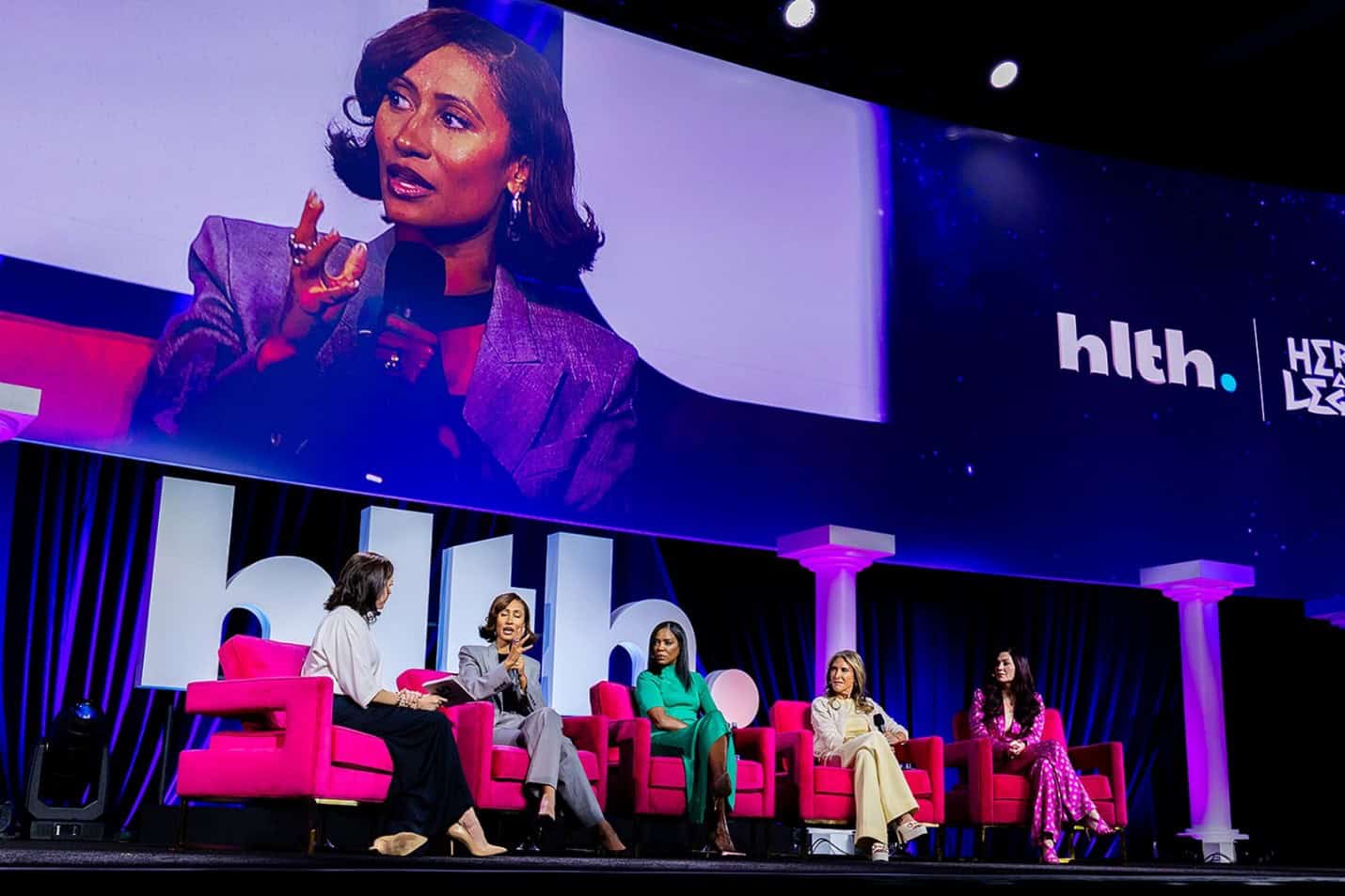
Podcast with Dr. Felicia Newhouse, Founder, AI-Powered Women

Human Centered Leadership is the Real Unlock for AI in Healthcare

To receive regular updates 

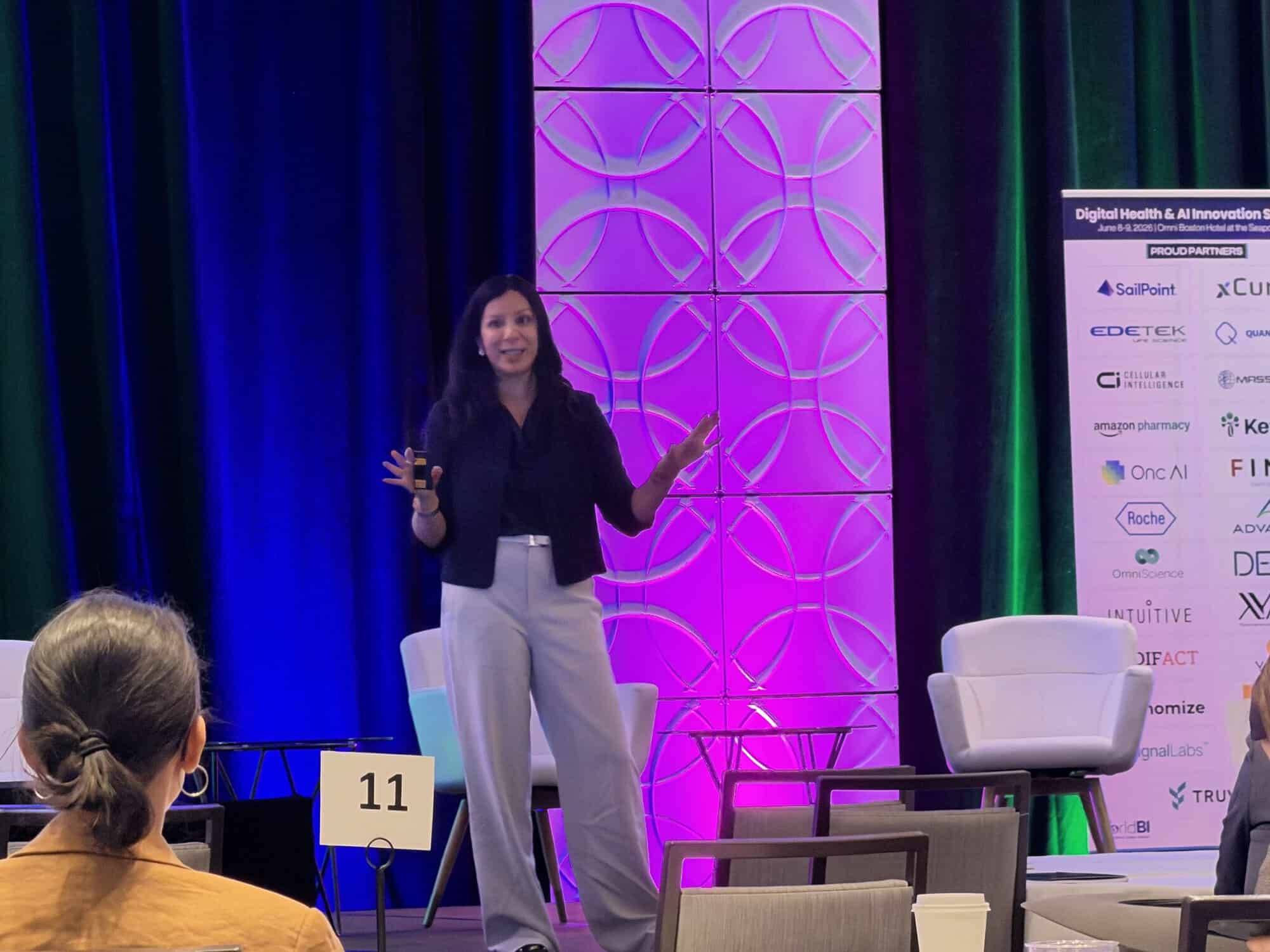
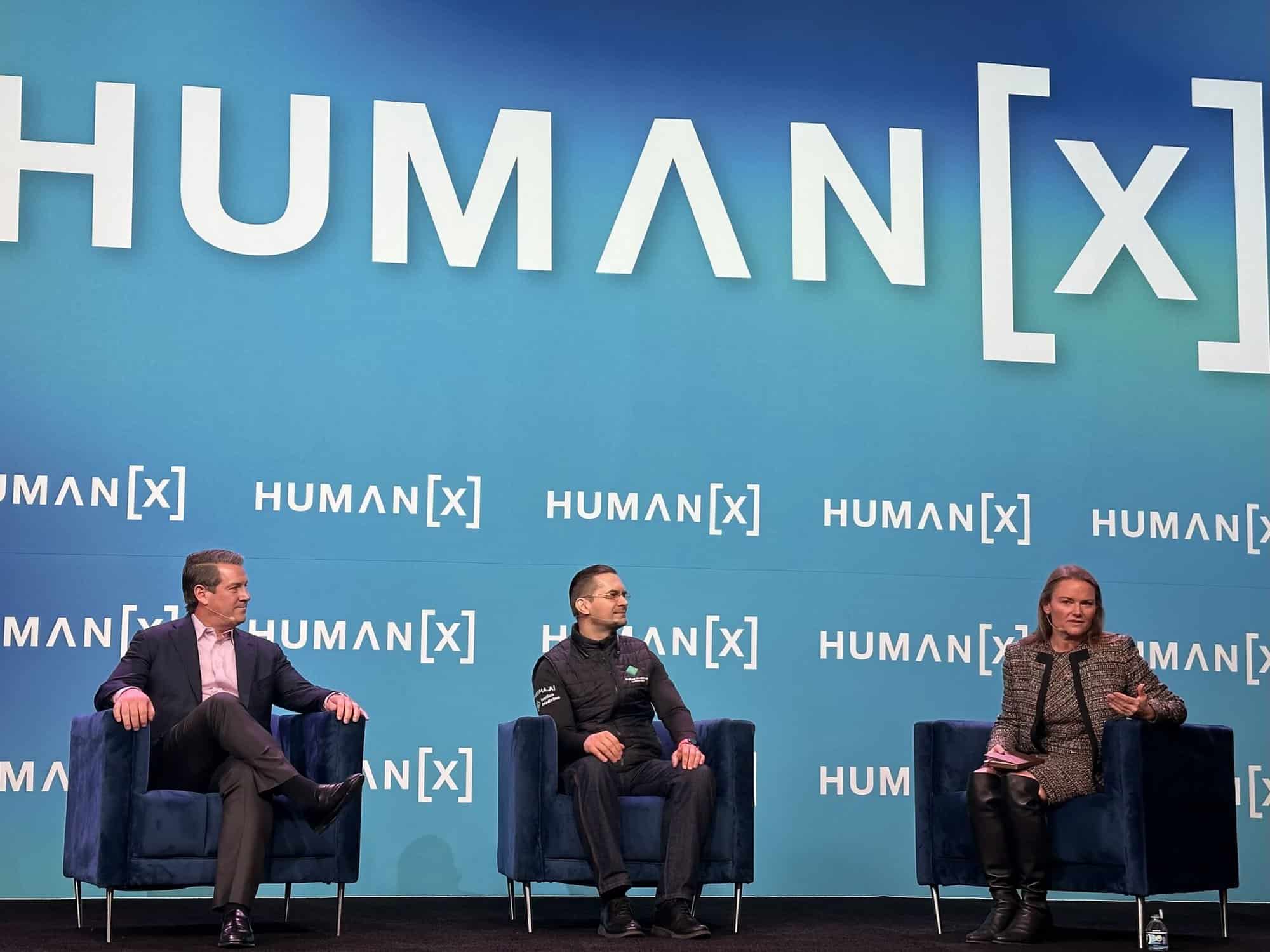
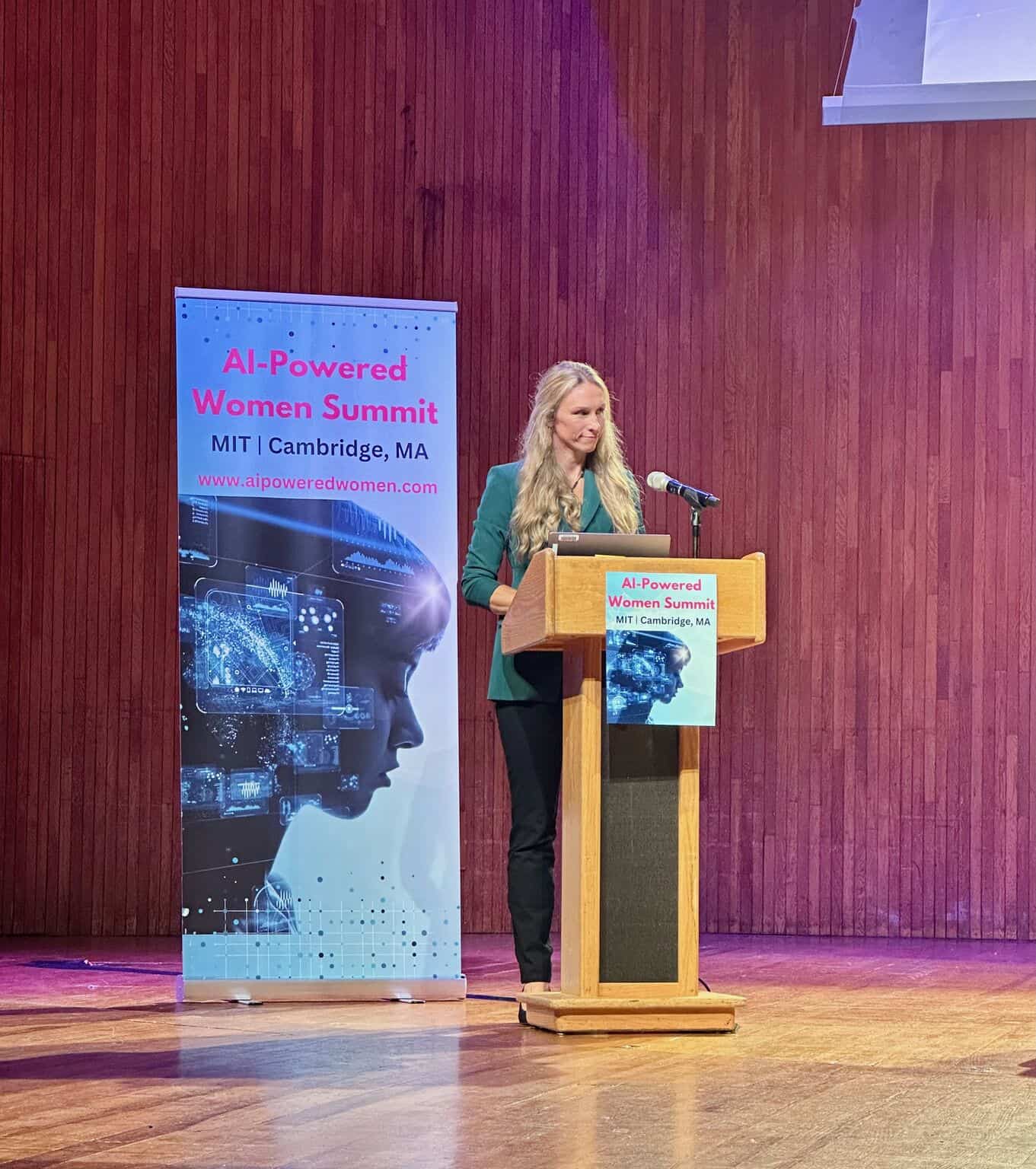
In this episode, Dr. Felicia Newhouse, Founder of AI-Powered Women, highlights the need for human centered leadership as the foundation for AI’s future in healthcare. Reflecting on her near-death experience and two decades in tech, she warns that rapid automation may boost efficiency but often leaves people feeling overwhelmed, disconnected, and burned out.

Dr. Newhouse emphasizes that true progress requires qualities only humans can bring, empathy, intuition, emotional intelligence, and what she describes as “systems awareness” and “systems feeling.” These capabilities help leaders understand the broader human impact of digital tools and design AI that supports well-being rather than replacing human judgment.

She urges organizations to slow down, prioritize dignity and belonging, and adopt AI in ways that strengthen human connection. According to Dr. Newhouse, the real unlock for healthcare will come when AI is guided by compassion, humanity, and mindful leadership. Take a listen.

Video Podcast and Extracts

About Our Guest

With over 20 years as a product tech executive, three successful startup exits, and a PhD focused on women’s leadership and transformational learning, Felicia Newhouse curates spaces where technical fluency meets inner evolution.

Drawing on her work as an energy practitioner and mindfulness-based leader, she integrates evidence-based approaches to human transformation with a deep understanding of consciousness and systemic change. Through the AI-Powered Women Academy and the annual MIT Summit, Felicia unites visionary educators, researchers, and changemakers ahead of their time to ensure women don’t just adapt to the age of AI—they lead it and evolve it with clarity, confidence, and consciousness.


Q: Hi, Dr. Michael Docktor, welcome to our Big Unlock podcast. We are really happy to have you as a guest on our show. Uh, it’s on our sixth season now, and, uh, we are looking forward to this conversation. I’m sure we’ll have a very engaging and interesting conversation about dog health, about healthcare in general, and the new trends about AI and all the buzzwords that people want to hear. Welcome to our show — we’d like to start with introductions. Happy to have you give your introduction. Thank you.

Michael: Yeah, thank you so much for having me. Yeah, I’m Michael Docktor, co-founder and CEO of Dock Health. I’m an ologist by trade. I am now on this, uh, healthcare venture outside of Boston Children’s Hospital where I started my GI career.

I was a busy clinician working on the clinical side as well as in innovation and informatics, and found that we had wonderful tools in the world outside of healthcare and struggled with my own challenges around managing all the tasks that are part of patient care. I found that I was using task management and project management tools that were not built for healthcare.

I scratched my head and wondered why we don’t have these things for healthcare. That was a journey. We started just over five years ago. We spun out Dock Health from Boston Children’s, and we’ve been on a very exciting journey in the world outside the academic walls since then.

It’s been fun. I’m excited to talk to you more about, uh, what we’re doing.

Q Great. That’s a great introduction. Thank you for letting our listeners know. We usually like to start with how you came into healthcare because everyone has an interesting story about what inspired them to become a physician.

For you, it’s particularly interesting because you’ve created this interface between design, technology, and healthcare — and you went beyond just visualizing what you wanted to do or asking why somebody doesn’t fix it, to actually building it yourself. I’d love to hear more about how you came into medicine and then into technology.

Michael: I could probably spend the entire podcast on this question. Obviously, my last name is Doctor, so there was some planting occurring there, and there’s something to be said for that.

One of my earliest memories was wanting to grow up to be a doctor. My younger sister had some GI issues when we were young, and I became very close with her gastroenterologist. I followed her on her journey and, unbeknownst to me, ended up following one of my mentors and was inspired to do the work for other children the way my sister was cared for. That was the initial inspiration.

You mentioned design. That’s interesting because my mother is an interior designer, my father is a dentist who specialized in aesthetics, and design — how things look, feel, and work — has always been part of my DNA. It was an amazing journey to go from being a traditional doctor in pediatric gastroenterology to discovering the importance of user experience and user interface.

Then the iPhone came out, then the iPad, and that really started me on my journey of exploring app development and software, and wondering why we didn’t use these wonderful devices in our pockets the way we should. That journey started more than 10 years ago and has led me to this perfect intersection of healthcare, design, and informatics, creating better experiences for patients and providers.

There’s a lot to unpack there, but people ask me if I would do it differently if I had the chance to do it all over — and absolutely not. I’m doing exactly what I want to be doing right now.

Q: Thank you for sharing that. That gives us so much perspective into how you came into this field, the influence of your parents, and how everyone around you inspired you to do this. That’s really interesting.

That leads us into how you built Dock Health. Tell us some examples of how you saw this becoming transformational in actual implementations with clients. When you built the tool, did you visualize exactly what it would do? Did it go beyond what you thought it would achieve in a healthcare setting? We’d love to hear more about that.

Michael: We’re far beyond where I ever thought we’d be when we first started this journey. That’s the exciting part. Fundamentally, we have such an administrative and operational challenge in healthcare. I saw it firsthand as a busy clinician struggling to manage all the clinically adjacent work that had to be done for my patients.

For example, I might have a patient with Crohn’s disease who needs to go to an infusion center. There are all these downstream tasks and administrative steps that need to be done by a team of people. We didn’t have assistants to do that, and the electronic health record wasn’t built for it.

A quarter of the $5 trillion spent in healthcare goes to administrative and operational challenges, and there really are no tools built for that. We rely on paper checklists, email, faxes, and spreadsheets to manage all the work happening outside the electronic health record.

For me, the realization was that I was using wonderful project management and task management tools to run software projects in my innovation and informatics roles—and yet nothing like that existed in healthcare. Patients, in many ways, are projects. There are tasks that form the essence of care, and they need to be tackled, managed, and collaborated on, with visibility and accountability across teams. That didn’t exist.

What we are now doing is serving as that productivity platform for healthcare, one that sits alongside the electronic health record in synergy, helping manage all the administrative and operational tasks of patient care in ways the EHR wasn’t designed for.

Some examples would be managing patient intake and all the processes associated with it. Referrals, inbound and outbound, with all the paperwork, eligibility checks, and faxes—those workflows are still incredibly manual. Referrals are a great example: 80% of referrals that come into major academic medical centers are still arriving by fax, despite the fact that they’re using Epic, a wonderful electronic health record.

These processes are still incredibly laborious, take too long, and are inefficient. Patient care suffers along the way. There’s a gigantic bottleneck around the administrative and operational work that moves patients through their journeys, and that’s what we’re focused on fixing.

Q: This is what we hear from a lot of our clients and other CIOs and C-suite leaders who come to our podcast—that this is one major problem with healthcare. It’s siloed, and the processes are really stuck in the dark ages.

We were talking to somebody from Athena, and they said they had an 800-person offshore center in India just to screen faxes. When a fax came in, one person looked at it to see if it was a pizza order or a referral. It sounds unbelievable in this day and age, but that’s how it works. I’m amazed to hear this from you as well. It’s remarkable.

Michael: Yeah. In fact, Athena is a partner of ours, and we’re working on referral management. It’s an incredibly antiquated process where everyone loses visibility. The amount of manual labor required to process these things is shocking in this day and age, when they can be handled through process automation, AI, and agents.

Q: Exactly. You’re talking about agentic, we’re talking about voice agents, and yet we’re still dealing with faxes. That’s really interesting to know.

Michael: There is reason to be hopeful. Healthcare is always many decades behind, but the adoption of AI is progressing more rapidly than I’ve seen any technology adopted in healthcare. There’s reason for hope.

Q: That leads into my next question, but before we get there, you mentioned Dock Health as a productivity platform. That’s what it does for doctors, clinicians, and patients. But when we talk to our doctors, clients, and health systems, the one word that always comes up is complexity. They deal with so many different systems and have to learn something new each time.

Where does Dock Health fit in? Is it another system they have to manage, or does it help reduce that burden?

Michael: Yeah, it’s all about reducing the burden and improving the user experience. That’s been fundamental to our belief system since the founding of the company.

First and foremost, we’re trying to become the productivity platform and the hub that handles the administrative and operational work. Instead of being “another system,” we’re often replacing spreadsheets, paper checklists, emails, and faxes—the ways we’ve traditionally managed the 50% or more of administrative and operational tasks required for patient care.

The EHR is great for clinical work, billing, prescribing, and scheduling, but so much happens downstream that isn’t covered. I’d argue we are creating the hub for that. Just as the EHR is the clinical hub, Dock Health serves as the operational hub. Together, it’s really one plus one equals three.

We’re also aiming to be much more consumer-like in our approach. Our tool can onboard a customer in 30 minutes. We offer a free trial, and for small organizations that want to get up and running, they can start using it right away—just like downloading an app. It’s lightweight, highly configurable for end users, and designed with a strong focus on user experience.

The real challenge is that clinicians don’t want another tool. They’re busy and need to spend their time in the EHR. Our core users are often the super users: front office staff, back office teams, operational leaders, and administrative staff who leverage our tool every day.

The important piece is that we connect to the electronic health record and provide visibility for clinicians. If they’re interested, they can see where a patient is in their journey or where a process stands, but they don’t have to be in our system all day, checking tasks or learning another workflow.

The intent is to provide that operational hub for administrative and support staff—the essential members of the care team—while clinicians continue their work in the EHR and often drive tasks into our system through their orders and actions there.

Q: Is the integration with the EHRs native, like with Epic, Cerner, and the big ones?

Michael: Yeah. We’re on the marketplace with a number of the top EHRs, including Epic and Cerner. We’re also working with Mayo Clinic, their Mayo Clinic Platform, and their Deploy platform.

The other thing I’d mention is that many organizations use our tools without being integrated with the electronic health record. That’s often because they’re smaller practices—mental health, concierge care, or primary care—that simply need a hub to handle administrative and operational work and collaborate as a team.

We spend a lot of time helping organizations define their processes, and those processes can then live in Dock, where they can be collaborated on and turned into operational best practices. That’s something that often doesn’t happen in traditional healthcare organizations, and our tool is valuable even when it’s not connected to an EHR.

Of course, the real value comes when we integrate with systems—EHRs, CRMs, patient engagement tools—and serve as the hub while automating as many tasks as possible. That’s when the flywheel starts turning, and organizations begin to feel the benefits of automation and work reduction. It ultimately moves the needle in a measurable way.

Q: So, you’re saying if there’s an integration with the EHR, then it’s end-to-end and people can see a complete view of what’s happening. But even without the EHR, because it helps with workflow management, it’s valuable for practices?

Michael: It’s just like every other industry. They have Asana, JIRA, Trello—all these tools where a lot of the real work gets done. That provides value in itself by giving a clear view into where the patient is in their journey and what process they’re following.

When we integrate with an EHR or other systems, we can then automate those workflows. For example, when a fax comes in, we can launch a workflow for a new patient referral. When a lab order is placed, we can launch a workflow for follow-up. Or when a patient has a procedure, we can launch a process for their downstream follow-up.

Q: That leads into the next question, which is your learning journey with AI. What advice do you have for our listeners about where AI is headed? And with voice agents and agentic tech being buzzwords, where do you see Dock Health going? Are you also looking at implementing voice agents?

Michael: AI is incredibly exciting. I’ve put it out there that we’re an AI-first company. We’ve been thinking about this for a while, and we already have what we call Dock Intelligence in production with customers. We started with the basics, using foundational models and generative AI to process large troves of data.

Now, we can summarize all the work being done for a patient and create a snapshot for the end user—showing all tasks, workflows, patient context, and even clinical context if available. That gives a quick overview of what’s happening. Users can edit that snapshot if needed, or generate a note that writes back to the EHR to keep the operational and clinical record in sync.

That’s the first step in our AI journey. From there, we realized tasks bundle into workflows, workflows can be automated, and now we’re starting to farm out those tasks to agents and AI. For example, a voice agent could follow up with a patient to confirm a referral or review lab results. We’re actively pursuing that, as well as leveraging AI to extract data from faxes to automate referral processes.

AI is the big unlock. In the next three to five years, I believe most administrative and operational tasks will be handled by automation and AI agents orchestrating together. These agents need rails to run on and structure to guide them, and end users must remain in the loop to provide oversight and visibility. But the lion’s share of this work will be handled by agents—and we’re building that future right now.

Q: Are you aligning specifically with any particular LLM or provider, or are you going to be completely agnostic?

Michael: I’d like to think we’ll be agnostic. We’re doing plenty of building on some of the foundational models ourselves, and we’re partnering where we can with great tools. For example, with voice agents, we’re not necessarily building them ourselves—there are excellent options out there. What we are doing is building our own homegrown AI agents that can manage processes and facilitate handoffs from task to task.

Our approach has always been to recognize that there’s a wonderful ecosystem out there. We want to be the hub that connects to the best-of-breed systems—whether that’s Epic as an EHR, Salesforce as a CRM, or other tools we can leverage to create a healthy ecosystem. That’s what we’re pursuing.

Q: I wanted to ask a question about that because with the LLMs, one of the main problems is the hallucinations or the repeatability or the trust factor there. So I saw that Dock is HITRUST certified. So, I just wanted to ask, what are your views on that? Because in terms of using generative AI when we talk to our clients, uh, for implementations on LLMs, or they’re more comfortable certainly with the administrative tasks, but even with the administrative tasks there’s always the question of what are the guardrails you put around that and how do you make sure that the results that you are seeing or you are displaying on Doc Health, you know, stay within that, those bounds of accuracy. Whathat are your thoughts around that?

Michael: AI is incredibly exciting—it’s moving at the speed of light, and everyone wants to benefit from it. I do think administrative and operational areas of healthcare are lower-hanging fruit and far less risky. We’re not yet in a place where we can reliably use AI for absolute clinical decision support and autonomy, though I believe we’ll get there in the not-too-distant future.

For now, the clunky and manual administrative work is ripe for AI. Still, we need to be mindful of potential hallucinations. In our experience so far, we haven’t seen issues, but we’ve put safeguards in place. That means keeping a human in the loop to ensure outputs are appropriate and relevant. We also give users the ability to edit results before they’re sent—whether it’s a summary being emailed to a colleague or written back into the EHR as a clinical note.

It’s essential to show your work. If we’re pulling data from various sources, we show those sources. We keep users in the loop, give them control to review and edit, and maintain tight feedback loops to catch and address anything off.

So far, even foundational LLMs have been surprisingly strong in our relatively narrow use cases. The real challenges will come as we move toward higher-risk clinical decision support—but I’m confident we’ll get there quickly.

Q: It’s interesting you mentioned humans in the loop and the fact that people can review or edit what’s being generated. But with agents, one of the key defining characteristics is autonomy—they can make API calls, send emails, even browse the web to find and act on information. How do you think about that level of control being handed over?

Michael: I think it’s all about balance. The value of task automation and workflow automation is clear. For us, one of our strengths is providing a user interface where the end user can actually see where a process is in its journey.

We’re working on features like showing confidence levels or confidence intervals for data extracted—for example, from a fax. That way, we not only show our work but also give transparency into how accurate that extraction might be. Using our interface, which breaks workflows into tasks, we can show exactly where a process stands. If we believe human involvement is needed, we assign a task and call someone in to review.

Even in the agentic future—which is already upon us and actively being built and tested—we see ways to keep humans in the loop. Operating entirely in a vacuum is risky. Part of my mantra, coming from clinical practice, is that I lacked visibility and accountability in the work being done on behalf of my patients, lost in a black hole of faxes and emails. It’s important to show where the patient is in their journey, where the process stands, whether an agent is handling it or automation is moving data between systems. Giving people visibility and the ability to drill down is critical.

Q: That’s an interesting viewpoint. You mentioned the front and back office and clinicians, but I didn’t realize patients might also have visibility into the system.

Michael: That’s certainly the vision for the future. Right now, our solution focuses on creating visibility and accountability for the care team—clinical and operational staff. But ultimately, the patient is part of the care team too. I would love to see a future where patients are assigned tasks and the rest of the care team has visibility into their progress. I think that’s inevitable. For now, we’re focused on giving the traditional care team the tools they need, but over time, I see patients and their home-based care team being part of that ecosystem.

Q: So I think we are almost at the end of the podcast. We would like to conclude by asking you what you think, maybe give a horizon of like a year and then maybe a five-year horizon. What do you think the top trends that are going to be in AI, and particularly for you at Dock Health? What are the three things that you are really keeping close tabs on and you feel that it’s going to really impact your product and be very transformational.

Michael: It’s tough to predict because AI is moving so fast. Moore’s Law doesn’t apply anymore—the doubling is happening every few months. Everything right now is AI, and “agentic” is the word of the day. I’ve even heard “ambient agents.” We see our role as orchestrating workflows where agents will carry out the majority of tasks.

When we started Dock Health, I imagined a day when it would be smart enough to handle processes automatically. AI has accelerated that roadmap by five to ten years, and the pace keeps shrinking. I truly believe that in the next five years, when healthcare spending in the U.S. reaches $10 trillion, the $2.2 trillion spent on administrative and operational costs may actually shrink because of operational efficiencies unlocked by AI.

We want to give care teams superpowers. Administrative and operational staff deserve better tools to do their work. Just as ambient scribes are now relieving clinicians from documentation, I believe AI will do the same for the administrative and operational burdens in healthcare. Within three to five years, I expect most of that work will be automated. Humans will still play a role, but much of it will feel like it just happens—almost magically.

If you zoom out five years from now, it will look like magic. But by then it will feel obvious. And that excites me, because at the end of the day, patients, our economy, and the world need more efficient care. The fact that we waste a trillion dollars a year on administrative tasks is shameful. Patients are asked to take on too much, like reminding us about referrals or tracking down lab results. These things happen because we’re human and don’t scale well. But now we have incredible tools at our fingertips, and I believe the next few years will be the most exciting time healthcare has ever experienced.

If we zoom out five years from now, it’s going to look like magic—but by then it will feel obvious. I’m excited for that future because, at the end of the day, patients, our economy, and our world need more efficient care. The fact that we waste a trillion dollars a year on administrative and operational tasks is shameful.

Too much of the burden falls on patients. Physicians and care teams often say, “Call me if you don’t get your referral in a couple of days,” or, as I saw with my own mom recently, patients are left chasing down lab results. These things happen because we’re human and we don’t scale well.

Now, we have incredible tools at our fingertips. That’s why I believe the coming years will be the most exciting time in healthcare that I’ve ever experienced—and likely the most exciting time the world has ever seen. Healthcare is primed for transformation and opportunity.

Q: Thank you for being with us on our podcast. It was a wonderful conversation, and we look forward to sharing your vision for the future with our listeners.

Michael: Thanks so much.

————

Subscribe to our podcast series at www.thebigunlock.com and write us at [email protected]  

Disclaimer: This Q&A has been derived from the podcast transcript and has been edited for readability and clarity.
About the host

Paddy is the co-author of Healthcare Digital Transformation – How Consumerism, Technology and Pandemic are Accelerating the Future (Taylor & Francis, Aug 2020), along with Edward W. Marx. Paddy is also the author of the best-selling book The Big Unlock – Harnessing Data and Growing Digital Health Businesses in a Value-based Care Era (Archway Publishing, 2017). He is the host of the highly subscribed The Big Unlock podcast on digital transformation in healthcare featuring C-level executives from the healthcare and technology sectors. He is widely published and has a by-lined column in CIO Magazine and other respected industry publications.

About the Host

Ritu M. Uberoy has over twenty-five years of experience in the software and information technology industry in the United States and in India. She established Saviance Technologies in India and has been involved in the delivery of several successful software projects and products to clients in various industry segments.

Ritu completed AI for Health Care: Concepts and Applications from the Harvard T.H. Chan School of Public Health and Applied Generative AI for Digital Transformation from MIT Professional Education. She has successfully taught Gen AI concepts in a classroom setting in Houston and in workshop settings to C-Suite leaders in Boston and Cleveland. She attended HIMSS in March 2024 at Orlando and the Imagination in Action AI Summit at MIT in April 2024. She is also responsible for the GenAI Center of Excellence at BigRio and DigiMTM Digital Maturity Model and Assessment at Damo.

Ritu earned her Bachelor’s degree in Computer Science from Delhi Institute of Technology (now NSIT) and a Master’s degree in Computer Science from Santa Clara University in California. She has participated in the Fellow’s program at The Wharton School, University of Pennsylvania.

About the Host

Rohit Mahajan is an entrepreneur and a leader in the information technology and software industry. His focus lies in the field of artificial intelligence and digital transformation. He has also written a book on Quantum Care, A Deep Dive into AI for Health Delivery and Research that has been published and has been trending #1 in several categories on Amazon.

Rohit is skilled in business and IT  strategy, M&A, Sales & Marketing and Global Delivery. He holds a bachelor’s degree in Electronics and Communications Engineering, is a  Wharton School Fellow and a graduate from the Harvard Business School. 

Rohit is the CEO of Damo, Managing Partner and CEO of BigRio, the President at Citadel Discovery, Advisor at CarTwin, Managing Partner at C2R Tech, and Founder at BetterLungs. He has previously also worked with IBM and Wipro. He completed his executive education programs in AI in Business and Healthcare from MIT Sloan, MIT CSAIL and Harvard School of Public Health. He has completed  the Global Healthcare Leaders Program from Harvard Medical School.

About the Legend

Paddy was the co-author of Healthcare Digital Transformation – How Consumerism, Technology and Pandemic are Accelerating the Future (Taylor &  Francis, Aug 2020), along with Edward W. Marx. Paddy was also the author of the best-selling book The Big Unlock – Harnessing Data and Growing Digital Health Businesses in a Value-based Care Era (Archway Publishing, 2017). He was the host of the highly subscribed The Big Unlock podcast on digital transformation in healthcare featuring C-level executives from the healthcare and technology sectors. He was widely published and had a by-lined column in CIO Magazine and other respected industry publications.

How Virtual Care Is Redefining Physician Capacity, Patient Access, and the Future of AI in Healthcare

How Virtual Care Is Redefining Physician Capacity, Patient Access, and the Future of AI in Healthcare

Insights from Dr. Chris Gallagher on The Big Unlock Podcast

Virtual care is no longer an experiment. It is becoming a core part of modern healthcare delivery. In a recent episode of The Big Unlock podcast, Dr. Chris Gallagher, Founder and Chief Strategy Officer at Access TeleCare, discussed the shift toward hybrid care models, how virtual care, tele-ICUs, and AI are reshaping physician distribution, hospital operations, and the patient experience, especially for underserved communities.

Chris’ story is both personal and systemic, rooted in early exposure to underserved communities, years before telehealth entered the mainstream. His experience provides a real-world blueprint for how virtual care models can solve persistent physician shortages, expand specialty care, and create safer, more efficient patient experiences.

From Rural Weekends to Virtual ICU Pioneer

Chris’s journey into telehealth began as a cardiology trainee spending weekends serving rural communities around Dallas, where he saw the same level of disease complexity as in major academic medical centers, often worse because conditions went undiagnosed for years. That experience convinced him that geography should not determine the quality of care, and it sparked a career-long focus on high-acuity, underserved patients.​

When recruitment of on-site specialists failed, he and his colleagues turned to telemedicine, eventually building the first virtual ICU in Texas in 2013. And on its third night, the program helped save a life and cemented his conviction that virtual care needed to be his life’s work.​

Overcoming Early Resistance to Telemedicine

Launching tele-ICU a decade before COVID meant pushing against skepticism from clinicians who questioned whether virtual models were “real medicine”. To win trust, Chris’s team limited their initial efforts to a single ICU for a year, proving safety, outcomes, and ROI before scaling.​

He describes the long stretch from 2014–2016 as mostly educating health systems, with a turning point around 2018 when leaders needed less explanation and more implementation. Then the pandemic accelerated acceptance by at least a decade and normalized virtual care as a core modality.​

Making Technology “Fisher-Price Easy”

One of Chris’s central themes is that technology must be radically simple if clinicians are going to use it in the chaos of real-world care. Early on, a virtual encounter required 27 steps for the physician and 13 for the nurse, which created friction and slowed adoption.​

His team adopted a design mantra – “Fisher-Price easy,” and relentlessly removed steps until clinicians could connect with a patient almost as easily as pressing a single button. As the user experience improved, encounters increased and adoption became self-sustaining, a pattern he believes will repeat with AI if solutions are intuitive and reliable.​

Solving Physician Distribution, Not Just Rural Access

While the origin story was rural underserved care, Chris emphasizes that the main telehealth use case has shifted dramatically. In just three years, Access TeleCare moved from serving 70% rural and 30% urban patients to the reverse – 70% urban and 30% rural.​

Today, virtual programs are as likely to support large city hospitals as small rural facilities, especially where there is only one on-site specialist who can never take a day off without leaving gaps in coverage. Telehealth becomes a “programmatic envelope of care,” adding fractional virtual FTEs around local clinicians so hospitals can achieve 24/7 coverage without burning out the in-person team.​

Virtual Coverage as a New Staffing Model

Chris describes a new staffing paradigm where hospitals no longer try to fully staff every specialty on-site around the clock. Instead, they:

  • Use virtual clinicians to cover nights, weekends, and low-volume periods.
  • Allow scarce specialists (like infectious disease or intensivists) to focus on clinic or procedures while telehealth handles inpatient consults.​

Because 66% of hospital time is nights and weekends, covering everything purely in person is either impossibly expensive or unsustainable for clinicians, whereas virtual care can be scaled “dose-dependently,” used only as much as needed, without idle capacity.​

AI, Automation, and The Digital Back Office

For Chris, AI is not abstract; it is already embedded in practical workflows. His organization is piloting AI in back-office areas such as revenue cycle and operational automations, as well as in clinical routing and scheduling to support nearly 800 physicians and nurse practitioners.​

Over 50% of consults now flow through digital automation rather than phone calls, with EMR-integrated workflows that let hospitals trigger a consult at the push of a button and route it directly to the right specialist’s mobile app. AI will make this routing smarter and faster, enabling his team to reach the bedside up to 20% sooner, crucial for emergencies like acute stroke or cardiac arrest.​

Voice Agents and The Next Wave Of AI

Chris is optimistic about voice agents as a natural evolution in AI-enabled care. His team is actively running pilots with multiple vendors to determine which tools best fit their physicians and advanced practitioners, focusing on both efficiency and experience.​

Most current use cases they are exploring sit behind the scenes – supporting revenue cycle, documentation, and operational workflows, rather than replacing the human interaction at the bedside. The goal is not to remove clinicians from the loop but to free them from administrative burden so they can spend more time in clinical decision-making and patient communication.​

Redefining The Digital Front Door For Acute Care

Unlike many digital health companies that focus on at-home consumers, Access TeleCare’s “digital front door” starts inside hospitals. All of their patients are in emergency departments, ICUs, inpatient floors, or clinics, and many encounters are unscheduled, triggered by sudden changes in condition.​

Instead of patients booking online, hospitals initiate virtual consults directly from Epic or Cerner, routing requests into a centralized platform that balances workload among specialists in seconds. This model turns telehealth into an invisible backbone of acute care, embedded in hospital operations rather than acting as an external service layer.​

Making Virtual Care Feel Like In-Person Medicine

To win clinician and patient trust, Chris insists that virtual encounters must feel as close as possible to traditional bedside care. Each hospital is equipped with a six-foot telemedicine cart featuring a large display, high-resolution zoom camera, and digital stethoscope so remote physicians can read monitors, view ventilator settings, and perform detailed physical exams.​

There is always a “patient presenter” in the room – usually a nurse, medical assistant, or ER physician – to provide hands-on support and carry out parts of the exam, while the remote physician documents, orders, and manages treatment within the hospital’s EMR as any on-site clinician would.​

Health Equity, Local Care, And Cost Savings

A major impact of these programs is on equity and local access. Around 82% of the patients Access TeleCare serves are underserved, including uninsured, Medicaid, and elderly populations who would otherwise face delayed or fragmented care.​

By bringing specialists to the bedside virtually, hospitals avoid costly transfers that can add about $5,000 per episode and, in the case of helicopter transports, tens of thousands of dollars more—costs that ripple through families and communities. For roughly the price of a $200 telemedicine consult, hospitals can keep patients in their home communities, close to their support systems, while still delivering high-quality specialty care.​

Toward A Virtual-First, Hybrid Future

Strategically, Chris sees health systems moving toward “virtual-first” models in many non-procedural specialties. In this vision, every patient is guaranteed baseline access to specialty care via virtual providers, and in-person clinicians are layered on top for procedures and high-volume needs.​

He argues that traditional physician staffing models, largely unchanged for a century, are no longer tenable in an era of workforce shortages and rising demand. Virtual care provides the flexibility to dial resources up or down, matching supply to demand without overworking clinicians or paying for idle capacity.​

A Turning Point for Medicine

Chris places AI and virtual care alongside antibiotics and modern surgical techniques as potential turning points in medical history. COVID, he notes, didn’t just accelerate telehealth adoption—it fundamentally lowered healthcare’s resistance to change and opened the door for broader digital transformation.​

He is bullish that AI will significantly enhance organizational efficiency, improve the physician experience, and ultimately elevate patient care, provided that governance, privacy, and safety guardrails are in place. For Chris Gallagher, the future of healthcare is hybrid, AI-enabled, and deeply human—using technology not to replace clinicians, but to extend their reach to every patient who needs them, wherever they are.

Virtual-First Care Starts with Making Technology Effortless

Season 6: Episode #188

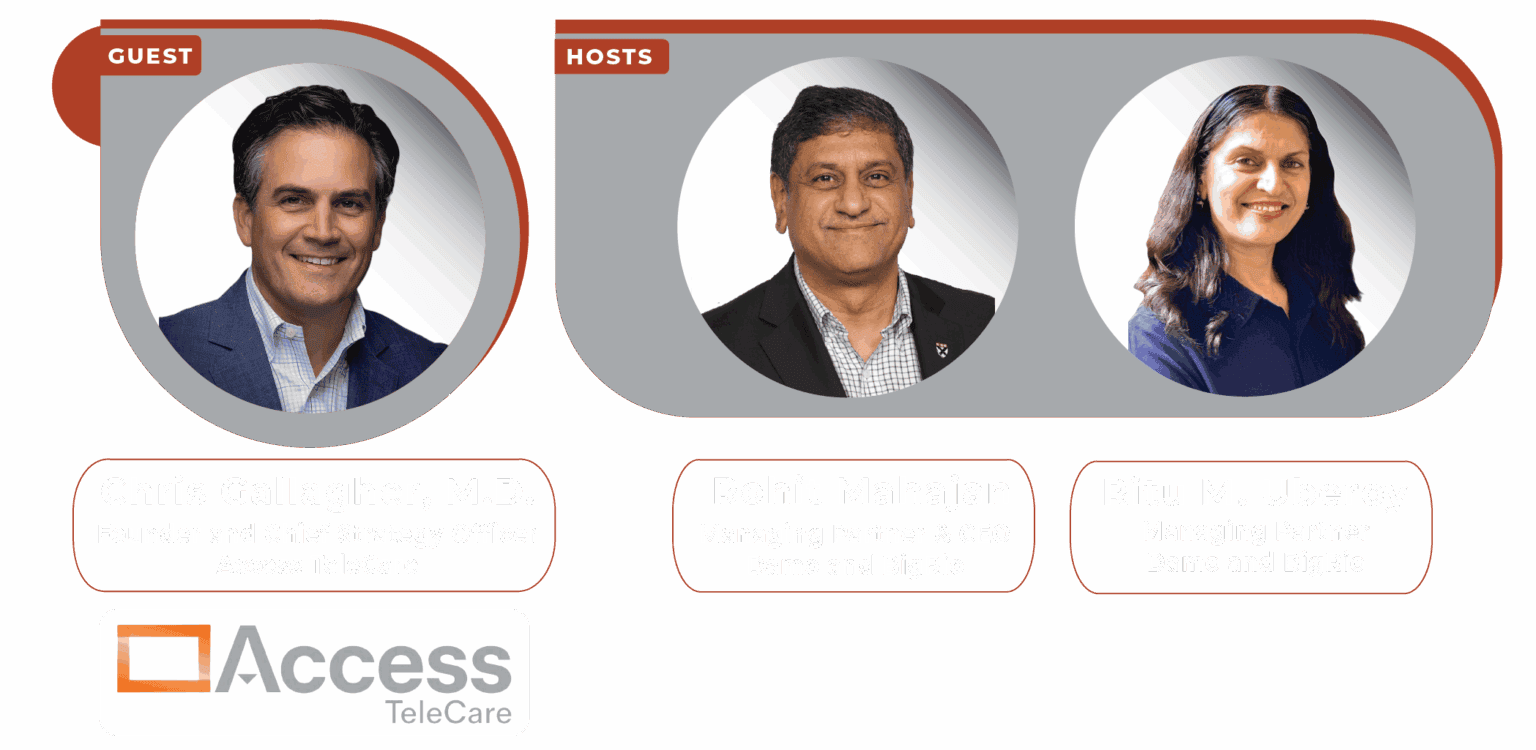
Podcast with Chris Gallagher, M.D., Founder and Chief Strategy Officer, Access TeleCare

Virtual-First Care Starts with Making Technology Effortless

To receive regular updates 

In this episode, Dr. Chris Gallagher, Founder and Chief Strategy Officer at Access TeleCare, shares valuable insights on the evolution of AI, how virtual care is reshaping access, staffing, and costs across health systems, and why making technology effortless is the key to driving a successful virtual-first care strategy.

Chris recounts the pioneering achievement of building the first virtual ICU in Texas in 2013, which quickly proved life-saving and marked a turning point in virtual health adoption. He discusses how they are addressing physician distribution issues by augmenting in-person staff, shifting its focus from predominantly rural to 70% urban facilities by offering essential 24/7 virtual specialists to care teams. Chris stresses that solutions must be effortless for clinicians, “Fisher Price easy,” so adoption becomes self-perpetuating.

Chris highlights AI’s immense potential to improve efficiency, enhance physician experience, and expedite patient care, especially through automation and a future “virtual-first” healthcare strategy. Take a listen.

Video Podcast and Extracts

About Our Guest

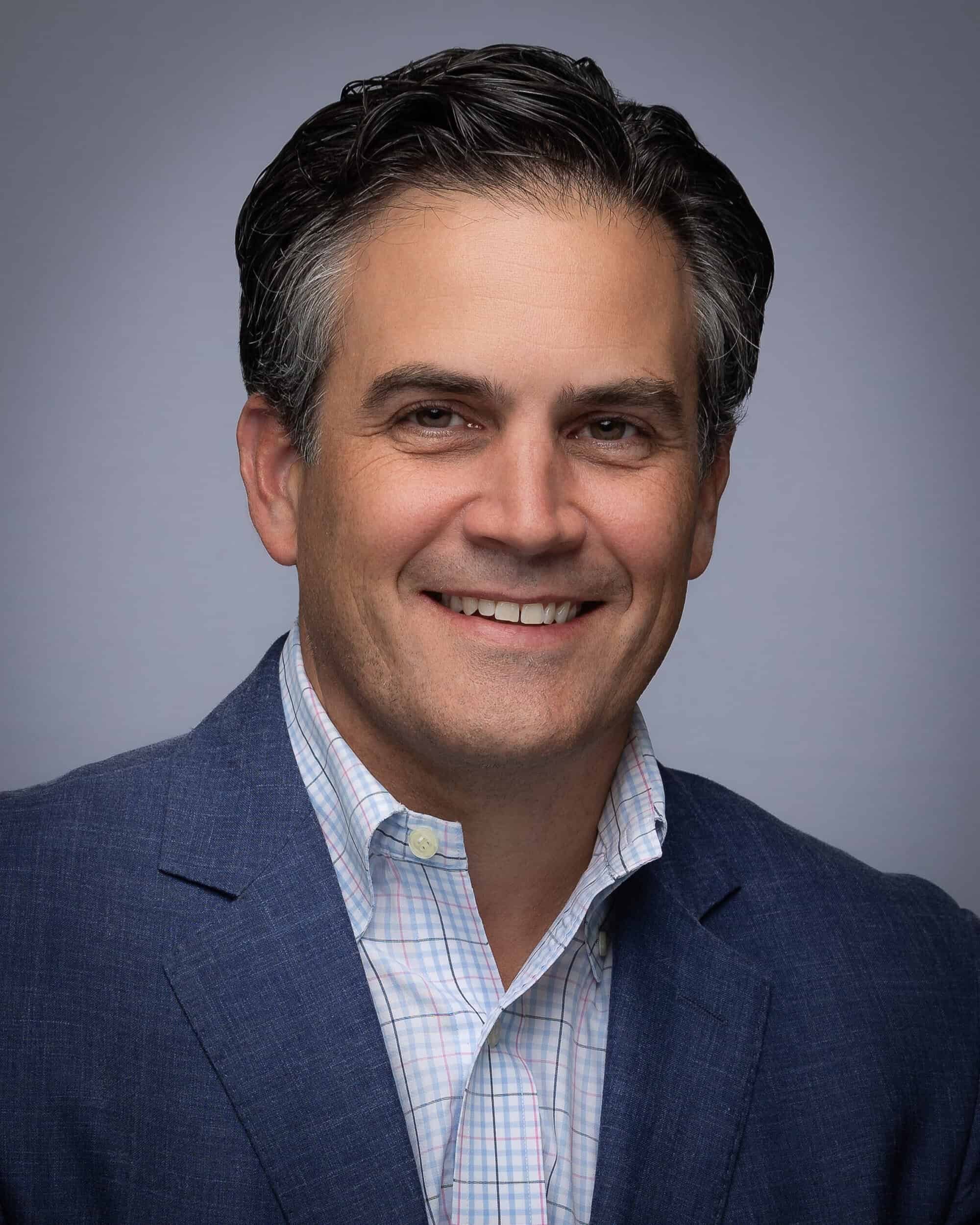
Chris Gallagher, M.D. is the Founder and Chief Strategy Officer of Access TeleCare. As a cardiologist in rural Texas hospitals, Dr. Gallagher noticed that timely care was one of the most important variables in a favorable patient outcome. However, this was not happening consistently across hospitals.

So, he started looking for a virtual solution that could ensure the delivery of high-quality, timely care. When he didn’t find it, he built it.

As founder of Access TeleCare, the nation’s largest high-acuity telemedicine provider, Dr. Gallagher brought his experience in internal medicine and cardiology to pave the way for tech-enabled clinical networks. Today, Access TeleCare is the standard bearer of excellence in telemedicine, a 2024 Top Remote Workplace, operating virtual care programs in all 50 states across 8 medical specialties, with a virtual catchment area of over 216 million Americans (across 15,000+ zip codes) representing roughly 65% of the U.S. population.

In his role as chief strategy officer, Dr. Gallagher drives innovation, identifies strategic partnerships, and plans for the company’s strategic growth.

Dr. Gallagher trained at UT Southwestern for his Internal Medicine Residency and Cardiology Fellowship and earned his Doctor of Medicine from Texas Tech University School of Medicine. He is a fellow in the American College of Cardiology and a member of the American Association of Cardiovascular and Pulmonary Rehabilitation, the American Medical Association, and the Texas Medical Association.


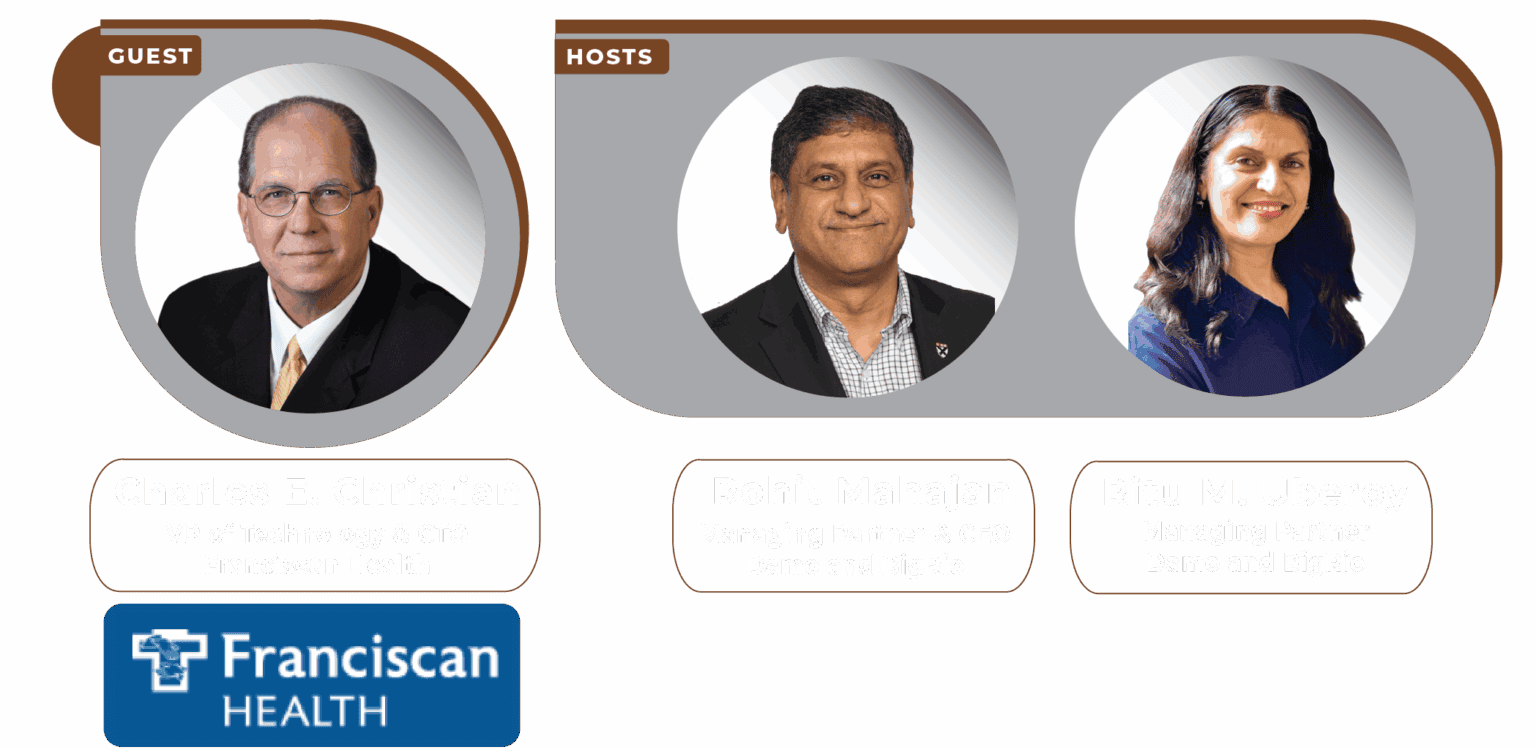
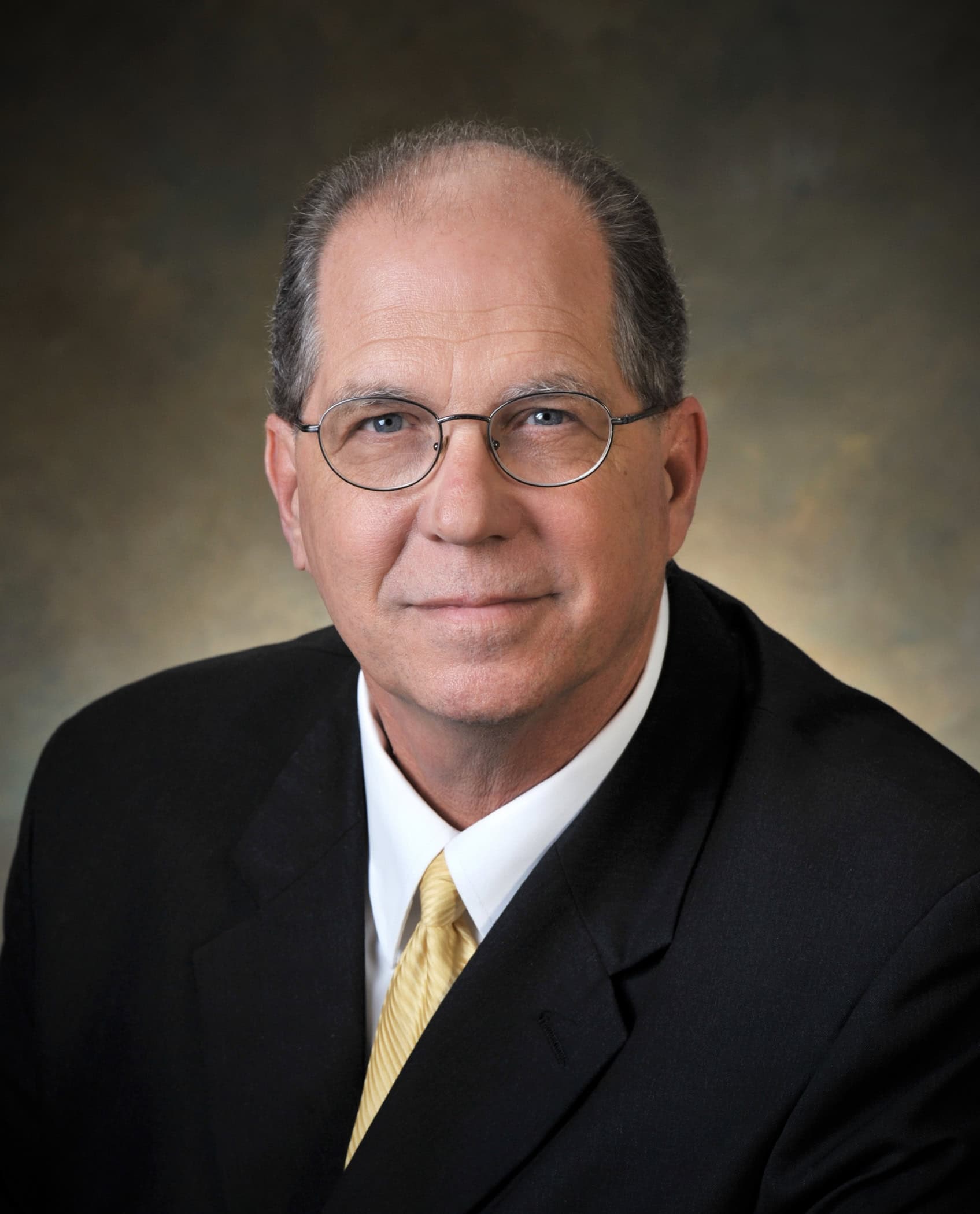
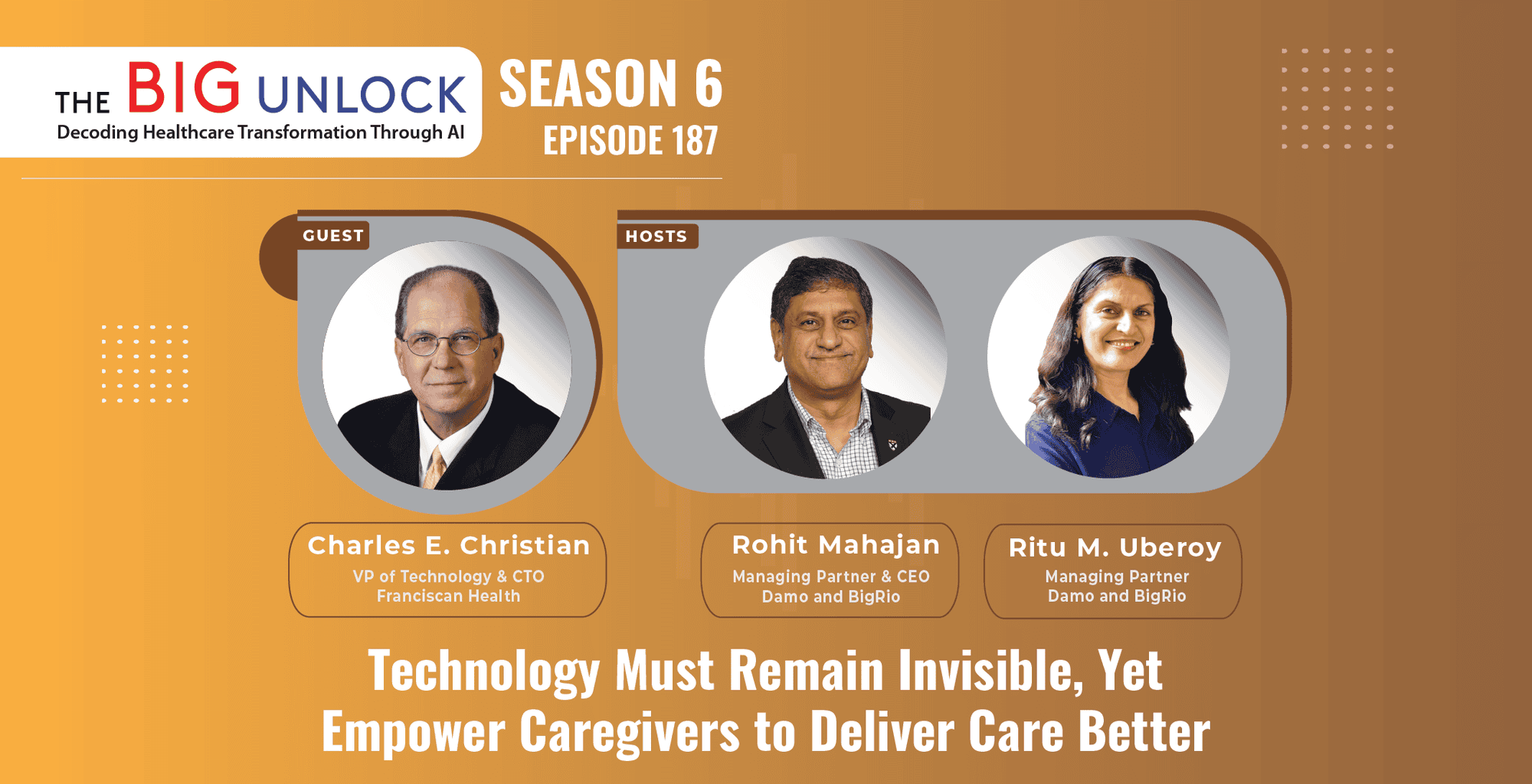
Charles: I am Chuck Christian. I’m the Vice President of Technology and CTO for Franciscan Health. Franciscan is a 12 or 13 hospital system, depending on how you count them. We cover a swath of the Midwest from just south of Indianapolis all the way to Chicago, basically following the I-65 corridor.

We have between 350 and 400 locations, including physician practices, imaging centers, lab draws, urgent cares, and oncology centers. It’s a pretty large organization. We have about 29,000 team members, both employees and contractors, at Franciscan Health.

We are truly mission focused. We are a Catholic healthcare system with a big C. We are owned by the Sisters of St. Francis of Perpetual Adoration. That means there are two sisters in the chapel praying for whatever they deem important and anything we ask them to pray for, 24 hours a day, seven days a week, 365 days a year. That’s where the “perpetual adoration” comes in.

We are a mission-driven organization. I believe in that. A lot of our hospitals are smaller and in underserved places, and we take care of that patient population. I think we’re really good at it.

I’ve known this organization almost 40 years. The CIO previous to Charles, who is our current COO, was a good friend of mine. I was CIO of a hospital in Southern Indiana for 24 years, and Bill and I ran a similar software stack. I watched Bill and learned a lot from him as far as how he ran this large organization.

I’ve been here for six years. I joined in April of 2019, so in dog years that’s like 35 years or more. We are very busy. I’m very blessed to have an outstanding team that manages all this, and I get to stand in awe and watch everything we accomplish every day.

Rohit: That’s fabulous. Thank you, Chuck for that intro.

Ritu: My name is Ritu Roy, and I’m the Managing Partner here at Damo and BigRio, and also the co-host of The Big Unlock podcast with Rohit. Thank you for being our guest today, Chuck. We are looking forward to an engaging and insightful conversation. With that, we can dive right in and get started.

Charles: Thank you.

Rohit: Hi Chuck. I’m Rohit Mahajan. I’m the Managing Partner and CEO at BigRio and Damo Consulting. It’s great to have you on the podcast. Like Ritu said, we’re looking forward to an engaging discussion. I’d like to start with the first thought on my mind. You’re in a mission-driven organization, and you’ve been a healthcare leader for many years. What started you on this journey? Tell us how you got started in healthcare, what attracted you, and what you’re passionate about.

Charles: Well, it depends on how far back you want to go. I’m an X-ray tech, radiologic technologist if you want to use the term. The first 14 years of my career were in radiology.

I stepped out of high school on June sixth in 1971, and on June seventh I stepped into the hospital, and I haven’t left since. Interesting enough, I did a lot of things in the radiology department and became part of the management team of that department. I guess if the chief tech had not been just a few years older than me, I’d still be there, because that was the role I wanted. But Roy just retired a few years ago, and I wasn’t going to wait that long.

I’m a geek, I’m a nerd. I was a nerd in high school. It wasn’t cool to be a nerd in high school back then, but it’s cool to be a nerd now. I did a lot of programming classes on the old System Threes with punch cards. Then I learned how to code for Z80 processors.

When we started automating hospitals back in the mid-eighties, I got chosen to run the ambulatory implementation of order management after we had put in patient management. I realized I liked it, and I knew that was where healthcare was going. Radiology has been a high-tech department in hospitals for a long time. I was trying to automate the patient record in radiology, but it was so expensive I couldn’t get any funding for it.

So I jumped ship and moved over to the vendors for about five years. Eventually I was asked to move to either an implementation manager role or the director of an outsourced IT department in southern Indiana. I did that. I had four daughters at the time, and it was the right thing to do because it was a great place to raise my girls.

I spent 24 years there. It was during the time the role of a healthcare CIO was defined. When I left that job, I was Vice President and CIO. I moved to Georgia to a health system there as Vice President and Chief Information Officer. Then I came back to Indiana and worked at the Indiana Health Information Exchange, which is now the only exchange in Indiana. I had been involved with it since 2005. I worked there for a little over four years, and then I took this role here. That’s my stint in healthcare, which has spanned over 50 years.

Rohit: That’s awesome, Chuck. You’ve been there, done it, and seen it as well. I was curious because a few days ago, when we were chatting, you were talking about being either back from UGM or about to go there.

We all know it’s a week-long affair, people go deep, and there are so many things to cover. We were wondering if you could share some of your experiences or a heads-up on topics you see coming our way.

Charles: Sure. I came home with a great deal of anxiety because of trying to figure out how we’re going to do everything and where healthcare is going. The nice thing about Epic is they now cover the entire gambit. I remember when Epic started; they were only in the ambulatory space and then only in large academic medical centers. They cover quite a scope of product these days.

Now that they have grown the applications, they have de-identified shared data, which I think is going to be a plus. The two-letter acronym was everywhere, AI, and how it’s going to be leveraged and used. They did a nice job showing scenarios of how it could be used and how organizations are using it.

We’re a risk-averse organization. We’re taking a more moderated approach. We’re getting our governance in place first. We already have a few things going through the AI mill, and we will have more. We split it into two pieces, one on the clinical side and one on the operational side. Epic has both, and I think they’re well positioned to do that work. They partner with Microsoft, and they continue to do so.

They announced they are working on their own ambient listening. They have business partners already, but they are creating their own product. I assume it will be predicated on the Microsoft stack, but they didn’t say, so I don’t know.

They also mentioned they are working on their own ERP and starting with workforce management. That makes sense because the workforce is in Epic all the time. Nursing staffing, scheduling, shifts, and how all that ties together. It’s an interesting leap.

Years ago, when Lawson, before being purchased by Infor, said they would create a patient accounting platform, I was in a CHIME focus group. When they mentioned that, a bunch of CIOs in the room asked why they would do that. You need to get your ERP right first. But I think the way Epic is approaching it makes sense.

It was great. I was there for about four days and spent most of the time listening to presentations. Judy did a great job with a big screen about what’s next and what’s coming. The rest of her team did a great job showing what you can do now and what’s coming. They do a good job setting expectations around timelines. They release quarterly. We do two a year, so we’re current from their perspective but behind. We don’t have the wherewithal to immediately adopt everything when they release it, so we have to plan accordingly.

Ritu: Yeah. So Chuck, when I was reading about the UGM, it was interesting because they said their unique proposition with AI is the de-identified patient records they have in Epic Cosmos, which is more than 15 billion patient records. They said that for the first time, it can actually move toward healthcare rather than sick care because doctors can predict trends. And I think they released two new things called Emmy and Penny, which will help doctors see the trajectory of what is going to happen with patients.

So I was curious about your thoughts because you’ve been in this industry for such a long time. Do you think that this USP—this huge bank of patient records—is really going to set them on a differentiating path compared to all the other AI startups trying to do the same thing?

Charles: I think that having the data is huge, honestly. It reminded me a lot of—if you remember years ago—they had a thing called PatientsLikeMe, where people with unique and rare diseases could find others and compare notes and treatment approaches. Working at the Indiana Health Information Exchange, I know they have about 30 years of data. Not all of it is discrete, but the majority is.

One question I asked the CEO, who is a friend of mine—and a lot of researchers use that de-identified data—is that when you create an AI model and just let it learn, there are all kinds of interesting determinations you can make once you have the data. So I think it’s going to be a game changer. Epic is also trying to outdo themselves. Given the market of EHR vendors, there aren’t many left standing. There are three or four. Others are creating similar repositories, but I’m not sure they have the long-term vision or the wherewithal to get it done. Knowing the talent Judy has pulled together, I think it will be very interesting to see what comes down the pike.

Ritu: Thank you.

Rohit: Chuck, you mentioned you’re taking a conservative approach to AI adoption and setting governance before taking major steps. How do you think about innovation or typical problem-solving—for example, reducing cognitive load across the organization? How do you balance this conservative approach with the fast-paced changes happening in the marketplace?

Charles: I think we have to be very clear about what problem we’re trying to solve. There are so many solutions being thrown at us—“Hey, we can do this, we can do that”—but often it’s not a problem we actually have. So we’re trying to pick and choose which targets to shoot at.

I’m married to a critical care nurse, so I’m very careful about getting in the way of the nursing staff. She’s retired, but for me, technology needs to be invisible. If it gets in the way of people being able to do their job, then it’s a problem.

If you think about it for a minute—and I’ll give you Chuck’s opinion—we don’t really have electronic medical record systems for documenting the care of the patient. What we have are electronic systems that capture information required for billing. That’s part of the problem. We have all these required elements clinicians have to document—physicians have to dot all the i’s and cross all the t’s—to get the appropriate words in so it can be translated into billing codes, ICD-10 codes, HPS codes, and so on. It truly gets in the way of taking care of patients.

But once we get that discrete data, we can use AI and other tools to help determine a better course of treatment. You’re never going to hear me say that we should depend solely upon AI. It has to be moderated and reviewed by someone with clinical training. Physicians have shown me I’ve been wrong more times than you can imagine. Working together and having good data aggregation is important.

One thing I learned early on when implementing the first physician order entry and clinical documentation systems was that physicians said: “Don’t tell me what I already know. Tell me what I don’t know. Better yet, tell me what I need to know about the patient in front of me right now.” There are things they don’t know. That’s where data aggregation from health information exchanges helps, because patients don’t get care in one location or from one physician.

I’m living proof of that. I get care in two—actually three—health systems because that’s where my specialists are. My primary care doctor wants to know what my orthopedist did or what my cardiologist’s course of treatment is, because he’s managing my diabetes and a few other things. Having access to information—recent labs, imaging studies—is extremely important.

We talked about interoperability, and that’s where it comes into play. Most hospitals in Indianapolis are on Epic, so you can get data easily. From non-Epic systems, there are mechanisms too. When I see my cardiologist—who uses a different system—and he already knows what my medications are because they were recently changed by another physician, that’s positive. I don’t have to list everything. When they know my latest labs, that’s positive too, because we’re not hunting for information.

It’s about providing information that is important to the treatment at that moment.

I had the privilege of sitting in a presentation—maybe eight or nine years ago—at Scripps Institute. They showed a demo of what a patient encounter could be. It was very Star Trek–like. The computer or AI interacted with the physician and patient appropriately. It listened in the background and captured information about the encounter. When the physician said, “We need to order a CT scan of your lower abdomen,” it was already getting that scheduled. When the patient was ready to leave, everything was set. It was also checking for recent labs and reminding the physician if the patient—say a diabetic—was due for an eye exam or foot check.

I think it’s about having access to the information so we can inform—not determine but inform—the physicians. Because at the end of the day, physicians are accountable for the outcomes. They have to be in control, not the AI.

Ritu: Yeah,

Charles: we’re not ready for Skynet yet.

Ritu: I think you described a multi-agent system where the agents are off doing things and then bringing it all back for the physician to review. With that being said, we all know that AgTech is one of the top trends everyone’s talking about these days. What are your thoughts on voice agents? Where is Franciscan with that? Have you had exposure to or tried voice agents in the hospital?

Charles: Yeah, we’ve got a trial. We’ve got over 200 physicians working on those. Is it going to be the end-all, be-all? I don’t know. The physicians seem to like it. It assists them; it helps with their pajama time.

I’ve listened to conversations from other health systems that were early adopters, and I have to go back in time to when we were looking at automating physician practices in Southern Indiana. We visited a group of 14 family practice doctors. The husband and wife who started the practice mostly did OB and family medicine. Their use of computers was minimal—they were still mostly on paper. But they had other physicians who, I think, slept with their laptops.

The interesting thing was that depending on how well a physician adopted the computer system and molded it to how they practiced, they got to take advantage of it. I think it’s going to be the same with AI and voice agents. If they allow it to help and figure out how to incorporate it into how they think and practice, they’ll see the benefit. The systems are pliable enough now that it’s easier to do.

When I was in Georgia, we needed to automate a lot of OB practices on the same platform. One OB had been practicing almost 30 years and already had a solution he had customized. He told me I would tear it out of his cold, dead fingers. So we worked with him. The new system was more flexible and pliable than his old one, and he became a champion because he was willing to take the time to understand how he could use the technology to help him practice.

I think that’s the key. If you’re resistant to it, that’s fine—that’s perfectly okay. But people who write software often think all physicians think the same way. They’re absolutely wrong. It depends on where they trained. I learned that when implementing emergency room electronic medical records. The physicians who helped design the software were trained with a very different approach to critical thinking than our physicians. We had to relearn and figure out ways to adjust, because once clinicians are trained a certain way, it’s hard to change those habits and the way they gather and maintain information.

Ritu: Thank you. Great answer.

Rohit: Chuck, I’d like to ask your thoughts about the innovation process. How do you approach it, and what are some of the things you do to foster innovation?

Charles: One of the things we did was stand up a Tech Innovation Lab. Honestly, it was a selfish move because people were just bringing technology into the organization. All the enterprise architects report to me, and we work together to understand what will work in our environment and what won’t. We try to standardize as much as we can.

So I created the Innovation Lab to bring these innovations into a controlled environment and try them there. It’s a walled garden. It’s not connected to the rest of the network. It has its own connections to the internet. So if we blow something up, it only blows up in the lab. That’s why we did it.

What we’re able to do is bring ideas in and fail fast—figure out what works and what doesn’t. We’ve done that several times. Virtual nursing is something we’ve worked on a lot. There were all kinds of interesting opportunities brought to us. One facility went ahead and put a solution into a live patient population, and we found out quickly that’s not how you do it. You don’t test that kind of thing in a live environment. It frustrates the staff and patients, and it leaves leadership thinking, “We already tried that—it doesn’t work.”

Well, you tried what doesn’t work. Let me show you what will work.

We needed the opportunity to rapidly figure out what would work. One issue with that failed experiment was that the people who built the carts didn’t understand our environment. They put a wireless access point in the cart that was incompatible with our network. Once we got the cart, we figured it out quickly. We re-engineered it, and it works fine now—but we’re not using that cart because it was over-engineered and very expensive.

We’re trying to use standard components that can be supported and replaced quickly. The idea is to generate a lot of ideas and figure out how to use them appropriately without getting in the way.

You also have to think about the aesthetics of the equipment you’re bringing in. The first cart had a big five-wheel base—kind of a star shape. In some patient rooms, it was in the way. Nursing quickly said, “That’s not going to work.”

So we found an iPad holder that hangs on the patient’s bedroom wall when not in use. It’s out of the way, easy to access, and uses magnetic connectors so if someone snags it, it just comes apart. No trip hazard.

You must consider not only the technology but how it fits in patient rooms.

Originally, the idea was that the Innovation Lab would review the technology, understand how it fits together, and then install it in our SIM labs. We have two—one north, one south. Then the simulation teams would put it in a physician office or patient room and see how it fits before we use it in live care. That’s our next step with virtual nursing.

We also have a lot of conversations with organizations that have fully rolled out these solutions. We learn from their experiences. A mistake is only a mistake if you don’t learn from it. If you do, then it’s experience. We leverage their experience so we don’t repeat the same things, and so we can move quicker.

Rohit: That’s awesome. As we are approaching the end of the podcast, I would like to ask if you would touch on the mentorship program.

Ritu: Yes, I would really like to hear more about that, Chuck, because it’s something unique and I think it would be interesting for our listeners as well.

Charles: Just making sure we’re talking about the virtual mentoring program. After COVID, we were bringing on a lot of new nurse graduates. When you bring someone into that role, they need a more experienced nurse for a procedure they may have never done before. That usually means waiting for that nurse to come to them.

We had a couple of nursing staff in the mentorship program who came up with a way to use technology for an on-screen virtual visit with the new nurse. The experienced nurse could walk them through the procedure and be there with them, or if the new nurse had a question, they could step out into the hall, ask it, and go back in. It improved speed to delivery of care more than anything else.

It also gave seasoned nurses a chance to step away from what they were doing instead of traveling to another location. If they need to go in person, they still do, but this gave us another option. We got great feedback from both the new nurses and our more mature nursing staff, and we rolled it out through the enterprise. I haven’t checked in on it recently, but I assume it’s still running. I only hear when things break, and if it’s not broken, I’m not going to fix it. I assume the technology is still working and paying dividends.

Ritu: Thank you so much.

Rohit: So, Chuck, as we come to the end of the podcast, any closing remarks or thoughts you’d like to share before we finish?

Charles: I’ve been in healthcare a long time. Healthcare is a target rich environment for creativity and innovation. But we’re still taking care of patients the same way we did, and it’s about the human touch and caring for people.

When I first started in radiology years ago, I was taken aback that people weren’t always treated as people. They were exams. Do this gallbladder in this room, do this hip nailing in that room. I was reminded they’re people. They could be my family. They could be my children. That’s why I’m passionate about making sure the technology works and doesn’t get in the way.

Have we reached the pinnacle? No. Is it better? I think it is. But we’re still trying to figure it out every day. As long as we have great people passionate about providing outstanding care and we understand where that ability comes from, we’ll keep moving forward.

We’re a Catholic healthcare system, and our rule is we start most meetings with prayer. We are called to love one another as God loves us, and we need to remember that every day. That’s why I keep doing what I’m doing.

Rohit: Awesome.

Ritu: Thank you so much, Chuck.

Rohit: Really appreciate it.

Charles: Okay. Thanks for the opportunity to share.

————

Subscribe to our podcast series at www.thebigunlock.com and write us at [email protected]   

Disclaimer: This Q&A has been derived from the podcast transcript and has been edited for readability and clarity.

About the Hosts

Rohit Mahajan is an entrepreneur and a leader in the information technology and software industry. His focus lies in the field of artificial intelligence and digital transformation. He has also written a book on Quantum Care, A Deep Dive into AI for Health Delivery and Research that has been published and has been trending #1 in several categories on Amazon.

Rohit is skilled in business and IT  strategy, M&A, Sales & Marketing and Global Delivery. He holds a bachelor’s degree in Electronics and Communications Engineering, is a  Wharton School Fellow and a graduate from the Harvard Business School. 

Rohit is the CEO of Damo, Managing Partner and CEO of BigRio, the President at Citadel Discovery, Advisor at CarTwin, Managing Partner at C2R Tech, and Founder at BetterLungs. He has previously also worked with IBM and Wipro. He completed his executive education programs in AI in Business and Healthcare from MIT Sloan, MIT CSAIL and Harvard School of Public Health. He has completed  the Global Healthcare Leaders Program from Harvard Medical School.

Ritu M. Uberoy has over twenty-five years of experience in the software and information technology industry in the United States and in India. She established Saviance Technologies in India and has been involved in the delivery of several successful software projects and products to clients in various industry segments.

Ritu completed AI for Health Care: Concepts and Applications from the Harvard T.H. Chan School of Public Health and Applied Generative AI for Digital Transformation from MIT Professional Education. She has successfully taught Gen AI concepts in a classroom setting in Houston and in workshop settings to C-Suite leaders in Boston and Cleveland. She attended HIMSS in March 2024 at Orlando and the Imagination in Action AI Summit at MIT in April 2024. She is also responsible for the GenAI Center of Excellence at BigRio and DigiMTM Digital Maturity Model and Assessment at Damo.

Ritu earned her Bachelor’s degree in Computer Science from Delhi Institute of Technology (now NSIT) and a Master’s degree in Computer Science from Santa Clara University in California. She has participated in the Fellow’s program at The Wharton School, University of Pennsylvania.

About the Legend

Paddy was the co-author of Healthcare Digital Transformation – How Consumerism, Technology and Pandemic are Accelerating the Future (Taylor &  Francis, Aug 2020), along with Edward W. Marx. Paddy was also the author of the best-selling book The Big Unlock – Harnessing Data and Growing Digital Health Businesses in a Value-based Care Era (Archway Publishing, 2017). He was the host of the highly subscribed The Big Unlock podcast on digital transformation in healthcare featuring C-level executives from the healthcare and technology sectors. He was widely published and had a by-lined column in CIO Magazine and other respected industry publications.

How Rush University System for Health Is Advancing Generative AI Innovation and Digital Transformation

Digital transformation in healthcare has accelerated dramatically over the past few years, driven by changing patient expectations, demographic shifts, and rapid advances in artificial intelligence. At the center of this transformation is Rush University System for Health, a Chicago-based academic health system known for its clinical excellence and forward-thinking approach to innovation. In a recent episode of The Big Unlock podcast, Anil Saldanha, Chief Innovation Officer at Rush University System for Health, offered a wide-ranging look at how the organization is advancing generative AI, expanding digital care models, and tackling systemic health inequities.

Anil’s role sits at the intersection of public health, community health, and care delivery – an ideal vantage point for understanding how technology can reshape health outcomes. His insights highlight not just where Rush University System for Health is today, but where healthcare as a whole is heading.

A Virtual-First Foundation for Digital Transformation

One of the most visible components of digital transformation at Rush University System for Health is the shift toward a virtual-first ecosystem. While the pandemic accelerated telehealth adoption nationwide, Rush took the momentum and built an intentional strategy around it.

Anil explained that Rush began by strengthening virtual primary care, followed by virtual urgent care and specialty care. The virtual urgent care service stands out for its ability to address more than 40 different conditions with a waiting time as short as 20 minutes. Patients who once needed to travel to a clinic for issues like cough, rashes, prescription refills, minor infections, or follow-up questions can now get the care they need from home.

Virtual specialty care has expanded across eight service areas, helping patients access high-quality clinical expertise without the typical logistical barriers.

This virtual backbone laid the groundwork for one of Rush’s most innovative offerings: Rush Connect Plus, a subscription-based service that reflects new consumer expectations in healthcare. Through Rush Connect Plus patients anywhere in the United States can get 24/7 access to a care team, digital triage support, referral pathways, and seamless connection to Rush specialists. As Anil explained, many younger patients “are not interested in having a dedicated primary care provider. They want care whenever they need it, wherever they are.” Rush Connect Plus reflects this shift and meets patients on their terms.


Addressing Chicago’s Life Expectancy Gap Through Data and Community Strategy

While digital convenience is important, Rush’s transformation is equally focused on tackling some of Chicago’s most deeply rooted public health inequities. The Chicago “death gap,” an extreme difference in life expectancy between neighborhoods, has long been a defining challenge for the city.

Anil described it clearly: “If you take four subway stops west of Michigan Avenue, life expectancy drops by 16 years. In the south of Chicago, it drops by 30 years.” Rush has made it a corporate mission to reduce this gap by 50% by the year 2030.

Several factors drive this disparity, including cardiovascular disease, cancer, firearm injuries, stroke, and uncontrolled hypertension. The social determinants of health adds another layer of complexity. To address these issues systematically, Rush secured a $7.5 million grant to build a Health Equity Analytics Studio, an advanced data environment designed to unite clinical data, census information, wearable insights, and community metrics into a single analytical foundation.

This ecosystem of data will allow Rush to identify “hot zones” of chronic disease risk across the region. The goal is to provide public health teams, community health workers, and clinical service lines with actionable insights so they can deliver targeted, high-impact interventions.

In Anil’s view, this kind of population-level digital infrastructure is essential for equity: “This will be a major digital aid for our public health and community health departments and help us understand the complex chronic care needs of our population.”


Transforming Cancer Care Through Early Detection and Strategic Collaboration

Cancer care has been another area of exceptional focus at Rush, supported by both clinical partnerships and bold technological initiatives.

A key strategic collaboration is Rush’s partnership with MD Anderson Cancer Center, widely recognized for world-class oncology care. Through this partnership, Rush has established several Rush MD Anderson Cancer Centers across the Chicago region, enabling patients to receive cutting-edge treatment and participate in advanced clinical trials without traveling to Houston. As Anil noted, this partnership ensures that “our patient population doesn’t have to travel to Houston to take advantage of MD Anderson’s excellence.”

Complementing this is Rush’s pioneering move into multi-cancer early detection. About a year ago, Rush began offering the Grail liquid biopsy test, which can identify more than 50 cancers and many of which have no other detectable biomarkers.

Anil described the decision to adopt Grail as a “bold bet,” grounded in scientific promise and clinical necessity. Despite the $750 out-of-pocket cost and lack of FDA approval, community demand has been overwhelming. “We’re not able to keep up with the demand,” he shared. Rush has systemized referral pathways and follow-up procedures to ensure patients receive timely support if they receive a positive signal from the test.

For Rush, early detection represents a shift in how society invests in cancer care. Instead of devoting most resources to end-of-life treatment, Anil and Rush’s CEO, Dr. Omar Latif, emphasize the need to invest earlier in the patient journey to prevent severe outcomes. This philosophy aligns with Rush’s broader mission of prevention, equity, and long-term community health.


Generative AI at Rush Health: Thoughtful Deployment and Research-Driven Innovation

Generative AI is becoming one of the defining forces in healthcare transformation, and Rush is embracing it with both enthusiasm and caution. Anil made it clear that Rush wants AI to enhance, not replace, clinical expertise and patient relationships.

Ambient listening technology is one area where generative AI is already making an impact. Rush uses Suki to reduce clinical documentation burden, allowing providers to focus more on patient care. Rush also deploys an AI-driven symptom checker across its website and mobile app, helping patients navigate symptoms and access appointments more efficiently.

One of the most groundbreaking, and lesser known, AI initiatives at Rush is the Socrates behavioral health kiosk, part of its RODO program supporting veterans with PTSD. The kiosk uses a multi-agent AI system built on OpenAI models. Patients interact with an AI therapist, while an AI rater and a third monitoring agent work behind the scenes to prevent hallucinations, avoid looping behavior, and maintain clinical relevance.

Anil highlighted the importance of this multi-agent design: “It allows us to make changes in real time to ensure looping doesn’t happen and hallucination concerns are mitigated.” While still in a research environment, Socrates represents a promising direction for behavioral health innovation at a time when staffing shortages persist across the country.

Beyond behavioral health, Rush is monitoring advancements in diagnostic AI, such as cardiovascular algorithms, vision-based imaging tools, and cancer detection systems. Saldanha views these developments as signs of a “hopeful” future, where traditional machine-learning models and generative AI will coexist to support clinical care.


Looking Ahead: A Connected, AI-Enabled Future for Care Delivery

When asked about what’s next, Anil spoke about the emergence of hospital-at-home programs and ambulatory-first models, reflecting a broader movement toward decentralizing care. He expects generative AI to play a growing role in patient education and preparation, a trend already visible in clinics.

He referenced a recent story of a patient who used ChatGPT to learn about a “Tilt Table Test” before coming in for vertigo. The clinician was surprised by the level of detail and preparation. For Anil, this is a sign of what he calls a “connected care ecosystem,” where patients become empowered partners in their own care.

“Patients are partners in their care,” he said. “The more they’re empowered and educated, the better society will be.”


A Model for the Future of Healthcare Transformation

Rush ’s journey reflects the intersection of technological progress, clinical innovation, and community responsibility. Through virtual-first care, generative AI adoption, early cancer detection, and data-driven equity initiatives, Rush is building a healthcare model that is not only future-ready but deeply human.

Anil concludes the podcast episode with optimism: “Healthcare affects all of us. Don’t give up on it. Be part of the solution in whatever way you can.”

The digital transformation at Rush, and its thoughtful use of generative AI, offers a powerful blueprint for any organization striving to deliver smarter, more equitable, and more connected care.

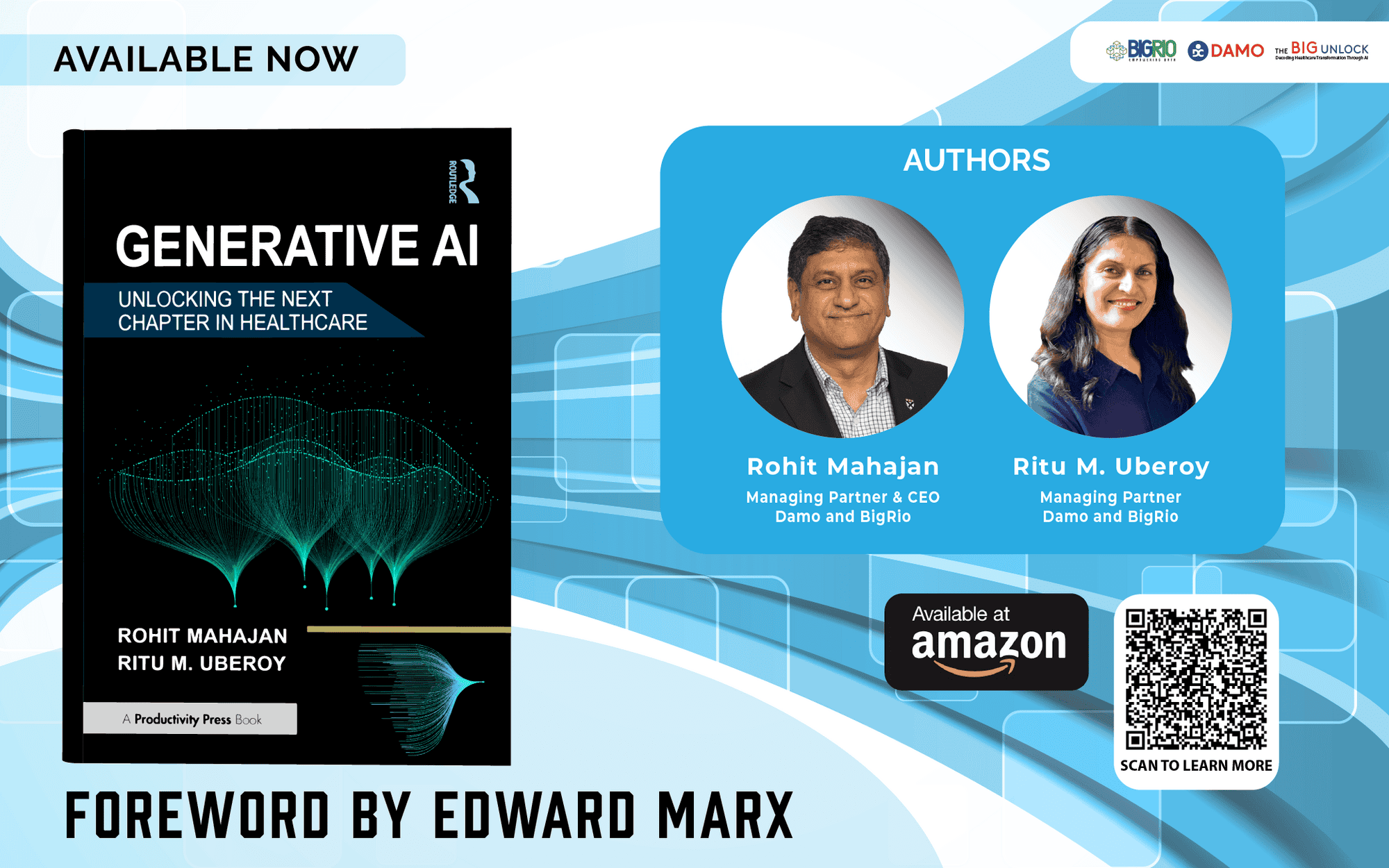
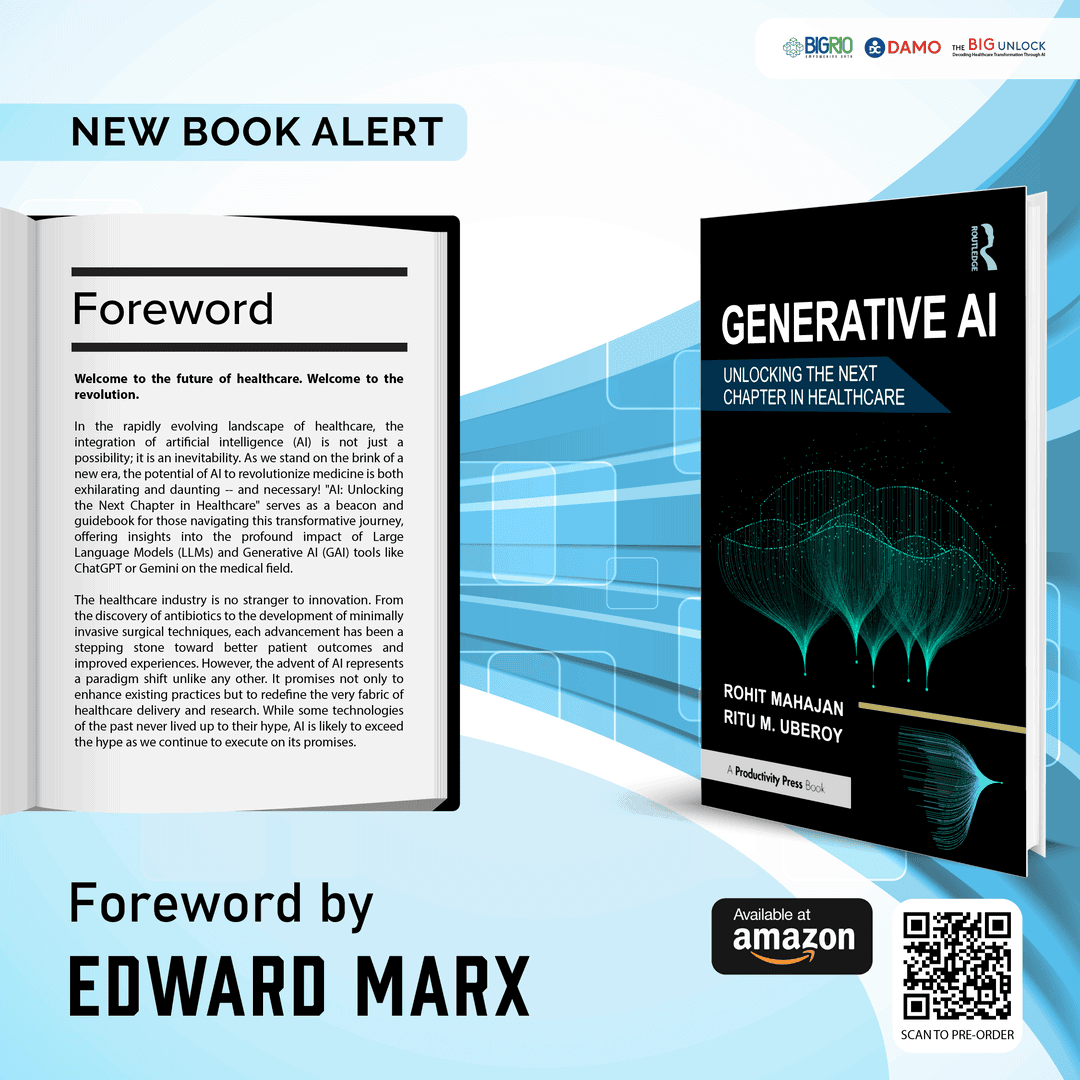
A First Look at Our New Book: Generative AI — Unlocking the Next Chapter in Healthcare

The Beginning of a New Era

When we began writing Generative AI: Unlocking the Next Chapter in Healthcare, we set out to capture a moment we could feel unfolding all around us. Hospitals were experimenting with generative models to summarize clinical notes. Pharmaceutical teams were using AI to design molecules. Patients, whether through voice agents, virtual coaches, or precision-care tools, were starting to experience medicine that learns from them in real time.

Healthcare has always evolved with technology, but something about generative AI feels different. It doesn’t just automate; it collaborates. It drafts, hypothesizes, and reasons. It changes how humans and machines think about each other and with each other.

Our goal was to document this transformation honestly, its potential and its pitfalls, and to offer leaders a practical framework for navigating what might be the most consequential technological shift in medicine since the discovery of antibiotics.

Inside the Book

In the opening chapters, we invite readers to step into the clinical frontier of this technology. Here is a brief passage from Chapter 1:

“The first wave of AI in medicine focused on detection, spotting a tumor, predicting a lab value, flagging an anomaly. The next wave, powered by generative models, focuses on creation, drafting treatment plans, designing trials, even writing the code that powers health systems themselves.”

Another early excerpt explores how this evolution is changing the physician’s daily experience:

“When an algorithm can generate a differential diagnosis or summarize a complex chart, it doesn’t diminish the clinician’s value. It redefines it. The new skill set is interpretive intelligence, the ability to question, contextualize, and apply machine-generated insight with empathy.”

Throughout the book we weaved together interviews, case studies, and lessons from our work at BigRio and Damo Consulting. Readers will find examples ranging from AI-assisted radiology and conversational triage tools to synthetic data pipelines accelerating clinical research.

But we also look beyond the technology. Each chapter ends with a reflection on governance, ethics, and human trust, because AI’s success in healthcare depends as much on values as on code.

From Algorithms to Empathy

One of our favorite sections explores the paradox at the heart of digital medicine: how machines that generate text, images, or predictions can actually restore the human connection in care.

“The gift of automation is time; the one resource healthcare professionals never seem to have enough of. When AI writes the discharge summary or reconciles the medication list, the clinician gets something priceless back: more time to give to the patient’s story.”

Generative AI, when properly implemented, becomes a quiet collaborator that amplifies compassion instead of replacing it. That vision runs through every chapter of our book.

Why This Book, Why Now?

We’re often asked what inspired us to write this book at this particular moment. The answer is urgency.

In 2025, healthcare organizations are under unprecedented pressure to modernize. They face clinician burnout, labor shortages, and an avalanche of unstructured data. At the same time, generative AI technologies are moving faster than regulation, raising new questions about bias, safety, and transparency.

We saw a need for a resource that bridges innovation and accountability. A guide written by those of us who have built AI systems inside real healthcare environments, not just in research labs.

Our message is simple:

  • The technology is powerful, but context matters.
  • Generative AI can democratize expertise, but only if governed ethically.
  • Healthcare’s next chapter must combine precision with empathy.

This is not a manifesto for automation; it’s a blueprint for collaboration. It is about ensuring that, as AI learns to write prescriptions or generate treatment options, humans remain the authors of care itself.

The Collaboration Behind the Pages

Writing together allowed us to merge two complementary perspectives. Rohit brings systems-architecture and data-science lens from decades of work in health IT and consulting. Ritu brings leadership and education focus, guiding organizations through responsible adoption and change management.

Our shared mission—reflected in the book and in The Big Unlock podcast—is to make AI accessible and actionable for healthcare executives, innovators, and clinicians alike.

We wanted the book to feel both visionary and grounded: rich in insight but practical enough that a hospital CIO, a data scientist, or a medical student could, or even a patient, could all find value in it.

Looking Ahead

As the launch approaches, we’re encouraged by the early enthusiasm from reviewers and peers who describe Generative AI: Unlocking the Next Chapter in Healthcare as “a rare combination of technical rigor and human empathy.”

In the coming months, we’ll continue the conversation through live webinars, podcast interviews, and case-study spotlights drawn from the book. Our hope is that this work sparks collaboration across disciplines and across the globe on how to responsibly unlock the full potential of Generative AI in medicine.

Order and Launch Details

Generative AI: Unlocking the Next Chapter in Healthcare
By Rohit Mahajan and Ritu M Uberoy
Published by Taylor & Francis Group
Available November 17, 2025, in soft cover, hardcover, and eBook formats.

Order or learn more at the official author webpage.

Generative AI: Unlocking the Next Chapter in Healthcare

Generative AI: Unlocking the Next Chapter in Healthcare

New Book Provides Insider Insight on the Impact of Generative AI on Healthcare!

CAMBRIDGE, Mass.Nov. 13, 2025 /PRNewswire-PRWeb/ — Artificial intelligence is no longer a future promise in healthcare, it’s the driving force behind how care is delivered, research is conducted, and data is transformed into lifesaving insight. A groundbreaking new book, Generative AI: Unlocking the Next Chapter in Healthcare, [ISBN: 9781041125693], published by Taylor & Francis Group, explores this evolution and what it means for clinicians, researchers, innovators, and policymakers worldwide.

Authored by Rohit Mahajan and Ritu M Uberoy, leading voices in healthcare technology and digital transformation, the book demystifies how generative AI and Agentic AI are reshaping patient engagement, drug discovery, diagnostics, and the very fabric of clinical decision-making.

Mahajan and Uberoy draw upon decades of experience driving AI innovation at BigRio and Damo Consulting. Through real-world case studies and expert insights, the authors examine how hospitals, payers, and life sciences organizations can responsibly implement generative AI to enhance both efficiency and patient care in healthcare delivery.

Mahajan and Uberoy draw upon decades of experience driving AI innovation at BigRio and Damo Consulting. Through real-world case studies and expert insights, the authors examine how hospitals, payers, and life sciences organizations can responsibly implement generative AI to enhance both efficiency and patient care in healthcare delivery.

The most balanced and forward-thinking treatment of generative AI in medicine to date.

“Healthcare stands at the crossroads of innovation and compassion,” said Rohit Mahajan, CEO of BigRio and Damo Consulting. “Our goal was to provide a playbook that helps organizations harness AI not just to cut costs but to elevate care quality and human connection.”

Co-author Ritu M Uberoy added, “We wanted to move the conversation beyond hype. Generative AI isn’t about replacing clinicians or healthcare decision makers, it’s about giving them superpowers through technology that learns, reasons, and collaborates.”

The book provides an accessible yet technically grounded guide to AI governance, data ethics, regulatory implications, and the emergence of agentic AI systems.


Early Reception

The release of the book comes at a pivotal time. Healthcare systems globally are accelerating digital transformation while grappling with workforce shortages and data fragmentation. Analysts forecast that AI-driven solutions could save the U.S. healthcare system more than $360 billion annually by 2030 through automation, improved diagnostics, and streamlined administrative tasks.

Early reviewers have praised the book as “the most balanced and forward-thinking treatment of generative AI in medicine to date.”

Industry thought leaders and academic reviewers note its blend of technical insight, ethical reflection, and pragmatic leadership advice.


About the Authors

Rohit Mahajan is the author of Quantum Care: A Deep Dive into AI for Health Delivery and Research, a number one Amazon bestseller exploring how AI is transforming healthcare. He is the Founder and Managing Partner at Saviance Technologies and serves as CEO of both BigRio and Damo, where he leads innovation in AI and digital health transformation.

Rohit co-hosts The Big Unlock podcast with Ritu M Uberoy, engaging senior healthcare leaders in conversations about the future of care delivery. In 2025, he received the GHLF Global Impact Award for Digital Health Innovation in recognition of his contributions to the field.

Ritu M Uberoy is a technology executive, entrepreneur, and educator with over 25 years of experience in the global software and IT industry. As Founder of Saviance Technologies and Managing Partner at BigRio and Damo Consulting, she leads digital transformation initiatives across healthcare and life sciences.

Ritu heads the Generative AI Center of Excellence at BigRio and the DigiMTM Digital Maturity Model at Damo, guiding healthcare organizations in adopting AI at scale. She is also the co-host of The Big Unlock podcast and a recognized voice in healthcare innovation.


Publication & Availability

Generative AI: Unlocking the Next Chapter in Healthcare is published by Taylor & Francis Group and will be available November 17, 2025, in print and eBook formats through Amazon, Barnes & Noble, Taylor & Francis (ebook only) and other online retailers. Discounts are available for bulk purchases through Taylor & Francis. For price quotes, please contact [email protected].

For more information or to join the launch mailing list, visit the official authors’ webpage.


About the Taylor Francis Group

Taylor & Francis Group partners with researchers, scholarly societies, universities and libraries worldwide to bring knowledge to life. As one of the world’s leading publishers of scholarly journals, books, eBooks and reference works our content spans all areas of Humanities, Social Sciences, Behavioral Sciences, Science, and Technology and Medicine. From our network of offices in Oxford, New York, Philadelphia, Boca Raton, Boston, Melbourne, Singapore, Beijing, Tokyo, Stockholm, New Delhi and Johannesburg, Taylor & Francis staff provide local expertise and support to our editors, societies and authors and tailored, efficient customer service to our library colleagues.


About BigRio

BigRio is a leading AI, Gen AI, Voice Agents, Data and Analytics professional services company. We are focused on Healthcare, Pharma, Digital Health, Provider, and Payer Industry segments with several innovative solutions. For more information, visit us at bigr.io.


Media Contact

Rohit Mahajan, The Big Unlock Podcast, 1 (857) 557-4302, [email protected]https://thebigunlock.com/

SOURCE The Big Unlock Podcast

Technology Must Remain Invisible, Yet Empower Caregivers to Deliver Care Better

Season 6: Episode #187

Podcast with Charles E. Christian,
Vice President of Technology and CTO, Franciscan Health

Technology Must Remain Invisible, Yet Empower Caregivers to Deliver Care Better

To receive regular updates 

In this episode, Charles E. Christian, VP of Technology and CTO at Franciscan Health, shares reflections from his five-decade journey in healthcare IT and how Franciscan is blending mission, compassion, and innovation to transform patient care.

Chuck explains how the health system is approaching AI adoption through strong governance and a clear focus on solving real problems, from reducing clinician burden to enhancing care delivery. He highlights several key initiatives, including voice agent pilots that help physicians reclaim after-hours time, a Tech Innovation Lab that allows teams to safely experiment and “fail fast,” and a virtual nurse mentoring program that connects senior nurses with new graduates for real-time guidance.

Chuck states that technology should serve, not distract, and the true goal of digital transformation is to enable better care for people. Take a listen.

Video Podcast and Extracts

About Our Guest

Mr. Christian is the Vice President of Technology and CTO for Franciscan Alliance, a thirteen (13) hospital system serving Indiana and Illinois.

Prior to joining Franciscan Alliance, Mr. Christian served as the Vice President of Technology and Engagement at the Indiana Health Information Exchange, the largest and oldest HIE in the country. Mr. Christian also served as the Vice President / Chief Information Officer of St. Francis Hospital, a free-standing, acute care, community hospital in west Georgia, a position he held for 2.5 years. Before his role at St. Francis, Mr. Christian served as the Vice President / Chief Information Officer for Good Samaritan Hospital, in Vincennes, Indiana. A position he held for almost 24 years. Before joining Good Samaritan Hospital, Mr. Christian worked in healthcare IT for Compucare and Baxter Travenol, in both management and implementation roles. Mr. Christian started his career in healthcare as a Registered Radiologic Technologist, serving in various Radiology roles for 14 years.

Mr. Christian holds a degree in Radiology Technology from Gadsden Community College and studied natural sciences at the University of Alabama in Birmingham.

Mr. Christian has delivered presentations on wide range of healthcare technology topics and is frequently quoted and published in national trade publications. He and co-authors, Judy Kirby and Steve Bennett published “Make I.T. Known-Marketing Strategies and Cases Studies in the Healthcare Environment.” Mr. Christian is also a frequent author in Modern Healthcare. Mr. Christian is also the author of the Irreverent-CIO health care blog. Mr. Christian has also authored chapters in multiple published management and college level textbooks.

Mr. Christian is a Life Fellow of the Healthcare Information and Management Systems Society (HIMSS) and is a Past Chair of the HIMSS Board of Directors, and past Chair of the HIMSS BOD Executive Committee. Mr. Christian was previously a member of the HIMSS Analytics Board of Directors. Mr. Christian is a Life Fellow and charter member of College of Health Information Management Executives (CHIME) and served on the CHIME BOD from 2003 through 2004 during which time he chaired the Membership Committee of the CHIME BOD. Mr. Christian is credentialed by CHIME as a Certified Healthcare CIO (CHCIO) and a Certified Digital Health Executive. Mr. Christian is a charter member of the re-established Indiana Chapter of HIMSS and served as a BOD member from 2000 - 2009. Mr. Christian served as a member of the Executive Advisory Board for Advance for Health Information Executives magazine. Mr. Christian served as a member of the Board of Directors of the Indiana Health Informatics Corporation by appointment of Indiana Governor Mitch Daniels. Governor Daniels also appointed Mr. Christian the Indiana Healthcare Information Technology Board of Directors.

Mr. Christian served as the CHIME Foundation Board of Directors as Chair and is the Past-Chair of the CHIME Board of Directors. Mr. Christian has served as the Chair of the CHIME Policy Steering Committee and continues to serve as a contributing member and is the Past-Chair of the SHIEC Advocacy Committee and is a past member of the Indiana HIMSS Chapter Board of Directors. Mr. Christian served on the Georgia HIMSS Board of Directors from 2013-2015, the KLAS Advisory Group from 2009-2013, and the CDW-Healthcare CIO Advisory Council from 2005-2010. Mr. Christian served the AHA Strategic Development Advisory Committee as a charter member. Mr. Christian is a past member of the Symantec Healthcare Advisory Group, and several other industry advisory groups/councils. Mr. Christian currently serves on the Virtustream Customer Advisory Board, the Hyland Executive Advisory Council, the Fortinet Advisory Board, HealthsystemCIO Board of Advisors and a member of the Indiana Hospital Association Information Management Council.


Charles: I am Chuck Christian. I’m the Vice President of Technology and CTO for Franciscan Health. Franciscan is a 12 or 13 hospital system, depending on how you count them. We cover a swath of the Midwest from just south of Indianapolis all the way to Chicago, basically following the I-65 corridor.

We have between 350 and 400 locations, including physician practices, imaging centers, lab draws, urgent cares, and oncology centers. It’s a pretty large organization. We have about 29,000 team members, both employees and contractors, at Franciscan Health.

We are truly mission focused. We are a Catholic healthcare system with a big C. We are owned by the Sisters of St. Francis of Perpetual Adoration. That means there are two sisters in the chapel praying for whatever they deem important and anything we ask them to pray for, 24 hours a day, seven days a week, 365 days a year. That’s where the “perpetual adoration” comes in.

We are a mission-driven organization. I believe in that. A lot of our hospitals are smaller and in underserved places, and we take care of that patient population. I think we’re really good at it.

I’ve known this organization almost 40 years. The CIO previous to Charles, who is our current COO, was a good friend of mine. I was CIO of a hospital in Southern Indiana for 24 years, and Bill and I ran a similar software stack. I watched Bill and learned a lot from him as far as how he ran this large organization.

I’ve been here for six years. I joined in April of 2019, so in dog years that’s like 35 years or more. We are very busy. I’m very blessed to have an outstanding team that manages all this, and I get to stand in awe and watch everything we accomplish every day.

Rohit: That’s fabulous. Thank you, Chuck for that intro.

Ritu: My name is Ritu Roy, and I’m the Managing Partner here at Damo and BigRio, and also the co-host of The Big Unlock podcast with Rohit. Thank you for being our guest today, Chuck. We are looking forward to an engaging and insightful conversation. With that, we can dive right in and get started.

Charles: Thank you.

Rohit: Hi Chuck. I’m Rohit Mahajan. I’m the Managing Partner and CEO at BigRio and Damo Consulting. It’s great to have you on the podcast. Like Ritu said, we’re looking forward to an engaging discussion. I’d like to start with the first thought on my mind. You’re in a mission-driven organization, and you’ve been a healthcare leader for many years. What started you on this journey? Tell us how you got started in healthcare, what attracted you, and what you’re passionate about.

Charles: Well, it depends on how far back you want to go. I’m an X-ray tech, radiologic technologist if you want to use the term. The first 14 years of my career were in radiology.

I stepped out of high school on June sixth in 1971, and on June seventh I stepped into the hospital, and I haven’t left since. Interesting enough, I did a lot of things in the radiology department and became part of the management team of that department. I guess if the chief tech had not been just a few years older than me, I’d still be there, because that was the role I wanted. But Roy just retired a few years ago, and I wasn’t going to wait that long.

I’m a geek, I’m a nerd. I was a nerd in high school. It wasn’t cool to be a nerd in high school back then, but it’s cool to be a nerd now. I did a lot of programming classes on the old System Threes with punch cards. Then I learned how to code for Z80 processors.

When we started automating hospitals back in the mid-eighties, I got chosen to run the ambulatory implementation of order management after we had put in patient management. I realized I liked it, and I knew that was where healthcare was going. Radiology has been a high-tech department in hospitals for a long time. I was trying to automate the patient record in radiology, but it was so expensive I couldn’t get any funding for it.

So I jumped ship and moved over to the vendors for about five years. Eventually I was asked to move to either an implementation manager role or the director of an outsourced IT department in southern Indiana. I did that. I had four daughters at the time, and it was the right thing to do because it was a great place to raise my girls.

I spent 24 years there. It was during the time the role of a healthcare CIO was defined. When I left that job, I was Vice President and CIO. I moved to Georgia to a health system there as Vice President and Chief Information Officer. Then I came back to Indiana and worked at the Indiana Health Information Exchange, which is now the only exchange in Indiana. I had been involved with it since 2005. I worked there for a little over four years, and then I took this role here. That’s my stint in healthcare, which has spanned over 50 years.

Rohit: That’s awesome, Chuck. You’ve been there, done it, and seen it as well. I was curious because a few days ago, when we were chatting, you were talking about being either back from UGM or about to go there.

We all know it’s a week-long affair, people go deep, and there are so many things to cover. We were wondering if you could share some of your experiences or a heads-up on topics you see coming our way.

Charles: Sure. I came home with a great deal of anxiety because of trying to figure out how we’re going to do everything and where healthcare is going. The nice thing about Epic is they now cover the entire gambit. I remember when Epic started; they were only in the ambulatory space and then only in large academic medical centers. They cover quite a scope of product these days.

Now that they have grown the applications, they have de-identified shared data, which I think is going to be a plus. The two-letter acronym was everywhere, AI, and how it’s going to be leveraged and used. They did a nice job showing scenarios of how it could be used and how organizations are using it.

We’re a risk-averse organization. We’re taking a more moderated approach. We’re getting our governance in place first. We already have a few things going through the AI mill, and we will have more. We split it into two pieces, one on the clinical side and one on the operational side. Epic has both, and I think they’re well positioned to do that work. They partner with Microsoft, and they continue to do so.

They announced they are working on their own ambient listening. They have business partners already, but they are creating their own product. I assume it will be predicated on the Microsoft stack, but they didn’t say, so I don’t know.

They also mentioned they are working on their own ERP and starting with workforce management. That makes sense because the workforce is in Epic all the time. Nursing staffing, scheduling, shifts, and how all that ties together. It’s an interesting leap.

Years ago, when Lawson, before being purchased by Infor, said they would create a patient accounting platform, I was in a CHIME focus group. When they mentioned that, a bunch of CIOs in the room asked why they would do that. You need to get your ERP right first. But I think the way Epic is approaching it makes sense.

It was great. I was there for about four days and spent most of the time listening to presentations. Judy did a great job with a big screen about what’s next and what’s coming. The rest of her team did a great job showing what you can do now and what’s coming. They do a good job setting expectations around timelines. They release quarterly. We do two a year, so we’re current from their perspective but behind. We don’t have the wherewithal to immediately adopt everything when they release it, so we have to plan accordingly.

Ritu: Yeah. So Chuck, when I was reading about the UGM, it was interesting because they said their unique proposition with AI is the de-identified patient records they have in Epic Cosmos, which is more than 15 billion patient records. They said that for the first time, it can actually move toward healthcare rather than sick care because doctors can predict trends. And I think they released two new things called Emmy and Penny, which will help doctors see the trajectory of what is going to happen with patients.

So I was curious about your thoughts because you’ve been in this industry for such a long time. Do you think that this USP—this huge bank of patient records—is really going to set them on a differentiating path compared to all the other AI startups trying to do the same thing?

Charles: I think that having the data is huge, honestly. It reminded me a lot of—if you remember years ago—they had a thing called PatientsLikeMe, where people with unique and rare diseases could find others and compare notes and treatment approaches. Working at the Indiana Health Information Exchange, I know they have about 30 years of data. Not all of it is discrete, but the majority is.

One question I asked the CEO, who is a friend of mine—and a lot of researchers use that de-identified data—is that when you create an AI model and just let it learn, there are all kinds of interesting determinations you can make once you have the data. So I think it’s going to be a game changer. Epic is also trying to outdo themselves. Given the market of EHR vendors, there aren’t many left standing. There are three or four. Others are creating similar repositories, but I’m not sure they have the long-term vision or the wherewithal to get it done. Knowing the talent Judy has pulled together, I think it will be very interesting to see what comes down the pike.

Ritu: Thank you.

Rohit: Chuck, you mentioned you’re taking a conservative approach to AI adoption and setting governance before taking major steps. How do you think about innovation or typical problem-solving—for example, reducing cognitive load across the organization? How do you balance this conservative approach with the fast-paced changes happening in the marketplace?

Charles: I think we have to be very clear about what problem we’re trying to solve. There are so many solutions being thrown at us—“Hey, we can do this, we can do that”—but often it’s not a problem we actually have. So we’re trying to pick and choose which targets to shoot at.

I’m married to a critical care nurse, so I’m very careful about getting in the way of the nursing staff. She’s retired, but for me, technology needs to be invisible. If it gets in the way of people being able to do their job, then it’s a problem.

If you think about it for a minute—and I’ll give you Chuck’s opinion—we don’t really have electronic medical record systems for documenting the care of the patient. What we have are electronic systems that capture information required for billing. That’s part of the problem. We have all these required elements clinicians have to document—physicians have to dot all the i’s and cross all the t’s—to get the appropriate words in so it can be translated into billing codes, ICD-10 codes, HPS codes, and so on. It truly gets in the way of taking care of patients.

But once we get that discrete data, we can use AI and other tools to help determine a better course of treatment. You’re never going to hear me say that we should depend solely upon AI. It has to be moderated and reviewed by someone with clinical training. Physicians have shown me I’ve been wrong more times than you can imagine. Working together and having good data aggregation is important.

One thing I learned early on when implementing the first physician order entry and clinical documentation systems was that physicians said: “Don’t tell me what I already know. Tell me what I don’t know. Better yet, tell me what I need to know about the patient in front of me right now.” There are things they don’t know. That’s where data aggregation from health information exchanges helps, because patients don’t get care in one location or from one physician.

I’m living proof of that. I get care in two—actually three—health systems because that’s where my specialists are. My primary care doctor wants to know what my orthopedist did or what my cardiologist’s course of treatment is, because he’s managing my diabetes and a few other things. Having access to information—recent labs, imaging studies—is extremely important.

We talked about interoperability, and that’s where it comes into play. Most hospitals in Indianapolis are on Epic, so you can get data easily. From non-Epic systems, there are mechanisms too. When I see my cardiologist—who uses a different system—and he already knows what my medications are because they were recently changed by another physician, that’s positive. I don’t have to list everything. When they know my latest labs, that’s positive too, because we’re not hunting for information.

It’s about providing information that is important to the treatment at that moment.

I had the privilege of sitting in a presentation—maybe eight or nine years ago—at Scripps Institute. They showed a demo of what a patient encounter could be. It was very Star Trek–like. The computer or AI interacted with the physician and patient appropriately. It listened in the background and captured information about the encounter. When the physician said, “We need to order a CT scan of your lower abdomen,” it was already getting that scheduled. When the patient was ready to leave, everything was set. It was also checking for recent labs and reminding the physician if the patient—say a diabetic—was due for an eye exam or foot check.

I think it’s about having access to the information so we can inform—not determine but inform—the physicians. Because at the end of the day, physicians are accountable for the outcomes. They have to be in control, not the AI.

Ritu: Yeah,

Charles: we’re not ready for Skynet yet.

Ritu: I think you described a multi-agent system where the agents are off doing things and then bringing it all back for the physician to review. With that being said, we all know that AgTech is one of the top trends everyone’s talking about these days. What are your thoughts on voice agents? Where is Franciscan with that? Have you had exposure to or tried voice agents in the hospital?

Charles: Yeah, we’ve got a trial. We’ve got over 200 physicians working on those. Is it going to be the end-all, be-all? I don’t know. The physicians seem to like it. It assists them; it helps with their pajama time.

I’ve listened to conversations from other health systems that were early adopters, and I have to go back in time to when we were looking at automating physician practices in Southern Indiana. We visited a group of 14 family practice doctors. The husband and wife who started the practice mostly did OB and family medicine. Their use of computers was minimal—they were still mostly on paper. But they had other physicians who, I think, slept with their laptops.

The interesting thing was that depending on how well a physician adopted the computer system and molded it to how they practiced, they got to take advantage of it. I think it’s going to be the same with AI and voice agents. If they allow it to help and figure out how to incorporate it into how they think and practice, they’ll see the benefit. The systems are pliable enough now that it’s easier to do.

When I was in Georgia, we needed to automate a lot of OB practices on the same platform. One OB had been practicing almost 30 years and already had a solution he had customized. He told me I would tear it out of his cold, dead fingers. So we worked with him. The new system was more flexible and pliable than his old one, and he became a champion because he was willing to take the time to understand how he could use the technology to help him practice.

I think that’s the key. If you’re resistant to it, that’s fine—that’s perfectly okay. But people who write software often think all physicians think the same way. They’re absolutely wrong. It depends on where they trained. I learned that when implementing emergency room electronic medical records. The physicians who helped design the software were trained with a very different approach to critical thinking than our physicians. We had to relearn and figure out ways to adjust, because once clinicians are trained a certain way, it’s hard to change those habits and the way they gather and maintain information.

Ritu: Thank you. Great answer.

Rohit: Chuck, I’d like to ask your thoughts about the innovation process. How do you approach it, and what are some of the things you do to foster innovation?

Charles: One of the things we did was stand up a Tech Innovation Lab. Honestly, it was a selfish move because people were just bringing technology into the organization. All the enterprise architects report to me, and we work together to understand what will work in our environment and what won’t. We try to standardize as much as we can.

So I created the Innovation Lab to bring these innovations into a controlled environment and try them there. It’s a walled garden. It’s not connected to the rest of the network. It has its own connections to the internet. So if we blow something up, it only blows up in the lab. That’s why we did it.

What we’re able to do is bring ideas in and fail fast—figure out what works and what doesn’t. We’ve done that several times. Virtual nursing is something we’ve worked on a lot. There were all kinds of interesting opportunities brought to us. One facility went ahead and put a solution into a live patient population, and we found out quickly that’s not how you do it. You don’t test that kind of thing in a live environment. It frustrates the staff and patients, and it leaves leadership thinking, “We already tried that—it doesn’t work.”

Well, you tried what doesn’t work. Let me show you what will work.

We needed the opportunity to rapidly figure out what would work. One issue with that failed experiment was that the people who built the carts didn’t understand our environment. They put a wireless access point in the cart that was incompatible with our network. Once we got the cart, we figured it out quickly. We re-engineered it, and it works fine now—but we’re not using that cart because it was over-engineered and very expensive.

We’re trying to use standard components that can be supported and replaced quickly. The idea is to generate a lot of ideas and figure out how to use them appropriately without getting in the way.

You also have to think about the aesthetics of the equipment you’re bringing in. The first cart had a big five-wheel base—kind of a star shape. In some patient rooms, it was in the way. Nursing quickly said, “That’s not going to work.”

So we found an iPad holder that hangs on the patient’s bedroom wall when not in use. It’s out of the way, easy to access, and uses magnetic connectors so if someone snags it, it just comes apart. No trip hazard.

You must consider not only the technology but how it fits in patient rooms.

Originally, the idea was that the Innovation Lab would review the technology, understand how it fits together, and then install it in our SIM labs. We have two—one north, one south. Then the simulation teams would put it in a physician office or patient room and see how it fits before we use it in live care. That’s our next step with virtual nursing.

We also have a lot of conversations with organizations that have fully rolled out these solutions. We learn from their experiences. A mistake is only a mistake if you don’t learn from it. If you do, then it’s experience. We leverage their experience so we don’t repeat the same things, and so we can move quicker.

Rohit: That’s awesome. As we are approaching the end of the podcast, I would like to ask if you would touch on the mentorship program.

Ritu: Yes, I would really like to hear more about that, Chuck, because it’s something unique and I think it would be interesting for our listeners as well.

Charles: Just making sure we’re talking about the virtual mentoring program. After COVID, we were bringing on a lot of new nurse graduates. When you bring someone into that role, they need a more experienced nurse for a procedure they may have never done before. That usually means waiting for that nurse to come to them.

We had a couple of nursing staff in the mentorship program who came up with a way to use technology for an on-screen virtual visit with the new nurse. The experienced nurse could walk them through the procedure and be there with them, or if the new nurse had a question, they could step out into the hall, ask it, and go back in. It improved speed to delivery of care more than anything else.

It also gave seasoned nurses a chance to step away from what they were doing instead of traveling to another location. If they need to go in person, they still do, but this gave us another option. We got great feedback from both the new nurses and our more mature nursing staff, and we rolled it out through the enterprise. I haven’t checked in on it recently, but I assume it’s still running. I only hear when things break, and if it’s not broken, I’m not going to fix it. I assume the technology is still working and paying dividends.

Ritu: Thank you so much.

Rohit: So, Chuck, as we come to the end of the podcast, any closing remarks or thoughts you’d like to share before we finish?

Charles: I’ve been in healthcare a long time. Healthcare is a target rich environment for creativity and innovation. But we’re still taking care of patients the same way we did, and it’s about the human touch and caring for people.

When I first started in radiology years ago, I was taken aback that people weren’t always treated as people. They were exams. Do this gallbladder in this room, do this hip nailing in that room. I was reminded they’re people. They could be my family. They could be my children. That’s why I’m passionate about making sure the technology works and doesn’t get in the way.

Have we reached the pinnacle? No. Is it better? I think it is. But we’re still trying to figure it out every day. As long as we have great people passionate about providing outstanding care and we understand where that ability comes from, we’ll keep moving forward.

We’re a Catholic healthcare system, and our rule is we start most meetings with prayer. We are called to love one another as God loves us, and we need to remember that every day. That’s why I keep doing what I’m doing.

Rohit: Awesome.

Ritu: Thank you so much, Chuck.

Rohit: Really appreciate it.

Charles: Okay. Thanks for the opportunity to share.

————

Subscribe to our podcast series at www.thebigunlock.com and write us at [email protected]   

Disclaimer: This Q&A has been derived from the podcast transcript and has been edited for readability and clarity.

About the Hosts

Rohit Mahajan is an entrepreneur and a leader in the information technology and software industry. His focus lies in the field of artificial intelligence and digital transformation. He has also written a book on Quantum Care, A Deep Dive into AI for Health Delivery and Research that has been published and has been trending #1 in several categories on Amazon.

Rohit is skilled in business and IT  strategy, M&A, Sales & Marketing and Global Delivery. He holds a bachelor’s degree in Electronics and Communications Engineering, is a  Wharton School Fellow and a graduate from the Harvard Business School. 

Rohit is the CEO of Damo, Managing Partner and CEO of BigRio, the President at Citadel Discovery, Advisor at CarTwin, Managing Partner at C2R Tech, and Founder at BetterLungs. He has previously also worked with IBM and Wipro. He completed his executive education programs in AI in Business and Healthcare from MIT Sloan, MIT CSAIL and Harvard School of Public Health. He has completed  the Global Healthcare Leaders Program from Harvard Medical School.

Ritu M. Uberoy has over twenty-five years of experience in the software and information technology industry in the United States and in India. She established Saviance Technologies in India and has been involved in the delivery of several successful software projects and products to clients in various industry segments.

Ritu completed AI for Health Care: Concepts and Applications from the Harvard T.H. Chan School of Public Health and Applied Generative AI for Digital Transformation from MIT Professional Education. She has successfully taught Gen AI concepts in a classroom setting in Houston and in workshop settings to C-Suite leaders in Boston and Cleveland. She attended HIMSS in March 2024 at Orlando and the Imagination in Action AI Summit at MIT in April 2024. She is also responsible for the GenAI Center of Excellence at BigRio and DigiMTM Digital Maturity Model and Assessment at Damo.

Ritu earned her Bachelor’s degree in Computer Science from Delhi Institute of Technology (now NSIT) and a Master’s degree in Computer Science from Santa Clara University in California. She has participated in the Fellow’s program at The Wharton School, University of Pennsylvania.

About the Legend

Paddy was the co-author of Healthcare Digital Transformation – How Consumerism, Technology and Pandemic are Accelerating the Future (Taylor &  Francis, Aug 2020), along with Edward W. Marx. Paddy was also the author of the best-selling book The Big Unlock – Harnessing Data and Growing Digital Health Businesses in a Value-based Care Era (Archway Publishing, 2017). He was the host of the highly subscribed The Big Unlock podcast on digital transformation in healthcare featuring C-level executives from the healthcare and technology sectors. He was widely published and had a by-lined column in CIO Magazine and other respected industry publications.

How to Build AI Literacy Programs in Healthcare Organizations

How to Build AI Literacy Programs in Healthcare Organizations

As artificial intelligence (AI) reshapes every industry, healthcare stands at a critical inflection point. Generative AI, predictive analytics, and intelligent automation are changing how clinicians diagnose, treat, and manage patients. Yet the biggest challenge isn’t technology – it’s people.

AI literacy has become essential to bridging the gap between innovation and real-world healthcare impact. It involves equipping professionals to understand, evaluate, and responsibly collaborate with AI systems. Without it, even the most advanced tools risk underuse, mistrust, or outright rejection. Building AI literacy goes beyond learning how to use new technologies, it’s about preparing the healthcare workforce to partner effectively with AI, interpret its outputs, and make informed, ethical decisions in patient care.

In one of the recent episode of The Big Unlock podcast, Jan Beger, Head of AI Advocacy at GE HealthCare joined hosts Rohit Mahajan, Managing Partner and CEO at BigRio and Damo, and Ritu M. Uberoy, Managing Partner at BigRio and Damo to share insights from GE’s global experience in building large-scale AI literacy programs. His perspective offers a practical roadmap for health systems, medtech firms, and digital health leaders who are navigating this transformation.

Why AI Literacy is the Cornerstone of AI Adoption

AI literacy sits at the intersection of technology, people, and culture. As Jan notes, healthcare conversations about AI often “get technical very quickly,” leaving behind the clinicians and professionals expected to use these tools in their daily work.

To make AI adoption sustainable, organizations must focus on the human side of innovation – helping staff understand what AI can and can’t do, building trust in its outputs, and empowering people to see it as an enabler rather than a threat.

According to a study by Workday and LinkedIn, 70% of job skills are expected to change by 2030, with AI driving much of that shift. In healthcare, where regulation, risk, and ethical complexity are high, this means rethinking skill sets and workflows in real time.

AI literacy ensures that clinicians, administrators, and executives can use AI responsibly to improve patient outcomes and system efficiency.


Defining AI Literacy for Healthcare

Jan Beger offers a simple but powerful definition of AI literacy built around three competencies:

  1. Collaborate responsibly with AI: Understand the fundamentals of AI, from machine learning to generative models, and how they integrate into clinical or operational workflows.

  2. Explain AI outputs: Be able to interpret what the AI system is showing — for example, how an algorithm supports a diagnostic decision or a chatbot retrieves information.

  3. Critically evaluate AI outputs: Avoid blind trust. Clinicians and employees must question results, verify data sources, and know when human judgment should override machine recommendations.

This mindset shift, from passive use to active collaboration, is the foundation of effective AI literacy.


Designing a Scalable AI Literacy Program

GE HealthCare’s approach provides a template for others to follow. Their Responsible AI strategy integrates literacy into employee education through multiple channels:

Live sessions and workshops with AI experts for hands-on learning.

Best-practice sharing sessions where teams demonstrate how they’ve applied AI in real workflows.

Self-paced learning modules tailored for different roles and levels of expertise, from basic AI terminology to deep dives into specific use cases.

For example, GE’s Hello AI program offers foundational and professional courses for healthcare professionals and students. The free foundational module introduces key AI concepts, while the professional course provides 25 hours of specialized healthcare content for a nominal fee. Over 5,000 healthcare professionals from 70+ countries have already participated.

This layered, accessible model helps organizations with large, distributed workforces like GE’s 51,000 employees across 160 countries — develop AI fluency at scale.


Building Engagement and Overcoming Resistance

Change management is at the heart of any AI literacy initiative. As Ritu M. Uberoy, co-host of The Big Unlock, noted, healthcare professionals often approach AI defensively: “Why should I do something that’s going to take my job away?”

To address this, organizations must position AI as a tool for empowerment, not replacement. Jan emphasizes that in every conversation, “we need to remove worries and fears among healthcare professionals” and show how AI helps them do their jobs better by increasing accuracy, efficiency, and patient satisfaction.

Face-to-face engagement remains key. Jan, who travels extensively to meet clinicians and hospital teams, finds that in-person discussions build trust and reveal practical barriers that online training alone can’t address. However, hybrid approaches which is a combination of digital learning and local advocacy can make programs more sustainable and scalable.


Measuring Success and Evolving Continuously

No literacy initiative is complete without metrics. Organizations must define what success looks like, and it will differ by role.

For example, GE HealthCare measures tangible productivity gains among software developers using AI coding tools. But for field engineers or clinical teams, success may initially focus on engagement, confidence, or adoption rates rather than speed or output.

As use cases evolve, KPIs must evolve too – from tracking participation in AI courses to measuring how AI literacy translates into improved workflows, reduced errors, or better patient outcomes.

Another lesson from GE’s experience is – AI literacy programs are not “set it and forget it” initiatives. They require continuous updates, new content, and maintenance to reflect the pace of innovation and regulatory changes.


The Broader Mission: Rethinking Roles in an AI-Driven Future

AI literacy isn’t just an education program, it’s a mindset shift. As Beger summarizes, everyone in healthcare should “start rethinking their job descriptions with AI in mind.” Understanding how AI can augment one’s role fosters curiosity, confidence, and innovation.

Moreover, Jan’s call to action extends beyond healthcare: “We have so many great AI experts working in gaming or banking. If they truly want to make an impact on society, they should consider joining healthcare.” That spirit of collaboration across domains, between technologists, clinicians, and educators, is what will truly accelerate the responsible use of AI in healthcare.

Building AI literacy programs in healthcare is not a technical challenge, it’s a leadership one. It requires empathy, structure, and a relentless focus on people. GE HealthCare’s example shows that when organizations invest in education, trust, and responsible innovation, they don’t just prepare their workforce for the future, they help shape it.

Empowering Patients and Closing Health Gaps with AI and Connected Care

Season 6: Episode #186

Podcast with Anil Saldanha
Chief Innovation Officer
Rush University System for Health

Empowering Patients and Closing Health Gaps with AI and Connected Care

To receive regular updates 

In this episode, Anil Saldanha, Chief Innovation Officer at Rush University System for Health shares how Rush is addressing deep-rooted health inequities in Chicago by targeting the life expectancy gap through bold, system-wide interventions.

Anil highlights Rush’s commitment to public health, chronic disease management, and early cancer detection by referring to innovative initiatives like Rush Connect Plus, which is an on-demand, subscription-based virtual care model, and the rollout of Grail’s multi-cancer early detection test. He explains their use of cutting-edge AI technologies, from ambient listening and AI-powered symptom checkers to novel behavioral health kiosks leveraging multi-agent generative AI for PTSD care.

Anil points to the impact of consumer-driven digital tools, health equity analytics, and a data warehouse that will enable targeted interventions for chronic care. He closes with optimism about AI’s future in healthcare, the shift toward “connected care anywhere,” and the growing role of empowered, informed patients. Take a listen.

Video Podcast and Extracts

About Our Guest

Anil Saldanha is the Chief Innovation Officer at Rush University System for Health. With a background in business and technology, Anil has the advantage of having learned skills and experiences in non-healthcare fields to now transform healthcare at Rush. He operates at the intersection of public health, community health, and delivery. He was a founding team member of Tempus AI in Chicago and has held leadership roles at companies such as GoSecure Inc., Trustwave Inc., Red Hat Inc., and Sun Microsystems. He is a strategic advisor on innovation and transformation to clinical, research, and technology leadership at Rush.


Ritu: Hi Jan, welcome to our podcast. We are so happy to have you here on The Big Unlock podcast, season six, and we are headed to 180 plus episodes now. Really great having you on the show today. Just a brief introduction — my name is Ritu Roy. I am the Managing Partner here at BigRio and Damo Consulting and a co-host of The Big Unlock podcast with Rohit. And with that, I’ll hand it over to Rohit. He can give a brief introduction and then over to Jan. Thank you.

Rohit: Hi Jan, great to have you here, like Ritu said, and thank you for making the time in the evening from where you are in Germany. Really excited to have this conversation. I’m Rohit Mahajan, CEO and Managing Partner at BigRio and Damo Consulting. And with that, Jan, would you like to start with your intro?

Jan: Absolutely. First of all, thank you both for having me today and for the invitation. Truly appreciate it and looking forward to a good conversation about this exciting topic of artificial intelligence in healthcare. As you mentioned, my name is Jan Beger, Head of AI Advocacy at GE Healthcare. My mission is to transform AI in healthcare from a conceptual promise into a high-impact reality. I focus on equipping healthcare professionals, executives, and the next generation—like students—with the knowledge, skills, and mindset to thrive in this AI-enabled future of healthcare.

Ritu: That’s really great. Wonderful introduction and really interesting title you have, Jan, because we’ve talked to CIOs and CMIOs, but you’re someone who’s the Head of AI Advocacy. I think that’s something new. Would love to hear about your journey—how you came to be in this role, how you combine expertise in healthcare and AI, and what your vision for AI is at GE Healthcare.

Jan: Thank you so much. I hope you agree—based on the many conversations you’ve had in this space with different experts—when we talk about AI in healthcare, those conversations very quickly get technical. But I think in healthcare, and maybe as an entire industry, we have not focused enough on one important aspect: making sure that those clinicians and healthcare professionals we expect to use AI technologies are taken with us on this technology journey.

So, things like change management and education—making sure we focus on the human aspect—is something I think has not been emphasized enough across the industry, maybe even to a point that it slows down AI adoption. This is what I’m really focusing on—what we need to do to remove worries and fears among healthcare professionals, help them gain a solid understanding of the technology, build basic trust in AI, and get them interested in testing and piloting these solutions. Ultimately, the idea is this could lead to faster adoption.

Ritu: Yeah, that’s an extremely valid point, Jan, because I was just at a conference at MIT yesterday, and this was one of the key things that came up — that it can’t be a top-down approach because whenever you ask somebody to do something, their initial reaction is to go into defensive mode and say, “Why should I do something that’s going to take my job away?” or “What’s in it for me?”
So we would be really interested in hearing from you how you are able to get buy-in from the teams across GE and get everybody on board, making sure everyone has the literacy skills, like you said, to understand that AI can actually be a tool to do your job better, increase productivity, bring efficiency, and do all the good things AI promises.

Jan: First of all, I think across different domains and industries — in a health system, but the same in a medtech or healthtech company — everything is being reinvented right now in real time. There’s a lot of activity in that space.
We at GE also look into processes and how we can support our workforce with generative AI technologies. Again, the technology is one part of the story; the second is how we make sure we enable our workforce — 51,000 employees across the globe in 160 countries — to leverage this technology well and responsibly, to truly make a difference in their day-to-day work.

This is exactly the same in the healthcare space as well. We are entering a state of skill redefinition in real time. Things that were important in the past — like routine execution, static expertise, or hierarchical knowledge — are becoming less relevant. And on the flip side, we see more important skills emerging, like adaptability, systems thinking, tech fluency, and AI know-how.

We all have to prepare for this. There was a study recently done by Workday and LinkedIn, which said that 70% of job skills are expected to change by 2030, with AI driving much of this shift. This is not just healthcare — this is across different industries.
Maybe in healthcare, this kind of change will feel a little bit slower because it’s highly regulated. But what I want to say by mentioning this number is that there is a massive technology transformation ahead of us, and a lot of people don’t even understand that this is coming — and coming with quite some impact.

We not only need to continue building great technologies and integrating AI into products and workflows, but also need to create awareness and build AI literacy so that everyone across the healthcare ecosystem can use this technology responsibly for better care and improved patient outcomes.

Ritu: Thank you, Jan. That answer leads into two follow-up questions. First, like you said, the speed of invention is at an unprecedented scale, which we haven’t seen before. The speed is also leading to democratization, where anybody can do low-code or build a tool or a prototype.
That leads to the next thing — this whole concept of AI literacy. If the tools are so easy to use and can unlock so many new ideas, you want everybody across the company to understand how to use them and be fluent. So, how does GE, with such a large employee base — 51,000 employees across 161 countries — handle this? Do you have an overall AI literacy program with different levels, or what systems are you setting up to address this?

Jan: Great question. First, I should define what AI literacy means to me, because it could mean different things for different people.
In a nutshell, I would say it’s three things: one is the competencies required to collaborate responsibly with AI and interact with technologies such as large language models and generative AI.
The second is to be able to explain their outputs.
Third, it’s to be able to critically evaluate those outputs — and then do something meaningful with them. As you know, the worst thing would be to blindly trust those outputs and leverage them in your day-to-day work. So, critical evaluation is a very important part of AI literacy overall.

At GE Healthcare, there is an AI literacy program in place, which is part of a broader Responsible AI strategy. We have different ways to educate our teams — live sessions where they can dial in and learn from experts on how to use generative AI integrated into our tech stack, best practice sharing sessions, and self-paced learning offerings for employees at different levels — from a foundational course covering basic AI terminology to more use-case-specific, in-depth training for specific groups and roles.

Rohit: I was just wondering, Jan, about the key initiatives you’re taking, which are so valuable moving forward for the company and the employees themselves, because they’re basically increasing their skillset as well. We’ve been thinking about some success metrics for our own organization and for some of our clients who’ve been asking for similar services. Any thoughts or ideas, Jan, on what success metrics one could track for such initiatives in any organization setting out on this journey?

Jan: I think those success metrics and KPIs are critically important to measure traction and see where we’re heading and if the investment in these efforts makes sense. For instance, one area where we’ve seen early positive results is with our software developers. With AI capabilities, we’ve seen improvements in speed—getting code done, getting code reviewed, those kinds of things.
So this is maybe one area where, across industries, we already have several best practices and standard ways to measure performance and progress. But then there are other groups of employees where those measures are harder to obtain, or maybe it’s too early because we just started using these capabilities.

For instance, our field engineers—people who visit customer sites to check or repair MRI devices—now get AI support through tools we’ve developed where they can have a natural language conversation with the service manual of a specific device or get help with scheduling. Those are new use cases, and we’re still defining the right success measures or KPIs for them.
There’s a wide range of capabilities and use cases across different groups and business units. Over time, we’re getting better at measuring progress. As I mentioned, in software development we already have specific measures in place and are seeing the benefits of AI, but there are other areas where it’s still greenfield, and KPIs will evolve over time.

Ritu: Thank you, Jan. Our listeners—and most of us—always like to hear about success stories and success metrics, but it’s also important to learn from failure. It would be really interesting to hear from you about a couple of cases where things didn’t go so well, what you learned from that, and how you came back to do something even better.

Jan: I’ll give you an example of a tool we built in-house to support our marketing teams with approved external communication content. We’re feeding a retrieval-augmented generation model with external content so that when a communications specialist gets a request from the media, they don’t need to start from scratch—they can leverage this chatbot, get approved responses, tweak and refine them, and then use them.
It’s useful, but it’s also a lot of work—making sure the knowledge base of the chatbot is always up to date. Maintenance is a challenge and requires manpower and effort. So it’s not just a one-off where you build a cool AI tool and send it out for people to use. A lot of those tools require continuous focus, effort, and maintenance.

Rohit: While you do this at such a global scale, are you traveling a lot and meeting people in person to motivate them, or are you using online tools to make this happen? What are some of the key tools or methods you’re using for the advocacy you’re doing with such a large group of people?

Jan: That’s a great question. When I introduced myself, I should have mentioned that I focus most of my time on our customers—health systems, hospitals, and healthcare professionals—and focus my AI advocacy and literacy work mainly on clinicians.
To answer your question, I travel about 80% of my time. I’ll be in the US next week in Seattle and Atlanta. It’s important to meet medical and clinical experts in person. I always learn from them—I want to understand their concerns, fears, issues, what works, and what doesn’t. Even with great remote technology, face-to-face works best for me.

Of course, there are things that can be done online too. For example, for a few years we’ve been running an AI literacy program for healthcare professionals called Hello AI. When you go to helloai-professional.com, you’ll find more information. It’s a self-paced e-learning offering with two modules where clinicians, students, researchers, and executives can educate themselves about AI in healthcare.

We’ve received great feedback. So far, we’ve educated more than 5,000 healthcare professionals from over 70 countries. Later this year, we’re launching a new learning module built specifically for healthcare executives—because this population is becoming increasingly important in the overall transformation.
Over the last few years, healthcare systems have made progress adopting and piloting AI, but mostly through point solutions—like a decision-support tool in radiology or something with EHRs. Executives now need to think about AI strategically—how to plan, deploy, and measure ROI at a system level. That’s why we’re launching this new offering for healthcare executives on the Hello AI platform later this year.

Rohit: That is fantastic. I think there’s definitely a need for such a thing. Tell us a little more about Hello AI. How did it come into being? Did it precede your joining GE Healthcare, or is it a GE Healthcare initiative? We’d love to learn more about this venture.

Jan: Thank you so much. First of all, when we think about AI in healthcare, there’s often the impression that this is a domain led by big tech or the innovative healthcare AI startup ecosystem around the globe. But that’s only partially true. The reality is that when you look into AI and machine-learning-enabled medical devices, you’ll quickly realize that it’s also a huge play for traditional medtech.
Companies such as GE Healthcare and Siemens Healthineers are leading the pack. The FDA has authorized more than 1,000 AI-enabled medical devices so far, and about 100 of those come from GE Healthcare.

We feel a responsibility as a leader in this field not only to build and integrate great technologies into our devices but also to focus on the change management and education for those we expect to use these technologies. This is how it started—and what Hello AI is.

It’s a learning offering for healthcare professionals and executives built by a network of partners—GE Healthcare, universities, and technology companies—working together to spread the word. Our mission is to make AI literacy accessible and affordable for healthcare professionals worldwide.

We’re trying to provide healthcare AI–specific education, not just general AI education. There’s a lot of free AI content online from big tech, but we focus on healthcare-specific AI education at no or low cost. For instance, we currently have two modules: a free foundational course for everyone, and a more in-depth Professional course with 25 hours of content for just $99.

Rohit: That’s awesome. Would you be open to licensing this as well? In case a large enterprise is interested in your offerings, I’m sure you’re looking at some licensing deals too.

Jan: Our partnership model is threefold. First, we look for partner institutions to join Hello AI and co-develop new content. AI is a fast-paced field, and there’s a lot happening. For instance, earlier today we had a session on federated learning, which is part of new content we’re adding to our modules.
Second, we focus on co-marketing and co-promotion.
Third, when an institution joins us and contributes in these areas, we provide their employees or members free access to Hello AI content.

Rohit: That’s awesome. This is great—you’re offering such a robust platform to increase awareness and education in this space. As we come to the end of the podcast, Jan, any other thoughts or predictions in AI? There’s a lot of agentic AI coming our way—any thoughts for the future audience?

Ritu: And I think Jan wanted to show the device, which might relate to my question: do you have an example where AI has made a difference in patient outcomes—something you’ve put into a device that really made an impact?

Jan: Maybe just quickly, Rohit. I’ll share a use case that’s been very impactful, and then I’ll give a few takeaways. First, as I showed earlier, this is a handheld wireless ultrasound scanner for specific use cases. Imagine an emergency doctor carrying this wherever they go—a powerful imaging tool with no radiation. But one limitation is that it’s very operator-dependent. You need a certain level of education and experience to get high-quality medical images.

So a few years ago, we embedded AI into these machines. It tells you, while scanning the patient, how to move the probe to get high-quality images. This means even less-experienced clinicians can achieve excellent results. The idea is to democratize ultrasound so it’s accessible to more users. That’s just one of many examples of AI making an impact in healthcare today.

A few takeaways for your audience:
First, I strongly recommend everyone—whether in tech, corporate, or healthcare—start rethinking their job descriptions with AI in mind. Think about what you do every day, how AI could support you, and how it changes your role. When you start thinking this way, you’ll begin learning about AI, open your mind to opportunities, and adopt the right mindset to embrace this technology.

Second, we have so many great AI experts, data scientists, and developers worldwide working in industries like gaming or banking. If you know them, tell them about healthcare. If they truly want to make an impact on society, they should consider joining healthcare. It’s still early-stage and slower because of regulation, but if you have this expertise, the industry would truly value it. We can make a real difference here.

Ritu: Thank you, Jan. This was awesome. I’m sure listeners have a lot to absorb and reflect on. Your call to action is excellent—this is an industry where we can see the maximum impact and really help people. Thank you.

Jan: Thank you so much for inviting me.

————

Subscribe to our podcast series at www.thebigunlock.com and write us at [email protected]    

Disclaimer: This Q&A has been derived from the podcast transcript and has been edited for readability and clarity.

About the Hosts

Rohit Mahajan is an entrepreneur and a leader in the information technology and software industry. His focus lies in the field of artificial intelligence and digital transformation. He has also written a book on Quantum Care, A Deep Dive into AI for Health Delivery and Research that has been published and has been trending #1 in several categories on Amazon.

Rohit is skilled in business and IT  strategy, M&A, Sales & Marketing and Global Delivery. He holds a bachelor’s degree in Electronics and Communications Engineering, is a  Wharton School Fellow and a graduate from the Harvard Business School. 

Rohit is the CEO of Damo, Managing Partner and CEO of BigRio, the President at Citadel Discovery, Advisor at CarTwin, Managing Partner at C2R Tech, and Founder at BetterLungs. He has previously also worked with IBM and Wipro. He completed his executive education programs in AI in Business and Healthcare from MIT Sloan, MIT CSAIL and Harvard School of Public Health. He has completed  the Global Healthcare Leaders Program from Harvard Medical School.

Ritu M. Uberoy has over twenty-five years of experience in the software and information technology industry in the United States and in India. She established Saviance Technologies in India and has been involved in the delivery of several successful software projects and products to clients in various industry segments.

Ritu completed AI for Health Care: Concepts and Applications from the Harvard T.H. Chan School of Public Health and Applied Generative AI for Digital Transformation from MIT Professional Education. She has successfully taught Gen AI concepts in a classroom setting in Houston and in workshop settings to C-Suite leaders in Boston and Cleveland. She attended HIMSS in March 2024 at Orlando and the Imagination in Action AI Summit at MIT in April 2024. She is also responsible for the GenAI Center of Excellence at BigRio and DigiMTM Digital Maturity Model and Assessment at Damo.

Ritu earned her Bachelor’s degree in Computer Science from Delhi Institute of Technology (now NSIT) and a Master’s degree in Computer Science from Santa Clara University in California. She has participated in the Fellow’s program at The Wharton School, University of Pennsylvania.

About the Legend

Paddy was the co-author of Healthcare Digital Transformation – How Consumerism, Technology and Pandemic are Accelerating the Future (Taylor &  Francis, Aug 2020), along with Edward W. Marx. Paddy was also the author of the best-selling book The Big Unlock – Harnessing Data and Growing Digital Health Businesses in a Value-based Care Era (Archway Publishing, 2017). He was the host of the highly subscribed The Big Unlock podcast on digital transformation in healthcare featuring C-level executives from the healthcare and technology sectors. He was widely published and had a by-lined column in CIO Magazine and other respected industry publications.

Day 4 – Driving Action from Innovation

Day 4 – Driving Action from Innovation

Picture of Rohit Mahajan

Rohit Mahajan

Co-Host of The Big Unlock Podcast

Share This Post

Wrapping up Day 4 at HLTH USA 2025, the energy of this event remains strong—and with good reason. The conversations here long ago moved beyond ideas to tangible actions shaping the future of healthcare.

Today’s sessions and keynotes emphasized sustainable, equitable healthcare models anchored in AI and data-driven insights. What stood out most to me? The recognition that technology’s true value lies in how it delivers measurable impact—improving care access, outcomes, and provider workflows at scale.

The main stage brought leaders together around one common goal: aligning innovation with real-world healthcare challenges. From diagnostics to policy, from startups to enterprises, the message was clear—collaboration is essential to accelerate progress.

I was particularly inspired by the final partner meetings and exhibitor demos that spotlighted solutions ready for deployment today. This event has reinforced why HLTH remains the go-to platform for driving healthcare transformation forward.

As I reflect on these past days, I’m excited to continue uncovering and sharing stories that unlock the next chapter of health innovation through The Big Unlock Podcast.

Thank you to all the brilliant minds who made this year’s HLTH so impactful. Until next time—let’s keep turning breakthrough ideas into better health outcomes.

#HLTH25 #HealthcareInnovation #AI #HealthEquity #TheBigUnlock #DigitalHealth #RohitMahajan

Event Gallery

Advancing Pediatric Care with AI in Radiology and Virtual Trials

Season 6: Episode #185

Podcast with Paul Yi, MD, Associate Member in Radiology, Section Chief of Intelligent Imaging Informatics (I3), St. Jude Children's Research Hospital

Advancing Pediatric Care with AI in Radiology and Virtual Trials

To receive regular updates 

In this episode, Dr. Paul Yi, Associate Member, Department of Radiology, Section Chief of Intelligent Imaging Informatics (I3) at St. Jude Children’s Research Hospital, shares his journey from radiology training at Johns Hopkins to leading AI initiatives at St. Jude, focusing on pediatric cancer and other catastrophic diseases. 

Dr. Yi highlights how AI is transforming the radiology workflow, from automating imaging protocols and improving image reconstruction to translating complex medical reports into patient-friendly language. He emphasizes the importance of data strategy, discussing the integration of clinical EMRs, PACS, and research databases, ensuring interoperability while leveraging domain expertise across disciplines. He explores generative AI applications, including virtual imaging trials that simulate patient populations for safer, faster, and cost-effective clinical research, as well as patient-facing applications like AI chatbots for healthcare education, noting both potential and limitations in trust and accuracy.

Dr. Yi reflects on bridging research and commercialization, underscoring the need to align academic and industry incentives. He envisions a future powered by multimodal AI models that combine imaging, vitals, labs, and clinical text to deliver comprehensive, personalized insights – accelerating precision care and innovation in pediatric oncology. Take a listen.

Video Podcast and Extracts

About Our Guest

Paul Yi, MD is an Associate Member, Department of Radiology and Section Chief of Intelligent Imaging Informatics (I3) at St. Jude Children's Research Hospital. Dr. Yi is a practitioner of diagnostic imaging. The field of radiology and diagnostic imaging has been a proving ground for medical applications of artificial intelligence for a number of years. As a physician-scientist, Dr. Yi’s research interests include the development and application of AI and deep learning towards medical imaging applications, with special interest in evaluating the trustworthiness and fairness of deep learning models.


Q: Hi, Dr. Michael Docktor, welcome to our Big Unlock podcast. We are really happy to have you as a guest on our show. Uh, it’s on our sixth season now, and, uh, we are looking forward to this conversation. I’m sure we’ll have a very engaging and interesting conversation about dog health, about healthcare in general, and the new trends about AI and all the buzzwords that people want to hear. Welcome to our show — we’d like to start with introductions. Happy to have you give your introduction. Thank you.

Michael: Yeah, thank you so much for having me. Yeah, I’m Michael Docktor, co-founder and CEO of Dock Health. I’m an ologist by trade. I am now on this, uh, healthcare venture outside of Boston Children’s Hospital where I started my GI career.

I was a busy clinician working on the clinical side as well as in innovation and informatics, and found that we had wonderful tools in the world outside of healthcare and struggled with my own challenges around managing all the tasks that are part of patient care. I found that I was using task management and project management tools that were not built for healthcare.

I scratched my head and wondered why we don’t have these things for healthcare. That was a journey. We started just over five years ago. We spun out Dock Health from Boston Children’s, and we’ve been on a very exciting journey in the world outside the academic walls since then.

It’s been fun. I’m excited to talk to you more about, uh, what we’re doing.

Q Great. That’s a great introduction. Thank you for letting our listeners know. We usually like to start with how you came into healthcare because everyone has an interesting story about what inspired them to become a physician.

For you, it’s particularly interesting because you’ve created this interface between design, technology, and healthcare — and you went beyond just visualizing what you wanted to do or asking why somebody doesn’t fix it, to actually building it yourself. I’d love to hear more about how you came into medicine and then into technology.

Michael: I could probably spend the entire podcast on this question. Obviously, my last name is Doctor, so there was some planting occurring there, and there’s something to be said for that.

One of my earliest memories was wanting to grow up to be a doctor. My younger sister had some GI issues when we were young, and I became very close with her gastroenterologist. I followed her on her journey and, unbeknownst to me, ended up following one of my mentors and was inspired to do the work for other children the way my sister was cared for. That was the initial inspiration.

You mentioned design. That’s interesting because my mother is an interior designer, my father is a dentist who specialized in aesthetics, and design — how things look, feel, and work — has always been part of my DNA. It was an amazing journey to go from being a traditional doctor in pediatric gastroenterology to discovering the importance of user experience and user interface.

Then the iPhone came out, then the iPad, and that really started me on my journey of exploring app development and software, and wondering why we didn’t use these wonderful devices in our pockets the way we should. That journey started more than 10 years ago and has led me to this perfect intersection of healthcare, design, and informatics, creating better experiences for patients and providers.

There’s a lot to unpack there, but people ask me if I would do it differently if I had the chance to do it all over — and absolutely not. I’m doing exactly what I want to be doing right now.

Q: Thank you for sharing that. That gives us so much perspective into how you came into this field, the influence of your parents, and how everyone around you inspired you to do this. That’s really interesting.

That leads us into how you built Dock Health. Tell us some examples of how you saw this becoming transformational in actual implementations with clients. When you built the tool, did you visualize exactly what it would do? Did it go beyond what you thought it would achieve in a healthcare setting? We’d love to hear more about that.

Michael: We’re far beyond where I ever thought we’d be when we first started this journey. That’s the exciting part. Fundamentally, we have such an administrative and operational challenge in healthcare. I saw it firsthand as a busy clinician struggling to manage all the clinically adjacent work that had to be done for my patients.

For example, I might have a patient with Crohn’s disease who needs to go to an infusion center. There are all these downstream tasks and administrative steps that need to be done by a team of people. We didn’t have assistants to do that, and the electronic health record wasn’t built for it.

A quarter of the $5 trillion spent in healthcare goes to administrative and operational challenges, and there really are no tools built for that. We rely on paper checklists, email, faxes, and spreadsheets to manage all the work happening outside the electronic health record.

For me, the realization was that I was using wonderful project management and task management tools to run software projects in my innovation and informatics roles—and yet nothing like that existed in healthcare. Patients, in many ways, are projects. There are tasks that form the essence of care, and they need to be tackled, managed, and collaborated on, with visibility and accountability across teams. That didn’t exist.

What we are now doing is serving as that productivity platform for healthcare, one that sits alongside the electronic health record in synergy, helping manage all the administrative and operational tasks of patient care in ways the EHR wasn’t designed for.

Some examples would be managing patient intake and all the processes associated with it. Referrals, inbound and outbound, with all the paperwork, eligibility checks, and faxes—those workflows are still incredibly manual. Referrals are a great example: 80% of referrals that come into major academic medical centers are still arriving by fax, despite the fact that they’re using Epic, a wonderful electronic health record.

These processes are still incredibly laborious, take too long, and are inefficient. Patient care suffers along the way. There’s a gigantic bottleneck around the administrative and operational work that moves patients through their journeys, and that’s what we’re focused on fixing.

Q: This is what we hear from a lot of our clients and other CIOs and C-suite leaders who come to our podcast—that this is one major problem with healthcare. It’s siloed, and the processes are really stuck in the dark ages.

We were talking to somebody from Athena, and they said they had an 800-person offshore center in India just to screen faxes. When a fax came in, one person looked at it to see if it was a pizza order or a referral. It sounds unbelievable in this day and age, but that’s how it works. I’m amazed to hear this from you as well. It’s remarkable.

Michael: Yeah. In fact, Athena is a partner of ours, and we’re working on referral management. It’s an incredibly antiquated process where everyone loses visibility. The amount of manual labor required to process these things is shocking in this day and age, when they can be handled through process automation, AI, and agents.

Q: Exactly. You’re talking about agentic, we’re talking about voice agents, and yet we’re still dealing with faxes. That’s really interesting to know.

Michael: There is reason to be hopeful. Healthcare is always many decades behind, but the adoption of AI is progressing more rapidly than I’ve seen any technology adopted in healthcare. There’s reason for hope.

Q: That leads into my next question, but before we get there, you mentioned Dock Health as a productivity platform. That’s what it does for doctors, clinicians, and patients. But when we talk to our doctors, clients, and health systems, the one word that always comes up is complexity. They deal with so many different systems and have to learn something new each time.

Where does Dock Health fit in? Is it another system they have to manage, or does it help reduce that burden?

Michael: Yeah, it’s all about reducing the burden and improving the user experience. That’s been fundamental to our belief system since the founding of the company.

First and foremost, we’re trying to become the productivity platform and the hub that handles the administrative and operational work. Instead of being “another system,” we’re often replacing spreadsheets, paper checklists, emails, and faxes—the ways we’ve traditionally managed the 50% or more of administrative and operational tasks required for patient care.

The EHR is great for clinical work, billing, prescribing, and scheduling, but so much happens downstream that isn’t covered. I’d argue we are creating the hub for that. Just as the EHR is the clinical hub, Dock Health serves as the operational hub. Together, it’s really one plus one equals three.

We’re also aiming to be much more consumer-like in our approach. Our tool can onboard a customer in 30 minutes. We offer a free trial, and for small organizations that want to get up and running, they can start using it right away—just like downloading an app. It’s lightweight, highly configurable for end users, and designed with a strong focus on user experience.

The real challenge is that clinicians don’t want another tool. They’re busy and need to spend their time in the EHR. Our core users are often the super users: front office staff, back office teams, operational leaders, and administrative staff who leverage our tool every day.

The important piece is that we connect to the electronic health record and provide visibility for clinicians. If they’re interested, they can see where a patient is in their journey or where a process stands, but they don’t have to be in our system all day, checking tasks or learning another workflow.

The intent is to provide that operational hub for administrative and support staff—the essential members of the care team—while clinicians continue their work in the EHR and often drive tasks into our system through their orders and actions there.

Q: Is the integration with the EHRs native, like with Epic, Cerner, and the big ones?

Michael: Yeah. We’re on the marketplace with a number of the top EHRs, including Epic and Cerner. We’re also working with Mayo Clinic, their Mayo Clinic Platform, and their Deploy platform.

The other thing I’d mention is that many organizations use our tools without being integrated with the electronic health record. That’s often because they’re smaller practices—mental health, concierge care, or primary care—that simply need a hub to handle administrative and operational work and collaborate as a team.

We spend a lot of time helping organizations define their processes, and those processes can then live in Dock, where they can be collaborated on and turned into operational best practices. That’s something that often doesn’t happen in traditional healthcare organizations, and our tool is valuable even when it’s not connected to an EHR.

Of course, the real value comes when we integrate with systems—EHRs, CRMs, patient engagement tools—and serve as the hub while automating as many tasks as possible. That’s when the flywheel starts turning, and organizations begin to feel the benefits of automation and work reduction. It ultimately moves the needle in a measurable way.

Q: So, you’re saying if there’s an integration with the EHR, then it’s end-to-end and people can see a complete view of what’s happening. But even without the EHR, because it helps with workflow management, it’s valuable for practices?

Michael: It’s just like every other industry. They have Asana, JIRA, Trello—all these tools where a lot of the real work gets done. That provides value in itself by giving a clear view into where the patient is in their journey and what process they’re following.

When we integrate with an EHR or other systems, we can then automate those workflows. For example, when a fax comes in, we can launch a workflow for a new patient referral. When a lab order is placed, we can launch a workflow for follow-up. Or when a patient has a procedure, we can launch a process for their downstream follow-up.

Q: That leads into the next question, which is your learning journey with AI. What advice do you have for our listeners about where AI is headed? And with voice agents and agentic tech being buzzwords, where do you see Dock Health going? Are you also looking at implementing voice agents?

Michael: AI is incredibly exciting. I’ve put it out there that we’re an AI-first company. We’ve been thinking about this for a while, and we already have what we call Dock Intelligence in production with customers. We started with the basics, using foundational models and generative AI to process large troves of data.

Now, we can summarize all the work being done for a patient and create a snapshot for the end user—showing all tasks, workflows, patient context, and even clinical context if available. That gives a quick overview of what’s happening. Users can edit that snapshot if needed, or generate a note that writes back to the EHR to keep the operational and clinical record in sync.

That’s the first step in our AI journey. From there, we realized tasks bundle into workflows, workflows can be automated, and now we’re starting to farm out those tasks to agents and AI. For example, a voice agent could follow up with a patient to confirm a referral or review lab results. We’re actively pursuing that, as well as leveraging AI to extract data from faxes to automate referral processes.

AI is the big unlock. In the next three to five years, I believe most administrative and operational tasks will be handled by automation and AI agents orchestrating together. These agents need rails to run on and structure to guide them, and end users must remain in the loop to provide oversight and visibility. But the lion’s share of this work will be handled by agents—and we’re building that future right now.

Q: Are you aligning specifically with any particular LLM or provider, or are you going to be completely agnostic?

Michael: I’d like to think we’ll be agnostic. We’re doing plenty of building on some of the foundational models ourselves, and we’re partnering where we can with great tools. For example, with voice agents, we’re not necessarily building them ourselves—there are excellent options out there. What we are doing is building our own homegrown AI agents that can manage processes and facilitate handoffs from task to task.

Our approach has always been to recognize that there’s a wonderful ecosystem out there. We want to be the hub that connects to the best-of-breed systems—whether that’s Epic as an EHR, Salesforce as a CRM, or other tools we can leverage to create a healthy ecosystem. That’s what we’re pursuing.

Q: I wanted to ask a question about that because with the LLMs, one of the main problems is the hallucinations or the repeatability or the trust factor there. So I saw that Dock is HITRUST certified. So, I just wanted to ask, what are your views on that? Because in terms of using generative AI when we talk to our clients, uh, for implementations on LLMs, or they’re more comfortable certainly with the administrative tasks, but even with the administrative tasks there’s always the question of what are the guardrails you put around that and how do you make sure that the results that you are seeing or you are displaying on Doc Health, you know, stay within that, those bounds of accuracy. Whathat are your thoughts around that?

Michael: AI is incredibly exciting—it’s moving at the speed of light, and everyone wants to benefit from it. I do think administrative and operational areas of healthcare are lower-hanging fruit and far less risky. We’re not yet in a place where we can reliably use AI for absolute clinical decision support and autonomy, though I believe we’ll get there in the not-too-distant future.

For now, the clunky and manual administrative work is ripe for AI. Still, we need to be mindful of potential hallucinations. In our experience so far, we haven’t seen issues, but we’ve put safeguards in place. That means keeping a human in the loop to ensure outputs are appropriate and relevant. We also give users the ability to edit results before they’re sent—whether it’s a summary being emailed to a colleague or written back into the EHR as a clinical note.

It’s essential to show your work. If we’re pulling data from various sources, we show those sources. We keep users in the loop, give them control to review and edit, and maintain tight feedback loops to catch and address anything off.

So far, even foundational LLMs have been surprisingly strong in our relatively narrow use cases. The real challenges will come as we move toward higher-risk clinical decision support—but I’m confident we’ll get there quickly.

Q: It’s interesting you mentioned humans in the loop and the fact that people can review or edit what’s being generated. But with agents, one of the key defining characteristics is autonomy—they can make API calls, send emails, even browse the web to find and act on information. How do you think about that level of control being handed over?

Michael: I think it’s all about balance. The value of task automation and workflow automation is clear. For us, one of our strengths is providing a user interface where the end user can actually see where a process is in its journey.

We’re working on features like showing confidence levels or confidence intervals for data extracted—for example, from a fax. That way, we not only show our work but also give transparency into how accurate that extraction might be. Using our interface, which breaks workflows into tasks, we can show exactly where a process stands. If we believe human involvement is needed, we assign a task and call someone in to review.

Even in the agentic future—which is already upon us and actively being built and tested—we see ways to keep humans in the loop. Operating entirely in a vacuum is risky. Part of my mantra, coming from clinical practice, is that I lacked visibility and accountability in the work being done on behalf of my patients, lost in a black hole of faxes and emails. It’s important to show where the patient is in their journey, where the process stands, whether an agent is handling it or automation is moving data between systems. Giving people visibility and the ability to drill down is critical.

Q: That’s an interesting viewpoint. You mentioned the front and back office and clinicians, but I didn’t realize patients might also have visibility into the system.

Michael: That’s certainly the vision for the future. Right now, our solution focuses on creating visibility and accountability for the care team—clinical and operational staff. But ultimately, the patient is part of the care team too. I would love to see a future where patients are assigned tasks and the rest of the care team has visibility into their progress. I think that’s inevitable. For now, we’re focused on giving the traditional care team the tools they need, but over time, I see patients and their home-based care team being part of that ecosystem.

Q: So I think we are almost at the end of the podcast. We would like to conclude by asking you what you think, maybe give a horizon of like a year and then maybe a five-year horizon. What do you think the top trends that are going to be in AI, and particularly for you at Dock Health? What are the three things that you are really keeping close tabs on and you feel that it’s going to really impact your product and be very transformational.

Michael: It’s tough to predict because AI is moving so fast. Moore’s Law doesn’t apply anymore—the doubling is happening every few months. Everything right now is AI, and “agentic” is the word of the day. I’ve even heard “ambient agents.” We see our role as orchestrating workflows where agents will carry out the majority of tasks.

When we started Dock Health, I imagined a day when it would be smart enough to handle processes automatically. AI has accelerated that roadmap by five to ten years, and the pace keeps shrinking. I truly believe that in the next five years, when healthcare spending in the U.S. reaches $10 trillion, the $2.2 trillion spent on administrative and operational costs may actually shrink because of operational efficiencies unlocked by AI.

We want to give care teams superpowers. Administrative and operational staff deserve better tools to do their work. Just as ambient scribes are now relieving clinicians from documentation, I believe AI will do the same for the administrative and operational burdens in healthcare. Within three to five years, I expect most of that work will be automated. Humans will still play a role, but much of it will feel like it just happens—almost magically.

If you zoom out five years from now, it will look like magic. But by then it will feel obvious. And that excites me, because at the end of the day, patients, our economy, and the world need more efficient care. The fact that we waste a trillion dollars a year on administrative tasks is shameful. Patients are asked to take on too much, like reminding us about referrals or tracking down lab results. These things happen because we’re human and don’t scale well. But now we have incredible tools at our fingertips, and I believe the next few years will be the most exciting time healthcare has ever experienced.

If we zoom out five years from now, it’s going to look like magic—but by then it will feel obvious. I’m excited for that future because, at the end of the day, patients, our economy, and our world need more efficient care. The fact that we waste a trillion dollars a year on administrative and operational tasks is shameful.

Too much of the burden falls on patients. Physicians and care teams often say, “Call me if you don’t get your referral in a couple of days,” or, as I saw with my own mom recently, patients are left chasing down lab results. These things happen because we’re human and we don’t scale well.

Now, we have incredible tools at our fingertips. That’s why I believe the coming years will be the most exciting time in healthcare that I’ve ever experienced—and likely the most exciting time the world has ever seen. Healthcare is primed for transformation and opportunity.

Q: Thank you for being with us on our podcast. It was a wonderful conversation, and we look forward to sharing your vision for the future with our listeners.

Michael: Thanks so much.

————

Subscribe to our podcast series at www.thebigunlock.com and write us at [email protected]  

Disclaimer: This Q&A has been derived from the podcast transcript and has been edited for readability and clarity.

About the host

Paddy is the co-author of Healthcare Digital Transformation – How Consumerism, Technology and Pandemic are Accelerating the Future (Taylor & Francis, Aug 2020), along with Edward W. Marx. Paddy is also the author of the best-selling book The Big Unlock – Harnessing Data and Growing Digital Health Businesses in a Value-based Care Era (Archway Publishing, 2017). He is the host of the highly subscribed The Big Unlock podcast on digital transformation in healthcare featuring C-level executives from the healthcare and technology sectors. He is widely published and has a by-lined column in CIO Magazine and other respected industry publications.

About the Host

Ritu M. Uberoy has over twenty-five years of experience in the software and information technology industry in the United States and in India. She established Saviance Technologies in India and has been involved in the delivery of several successful software projects and products to clients in various industry segments.

Ritu completed AI for Health Care: Concepts and Applications from the Harvard T.H. Chan School of Public Health and Applied Generative AI for Digital Transformation from MIT Professional Education. She has successfully taught Gen AI concepts in a classroom setting in Houston and in workshop settings to C-Suite leaders in Boston and Cleveland. She attended HIMSS in March 2024 at Orlando and the Imagination in Action AI Summit at MIT in April 2024. She is also responsible for the GenAI Center of Excellence at BigRio and DigiMTM Digital Maturity Model and Assessment at Damo.

Ritu earned her Bachelor’s degree in Computer Science from Delhi Institute of Technology (now NSIT) and a Master’s degree in Computer Science from Santa Clara University in California. She has participated in the Fellow’s program at The Wharton School, University of Pennsylvania.

About the Host

Rohit Mahajan is an entrepreneur and a leader in the information technology and software industry. His focus lies in the field of artificial intelligence and digital transformation. He has also written a book on Quantum Care, A Deep Dive into AI for Health Delivery and Research that has been published and has been trending #1 in several categories on Amazon.

Rohit is skilled in business and IT  strategy, M&A, Sales & Marketing and Global Delivery. He holds a bachelor’s degree in Electronics and Communications Engineering, is a  Wharton School Fellow and a graduate from the Harvard Business School. 

Rohit is the CEO of Damo, Managing Partner and CEO of BigRio, the President at Citadel Discovery, Advisor at CarTwin, Managing Partner at C2R Tech, and Founder at BetterLungs. He has previously also worked with IBM and Wipro. He completed his executive education programs in AI in Business and Healthcare from MIT Sloan, MIT CSAIL and Harvard School of Public Health. He has completed  the Global Healthcare Leaders Program from Harvard Medical School.

About the Legend

Paddy was the co-author of Healthcare Digital Transformation – How Consumerism, Technology and Pandemic are Accelerating the Future (Taylor &  Francis, Aug 2020), along with Edward W. Marx. Paddy was also the author of the best-selling book The Big Unlock – Harnessing Data and Growing Digital Health Businesses in a Value-based Care Era (Archway Publishing, 2017). He was the host of the highly subscribed The Big Unlock podcast on digital transformation in healthcare featuring C-level executives from the healthcare and technology sectors. He was widely published and had a by-lined column in CIO Magazine and other respected industry publications.

Day 3 – Diagnostics, Data, and the Dawn of Intelligent Care

Day 3 – Diagnostics, Data, and the Dawn of Intelligent Care

Picture of Rohit Mahajan

Rohit Mahajan

Co-Host of The Big Unlock Podcast

Share This Post

Day 3 at HLTH USA 2025 was where boundaries blurred between breakthroughs in diagnostics, bioinformatics, and clinical intelligence — a powerful convergence making precision medicine accessible, scalable, and actionable. Conversations today revolved around how AI isn’t just augmenting care — it’s anticipating it.

From liquid biopsy breakthroughs to digital pathology and point-of-care testing innovations, the Diagnostics Zone became a hub for collaboration between AI, cloud, and clinical labs. Companies showcased advances that shifted healthcare from reactive to predictive — reducing diagnostic delays and driving early intervention across oncology, cardiology, and rare diseases.

The AI Zone was standing room only for Microsoft Health’s deep dive into contextual AI agents designed to accelerate provider insights in real time. Meanwhile, investor and startup dialogues underscored how trust and traceability in data pipelines remain central to AI’s adoption in diagnostics and population health.

Themes from the main stage extended this thread — with providers calling for smarter integration between diagnostic intelligence and reimbursement workflows, and innovators urging joint accountability between payers, developers, and clinicians.

Walking through the show floors, it was clear that HLTH isn’t just hosting dialogues — it’s brokering the future of connected care. In the words of one panelist: “Accuracy will always matter, but accessibility is where real impact begins.”

Tomorrow the event closes but today offered the clearest blueprint yet for AI-driven transformation that’s both ethical and executable.

Event Gallery

Day 2 – Scaling, Diagnostics, and AI in Action – Highlights from HLTH USA 2025

Day 2 – Scaling, Diagnostics, and AI in Action – Highlights from HLTH USA 2025

Picture of Rohit Mahajan

Rohit Mahajan

Co-Host of The Big Unlock Podcast

Share This Post

Thanks for following along. Day 2 brought depth, signal and high-energy exchanges at HLTH USA 2025. I’m looking forward to what tomorrow brings — stay tuned for more insights from Las Vegas!

What stood out on Day 2:

  • Key thematic zones took centre-stage:
    • The AI & Emerging Technology Zone from ~10:00 AM to 4:00 PM, where practical deployment stories and ethical frameworks were front-and-centre.
    • The Diagnostics Zone ran concurrently, highlighting how imaging, molecular, data-driven diagnostics are positioning themselves differently.
    • The Pharma & Life Sciences track, was also active between ~10:00 AM and 4:00 PM, with interesting panels including how AI is reshaping drug development and distribution.
  • Award moments added high-energy: e.g., the “Digital Health Hub AI Awards,” “Diagnostics Awards,” and later the Women @ HLTH reception in the evening. HLTH+1

On the floor, I heard consistent themes such as scaling from pilot to production, moving beyond idealistic AI demos, and diagnostic-enabled value models (vs just imaging tech).

Key reflections for our global health-innovation community

  • AI is shifting from buzz to deployment: It’s clear now that the conversation is less “if we adopt AI” and more “how we embed AI responsibly across diagnostics, pharma and care delivery”.
  • Diagnostics is re-emerging as a core business model, not just a cost centre: With the Diagnostics Zone packed and panels discussing ROI, leadership is viewing diagnostics as strategic (e.g., early detection + data-driven care) rather than ancillary.
  • Pharma & life sciences are embracing tech-driven agility: On panels today, organizations shared how AI and diagnostics are entering earlier into the R&D and commercialization pathways — the ecosystem is consolidating around fewer, more integrated solutions.
  • Awards matter — they signal what the community values: Watching the Digital Health Hub Awards gave me a lens on what makers, investors and buyers are looking at: scalability, measurable outcomes, equity, and sustainability.
  • Networking remains where the magic happens: While the content is strong, the momentum lies in the pairings — whether it’s 1:1 matches via Investor Connect or spontaneous show-floor meetups. These informal connections often generate the most actionable insights.

Event Gallery

Day 1 – Kicking Off HLTH USA 2025: Big Ideas, Bold Voices, and Real Momentum

Day 1 – Kicking Off HLTH USA 2025: Big Ideas, Bold Voices, and Real Momentum

Picture of Rohit Mahajan

Rohit Mahajan

Co-Host of The Big Unlock Podcast

Share This Post

It was an energizing start to HLTH USA 2025 here in Las Vegas! As host of The Big Unlock podcast and a media attendee, I spent the day immersed in conversations, sessions, and stories that set the tone for a transformative week ahead in healthcare innovation.

  • The event opened with a full slate of partner programs—from Value-Based Care to Pharma and Clinician tracks—each tackling the urgent need for integration, data transparency, and sustainable value creation in care delivery.
  • The opening keynote and welcome session brought palpable momentum. Mark Cuban’s fiery take on drug pricing and transparency reminded everyone that the business of healthcare must evolve to serve patients better.
  • AI was everywhere—not as a buzzword, but as a practical tool already reshaping clinical workflows, patient access, and decision-making. The message was clear: AI-native healthcare isn’t coming; it’s already here.

The networking floor buzzed with startups, investors, and providers exploring collaborations that could define the next generation of digital health solutions.

Some takeaways

  • Transparency and affordability are fast becoming the moral currency of healthcare innovation.
  • AI adoption has crossed the experimentation phase—the focus now is on scaling responsibly and proving measurable outcomes.
  • Ecosystem collaboration is the new competitive advantage; silos are dissolving as employers, payers, and tech companies seek shared wins.
  • And perhaps most importantly—the best insights often came from hallway conversations and spontaneous exchanges, not just the mainstage.

Event Gallery

Join Me at HLTH 2025 as We Unlock the Future of Health Together

Join Me at HLTH 2025 as We Unlock the Future of Health Together

Join Me at HLTH 2025 as We Unlock the Future of Health Together

Connect with Rohit on LinkedIn

Subscribe to The Big Unlock Podcast newsletter

“HLTH brings together the brightest minds in healthcare to drive real-world transformation through AI, data, and workflow innovation. The energy, collaboration, and actionable insights here are truly reshaping the future of care at scale.”

– Rohit Mahajan, Co-host of The Big Unlock Podcast

As HLTH USA 2025 approaches, I am filled with genuine excitement and anticipation for what promises to be an incredible gathering of healthcare visionaries, innovators, and leaders. HLTH has truly evolved into the heartbeat of healthcare transformation, a place where technology meets purpose and the future of health is actively shaped.

One of the most thrilling aspects for me this year is the focus on AI in healthcare. From predictive analytics and patient engagement to workflow automation and governance, the AI spotlight at HLTH is illuminating how health systems can accelerate adoption and drive meaningful outcomes. The conversations around AI Centers of Excellence are especially inspiring—they showcase real-world use cases where AI isn’t just an experiment but a scalable, trusted part of the clinical and operational fabric.

I will be speaking at the Future and Health: AI Centers of Excellence Summit during HLTH. This is where I’ll share insights on leveraging platforms, data fabric, and AI agents to power enterprise transformation. I am eager to contribute to calls for responsible AI use that elevates quality, safety, and most importantly, the patient and caregiver experience.

Through The Big Unlock Podcast, I will be interviewing many of these incredible minds on-site, gathering firsthand stories about the challenges, successes, and breakthroughs shaping the AI-powered future.

Beyond the panels and sessions, what truly energizes me is the opportunity to reconnect with my peers and meet new industry leaders. HLTH brings together this remarkable ecosystem—tech innovators, clinicians, executives, investors—all passionate about pushing healthcare forward. Through The Big Unlock Podcast, I will be interviewing many of these incredible minds on-site, gathering firsthand stories about the challenges, successes, and breakthroughs shaping the AI-powered future.

The vibe at HLTH is unique—intense yet collaborative; visionary yet grounded in practical reality. There’s a collective drive to unlock new possibilities and to learn from one another’s journeys. It’s that spirit of openness and forward-thinking that makes HLTH more than an event—it’s a launchpad for the next wave of healthcare innovation.

For anyone interested in the future of health, HLTH is the place to be. Whether you’re passionate about AI, digital health, patient experience, or enterprise transformation, the energy and insights you’ll find here are unmatched. I’m looking forward to bringing back those voices and perspectives through the podcast, sharing episodes that inspire, challenge, and inform.

In the coming days, follow my journey at HLTH for exclusive interviews, thought leadership, and a front-row seat to the evolution of healthcare. Together, we’ll explore how AI and innovation are not just concepts but powerful tools unlocking better care for all.

Stay tuned and get ready to unlock the future of health with me at HLTH USA 2025!

Connect with Rohit on LinkedIn

Subscribe to The Big Unlock Podcast newsletter

Event Gallery

Day 1 – Kicking Off HLTH USA 2025: Big Ideas, Bold Voices, and Real Momentum

Picture of Rohit Mahajan

Rohit Mahajan

Co-Host of The Big Unlock Podcast

Share This Post

It was an energizing start to HLTH USA 2025 here in Las Vegas! As host of The Big Unlock podcast and a media attendee, I spent the day immersed in conversations, sessions, and stories that set the tone for a transformative week ahead in healthcare innovation.

  • The event opened with a full slate of partner programs—from Value-Based Care to Pharma and Clinician tracks—each tackling the urgent need for integration, data transparency, and sustainable value creation in care delivery.
  • The opening keynote and welcome session brought palpable momentum. Mark Cuban’s fiery take on drug pricing and transparency reminded everyone that the business of healthcare must evolve to serve patients better.
  • AI was everywhere—not as a buzzword, but as a practical tool already reshaping clinical workflows, patient access, and decision-making. The message was clear: AI-native healthcare isn’t coming; it’s already here.

The networking floor buzzed with startups, investors, and providers exploring collaborations that could define the next generation of digital health solutions.

Some takeaways

  • Transparency and affordability are fast becoming the moral currency of healthcare innovation.
  • AI adoption has crossed the experimentation phase—the focus now is on scaling responsibly and proving measurable outcomes.
  • Ecosystem collaboration is the new competitive advantage; silos are dissolving as employers, payers, and tech companies seek shared wins.
  • And perhaps most importantly—the best insights often came from hallway conversations and spontaneous exchanges, not just the mainstage.

Event Gallery

Day 2 – Scaling, Diagnostics, and AI in Action – Highlights from HLTH USA 2025

Picture of Rohit Mahajan

Rohit Mahajan

Co-Host of The Big Unlock Podcast

Share This Post

Thanks for following along. Day 2 brought depth, signal and high-energy exchanges at HLTH USA 2025. I’m looking forward to what tomorrow brings — stay tuned for more insights from Las Vegas!

What stood out on Day 2:

  • Key thematic zones took centre-stage:
    • The AI & Emerging Technology Zone from ~10:00 AM to 4:00 PM, where practical deployment stories and ethical frameworks were front-and-centre.
    • The Diagnostics Zone ran concurrently, highlighting how imaging, molecular, data-driven diagnostics are positioning themselves differently.
    • The Pharma & Life Sciences track, was also active between ~10:00 AM and 4:00 PM, with interesting panels including how AI is reshaping drug development and distribution.
  • Award moments added high-energy: e.g., the “Digital Health Hub AI Awards,” “Diagnostics Awards,” and later the Women @ HLTH reception in the evening. HLTH+1

On the floor, I heard consistent themes such as scaling from pilot to production, moving beyond idealistic AI demos, and diagnostic-enabled value models (vs just imaging tech).

Key reflections for our global health-innovation community

  • AI is shifting from buzz to deployment: It’s clear now that the conversation is less “if we adopt AI” and more “how we embed AI responsibly across diagnostics, pharma and care delivery”.
  • Diagnostics is re-emerging as a core business model, not just a cost centre: With the Diagnostics Zone packed and panels discussing ROI, leadership is viewing diagnostics as strategic (e.g., early detection + data-driven care) rather than ancillary.
  • Pharma & life sciences are embracing tech-driven agility: On panels today, organizations shared how AI and diagnostics are entering earlier into the R&D and commercialization pathways — the ecosystem is consolidating around fewer, more integrated solutions.
  • Awards matter — they signal what the community values: Watching the Digital Health Hub Awards gave me a lens on what makers, investors and buyers are looking at: scalability, measurable outcomes, equity, and sustainability.
  • Networking remains where the magic happens: While the content is strong, the momentum lies in the pairings — whether it’s 1:1 matches via Investor Connect or spontaneous show-floor meetups. These informal connections often generate the most actionable insights.

Event Gallery

Day 3 – Diagnostics, Data, and the Dawn of Intelligent Care

Picture of Rohit Mahajan

Rohit Mahajan

Co-Host of The Big Unlock Podcast

Share This Post

Day 3 at HLTH USA 2025 was where boundaries blurred between breakthroughs in diagnostics, bioinformatics, and clinical intelligence — a powerful convergence making precision medicine accessible, scalable, and actionable. Conversations today revolved around how AI isn’t just augmenting care — it’s anticipating it.

From liquid biopsy breakthroughs to digital pathology and point-of-care testing innovations, the Diagnostics Zone became a hub for collaboration between AI, cloud, and clinical labs. Companies showcased advances that shifted healthcare from reactive to predictive — reducing diagnostic delays and driving early intervention across oncology, cardiology, and rare diseases.

The AI Zone was standing room only for Microsoft Health’s deep dive into contextual AI agents designed to accelerate provider insights in real time. Meanwhile, investor and startup dialogues underscored how trust and traceability in data pipelines remain central to AI’s adoption in diagnostics and population health.

Themes from the main stage extended this thread — with providers calling for smarter integration between diagnostic intelligence and reimbursement workflows, and innovators urging joint accountability between payers, developers, and clinicians.

Walking through the show floors, it was clear that HLTH isn’t just hosting dialogues — it’s brokering the future of connected care. In the words of one panelist: “Accuracy will always matter, but accessibility is where real impact begins.”

Tomorrow the event closes but today offered the clearest blueprint yet for AI-driven transformation that’s both ethical and executable.

Event Gallery

Day 4 – Driving Action from Innovation

Picture of Rohit Mahajan

Rohit Mahajan

Co-Host of The Big Unlock Podcast

Share This Post

Wrapping up Day 4 at HLTH USA 2025, the energy of this event remains strong—and with good reason. The conversations here long ago moved beyond ideas to tangible actions shaping the future of healthcare.

Today’s sessions and keynotes emphasized sustainable, equitable healthcare models anchored in AI and data-driven insights. What stood out most to me? The recognition that technology’s true value lies in how it delivers measurable impact—improving care access, outcomes, and provider workflows at scale.

The main stage brought leaders together around one common goal: aligning innovation with real-world healthcare challenges. From diagnostics to policy, from startups to enterprises, the message was clear—collaboration is essential to accelerate progress.

I was particularly inspired by the final partner meetings and exhibitor demos that spotlighted solutions ready for deployment today. This event has reinforced why HLTH remains the go-to platform for driving healthcare transformation forward.

As I reflect on these past days, I’m excited to continue uncovering and sharing stories that unlock the next chapter of health innovation through The Big Unlock Podcast.

Thank you to all the brilliant minds who made this year’s HLTH so impactful. Until next time—let’s keep turning breakthrough ideas into better health outcomes.

#HLTH25 #HealthcareInnovation #AI #HealthEquity #TheBigUnlock #DigitalHealth #RohitMahajan

Event Gallery

Human X 2025

Transforming Behavioral Health by Merging Psychology with AI

Season 6: Episode #184

Podcast with Dr. Andreas Michaelides
Shaping Clinical AI with Google
Ex-Noom Chief of Psychology

Transforming Behavioral Health by Merging Psychology with AI

To receive regular updates 

In this episode, Dr. Andreas Michaelides, Clinical Psychologist helping shape Clinical AI with Google and Former Chief of Psychology at Noom, discusses the evolving intersection of technology and psychology, emphasizing how digital platforms and behavioral science can drive meaningful health outcomes at scale.

Drawing from his extensive experience at Noom and current role at Google, he highlights the value of integrating personalized care, education, and accountability through innovative technologies such as AI and wearables. Dr. Michaelides explores the ethical complexities and societal impact of AI-driven health solutions, underscoring the necessity for thoughtful governance and responsible implementation. He notes the transformative potential of predictive analytics and adaptive digital tools in enabling better assessments, interventions, and relationships between humans and technology.

Dr. Michaelides encourages practitioners to embrace uncertainty, unlearn traditional paradigms, and innovate by merging expertise with curiosity. While acknowledging fears around the rapid pace of tech advancement, he conveys an optimistic outlook on the future of digital health and behavioral change. Take a listen.

Video Podcast and Extracts

About Our Guest

Andreas Michaelides, Ph.D. Global Head of AI Advocacy at is a clinical psychologist and health-tech expert working at the intersection of behavior change and artificial intelligence.

As the former Chief of Psychology at Noom, he founded the company’s coaching and behavioral science teams — scaling the coaching program from 0 to over 3,000 coaches and leading the development of the first fully digital, CDC-recognized Diabetes Prevention Program.

Today, he’s shaping the future of health at Google, building AI-powered systems designed to drive real-world behavior change. With over 20 years of experience in behavior science and more than a decade integrating psychology, technology, and leadership, Andreas is focused on making wellness smarter, scalable, and deeply human.


Q: Hi, Dr. Michael Docktor, welcome to our Big Unlock podcast. We are really happy to have you as a guest on our show. Uh, it’s on our sixth season now, and, uh, we are looking forward to this conversation. I’m sure we’ll have a very engaging and interesting conversation about dog health, about healthcare in general, and the new trends about AI and all the buzzwords that people want to hear. Welcome to our show — we’d like to start with introductions. Happy to have you give your introduction. Thank you.

Michael: Yeah, thank you so much for having me. Yeah, I’m Michael Docktor, co-founder and CEO of Dock Health. I’m an ologist by trade. I am now on this, uh, healthcare venture outside of Boston Children’s Hospital where I started my GI career.

I was a busy clinician working on the clinical side as well as in innovation and informatics, and found that we had wonderful tools in the world outside of healthcare and struggled with my own challenges around managing all the tasks that are part of patient care. I found that I was using task management and project management tools that were not built for healthcare.

I scratched my head and wondered why we don’t have these things for healthcare. That was a journey. We started just over five years ago. We spun out Dock Health from Boston Children’s, and we’ve been on a very exciting journey in the world outside the academic walls since then.

It’s been fun. I’m excited to talk to you more about, uh, what we’re doing.

Q Great. That’s a great introduction. Thank you for letting our listeners know. We usually like to start with how you came into healthcare because everyone has an interesting story about what inspired them to become a physician.

For you, it’s particularly interesting because you’ve created this interface between design, technology, and healthcare — and you went beyond just visualizing what you wanted to do or asking why somebody doesn’t fix it, to actually building it yourself. I’d love to hear more about how you came into medicine and then into technology.

Michael: I could probably spend the entire podcast on this question. Obviously, my last name is Doctor, so there was some planting occurring there, and there’s something to be said for that.

One of my earliest memories was wanting to grow up to be a doctor. My younger sister had some GI issues when we were young, and I became very close with her gastroenterologist. I followed her on her journey and, unbeknownst to me, ended up following one of my mentors and was inspired to do the work for other children the way my sister was cared for. That was the initial inspiration.

You mentioned design. That’s interesting because my mother is an interior designer, my father is a dentist who specialized in aesthetics, and design — how things look, feel, and work — has always been part of my DNA. It was an amazing journey to go from being a traditional doctor in pediatric gastroenterology to discovering the importance of user experience and user interface.

Then the iPhone came out, then the iPad, and that really started me on my journey of exploring app development and software, and wondering why we didn’t use these wonderful devices in our pockets the way we should. That journey started more than 10 years ago and has led me to this perfect intersection of healthcare, design, and informatics, creating better experiences for patients and providers.

There’s a lot to unpack there, but people ask me if I would do it differently if I had the chance to do it all over — and absolutely not. I’m doing exactly what I want to be doing right now.

Q: Thank you for sharing that. That gives us so much perspective into how you came into this field, the influence of your parents, and how everyone around you inspired you to do this. That’s really interesting.

That leads us into how you built Dock Health. Tell us some examples of how you saw this becoming transformational in actual implementations with clients. When you built the tool, did you visualize exactly what it would do? Did it go beyond what you thought it would achieve in a healthcare setting? We’d love to hear more about that.

Michael: We’re far beyond where I ever thought we’d be when we first started this journey. That’s the exciting part. Fundamentally, we have such an administrative and operational challenge in healthcare. I saw it firsthand as a busy clinician struggling to manage all the clinically adjacent work that had to be done for my patients.

For example, I might have a patient with Crohn’s disease who needs to go to an infusion center. There are all these downstream tasks and administrative steps that need to be done by a team of people. We didn’t have assistants to do that, and the electronic health record wasn’t built for it.

A quarter of the $5 trillion spent in healthcare goes to administrative and operational challenges, and there really are no tools built for that. We rely on paper checklists, email, faxes, and spreadsheets to manage all the work happening outside the electronic health record.

For me, the realization was that I was using wonderful project management and task management tools to run software projects in my innovation and informatics roles—and yet nothing like that existed in healthcare. Patients, in many ways, are projects. There are tasks that form the essence of care, and they need to be tackled, managed, and collaborated on, with visibility and accountability across teams. That didn’t exist.

What we are now doing is serving as that productivity platform for healthcare, one that sits alongside the electronic health record in synergy, helping manage all the administrative and operational tasks of patient care in ways the EHR wasn’t designed for.

Some examples would be managing patient intake and all the processes associated with it. Referrals, inbound and outbound, with all the paperwork, eligibility checks, and faxes—those workflows are still incredibly manual. Referrals are a great example: 80% of referrals that come into major academic medical centers are still arriving by fax, despite the fact that they’re using Epic, a wonderful electronic health record.

These processes are still incredibly laborious, take too long, and are inefficient. Patient care suffers along the way. There’s a gigantic bottleneck around the administrative and operational work that moves patients through their journeys, and that’s what we’re focused on fixing.

Q: This is what we hear from a lot of our clients and other CIOs and C-suite leaders who come to our podcast—that this is one major problem with healthcare. It’s siloed, and the processes are really stuck in the dark ages.

We were talking to somebody from Athena, and they said they had an 800-person offshore center in India just to screen faxes. When a fax came in, one person looked at it to see if it was a pizza order or a referral. It sounds unbelievable in this day and age, but that’s how it works. I’m amazed to hear this from you as well. It’s remarkable.

Michael: Yeah. In fact, Athena is a partner of ours, and we’re working on referral management. It’s an incredibly antiquated process where everyone loses visibility. The amount of manual labor required to process these things is shocking in this day and age, when they can be handled through process automation, AI, and agents.

Q: Exactly. You’re talking about agentic, we’re talking about voice agents, and yet we’re still dealing with faxes. That’s really interesting to know.

Michael: There is reason to be hopeful. Healthcare is always many decades behind, but the adoption of AI is progressing more rapidly than I’ve seen any technology adopted in healthcare. There’s reason for hope.

Q: That leads into my next question, but before we get there, you mentioned Dock Health as a productivity platform. That’s what it does for doctors, clinicians, and patients. But when we talk to our doctors, clients, and health systems, the one word that always comes up is complexity. They deal with so many different systems and have to learn something new each time.

Where does Dock Health fit in? Is it another system they have to manage, or does it help reduce that burden?

Michael: Yeah, it’s all about reducing the burden and improving the user experience. That’s been fundamental to our belief system since the founding of the company.

First and foremost, we’re trying to become the productivity platform and the hub that handles the administrative and operational work. Instead of being “another system,” we’re often replacing spreadsheets, paper checklists, emails, and faxes—the ways we’ve traditionally managed the 50% or more of administrative and operational tasks required for patient care.

The EHR is great for clinical work, billing, prescribing, and scheduling, but so much happens downstream that isn’t covered. I’d argue we are creating the hub for that. Just as the EHR is the clinical hub, Dock Health serves as the operational hub. Together, it’s really one plus one equals three.

We’re also aiming to be much more consumer-like in our approach. Our tool can onboard a customer in 30 minutes. We offer a free trial, and for small organizations that want to get up and running, they can start using it right away—just like downloading an app. It’s lightweight, highly configurable for end users, and designed with a strong focus on user experience.

The real challenge is that clinicians don’t want another tool. They’re busy and need to spend their time in the EHR. Our core users are often the super users: front office staff, back office teams, operational leaders, and administrative staff who leverage our tool every day.

The important piece is that we connect to the electronic health record and provide visibility for clinicians. If they’re interested, they can see where a patient is in their journey or where a process stands, but they don’t have to be in our system all day, checking tasks or learning another workflow.

The intent is to provide that operational hub for administrative and support staff—the essential members of the care team—while clinicians continue their work in the EHR and often drive tasks into our system through their orders and actions there.

Q: Is the integration with the EHRs native, like with Epic, Cerner, and the big ones?

Michael: Yeah. We’re on the marketplace with a number of the top EHRs, including Epic and Cerner. We’re also working with Mayo Clinic, their Mayo Clinic Platform, and their Deploy platform.

The other thing I’d mention is that many organizations use our tools without being integrated with the electronic health record. That’s often because they’re smaller practices—mental health, concierge care, or primary care—that simply need a hub to handle administrative and operational work and collaborate as a team.

We spend a lot of time helping organizations define their processes, and those processes can then live in Dock, where they can be collaborated on and turned into operational best practices. That’s something that often doesn’t happen in traditional healthcare organizations, and our tool is valuable even when it’s not connected to an EHR.

Of course, the real value comes when we integrate with systems—EHRs, CRMs, patient engagement tools—and serve as the hub while automating as many tasks as possible. That’s when the flywheel starts turning, and organizations begin to feel the benefits of automation and work reduction. It ultimately moves the needle in a measurable way.

Q: So, you’re saying if there’s an integration with the EHR, then it’s end-to-end and people can see a complete view of what’s happening. But even without the EHR, because it helps with workflow management, it’s valuable for practices?

Michael: It’s just like every other industry. They have Asana, JIRA, Trello—all these tools where a lot of the real work gets done. That provides value in itself by giving a clear view into where the patient is in their journey and what process they’re following.

When we integrate with an EHR or other systems, we can then automate those workflows. For example, when a fax comes in, we can launch a workflow for a new patient referral. When a lab order is placed, we can launch a workflow for follow-up. Or when a patient has a procedure, we can launch a process for their downstream follow-up.

Q: That leads into the next question, which is your learning journey with AI. What advice do you have for our listeners about where AI is headed? And with voice agents and agentic tech being buzzwords, where do you see Dock Health going? Are you also looking at implementing voice agents?

Michael: AI is incredibly exciting. I’ve put it out there that we’re an AI-first company. We’ve been thinking about this for a while, and we already have what we call Dock Intelligence in production with customers. We started with the basics, using foundational models and generative AI to process large troves of data.

Now, we can summarize all the work being done for a patient and create a snapshot for the end user—showing all tasks, workflows, patient context, and even clinical context if available. That gives a quick overview of what’s happening. Users can edit that snapshot if needed, or generate a note that writes back to the EHR to keep the operational and clinical record in sync.

That’s the first step in our AI journey. From there, we realized tasks bundle into workflows, workflows can be automated, and now we’re starting to farm out those tasks to agents and AI. For example, a voice agent could follow up with a patient to confirm a referral or review lab results. We’re actively pursuing that, as well as leveraging AI to extract data from faxes to automate referral processes.

AI is the big unlock. In the next three to five years, I believe most administrative and operational tasks will be handled by automation and AI agents orchestrating together. These agents need rails to run on and structure to guide them, and end users must remain in the loop to provide oversight and visibility. But the lion’s share of this work will be handled by agents—and we’re building that future right now.

Q: Are you aligning specifically with any particular LLM or provider, or are you going to be completely agnostic?

Michael: I’d like to think we’ll be agnostic. We’re doing plenty of building on some of the foundational models ourselves, and we’re partnering where we can with great tools. For example, with voice agents, we’re not necessarily building them ourselves—there are excellent options out there. What we are doing is building our own homegrown AI agents that can manage processes and facilitate handoffs from task to task.

Our approach has always been to recognize that there’s a wonderful ecosystem out there. We want to be the hub that connects to the best-of-breed systems—whether that’s Epic as an EHR, Salesforce as a CRM, or other tools we can leverage to create a healthy ecosystem. That’s what we’re pursuing.

Q: I wanted to ask a question about that because with the LLMs, one of the main problems is the hallucinations or the repeatability or the trust factor there. So I saw that Dock is HITRUST certified. So, I just wanted to ask, what are your views on that? Because in terms of using generative AI when we talk to our clients, uh, for implementations on LLMs, or they’re more comfortable certainly with the administrative tasks, but even with the administrative tasks there’s always the question of what are the guardrails you put around that and how do you make sure that the results that you are seeing or you are displaying on Doc Health, you know, stay within that, those bounds of accuracy. Whathat are your thoughts around that?

Michael: AI is incredibly exciting—it’s moving at the speed of light, and everyone wants to benefit from it. I do think administrative and operational areas of healthcare are lower-hanging fruit and far less risky. We’re not yet in a place where we can reliably use AI for absolute clinical decision support and autonomy, though I believe we’ll get there in the not-too-distant future.

For now, the clunky and manual administrative work is ripe for AI. Still, we need to be mindful of potential hallucinations. In our experience so far, we haven’t seen issues, but we’ve put safeguards in place. That means keeping a human in the loop to ensure outputs are appropriate and relevant. We also give users the ability to edit results before they’re sent—whether it’s a summary being emailed to a colleague or written back into the EHR as a clinical note.

It’s essential to show your work. If we’re pulling data from various sources, we show those sources. We keep users in the loop, give them control to review and edit, and maintain tight feedback loops to catch and address anything off.

So far, even foundational LLMs have been surprisingly strong in our relatively narrow use cases. The real challenges will come as we move toward higher-risk clinical decision support—but I’m confident we’ll get there quickly.

Q: It’s interesting you mentioned humans in the loop and the fact that people can review or edit what’s being generated. But with agents, one of the key defining characteristics is autonomy—they can make API calls, send emails, even browse the web to find and act on information. How do you think about that level of control being handed over?

Michael: I think it’s all about balance. The value of task automation and workflow automation is clear. For us, one of our strengths is providing a user interface where the end user can actually see where a process is in its journey.

We’re working on features like showing confidence levels or confidence intervals for data extracted—for example, from a fax. That way, we not only show our work but also give transparency into how accurate that extraction might be. Using our interface, which breaks workflows into tasks, we can show exactly where a process stands. If we believe human involvement is needed, we assign a task and call someone in to review.

Even in the agentic future—which is already upon us and actively being built and tested—we see ways to keep humans in the loop. Operating entirely in a vacuum is risky. Part of my mantra, coming from clinical practice, is that I lacked visibility and accountability in the work being done on behalf of my patients, lost in a black hole of faxes and emails. It’s important to show where the patient is in their journey, where the process stands, whether an agent is handling it or automation is moving data between systems. Giving people visibility and the ability to drill down is critical.

Q: That’s an interesting viewpoint. You mentioned the front and back office and clinicians, but I didn’t realize patients might also have visibility into the system.

Michael: That’s certainly the vision for the future. Right now, our solution focuses on creating visibility and accountability for the care team—clinical and operational staff. But ultimately, the patient is part of the care team too. I would love to see a future where patients are assigned tasks and the rest of the care team has visibility into their progress. I think that’s inevitable. For now, we’re focused on giving the traditional care team the tools they need, but over time, I see patients and their home-based care team being part of that ecosystem.

Q: So I think we are almost at the end of the podcast. We would like to conclude by asking you what you think, maybe give a horizon of like a year and then maybe a five-year horizon. What do you think the top trends that are going to be in AI, and particularly for you at Dock Health? What are the three things that you are really keeping close tabs on and you feel that it’s going to really impact your product and be very transformational.

Michael: It’s tough to predict because AI is moving so fast. Moore’s Law doesn’t apply anymore—the doubling is happening every few months. Everything right now is AI, and “agentic” is the word of the day. I’ve even heard “ambient agents.” We see our role as orchestrating workflows where agents will carry out the majority of tasks.

When we started Dock Health, I imagined a day when it would be smart enough to handle processes automatically. AI has accelerated that roadmap by five to ten years, and the pace keeps shrinking. I truly believe that in the next five years, when healthcare spending in the U.S. reaches $10 trillion, the $2.2 trillion spent on administrative and operational costs may actually shrink because of operational efficiencies unlocked by AI.

We want to give care teams superpowers. Administrative and operational staff deserve better tools to do their work. Just as ambient scribes are now relieving clinicians from documentation, I believe AI will do the same for the administrative and operational burdens in healthcare. Within three to five years, I expect most of that work will be automated. Humans will still play a role, but much of it will feel like it just happens—almost magically.

If you zoom out five years from now, it will look like magic. But by then it will feel obvious. And that excites me, because at the end of the day, patients, our economy, and the world need more efficient care. The fact that we waste a trillion dollars a year on administrative tasks is shameful. Patients are asked to take on too much, like reminding us about referrals or tracking down lab results. These things happen because we’re human and don’t scale well. But now we have incredible tools at our fingertips, and I believe the next few years will be the most exciting time healthcare has ever experienced.

If we zoom out five years from now, it’s going to look like magic—but by then it will feel obvious. I’m excited for that future because, at the end of the day, patients, our economy, and our world need more efficient care. The fact that we waste a trillion dollars a year on administrative and operational tasks is shameful.

Too much of the burden falls on patients. Physicians and care teams often say, “Call me if you don’t get your referral in a couple of days,” or, as I saw with my own mom recently, patients are left chasing down lab results. These things happen because we’re human and we don’t scale well.

Now, we have incredible tools at our fingertips. That’s why I believe the coming years will be the most exciting time in healthcare that I’ve ever experienced—and likely the most exciting time the world has ever seen. Healthcare is primed for transformation and opportunity.

Q: Thank you for being with us on our podcast. It was a wonderful conversation, and we look forward to sharing your vision for the future with our listeners.

Michael: Thanks so much.

————

Subscribe to our podcast series at www.thebigunlock.com and write us at [email protected]  

Disclaimer: This Q&A has been derived from the podcast transcript and has been edited for readability and clarity.

About the host

Paddy is the co-author of Healthcare Digital Transformation – How Consumerism, Technology and Pandemic are Accelerating the Future (Taylor & Francis, Aug 2020), along with Edward W. Marx. Paddy is also the author of the best-selling book The Big Unlock – Harnessing Data and Growing Digital Health Businesses in a Value-based Care Era (Archway Publishing, 2017). He is the host of the highly subscribed The Big Unlock podcast on digital transformation in healthcare featuring C-level executives from the healthcare and technology sectors. He is widely published and has a by-lined column in CIO Magazine and other respected industry publications.

About the Host

Ritu M. Uberoy has over twenty-five years of experience in the software and information technology industry in the United States and in India. She established Saviance Technologies in India and has been involved in the delivery of several successful software projects and products to clients in various industry segments.

Ritu completed AI for Health Care: Concepts and Applications from the Harvard T.H. Chan School of Public Health and Applied Generative AI for Digital Transformation from MIT Professional Education. She has successfully taught Gen AI concepts in a classroom setting in Houston and in workshop settings to C-Suite leaders in Boston and Cleveland. She attended HIMSS in March 2024 at Orlando and the Imagination in Action AI Summit at MIT in April 2024. She is also responsible for the GenAI Center of Excellence at BigRio and DigiMTM Digital Maturity Model and Assessment at Damo.

Ritu earned her Bachelor’s degree in Computer Science from Delhi Institute of Technology (now NSIT) and a Master’s degree in Computer Science from Santa Clara University in California. She has participated in the Fellow’s program at The Wharton School, University of Pennsylvania.

About the Host

Rohit Mahajan is an entrepreneur and a leader in the information technology and software industry. His focus lies in the field of artificial intelligence and digital transformation. He has also written a book on Quantum Care, A Deep Dive into AI for Health Delivery and Research that has been published and has been trending #1 in several categories on Amazon.

Rohit is skilled in business and IT  strategy, M&A, Sales & Marketing and Global Delivery. He holds a bachelor’s degree in Electronics and Communications Engineering, is a  Wharton School Fellow and a graduate from the Harvard Business School. 

Rohit is the CEO of Damo, Managing Partner and CEO of BigRio, the President at Citadel Discovery, Advisor at CarTwin, Managing Partner at C2R Tech, and Founder at BetterLungs. He has previously also worked with IBM and Wipro. He completed his executive education programs in AI in Business and Healthcare from MIT Sloan, MIT CSAIL and Harvard School of Public Health. He has completed  the Global Healthcare Leaders Program from Harvard Medical School.

About the Legend

Paddy was the co-author of Healthcare Digital Transformation – How Consumerism, Technology and Pandemic are Accelerating the Future (Taylor &  Francis, Aug 2020), along with Edward W. Marx. Paddy was also the author of the best-selling book The Big Unlock – Harnessing Data and Growing Digital Health Businesses in a Value-based Care Era (Archway Publishing, 2017). He was the host of the highly subscribed The Big Unlock podcast on digital transformation in healthcare featuring C-level executives from the healthcare and technology sectors. He was widely published and had a by-lined column in CIO Magazine and other respected industry publications.

Bridging the AI Gap in Healthcare with AI Literacy and Trust

Season 6: Episode #183

Podcast with Jan Beger
Global Head of AI Advocacy
GE HealthCare

Bridging the AI Gap in Healthcare with AI Literacy and Trust

To receive regular updates 

In this episode, Jan Beger, Global Head of AI Advocacy at GE HealthCare, shares his mission to bridge the gap between the conceptual promise and real-world impact of AI in healthcare. He stresses on the critical need to build AI literacy and trust among clinicians, executives, and students, and explains why a human-centric approach and strong change management are critical for successful adoption.

Jan highlights GE’s global AI literacy programs that train employees and clinicians on responsible use, practical applications, and critical evaluation of AI. He highlights how moving beyond pilots to strategic, systemwide deployment requires continuous education, executive engagement, and a focus on change management. He also spoke about GE’s successes such as improved efficiency in software development and innovations like AI-guided handheld ultrasound devices that democratize imaging by supporting users of varied expertise, as well as the challenges of keeping AI tools robust and up-to-date.

Jan addresses the future of the workforce, noting that adaptability and tech fluency will be essential as 70% of job skills evolve by 2030. He encourages healthcare leaders to see AI not just as technology, but as a transformative tool to enhance care and outcomes. Take a listen.

Video Podcast and Extracts

About Our Guest

Jan Beger Global Head of AI Advocacy at GE HealthCare, is on a mission to transform AI in healthcare from a conceptual promise into a practical, high-impact reality by equipping healthcare professionals with the knowledge and skills to drive this change.

With over 20 years of experience in healthcare informatics, medical imaging, and artificial intelligence, Jan bridges the gap between cutting-edge technology and real-world application. His work makes AI accessible, understandable, and actionable for healthcare professionals worldwide.

As Executive Director of HelloAI, a strategic educational initiative supported by EIT Health, Jan leads efforts to enhance AI literacy among healthcare professionals, medical students, researchers, and IT specialists. The program, which has reached over 3,500 participants across 70+ countries, offers a flexible, self-paced learning experience enriched by live online events. Through HelloAI, participants gain practical AI skills, empowering them to confidently integrate AI into clinical and operational workflows.

Beyond education, Jan focuses on driving real-world AI adoption. He founded Edison Accelerator, a start-up acceleration and healthcare provider collaboration program, developed by GE HealthCare in partnership with Telefónica’s Open Innovation Hub. This initiative connects healthcare providers, industry leaders, and startups to co-develop and integrate AI-enabled digital solutions, accelerating healthcare’s digital transformation.

Recognizing the importance of early AI education, Jan also founded GR4AI.Academy, a non-profit organization dedicated to helping children understand AI’s societal impact. Through this initiative, the academy provides a balanced perspective on AI’s opportunities and challenges, equipping future generations with essential AI knowledge from an early age.

Jan is committed to advancing AI literacy and adoption, empowering healthcare professionals to navigate and shape the future of AI. By providing the right knowledge and skills, he enables them to leverage AI effectively—enhancing decision-making, optimizing workflows, and improving healthcare delivery. His work ensures that AI is not just a technological advancement but a practical tool that supports clinicians, streamlines operations, and ultimately benefits patients.


Ritu: Hi Jan, welcome to our podcast. We are so happy to have you here on The Big Unlock podcast, season six, and we are headed to 180 plus episodes now. Really great having you on the show today. Just a brief introduction — my name is Ritu Roy. I am the Managing Partner here at BigRio and Damo Consulting and a co-host of The Big Unlock podcast with Rohit. And with that, I’ll hand it over to Rohit. He can give a brief introduction and then over to Jan. Thank you.

Rohit: Hi Jan, great to have you here, like Ritu said, and thank you for making the time in the evening from where you are in Germany. Really excited to have this conversation. I’m Rohit Mahajan, CEO and Managing Partner at BigRio and Damo Consulting. And with that, Jan, would you like to start with your intro?

Jan: Absolutely. First of all, thank you both for having me today and for the invitation. Truly appreciate it and looking forward to a good conversation about this exciting topic of artificial intelligence in healthcare. As you mentioned, my name is Jan Beger, Head of AI Advocacy at GE Healthcare. My mission is to transform AI in healthcare from a conceptual promise into a high-impact reality. I focus on equipping healthcare professionals, executives, and the next generation—like students—with the knowledge, skills, and mindset to thrive in this AI-enabled future of healthcare.

Ritu: That’s really great. Wonderful introduction and really interesting title you have, Jan, because we’ve talked to CIOs and CMIOs, but you’re someone who’s the Head of AI Advocacy. I think that’s something new. Would love to hear about your journey—how you came to be in this role, how you combine expertise in healthcare and AI, and what your vision for AI is at GE Healthcare.

Jan: Thank you so much. I hope you agree—based on the many conversations you’ve had in this space with different experts—when we talk about AI in healthcare, those conversations very quickly get technical. But I think in healthcare, and maybe as an entire industry, we have not focused enough on one important aspect: making sure that those clinicians and healthcare professionals we expect to use AI technologies are taken with us on this technology journey.

So, things like change management and education—making sure we focus on the human aspect—is something I think has not been emphasized enough across the industry, maybe even to a point that it slows down AI adoption. This is what I’m really focusing on—what we need to do to remove worries and fears among healthcare professionals, help them gain a solid understanding of the technology, build basic trust in AI, and get them interested in testing and piloting these solutions. Ultimately, the idea is this could lead to faster adoption.

Ritu: Yeah, that’s an extremely valid point, Jan, because I was just at a conference at MIT yesterday, and this was one of the key things that came up — that it can’t be a top-down approach because whenever you ask somebody to do something, their initial reaction is to go into defensive mode and say, “Why should I do something that’s going to take my job away?” or “What’s in it for me?”
So we would be really interested in hearing from you how you are able to get buy-in from the teams across GE and get everybody on board, making sure everyone has the literacy skills, like you said, to understand that AI can actually be a tool to do your job better, increase productivity, bring efficiency, and do all the good things AI promises.

Jan: First of all, I think across different domains and industries — in a health system, but the same in a medtech or healthtech company — everything is being reinvented right now in real time. There’s a lot of activity in that space.
We at GE also look into processes and how we can support our workforce with generative AI technologies. Again, the technology is one part of the story; the second is how we make sure we enable our workforce — 51,000 employees across the globe in 160 countries — to leverage this technology well and responsibly, to truly make a difference in their day-to-day work.

This is exactly the same in the healthcare space as well. We are entering a state of skill redefinition in real time. Things that were important in the past — like routine execution, static expertise, or hierarchical knowledge — are becoming less relevant. And on the flip side, we see more important skills emerging, like adaptability, systems thinking, tech fluency, and AI know-how.

We all have to prepare for this. There was a study recently done by Workday and LinkedIn, which said that 70% of job skills are expected to change by 2030, with AI driving much of this shift. This is not just healthcare — this is across different industries.
Maybe in healthcare, this kind of change will feel a little bit slower because it’s highly regulated. But what I want to say by mentioning this number is that there is a massive technology transformation ahead of us, and a lot of people don’t even understand that this is coming — and coming with quite some impact.

We not only need to continue building great technologies and integrating AI into products and workflows, but also need to create awareness and build AI literacy so that everyone across the healthcare ecosystem can use this technology responsibly for better care and improved patient outcomes.

Ritu: Thank you, Jan. That answer leads into two follow-up questions. First, like you said, the speed of invention is at an unprecedented scale, which we haven’t seen before. The speed is also leading to democratization, where anybody can do low-code or build a tool or a prototype.
That leads to the next thing — this whole concept of AI literacy. If the tools are so easy to use and can unlock so many new ideas, you want everybody across the company to understand how to use them and be fluent. So, how does GE, with such a large employee base — 51,000 employees across 161 countries — handle this? Do you have an overall AI literacy program with different levels, or what systems are you setting up to address this?

Jan: Great question. First, I should define what AI literacy means to me, because it could mean different things for different people.
In a nutshell, I would say it’s three things: one is the competencies required to collaborate responsibly with AI and interact with technologies such as large language models and generative AI.
The second is to be able to explain their outputs.
Third, it’s to be able to critically evaluate those outputs — and then do something meaningful with them. As you know, the worst thing would be to blindly trust those outputs and leverage them in your day-to-day work. So, critical evaluation is a very important part of AI literacy overall.

At GE Healthcare, there is an AI literacy program in place, which is part of a broader Responsible AI strategy. We have different ways to educate our teams — live sessions where they can dial in and learn from experts on how to use generative AI integrated into our tech stack, best practice sharing sessions, and self-paced learning offerings for employees at different levels — from a foundational course covering basic AI terminology to more use-case-specific, in-depth training for specific groups and roles.

Rohit: I was just wondering, Jan, about the key initiatives you’re taking, which are so valuable moving forward for the company and the employees themselves, because they’re basically increasing their skillset as well. We’ve been thinking about some success metrics for our own organization and for some of our clients who’ve been asking for similar services. Any thoughts or ideas, Jan, on what success metrics one could track for such initiatives in any organization setting out on this journey?

Jan: I think those success metrics and KPIs are critically important to measure traction and see where we’re heading and if the investment in these efforts makes sense. For instance, one area where we’ve seen early positive results is with our software developers. With AI capabilities, we’ve seen improvements in speed—getting code done, getting code reviewed, those kinds of things.
So this is maybe one area where, across industries, we already have several best practices and standard ways to measure performance and progress. But then there are other groups of employees where those measures are harder to obtain, or maybe it’s too early because we just started using these capabilities.

For instance, our field engineers—people who visit customer sites to check or repair MRI devices—now get AI support through tools we’ve developed where they can have a natural language conversation with the service manual of a specific device or get help with scheduling. Those are new use cases, and we’re still defining the right success measures or KPIs for them.
There’s a wide range of capabilities and use cases across different groups and business units. Over time, we’re getting better at measuring progress. As I mentioned, in software development we already have specific measures in place and are seeing the benefits of AI, but there are other areas where it’s still greenfield, and KPIs will evolve over time.

Ritu: Thank you, Jan. Our listeners—and most of us—always like to hear about success stories and success metrics, but it’s also important to learn from failure. It would be really interesting to hear from you about a couple of cases where things didn’t go so well, what you learned from that, and how you came back to do something even better.

Jan: I’ll give you an example of a tool we built in-house to support our marketing teams with approved external communication content. We’re feeding a retrieval-augmented generation model with external content so that when a communications specialist gets a request from the media, they don’t need to start from scratch—they can leverage this chatbot, get approved responses, tweak and refine them, and then use them.
It’s useful, but it’s also a lot of work—making sure the knowledge base of the chatbot is always up to date. Maintenance is a challenge and requires manpower and effort. So it’s not just a one-off where you build a cool AI tool and send it out for people to use. A lot of those tools require continuous focus, effort, and maintenance.

Rohit: While you do this at such a global scale, are you traveling a lot and meeting people in person to motivate them, or are you using online tools to make this happen? What are some of the key tools or methods you’re using for the advocacy you’re doing with such a large group of people?

Jan: That’s a great question. When I introduced myself, I should have mentioned that I focus most of my time on our customers—health systems, hospitals, and healthcare professionals—and focus my AI advocacy and literacy work mainly on clinicians.
To answer your question, I travel about 80% of my time. I’ll be in the US next week in Seattle and Atlanta. It’s important to meet medical and clinical experts in person. I always learn from them—I want to understand their concerns, fears, issues, what works, and what doesn’t. Even with great remote technology, face-to-face works best for me.

Of course, there are things that can be done online too. For example, for a few years we’ve been running an AI literacy program for healthcare professionals called Hello AI. When you go to helloai-professional.com, you’ll find more information. It’s a self-paced e-learning offering with two modules where clinicians, students, researchers, and executives can educate themselves about AI in healthcare.

We’ve received great feedback. So far, we’ve educated more than 5,000 healthcare professionals from over 70 countries. Later this year, we’re launching a new learning module built specifically for healthcare executives—because this population is becoming increasingly important in the overall transformation.
Over the last few years, healthcare systems have made progress adopting and piloting AI, but mostly through point solutions—like a decision-support tool in radiology or something with EHRs. Executives now need to think about AI strategically—how to plan, deploy, and measure ROI at a system level. That’s why we’re launching this new offering for healthcare executives on the Hello AI platform later this year.

Rohit: That is fantastic. I think there’s definitely a need for such a thing. Tell us a little more about Hello AI. How did it come into being? Did it precede your joining GE Healthcare, or is it a GE Healthcare initiative? We’d love to learn more about this venture.

Jan: Thank you so much. First of all, when we think about AI in healthcare, there’s often the impression that this is a domain led by big tech or the innovative healthcare AI startup ecosystem around the globe. But that’s only partially true. The reality is that when you look into AI and machine-learning-enabled medical devices, you’ll quickly realize that it’s also a huge play for traditional medtech.
Companies such as GE Healthcare and Siemens Healthineers are leading the pack. The FDA has authorized more than 1,000 AI-enabled medical devices so far, and about 100 of those come from GE Healthcare.

We feel a responsibility as a leader in this field not only to build and integrate great technologies into our devices but also to focus on the change management and education for those we expect to use these technologies. This is how it started—and what Hello AI is.

It’s a learning offering for healthcare professionals and executives built by a network of partners—GE Healthcare, universities, and technology companies—working together to spread the word. Our mission is to make AI literacy accessible and affordable for healthcare professionals worldwide.

We’re trying to provide healthcare AI–specific education, not just general AI education. There’s a lot of free AI content online from big tech, but we focus on healthcare-specific AI education at no or low cost. For instance, we currently have two modules: a free foundational course for everyone, and a more in-depth Professional course with 25 hours of content for just $99.

Rohit: That’s awesome. Would you be open to licensing this as well? In case a large enterprise is interested in your offerings, I’m sure you’re looking at some licensing deals too.

Jan: Our partnership model is threefold. First, we look for partner institutions to join Hello AI and co-develop new content. AI is a fast-paced field, and there’s a lot happening. For instance, earlier today we had a session on federated learning, which is part of new content we’re adding to our modules.
Second, we focus on co-marketing and co-promotion.
Third, when an institution joins us and contributes in these areas, we provide their employees or members free access to Hello AI content.

Rohit: That’s awesome. This is great—you’re offering such a robust platform to increase awareness and education in this space. As we come to the end of the podcast, Jan, any other thoughts or predictions in AI? There’s a lot of agentic AI coming our way—any thoughts for the future audience?

Ritu: And I think Jan wanted to show the device, which might relate to my question: do you have an example where AI has made a difference in patient outcomes—something you’ve put into a device that really made an impact?

Jan: Maybe just quickly, Rohit. I’ll share a use case that’s been very impactful, and then I’ll give a few takeaways. First, as I showed earlier, this is a handheld wireless ultrasound scanner for specific use cases. Imagine an emergency doctor carrying this wherever they go—a powerful imaging tool with no radiation. But one limitation is that it’s very operator-dependent. You need a certain level of education and experience to get high-quality medical images.

So a few years ago, we embedded AI into these machines. It tells you, while scanning the patient, how to move the probe to get high-quality images. This means even less-experienced clinicians can achieve excellent results. The idea is to democratize ultrasound so it’s accessible to more users. That’s just one of many examples of AI making an impact in healthcare today.

A few takeaways for your audience:
First, I strongly recommend everyone—whether in tech, corporate, or healthcare—start rethinking their job descriptions with AI in mind. Think about what you do every day, how AI could support you, and how it changes your role. When you start thinking this way, you’ll begin learning about AI, open your mind to opportunities, and adopt the right mindset to embrace this technology.

Second, we have so many great AI experts, data scientists, and developers worldwide working in industries like gaming or banking. If you know them, tell them about healthcare. If they truly want to make an impact on society, they should consider joining healthcare. It’s still early-stage and slower because of regulation, but if you have this expertise, the industry would truly value it. We can make a real difference here.

Ritu: Thank you, Jan. This was awesome. I’m sure listeners have a lot to absorb and reflect on. Your call to action is excellent—this is an industry where we can see the maximum impact and really help people. Thank you.

Jan: Thank you so much for inviting me.

————

Subscribe to our podcast series at www.thebigunlock.com and write us at [email protected]    

Disclaimer: This Q&A has been derived from the podcast transcript and has been edited for readability and clarity.


About the Hosts

Rohit Mahajan is an entrepreneur and a leader in the information technology and software industry. His focus lies in the field of artificial intelligence and digital transformation. He has also written a book on Quantum Care, A Deep Dive into AI for Health Delivery and Research that has been published and has been trending #1 in several categories on Amazon.

Rohit is skilled in business and IT  strategy, M&A, Sales & Marketing and Global Delivery. He holds a bachelor’s degree in Electronics and Communications Engineering, is a  Wharton School Fellow and a graduate from the Harvard Business School. 

Rohit is the CEO of Damo, Managing Partner and CEO of BigRio, the President at Citadel Discovery, Advisor at CarTwin, Managing Partner at C2R Tech, and Founder at BetterLungs. He has previously also worked with IBM and Wipro. He completed his executive education programs in AI in Business and Healthcare from MIT Sloan, MIT CSAIL and Harvard School of Public Health. He has completed  the Global Healthcare Leaders Program from Harvard Medical School.

Ritu M. Uberoy has over twenty-five years of experience in the software and information technology industry in the United States and in India. She established Saviance Technologies in India and has been involved in the delivery of several successful software projects and products to clients in various industry segments.

Ritu completed AI for Health Care: Concepts and Applications from the Harvard T.H. Chan School of Public Health and Applied Generative AI for Digital Transformation from MIT Professional Education. She has successfully taught Gen AI concepts in a classroom setting in Houston and in workshop settings to C-Suite leaders in Boston and Cleveland. She attended HIMSS in March 2024 at Orlando and the Imagination in Action AI Summit at MIT in April 2024. She is also responsible for the GenAI Center of Excellence at BigRio and DigiMTM Digital Maturity Model and Assessment at Damo.

Ritu earned her Bachelor’s degree in Computer Science from Delhi Institute of Technology (now NSIT) and a Master’s degree in Computer Science from Santa Clara University in California. She has participated in the Fellow’s program at The Wharton School, University of Pennsylvania.

About the Legend

Paddy was the co-author of Healthcare Digital Transformation – How Consumerism, Technology and Pandemic are Accelerating the Future (Taylor &  Francis, Aug 2020), along with Edward W. Marx. Paddy was also the author of the best-selling book The Big Unlock – Harnessing Data and Growing Digital Health Businesses in a Value-based Care Era (Archway Publishing, 2017). He was the host of the highly subscribed The Big Unlock podcast on digital transformation in healthcare featuring C-level executives from the healthcare and technology sectors. He was widely published and had a by-lined column in CIO Magazine and other respected industry publications.

Harnessing AI to Transform Innovation in Pharma and Healthcare

Harnessing AI to Transform Innovation in Pharma and Healthcare

Harnessing AI to Transform Innovation in Pharma and Healthcare

In the rapidly evolving world of pharmaceutical research, few organizations embody the promise of artificial intelligence (AI) as comprehensively as Eli Lilly. With a legacy spanning 150 years, Lilly is one of the world’s most established pharmaceutical companies and also the most comprehensive adopters of AI across its value chain, from drug discovery to patient care.

In one of the recent episodes of The Big Unlock podcast, our CEO Rohit Mahajan, and Managing Partner Ritu M. Uberoy interviewed Thomas Fuchs, Chief AI Officer at Eli Lilly, whose journey in AI and healthcare provides valuable context for the company’s current strategy. Thomas’ career has spanned academia, startups, and large-scale innovation, including FDA-approved AI systems in oncology. His deep-rooted belief in the power of code to improve human health has shaped his mission at Lilly that is to make AI a driver of medical breakthroughs at scale.

From Early Curiosity to AI in Healthcare

Thomas’ fascination with AI began early, inspired by a childhood viewing of 2001: A Space Odyssey. Later, during his academic work, he encountered one of the earliest demonstrations of neural networks distinguishing between cancerous and non-cancerous tissue. “Being able to help people by writing code is something amazing,” he recalls—a realization that propelled him into decades of work at the intersection of machine learning and medicine.

After roles at institutions like Memorial Sloan Kettering Cancer Center and Mount Sinai, and founding multiple startups including Paige.AI, which built frontier AI models for pathology and achieved the first FDA breakthrough designation in oncology AI, Thomas now brings that entrepreneurial mindset to Lilly. He emphasizes – “At Lilly, we have the enormous opportunity to reach millions of patients.”

A Thousand AI Projects and Counting

What sets Lilly apart is the breadth of AI adoption. Unlike startups focused on a single use case, Lilly is running over 1,000 active AI projects across its global operations. The company maintains a centralized AI registry to track projects, ensuring that innovation remains coordinated and impactful.

Applications span nearly every domain of the pharmaceutical value chain including:

  • Drug Discovery – AI models co-design novel molecules for small molecules, large molecules, and genetic medicines, accelerating research and improving the odds of success.
  • Regulatory Documentation – Large language models (LLMs) assist in drafting submissions to regulatory agencies, streamlining workflows for highly complex processes.
  • Manufacturing – Digital twins and computer vision systems optimize production lines, boosting throughput and reducing errors.
  • Commercial Operations – AI supports sales teams with route planning, physician outreach, and forecasting.
  • Financial Planning – Time-series models help forecast performance across Lilly’s profit centers.

This sweeping strategy reflects a clear goal – to use AI not just as a point solution but as a transformational lever across every aspect of drug development and delivery.

Success Stories in AI-Driven Innovation

Lilly’s AI portfolio includes several standout initiatives that demonstrate both scientific impact and practical value:

AI-Powered Drug Discovery: Lilly’s internal teams are building foundation models from scratch using decades of proprietary data, including reaction data from more than 20 years of experiments. These models support property prediction, de novo molecular design, and candidate selection. In some cases, AI has already co-designed leading molecules for critical targets, showcasing how digital innovation can complement human expertise.

Manufacturing Innovation: Computer vision models, such as vision transformers, have been deployed in quality control for injection lines, increasing throughput by millions of units. This is a tangible example of AI improving efficiency and scalability in pharmaceutical manufacturing—an area often overlooked in discussions about drug discovery.

Knowledge Access with “Chat in the Box”: Lilly has created an internal system called Chat in the Box, which enables employees to build specialized chatbots to search and analyze organizational knowledge. Hundreds of such bots are now in active use, helping teams work smarter and faster across departments.

These examples underscore Lilly’s approach – blending cutting-edge AI with practical use cases that solve real-world problems and deliver measurable results.

Building Trust and Human Oversight

While the technology is powerful, Thomas emphasizes that AI at Lilly is never about blind automation and human oversight and co-development remain central to every project.

He notes that, “One thing that never works is developing something outside and then trying to throw it over the fence into the application area.” Instead, Lilly embeds AI teams alongside scientists, physicians, and business experts to ensure solutions address real needs and integrate seamlessly into workflows.

Transparency is equally important. Thomas stresses the need to set realistic expectations avoiding both the hype that portrays AI as “magic” and the skepticism that dismisses it as unreliable. Clear communication about what AI can and cannot do builds organizational trust and supports broader adoption.

The Role of Data: A Moving Target

Lilly’s 150-year history provides a unique advantage: vast troves of proprietary data. Unlike many organizations still struggling with siloed or fragmented datasets, Lilly’s data infrastructure was surprisingly well-prepared when Thomas arrived.

Yet challenges remain. New devices and labs generate continuous streams of fresh data, while legacy datasets require ongoing integration. To keep pace, Lilly combines real-world data with synthetic data generation, enabling training at scales otherwise impossible. Thomas compares this to the self-driving car industry, where models must generate more training data than could ever be collected from real-world driving.

This hybrid approach, leveraging both historical data and lab-in-the-loop experiments, enables Lilly to train frontier AI models that push the boundaries of what’s possible in drug discovery.

Educating and Empowering a Global Workforce

Fostering AI literacy across the organization is a key priority. Lilly requires staff in its technology divisions to complete foundational AI training and has appointed AI “change champions” across departments to promote adoption and surface new ideas. The result is a dynamic feedback loop where employees not only use AI tools but also contribute insights that feed into a central registry of projects. This democratized approach ensures that innovation emerges from every part of the organization not just the C-suite or R&D labs.

Challenges in a Regulated World

Pharmaceuticals operate in a uniquely complex regulatory environment. Lilly must comply with requirements from the FDA, EMA, and dozens of other agencies worldwide. This means innovation must balance speed with safety.

In research settings, teams are encouraged to “fail fast,” running proof-of-concept pilots in as little as two weeks. But in areas involving patients or regulators, rigorous quality systems and compliance structures are essential. As Thomas puts it, “You can run fast and break things in research, but you cannot do that when you are patient-facing.”

The Future of AI in Pharma

For Thomas, the future of AI in pharmaceuticals is both exciting and demanding. He identifies several key trends shaping the road ahead:

  1. De Novo Drug Design at Scale
    AI is accelerating the generation of synthesizable, high-quality molecules. While new medicines can’t be developed as quickly as AI-generated text, the ability to propose and refine candidates at unprecedented scale represents a paradigm shift.
  2. Rethinking Clinical Trials and Regulatory Processes
    Traditional submissions can span 100,000 pages—documents that regulators themselves may soon analyze with AI. Fuchs envisions a future where agencies and companies exchange structured data directly, reducing timelines and accelerating access to safe, effective therapies.
  3. Democratizing Access to Medicines
    Manufacturing advances, robotics, and global distribution strategies will play a pivotal role in ensuring therapies reach patients everywhere—not just in high-resource settings. “It’s easier to ship a pill than an injector,” Thomas points out, highlighting how drug design choices impact global access.

Ultimately, the vision is clear: to use AI not just to invent new medicines, but to get them to patients faster, more equitably, and more effectively.

A Human-Centered AI Revolution

Eli Lilly’s AI journey reflects the convergence of technology, trust, and human ingenuity. By embedding AI across discovery, development, manufacturing, and delivery, Lilly is redefining what pharmaceutical innovation looks like in the 21st century.

Yet, as Fuchs reminds us, this transformation is not about machines replacing people. It’s about empowering scientists, clinicians, and patients with better tools and faster insights. “Medicines make our lives better for everyone,” he says. “Doing that by writing code is just amazing.”

In a world where healthcare challenges continue to grow, Lilly’s approach offers a hopeful vision: an AI-powered future where innovation is accelerated, outcomes are improved, and access is democratized—bringing the promise of advanced medicine to millions around the globe.

AI Innovation Across Healthcare and Pharma

Season 6: Episode #182

Podcast with Thomas J. Fuchs,
Chief AI Officer, Eli Lilly and Company

AI Innovation Across Healthcare and Pharma

To receive regular updates 

In this episode, Thomas Fuchs, Chief AI Officer at Eli Lilly, shares his journey from early machine learning research to spearheading transformative AI initiatives across the pharmaceutical value chain. Lilly is running over a thousand AI projects—from drug discovery and development to manufacturing and commercial operations—leveraging innovations like language models for chatbots, computer vision for quality control, and biomarker development.

Thomas emphasizes trust, transparency, and collaboration as critical to AI adoption, supported by AI certification programs for all Lilly technology employees, as well as AI education resources being made available for everyone at Lilly. He also highlights the company’s unique “lab-in-the-loop” setups that generate synthetic data to accelerate innovation.

Thomas shares real-world successes, including AI-assisted drug discovery and intelligent chatbots, and how AI is building confidence across the organization. With robust data infrastructure and scalable strategies for synthesizing large datasets, Lilly is driving rapid innovation. Thomas predicts faster drug design, broader access to medicines, and continuous education as defining trends for AI in healthcare. Take a listen.

Video Podcast and Extracts

About Our Guest

Thomas J. Fuchs, Dr.sc., joined Eli Lilly and Company as its first chief AI officer in 2024. In this role, Fuchs provides vision, strategic direction and overall leadership of AI initiatives across Lilly, including drug discovery, clinical trials, manufacturing, commercial activities and internal functions. He also identifies, builds and manages AI and machine learning solutions to help Lilly provide medicines to patients around the world.

Before Lilly, Fuchs was dean and inaugural department chair for AI and Human Health at Mount Sinai, director of the Hasso Plattner Institute for Digital Health at Mount Sinai, and endowed Barbara T. Murphy professor for AI and computational pathology at the Icahn School of Medicine at Mount Sinai. Prior, Fuchs held positions at Memorial Sloan Kettering Cancer Center, NASA's Jet Propulsion Laboratory and the California Institute of Technology. He also founded three companies, including Paige AI. Fuchs holds a doctoral degree in machine learning from ETH Zurich and a master’s degree in technical mathematics from Graz Technical University in Austria.


Ritu: Hi Thomas. We are delighted to have you as our guest today on The Big Unlock podcast. This is season six, and we are at about 180 episodes. Our listeners love to hear from people at the forefront of AI who are using it successfully in their organizations. My name is Ritu M. Uberoy, and I’m Managing Partner at BigRio and Damo Consulting, and co-host of The Big Unlock podcast with Rohit. With that, I’ll hand it over to Rohit, and then you can get started. Thank you.

Rohit: Hi Thomas, a very warm welcome to the podcast. We are looking forward to an exciting conversation. I’m Rohit Mahajan, CEO and Managing Partner at BigRio and Damo Consulting. Over to you, Thomas, for your introduction.

Thomas: Thank you so much for having me. It’s a pleasure to be with you. I’ve seen many of your episodes—it’s a great podcast. I’m looking forward to the conversation. I serve as Chief AI Officer at Eli Lilly and Company, a great place to develop AI, build medicines with AI, and help the pharmaceutical value chain deliver more medicines to patients.
My background is in AI. I have a PhD in machine learning from a time when it was not cool yet, and I’ve spent nearly my whole career in AI in healthcare at large systems like Memorial Sloan Kettering and Mount Sinai. I’ve had many students and founded three startups, some of which received FDA approval for AI in healthcare. I’m really excited to be here.

Ritu: Wow. Our listeners always love the origin story. So what pulled you to healthcare specifically, Thomas? You said you were in machine learning, but why did you choose healthcare? That always uncovers a very good journey, if I may say so.

Thomas: Very good question. As a kid, my father took me to a rescreening of 2001: A Space Odyssey, and then I wanted to build AI—like HAL 9000, but a good one. When I did my master’s thesis, I had a colleague who trained a neural network to differentiate cancer from non-cancer. I was completely surprised it was even possible. It was amazing that you can do that with code and help patients. It took over 20 years to get that into the clinic, but being able to help people by writing code is amazing. That got me hooked and that’s why I spend my career and energy in machine learning and healthcare.

Ritu: Great answer. Thank you so much. Rohit, would you like to ask the next question?

Rohit: Thomas, you have a unique perspective having worked in startups and having become familiar with AI before the ChatGPT movement, where AI has been democratized and is within reach of everyone. Please tell us more about your role at Lilly and the initiatives you’re focusing on. We’d love to learn more about what you’re setting out to do.

Thomas: Lilly is a fascinating place because, in contrast to many startups or other organizations, the breadth of AI application is enormous. We use AI in drug discovery for small molecules, large molecules, and genetic medicines. We use it in development, large language models to help draft documents for regulatory agencies or answer questions, and to improve workflows across the organization.

There’s also a huge space in manufacturing. There’s a lot you can do with AI and digital twins to produce medicines better and faster. We use time-based models in financial forecasting for profit centers and P&L, and on the commercial side, we use AI to help our sales force contact HCPs and plan routes.

It’s very diverse throughout Lilly where AI can be applied. We have a central registry tracking all AI projects, currently over a thousand across different areas, making it a very interesting and diverse job.

Ritu: Great answer, Thomas. You know, that leads us into the next question. Last year when we were at HIMSS or any of the other conferences, the main keyword was human in the loop. You know, AI is here to augment, not automate. There was a clear distinction that this is going to be a tool that helps you in your work or makes you do things in a better, easier, or faster way.
But now, with the rise of agentic AI and frameworks, we are seeing complete autonomy. The talk of human in the loop is kind of taking a backseat, and we’re seeing that these agents can autonomously accomplish a lot of work. But with that comes the trust factor. Since you said the range of applications is so broad across Lilly, how do you see that?
How are you evangelizing AI at Lilly to help pathologists, physicians, data scientists, and others trust AI and make sure it’s there to help them in their work and augment human capabilities?

Thomas: Very good question, thank you. And of course, a very broad one. First of all, I think it helps to ground the conversation a little bit. These AI models are all fabulous machine learning models and help us tremendously, yes, but there’s no magic behind them. These models don’t have will or volition, and they’re not going to run off and destroy civilization.

Regarding agentic AI, we use agentic approaches in many areas. We use agentic orchestration, for example, in lab-in-the-loop scenarios or in complicated submission systems. But often, the heavy lifting is not done by the language models used to orchestrate everything, but by dedicated models—for example, diffusion models for molecules or temporal models that we use on the financial side.

There’s a lot of AI outside of language that’s very important, but the orchestration is often done in an agentic way, and the LLMs allow us to have an interface to all of these.

Regarding trust, you are spot on. In organizations like ours, and actually very successful ones, it can be more difficult to have that organizational change management. You have to convince colleagues to use new tools and change what they did in the past. That only works if you are deep in the trenches with the various areas where you apply it. You co-develop with them from the beginning, solve real business or scientific problems, and make sure you can actually integrate them into their workflow.

What never works—didn’t work in healthcare or in startups, and doesn’t work at Lilly—is developing something very cool outside and then trying to throw it over the fence into the application area. That always fails. You have to really do it together, and that builds trust. You also have to have complete transparency and be very clear about the goals—what these things can and cannot do.

Some people think AI is magic and will take over everything, while others fall into the pessimistic camp and think it doesn’t work at all. If you are very clear that these large and powerful statistical models can help many processes and accelerate what we do to get medicines out faster for patients, then you can build that trust and integrate AI systems into daily practice.

Ritu: That’s a great answer. I really agree with you because that’s what we heard at other conferences as well—that it can never be a top-down dictate. It has to be a buy-in from everybody in the company. People have to feel involved, and that makes them more open to being part of the change management.
With that being said, Thomas, if you can give us one or two real-world examples of success stories at Lilly where you’ve had great success with your approach to AI, or demonstrated projects that brought people on board and showed the power of AI, I think our listeners would love to hear more about that.

Thomas: Of course, yes. There are many in the language space. For example, our software product engineering team built something called Cortex, and on top of that, there’s Chat in the Box. These are systems any employee can use. If you have hundreds or thousands of PDFs in your area, you can index them, load them there, and build your own chatbot. We have hundreds of very specialized chatbots in the language areas that people use constantly.
We also have larger, advanced systems with guardrails for communications with regulatory agencies, drafting documents, and so forth.

Outside of language, we have a large initiative in discovery—that’s large molecules, small molecules, nucleotide language models for genetic medicines. For some of our targets, some of the leading molecules were already co-designed with AI. We build our own foundation models at Lilly. We have the luxury of an enormous wealth of data over many decades—Lilly is 150 years old—and reaction data from two decades alone provides a huge resource to build property prediction models and de novo design models. They compare very well with other approaches, which is very motivating for the team.

In the computer vision space, we use vision transformer models or other image-based models for quality control in manufacturing. That has allowed us to increase throughput on production lines for millions of injectors. There you have immediate impact with AI and computer vision. We also use AI to build more biomarkers—where I come from, in pathology—to find and classify cancer, and in the preclinical space to assess disease or reactions to medication in preclinical models. Later, in radiology, we use it to track disease. These are very exciting areas with concrete implications at Lilly.

Ritu: Thank you for sharing some of those examples with us. It’s very interesting, and when you say you have data from 150 years, that’s where most companies get stuck because that data is either isolated or not in a shape or form to be used. So that data scrubbing or data labeling itself becomes a huge project. Did you at Lilly feel the same way, or was the data already in a good enough shape or form to be used or input into your AI systems?

Thomas: Of course, that’s always a moving target for every large organization, but I was surprised how well in shape the data infrastructure actually was when I joined Lilly.

It’s quite amazing. But it is, of course, a moving target. Lilly brings on dozens of new devices every single day, every lab that goes online and so forth. We constantly have new data coming in, new data streaming, and new old data sources being opened up.

So, AI allows us to take advantage of data we couldn’t take advantage of some years back, be it unstructured text data or image data and so forth. It is a constant moving target, and as you know, in machine learning, 80% of your work is always data work, and then 20% is machine learning on top. That does not change at Lilly; it’s like at a startup or in academia as well.

What is very unique here is that we can also produce a lot of data. We have various initiatives where we build lab-in-the-loop setups where we can produce huge amounts of data we can then use to train models at a scale I haven’t seen before. That is very exciting, but it’s also necessary, so you can really compare it to the self-driving car industry where you need your models to produce much more data than you could properly collect in the real world. And that combination of synthetic data and real-world data really gives us the amount of data that facilitates the training of these frontier models internally, which we then can use to design molecules or for all kinds of predictions.

Ritu: That’s a very good insight because I remember hearing about Wabi, who are doing self-driving trucks, and they said there’s just not enough training data in the world to train those trucks, so they had to simulate an entire universe and use synthetic training data to train the self-driving trucks. Those trucks are now driving on the roads of Houston, and it’s really interesting to see how they’ve been trained on synthetic data, but they actually proved that the synthetic data is equivalent. There was no difference between the real-world data and the synthetic data. So that’s a very interesting insight. Thank you for sharing that, Thomas.

Rohit: I was thinking about that, such a large organization with a very large number of employees, Thomas, possibly approaching 50,000 employees globally and many different cultures and languages. Now we have this new thing which is AI and very fast-moving generative AI. How do you win hearts and minds, or how do you influence or turn around such a big ship that you are now suddenly the captain of or steering towards AI? Any initiatives or early steps?

Ritu: With AI literacy, I think Rohit wants to ask how generally?

Thomas: I have to say, first of all, it’s actually easier these days than just a few years back. That’s the change of mind of the whole society. If you think about AI five, ten years back, you had to push ideas very hard to be adopted. For example, in a medical setting, these days, sometimes you have the opposite problem. Again, there’s so much demand that you can hardly fulfill it. In our AI group throughout Lilly, you mentioned the global reach, and I think that’s something very important at an organization like ours. For example, I have great teams in Bangalore, and now we also have teams in Hyderabad, in Ireland, all over the U.S., and many places in the world. That also gives you very diverse ideas about AI, the use of AI across the world from very different societies. That certainly makes our work much stronger, much more robust to all the changes that are happening in our society across the globe. So first of all, that helps a lot.

Second, we do a lot of internal education, of course. At Tech at Lilly, everybody has to be certified in foundation courses in AI. We do advocacy and education for everyone at Lilly. There are a lot of resources we bring to bear. And then we have change champions for AI in all different parts of the organization who not only disseminate knowledge but also get ideas back. With our central AI registry, we are collecting this enormous wealth of ideas throughout the organization. Then we can pick and choose the ones which really drive us forward most and which will help the patients most at the end of the day.

But, of course, since we are in a regulated setting globally, there are a lot of things you cannot easily change. You can run fast and break things and fail a lot, as we do in research, but you cannot do that when you are patient-facing. There, you need quality systems at the highest possible standard in AI as well as in all other spaces. And then, of course, there are regulatory requirements not only from the FDA but also the EMA in Europe, or in South America and Asia, and they all have different AI regulations we have to take into account. So we also have a large initiative on the legal, compliance, and ethics side on how we handle AI throughout Lilly and across these applications.

Ritu: So, for some of the projects that you see, what would be the typical time horizon? Because you said there’s an AI registry and people bring you these ideas. Can you give us a little insight into that? Because you said you like to fail fast and try out ideas. So what are some of the typical timelines for these projects?

Thomas: Of course, it depends, but that’s a very good question. We have a risk-based approach. For example, if you do an internal proof of concept on data that’s not embargoed or doesn’t include PHI, you can be very fast. We often have POCs that take only two weeks—really amazingly fast. I was very surprised when I came in how fast Lilly is moving compared to other areas. But then, of course, if you think about discovery—the development of molecules—these are very difficult things. That takes years, and you need the breadth to develop that and the AI for these models over many years. That also needs expertise of computational biologists or computational chemists who’ve used AI in that field for decades.

So, we set up dedicated teams that dive deeply into these areas. These are not things you can just try out. You can’t throw all your electron microscope data into ChatGPT and hope something comes out. These language models will never solve science on that level. You really need dedicated models, dedicated expertise, and years of work in these different areas. But it’s worthwhile doing that difficult part. And it’s also something I always tell startups. We get so many startups who think they’ll just try something with an API to a language model, make a mock-up in two weeks, and then sell that to pharma. But every startup has to be aware: if it only took them two weeks, then our internal software AI team also only needs two weeks. It’s much more worthwhile to go after the really difficult things—the problems not everybody can solve. And of course, those are the most exciting areas.

Rohit: To that point, Ritu, I’m chiming in – it just sparked a thought around the startup world and innovation in large business enterprises. You’ve seen both, Thomas. You’ve bridged the gap. Would love to hear more about your entrepreneurial journey. What kind of startups you ventured into, how you feel now in a large corporate environment doing innovation, and whether the approaches are different or similar.

Thomas: I had my first startup at 16 in Austria in the nineties. That was a very different world than Lilly is now. Back then, I coded a whole hypertext system without the internet—just from books and magazines. That’s very different from the AI-supported coding we can do today. But it teaches you a lot. One thing that stays constant is that you need, at the end, the customer who’s actually interested and buys what you make, and it has to fit into the workflows you’re developing for.

One of the most interesting startups I founded was called Paige—Pathology Artificial Intelligence Guidance Engine. We spun it out in 2017 from Sloan Kettering. There, we built very large models in pathology. We digitized millions of slides—billions of images, 10 times more pixels than the whole Netflix catalog. With that, we built large frontier models in pathology that led to models for cancer classification in prostate cancer, breast cancer, and so forth. That led to the first breakthrough designation of any AI in oncology from the FDA and the first approval of an AI in pathology. These models work surprisingly well across the globe, so they can generalize.

But in practice, of course, you have hurdles in terms of reimbursement and digitization. Even in the U.S., only 10% of hospitals are digital in pathology. In the other 90%, diagnostics are done like 150 years ago—pathologists looking through a microscope and making a judgment on a slide instead of having a quantitative readout. There’s a huge gap between what we can do today in AI and diagnostics and what patients actually get access to. As William Gibson said, “The future is already here—it’s just not evenly distributed.” You see that constantly.

One reason for joining Lilly was that we have the enormous opportunity to reach millions of patients. You can have an impact at a much larger scale than before. Many of the drugs we’re developing are for terrible diseases like obesity that affect over a billion people globally. To do something against that and help with AI is, of course, fabulous. The sheer scale is very different than back in the day, but of course, a large organization is also very different from a startup.

Rohit: Tough job. I would say Thomas.

Ritu: But extremely rewarding. We’d like to ask Thomas for some closing comments—where do you think the future is headed? What do you think the next three top trends are going to be, for Lilly or for AI in general? Anything else you’d like to share with our listeners? Thank you, Thomas.

Thomas: That’s a difficult question—predicting the future is always challenging. A big area is de novo design of molecules. This is enormously challenging, but the speed of change there is dramatic. Although some are skeptical because we can’t pump out new medicines with AI the way we can generate poems in language, the sheer scale at which we can now propose new molecules that are synthesizable and have attractive properties is a huge phase change compared to one or two years ago. That will impact how fast we can develop drugs, but more importantly, whether we can find the right drugs for the right targets.

When you start solving that problem, the next challenge becomes development—how to prove these drugs work efficiently. That requires rethinking how we run trials. Some of our submissions have 100,000 pages of documents to regulatory agencies—nobody’s going to read that. The agencies will use AI to read it. So wouldn’t it be better to exchange data and do that faster, to get drugs to patients more quickly, given they’re safe, effective, and equitable? If we can prove that, we can hopefully increase the number of medicines delivered globally.

That’s why there’s also a push for small molecules—it’s easier to ship a pill than an injector, which democratizes access to medicines across the world. To do that effectively, we’re again in manufacturing—you have to do it at scale very efficiently. That’s a huge challenge and includes not only digital twins but also robotics, not always humanoid, but industrial robotics, autonomous mobility on manufacturing floors, and across the world. It’s a very exciting area.

Then, of course, a lot of education—not only for healthcare providers but also for patients globally. Hopefully, we’ll have better mechanisms to get drugs to patients. We should never forget that of the increase in life expectancy over the last 100 years, 20 years of that came from better medicines. It’s medicines that make our lives better, and that’s a worthwhile goal to pursue. Doing that by writing code is just amazing.

Ritu: Thank you, Thomas. Great closing thoughts, and I’m sure that leaves a lot for our listeners to think about.

Rohit: Thank you, Thomas, for such an engaging discussion. We really appreciate it, Thomas. Hopefully, we’ll be back again sometime soon to discuss another topic.

Thomas: Thank you for the invitation and for a very engaging conversation. It was fabulous.

————

Subscribe to our podcast series at www.thebigunlock.com and write us at [email protected]    

Disclaimer: This Q&A has been derived from the podcast transcript and has been edited for readability and clarity.

About the host

Paddy is the co-author of Healthcare Digital Transformation – How Consumerism, Technology and Pandemic are Accelerating the Future (Taylor & Francis, Aug 2020), along with Edward W. Marx. Paddy is also the author of the best-selling book The Big Unlock – Harnessing Data and Growing Digital Health Businesses in a Value-based Care Era (Archway Publishing, 2017). He is the host of the highly subscribed The Big Unlock podcast on digital transformation in healthcare featuring C-level executives from the healthcare and technology sectors. He is widely published and has a by-lined column in CIO Magazine and other respected industry publications.

About the Hosts

Rohit Mahajan is an entrepreneur and a leader in the information technology and software industry. His focus lies in the field of artificial intelligence and digital transformation. He has also written a book on Quantum Care, A Deep Dive into AI for Health Delivery and Research that has been published and has been trending #1 in several categories on Amazon.

Rohit is skilled in business and IT  strategy, M&A, Sales & Marketing and Global Delivery. He holds a bachelor’s degree in Electronics and Communications Engineering, is a  Wharton School Fellow and a graduate from the Harvard Business School. 

Rohit is the CEO of Damo, Managing Partner and CEO of BigRio, the President at Citadel Discovery, Advisor at CarTwin, Managing Partner at C2R Tech, and Founder at BetterLungs. He has previously also worked with IBM and Wipro. He completed his executive education programs in AI in Business and Healthcare from MIT Sloan, MIT CSAIL and Harvard School of Public Health. He has completed  the Global Healthcare Leaders Program from Harvard Medical School.

Ritu M. Uberoy has over twenty-five years of experience in the software and information technology industry in the United States and in India. She established Saviance Technologies in India and has been involved in the delivery of several successful software projects and products to clients in various industry segments.

Ritu completed AI for Health Care: Concepts and Applications from the Harvard T.H. Chan School of Public Health and Applied Generative AI for Digital Transformation from MIT Professional Education. She has successfully taught Gen AI concepts in a classroom setting in Houston and in workshop settings to C-Suite leaders in Boston and Cleveland. She attended HIMSS in March 2024 at Orlando and the Imagination in Action AI Summit at MIT in April 2024. She is also responsible for the GenAI Center of Excellence at BigRio and DigiMTM Digital Maturity Model and Assessment at Damo.

Ritu earned her Bachelor’s degree in Computer Science from Delhi Institute of Technology (now NSIT) and a Master’s degree in Computer Science from Santa Clara University in California. She has participated in the Fellow’s program at The Wharton School, University of Pennsylvania.

About the Host

Rohit Mahajan is an entrepreneur and a leader in the information technology and software industry. His focus lies in the field of artificial intelligence and digital transformation. He has also written a book on Quantum Care, A Deep Dive into AI for Health Delivery and Research that has been published and has been trending #1 in several categories on Amazon.

Rohit is skilled in business and IT  strategy, M&A, Sales & Marketing and Global Delivery. He holds a bachelor’s degree in Electronics and Communications Engineering, is a  Wharton School Fellow and a graduate from the Harvard Business School. 

Rohit is the CEO of Damo, Managing Partner and CEO of BigRio, the President at Citadel Discovery, Advisor at CarTwin, Managing Partner at C2R Tech, and Founder at BetterLungs. He has previously also worked with IBM and Wipro. He completed his executive education programs in AI in Business and Healthcare from MIT Sloan, MIT CSAIL and Harvard School of Public Health. He has completed  the Global Healthcare Leaders Program from Harvard Medical School.

About the Legend

Paddy was the co-author of Healthcare Digital Transformation – How Consumerism, Technology and Pandemic are Accelerating the Future (Taylor &  Francis, Aug 2020), along with Edward W. Marx. Paddy was also the author of the best-selling book The Big Unlock – Harnessing Data and Growing Digital Health Businesses in a Value-based Care Era (Archway Publishing, 2017). He was the host of the highly subscribed The Big Unlock podcast on digital transformation in healthcare featuring C-level executives from the healthcare and technology sectors. He was widely published and had a by-lined column in CIO Magazine and other respected industry publications.

From Reactive to Proactive Care with AI in Healthcare

From Reactive to Proactive Care with AI in Healthcare

From Reactive to Proactive Care with AI in Healthcare

In a recent episode of The Big Unlock podcast, Dr. Girish N. Nadkarni – Fishberg Professor of Medicine, Chair of the Windreich Department of Artificial Intelligence and Human Health, and Chief AI Officer of the Mount Sinai Health System — offered a clear, pragmatic perspective on how technology can reshape clinical care. Drawing on clinical practice, research, and operational leadership, Dr. Nadkarni emphasized that the real promise of digital health is not novelty for novelty’s sake, but the ability to scale medical knowledge and buy clinicians time to make better decisions.

From Clinician to AI Leader

Dr. Nadkarni’s professional background informs his practical outlook. A trained internist and nephrologist who still spends roughly 25 percent of his time in patient care, he described how his clinical work and academic research intersect in a health system that uniquely integrates its medical school and clinical operations. That integration, he explained, creates a virtuous cycle: clinical problems inspire research questions, and academic breakthroughs can be translated, deployed, and scaled across the system. This operating model gives his perspectives an operational realism that is often missing in more theoretical discussions about AI.

AI as an “Arbitrage of Knowledge for Time”

One of the episode’s most resonant themes was Dr. Nadkarni’s description of AI as an “arbitrage of knowledge for time.” He used concrete examples to unpack this idea. Ambient AI scribes, for instance, transcribe clinical conversations and generate structured notes that clinicians can review and sign. What previously consumed ten minutes per patient for documentation can be reduced to a matter of seconds — Dr. Nadkarni cited a shift from about ten minutes to roughly 30 seconds to finalize notes. That regained time is not trivial: it removes after-hours clerical burden, improves clinician well-being, and returns face-to-face time to patients.

Another application moves care from reactive to proactive. Dr. Nadkarni described a deterioration model deployed in production that predicts patient decline an hour before it happens. That early warning allows teams to intervene — adjusting fluids, antibiotics, or other treatments — potentially averting serious deterioration. Similarly, in the neonatal intensive care unit, vision-based AI systems can continuously monitor infants and flag signs of impending illness well before clinical deterioration. In these cases, the system provides a crucial window of time for lifesaving interventions: that is the practical meaning of arbitraging knowledge for time.

Trust, Scale, and the Double-edged Nature of Technology

Dr. Nadkarni was careful to balance enthusiasm with caution. He stressed that healthcare is a trust-sensitive industry: “trust between a provider and a patient… is paramount.” Scale multiplies both benefits and risks. “If goodness can scale, badness can scale as well,” he warned. A well-intentioned model that contains bias or is applied without contextual safeguards can propagate harm at scale. He used an illustrative example: an algorithm predicting which patients might not show up for clinic appointments could, if misapplied, lead to cancelling appointments for patients who most need care — often the very people experiencing social barriers to access. The right response, he argued, is to address unmet social needs (transport, financial assistance) rather than withdraw services.

To mitigate such risks, Dr. Nadkarni outlined governance mechanisms: an assurance lab to monitor models and a REP (Risk, Ethics, and Policy) committee to evaluate applications. He argued that prototyping and scaling are valid ambitions only if paired with rigor, evidence, and thoughtful governance — a framework that ensures AI systems are safe, effective, responsible, and ethical.

Predictive AI Versus Generative AI: Different Characters, Different Guards

The podcast highlighted the distinction between predictive AI and newer generative models. Predictive models tend to be deterministic and repeatable: the same input yields the same output, which lends itself to reproducible evaluation and monitoring for drift and bias over time. Generative models and large language models, by contrast, are more flexible and non-deterministic; their outputs can vary and require broader evaluation against ethical principles and guardrails.

Dr. Nadkarni described this contrast metaphorically as akin to “left and right sides of the brain” — one logical and structured, the other creative and non-linear. For institutions, the implication is that evaluation and governance strategies must be tailored to the technology class. Both model types require monitoring, but the methods and metrics differ.

Operationalizing AI: Teams, Governance, and Multidimensional ROI

Operational readiness is a recurring theme for leaders trying to move from pilots to scale. Dr. Nadkarni emphasized the importance of cross-functional and multidimensional teams that blend clinical domain expertise with technical capability. Effective AI teams include clinicians or allied professionals who understand the problem, MLOps or AI-ops engineers who build scalable models, research scientists who explore novel approaches, and ethicists who assess risk and fairness.

His description of Mount Sinai’s governance architecture is instructive: AI applications are grouped into domains — clinical care, operations, workforce, research, and students — and supported by an assurance function and a REP committee. This structure enables domain-specific workflows while maintaining centralized oversight.

On prioritization, Mount Sinai requires submissions of ideas from across the health system and aligns them against a 12–24 month set of strategic priorities. Projects are evaluated not only for financial return but for workforce impact, patient experience, and other non-monetary dimensions. This “360-degree” ROI approach ensures that success metrics include provider satisfaction, patient outcomes, and adherence to ethical milestones — with remediation plans if KPIs fall short.

Where Next: Multimodal Integration and Augmentation

Dr. Nadkarni expects the next wave to be multimodal AI – systems that combine text, voice, image, and sensor data. Medicine is inherently multimodal — clinicians integrate visual inspection, conversation, and subtle behavioral cues when making judgments — and AI will need to mirror that complexity. He cautioned that progress will be incremental and that augmentation, not replacement, is the likely near-term path. “In the short term… it’s about augmentation rather than replacement,” he said, underscoring both the potential and the limitations of current systems.

In addition, leaders should prioritize transparency with patients and staff, obtain informed consent, clearly explain how AI-generated notes and alerts are used, and provide clinicians straightforward ways to review and correct machine outputs. Transparency builds trust and smooths adoption. Health systems must invest in continuous monitoring and learning loops so models improve over time and minimize drift or unexpected bias. Training programs to help clinicians interpret AI outputs and to act on recommendations will accelerate practical adoption. These operational investments — governance, monitoring, education, and workflow redesign — are essential complements to any technical innovation.

Practical Implications for Clinicians and Health Leaders

For clinicians and executives contemplating AI adoption, the episode offers several actionable takeaways. First, focus on problems that buy time or reduce friction — documentation automation and early warning systems are tangible, high-impact examples. Second, build multidisciplinary teams and governance processes before scaling. Third, adopt multidimensional ROI frameworks to capture patient and workforce effects, not just cost savings. Fourth, prioritize transparency and training so clinicians understand AI outputs and patients are informed about how data are used. Finally, monitor models continuously to detect drift, bias, and unintended consequences.

Dr. Nadkarni’s mantra — that AI is an “arbitrage of knowledge for time” — reframes technology as a time-saving, decision-enabling tool rather than a pure technical curiosity. By combining clinical insight, disciplined governance, and a patient-centered ROI lens, organizations can harness AI to shift care from reactive to proactive — while safeguarding trust and equity at scale.

AI in Healthcare is an Arbitrage of Knowledge for Time

Season 6: Episode #181

Podcast with Dr. Girish N. Nadkarni, Chief AI Officer, Mount Sinai Health System

AI in Healthcare is an Arbitrage of Knowledge for Time

To receive regular updates 

In this episode, Dr. Girish N. Nadkarni, Chief AI Officer at Mount Sinai Health System, discusses his background as a physician-technologist and his vision for AI in healthcare as a tool that augments rather than replaces clinicians.

Dr. Nadkarni shares insights on how AI is reshaping healthcare. He describes AI as an ‘arbitrage of knowledge for time,’ enabling physicians to spend less time on administrative work and more time with patients. He also shares real-world examples including ambient AI scribes that eliminate manual note-taking and predictive models that detect patient deterioration hours before it occurs, especially in critical care units such as the NICU. Dr. Nadkarni distinguishes predictive AI’s deterministic approach from generative AI’s flexible, non-linear potential, emphasizing the need for governance, ethics, and trust in deploying both. He outlines Mount Sinai’s cross-functional framework—spanning care, operations, workforce, and research—supported by an assurance lab to monitor bias and safety.

Dr. Nadkarni highlights current AI applications that save physicians time and enable proactive care, while predicting future developments will include multimodal integration of text, voice, images, and video to better reflect clinical decision-making processes. Take a listen.

Video Podcast and Extracts

About Our Guest

Dr. Girish N. Nadkarni is the Fishberg Professor of Medicine, Chair of the Windreich Department of Artificial Intelligence and Human Health, and Chief AI Officer of the Mount Sinai Health System. A physician-scientist and clinical informaticist, he leads transformative AI research in cardiovascular and kidney care, including the first FDA-approved AI-bioprognostic for kidney disease. He has over 460 publications, 40,000 citations, and an h-index of 93. As PI on ~$40M in grants and contracts, he also co-founded multiple FDA-cleared AI startups. Dr. Nadkarni serves nationally in AI leadership and mentors future faculty leaders, earning numerous awards for research and innovation.


Rohit: Hi Girish. Welcome to The Big Unlock podcast. Really wonderful to have you here.

Girish: Hi Rohit, hi Ritu. Thanks for having me. It’s a pleasure.

Ritu: Welcome, Dr. Girish. We have a lot of episodes—175 and counting. Listeners are always in for a treat, and they enjoy hearing new perspectives on AI. Every physician has such different thoughts about AI, how they got here, and what they think future trends will be. So, I’m looking forward to an engaging and interesting discussion. Welcome once again.

Rohit: Thank you. I’m Rohit Mahajan, Managing Partner and CEO at Damo Consulting and BigRio.

Ritu: I’m Ritu M. Uberoy, currently based in Gurugram, India. Also, a Managing Partner at BigRio and Damo Consulting, and co-host of The Big Unlock podcast with Rohit. Looking forward to our discussion today. We’d love to start with your introduction.

Girish: Thanks, Ritu and Rohit. My name is Girish Nadkarni. I am the Chair of the Windreich Department of Artificial Intelligence at the Mount Sinai Health System. The department is the first of its kind in the country, established within a health system and medical school.

I’m also the Director of the Hasso Plattner Institute for Digital Health at Mount Sinai. Those are my academic roles. In addition, I serve as the Chief AI Officer for the health system. Clinically, I’m an internist and nephrologist, and I still actively see patients about 25% of my time—both in outpatient settings and on the clinical floors.

Most of my time is spent doing research, but more importantly, translating, deploying, and scaling that research into clinical care and operations.

I grew up in Bombay, India, which some of you may know is one of the largest cities in the country. I live in New York City now, but the scale of Bombay—or Mumbai—can put New York City to shame, just in terms of the number of people.

I went to medical school in India. From a young age, I was interested in tech and computer science. As you both know, in India you typically either go into engineering or medicine. My parents made it clear: you’re either a doctor or an engineer—or you’re a failure. Both of my parents were doctors, and although I cleared the engineering entrance exam, I was drawn to medicine.

Medicine is a noble profession. What’s more noble than helping and healing people when they’re most vulnerable? More importantly, I was interested in prevention—helping people before they became that sick.

During medical school in India, I always wanted to further my training in the United States because it has led the world in innovation at the intersection of medicine and technology. I came to the U.S., completed a master’s degree and postdoctoral fellowship at Johns Hopkins, and since 2009 I’ve been in New York City.

I did my residency, fellowship, research, operational training, and faculty roles all at Mount Sinai. The health system is unique because it combines a medical school and a health system, which creates a free-flowing exchange between academic discoveries and clinical operations. Research can be translated and scaled across the system, while clinical practice inspires new basic research questions.

I feel fortunate to be in this role. Healthcare is a field where change is often imposed externally—by policies or new technology—but meaningful change must also come from within. If clinicians broadly—physicians, nurses, and other health professionals—become true evangelists for responsible tech, we can create transformative change in healthcare like never before.

Ritu: That’s a great introduction. Thank you so much, Girish. I’m really curious—right now with AI and the rapid pace of change, especially with LLMs, we’re hearing about a lot of physicians and clinicians getting into tech. But your interest in tech predated all of this. Tell us a little bit about that—how you felt back then versus now.

Today, people feel that AI is so enabling. It has democratized access to technology and made it easier for non-tech people, especially clinicians and physicians, to prototype and build things they couldn’t before. Do you feel the same way? Do you think the pace of change has been like light years’ worth?

Girish: I’ve been in this field for the last 15 years, and my interest in tech has always been for medicine’s sake. Technology is one way you can scale impact in ways a single physician—or even a single healthcare system—cannot. Tech can touch millions of lives at scale, which is what drew me to it.

The idea is to take what we know from medicine and codify it into a knowledge base that can then scale across demographics, populations, countries—even globally. That’s the promise of tech.

Yes, things have gotten easier in terms of building and prototyping because of large language models. If you think about what LLMs are, they’re essentially encoded human knowledge at scale. They’ve read all of human knowledge, compressed it, and made it possible to converse with and ask the right questions to get back knowledge at scale.

This democratizes access. Now, if a physician has an idea, they don’t need to rely on a lengthy process to prototype it. They can bring their idea to life as an app or a product and test how it works.

But this also introduces unique challenges. Let me start with a couple of assumptions I hope we all agree on. First, healthcare is an industry where trust is paramount—trust between provider and patient, and trust between the system and the broader social and cultural environment it operates in. We must safeguard that trust.

Second, while scale is useful, it has a flip side. If goodness can scale, badness can scale too. A useful, effective product can scale—but so can mistakes or bias. That’s why it’s essential to be rigorous, responsible, and trustworthy in healthcare. This is a trust-sensitive, patient-centric industry, and we cannot allow mistakes or bias to scale unchecked.

So yes, prototyping and scaling make sense—but they must be backed by rigor, good governance, and solid evidence.

Ritu: Great. That’s what we’ve been hearing across the board—it comes with its own baggage, and you have to be really careful to, as you said, have rigor, responsibility, and trust, which are paramount. Great answer, thank you. Rohit, would you like to ask a question?

Rohit: Yeah, Girish. Could you tell us a little more about your AI journey, or share examples you’ve seen that have positively impacted patients—something we could talk about today?

Girish: Oh, absolutely. I can talk about the broader AI landscape in healthcare right now. I think healthcare is at a transition point. The U.S. healthcare system costs a lot of money and is focused predominantly on sick care rather than healthcare. We wait for people to get sick, then we treat the sickness. The financial incentives are also aligned that way—and that needs to change.

The promise of AI, in my view, is that it’s an “arbitrage of knowledge for time.” What I mean is that because knowledge is compressed and encoded, you can use it to buy time for making decisions.

A great example in healthcare is ambient scribes. As a physician, suppose I have a 20-minute patient visit. In practice, I spend 10 minutes talking to and examining the patient, then another 10 minutes typing up my note. Alternatively, I could spend the full 20 minutes with the patient—but then I’d have to go home after putting my kids to bed and finish my notes.

Ambient AI scribes flip that paradigm. During a natural clinical conversation with a patient, you don’t have to type into the computer. The entire interaction is transcribed into a structured note. All you have to do is review it for accuracy and sign off. What used to take 10 minutes per patient now takes 30 seconds. That’s what I mean by arbitraging knowledge for time—you gain time back with every patient and avoid doing data entry after hours.

Another example: imagine if you knew a patient was going to deteriorate in the hospital one or two hours before it happened. That time would allow you to make a life-saving intervention. That’s another way AI arbitrages knowledge for time—by shifting care from reactive to proactive.

We developed a deterioration model that predicts if a patient is going to get sick an hour in advance. It allows clinicians to intervene, maybe give IV fluids or switch antibiotics, before the patient worsens. That model is already in production.

A second example, very close to my heart, is in the neonatal intensive care unit, where premature babies are often the sickest patients in the hospital. Using vision AI—similar to the technology in self-driving cars—we can continuously monitor babies and predict an hour in advance if one is going to get sick. That gives care teams time to act and potentially prevent deterioration.

So again, I like to say AI in healthcare is an arbitrage of knowledge for time. It gives providers time to make critical decisions and also gives them back time in their day that would otherwise be lost to data entry and processing tasks.

Ritu: Amazing. This neonatal ICU example is incredible. I can only imagine how many babies’ lives have been positively impacted. That’s a wonderful story—thank you for sharing, Girish.

Rohit: Girish, I think we were talking the other day about traditional AI and the new AI—generative AI and large language models. How do you distinguish between the two in your team? And how do you build teams for AI work, since these tasks often require cross-functional expertise—problem definition, technical skills, and domain knowledge? How do you structure that at your organization?

Girish: That’s a big question, but I’ll try to answer it in parts. AI has been used in medicine for a while now, but most of it has been predictive AI. It’s been, “Given this set of data, what is the probability that something good or bad will happen to the patient in a certain amount of time?”

The difference between that and generative AI is that predictive AI is usually deterministic. If you enter the same set of features, you’ll get the same answer every time—it’s very repeatable. New AI, on the other hand, is much more flexible and non-deterministic. You can get different answers to the same question depending on context.

It’s almost like the left and right sides of the brain. Predictive AI is extremely logical, follows a process, and arrives at an answer. Generative AI is more creative and non-linear. Both have to be governed differently, and the way you evaluate them is also different.

With predictive AI, you focus on making sure it isn’t biased against certain populations, and that when you deploy and monitor it over time there’s no drift—meaning the model doesn’t degrade as the underlying data changes. Generative AI requires a more holistic evaluation. You have to ensure it aligns with a broader set of ethics and values, and put guardrails in place so it doesn’t deviate from them.

We’re setting up what we call an “assurance lab” to monitor both predictive and generative AI in different ways, but with the same underlying goal: AI must be safe, effective, responsible, and ethical.

And for that, you need cross-functional teams. You need someone who understands the clinical problem—that could be a doctor, nurse, medical assistant, or allied professional. Then you need someone who can build AI models at scale, usually an MLOps or AIOps engineer. You also need researchers, because sometimes you need people to think outside the box and explore different solutions. Finally, you need a layer of ethics—people who understand the risks and ensure the work is responsible.

We’ve set up a governance structure that combines all digital and AI applications, divided by domain. There’s an AI care domain focused on clinical care; an AI operations domain for back-office operations, finance, and regulatory; an AI workforce domain for workforce applications; a research domain; and a student domain. All of these are underpinned by the assurance lab and by the REP—Risk, Ethics, and Policy—committee.

Why is this important? Because even if an algorithm is pristine, its application can have issues. For example, you could have an algorithm to predict which patients won’t show up for clinic appointments. But if applied incorrectly, you might cancel the appointments of the very patients who most need care. Often, patients who miss appointments have unmet social needs. The right solution isn’t to cancel on them—it’s to address those needs, like providing transportation or financial support.

So yes, you need cross-functional and multidimensional teams to tackle clinical, operational, or workforce problems. But everything must run through governance to ensure the work is safe, effective, responsible, and ethical.

Rohit: That’s great to know. And when you look at these applications, do you have some kind of framework or success metrics—what people often call return on investment? How do you go about prioritizing projects, especially now that so many physicians are becoming interested and more ideas are coming your way as Chief AI Officer?

Girish: Yes. We have a process where anyone in the health system can submit an AI or digital idea. I work closely with the Chief Digital Transformation Officer, Robbie Freeman, and our Chief Digital Officer, Lisa Stump, on this.

First, as a health system and academic institution, we define a list of clinical and operational priorities for the next 12–24 months. Part of the process is aligning ideas to those priorities. If an idea aligns with strategic priorities, it gets higher prioritization and faster execution.

Second, every idea must go through governance, as I described earlier, to ensure it is safe, effective, ethical, and responsible—not only in development, but also in execution.

Third, we calculate ROI for all priority projects. But this is a multidimensional ROI—it’s not just financial. We also consider workforce impact and patient experience impact. It’s a holistic, 360-degree evaluation.

We also monitor projects over time to ensure they meet predefined milestones. For example, with an ambient AI project, one milestone might be provider satisfaction. How many providers are satisfied with it? We track KPIs, and if a milestone isn’t met, we require an explanation and a remediation plan.

This way, we ensure ROI is not just about finances—it’s about employee experience, broadly defined, and patient experience as well.

Rohit: And one tough problem I’ve seen before—and something the C-suite often struggles with—is where the money comes from. If you’re focused on cost savings, you might say, “We’re going to save costs by becoming more efficient.” That’s one way to look at it. But how do you think about budgeting for AI? Is it longer-term or shorter-term? Any high-level perspective you can share?

Girish: If you align your roadmap—your operational map—with the larger strategic priorities, then you automatically get C-suite buy-in. These are priorities already set by leadership, and we’re just enabling and accelerating them. That also makes it easier because budgets have already been allocated for those priorities.

And honestly, the cost of generating software has gone down significantly. You know this better than me—the cost of coding agents and developing software is far lower than it used to be. So if incentives, strategic priorities, and broader vision are aligned, the more tactical, lower-scale items start to align as well.

Rohit: That’s great to know.

Ritu: So Girish, you mentioned “ambient” a couple of times, and we all know that’s been one of the big success stories across hospitals and health systems. Our listeners always want to hear what’s coming next—straight from our guests. In terms of trends, what do you think will be the next big win for AI? Where is it headed in the next 6–12 months?

Girish: In the next 12 months, I think we’ll see much more multimodal integration, which is especially relevant in medicine. Right now, most AI is text-based. But that’s not how clinical decisions are made. Clinical decisions involve talking to the patient, observing them, noting how they look, how they speak, and even their frame of mind in that moment.

The technology isn’t fully there yet, but I think it will be in the next few years. And I still believe that in the short term—say, the next 10 years—it’s about augmentation rather than replacement. These systems, while powerful, are fragile, and trust is a huge factor. People aren’t ready for a fully autonomous AI doctor.

So I see multimodal integration—combining text, voice, images—becoming more common. We’ll see a push beyond ambient recording, perhaps toward video recording with patient consent, sensors, and more. Broadly, though, I think the shift will be from reactive medicine to proactive medicine, and AI in all its forms will be an enabler of that.

Ritu: Great point. We’ve also been hearing a lot about voice agents and conversational AI, so I think you’ve hit the nail on the head there. Thank you.

Rohit: Thank you, Girish. As we come to the close of the podcast, are there any final thoughts you’d like to share with our listeners?

Girish: I’d just say this: AI is a very impressive technology. For the first time in human history, it’s approaching cognition, which until now was the preserve of humans. We should think of AI as a collaborator, not a replacement—something that helps us become the best version of ourselves.

At the same time, we shouldn’t wear blinders and assume it’s flawless. We need honest assessments, constant monitoring, and recognition of its flaws. There’s hope, and yes, there’s hype, but it should always be tempered by reality and rigor.

Rohit: That’s a great closing thought. Thank you so much, Girish. We really appreciate your time.

Ritu: It was wonderful having you on the show. Thank you for joining us.

Girish: Thank you both. It was a pleasure.

————

Subscribe to our podcast series at www.thebigunlock.com and write us at [email protected]  

Disclaimer: This Q&A has been derived from the podcast transcript and has been edited for readability and clarity.

About the host

Paddy is the co-author of Healthcare Digital Transformation – How Consumerism, Technology and Pandemic are Accelerating the Future (Taylor & Francis, Aug 2020), along with Edward W. Marx. Paddy is also the author of the best-selling book The Big Unlock – Harnessing Data and Growing Digital Health Businesses in a Value-based Care Era (Archway Publishing, 2017). He is the host of the highly subscribed The Big Unlock podcast on digital transformation in healthcare featuring C-level executives from the healthcare and technology sectors. He is widely published and has a by-lined column in CIO Magazine and other respected industry publications.

About the Hosts

Rohit Mahajan is an entrepreneur and a leader in the information technology and software industry. His focus lies in the field of artificial intelligence and digital transformation. He has also written a book on Quantum Care, A Deep Dive into AI for Health Delivery and Research that has been published and has been trending #1 in several categories on Amazon.

Rohit is skilled in business and IT  strategy, M&A, Sales & Marketing and Global Delivery. He holds a bachelor’s degree in Electronics and Communications Engineering, is a  Wharton School Fellow and a graduate from the Harvard Business School. 

Rohit is the CEO of Damo, Managing Partner and CEO of BigRio, the President at Citadel Discovery, Advisor at CarTwin, Managing Partner at C2R Tech, and Founder at BetterLungs. He has previously also worked with IBM and Wipro. He completed his executive education programs in AI in Business and Healthcare from MIT Sloan, MIT CSAIL and Harvard School of Public Health. He has completed  the Global Healthcare Leaders Program from Harvard Medical School.

Ritu M. Uberoy has over twenty-five years of experience in the software and information technology industry in the United States and in India. She established Saviance Technologies in India and has been involved in the delivery of several successful software projects and products to clients in various industry segments.

Ritu completed AI for Health Care: Concepts and Applications from the Harvard T.H. Chan School of Public Health and Applied Generative AI for Digital Transformation from MIT Professional Education. She has successfully taught Gen AI concepts in a classroom setting in Houston and in workshop settings to C-Suite leaders in Boston and Cleveland. She attended HIMSS in March 2024 at Orlando and the Imagination in Action AI Summit at MIT in April 2024. She is also responsible for the GenAI Center of Excellence at BigRio and DigiMTM Digital Maturity Model and Assessment at Damo.

Ritu earned her Bachelor’s degree in Computer Science from Delhi Institute of Technology (now NSIT) and a Master’s degree in Computer Science from Santa Clara University in California. She has participated in the Fellow’s program at The Wharton School, University of Pennsylvania.

About the Legend

Paddy was the co-author of Healthcare Digital Transformation – How Consumerism, Technology and Pandemic are Accelerating the Future (Taylor &  Francis, Aug 2020), along with Edward W. Marx. Paddy was also the author of the best-selling book The Big Unlock – Harnessing Data and Growing Digital Health Businesses in a Value-based Care Era (Archway Publishing, 2017). He was the host of the highly subscribed The Big Unlock podcast on digital transformation in healthcare featuring C-level executives from the healthcare and technology sectors. He was widely published and had a by-lined column in CIO Magazine and other respected industry publications.

AI, Design, and the Future of Operational Workflows in Unlocking Healthcare Efficiency

Season 6: Episode #180

Podcast with Michael Docktor, MD,
Co-founder and CEO of Dock Health

AI, Design, and the Future of Operational Workflows in Unlocking Healthcare Efficiency

To receive regular updates 

In this episode, Dr. Michael Docktor, Co-founder and CEO at Dock Health, shares his journey from being a pediatric gastroenterologist at Boston Children’s Hospital to building a healthcare technology company. Inspired by his sister’s medical experiences and his family’s design background, Dr. Doctor combined medicine, design, and technology to address inefficiencies in operational workflows, particularly the administrative burdens that weigh heavily on providers and staff.

Dr. Docktor explains how Dock Health was created to serve as a productivity platform for healthcare, filling the gap between electronic health records (EHRs) and the countless administrative tasks not supported by them. By digitizing and streamlining processes like referrals, patient intake, and care coordination—often still managed through faxes, emails, and spreadsheets—Dock Health aims to reduce redundancy, improve visibility, and enhance the overall user experience for healthcare organizations of all sizes.

The conversation also focuses on the role of AI and automation in transforming healthcare operations. Dr. Docktor highlights Dock Health’s “AI‑first” approach, incorporating generative AI and agentic models to automate routine tasks while keeping humans in the loop for oversight. He envisions a near future where administrative inefficiencies are largely eliminated, giving clinicians more time with patients. Dr. Docktor also describes AI as the “big unlock” that could massively reduce the trillions wasted annually in healthcare administration, making care more efficient, accessible, and patient‑centered. Take a listen.

Video Podcast and Extracts

About Our Guest

Michael Docktor, MD, is the co-founder and CEO of Dock Health, the first AI-powered productivity platform purpose-built to solve healthcare’s operational challenges — from referral management to task automation and workflow orchestration. A practicing pediatric gastroenterologist at Boston Children’s Hospital, Docktor previously served as the hospital’s clinical director of innovation and director of clinical mobile solutions.

With nearly two decades of experience at the intersection of clinical care and digital transformation, he is focused on bringing clarity, accountability, and efficiency to the work behind care.


Q: Hi, Dr. Michael Docktor, welcome to our Big Unlock podcast. We are really happy to have you as a guest on our show. Uh, it’s on our sixth season now, and, uh, we are looking forward to this conversation. I’m sure we’ll have a very engaging and interesting conversation about dog health, about healthcare in general, and the new trends about AI and all the buzzwords that people want to hear. Welcome to our show — we’d like to start with introductions. Happy to have you give your introduction. Thank you.

Michael: Yeah, thank you so much for having me. Yeah, I’m Michael Docktor, co-founder and CEO of Dock Health. I’m an ologist by trade. I am now on this, uh, healthcare venture outside of Boston Children’s Hospital where I started my GI career.

I was a busy clinician working on the clinical side as well as in innovation and informatics, and found that we had wonderful tools in the world outside of healthcare and struggled with my own challenges around managing all the tasks that are part of patient care. I found that I was using task management and project management tools that were not built for healthcare.

I scratched my head and wondered why we don’t have these things for healthcare. That was a journey. We started just over five years ago. We spun out Dock Health from Boston Children’s, and we’ve been on a very exciting journey in the world outside the academic walls since then.

It’s been fun. I’m excited to talk to you more about, uh, what we’re doing.

Q Great. That’s a great introduction. Thank you for letting our listeners know. We usually like to start with how you came into healthcare because everyone has an interesting story about what inspired them to become a physician.

For you, it’s particularly interesting because you’ve created this interface between design, technology, and healthcare — and you went beyond just visualizing what you wanted to do or asking why somebody doesn’t fix it, to actually building it yourself. I’d love to hear more about how you came into medicine and then into technology.

Michael: I could probably spend the entire podcast on this question. Obviously, my last name is Doctor, so there was some planting occurring there, and there’s something to be said for that.

One of my earliest memories was wanting to grow up to be a doctor. My younger sister had some GI issues when we were young, and I became very close with her gastroenterologist. I followed her on her journey and, unbeknownst to me, ended up following one of my mentors and was inspired to do the work for other children the way my sister was cared for. That was the initial inspiration.

You mentioned design. That’s interesting because my mother is an interior designer, my father is a dentist who specialized in aesthetics, and design — how things look, feel, and work — has always been part of my DNA. It was an amazing journey to go from being a traditional doctor in pediatric gastroenterology to discovering the importance of user experience and user interface.

Then the iPhone came out, then the iPad, and that really started me on my journey of exploring app development and software, and wondering why we didn’t use these wonderful devices in our pockets the way we should. That journey started more than 10 years ago and has led me to this perfect intersection of healthcare, design, and informatics, creating better experiences for patients and providers.

There’s a lot to unpack there, but people ask me if I would do it differently if I had the chance to do it all over — and absolutely not. I’m doing exactly what I want to be doing right now.

Q: Thank you for sharing that. That gives us so much perspective into how you came into this field, the influence of your parents, and how everyone around you inspired you to do this. That’s really interesting.

That leads us into how you built Dock Health. Tell us some examples of how you saw this becoming transformational in actual implementations with clients. When you built the tool, did you visualize exactly what it would do? Did it go beyond what you thought it would achieve in a healthcare setting? We’d love to hear more about that.

Michael: We’re far beyond where I ever thought we’d be when we first started this journey. That’s the exciting part. Fundamentally, we have such an administrative and operational challenge in healthcare. I saw it firsthand as a busy clinician struggling to manage all the clinically adjacent work that had to be done for my patients.

For example, I might have a patient with Crohn’s disease who needs to go to an infusion center. There are all these downstream tasks and administrative steps that need to be done by a team of people. We didn’t have assistants to do that, and the electronic health record wasn’t built for it.

A quarter of the $5 trillion spent in healthcare goes to administrative and operational challenges, and there really are no tools built for that. We rely on paper checklists, email, faxes, and spreadsheets to manage all the work happening outside the electronic health record.

For me, the realization was that I was using wonderful project management and task management tools to run software projects in my innovation and informatics roles—and yet nothing like that existed in healthcare. Patients, in many ways, are projects. There are tasks that form the essence of care, and they need to be tackled, managed, and collaborated on, with visibility and accountability across teams. That didn’t exist.

What we are now doing is serving as that productivity platform for healthcare, one that sits alongside the electronic health record in synergy, helping manage all the administrative and operational tasks of patient care in ways the EHR wasn’t designed for.

Some examples would be managing patient intake and all the processes associated with it. Referrals, inbound and outbound, with all the paperwork, eligibility checks, and faxes—those workflows are still incredibly manual. Referrals are a great example: 80% of referrals that come into major academic medical centers are still arriving by fax, despite the fact that they’re using Epic, a wonderful electronic health record.

These processes are still incredibly laborious, take too long, and are inefficient. Patient care suffers along the way. There’s a gigantic bottleneck around the administrative and operational work that moves patients through their journeys, and that’s what we’re focused on fixing.

Q: This is what we hear from a lot of our clients and other CIOs and C-suite leaders who come to our podcast—that this is one major problem with healthcare. It’s siloed, and the processes are really stuck in the dark ages.

We were talking to somebody from Athena, and they said they had an 800-person offshore center in India just to screen faxes. When a fax came in, one person looked at it to see if it was a pizza order or a referral. It sounds unbelievable in this day and age, but that’s how it works. I’m amazed to hear this from you as well. It’s remarkable.

Michael: Yeah. In fact, Athena is a partner of ours, and we’re working on referral management. It’s an incredibly antiquated process where everyone loses visibility. The amount of manual labor required to process these things is shocking in this day and age, when they can be handled through process automation, AI, and agents.

Q: Exactly. You’re talking about agentic, we’re talking about voice agents, and yet we’re still dealing with faxes. That’s really interesting to know.

Michael: There is reason to be hopeful. Healthcare is always many decades behind, but the adoption of AI is progressing more rapidly than I’ve seen any technology adopted in healthcare. There’s reason for hope.

Q: That leads into my next question, but before we get there, you mentioned Dock Health as a productivity platform. That’s what it does for doctors, clinicians, and patients. But when we talk to our doctors, clients, and health systems, the one word that always comes up is complexity. They deal with so many different systems and have to learn something new each time.

Where does Dock Health fit in? Is it another system they have to manage, or does it help reduce that burden?

Michael: Yeah, it’s all about reducing the burden and improving the user experience. That’s been fundamental to our belief system since the founding of the company.

First and foremost, we’re trying to become the productivity platform and the hub that handles the administrative and operational work. Instead of being “another system,” we’re often replacing spreadsheets, paper checklists, emails, and faxes—the ways we’ve traditionally managed the 50% or more of administrative and operational tasks required for patient care.

The EHR is great for clinical work, billing, prescribing, and scheduling, but so much happens downstream that isn’t covered. I’d argue we are creating the hub for that. Just as the EHR is the clinical hub, Dock Health serves as the operational hub. Together, it’s really one plus one equals three.

We’re also aiming to be much more consumer-like in our approach. Our tool can onboard a customer in 30 minutes. We offer a free trial, and for small organizations that want to get up and running, they can start using it right away—just like downloading an app. It’s lightweight, highly configurable for end users, and designed with a strong focus on user experience.

The real challenge is that clinicians don’t want another tool. They’re busy and need to spend their time in the EHR. Our core users are often the super users: front office staff, back office teams, operational leaders, and administrative staff who leverage our tool every day.

The important piece is that we connect to the electronic health record and provide visibility for clinicians. If they’re interested, they can see where a patient is in their journey or where a process stands, but they don’t have to be in our system all day, checking tasks or learning another workflow.

The intent is to provide that operational hub for administrative and support staff—the essential members of the care team—while clinicians continue their work in the EHR and often drive tasks into our system through their orders and actions there.

Q: Is the integration with the EHRs native, like with Epic, Cerner, and the big ones?

Michael: Yeah. We’re on the marketplace with a number of the top EHRs, including Epic and Cerner. We’re also working with Mayo Clinic, their Mayo Clinic Platform, and their Deploy platform.

The other thing I’d mention is that many organizations use our tools without being integrated with the electronic health record. That’s often because they’re smaller practices—mental health, concierge care, or primary care—that simply need a hub to handle administrative and operational work and collaborate as a team.

We spend a lot of time helping organizations define their processes, and those processes can then live in Dock, where they can be collaborated on and turned into operational best practices. That’s something that often doesn’t happen in traditional healthcare organizations, and our tool is valuable even when it’s not connected to an EHR.

Of course, the real value comes when we integrate with systems—EHRs, CRMs, patient engagement tools—and serve as the hub while automating as many tasks as possible. That’s when the flywheel starts turning, and organizations begin to feel the benefits of automation and work reduction. It ultimately moves the needle in a measurable way.

Q: So, you’re saying if there’s an integration with the EHR, then it’s end-to-end and people can see a complete view of what’s happening. But even without the EHR, because it helps with workflow management, it’s valuable for practices?

Michael: It’s just like every other industry. They have Asana, JIRA, Trello—all these tools where a lot of the real work gets done. That provides value in itself by giving a clear view into where the patient is in their journey and what process they’re following.

When we integrate with an EHR or other systems, we can then automate those workflows. For example, when a fax comes in, we can launch a workflow for a new patient referral. When a lab order is placed, we can launch a workflow for follow-up. Or when a patient has a procedure, we can launch a process for their downstream follow-up.

Q: That leads into the next question, which is your learning journey with AI. What advice do you have for our listeners about where AI is headed? And with voice agents and agentic tech being buzzwords, where do you see Dock Health going? Are you also looking at implementing voice agents?

Michael: AI is incredibly exciting. I’ve put it out there that we’re an AI-first company. We’ve been thinking about this for a while, and we already have what we call Dock Intelligence in production with customers. We started with the basics, using foundational models and generative AI to process large troves of data.

Now, we can summarize all the work being done for a patient and create a snapshot for the end user—showing all tasks, workflows, patient context, and even clinical context if available. That gives a quick overview of what’s happening. Users can edit that snapshot if needed, or generate a note that writes back to the EHR to keep the operational and clinical record in sync.

That’s the first step in our AI journey. From there, we realized tasks bundle into workflows, workflows can be automated, and now we’re starting to farm out those tasks to agents and AI. For example, a voice agent could follow up with a patient to confirm a referral or review lab results. We’re actively pursuing that, as well as leveraging AI to extract data from faxes to automate referral processes.

AI is the big unlock. In the next three to five years, I believe most administrative and operational tasks will be handled by automation and AI agents orchestrating together. These agents need rails to run on and structure to guide them, and end users must remain in the loop to provide oversight and visibility. But the lion’s share of this work will be handled by agents—and we’re building that future right now.

Q: Are you aligning specifically with any particular LLM or provider, or are you going to be completely agnostic?

Michael: I’d like to think we’ll be agnostic. We’re doing plenty of building on some of the foundational models ourselves, and we’re partnering where we can with great tools. For example, with voice agents, we’re not necessarily building them ourselves—there are excellent options out there. What we are doing is building our own homegrown AI agents that can manage processes and facilitate handoffs from task to task.

Our approach has always been to recognize that there’s a wonderful ecosystem out there. We want to be the hub that connects to the best-of-breed systems—whether that’s Epic as an EHR, Salesforce as a CRM, or other tools we can leverage to create a healthy ecosystem. That’s what we’re pursuing.

Q: I wanted to ask a question about that because with the LLMs, one of the main problems is the hallucinations or the repeatability or the trust factor there. So I saw that Dock is HITRUST certified. So, I just wanted to ask, what are your views on that? Because in terms of using generative AI when we talk to our clients, uh, for implementations on LLMs, or they’re more comfortable certainly with the administrative tasks, but even with the administrative tasks there’s always the question of what are the guardrails you put around that and how do you make sure that the results that you are seeing or you are displaying on Doc Health, you know, stay within that, those bounds of accuracy. Whathat are your thoughts around that?

Michael: AI is incredibly exciting—it’s moving at the speed of light, and everyone wants to benefit from it. I do think administrative and operational areas of healthcare are lower-hanging fruit and far less risky. We’re not yet in a place where we can reliably use AI for absolute clinical decision support and autonomy, though I believe we’ll get there in the not-too-distant future.

For now, the clunky and manual administrative work is ripe for AI. Still, we need to be mindful of potential hallucinations. In our experience so far, we haven’t seen issues, but we’ve put safeguards in place. That means keeping a human in the loop to ensure outputs are appropriate and relevant. We also give users the ability to edit results before they’re sent—whether it’s a summary being emailed to a colleague or written back into the EHR as a clinical note.

It’s essential to show your work. If we’re pulling data from various sources, we show those sources. We keep users in the loop, give them control to review and edit, and maintain tight feedback loops to catch and address anything off.

So far, even foundational LLMs have been surprisingly strong in our relatively narrow use cases. The real challenges will come as we move toward higher-risk clinical decision support—but I’m confident we’ll get there quickly.

Q: It’s interesting you mentioned humans in the loop and the fact that people can review or edit what’s being generated. But with agents, one of the key defining characteristics is autonomy—they can make API calls, send emails, even browse the web to find and act on information. How do you think about that level of control being handed over?

Michael: I think it’s all about balance. The value of task automation and workflow automation is clear. For us, one of our strengths is providing a user interface where the end user can actually see where a process is in its journey.

We’re working on features like showing confidence levels or confidence intervals for data extracted—for example, from a fax. That way, we not only show our work but also give transparency into how accurate that extraction might be. Using our interface, which breaks workflows into tasks, we can show exactly where a process stands. If we believe human involvement is needed, we assign a task and call someone in to review.

Even in the agentic future—which is already upon us and actively being built and tested—we see ways to keep humans in the loop. Operating entirely in a vacuum is risky. Part of my mantra, coming from clinical practice, is that I lacked visibility and accountability in the work being done on behalf of my patients, lost in a black hole of faxes and emails. It’s important to show where the patient is in their journey, where the process stands, whether an agent is handling it or automation is moving data between systems. Giving people visibility and the ability to drill down is critical.

Q: That’s an interesting viewpoint. You mentioned the front and back office and clinicians, but I didn’t realize patients might also have visibility into the system.

Michael: That’s certainly the vision for the future. Right now, our solution focuses on creating visibility and accountability for the care team—clinical and operational staff. But ultimately, the patient is part of the care team too. I would love to see a future where patients are assigned tasks and the rest of the care team has visibility into their progress. I think that’s inevitable. For now, we’re focused on giving the traditional care team the tools they need, but over time, I see patients and their home-based care team being part of that ecosystem.

Q: So I think we are almost at the end of the podcast. We would like to conclude by asking you what you think, maybe give a horizon of like a year and then maybe a five-year horizon. What do you think the top trends that are going to be in AI, and particularly for you at Dock Health? What are the three things that you are really keeping close tabs on and you feel that it’s going to really impact your product and be very transformational.

Michael: It’s tough to predict because AI is moving so fast. Moore’s Law doesn’t apply anymore—the doubling is happening every few months. Everything right now is AI, and “agentic” is the word of the day. I’ve even heard “ambient agents.” We see our role as orchestrating workflows where agents will carry out the majority of tasks.

When we started Dock Health, I imagined a day when it would be smart enough to handle processes automatically. AI has accelerated that roadmap by five to ten years, and the pace keeps shrinking. I truly believe that in the next five years, when healthcare spending in the U.S. reaches $10 trillion, the $2.2 trillion spent on administrative and operational costs may actually shrink because of operational efficiencies unlocked by AI.

We want to give care teams superpowers. Administrative and operational staff deserve better tools to do their work. Just as ambient scribes are now relieving clinicians from documentation, I believe AI will do the same for the administrative and operational burdens in healthcare. Within three to five years, I expect most of that work will be automated. Humans will still play a role, but much of it will feel like it just happens—almost magically.

If you zoom out five years from now, it will look like magic. But by then it will feel obvious. And that excites me, because at the end of the day, patients, our economy, and the world need more efficient care. The fact that we waste a trillion dollars a year on administrative tasks is shameful. Patients are asked to take on too much, like reminding us about referrals or tracking down lab results. These things happen because we’re human and don’t scale well. But now we have incredible tools at our fingertips, and I believe the next few years will be the most exciting time healthcare has ever experienced.

If we zoom out five years from now, it’s going to look like magic—but by then it will feel obvious. I’m excited for that future because, at the end of the day, patients, our economy, and our world need more efficient care. The fact that we waste a trillion dollars a year on administrative and operational tasks is shameful.

Too much of the burden falls on patients. Physicians and care teams often say, “Call me if you don’t get your referral in a couple of days,” or, as I saw with my own mom recently, patients are left chasing down lab results. These things happen because we’re human and we don’t scale well.

Now, we have incredible tools at our fingertips. That’s why I believe the coming years will be the most exciting time in healthcare that I’ve ever experienced—and likely the most exciting time the world has ever seen. Healthcare is primed for transformation and opportunity.

Q: Thank you for being with us on our podcast. It was a wonderful conversation, and we look forward to sharing your vision for the future with our listeners.

Michael: Thanks so much.

————

Subscribe to our podcast series at www.thebigunlock.com and write us at [email protected]  

Disclaimer: This Q&A has been derived from the podcast transcript and has been edited for readability and clarity.

About the host

Paddy is the co-author of Healthcare Digital Transformation – How Consumerism, Technology and Pandemic are Accelerating the Future (Taylor & Francis, Aug 2020), along with Edward W. Marx. Paddy is also the author of the best-selling book The Big Unlock – Harnessing Data and Growing Digital Health Businesses in a Value-based Care Era (Archway Publishing, 2017). He is the host of the highly subscribed The Big Unlock podcast on digital transformation in healthcare featuring C-level executives from the healthcare and technology sectors. He is widely published and has a by-lined column in CIO Magazine and other respected industry publications.

About the Host

Ritu M. Uberoy has over twenty-five years of experience in the software and information technology industry in the United States and in India. She established Saviance Technologies in India and has been involved in the delivery of several successful software projects and products to clients in various industry segments.

Ritu completed AI for Health Care: Concepts and Applications from the Harvard T.H. Chan School of Public Health and Applied Generative AI for Digital Transformation from MIT Professional Education. She has successfully taught Gen AI concepts in a classroom setting in Houston and in workshop settings to C-Suite leaders in Boston and Cleveland. She attended HIMSS in March 2024 at Orlando and the Imagination in Action AI Summit at MIT in April 2024. She is also responsible for the GenAI Center of Excellence at BigRio and DigiMTM Digital Maturity Model and Assessment at Damo.

Ritu earned her Bachelor’s degree in Computer Science from Delhi Institute of Technology (now NSIT) and a Master’s degree in Computer Science from Santa Clara University in California. She has participated in the Fellow’s program at The Wharton School, University of Pennsylvania.

About the Host

Rohit Mahajan is an entrepreneur and a leader in the information technology and software industry. His focus lies in the field of artificial intelligence and digital transformation. He has also written a book on Quantum Care, A Deep Dive into AI for Health Delivery and Research that has been published and has been trending #1 in several categories on Amazon.

Rohit is skilled in business and IT  strategy, M&A, Sales & Marketing and Global Delivery. He holds a bachelor’s degree in Electronics and Communications Engineering, is a  Wharton School Fellow and a graduate from the Harvard Business School. 

Rohit is the CEO of Damo, Managing Partner and CEO of BigRio, the President at Citadel Discovery, Advisor at CarTwin, Managing Partner at C2R Tech, and Founder at BetterLungs. He has previously also worked with IBM and Wipro. He completed his executive education programs in AI in Business and Healthcare from MIT Sloan, MIT CSAIL and Harvard School of Public Health. He has completed  the Global Healthcare Leaders Program from Harvard Medical School.

About the Legend

Paddy was the co-author of Healthcare Digital Transformation – How Consumerism, Technology and Pandemic are Accelerating the Future (Taylor &  Francis, Aug 2020), along with Edward W. Marx. Paddy was also the author of the best-selling book The Big Unlock – Harnessing Data and Growing Digital Health Businesses in a Value-based Care Era (Archway Publishing, 2017). He was the host of the highly subscribed The Big Unlock podcast on digital transformation in healthcare featuring C-level executives from the healthcare and technology sectors. He was widely published and had a by-lined column in CIO Magazine and other respected industry publications.

Reducing Clinician Burden and Unlocking Value Through AI

Reducing Clinician Burden and Unlocking Value Through AI

Reducing Clinician Burden and Unlocking Value Through AI

Artificial intelligence in healthcare has rapidly moved from hype to practical implementation. At Hackensack Meridian Health (HMH), one of New Jersey’s largest health systems, AI is no longer a futuristic concept but a daily reality that is reshaping workflows, improving patient experience, and supporting clinicians.

In a recent episode of The Big Unlock podcast, Sameer Sethi, Senior Vice President and Chief AI & Insights Officer at HMH, shared how the organization is embedding AI into its core operations. With a portfolio spanning data and analytics, AI, robotic process automation (RPA), and software development, Sameer and his team are focused on one mission—using AI to create real-world impact.

Moving Beyond Theory: AI in Clinician Workflows

For Sameer, the value of AI lies not in experimental pilots or theoretical discussions, but in embedding technology directly into workflows. “It’s one thing to give someone access to a conversational AI,” he explained. “But the real value is in customizing it for clinicians at the point of care.”

One of HMH’s earliest use cases with large language models was clinical summarization. Traditionally, physicians spend significant time combing through patient records during visits, time that often takes away from patient interaction. By building an AI-powered “summarize” button, clinicians can now generate instant patient summaries. Over time, this tool has evolved to generate specialty-specific summaries for more than 15 clinical disciplines.

The impact has been tangible – less “pajama time” spent completing documentation, reduced cognitive burden, and more meaningful clinician-patient interactions.

Harnessing Patient Feedback at Scale

AI is also helping HMH analyze patient sentiment at scale. Post-discharge surveys often contain rich insights, but unstructured comments are difficult to process manually. Sameer’s team applied generative AI models to perform sentiment analysis across thousands of survey responses.

This approach revealed trends that might have been overlooked, giving unit-level leaders actionable insights. “We’re not just looking at individual comments but synthesizing them in volume,” Sameer noted. “That allows us to surface patterns and improve care delivery.”

Building Trust and Adoption: Governance and Feedback Loops

Sameer emphasized that technology alone is not enough—adoption requires trust. At HMH, clinicians are closely involved in the development process. “We first understand the problem that needs to be solved, then partner with the clinicians who want to solve it,” he said.

Transparency is key. For example, with clinical summarization, clinicians are reminded that AI is not 100% accurate and should be treated as a decision-support tool, not a replacement. This approach helps maintain trust while reinforcing the principle of keeping a “human in the loop.”

Equally important are continuous feedback loops. From simple thumbs-up/thumbs-down ratings to detailed comments, feedback is built into every deployment. “If we don’t capture feedback, adoption eventually suffers,” Sameer explained.

6 Strategic Focus Areas for AI

On a broader level, HMH has established a governance “pyramid” that ensures AI implementation aligns with organizational priorities. It starts with technical teams evaluating models, includes a cross-departmental governance group with representatives from legal, HR, finance, and clinical domains, and culminates in oversight by the executive leadership team and board. To channel innovation into meaningful outcomes, HMH outlined six focus areas for AI. Every proposed AI use case is evaluated against this framework, with higher priority given to those that align with multiple focus areas and deliver clear ROI.


Disease Detection and Early Intervention

Unlike many health systems that avoid AI-driven disease detection due to regulatory concerns, HMH has embraced it using machine learning models with minimal risk of “hallucinations.” Sameer shared that disease detection emerged as the top priority during a board vote.

Examples include:

  • Mortality Prediction and Palliative Care Nudges: A model predicts a patient’s likelihood of mortality within six months. If triggered, clinicians receive a best practice alert prompting them to consider a palliative care referral. “We’re not making decisions—we’re nudging clinicians at the right time,” Sameer clarified. This approach ensures patients and families receive appropriate support earlier in their care journey.
  • Chronic Kidney Disease (CKD) Detection: Early identification of CKD enables timely interventions that can slow progression and improve outcomes.
  • Chronic Asthma Prediction: Similar predictive models are being developed to flag patients at risk of asthma complications.

These initiatives underscore Sethi’s philosophy: AI should support clinicians in making informed decisions, not replace their judgment.


The Next Frontier: Agentic AI

When asked about future trends, Sameer response was unequivocal: “Agents. Agents. Agents.”

Agentic AI, he explained, represents the next evolution—where different technologies such as large language models, rule engines, and RPA are orchestrated to perform complex workflows end-to-end.

Take denial management as an example. Traditionally, humans analyze insurance denial letters, identify issues, prepare appeals, and resubmit claims—a time-intensive process that affects cash flow. At HMH, an AI agent now handles much of this sequence:

  • Reading and synthesizing denial letters with a language model
  • Applying a rule engine to identify missing information
  • Drafting an appeal letter with generative AI
  • Using RPA to route it to a human for review and submission

By automating most of the process, humans intervene only at the final review stage, dramatically reducing turnaround times and administrative burden.

“This is the evolution of AI,” Sameer said. “Taking insights and moving them into the next step without always relying on a human.”


A Personal Journey into Healthcare

Sameer’s commitment to healthcare is deeply personal. Early in his career, he worked in financial services, while his wife, an occupational therapist, returned home one day and told him, “I made someone walk today. What did you do?” That moment, he recalls, triggered a desire to make a direct impact on people’s lives.

“I realized I could apply my skills in analytics to healthcare and help patients live better—or even die better,” he reflected. Since then, he has remained firmly committed to the field.


Looking Ahead: Data, Capabilities, and Willing Consumers

Sameer is optimistic about the future of AI in healthcare, citing three enablers that did not exist a decade ago:

  1. Data abundance: From EHRs to wearables, data is now ubiquitous.
  2. Advanced capabilities: Off-the-shelf models and cloud platforms accelerate innovation.
  3. Consumer readiness: Patients have become more open to digital care, especially post-COVID.

“Healthcare will always be a people business,” he acknowledged, “but the world—and consumers—are ready for digital means of delivery.”

Sameer’s work at Hackensack Meridian Health highlights a critical shift in healthcare AI: from experimentation to embedded, trusted, and scalable solutions. By focusing on clinician workflows, patient sentiment, governance, and forward-looking technologies like agentic AI, HMH is building a model of AI adoption that balances innovation with responsibility.

As health systems everywhere grapple with clinician burnout, administrative inefficiencies, and rising costs, Hackensack’s approach offers a clear blueprint: start with real problems, keep clinicians engaged, embed AI into workflows, and never lose sight of the human element.

Using AI to Ease Clinician Burden and Deliver Real Value in Healthcare

Season 6: Episode #179

Podcast with Sameer Sethi, SVP, Chief AI & Insights Officer, Hackensack Meridian Health

Using AI to Ease Clinician Burden and Deliver Real Value in Healthcare

To receive regular updates 

In this episode, Sameer Sethi, SVP and Chief AI & Insights Officer at Hackensack Meridian Health, shares how the health system is embedding AI directly into clinician workflows, moving from theory to real-world transformation.

Sameer outlines practical applications such as specialty-specific clinical note summarization, which reduces “pajama time” for physicians and improves patient interactions, and sentiment analysis of patient survey data, which surfaces actionable insights at scale. He also describes Hackensack’s AI governance framework – a board-approved structure with six strategic focus areas, guided by cross-departmental representation to ensure safe, effective adoption.

Emphasizing that AI solutions serve as decision-support rather than decision-making tools, Sameer highlights the importance of keeping a “human in the loop.” He sees agentic AI as the next frontier – integrating LLMs, RPA, and rule engines to automate complex processes such as prior authorizations and denial management. The result: faster workflows, administrative efficiency, and truly personalized care at scale. Take a listen.

Video Podcast and Extracts

About Our Guest

Sameer Sethi, is the SVP, Chief AI & Insights Officer at Hackensack Meridian Health Mr. Sethi is a seasoned leader and expert in healthcare data and analytics with a proven track record of enabling use of data and analytical techniques to drive distinctiveness and deliver transformative impact. He has focused his career on data, technology, and innovation for healthcare providers. Starting his healthcare career in EMR implementations motivated Mr. Sethi to find ways to use digitized medical data to improve patient care, influence clinical workflow and provider network operations. He has since operated at the cross-section of healthcare and technology to improve quality, access and cost-of-care delivery.

Mr. Sethi previously worked at Mount Sinai Health System, McKinsey, Bon Secours Mercy Health and now serves as Chief AI & Insights Officer at Hackensack Meridian Health. His experiences in data and analytics roles across consulting and health systems gives him diverse perspectives on the challenges facing providers in data and insights enablement and technology adoption. Mr. Sethi and his team are currently focused on accelerating the use of Artificial Intelligence (AI) and Machine Learning (ML) to deliver high quality, affordable, more accessible, and more efficient healthcare. Recently, Mr. Sethi was named by Becker’s Hospital Review among leading hospital and health system chief data and analytics officers making an impact.


Ritu: Hi Sameer. Welcome to our podcast, The Big Unlock, season six. My name is Tum Roy, and I’m the Managing Partner at Damo and BigRio, based out of Gurugram, India. Always a pleasure to chat with CMIOs, CIOs, CDOs, and Chief Information and AI Officers about all the latest developments in healthcare systems. I hope this will be a really exciting and engaging conversation. Welcome to the podcast once again.

Rohit: Thank you, Sameer. Welcome to the podcast. I’m Rohit Mahajan, Managing Partner and CEO at BigRio. Over to you.

Sameer: Thanks for having me, folks. Excited about this conversation.

I’m Sameer Sethi. I function as the AI and Insights Officer for Hackensack Meridian Health. We are a health system based out of New Jersey, a combination of 18 hospitals and close to 500 care sites. We do this with the help of around 40,000 team members, both clinicians and non-clinicians. Our care is mostly across New Jersey, and we also have a very big digital presence.

My focus within the organization is primarily on four areas. One is data and analytics. This is where we produce and ingest data from various source systems, with our electronic medical record being the biggest one. My team helps normalize that data and make it available not just as raw data, but also as insights.

The second is AI. This involves moving beyond explaining what has happened to understanding why it happened and predicting what may happen next. Those capabilities are now more easily available to us through third-party models. Building capabilities that leverage large language models and generative AI is a big piece of our portfolio as well.

The third is robotic process automation. This is where we write code to emulate human functions where appropriate. We have a large program that focuses on automating mundane tasks or tasks that require accuracy that machines can deliver better, or speed that humans cannot match. We now have over 200 automations in production today—a really large portfolio we’ve been building for quite some time.

And the fourth is software development. At times, when purchasing software or capabilities is not viable for Hackensack—either because it’s not what we need, it’s too expensive, or it’s not available—we will write software and deliver it to our clinicians and operators.

So that’s what I do for Hackensack. I’ve been here for three and a half years, and it’s been a really rewarding experience.

Ritu: Thank you for that introduction, Sameer. Lots to talk about. We were very interested to hear how you think AI is not just for the sake of AI, but about putting it to the right use. We would love to hear about some applications at Hackensack that you’ve built where you really feel AI has demonstrated transformational change and made the patient experience better.

Sameer: Absolutely. We’ve been excited about this. We’ve been at it for almost three years now, with a very heavy focus on AI in the last two years. Three years ago, the conversation on AI was more about machine learning. Now it’s more about generative AI, and the talk track behind why this is so important has changed as well.

At Hackensack, because we are so serious about this, we’ve really thought about how to put AI to use. This goes beyond just talking about how AI is good and the governance around it. While we do that, we are also focused on building the right solutions. There’s one thing to look at tools like ChatGPT and say you can ask a question and get an answer back. But the real value is in embedding these technologies into workflows. That’s what we are most focused on.

Giving someone access to a conversational AI—whether by voice or typing—gets you to a certain point. But the real impact is in customizing it for a clinician at the time of care. That’s where Hackensack has put its efforts.

A good example: as a hospital system, our clinicians see patients, and when they do, they face a sea of valuable data. Reviewing that data takes time—time they often don’t have, or time taken away from the patient. One of our first use cases when large language models became available was to use generative AI to summarize that data. We essentially wanted to improve the experience.

We’re all consumers of healthcare. I’m sure you’ve been in situations where you go to a doctor’s office and the doctor is staring at the screen while trying to listen to you. What that clinician is doing is trying to understand your clinical record, which takes time. We made that easier. We provided a button for clinicians to summarize a patient’s information instantly—in seconds.

That use case has evolved. Initially, the summaries were general. But through feedback we realized summaries had to be by specialty. An oncologist, for example, needs different details compared to a primary care physician. So, we started with eight specialties and today it’s almost 15, giving physicians the option to summarize by specialty. That has been very valuable.

That’s one way we’ve used generative AI technology and put it to good use. This continues to grow. For example, we’ve also applied it to patient survey data. We collect survey information from patients and families post-discharge. The structured data was already in dashboards, but we realized patients were typing a lot of comments.

So, we created sentiment analysis on top of that unstructured data and gave it back to the business at a unit level. This wasn’t happening before. Operators can only read so many comments. By synthesizing comments in volume, we can surface trends across unstructured data. Again, we used large language models to deliver those insights back to the business.

This is an important part of the conversation. When we talk about AI and how to put it to use, there’s the aspect of finding the right use cases, but there’s also a technical side. There’s a lot of discussion around tools like ChatGPT not giving the right answers. At Hackensack, we put together a center of excellence that focuses on indexing. Why? Because indexing makes the answers better.

So, at Hackensack we’ve not only been exercising the muscle of finding the right use cases and delivering them, but also learning how to harness the technology and use it better. This technology is here to stay. It’s really good—you just have to know how to put it to the right use.

Ritu: Thank you, Sameer, for sharing those use cases. It’s really incredible that you were able to do clinical note summarization, especially across so many specialties, and provide customized information to physicians. Did you feel there was any pushback? How did you handle the literacy or acceptance part of it? Because some people we talk to feel innovation is difficult for healthcare professionals to accept, and it takes much longer. I’m sure they saw the benefits, but it might have been a steep curve. What was your experience?

Sameer: At Hackensack, this has been a bit of us learning from our mistakes over time. How you build these things is really important. And when I say “how,” I mean the non-technical side.

What we did well was first understanding the problem that needed to be solved, and then partnering with the clinicians who wanted to solve it. When there’s mutual participation, there’s better acceptance. We also set clear expectations from the start—what this technology is, what it isn’t, how accurate it is, and how accurate it isn’t.

For example, with clinical note summarization, our intent was never to replace anyone’s work. Our intent is to help people work at the top of their license. So, we tell clinicians: this isn’t 100% accurate. You still have the whole patient record if you want to review it. If something in the summary doesn’t look right, it’s your obligation to check the full record. But what we’ve given you is a strong head start. That’s what reduces pajama time. That level of transparency has helped us get much better acceptance.

And by the way, my team and I welcome pushback. It teaches us a lot. As technologists, we’re keen to build solutions, but they have to be used by clinicians. When we get pushback, we consider it feedback. Maybe we’re not explaining the solution well, maybe we haven’t designed the right user interface, or maybe we haven’t embedded the capability properly into the workflow. We look at the positives in pushback, and it has worked to our benefit.

Ritu: That reminds me—many years ago I attended a lecture by Marshall Goldsmith where he said, “I don’t know why people call it feedback. It should be called feed-forward.” Because anytime you get feedback, it’s actually helping you move forward. I really love that line and share it with so many people.

Sameer: We actually make a very strong attempt to build feedback—or feed-forward—mechanisms into almost everything we deliver. Not capturing that feedback over time results in lack of adoption.

Ritu: Yeah, because you start drifting away from what people actually need.

Sameer: Exactly. Even a basic thumbs up or thumbs down is valuable. A thumbs down signals us to go back to the user and ask, “What happened here?” We try not to complicate feedback collection, but we always make sure to build feedback loops into our solutions.

Ritu: So, you’re saying one of the keystones of AI adoption at Hackensack is bringing everybody along for the ride and ensuring buy-in from all stakeholders.

Sameer: You know, I also want to add something valuable to this conversation—we’ve thought a lot about governance. I think all of us have, but it’s still such a word out there and people don’t always know what it really means. So I’ll tell you our journey.

We call it our governance pyramid. At the bottom is the technical tier, which is our team evaluating and building AI. On top of that, and more important in this context, is what we call our AI and Automation Governance Group. This is made up of 13 domains across the health system coming together. When we built our governance process, we invited representation from every domain—legal, HR, clinical documentation, finance, and others—so that every voice had a seat at the table. That inclusion really helped us.

Then we have the next level up, which is our governance committee, primarily the executive leadership team. These are the folks that help us prioritize, because everything can look good, but we can’t do everything. So the committee decides which problems to solve first and which areas deserve focus. That model has been very helpful in keeping us on track.

Our board has also played a very large role, and sitting on top of all this we had our annual summit last year. As you can imagine, when we started doing AI—and especially when generative AI came in—there was a rush of demands from the business. Everyone was saying, “I hear this is available, do this,” or “This looks really cool, let’s try it.” At a certain point, I honestly didn’t know what direction to look in.

So we went to the board and established six areas of focus for Hackensack. The reason we did this was because we knew if we didn’t, we’d end up chasing shiny objects. With the help of the board and our executive leadership team, we identified six strategic areas, and the principle was simple: if a use case didn’t fall into these areas, we wouldn’t do it.

The six areas are creating personalized and equitable patient experiences, streamlining administrative and clinical efficiencies, capacity management and reducing burnout, disease detection, precision treatment by customizing therapies for patients, and research and innovation. These are broad enough that most initiatives can align, but focused enough to give us discipline.

Every use case that comes to the governance committee now goes through a scoring process, which looks at ROI and how many of these buckets it fits into. The more it aligns with our focus areas, the higher its score, and that’s what determines where we put our efforts. That process has been very valuable for us and has helped us stay focused on the right problems.

Ritu: So, most of the CIOs we talk to say that they’re concentrating more on the digital front door and the patient experience. They want to stay away from disease detection and anything that requires like FDA approval. I’m curious, when you talk about disease detection, what are some of the use cases there and how do you get around that?

Because. Exactly the problems that you mentioned earlier with LLMs still having hallucinations and other things, and a human in the loop having to review all the results. So, for disease detection, how do solve that.

Sameer: That’s a great question, and I think you’re asking it with generative AI in mind, which makes sense because that’s where most of the buzz is right now. But the reality is that disease detection is much more a machine learning use case than a GenAI one. With machine learning, you don’t really have hallucinations, or they’re almost nonexistent. And that’s an important distinction. Too often people hear “AI” today and immediately think only of GenAI, when in fact, there’s so much more to it.

What’s interesting is that when we had our last board summit, we actually ran a voting exercise across the six areas of focus we had defined. And surprisingly, disease detection came out on top. Right after that was streamlining administrative efficiencies and addressing burnout—clinicians, as you can imagine, pushed for burnout relief, and operators pushed for efficiency. But overall, the board said disease detection should be front and center.

And honestly, it makes sense. We’re a hospital system. If we can detect disease earlier, we can keep patients healthier. That’s the whole point of what we do.

Let me share a couple of examples. The first is mortality detection. This one is personal for me. A few years ago, I lost my mother-in-law, and I’ll never forget the palliative care team telling us, “We should have been here six months ago.” I remember sitting with the physician and asking, “What happened? Why didn’t anyone flag this earlier?” And the honest answer was, they’re not wired that way. Physicians and nurses are trained to keep fighting, to keep trying to fix the patient. Letting go and saying, “It may be time for palliative care,” doesn’t come naturally.

So what we did was build a model that produces a mortality score. And then we embedded it directly into the clinical workflow. Here’s how it works: a clinician might go into the patient record to prescribe something simple, like Tylenol. At that moment, a best practice alert pops up and says, “The model predicts a high likelihood of mortality within six months. Consider palliative care.” The clinician can review the labs, the patient history, and if they agree, they click “yes.” That automatically creates an order for the palliative care team to engage. If they don’t agree, they hit “no” and provide feedback, which we use to improve the model.

So what we’ve created is a chain: a mortality score that becomes a nudge, that then becomes an order—all with the clinician still in the driver’s seat. And the result is that patients are now being referred to palliative care much sooner. They likely would have ended up there eventually, but now families are getting the support earlier, which makes a huge difference.

Another example is chronic kidney disease. We’ve built capabilities that allow us to detect CKD much earlier in the progression of the disease, and that early identification can dramatically improve patient outcomes. And right now, we’re also working on chronic asthma detection.

So those are just a few of the use cases, but the bigger point is this: disease detection is core to us as a health system. It’s not about replacing clinical judgment. It’s about surfacing signals—signals that help our clinicians make the right calls, earlier, and give patients better care.

Ritu: That’s really interesting because we haven’t heard that from other hospitals, so, that’s really incredible to hear.

Sameer: You know, one thing I always want to emphasize is that what we’re building are not decision tools—they’re decision support tools. There’s a big difference. The final call always rests with the clinician. Take the mortality model I mentioned earlier: yes, it provides a nudge, but alongside the “yes” button, there’s always a “no” button.

Ritu: You’re alerting them, but the decision is still theirs.

Sameer: Exactly. And when they press “no,” they’re asked to provide a reason. That feedback is incredibly valuable to us. It helps us refine the model, learn where it might not align with clinical judgment, and continue improving it. But at the end of the day, the conversation with the patient, the clinical decisions—that all stays firmly in the hands of the physician. What we’re doing is simply surfacing insights at the right moment, in a way that makes patient care better.

Ritu: I think this has been a really insightful part of the conversation.

Thank you, Sameer, for sharing those use cases for disease detection. Looking forward, you know, if you looked at the next six months or a year or maybe two years, what do you think the top three trends in AI would be? You know, I know we talked a little bit about agents in our prep call yesterday, and uh, you had like a very good story about agents as well, where you said that agents are, you know, more, mostly an orchestration platform.

So, if you would like to talk a little bit about that, share what you think the next three big trends are going to be. Or not trends, but like things which are going to, you know, come to the front line and be a focus area of focus for Hackensack.

Sameer: I’ll tell you my top three are going to be agents, agents, and agents. Agents. This is an opportunity for us to use technology that is here now to orchestrate. For me, when I think about agents, it’s a concept. The concept is: how do you orchestrate different technologies to work together and provide an output that a human can interact with better? That’s an agent.

In the past, folks like me have tried to build these ourselves, similar to how we built machine learning models. Today, those models are available—now they are machine learning models versus large language models, but just using that as a concept. What I’m trying to portray is that we’ve been trying to build these agents for a long while, but the tech had to be developed from scratch. Orchestrating RPA software and a database to all work together in a certain sequence wasn’t easy to do. We did it, and today, technology companies like UiPath, Google, and others have built platforms to orchestrate that.

Now the orchestration has become a lot easier. Why is orchestration important, especially in healthcare? Because we are now not just relying on humans to do certain things. In the past, we built AI and gave it to a human. Rightfully so, in some situations, a human has to interact with it, like the mortality example. But there are instances where we’re building AI signals that do not require a human. The next step can still be taken by a machine.

In the past, when building these signals, we would rely on a human to interact with it and do something, even when the human wasn’t needed.

That doesn’t hold true for all use cases and applications. In certain places you still need humans, but that’s what I’m most excited about. In places where I don’t need a human, how do I build and take it to the next step? Because then those insights will be used, rather than relying on a human who may not have time, or the program lacks buy-in. What I’m most excited about is how do I take those instances and use all these insights more effectively. Now you can move to the next step without relying on a human. I think that is the evolution of AI, and that’s why I choose this as my top three focus areas.

Now look at the portfolio I’m privileged to own: RPA and AI and software. Now the world has given me a platform where I can plug all this together. I’ll use an example: as a health system, we receive a lot of denials from insurance companies.

Rohit: Mm-hmm.

Sameer: We rely on humans to take that denial, synthesize it, get information, then generate a new appeals letter and send it. That’s a process—requires expertise, humans, and time. The impact is that getting this together delays the cash flow until the insurance pays. What we’re building is an agent that will do most of that work: receiving a denial letter, extracting information about the denial (maybe a missing modifier or pre-authorization), then using a large language model to synthesize that information.

Then it taps into a rule-based engine we built: if the denial reason and modifier meet a certain rule, do this. I’m oversimplifying, but it relies on the rule-based engine to identify the opportunity and the deficiency in the previous claim or submission. Then it creates a new claim or appeal, using generative AI. RPA pushes it to a human who reviews, approves, and then it’s processed again with the insurance company. This was all done by humans previously. Now, orchestration platforms can switch between a large language model, a rule-based engine, generative AI, and RPA—moving all these pieces together. That saves time and a lot of money. Humans are still involved toward the end, reviewing, but the things we didn’t need humans for are now done by machines.

Ritu: Amazing. Great to hear that, Sameer. Rohit, do you have any last questions for Sameer?

Rohit: Y Sameer has given a lot of food for thought. I’ll be taking exhaustive notes. I have enough questions for another complete podcast, but what I’d like to ask you—and I’m very interested in the center of excellence on the data indexing part, so I’ll come back to you on that as well—but could you share with listeners what motivated you to get into healthcare, how you started, and your story? That would be great to end the podcast with.

Sameer: That’s a very good question. I love sharing this story. This goes back almost 15, 16 years. I worked in financial services. I married Simon, she’s an occupational therapist. She works as hard as I do, if not more. I still remember her coming home after we got married in 2006. I was at Deloitte, not in healthcare then, and she said, “I see you on the computer all day. You do great work and provide for the family, but I want to share some feedback: I made someone walk today. What did you do?” That triggered something in me. I wasn’t much of a charitable person, but I thought—maybe I can do something that saves a life or saves money and care. I looked into different things and eventually, I landed in analytics.

That’s what motivated me—I wanted a job and career where I could make an impact without going back to school to become a doctor or clinician. This is my calling, where my team’s hard work hopefully helps someone live better, or maybe, as in the example, die better. For me, it’s a very passionate thing. I tell people I came into healthcare and am never leaving, just for those reasons. Whenever I think about an opportunity beyond healthcare, I hear my wife saying, “I made someone walk—what did you do?”

Rohit: That’s an amazing story, Sameer. There is a saying at Harvard Business School about the benefit of a physical footprint, but what about an intellectual footprint that can span the world? You have so many great ideas that can be propagated. I’ll definitely be back in touch with you on that. Thank you so much.

Sameer: What’s most exciting for folks like me is that, first of all, the data is there. There’s so much data being generated now—from our watches, phones, doctors—it’s all available. Second, we’re not alone anymore. I remember the days when the only model you had was one you built yourself. Now, Google and OpenAI—everyone has a model. There’s so much opportunity between available data and capabilities. The third thing is willingness—consumer willingness. I have a relative I help with doctor visits. Pre-COVID, she always wanted to visit her doctor in person. Post-COVID, she asks, “Can I take a telemedicine appointment?” It’s a big change.

Consumers are open to digital means of delivery now. Technology will do well, though healthcare will always be a very people-centric business. But I’m excited—the data is there, capabilities are there, and consumers are ready.

————

Subscribe to our podcast series at www.thebigunlock.com and write us at [email protected]  

Disclaimer: This Q&A has been derived from the podcast transcript and has been edited for readability and clarity.

About the host

Paddy is the co-author of Healthcare Digital Transformation – How Consumerism, Technology and Pandemic are Accelerating the Future (Taylor & Francis, Aug 2020), along with Edward W. Marx. Paddy is also the author of the best-selling book The Big Unlock – Harnessing Data and Growing Digital Health Businesses in a Value-based Care Era (Archway Publishing, 2017). He is the host of the highly subscribed The Big Unlock podcast on digital transformation in healthcare featuring C-level executives from the healthcare and technology sectors. He is widely published and has a by-lined column in CIO Magazine and other respected industry publications.

About the Hosts

Rohit Mahajan is an entrepreneur and a leader in the information technology and software industry. His focus lies in the field of artificial intelligence and digital transformation. He has also written a book on Quantum Care, A Deep Dive into AI for Health Delivery and Research that has been published and has been trending #1 in several categories on Amazon.

Rohit is skilled in business and IT  strategy, M&A, Sales & Marketing and Global Delivery. He holds a bachelor’s degree in Electronics and Communications Engineering, is a  Wharton School Fellow and a graduate from the Harvard Business School. 

Rohit is the CEO of Damo, Managing Partner and CEO of BigRio, the President at Citadel Discovery, Advisor at CarTwin, Managing Partner at C2R Tech, and Founder at BetterLungs. He has previously also worked with IBM and Wipro. He completed his executive education programs in AI in Business and Healthcare from MIT Sloan, MIT CSAIL and Harvard School of Public Health. He has completed  the Global Healthcare Leaders Program from Harvard Medical School.

Ritu M. Uberoy has over twenty-five years of experience in the software and information technology industry in the United States and in India. She established Saviance Technologies in India and has been involved in the delivery of several successful software projects and products to clients in various industry segments.

Ritu completed AI for Health Care: Concepts and Applications from the Harvard T.H. Chan School of Public Health and Applied Generative AI for Digital Transformation from MIT Professional Education. She has successfully taught Gen AI concepts in a classroom setting in Houston and in workshop settings to C-Suite leaders in Boston and Cleveland. She attended HIMSS in March 2024 at Orlando and the Imagination in Action AI Summit at MIT in April 2024. She is also responsible for the GenAI Center of Excellence at BigRio and DigiMTM Digital Maturity Model and Assessment at Damo.

Ritu earned her Bachelor’s degree in Computer Science from Delhi Institute of Technology (now NSIT) and a Master’s degree in Computer Science from Santa Clara University in California. She has participated in the Fellow’s program at The Wharton School, University of Pennsylvania.

About the Legend

Paddy was the co-author of Healthcare Digital Transformation – How Consumerism, Technology and Pandemic are Accelerating the Future (Taylor &  Francis, Aug 2020), along with Edward W. Marx. Paddy was also the author of the best-selling book The Big Unlock – Harnessing Data and Growing Digital Health Businesses in a Value-based Care Era (Archway Publishing, 2017). He was the host of the highly subscribed The Big Unlock podcast on digital transformation in healthcare featuring C-level executives from the healthcare and technology sectors. He was widely published and had a by-lined column in CIO Magazine and other respected industry publications.

Driving Digital Transformation in Healthcare: Insights from Inderpal Kohli

Driving Digital Transformation in Healthcare: Insights from Inderpal Kohli

Driving Digital Transformation in Healthcare Insights from Inderpal Kohli

Healthcare is undergoing a profound shift, with technology playing an increasingly central role in improving patient outcomes, clinician efficiency, and organizational sustainability. Few leaders have been as deeply immersed in this transformation as Inderpal Kohli, a veteran healthcare executive technology leader with over two decades of experience across institutions such as Columbia University Medical Center, Hospital for Special Surgery (HSS), and Englewood Health.

In a recent episode of The Big Unlock podcast, Inderpal shared his journey, lessons learned, and his perspectives on the future of healthcare digital transformation. His experiences shed light on how health systems can approach innovation thoughtfully, balance risks with rewards, and deliver tangible results for both patients and clinicians.

A Career that Blends Technology with Care

Like many technologists who entered healthcare by chance, Inderpal’s career began in software development for the banking and financial industry. A project assignment at Columbia University Medical Center introduced him to biomedical informatics and clinical research systems—a turning point that solidified his decision to stay in healthcare.

At Columbia, he witnessed firsthand how research innovations could translate from “bench to bedside.” That early experience taught him the importance of building digital solutions that directly impact patient care. His subsequent roles at HSS and Englewood Health gave him opportunities to work on digital transformation initiatives at scale—from EHR implementation and clinical system integration to enterprise-wide modernization in cybersecurity, networking, and data centers.

This journey highlights a central theme in healthcare IT leadership: success comes not just from technical expertise, but from understanding the continuum of patient care and clinician needs.

Digital Pathology: A Breakthrough in Diagnostics

One of the projects Inderpal is most proud of is the digital pathology transformation at HSS. While radiology has long been digitized, pathology remained tied to glass slides and microscopes. Recognizing the inefficiencies of this approach, he championed a program to digitize pathology workflows, working with Epic, PACS vendors, and scanner providers.

The timing coincided with the COVID-19 pandemic, which accelerated adoption. Within a year, 70% of pathology cases were being diagnosed digitally—a remarkable achievement for a specialty deeply rooted in traditional methods.

The benefits went beyond efficiency. Digital pathology allowed pathologists, surgeons, radiologists, and infectious disease specialists to correlate images seamlessly, improving collaboration and patient care. It also opened the door to AI-powered tools for cell counting, pattern recognition, and diagnostic quality improvement.

As Inderpal noted, digital pathology was “a first in the country” at that time and set the stage for broader adoption of AI in diagnostics.


Patient Engagement and Remote Care Yield Measurable Outcomes

At Englewood Health, Inderpal spearheaded a three-pronged digital physician strategy:

  • Patient engagement and self-service: By expanding digital front doors and enabling online scheduling, Englewood achieved an 18–20% increase in digital appointments, despite the cultural challenge of convincing physicians to open their schedules.
  • Proactive outreach through digital campaigns: Using Epic’s CRM platform, Englewood launched automated campaigns for preventive care screenings like mammograms and colonoscopies. The results were significant—21% success in first-time mammogram screenings and 6% success in new preventive screenings, far outperforming traditional paper-based outreach.
  • Remote patient monitoring (RPM): Starting with blood pressure monitoring, the program showed early success, with 84% of participating patients demonstrating improved outcomes within six months.

These initiatives reinforced a powerful lesson: when thoughtfully integrated with core systems like Epic, digital engagement strategies not only enhance convenience but also deliver measurable improvements in population health.


Supporting Clinicians Through Ambient Technology and AI

A recurring theme in Inderpal’s work is reducing the burden on clinicians. At Englewood, he introduced ambient documentation technology to relieve physicians of the after-hours “pajama time” spent completing charts.

The impact was significant:

  • 40% reduction in after-hours documentation among physicians using ambient solutions.
  • Improved patient satisfaction, as doctors could focus more on conversations rather than typing notes.
  • Potential financial benefits from more accurate coding, with some organizations reporting savings of up to $13,000 per physician per year through improved HCC and E&M coding.

In addition, AI-driven tools are now assisting with MyChart message responses, chart summarization, and prior authorization workflows. By embedding these technologies within the EHR, organizations can scale efficiencies while maintaining clinician trust.


Overcoming the Challenges of Digital Transformation

Despite the successes, Inderpal is candid about the challenges. He categorizes them into technology, process, and resource barriers:

  • Technology: Beyond obsolete systems, technical debt often shows up in how solutions were originally designed without a digital-first mindset. Fixing foundational data definitions and architectures is critical for making data-driven decisions.
  • Process: Healthcare organizations must embrace agile experimentation rather than expecting every project to succeed. Piloting solutions for 90 days, measuring KPIs, and being willing to walk away is essential—yet culturally difficult for organizations used to long project cycles.
  • Resources: IT teams trained in controlled clinical environments must adapt to the unpredictable world of patient-facing solutions, where user experience (UX) plays a critical role. Many organizations are now building dedicated digital teams with consumer-oriented skills to bridge this gap.

These insights emphasize that digital transformation is as much about mindset change as it is about technology adoption.


The Future: AI, Agentic Workflows, and Personalized Medicine

Looking ahead, Inderpal sees AI and agent-based automation as central to the next phase of transformation. While today’s deployments focus on low-risk, non-clinical areas such as scheduling and payments, he predicts rapid expansion into clinical workflows.

  • Ambient AI will become pervasive across inpatient and outpatient care, evolving beyond physician documentation to nursing and other clinical roles.
  • Agent AI will transform back-office functions like prior authorization, denials management, and patient communication, streamlining administrative burdens.
  • Digital twins—though currently cost-prohibitive—hold promise as a game-changer, enabling organizations to simulate and test changes before real-world rollout.
  • Ultimately, the pinnacle of AI in healthcare will be personalized medicine, where treatments and dosages are tailored to individual patients rather than populations.

Inderpal captures the spirit of this transformation with a memorable quote:

“AI won’t replace clinicians, but clinicians who use AI will outperform those who don’t.”

The message is clear: healthcare’s future will be shaped not just by tools, but by how leaders and clinicians reimagine workflows, patient interactions, and care delivery through these tools.

Price Transparency, Data, and AI for a Better Healthcare Experience

Season 6: Episode #178

Podcast with Ramesh Kumar, CEO and Co-Founder, zakipoint Health

Price Transparency, Data, and AI for a Better Healthcare Experience

To receive regular updates 

In this episode, Ramesh Kumar, CEO and Co-founder of Zakipoint Health, shares his perspective on addressing healthcare’s persistent challenges—high costs, lack of price transparency, and fragmented care. He emphasizes that patients, or ‘members,’ often struggle to understand the true value of care, even as regulatory pushes for transparency continue.

Ramesh highlights how greater data visibility and patient empowerment can shift the system toward value-based outcomes. He emphasizes that true digital transformation goes beyond compliance and organizations must leverage transparency in data to create actionable insights for patients, employers, and providers alike. He also discusses the role of AI and agentic AI in simplifying complexity, reducing administrative burden, and enabling more personalized, efficient care delivery.

Ramesh underscores the need for co-creation between payers, providers, and technology innovators to build sustainable solutions. For him, the convergence of transparency, digital innovation, and AI marks a pivotal moment to reimagine healthcare’s future. Take a listen.

Video Podcast and Extracts

About Our Guest

Ramesh Kumar is the CEO and Co-Founder at zakipoint Health. He helps Healthcare Benefit Administrators deliver value to their self-funded employers through data driven cost containment and high impact member experience that steers the population.

With over two decades of experience in healthcare analytics, Ramesh helps self-funded employers optimize healthcare programs, reduce costs, and enhance care quality. His focus on personalization, patient engagement, and benchmarking provides insights that improve transparency and allow employees to better manage their healthcare expenses. Throughout his career, he has led business development, marketing, and product innovation to simplify healthcare, delivering tools that lead to lower costs and better outcomes.


Q: Hi Regina. Welcome to The Big Unlock Podcast. I am Rohit Mahajan, Managing Partner and CEO at BigRio and Damo Consulting. It’s so nice to have you on the podcast, especially since you are a practicing physician. Would you like to introduce yourself to the audience? 

Regina: Well, Rohit, thank you so much for having me, especially since I am a practicing physician. I’m not a technical founder or someone in the data world full-time.

For you listeners, I am Dr. Regina Druz. I’m a board-certified cardiologist since 2001. I’ve gone through all the traditional cardiology training and worked in hospital settings, academic settings, and private practice. Along the way, I went down the entrepreneurial route, which led me to personalized precision medicine, longevity medicine, and rethinking what cardiology should be. One of my colleagues calls it “comprehensive cardiology.” It’s about redefining what I can bring to patients and how they can benefit beyond traditional, expected care.

Q: That’s very cool, Regina, to know that you are now on the path of your entrepreneurial journey as well. So tell us, what attracted you to healthcare in the first place? How did it all start?

Regina: Good question. My parents are not physicians, but I grew up with amazing role models. My aunt and her daughter, my cousin, were the original power women, though the term didn’t exist then. Both were physicians—obstetrician-gynecologists—and were excellent at what they did. My aunt, after her education, was asked to go to an underdeveloped country to help build healthcare and improve maternal mortality. Many women at that time were dying in childbirth, and she brought in new practices that made a huge impact.

They were inspiring role models. Since I was young, I said, “I’m going to be like them. I’ll be a doctor, I’ll be strong, I’ll cure the world.” My father, an electronics engineer, pushed me toward technical fields, and I enjoyed science. But biology really grabbed my attention. The rest was conventional: medical school, residency, fellowship.

I didn’t end up a gynecologist, which disappointed my family a bit. They said, “Oh my goodness, you’re choosing to be a cardiologist?” But I said, “Women can do cardiology too.” Luckily, more women have entered cardiology over the past 20–30 years, and specialties once dominated by men are now more welcoming. Women are making their mark. That’s me in a nutshell.

Q: That’s a very cool journey, Regina. So you talked about something in your introduction which caught my attention around personalized medicine and longevity. So please tell us like what does it all mean and how’s it coming together?

Regina: That’s a great question, Rohit. Maybe I’ll take you back to some of my more traditional cardiology days. When I was working in a hospital setting, I was responsible for an area involved with cardiac imaging. We have various procedures to image the heart, understand how it functions, if the blood vessels are open, if the valves are doing okay, and if we can foresee the future and understand what’s going on. My particular area was nuclear stress tests. Patients typically had to exercise on a treadmill as part of a stress test. For those who couldn’t exercise, we used a chemical stress test, but the majority exercised on a treadmill. We would inject a little bit of radioactive material to see how blood flows into their heart and determine if their heart is healthy.

What came out of it is that as doctors, we were a bit biased. We would expect younger people to do better, and that older people would not do as well. But 20–30% of the time, we would get the opposite—an older person who did much better than expected, and a younger person who did very poorly. This started my journey into personalized medicine. I started to ask if there was a pattern—what are the older people doing to preserve this ability into older age, and what are the younger people doing, or not doing, that actually takes away from what we think they should be able to do, cardiac-wise and physically?

I started asking patients questions that weren’t part of our standard intake. Do you exercise at home? Do you garden? Do you travel? What do you like to do? What gives you purpose? I looked at other physicians who introduced this idea of “n of one,” of personalized medicine. There are reasons, systems biology, root causes driving health and longevity, and also driving disease. It’s not standardized; it’s not a population-based metric. It’s literally the N of one.

That piqued my curiosity, so I decided that the best way to address it was to take what I know in cardiology and bring it into a personalized medicine approach. The best fit for it was integrative and functional medicine, where we could expand our lens and look beyond just hard numbers—like cholesterol, blood pressure, and medications—and ask why levels are elevated, and what we can do lifestyle-wise to optimize health. Optimized health is a major contributor to longevity. Physical health, cardiovascular health, brain health, and systemic health are really the foundation of any longevity equation. You can’t talk about longevity if health isn’t optimal.

That was the beginning of going off the beaten path. My colleagues thought I was crazy because they could not understand it. They said, you have great credentials and roles. At that time, about ten years ago, there was no room in the institutional setting for this. There could have been some departments inclined toward integrative or complementary medicine, but nothing institutional. That meant going on my own, right as medicine was beginning to consolidate. People said I was insane and would do very poorly. I opened my first tiny practice with about three patients in an area saturated with cardiologists. Even back then. Today, it’s exponentially so. I’m here to tell you this works, and this was not only a huge benefit to my patients, but it was a benefit to me.

Q: That’s awesome, Regina. And I know you are very interested in all the new technologies coming our way. In any podcast these days, we have to touch upon AI. How do you look at AI and digital health from the lens of cardiology? What does it mean to you, and how do you see some use cases from a physician, patient, and caregiver perspective? How does it all play out in your world?

Regina: It’s a great question, Rohit. I was an early adopter, so back then there weren’t as many things available to us. Right now we have so much more. In any digital health domains, in cardiology or any specialty, you have to ask how they benefit a patient, and how they help doctors, patients, and nurses to do the right thing without burning out, saving on cost, and staying compliant with regulations.

I started with telemedicine. I was an early adopter, and since my practice was personalized, telemedicine is a great tool. It gives patients a lot of access, but it has a major deficiency: you’re not getting a physical exam. You can’t listen to a patient or do those things. I needed their blood pressure, electrocardiogram, and a couple of other measures to assess if they are okay. This led me to explore digital tools available—there are quite a few. For example, a company called AliveCor created a device you could clip onto an iPhone, and by putting two fingers on metallic plates, it would record a single-lead electrocardiogram. It wasn’t a full EKG, but it was the beginning.

Other companies like Omron and Withings came out with Bluetooth-enabled blood pressure cuffs, letting patients check their blood pressure and transmit the information to me. For the first time, with telemedicine adoption, I wasn’t blind anymore. When COVID came and in-person visits were canceled, I wasn’t stuck. I already had the telemedicine platform and some of these tools.

Now it’s even more diverse. I routinely use the tools from these companies. Now we can do a Bluetooth-enabled 12-lead electrocardiogram with AliveCor—no traditional machine needed, just a small remote controller with a button. Cardiac and vascular ultrasounds now have devices like Butterfly IQ, which has ultrasound on a chip that connects to a phone or iPad, providing diagnostic images affordably.

Digital devices first went to practitioners and are now available to patients. Patients use Apple Watch, Withings, Fitbits, and other trackers. Suddenly we have overwhelming streams of data. Now, AI has come into the picture. Patients are becoming “citizen patients”—they investigate themselves, upload their data into large language models, and get outputs. They have agency to do this, even if they can’t always tell whether the output is correct.

These data streams are becoming routine in medical practice. Places like Mayo Clinic use large data repositories and AI tools to analyze electrocardiograms and predict heart failure years before symptoms appear. This is a huge opportunity. We could work with high-risk individuals preventatively, sparing them clinical heart failure. Once someone has their first heart failure episode, five-year mortality is 50%. Imagine if we could be ahead of this curve.

We are evolving from curiosity to clinical implementation and, hopefully, to clinical competency—making this standard care, not just a nice-to-have. Regulatory bodies recognize the value of these devices. Medicare, for example, pays for remote care monitoring (RCM), usually reserved for higher-risk patients and accomplished through digital devices and AI interfaces. They allow us to identify what’s happening—a sort of third eye.

Q: That’s pretty deep usage of AI and digital devices in different ways, Regina. One other thing—I know you mentioned large language models. Another thing that’s become very popular is AI coding tools. We were just chatting before the podcast, and I have several physician friends experimenting with such tools. So tell us your experience. You mentioned an article too; tell us more about what you’re seeing in this space. 

Regina: This is very interesting because when ChatGPT became a household name, I said, okay, let me give it a try. At the time, I was studying for my boards. Cardiology boards have different ways to maintain certification. One newer way is that every year you do a small cardiology knowledge exam. It was time for my exam, and I was studying using traditional stuff from the American College of Cardiology, but some explanations to questions left me wanting more. So I started putting those questions into ChatGPT, and it gave me deep, nice, long explanations that covered some of my blind spots. That was interesting. I think large language models, when they don’t hallucinate, are great educational tools. You can constrict them to look at specific journals or guidelines.

But the real breakthrough for me as a practicing clinician came from ambient AI scribes. They became indispensable in my practice. There are several companies; I personally use one called Heidi Health, a startup from Australia. Most people think ambient AI scribes just catch conversations and save time on notes, which is true, but there was something else—a positive externality. The structure of the AI scribe allowed me to generate versions of notes, including one I could send as a message to patients via patient portals. This summarized next steps clearly—what they need to do and how. Instead of reinventing this, after some tinkering, I generated a template I liked. This enhanced my patient care meaningfully by adding another touchpoint, another opportunity for engagement. It also helped me not have to remember everything but to clearly outline the next step.

In personalized medicine and longevity health optimization, this requires a lot of participation. It’s very different from traditional medicine where doctors just tell patients what to do and wait for them to come back. Here, it’s the opposite; you need to reach out regularly. The AI scribes gave me that ability to be efficient and effective and to “excite and delight” patients with better communication.

As a clinician entrepreneur, I am also experimenting with Agentic AI. Some experiences are helpful; some are questionable. One unsettling issue, raised by AI experts like the CEO of Tropic, is that AI is a black box. We lack full visibility into how it generates answers, especially with agent AI. I asked it for a simulation on a complex patient with cardiac and immune issues, including all parameters we know. The AI produced a great output with references and did not hallucinate. My initial hunch was correct, but I wanted to know how it built the case. In medicine, we use frameworks for diagnosis, workup, and prognosis—check and balances learned from real outcomes. That’s where AI’s black box presents challenges.

Whether it’s LLMs or chatbots or more complex agent functions, we are in uncharted waters. We will use them going forward, but we need more visibility into their processes for trust and safety.

Q: Of course. Regina, I think we hit on something during our pre-podcast discussion about the digital divide. You said people with high agency will propel ahead using such tools. Could you explain your thought process behind that? 

Regina: Great question, Rahi. The digital divide often comes up with digital tools like wearables or telemedicine platforms. We have to ask whether certain patient groups will face barriers. Older patients may not be technologically savvy enough to navigate telemedicine or connect Bluetooth-enabled devices like blood pressure cuffs. They might struggle with mobile apps or synchronizing devices. Plus, healthcare privacy is heavily regulated.

Traditionally, the digital divide affects older patients, those with cognitive issues, non-English speakers, and those who can’t afford or access these tools. But I believe another digital divide is forming. Recently, I read a Wall Street Journal piece about AI tools that almost anyone can access at a free level. To truly benefit, users must be “high-agency” individuals—able to instruct the tool, understand its limitations, refine outputs, and keep moving forward.

I see this with my patients. Those with high agency get more information, more touchpoints, and a very different experience managing their health compared to those less inclined to use these tools. Physicians sometimes reinforce this divide. One colleague, Dr. Kim Williams, former ACC president and lifestyle medicine champion, uses ChatGPT as part of his team. He inputs patient scenarios—not for medical advice but for cultural context—to help patients transition to healthier diets without overwhelming them.

Q: That’s awesome. As we close, Regina, looking into your crystal ball over the next 3–5 years, what exciting things do you see coming our way? 

Regina: It’s an interesting one because I ask it to myself very often. In the physician community, there are a lot of voices who say AI is going to replace doctors. And then, from the tech world, there are predictions like no more radiologists.

Of course, there are other voices that are more introspective and say no, AI is not going to replace doctors. To me, it’s very clear that we are going to see in the next five years a rapid emergence of agentic AI in all verticals of healthcare. It’s going to take care of mundane tasks like pre-authorizations, appointment scheduling, and supply chain management.

Then it’s going to really make its mark in staffing decision making, especially when calibration is needed between demand and supply. And it’s already doing it in clinical decision support. For example, there is a company called Aidoc that allows radiologists to identify life-threatening pathology on brain scans that potentially they may have missed. There are AI-enabled mammography tools that can predict occurrence of breast cancer before it even happens.

There is also an investigational AI tool that allows clinicians to predict the onset of Alzheimer’s dementia before any cognitive decline. As a personalized medicine and longevity doctor, this is where I see the biggest impact. Transitioning into clinical decision support, I predict it will make the “N of one” personalized medicine a standard type of medicine. Eventually, we will abandon our focus on large populations because AI will enable us to address population health differently. We’ll be able to leverage small data, that N of one, to build much more enriched phenotypes. Populations as we know them for investigations and healthcare will be redefined through AI, and that will be a huge impact.

Q: That’s awesome. Thank you, Regina. This has been a very interesting conversation. Really appreciate it. Any other last comments? 

Regina: Maybe just a quick note to anyone listening who might be a physician, nurse, nurse practitioner, or anyone in healthcare with a medical affiliation. If you’re thinking, should I be doing it, should I not, should I jump into this entrepreneurial route and see where it takes me? There are no guarantees, but if you are one of those people, the best time was 30 years ago. The second-best time is now.

————-

Subscribe to our podcast series at www.thebigunlock.com and write us at [email protected]  

Disclaimer: This Q&A has been derived from the podcast transcript and has been edited for readability and clarity.

About the host

Paddy is the co-author of Healthcare Digital Transformation – How Consumerism, Technology and Pandemic are Accelerating the Future (Taylor & Francis, Aug 2020), along with Edward W. Marx. Paddy is also the author of the best-selling book The Big Unlock – Harnessing Data and Growing Digital Health Businesses in a Value-based Care Era (Archway Publishing, 2017). He is the host of the highly subscribed The Big Unlock podcast on digital transformation in healthcare featuring C-level executives from the healthcare and technology sectors. He is widely published and has a by-lined column in CIO Magazine and other respected industry publications.

About the Host

Rohit Mahajan is an entrepreneur and a leader in the information technology and software industry. His focus lies in the field of artificial intelligence and digital transformation. He has also written a book on Quantum Care, A Deep Dive into AI for Health Delivery and Research that has been published and has been trending #1 in several categories on Amazon.

Rohit is skilled in business and IT  strategy, M&A, Sales & Marketing and Global Delivery. He holds a bachelor’s degree in Electronics and Communications Engineering, is a  Wharton School Fellow and a graduate from the Harvard Business School. 

Rohit is the CEO of Damo, Managing Partner and CEO of BigRio, the President at Citadel Discovery, Advisor at CarTwin, Managing Partner at C2R Tech, and Founder at BetterLungs. He has previously also worked with IBM and Wipro. He completed his executive education programs in AI in Business and Healthcare from MIT Sloan, MIT CSAIL and Harvard School of Public Health. He has completed  the Global Healthcare Leaders Program from Harvard Medical School.

About the Legend

Paddy was the co-author of Healthcare Digital Transformation – How Consumerism, Technology and Pandemic are Accelerating the Future (Taylor &  Francis, Aug 2020), along with Edward W. Marx. Paddy was also the author of the best-selling book The Big Unlock – Harnessing Data and Growing Digital Health Businesses in a Value-based Care Era (Archway Publishing, 2017). He was the host of the highly subscribed The Big Unlock podcast on digital transformation in healthcare featuring C-level executives from the healthcare and technology sectors. He was widely published and had a by-lined column in CIO Magazine and other respected industry publications.

AI and the Future of Longevity-Driven Personalized Care

Season 6: Episode #177

Podcast with Dr. Regina Druz, Founder and CEO, Holistic Heart Centers

AI and the Future of Longevity-Driven Personalized Care

To receive regular updates 

In this episode, Dr. Regina Druz, Founder and CEO at Holistic Heart Centers, shares her journey from conventional hospital-based cardiology to leading the charge in personalized precision medicine and longevity-focused care. She explains why optimizing health is the cornerstone of extending lifespan and how digital health innovations must deliver value for patients, clinicians, and caregivers—improving outcomes, reducing burnout, lowering costs, and meeting regulatory demands.

A pioneer in telemedicine, digital devices, and AI tools such as ambient scribes and large language models, Dr. Druz examines the opportunities and challenges of Agentic AI in transforming healthcare workflows. She envisions a near future where AI goes beyond administrative tasks to provide advanced clinical decision support—predicting and preventing conditions like Alzheimer’s and heart failure years before symptoms arise.

For Dr. Druz, the “N-of-1” approach—tailoring care to each individual’s unique biology and circumstances—will become the new standard, redefining population health through truly personalized care. Take a listen.

Video Podcast and Extracts

About Our Guest

Dr. Regina Druz is not just a cardiologist — she’s a trailblazer in the movement toward precision-based, longevity-focused medicine. As CEO and founder of Holistic Heart Centers™, she is redefining heart health through a cutting-edge fusion of integrative cardiology, functional medicine, and digital innovation.

With a medical degree from Cornell University, board certification in cardiology, and advanced training in functional medicine, Dr. Druz brings scientific depth and systems-thinking to every patient encounter. Her proprietary program, Fit in Your GENES®, personalizes care through genetic and metabolic profiling, offering clients a transformative roadmap to vitality and healthspan extension.

After earning a dual Executive MBA and Master of Health Policy and Research from Cornell, she went on to lead value-based cardiology transformation at the national level. Today, she applies that strategic vision to build scalable models of care that are personalized, proactive, and precision-driven.

Driven by data, powered by purpose, and rooted in compassion — Dr. Druz helps patients and healthcare systems move beyond risk management to true health optimization.


Q: Hi Regina. Welcome to The Big Unlock Podcast. I am Rohit Mahajan, Managing Partner and CEO at BigRio and Damo Consulting. It’s so nice to have you on the podcast, especially since you are a practicing physician. Would you like to introduce yourself to the audience? 

Regina: Well, Rohit, thank you so much for having me, especially since I am a practicing physician. I’m not a technical founder or someone in the data world full-time.

For you listeners, I am Dr. Regina Druz. I’m a board-certified cardiologist since 2001. I’ve gone through all the traditional cardiology training and worked in hospital settings, academic settings, and private practice. Along the way, I went down the entrepreneurial route, which led me to personalized precision medicine, longevity medicine, and rethinking what cardiology should be. One of my colleagues calls it “comprehensive cardiology.” It’s about redefining what I can bring to patients and how they can benefit beyond traditional, expected care.

Q: That’s very cool, Regina, to know that you are now on the path of your entrepreneurial journey as well. So tell us, what attracted you to healthcare in the first place? How did it all start?

Regina: Good question. My parents are not physicians, but I grew up with amazing role models. My aunt and her daughter, my cousin, were the original power women, though the term didn’t exist then. Both were physicians—obstetrician-gynecologists—and were excellent at what they did. My aunt, after her education, was asked to go to an underdeveloped country to help build healthcare and improve maternal mortality. Many women at that time were dying in childbirth, and she brought in new practices that made a huge impact.

They were inspiring role models. Since I was young, I said, “I’m going to be like them. I’ll be a doctor, I’ll be strong, I’ll cure the world.” My father, an electronics engineer, pushed me toward technical fields, and I enjoyed science. But biology really grabbed my attention. The rest was conventional: medical school, residency, fellowship.

I didn’t end up a gynecologist, which disappointed my family a bit. They said, “Oh my goodness, you’re choosing to be a cardiologist?” But I said, “Women can do cardiology too.” Luckily, more women have entered cardiology over the past 20–30 years, and specialties once dominated by men are now more welcoming. Women are making their mark. That’s me in a nutshell.

Q: That’s a very cool journey, Regina. So you talked about something in your introduction which caught my attention around personalized medicine and longevity. So please tell us like what does it all mean and how’s it coming together?

Regina: That’s a great question, Rohit. Maybe I’ll take you back to some of my more traditional cardiology days. When I was working in a hospital setting, I was responsible for an area involved with cardiac imaging. We have various procedures to image the heart, understand how it functions, if the blood vessels are open, if the valves are doing okay, and if we can foresee the future and understand what’s going on. My particular area was nuclear stress tests. Patients typically had to exercise on a treadmill as part of a stress test. For those who couldn’t exercise, we used a chemical stress test, but the majority exercised on a treadmill. We would inject a little bit of radioactive material to see how blood flows into their heart and determine if their heart is healthy.

What came out of it is that as doctors, we were a bit biased. We would expect younger people to do better, and that older people would not do as well. But 20–30% of the time, we would get the opposite—an older person who did much better than expected, and a younger person who did very poorly. This started my journey into personalized medicine. I started to ask if there was a pattern—what are the older people doing to preserve this ability into older age, and what are the younger people doing, or not doing, that actually takes away from what we think they should be able to do, cardiac-wise and physically?

I started asking patients questions that weren’t part of our standard intake. Do you exercise at home? Do you garden? Do you travel? What do you like to do? What gives you purpose? I looked at other physicians who introduced this idea of “n of one,” of personalized medicine. There are reasons, systems biology, root causes driving health and longevity, and also driving disease. It’s not standardized; it’s not a population-based metric. It’s literally the N of one.

That piqued my curiosity, so I decided that the best way to address it was to take what I know in cardiology and bring it into a personalized medicine approach. The best fit for it was integrative and functional medicine, where we could expand our lens and look beyond just hard numbers—like cholesterol, blood pressure, and medications—and ask why levels are elevated, and what we can do lifestyle-wise to optimize health. Optimized health is a major contributor to longevity. Physical health, cardiovascular health, brain health, and systemic health are really the foundation of any longevity equation. You can’t talk about longevity if health isn’t optimal.

That was the beginning of going off the beaten path. My colleagues thought I was crazy because they could not understand it. They said, you have great credentials and roles. At that time, about ten years ago, there was no room in the institutional setting for this. There could have been some departments inclined toward integrative or complementary medicine, but nothing institutional. That meant going on my own, right as medicine was beginning to consolidate. People said I was insane and would do very poorly. I opened my first tiny practice with about three patients in an area saturated with cardiologists. Even back then. Today, it’s exponentially so. I’m here to tell you this works, and this was not only a huge benefit to my patients, but it was a benefit to me.

Q: That’s awesome, Regina. And I know you are very interested in all the new technologies coming our way. In any podcast these days, we have to touch upon AI. How do you look at AI and digital health from the lens of cardiology? What does it mean to you, and how do you see some use cases from a physician, patient, and caregiver perspective? How does it all play out in your world?

Regina: It’s a great question, Rohit. I was an early adopter, so back then there weren’t as many things available to us. Right now we have so much more. In any digital health domains, in cardiology or any specialty, you have to ask how they benefit a patient, and how they help doctors, patients, and nurses to do the right thing without burning out, saving on cost, and staying compliant with regulations.

I started with telemedicine. I was an early adopter, and since my practice was personalized, telemedicine is a great tool. It gives patients a lot of access, but it has a major deficiency: you’re not getting a physical exam. You can’t listen to a patient or do those things. I needed their blood pressure, electrocardiogram, and a couple of other measures to assess if they are okay. This led me to explore digital tools available—there are quite a few. For example, a company called AliveCor created a device you could clip onto an iPhone, and by putting two fingers on metallic plates, it would record a single-lead electrocardiogram. It wasn’t a full EKG, but it was the beginning.

Other companies like Omron and Withings came out with Bluetooth-enabled blood pressure cuffs, letting patients check their blood pressure and transmit the information to me. For the first time, with telemedicine adoption, I wasn’t blind anymore. When COVID came and in-person visits were canceled, I wasn’t stuck. I already had the telemedicine platform and some of these tools.

Now it’s even more diverse. I routinely use the tools from these companies. Now we can do a Bluetooth-enabled 12-lead electrocardiogram with AliveCor—no traditional machine needed, just a small remote controller with a button. Cardiac and vascular ultrasounds now have devices like Butterfly IQ, which has ultrasound on a chip that connects to a phone or iPad, providing diagnostic images affordably.

Digital devices first went to practitioners and are now available to patients. Patients use Apple Watch, Withings, Fitbits, and other trackers. Suddenly we have overwhelming streams of data. Now, AI has come into the picture. Patients are becoming “citizen patients”—they investigate themselves, upload their data into large language models, and get outputs. They have agency to do this, even if they can’t always tell whether the output is correct.

These data streams are becoming routine in medical practice. Places like Mayo Clinic use large data repositories and AI tools to analyze electrocardiograms and predict heart failure years before symptoms appear. This is a huge opportunity. We could work with high-risk individuals preventatively, sparing them clinical heart failure. Once someone has their first heart failure episode, five-year mortality is 50%. Imagine if we could be ahead of this curve.

We are evolving from curiosity to clinical implementation and, hopefully, to clinical competency—making this standard care, not just a nice-to-have. Regulatory bodies recognize the value of these devices. Medicare, for example, pays for remote care monitoring (RCM), usually reserved for higher-risk patients and accomplished through digital devices and AI interfaces. They allow us to identify what’s happening—a sort of third eye.

Q: That’s pretty deep usage of AI and digital devices in different ways, Regina. One other thing—I know you mentioned large language models. Another thing that’s become very popular is AI coding tools. We were just chatting before the podcast, and I have several physician friends experimenting with such tools. So tell us your experience. You mentioned an article too; tell us more about what you’re seeing in this space. 

Regina: This is very interesting because when ChatGPT became a household name, I said, okay, let me give it a try. At the time, I was studying for my boards. Cardiology boards have different ways to maintain certification. One newer way is that every year you do a small cardiology knowledge exam. It was time for my exam, and I was studying using traditional stuff from the American College of Cardiology, but some explanations to questions left me wanting more. So I started putting those questions into ChatGPT, and it gave me deep, nice, long explanations that covered some of my blind spots. That was interesting. I think large language models, when they don’t hallucinate, are great educational tools. You can constrict them to look at specific journals or guidelines.

But the real breakthrough for me as a practicing clinician came from ambient AI scribes. They became indispensable in my practice. There are several companies; I personally use one called Heidi Health, a startup from Australia. Most people think ambient AI scribes just catch conversations and save time on notes, which is true, but there was something else—a positive externality. The structure of the AI scribe allowed me to generate versions of notes, including one I could send as a message to patients via patient portals. This summarized next steps clearly—what they need to do and how. Instead of reinventing this, after some tinkering, I generated a template I liked. This enhanced my patient care meaningfully by adding another touchpoint, another opportunity for engagement. It also helped me not have to remember everything but to clearly outline the next step.

In personalized medicine and longevity health optimization, this requires a lot of participation. It’s very different from traditional medicine where doctors just tell patients what to do and wait for them to come back. Here, it’s the opposite; you need to reach out regularly. The AI scribes gave me that ability to be efficient and effective and to “excite and delight” patients with better communication.

As a clinician entrepreneur, I am also experimenting with Agentic AI. Some experiences are helpful; some are questionable. One unsettling issue, raised by AI experts like the CEO of Tropic, is that AI is a black box. We lack full visibility into how it generates answers, especially with agent AI. I asked it for a simulation on a complex patient with cardiac and immune issues, including all parameters we know. The AI produced a great output with references and did not hallucinate. My initial hunch was correct, but I wanted to know how it built the case. In medicine, we use frameworks for diagnosis, workup, and prognosis—check and balances learned from real outcomes. That’s where AI’s black box presents challenges.

Whether it’s LLMs or chatbots or more complex agent functions, we are in uncharted waters. We will use them going forward, but we need more visibility into their processes for trust and safety.

Q: Of course. Regina, I think we hit on something during our pre-podcast discussion about the digital divide. You said people with high agency will propel ahead using such tools. Could you explain your thought process behind that? 

Regina: Great question, Rahi. The digital divide often comes up with digital tools like wearables or telemedicine platforms. We have to ask whether certain patient groups will face barriers. Older patients may not be technologically savvy enough to navigate telemedicine or connect Bluetooth-enabled devices like blood pressure cuffs. They might struggle with mobile apps or synchronizing devices. Plus, healthcare privacy is heavily regulated.

Traditionally, the digital divide affects older patients, those with cognitive issues, non-English speakers, and those who can’t afford or access these tools. But I believe another digital divide is forming. Recently, I read a Wall Street Journal piece about AI tools that almost anyone can access at a free level. To truly benefit, users must be “high-agency” individuals—able to instruct the tool, understand its limitations, refine outputs, and keep moving forward.

I see this with my patients. Those with high agency get more information, more touchpoints, and a very different experience managing their health compared to those less inclined to use these tools. Physicians sometimes reinforce this divide. One colleague, Dr. Kim Williams, former ACC president and lifestyle medicine champion, uses ChatGPT as part of his team. He inputs patient scenarios—not for medical advice but for cultural context—to help patients transition to healthier diets without overwhelming them.

Q: That’s awesome. As we close, Regina, looking into your crystal ball over the next 3–5 years, what exciting things do you see coming our way? 

Regina: It’s an interesting one because I ask it to myself very often. In the physician community, there are a lot of voices who say AI is going to replace doctors. And then, from the tech world, there are predictions like no more radiologists.

Of course, there are other voices that are more introspective and say no, AI is not going to replace doctors. To me, it’s very clear that we are going to see in the next five years a rapid emergence of agentic AI in all verticals of healthcare. It’s going to take care of mundane tasks like pre-authorizations, appointment scheduling, and supply chain management.

Then it’s going to really make its mark in staffing decision making, especially when calibration is needed between demand and supply. And it’s already doing it in clinical decision support. For example, there is a company called Aidoc that allows radiologists to identify life-threatening pathology on brain scans that potentially they may have missed. There are AI-enabled mammography tools that can predict occurrence of breast cancer before it even happens.

There is also an investigational AI tool that allows clinicians to predict the onset of Alzheimer’s dementia before any cognitive decline. As a personalized medicine and longevity doctor, this is where I see the biggest impact. Transitioning into clinical decision support, I predict it will make the “N of one” personalized medicine a standard type of medicine. Eventually, we will abandon our focus on large populations because AI will enable us to address population health differently. We’ll be able to leverage small data, that N of one, to build much more enriched phenotypes. Populations as we know them for investigations and healthcare will be redefined through AI, and that will be a huge impact.

Q: That’s awesome. Thank you, Regina. This has been a very interesting conversation. Really appreciate it. Any other last comments? 

Regina: Maybe just a quick note to anyone listening who might be a physician, nurse, nurse practitioner, or anyone in healthcare with a medical affiliation. If you’re thinking, should I be doing it, should I not, should I jump into this entrepreneurial route and see where it takes me? There are no guarantees, but if you are one of those people, the best time was 30 years ago. The second-best time is now.

————-

Subscribe to our podcast series at www.thebigunlock.com and write us at [email protected]  

Disclaimer: This Q&A has been derived from the podcast transcript and has been edited for readability and clarity.

About the host

Paddy is the co-author of Healthcare Digital Transformation – How Consumerism, Technology and Pandemic are Accelerating the Future (Taylor & Francis, Aug 2020), along with Edward W. Marx. Paddy is also the author of the best-selling book The Big Unlock – Harnessing Data and Growing Digital Health Businesses in a Value-based Care Era (Archway Publishing, 2017). He is the host of the highly subscribed The Big Unlock podcast on digital transformation in healthcare featuring C-level executives from the healthcare and technology sectors. He is widely published and has a by-lined column in CIO Magazine and other respected industry publications.

About the Host

Rohit Mahajan is an entrepreneur and a leader in the information technology and software industry. His focus lies in the field of artificial intelligence and digital transformation. He has also written a book on Quantum Care, A Deep Dive into AI for Health Delivery and Research that has been published and has been trending #1 in several categories on Amazon.

Rohit is skilled in business and IT  strategy, M&A, Sales & Marketing and Global Delivery. He holds a bachelor’s degree in Electronics and Communications Engineering, is a  Wharton School Fellow and a graduate from the Harvard Business School. 

Rohit is the CEO of Damo, Managing Partner and CEO of BigRio, the President at Citadel Discovery, Advisor at CarTwin, Managing Partner at C2R Tech, and Founder at BetterLungs. He has previously also worked with IBM and Wipro. He completed his executive education programs in AI in Business and Healthcare from MIT Sloan, MIT CSAIL and Harvard School of Public Health. He has completed  the Global Healthcare Leaders Program from Harvard Medical School.

About the Legend

Paddy was the co-author of Healthcare Digital Transformation – How Consumerism, Technology and Pandemic are Accelerating the Future (Taylor &  Francis, Aug 2020), along with Edward W. Marx. Paddy was also the author of the best-selling book The Big Unlock – Harnessing Data and Growing Digital Health Businesses in a Value-based Care Era (Archway Publishing, 2017). He was the host of the highly subscribed The Big Unlock podcast on digital transformation in healthcare featuring C-level executives from the healthcare and technology sectors. He was widely published and had a by-lined column in CIO Magazine and other respected industry publications.

Redefining Senior Living – Michael Hughes on Innovation, Social Determinants of Health, and the Future of Aging Care

Redefining Senior Living – Michael Hughes on Innovation, Social Determinants of Health, and the Future of Aging Care

The senior living industry is undergoing a quiet revolution. What was once viewed primarily as housing for older adults is transforming into a holistic health and wellness ecosystem, where housing is just one part of the story. Michael Hughes, Chief Transformation and Innovation Officer at United Church Homes, is at the forefront of this change — driving initiatives that combine affordable housing, healthcare partnerships, advanced technology, and human-centered care models to better serve an aging population.

In a recent episode of The Big Unlock podcast, Mike shared his perspectives on where the industry is headed, the role of social determinants of health (SDOH), and why co-creation and prevention will define the next chapter of senior living. His message is clear: the future will be more connected, more personalized, and more prevention-driven than ever before.

From Housing Providers to Health and Wellness Partners

United Church Homes operates more than 100 properties across 15 states and two tribal nations, encompassing affordable housing, life plan communities, skilled nursing, and independent living. But Mike believes the industry’s future isn’t about the physical buildings — it’s about integrating housing with wraparound services that help older adults remain healthier, happier, and more independent for longer. He states that, “The future of senior living is transitioning from housing providers to health and wellness providers with housing at its core.”

This shift requires a mindset change. Instead of focusing solely on residents who can relocate into communities, United Church Homes is building partnerships with CMS programs, managed care organizations, and local service providers to bring services directly to where people live.

Their decentralized, hub-and-spoke model allows the organization to support older adults who may never move into a senior living facility but still face challenges in managing health, safety, and daily living. For Mike, this approach is not just about expanding reach — it’s about meeting people where they are and creating sustainable models for the future.

Service Coordination + Social Determinants = Fewer Hospitalizations

One of United Church Homes’ most impactful innovations is its service coordination program in affordable housing communities. Funded through HUD, these coordinators assess residents’ social determinants of health — the non-clinical factors such as transportation, food security, financial stability, and home safety that account for roughly 70% of health outcomes.

The impact is measurable and remarkable. Out of 3,200 affordable housing residents with service coordination, only 50 moved into skilled nursing facilities and 110 experienced unplanned hospitalizations over a 15-month period. For a population often living with multiple chronic conditions, these numbers are exceptionally low.

Mike credits this success to a trust-based, relational care model. Coordinators do far more than connect residents to resources like Medicaid waivers or home health agencies — they also provide emotional support and guidance during health crises. He says, “Nobody takes their pills because they like how they taste. We build care plans around personal goals and motivations.” This focus on personal motivation — whether it’s wanting to keep a beloved pet, maintain a garden, or attend a local art exhibit — turns care into a collaborative process rather than a compliance exercise.

By unbundling service coordination as a standalone service, Mike sees potential to integrate it into managed care programs, employer wellness benefits, and long-term care insurance models — particularly for high-cost, high-need populations.

Using AI and Machine Learning for Preventative Wellness

While technology is often positioned as the silver bullet for healthcare challenges, Mike approaches it with a clear focus on prevention and practicality. His innovation strategy prioritizes tools that generate actionable insights and measurable outcomes, rather than chasing every new gadget.

Machine learning currently tops his list, especially for analyzing the effectiveness of community referrals and identifying which services truly improve health outcomes. By combining clinical and non-clinical data — such as functional status, home safety, and caregiver availability — United Church Homes is building predictive models that can guide earlier interventions and strengthen value-based care partnerships.

Some of the most promising solutions are also the most cost-effective. For example, Mike is testing RFID tags in shoes to monitor mobility patterns, replacing more expensive and complex sensor systems. This approach aims to capture 60% of the data that drives 80% of the insights — at a fraction of the cost.

He also sees potential in agent-based AI for automating routine but time-consuming tasks, such as arranging transportation after a doctor’s appointment or processing prescription renewals. If done right, this could free human staff to focus on relationship-based care, where the greatest value lies.

Co-Creation Through the Entrepreneur-in-Residence Program

For Mike, successful innovation in senior living starts with deep immersion in the environment you want to improve. That belief inspired United Church Homes’ Entrepreneur-in-Residence program.

Participants in this program live in a senior living community for two weeks. The first week is spent shadowing staff to understand operational realities; the second is a “choose your own adventure,” where participants adopt the persona of a new resident and experience daily life firsthand.

This immersive approach helps innovators fall in love with the problems before proposing solutions. It reveals nuances of resident experience, staff workflows, and organizational culture that would be missed in a traditional consulting or product design process. Mike says, “Unless you co-create with the people you aim to serve, you have no load around your system.”

The program has already sparked collaborations and produced solutions that are better aligned with resident needs, easier to implement, and more sustainable. Mike hopes to see other senior living providers replicate this model as a best practice for human-centered innovation.

The Future: Decentralized, Purpose-Driven, and Prevention-Focused

Looking ahead, Mike envisions a more distributed model of senior care — one that extends far beyond the walls of any single facility. This future will be supported by technology, community partnerships, and purpose-driven engagement.

One concept gaining traction is social prescribing — where healthcare providers “prescribe” community-based activities such as nature walks, museum visits, or volunteer work to combat loneliness, boost mental health, and encourage physical activity. Countries like the UK and Canada have embraced this approach, and Mike believes it could play a major role in U.S. aging services as well.

At the core of his vision is the idea that purpose is as important as care in later life. Whether it’s spending time with grandchildren, tending a garden, or pursuing a creative hobby, these motivations should anchor care plans and guide service delivery.

Mike also emphasizes the need to remove daily life frictions — from home maintenance challenges to transportation gaps — so older adults can maintain independence and dignity. This, he says, is where innovation should focus its energy: creating systems and services that empower older adults to live abundantly in the place they choose.

Digital Twins Could Be a Game-Changer for Scalable Healthcare Innovation

Season 6: Episode #176

Podcast with Inderpal Kohli, Healthcare Executive Leader (Englewood Health, HSS, and Columbia University Medical Center)

Digital Twins Could Be a Game-Changer for Scalable Healthcare Innovation

To receive regular updates 

In this episode, Inderpal Kohli, Healthcare Executive Leader (Englewood Health, HSS, and Columbia University Medical Center), shares his vision for scalable digital health transformation. He outlines a proven framework focused on patient engagement, clinically integrated care, and remote patient monitoring—strategies that have already driven an 18–20% increase in online scheduling and improved outcomes in preventive care campaigns.

Inderpal also reflects on how a chance project in biomedical informatics sparked his passion for digital transformation, leading to pioneering work in digital pathology, remote monitoring, and digital front door solutions. He explores the promise of ambient documentation in reducing clinician burden and enhancing satisfaction, and addresses the persistent challenge of integrating EHR systems with third-party tools—stressing the importance of seamless integration for meaningful impact.

He also discusses the potential of digital twins as a game-changer, shares lessons on building agile, consumer-focused digital teams, and weighs in on how GenAI and agentic automation are poised to reshape care delivery. Take a listen.

Video Podcast and Extracts

About Our Guest

Inderpal Kohli is a mission-driven CIO with over 25 years of experience transforming complex healthcare systems through digital innovation, AI enablement, and operational excellence. Kohli has extensive expertise in strategic planning and deploying enterprise information systems to support centralized clinical and business operations. Most recently he was the Vice President of IT and Chief Information Officer at Englewood Health, where he led all technology aspects, guiding digital and AI transformation strategies for the health system, including its acute care hospital, a network of over 100 locations, and more than 700 physicians in the network, all connected through a single electronic medical record system. Leading a high-performing team of over 160 members and managing a $50 million budget, significant initiatives at Englewood include a digital transformation strategy and execution, an enterprise cybersecurity program, the deployment of the first in any hospital, a unified communications architecture on the Zoom platform, the expansion and enhancement of Epic, and a cloud-based Enterprise Imaging solution.

Before his tenure at Englewood, Kohli was an assistant vice president at the Hospital for Special Surgery in New York City. There, he was responsible for overseeing the implementation of various enterprise information systems, including Epic. Furthermore, Kohli played a key role in pioneering an advanced digital pathology solution that enabled integrated diagnostics by capturing, sharing, and correlating high-resolution digital images of glass laboratory slides—marking a first in the country.

Kohli also served as the information systems manager at Columbia University Medical Center. During this time, he played a key role in designing and developing a flexible information infrastructure focused on clinical research, including an epidemiological study that contributed to one of the largest genetic material databases in the country.

Beyond his professional achievements, Kohli actively participates in the healthcare community as a sought-after panelist and speaker at various healthcare and technology conferences. He is also a prolific contributor to print and digital media outlets. He was recently honored with the 2024 NJBIZ Leaders in Digital Technology Award.

Kohli holds a master's degree in Technology Management from Columbia University and a Bachelor's degree in Computer Science from India. His dedication to education is evident through over a decade of teaching experience at the master's level. At Weill Cornell Medical College in New York, he led a curriculum focused on healthcare informatics, passing on his extensive knowledge to the next generation of IT professionals.


Q: Hi Inder, it’s great to have you on the podcast. I am Rohit Mahajan. I’m the managing partner and CEO at BigRio and Damo Consulting. This Big Unlock podcast was actually started by Paddy Padmanabhan, who founded and started Damo Consulting. I’m very happy to carry on his legacy. He’s pretty well known in the healthcare circles. I’m sure you’ve probably met him at one of the conferences as well.

So, super excited to have you here Inder, and over to you for your introduction.

Inderpal: Thank you, Rohit. And yes, you bring up Paddy, and who doesn’t know him and what a great individual he was. I’m glad I had the opportunity to work with him. Thank you for this opportunity. I’ve been in healthcare technology space for over two decades now, consistently working on innovation and digital transformation across complex organizations. I have very good experience working with some of the best organizations in the area. I landed in healthcare at Columbia University Medical Center, had a long stint at HSS in New York, and then Englewood Health in New Jersey. I’ve gained experience by rising up the ladder over these years and have a good grasp of the entire continuum of healthcare from a provider and patient delivery perspective. I’m really excited to talk about what my experiences have been and what your viewers are interested in. 

Q: Absolutely. Inder, like you said, you got started in healthcare over 20 years ago, and you worked with some of the finest institutions. You are well regarded as a healthcare leader in the space. Tell us more: what attracted you or how did you gravitate into healthcare? 

Inderpal: The first few years of my career, I worked in India, Southeast Asia, and the Middle East, mostly around banking and financial sector. Even in the US, I had a stint working with CitiMortgage for almost two years, and then the project ended and we were looking for a new project. I landed a new project at Columbia University Medical Center. I did not know at that time how lucky of a break that was because I landed at the biomedical informatics department, a pinnacle of informatics research back then and even today. That’s where I first entered healthcare by accident, but then decided to stay in. The clinical research part, clinical trials management—all that was new to me but interesting. We also developed solutions which we deployed at New York Presbyterian Hospital for patient care. That was my first exposure to what bench to bedside looks like, and that really solidified my interest to stay in healthcare.

I was part of the Epic transformation journey for many years, as HSS grew and made collaborations with other hospitals like Stanford in Connecticut, Florida Tenant Hospital, and New York Presbyterian. I was part of clinical integration and external integration workflows. It was a great stint at HSS, and then an opportunity at Englewood to manage all aspects of IT as CIO. This broadened my horizons further; application was my home base, but I also took over cybersecurity, infrastructure, and networking, led modernization efforts around infrastructure, storage, servers, data centers, disaster recovery, and built the cybersecurity program. This gave me a holistic experience, and that has been my journey—23, 24 years in strictly healthcare organizations.

Q: That’s awesome. So could you please share with us in the aspects of this journey with us in terms of what are the digital health programs that you kind of like, were very close with and you, you kind of have oversee, and what have you been your current priorities? Any recent deployments and any outcomes that you have?

Inderpal: Yeah. So my digital health or digital transformation journey really started at HSS. HSS was a two-part, right? There was a huge emphasis on operational efficiency because we ran 39 ORs. The more efficiently we ran ORs, the better it was for patient care, for business, for the organization.

So we started with this whole concept of a command center, a digital clinical command center and digital twin, which was a very new concept back then, to really look at and run models on operational efficiency, clinical efficiency, clinical care, and outcomes. That journey started there for me.

In parallel, HSS was also doing what was typical digital transformation of patient outreach, patient engagement, and front doors. Then COVID came and kind of brought a screeching halt to that journey. But lucky enough for me, I was also working in parallel on a very innovative solution for digital pathology.

As you know, radiology has been digital for ages now. We don’t even know what film x-ray looks like, but pathology is still on glass slides and microscopes. That is one thing I wanted to change, and I found the right champion in my chief of pathology. Together, we put through a program, almost a year and a half of development with Epic, our PACS vendor, the scanner vendor, and my team, to develop a digital pathology solution, which wasn’t FDA approved then, so we couldn’t use it for primary diagnosis. But then they applied for FDA approval and once FDA approval came, we were ready to hit the ground running. You talk about outcomes—this is where the outcomes were significantly faster because of the situation we were in.

During COVID, within a year, 70% of all pathology cases were being diagnosed digitally. Huge change for an organization or for a group of physicians who have always been tied to the microscope. It also offers better patient care because now the radiologists, the pathologists, the surgeons, the infectious disease doctors all can correlate images—both radiology images and other ologies—which was not the case before; they had to sit across a double-headed microscope. And of course, for teaching, for research, for second opinions. And then, back in 2021, we did not have it, but now all of the tools are layering on top of it, because digital pathology lends itself to a lot of AI tools. It’s about cell counting, pattern recognition, quality of diagnosis—all of that could be improved and normalized across the institution with the tools. So a really great program and I’m very proud of it, and that happened to be the first in the country back in 2021.

And then I carried on the same digital journey when I joined Englewood. We initiated our whole digital transformation strategy. It was a three-pronged approach: patient engagement and patient self-service; clinically integrated care—because Englewood is a large physician practice organization, 700 physicians in practice across multiple specialties—so we feel it’s much better for us to take care of a patient and we can take care of the patient much better compared to sending the patient outside because of the availability of all data and historic diagnostics for the patient within our system; and then the third piece of that was when the patient is not with us—how do we continue to manage the patient remotely?

Since you talk about outcomes, I think that’s most exciting for the team. As part of our digital front door strategy—the typical patient self-scheduling, rescheduling, request for services—we saw about 18 to 20% increase in online scheduling of appointments, and that number was consistently rising.

The big challenge with that is not technology. It’s aligning the physician organization to open up schedules for patients. Then we ran campaigns for patients. This was post-COVID. A lot of preventive care was put on a back burner by patients, and those campaigns were delivered digitally through Epic’s CRM product. So really no manual assembly and actionable text messages. For first-time annual overdue screening mammograms, we saw a 21% success rate—huge in this case. For first-time screening, we saw 6%. So you’re reaching out to your eligible patient population, and once you set the campaign, it’s really in auto mode. From that point, the patient gets a text message which is actionable: schedule an appointment, move on. Then we extended this to colorectal screening and lung cancer screening. All of them saw at least 7 to 10% success rate. It looks like a small number, but we were doing these campaigns via paper and were not seeing anywhere close to this number. A 10% success rate is huge versus not getting anything.

Another aspect I talked about was when the patient is not within our four walls. So how can we take care of them? We initiated a remote patient monitoring solution integrated with Epic. That’s key—so the physician has the data back in Epic. That program saw success. It was for blood pressure monitoring initially, and 84% of the patients who were part of the program within the first six months saw better numbers—not on any new meds or anything, but with active monitoring, care coaching, and the new technology. We saw a trending line which was better than before—positive trending for those patients. So early success factors there.

Then, this was all around patient care, and we also started working towards physician burden because they’ve been overburdened with all the technology we have laid out. So ambient charting was one of the products we rolled out in our physician offices, and ambient charting has a three-pronged benefit: for physicians, it’s timely documentation, real-time documentation, and being able to spend more time with the patient. It saves a few minutes in an appointment. And what does it mean? It means you’re not staying up late and using your pajama time to do documentation. We saw a 40% reduction of that time for the physicians who were using ambient charting.

The other benefit for ambient charting is better coding. Englewood was at the top quartile to begin with, so we didn’t see better results there, but I read statistics the other day at a hospital in Iowa that was saving an average of $13,000 per physician per year because of the ambient charting product, and most of the recovery was with better coding and charging. HCC coding resulted in $10,000; E&M coding resulted in $3,000. Huge number, and a huge physician satisfaction, even patient satisfaction, because the physician is talking to them. We saw those benefits.

Then we worked on a lot of other back-office functions. We’ve all been very fast at reaching out to physicians via MyChart messages. That burden is huge on physicians with everyone sending those messages. So we put in an AI tool—augmented response technology in Epic—to draft and generate a response to the patient based on the question, chart history, and what the patient has asked in the past. That is again an efficiency function. A quick chart summarization—you’re seeing a patient after a long time; you don’t need to click through the chart— a quick chart summary will come up with all the pertinent things. Then we also moved back-office functions like denials and appeals letters and prior authorization. This is a combination of RPA and some generative AI, but the outcome is important for all of these.

Q: That is cool to know. So obviously, during all these initiatives, there would be challenges in building and delivering the digital capabilities—whether technology, people, resources, or process. What are some of your learnings there, and what could you share with the audience on how you surmount these challenges?

Inderpal: Challenges are many. I will classify them as technology challenges, process challenges, and resource challenges. Technology challenges, for the most part, we are able to overcome, but what we call technical debt sometimes gets in the way. Technical debt is not necessarily obsolete operating systems and obsolete technology. Sometimes technical debt could also be in the form of how a modern system was built and deployed when we didn’t plan for digital transformation a few years later—how appointments were established, appointment types, or departments were established in a solution. All of those build decisions, if they were not planned with a digital lens, will require us to go back. And that happened with us. We had to go back and fix it. It wasn’t about a technology solution.

Sometimes the technology debt comes in if your data architecture is not where it needs to be—you don’t have your right data definitions. We want to make data-driven decisions, and for that, we need to be aligned and have confidence around the organization’s data. That’s one challenge for most organizations.

Then the other is moving your organization—executive and operational leadership—onto an agile process. The first thing I prepared my organization for was: be prepared to fail occasionally. Everything will not be a success because we are not dealing with an ecosystem like big vendors like Epic and Cerner, where it’s a proven thing and it’s a 12–18 month project and we’ll have success at the end of it. We are dealing with an ecosystem where there are a lot of new players in the market. They have promise; some will pan out, some may not. But the good thing is that we will not wait 18 months for the outcome. We will be agile. We’ll try for three months, measure the KPIs, and make a decision. That’s a mindset change for an organization. Once a project is authorized, it’s difficult to walk away from it. That’s one challenge.

Then resources. We are all short-staffed and our resources have a full plate, but are very dedicated and specialized. Now, suddenly in digital, we’ve been used to working in a controlled environment until about five or six years ago. We know the clinicians, how they will use systems; we map their workflows; we build a system according to their requirements. But now you’re dealing with an uncontrolled environment of the patient. You don’t know how they will use it. Suddenly the UX design, the patient engagement piece—your teams have to learn about it, think about it, and the environment they cannot map. They can only predict as a consumer how they will use it. That is a big challenge for resources—not necessarily just a resource gap, but also the mindset change for your teams.

So most organizations are building separate digital teams which have more ear to the ground in terms of what consumers are looking at and are also looking at other industries and how they’re utilizing. I’ll end with one thing: every patient understands—me and you—that seeking healthcare is more complicated than ordering a meal or hailing a ride. It doesn’t mean we don’t want that with healthcare. Deep inside, we all want that kind of convenience, and I think that’s the big challenge on the other side of providing that level of convenience, which is unfair to say because it’s a lot more complex—but still.

Q: That’s true. That’s a good vision, Inder. Moving on to another topic, I wanted to touch upon the role of EHR versus non-EHR platform choices and what that means in the healthcare setting. You make a lot of decisions; you’re grappling with a complex system with lots of enterprise software. Any thoughts there?

Inderpal: I would say this—I’ll answer on both sides. First, my responsibility and everyone else’s is to maximize our investment. If I’ve already invested in a solution—and it’s not just dollar investment, but team, resources, and knowledge investment—and there’s a function offered out of an EHR solution, it’s better because it’s already integrated in the workflow. It will not require relearning a new system and may deliver the same value. That’s the good part. I’ve increasingly found it often turns out economical because the base is all there. The downside is being bound by an EMR/EHR vendor’s product life cycle. To be fair, they have a much bigger responsibility managing the entire hospital: clinical documentation, compliance, patient safety, efficiency. They consistently improve their product as that’s their focus. Customers ask why their million-dollar product doesn’t do certain things. They add modules. They are torn where to focus. Their primary focus has to be patient safety and core system functions. That tussle always exists and may or may not work for me, depending on my timeline.

If I go third-party, we all have been there. Best-of-breed solutions focus on one to three matching functions—often done better—but then integration with EMR is essential, or there’s no utility. There’s added cost, team training, etc. It depends where you are on your journey. Every organization is different. If you absolutely need, say, a patient campaign function with clear ROI, it makes sense to invest. That investment can be interim until your EMR adds a similar solution or maybe never. I think the value is timely implementation and deriving clinical and business value from the solution. If your EMR vendor’s timeline aligns, it’s a good choice. More often than not, the functions you need are in third-party solutions and need evaluation for longevity and business sense. I think both have significant roles and will continue to.

Q: That’s a good point. I like how you said that if a third-party solution integrates with the EMR/EHR, it has more value. 

Inderpal: Oh yeah, that’s the sign nowadays. Otherwise, no technology leader would entertain a standalone solution. 

Q: Yes, integration is key. Now, coming to the fun part, no podcast is complete without AI, GenAI, LLMs, and all these agentic AI things. Where do you see the future of digital and AI transformation? What are some things you are currently or looking to focus on in the future?

Inderpal: Sure. I was listening to someone the other day say that, like everything else, AI had a hype—blockchain had a hype, everyone had a hype. It won’t do everything for everyone, and I agree at a high level. But it’s here to stay and scale. Healthcare did not wait on the sidelines. We all wanted to jump in, even if limited, and most healthcare systems use at least some tools in the space. I use a few; everyone does. Right now, we’re doing what I call low-risk patient engagement, self-services, scheduling—all of those things. That’s how you want to dip your toe in the water. For my GenAI-based virtual agent, initial use cases are appointment scheduling, rescheduling, info requests, payments—no clinical data. That will continue to evolve; this is normal in other industries. I was trying to get services from Verizon yesterday; their chatbot and virtual agent were great—I didn’t need to talk to a person. It’s everywhere; we will get better. Integration and alignment are key to offering those services to patients, so that’s here to stay.

Ambient documentation is here to stay and will be all-pervasive. It’s already beyond physician offices—to inpatient rooms, nursing. Eventually, ambient and dictation systems will merge, become redundant as separate systems. Ambient will continue evolving over 12 to 18 months. Workflow alignment will come. Technology is already aligned and giving benefits; workflow alignment is required to best use it and get outcomes. My long-term guess is that in 4 to 6 years, clinical use of AI will be a differentiator.

The pinnacle will be personalized medicine. We talk about it now—dosage based on population sectors. Personalized medicine is probably the pinnacle, but before that, point-of-care recommendations and decision-making will be reality in 4 to 7 years. Agentic and agent-based AI will take root in many back-office functions, which have many manual processes that can be automated. RPA did some, but now agent-based AI will ramp up.

Digital twin technology is cost-prohibitive today but could be a game changer for personalized care and letting health systems try things rather than run long pilots. If widely adopted in healthcare solutions, digital twin could speed design changes and implementations faster than parallel testing and pilots.

Q: True. We’re seeing a lot in the agentic AI space, personally and at BigRio, with clients including voice agents. 

Inderpal: You’re right. We did omnichannel virtual agents—voice, text, and web—with Zoom, Epic, and Amelia. I saw your agentic AI webinar recently; very cool. I personally haven’t used agentic AI but would like to try it. Sometimes it looks too good to be true, but it’s happening in real time and performing roles. I wish to try it in the next months or years.

Q: Awesome. Thank you for sharing your thoughts and vision on this podcast. Any parting thoughts to wrap up? 

Inderpal: I read a quote recently that stayed with me: “AI won’t replace clinicians, but clinicians who use AI will outperform those who don’t.” I think it’s for everyone. Real transformation isn’t about tools; it’s how we imagine using them, how care is delivered, and how patients experience interactions. An AI agent can’t do that alone—it requires humans: clinicians and operators. That quote stayed with me.

Q: That’s a fabulous quote. I’ll end by saying we have an exciting partnership with a startup to bring AI at scale to healthcare systems. You know what I mean. So yeah, very happy to, uh, collaborate with you in there on that as well later on. So thank you once again and have a great day and we’ll catch up soon.

Inderpal: Thank you. Thank you for the opportunity and thank you to your viewers.

Subscribe to our podcast series at www.thebigunlock.com and write us at [email protected]  

 Disclaimer: This Q&A has been derived from the podcast transcript and has been edited for readability and clarity.

About the host

Paddy is the co-author of Healthcare Digital Transformation – How Consumerism, Technology and Pandemic are Accelerating the Future (Taylor & Francis, Aug 2020), along with Edward W. Marx. Paddy is also the author of the best-selling book The Big Unlock – Harnessing Data and Growing Digital Health Businesses in a Value-based Care Era (Archway Publishing, 2017). He is the host of the highly subscribed The Big Unlock podcast on digital transformation in healthcare featuring C-level executives from the healthcare and technology sectors. He is widely published and has a by-lined column in CIO Magazine and other respected industry publications.

About the Host

Rohit Mahajan is an entrepreneur and a leader in the information technology and software industry. His focus lies in the field of artificial intelligence and digital transformation. He has also written a book on Quantum Care, A Deep Dive into AI for Health Delivery and Research that has been published and has been trending #1 in several categories on Amazon.

Rohit is skilled in business and IT  strategy, M&A, Sales & Marketing and Global Delivery. He holds a bachelor’s degree in Electronics and Communications Engineering, is a  Wharton School Fellow and a graduate from the Harvard Business School. 

Rohit is the CEO of Damo, Managing Partner and CEO of BigRio, the President at Citadel Discovery, Advisor at CarTwin, Managing Partner at C2R Tech, and Founder at BetterLungs. He has previously also worked with IBM and Wipro. He completed his executive education programs in AI in Business and Healthcare from MIT Sloan, MIT CSAIL and Harvard School of Public Health. He has completed  the Global Healthcare Leaders Program from Harvard Medical School.

About the Legend

Paddy was the co-author of Healthcare Digital Transformation – How Consumerism, Technology and Pandemic are Accelerating the Future (Taylor &  Francis, Aug 2020), along with Edward W. Marx. Paddy was also the author of the best-selling book The Big Unlock – Harnessing Data and Growing Digital Health Businesses in a Value-based Care Era (Archway Publishing, 2017). He was the host of the highly subscribed The Big Unlock podcast on digital transformation in healthcare featuring C-level executives from the healthcare and technology sectors. He was widely published and had a by-lined column in CIO Magazine and other respected industry publications.

Unlocking Healthcare’s Future: Ashis Barad’s Vision for Digital Transformation

Unlocking Healthcare’s Future: Ashis Barad’s Vision for Digital Transformation

Unlocking Healthcare's Future Ashis Barad's Vision for Digital Transformation

In an insightful episode of The Big Unlock podcast, Dr. Ashis Barad, Chief Digital Technology Officer at the Hospital for Special Surgery (HSS), shared his profound perspectives on the ongoing digital transformation in healthcare. Hosted by Rohit Mahajan, Managing Partner and CEO, and Ritu M. Uberoty, Managing Partner of BigRio and Damo Consulting, the discussion delved into Ashis’s unique journey from a practicing paediatric gastroenterologist to a leading figure in health technology, offering critical insights into the challenges and opportunities ahead.

The “Work-Life Integration” Philosophy: Passion as Fuel

Early in the podcast, Ashis tackled the traditional concept of “work-life balance” with a refreshing perspective, advocating instead for “work-life integration”. Drawing inspiration from books like “Conscious Business,” he suggests that when work is driven by passion, the lines between personal and professional life naturally blur. For Ashis, his work is a source of energy and passion, much like eating is an intrinsic part of life, not a separate task to be balanced. This deep personal investment, he believes, is evident in his fervent discussions about digital health, demonstrating how he truly enjoys the space. This approach underscores that true fulfilment comes from aligning one’s work with their core passions, allowing for a more harmonious and energetic existence, rather than a constant struggle for an elusive balance.

The Physician-Technologist Hybrid: Bridging the Gap

Ashis’s journey from a paediatric gastroenterologist who never stopped practicing to a Chief Digital Technology Officer is a defining aspect of his approach. He emphatically states, “I’m absolutely a doctor first, a technologist second, and I am to this day.” This unique dual perspective is a key differentiator that he believes brings immense value to discussions and solutions in healthcare technology. He intimately understands the frustrations faced by frontline clinicians when “logical” technology solutions, conceived by the C-suite, inadvertently add burden to their workflows. His commitment to spending time with clinical teams, observing their daily realities, and truly understanding their problems from the ground up ensures that the technology solutions implemented are not just theoretically sound but actually solve real problems without creating new friction. This commitment to bridging the gap between clinical practice and technological innovation is crucial for effective digital transformation.

The Driving Force: Democratizing Access to Right Care

A deeply personal experience from Ashis’s childhood fundamentally shaped his mission to democratise healthcare access. At eight years old, during a family trip to rural India, he contracted typhoid fever, which was initially misdiagnosed as malaria. Severely ill and rapidly losing weight, his life was saved by a physician cousin who correctly identified and treated his condition. This profound experience of receiving the “wrong care” until he gained access to the “right care” ignited his passion. He questioned, “How do we give, how do we distribute? How do we democratize? How do we get the right care to all people?” This foundational belief continues to fuel his digital transformation efforts, aiming to leverage technology not just for efficiency but to ensure equitable access and better health outcomes for everyone.

Agentic AI: The Workflow Orchestrator of the Future

Ashis suggests that the two most critical discussions in healthcare today are “agentic AI and change management”. He is a self-proclaimed “techno optimist” but also a pragmatist, wanting technology that genuinely works and solves problems. His excitement for Agentic AI stems from its potential as a “workflow orchestrator,” a capability largely missing in current point solutions or even the Electronic Medical Record (EMR) which, despite its utility, can be burdened by “friction and lots of clicks”. Healthcare, he argues, operates in complex workflows, not isolated moments. He states – “Healthcare is about workflows. Healthcare isn’t about a moment in time.” He further notes, “The only two things that we should be talking about in healthcare right now is Agentic AI and change management.

Every “handoff” in a patient’s journey – from finding care, to scheduling, receiving treatment, and post-care – presents opportunities for friction and significant waste due to a lack of coordination across vertically structured hospital systems. Agentic AI, by orchestrating across these traditionally siloed operations, promises to improve patient experience, enhance coordination, improve outcomes, and ultimately reduce costs by eliminating the “white space” between different care episodes.

HSS’s “Focus Factory” Advantage: A Lighthouse for Innovation

Ashis chose to join the Hospital for Special Surgery (HSS) for a very purposeful reason, despite having worked for much larger organisations. He refers to HSS as a “focus factory,” dedicated exclusively to musculoskeletal care. This specialisation, while seemingly narrow, actually impacts a significant portion of the population (30-40% experience mobility problems) and involves many algorithmic and elective procedures, making it an ideal environment for the application of Agentic AI. Unlike larger, more diverse healthcare systems where orchestrating across multiple complex specialties (e.g., cardiac, cancer) would take “5 to 10, 20 years,” HSS’s singular focus allows for deep vertical development and a much shorter timeline of “two to five years” for implementing comprehensive digital transformation. Ashis envisions HSS becoming a “lighthouse” for healthcare, demonstrating the feasibility of automating backend processes and orchestrating care workflows. The ambition is not only to show what’s possible but also to codify HSS’s world-class knowledge and distribute it globally, democratising access to the best musculoskeletal care.

Rehumanizing Healthcare with AI: Beyond Efficiency to Effectiveness

A crucial aspect of Ashis’s vision is that digital transformation, particularly through AI, should not lead to “less humans” in healthcare. Instead, he believes it will allow healthcare professionals to “double down” on direct human interaction with patients, freeing them from burdensome backend processes that can be automated by AI and agents. This fundamental shift asks the “existential question: what needs to be human, what is best done by human, what is best done by automation?” 

Furthermore, Ashis stresses that AI’s potential extends beyond mere efficiency, which he acknowledges healthcare desperately needs. The second, often overlooked, ‘E’ in AI is effectiveness. He says – There’s two E’s in AI and everybody forgets the second E. The first E is efficiency and everybody talks about efficiency. However, I think we miss the ball if we only focus on that one. And the second is effectiveness.

He argues that healthcare must do better than it does today, addressing unmet needs, improving access, and ensuring people receive the “right care” more consistently. HSS’s commitment is not just to perform optimally but to codify that optimal approach and leverage technology to make healthcare more effective at delivering superior musculoskeletal care globally.

Movement: The Heart of Longevity and Healthcare

Finally, Ashis expands HSS’s broader vision beyond orthopaedics to movement itself, a cornerstone of quality of life. In a world focused on wearables and longevity, the ability to move freely is paramount. While much of healthcare focuses on loss associated with disease, musculoskeletal care represents gain—being able to play with grandchildren, run marathons, and live actively into old age. This vision aligns with Ashis’s hope for AI and digital transformation to “actually rehumanize healthcare” by preserving and enhancing the human capacity for life and movement.

Ashis Barad’s insights paint a compelling picture of a future where digital transformation, guided by clinical understanding and a clear vision for effectiveness, improves healthcare delivery fundamentally. His practical approach, rooted in personal experience and strategic focus, offers a roadmap for leveraging advanced technologies like Agentic AI to streamline operations, rehumanize patient experience, and democratize access to world-class care—impacting both the industry and lives worldwide.

AI If Done Right Can Rehumanize Healthcare

Season 6: Episode #175

Podcast with Dr. Ashis Barad, Chief Digital Technology Officer, Hospital for Special Surgery (HSS)

AI If Done Right Can Rehumanize Healthcare

To receive regular updates 

In this episode, Ashis Barad, Chief Digital Technology Officer at the Hospital for Special Surgery (HSS), discusses his journey in rehumanizing healthcare through digital health transformation. A practicing pediatric gastroenterologist, Ashis advocates for tech that genuinely solves problems, viewing himself as a “doctor first, technologist second.”

Ashis stresses on Agentic AI and change management as pivotal elements in healthcare transformation. Healthcare is inherently workflow-centric, not a series of isolated moments. Barad explains Agentic AI as a workflow orchestrator designed to reduce administrative waste, enhance patient experience, and accelerate the adoption of best practices.

Ashis outlines HSS’s strategy to leverage its specialized focus to build a modern data lakehouse architecture and deploy AI-powered solutions through key partnerships. He envisions rehumanizing healthcare by automating backend processes, expanding clinician-patient time, and codifying best practices that can be scaled globally, especially in musculoskeletal care and movement. Take a listen.

Video Podcast and Extracts

About Our Guest

Dr. Ashis Barad is a nationally recognized physician-executive and digital health innovator, currently serving as the Chief Digital & Technology Officer at the Hospital for Special Surgery (HSS) in New York, the world’s leading institution for musculoskeletal health. In this role, Dr. Barad leads enterprise-wide technology initiatives and digital operations collaborating with HSS leaders to enhance care delivery, the patient experience and clinical outcomes.

A board-certified pediatric gastroenterologist, Dr. Barad brings over 18 years of clinical experience and has been instrumental in driving digital transformation and modernizing healthcare delivery. Prior to HSS, he served as Chief Information & Digital Officer at Allegheny Health Network (AHN), where he led digital transformation efforts including enterprise EHR optimization, remote patient monitoring, AI integration, and patient-facing technology. He also held digital leadership roles at Baylor Scott & White Health, where he helped design and expand virtual care programs, including early telehealth initiatives, remote monitoring, and digital health platforms that enhanced access to care during the COVID-19 pandemic.

Dr. Ashis Barad earned his medical degree from Texas Tech University Health Sciences Center, completed a residency in pediatrics at Dell Medical School, University of Texas at Austin, and a fellowship in pediatric gastroenterology at Northwestern University.


Rohit: Hi Ashis. It’s great to have you back on the Big Unlock podcast. Thank you for joining us, 

Ashis: Rohit, Ritu, it’s wonderful being back. It’s been a few years and I’m excited to join again. Thank you for having me.

Rohit: Thank you, Ashis. As we discussed before the podcast, we are carrying on Paddy’s legacy and are very fortunate to be doing so. Our podcast is now more than 170 episodes, so we have a very excited base of listeners for this interaction with you. I’m Rohit Mahajan, Managing Partner and CEO at BigRio and Damo Consulting, based in Boston and host of the Big Unlock podcast.

Ritu: Hi Ashish, really nice to have you on the podcast. Welcome. My name is Ritu Roy, Managing Partner at Big Rio and Damo Consulting, currently based out of Gurugram, India. Looking forward to a very engaging discussion. Thank you for being here. 

Ashis: So good to be here. Thank you again for having me. I am the Chief Digital Technology Officer at the Hospital for Special Surgery, which is a hospital on the Upper East Side of New York and the tri-state region on the East coast. We specifically focus on musculoskeletal care. You may know us as the orthopedic surgical hospital, but we actually have the largest rheumatology practice in the world, as well as psychiatry and other aspects of skeletal care, so we provide the full spectrum.

I started my career in Texas and I am a pediatric gastroenterologist. I’ve never stopped practicing and I practiced for a long time at Baylor Scott and White, which was the position I held when I was fortunate enough to meet Paddy long ago, where he became what I consider a friend.

I told him long ago, the Big Unlock was absolutely the main podcast I listened to—one of the first I started listening to when I wanted to learn about digital health. I was a frontline doctor and felt that digital health was going to be something significant for healthcare. Before people really knew, I think Paddy was onto something, and the fact that he made it his mission to talk about it, to educate, and to really move the field, is inspiring still. I think that has really created this forum of where it is now.

When I was at Baylor, I was fortunate to be at a system that was very far ahead in the virtual and digital space. I then moved over to Highmark and Allegheny Health Network as the Chief Digital Information Officer. I did that for a few years—a fantastic time. I learned about a whole new world as a doctor: insurance and value-based care specifically, and was able to make a lot of great programs there and do a lot of good work.

Then, when HSS came calling—which we can talk about more in the podcast as to why I made the move—I jumped at it about 10 months ago, and it’s been the best decision of my career.

Rohit: That’s great to know. Ashis, so very curious. You said that you never stopped practicing, right? You are looking at digital transformation initiatives at one of the largest hospitals in orthopedics and MSK in the New York area, which is one of the largest states. So how do you balance it, Ashish? That is one of my questions. And second, what motivated you in the first place? I know that you started your work as a physician, but what motivated you to become a physician? Please share that story with us as well.

Ashis: Oh gosh. Okay, so I have trouble with brevity at times, so I’m going to do my best. It’s a big question. Let me start with the latter and then you can remind me the former. As far as being a physician—and you said balance—I don’t believe in balance anymore.

One of my favorite books is Conscious Business. One quick premise of the book is that work-life balance is kind of like eat-life balance. You eat as part of life and you don’t really think of it as separate. Sometimes you have to stop to eat, sometimes you really enjoy the meal, and that meal can be at 11 o’clock in the morning, or it could be at nine o’clock at night, or anything in between. The point is, if your passion is your work, then there doesn’t have to be a line between the two. There are times in the day when I can take my son to a game at 3:00 PM and that’s okay, but then I may be working at nine o’clock at night, and that’s okay too. The balance aspect of things is always a struggle, but I think that if you strive for balance, you’re maybe focusing on the wrong thing because you probably don’t have balance with what you’re doing at work. Does it feed you? Does it give you passion? Does it give you energy? I don’t have a problem with it. My wife may argue at that point, but I don’t have a problem with it in the sense that my work is my passion. It’s what gives me energy, it feeds me, and I enjoy it.

I think before the podcast, you told me that when you met me the first time, you didn’t get too many words in because I was speaking with such passion and energy and fervor about what we were doing. That’s just me. I apologize for that, but that goes to show how much I really enjoy the space. My life is my work, meaning my kids, my wife, the dog, and everything else comes with it—just as passionate, just as energetic—and they melt together.

All of that being said, I’m a doctor first. I’m absolutely a doctor first, a technologist second, and I am to this day. I think that’s a differentiator. I think it’s a bit different than most people with my titles and roles, and I hope that brings a different perspective and value to the equation and discussions. I grew up during the High Tech Act and turned on a lot of Epic systems and what have you.

To answer your question directly about why I became a doctor: I am the first doctor in my family. So that’s not a typical Indian answer—many doctors and engineers in Indian families—but my parents immigrated right before I was born. I was born in Chicago, we moved to Texas when I was little. I’m an ABCD kind, if anybody knows that term. I was born in the States and grew up in Houston, and it was a passion from the get-go. I always knew I was going to be a pediatrician. I really enjoy families; I enjoy working with kids. That was something I just gravitated to, and there was never a question of anything else—pediatrics was something I wanted.

The other side of it is, we took a family trip to India when I was a kid, around eight years old. I actually contracted typhoid fever when I was in India—salmonella typhi. It’s very significant, and I was in rural India at the time. It was misdiagnosed as malaria and I was being mistreated. As an eight-year-old skinny Indian kid that maybe weighed 60 or 70 pounds at best, I lost 25 pounds at that time, and I was actually very close to passing. By luck, my cousin was marrying a physician in India—Manish, who lives in Ohio now. So, Manish, if you’re listening, you saved my life. Manish knows this. At every wedding we see, he says, “You’re alive.” To this day. Manish Bai came by because he heard that I was ill and he quickly figured out that I had typhoid fever. He brought me to his home, treated me, and I was able to get the right treatment and get back to the States. Obviously, I’m here and well.

That played a significant role in my life; I wanted to be a doctor like Manish—he is a family practice doctor in Ohio now. Pediatrics was something that resonated with me because I was a kid at the time. It plays a big role in who I am today. I received the wrong care, I didn’t have access to care—I received the wrong care until I got the right care. So the questions are: how do we distribute, how do we democratize, how do we get the right care to all people? Again, being at that age, I think it was a profound effect on me.

Rohit: That’s an amazing journey, Ashish. Thank you for sharing that background and insight. And Ashish, that brings us right to the persistent challenges in healthcare. We all kind of know what they are. I have a laundry list here: limited access, rising cost, clinician burnout, admin burden, and systemic waste. There are many persistent problems that we are trying to solve. I think we are making great progress on several fronts. How do you think about your digital transformation efforts at the current organization and what you have done before? Can you share with us some thoughts and ideas on how you approach this and what solutions you’ve been able to put into place to address these?

Ritu: Yeah, just before you answer, at Human X, there was a panel and a very interesting perspective on this—how slow things are in medicine, and how it takes years for doctors to adopt new ideas. Even the stethoscope took many years before it became acceptable. Because you bridge that gap between being a doctor coming into technology—when you address these problems, do you feel you have to address the issue between how technology moves, especially now with AI moving at light speed, and how things in healthcare move slowly? Is that frustrating for you? I just wanted to bring that in.

Ashis: Now you know that they have long-form podcasts that go on for 48 hours. There’s so much there. But knowing this is not one of those, let’s keep it succinct but try to create value in my answer.

A short answer—frustration—or it’s one of those things: how do you look at it, and do you see it as an opportunity? Do you see it as something we can really go do? The short answer is the time—even best practices. The amount of literature is doubling at a rate that is unreal. As a pediatric gastroenterologist, I can’t read enough journal articles to know what is published, let alone keep up with MSK, orthopedics, and everything else. There just aren’t enough human hours in the day, with all the other burdens of healthcare. There’s much more data and information constantly coming up. The average time for a physician to put a journal article or best practice into practice is something like 16–17 years.

Then, the innovation timeline—from something being invented to being used at HSS—is very long. The first knee implant was invented at HSS; it’s a culture of innovation. But by the time things get invented and then widely used, that timeline is massively long. How do we shorten that? I believe AI can significantly shorten that journey, especially with cognitive knowledge—getting best practices to pop up in the care journey, nudging clinicians when new evidence emerges. That is 100% doable, and you’re already seeing some vendors partnering to bring that insight into the workflow. That excites me.

For the broader question of digital transformation, there are many ways to frame it. The very broad way: how do we improve clinical outcomes and reduce administrative waste? Generally, let me zoom out and say—I was talking to an academic professor recently, and she said, “The only two things we should be talking about in healthcare right now are Agentic AI and change management.” To some degree, you can debate that, but they impact all aspects of healthcare.

I’m a techno-optimist, but I don’t just want tech for the sake of tech. I want tech that works, that actually solves problems. When I was a frontline doc, there was so much tech thrown at me, supposedly logical and great, but people didn’t realize it added burden to my workflow. So, part of my journey is representing the front lines—knowing what problems actually need to be solved. That takes a lot of listening, learning, and observation.

What excites me most now is Agentic AI. Healthcare is about workflows—it’s not about a moment in time. No doctor, nurse, patient, or consumer spends their healthcare journey in just a moment. Point solutions and things like generative AI chatbots still solve only moments in time. If I have a rev cycle authorization tool, or an ambient scribe, or an OR dashboard, that’s only solving a moment. But in healthcare, problems have downstream and upstream effects through workflows.

When I think about Agentic, it’s a workflow orchestrator—something that hasn’t existed outside the EMR. Of course, EMRs have workflows, but with lots of friction and clicks. Agentic has the potential to be a workstream orchestrator for everyone—consumers, operators, clinicians, administrators. This orchestration is where the magic and value will be, because every handoff in healthcare—from scheduling to aftercare—is where friction and waste happen due to lack of coordination across silos.

I believe as we solve across, and make the “white space” between verticals go away, we improve experience, coordination, and outcomes—and reduce cost. But that world has to be purposely built—it won’t magically appear from a platform or from thousands of point solutions that somehow orchestrate together.

My teams are working on that, with the first part being our data. We are building Lakehouse architecture—making sure our source of truth is in one place, linking all the data within context. Whether it’s consumer data, finance, operational, HR, clinical, wearable data, etc.—with all that linked, an agent system on top can orchestrate to take real action, which can then inform humans.

Lastly, it’s important I say all this is not to imply that there will be fewer humans in healthcare. If you’re touching a human, if you’re in front of a patient, we need to double down on that. We shouldn’t orchestrate, automate, or agent that away. Rather, we want to take away backend processes so we can double down on human engagement at the front end. The question is: what should be done by humans, and what by AI? Change management—upskilling, reskilling, onboarding—really means asking what needs to be human and what is best done by automation. That shouldn’t create fear that there’s loss; I think there’s actually gain—more time with patients, more humanized healthcare. I genuinely believe, if done right, AI has the potential to actually rehumanize healthcare.

Rohit: That’s true. 

Ritu: Great answer. Ashish really hit the nail on the head there. 

Rohit: I think it’s a different way of thinking, like you said, Ashish, about workflows, change management, Agentic AI, and all the white space that can be filled in. Would you think of any possible example? This data preparation that you’re building in the lakehouse is not a trivial effort. It’s going to be, possibly, a multi-year journey. And now you’re layering agent AI on top of it to fill this white space and orchestrate everything in the workflow. So is this too far in the future or near, and what are you seeing in terms of timelines? Also, in change management, what are some of the challenges you’re looking at, and how are you possibly overcoming those?

Ashis: It’s a great question and I understand the essence of it. This comes back to why I am at Hospital for Special Surgery. Let me frame that first, because I think it’s important. I was at much bigger companies, in terms of revenue and size. There’s a very purposeful reason for my move, based on my learnings. One of the struggles—and it’s understandable, especially since I’m very mission-based (as you may recall, I once said we’re missionaries, not mercenaries, and I still hold true to that)—is that healthcare is so complex. We all know that. Healthcare is complex due to the human factor, payment complexity, and more. In big systems, what’s harder is orchestrating between cardiac, cancer, peds, and different geographies and cities. What you described could take five, ten, even twenty years—it’s like boiling the ocean; it’s massively complex. You end up being one inch deep on everything and don’t know where to start. If I go to another system, do I start in cardiac, cancer, or orthopedics? No one wants to be second or eighth on the list; there’s politics and competition among divisions, with everyone wanting priority.

Healthcare is now hyperspecialized—doctors think inside their narrow specialty, which sometimes holds us back from thinking more broadly. The “focus factory” that is HSS—just doing one thing and doing it at a superb, world-class level—is very important. It lets us go deep, which is extremely difficult for broad systems. Even though orthopedic and musculoskeletal care isn’t super narrow (30–40% of people have mobility problems, so the impact is great), we get to go deep in one specialty. A lot of what we do is elective and algorithmic, which aligns well with Agentic AI.

So for us, there’s a bit of a perfect storm of positive aspects: we are the best at what we do, focusing on one thing, and it’s highly algorithmic (while still having plenty of human factors). I believe what I’ve described has a timeline of two to five years, rather than ten to twenty. At HSS, my and my team’s hope and vision is to create a very talented team to do this. We’re building a lighthouse for what is possible in healthcare, to show the world it’s possible to automate backend processes and orchestrate workflows. Our mission is to show that this role is possible—because of this focus factory aspect and being the best at what we do—and then distribute that globally.

If we codify the knowledge base that’s here at HSS, the best at what we do, why can’t AgTech orchestration distribute that, not only across rural America and the US, but also the globe? It can be codified. We really see ourselves as having an obligation to take what’s incredibly special at HSS and extend it. When you walk into HSS, you feel the experience, passion, and outcomes—it’s incredible. The question is, why is it only those living in the tri-state region who get access to what healthcare should be?

It’s really incredible. How do we take what’s so special, these care pathways, and this innovation, and broaden that knowledge, education, and capability globally? If we’re at the tip of the spear—using AI navigation, robotics, and other aspects of musculoskeletal care—then we want to broaden that knowledge and ability for everyone. 

And you know it, and the surgeons and the rheumatologists and the nurses at every level, an exceptional and it’s, you know, for me. It’s, why is it only if you live in the tri-state region, do you get access to the, what healthcare should be? 

And you know it—the surgeons, the rheumatologists, and the nurses at every level, they’re exceptional. For me, it’s: why is it only if you live in the tri-state region that you get access to what healthcare should be?

It’s really incredible. How do we take what’s so special? How do we take these care pathways? How do we create this innovation?

If we have something we’re able to use at HSS—and we are at the tip of the spear, using AI navigation, robotics, and other aspects of musculoskeletal care—how do we broaden that knowledge, education, and ability across the globe?

Rohit: That’s amazing, Ashish, very admirable vision. For those people on the podcast and for myself, I’m curious to learn a little deeper—it’s a more tactical than strategic question at this time, but you mentioned algorithmic. Could you throw some light on what you mean by that?

Ashis: Let’s talk to that quickly because I don’t want this to sound like just medical futurism—like, “oh, in 30 years we’ll do it.” How do we get there? As I said, data architecture is super critical, and one thing I’ve learned, and for which I’ve hired significant talent, is really focusing on the data. From my position, growing up as a doctor first, then becoming a technologist, everyone talks about the wonderful things, but what’s step one? Where do I put my first foot down? It’s very difficult. What I implore anyone on the podcast: really start with the data and make sure you have a data strategy that allows you to put an agentic system on top of it. The capabilities are there, the tools are there, but the context may not be. You have capabilities like OpenAI—now they’ve launched ChatGPT agents, it’s incredible. That’s the capability, but it has no context, no data to inform or make an intelligent decision. We need to get the context right, which is getting the data right. First step is making sure we get the context and the data right, and we’re centralizing that.

The second aspect is that we’ve made key partnership decisions. This is not something we’re going to do alone. We’ve made some key partnership decisions to bring big tech and startup innovation into our ecosystem. I’m a big ecosystem fan. I think it’s going to take an ecosystem. So, this week and others, we’ve launched ambient listening—it’s not just listening. We don’t see it as only ambient listening. Describing is only the first step. Having the scribing inform coding, CDI, authorizations, scheduling, even CRM tools—this is how we see the platform going forward. We’re looking at that.

Secondly, we’ve partnered with Palantir. What is Palantir doing for us? Palantir is thinking through the journey from end-to-end, from a consumer lens, from the beginning of care to orchestration. From operational flow, from a business intelligence standpoint—though that term minimizes it because it’s much more than that. It’s creating a kind of GPS—I want to define the main road of care, and when you get off the path, the GPS system activates to get you back on the main road. I think of Palantir building that with us.

Third, I’m a strong believer in low-code, no-code for the masses. Palantir is pro-code; it’s heavy and not something I can just democratize for any employee. So I need another agent layer of low-code, no-code. I think the future of work in healthcare is operator and engineer, unlike when I was a pediatrician and had a great idea but had to put a ticket into central IT, then wait six months only to be told it’s lower priority. I knew it would help my patients and outcomes, but I didn’t have the tools to build it in a safe, secure, PHI/HIPAA-compliant, easy workflow.

I think that’s changing. If I have an agent platform, from a coding perspective, I can say, “Here’s what I want,” and that’s what’s changed. OpenAI gives coding ability to everyone—it’s in plain English, written or verbal. So now, why can’t my revenue cycle folks build their own workflows? Why can’t my surgeons? That’s real capability. Why doesn’t it work today? Because the data is siloed. If they build an agent for calling post-op patients, another for collecting prompts, another for getting access, that’s like five different phone numbers—they’re not orchestrating. It goes back to vertical agents that aren’t orchestrating care, creating more friction and cost.

So, the answer is orchestration—having one agent platform for the enterprise and making sure the data is structured so it allows orchestration of those agents. So, it’s ambient, our Palantir work for high-code, and then an enterprise orchestration platform as well. Those are the three partnerships we’re building.

Rohit: That’s great. So Ashish, I think we’re coming towards the end of the podcast. As you said, there is so much to talk about—it went by so quickly and was a very different perspective. Would you like to offer any parting thoughts? Hopefully we’ll have you back soon to build on what we discussed.

Ashis: It’s important to me that we have a responsibility to transform healthcare and make it better. While I think about AI and agents—Dr. Michael O’Hara, our chief data analytics officer, always says there are two E’s in AI and everyone forgets the second. The first E is efficiency—everyone talks about that. We need more efficiency in healthcare, but I think we miss the ball if we only focus on one E. The second E is effectiveness. We can do better than we do today. It’s not just about doing things efficiently; the goal is to actually do better. People have unmet needs, lack access, or get the wrong care more than the right care. We need to do better—not just efficiently, but more effectively.

Hospital for Special Surgery does the best at what they do, and that’s true. What we’d love to do is ask: what do we do better, how do we codify and share that, and help make healthcare more effective in musculoskeletal care? If we can package up what’s special at HSS and make it a global brand, we should do that. Lastly, even though “surgery” is in our name, we actually do more non-surgical than surgical care at HSS—not many people know that. We live in the world of movement, and people care a lot about movement—wearables, watches, step counts. When you lose movement, you lose much. A lot of healthcare is about loss—loss of function, cancer, chronic disease—but what excites me is that musculoskeletal care is about gain. People want to move better, play with grandkids at 80, run marathons at 60, live better and longer. The number one component of longevity is movement. You don’t want to be 120 years old and wheelchair-bound—you want to be active. So we’re thinking more broadly—movement, not just orthopedics. I’ll leave you with that. Thank you.

Rohit: That’s awesome. Thank you so much, Ashish. It was pleasure having you on the podcast. 

Subscribe to our podcast series at www.thebigunlock.com and write us at [email protected]   

Disclaimer: This Q&A has been derived from the podcast transcript and has been edited for readability and clarity.

About the host

Paddy is the co-author of Healthcare Digital Transformation – How Consumerism, Technology and Pandemic are Accelerating the Future (Taylor & Francis, Aug 2020), along with Edward W. Marx. Paddy is also the author of the best-selling book The Big Unlock – Harnessing Data and Growing Digital Health Businesses in a Value-based Care Era (Archway Publishing, 2017). He is the host of the highly subscribed The Big Unlock podcast on digital transformation in healthcare featuring C-level executives from the healthcare and technology sectors. He is widely published and has a by-lined column in CIO Magazine and other respected industry publications.

About the Hosts

Rohit Mahajan is an entrepreneur and a leader in the information technology and software industry. His focus lies in the field of artificial intelligence and digital transformation. He has also written a book on Quantum Care, A Deep Dive into AI for Health Delivery and Research that has been published and has been trending #1 in several categories on Amazon.

Rohit is skilled in business and IT  strategy, M&A, Sales & Marketing and Global Delivery. He holds a bachelor’s degree in Electronics and Communications Engineering, is a  Wharton School Fellow and a graduate from the Harvard Business School. 

Rohit is the CEO of Damo, Managing Partner and CEO of BigRio, the President at Citadel Discovery, Advisor at CarTwin, Managing Partner at C2R Tech, and Founder at BetterLungs. He has previously also worked with IBM and Wipro. He completed his executive education programs in AI in Business and Healthcare from MIT Sloan, MIT CSAIL and Harvard School of Public Health. He has completed  the Global Healthcare Leaders Program from Harvard Medical School.

Ritu M. Uberoy has over twenty-five years of experience in the software and information technology industry in the United States and in India. She established Saviance Technologies in India and has been involved in the delivery of several successful software projects and products to clients in various industry segments.

Ritu completed AI for Health Care: Concepts and Applications from the Harvard T.H. Chan School of Public Health and Applied Generative AI for Digital Transformation from MIT Professional Education. She has successfully taught Gen AI concepts in a classroom setting in Houston and in workshop settings to C-Suite leaders in Boston and Cleveland. She attended HIMSS in March 2024 at Orlando and the Imagination in Action AI Summit at MIT in April 2024. She is also responsible for the GenAI Center of Excellence at BigRio and DigiMTM Digital Maturity Model and Assessment at Damo.

Ritu earned her Bachelor’s degree in Computer Science from Delhi Institute of Technology (now NSIT) and a Master’s degree in Computer Science from Santa Clara University in California. She has participated in the Fellow’s program at The Wharton School, University of Pennsylvania.

About the Legend

Paddy was the co-author of Healthcare Digital Transformation – How Consumerism, Technology and Pandemic are Accelerating the Future (Taylor &  Francis, Aug 2020), along with Edward W. Marx. Paddy was also the author of the best-selling book The Big Unlock – Harnessing Data and Growing Digital Health Businesses in a Value-based Care Era (Archway Publishing, 2017). He was the host of the highly subscribed The Big Unlock podcast on digital transformation in healthcare featuring C-level executives from the healthcare and technology sectors. He was widely published and had a by-lined column in CIO Magazine and other respected industry publications.

Interoperability and AI Adoption are the Pillars of Healthcare

Season 6: Episode #174

Podcast with Michael Marchant, Director of Digital Applications, Sutter Health

Interoperability and AI Adoption are the Pillars of Healthcare

To receive regular updates 

In this episode, Michael Marchant, Director of Digital Applications at Sutter Health, shares his expert perspective on how interoperability and AI are reshaping the future of healthcare. He discusses the promise of TEFCA (Trusted Exchange Framework and Common Agreement) in expanding data exchange beyond treatment to support broader care coordination. He also highlights California’s Data Exchange Framework as a model for equitable and inclusive health information sharing across diverse communities.

The conversation explores the real-world applications of generative AI in clinical settings, from ambient documentation to AI-powered inbox agents that reduce administrative burden and help clinicians deliver faster, more personalized care.

Michael emphasizes the importance of assistive, not autonomous, AI, spotlighting use cases where technology enhances the capabilities of care teams without replacing the human touch. Drawing on decades of experience in health IT and data policy, Michael offers a grounded yet visionary take on building scalable, interoperable, and patient-centered digital ecosystems. Take a listen.

Video Podcast and Extracts

About Our Guest

Michael Marchant is a seasoned healthcare technology executive with 30+ years of leadership experience. His expertise lies in the strategic implementation and integration of enterprise systems and workflows across diverse healthcare environments. Michael has held pivotal roles with technology vendors, government contractors, and healthcare provider organizations, providing him with a well-rounded perspective on industry challenges and opportunities.

Passionate about advancing healthcare interoperability, Michael actively contributes to shaping the future of the industry through his leadership roles in various organizations. He serves as Chair of Epic’s Care Everywhere Governing Council, Board Member for eHealth Exchange and Co-Chair of the Carequality Advisory Committee. Additionally, previously served as Co-Chair of the AAMC's Diversity and Inclusion Workgroup, two-time member of the HIMSS Interoperability Committee, member of the SDoH workgroup and Blockchain Task Force as well as several HL7 FHIR Accelerator workgroups.

Currently, Michael is the Director of Digital Applications at Sutter Health, where he leads the Sutter Community Connect and Enterprise Data Integration teams, driving innovation and collaboration to enhance patient care and data sharing.


Q: Hi Michael. Welcome to the Big Unlock podcast. Very excited to have you here. The healthcare audience is super excited to listen to our podcast. I’m Rohit, the Managing Partner and CEO at BigRio and Damo Consulting. With that, I’d like to request you to introduce yourself, Michael. 

Michael: Yeah, I’m excited to be here too. I’m Michael Marchant, Director for Digital Applications at Sutter Health. I’ve been here almost a year now, focusing on core interoperability, enterprise data integration, and also running our Community Connect program with about 250 practices.

I’ve been in interoperability for a long time. I’ve participated on the Epic Care Everywhere Governing Council, I’m on the Carequality Advisory Council, and I serve on the eHealth Exchange Board. So, interoperability and health technology are core to what I do every day—making decisions and planning for how we get people the data they need to make decisions around their healthcare. Excited to be here.

Q: That’s great. Michael, would you like to share your journey in healthcare? What got you started? What roles have you played, and what do you find interesting about this field? 

Michael: It’s a long and interesting story. I went to college in Virginia at Old Dominion University, studying Human Resource Management. I started as an internal auditor. My father worked for a small software company called Comcare, and when I moved to California, they were looking for someone to install patient financial software—AP, GL, payroll, personnel.

I had some technical background but no real experience in software implementation. They were willing to train me, and I got on board. My first foray into interoperability was doing payroll installs—sending data from point A to point B to ensure employees got paid. That was my first critical experience with data exchange.

I moved from payroll into accounts payable and general ledger—again, lots of data movement and system frameworks. Comcare had a partnership with DataGate, which had an interface engine, and that’s where I started programming. That kicked off my career in health IT.

After having kids, Southern California became expensive, and my wife, despite her advanced degree, wanted to stay home with the kids. So, we moved to Sacramento, and I started with Sutter. I was part of the Y2K program with MedSeries4, working on integration across sites to ensure interfaces were Y2K-compliant—moving from two-digit to four-digit years and ensuring backward compatibility.

At Sutter, I moved up from analyst and project manager to director. Sutter Connect brought me over to run what we then called the Independent Practice Services program—it wasn’t yet Community Connect. We deployed GE’s product (GE had acquired IDX) to about 50 practices and 100 physicians before I moved on.

After that, I worked with the state contractor for the EHR Incentive Program. ACS Xerox partnered with California’s Department of Healthcare Services to build the state’s enrollment portal for incentive funds. I helped with training, enrollment, and deployment. By the end, we had paid out about $500 million in incentives.

Then I went to UC Davis, where I was Director of the Interop and Innovation Team. That’s when I got deeply involved in the industry—Carequality, HL7’s Interop Committee, and the blockchain task force. I still believe blockchain has potential, even if people aren’t quite comfortable with it yet.

I spent about 10 years at UC Davis and recently returned to Sutter, leading two teams. For me, technology is in the background, serving a purpose—automating, simplifying, accelerating. It’s about getting the right information to the right people so they can make the best decisions about care.

That’s what drives me: improving processes, delivering value to both internal and external stakeholders—our physicians, clinicians, and most importantly, the patients. This work creates better care, and I try to reinforce that with our teams. Even when you’re buried in the weeds of programming or writing specs, I try to help everyone see the forest through the trees.

Q: That’s awesome. And Michael, could you talk to us at a high level about Sutter as an organization—patients being served, locations, hospitals, physicians, and overall size? 

Michael: For sure. Sutter Health is a large organization in Northern California. The Sutter footprint goes from about Sacramento, or a little north and east of Sacramento, down to Santa Barbara. We recently acquired the Sansum Clinics in the Santa Barbara area. So, from north of Sacramento to Santa Barbara, you’ll find Sutter entities and coverage.

We have around 25 to 27 hospitals, a number of ambulatory surgery centers, and we’re continuing to grow in the ASC space. We’re building a couple of cancer centers and a few other joint ventures. We really serve the population of Northern California—probably 2 to 3 million covered lives from a value-based care perspective, and hundreds of thousands of visits. We have a strong online presence as well as a physical presence in many Northern California communities, always aiming to deliver the best care.

Sutter has won a lot of awards—I don’t have my slide deck in front of me, but if I were doing a PowerPoint, I’d have the slide with all the awards.

Q: This high-level information is awesome, thank you. It’s good to know—it’s a pretty large footprint. With that, I’d like to segue into the first question. We were talking earlier about the CMS and ONC RFI that’s out right now and the TEFCA implementations you’ve seen to date. How do you think about this emerging process? 

Michael: Yeah, I’ll start with TEFCA and then go to the RFI. The general idea from ONC, now under CMS, is to expand the capabilities of our national networks.

Historically, eHealth Exchange, CommonWell, and Carequality were the three national networks enabling organizations to do nationwide data exchange—mostly CCD documents—on a request-response basis, securing the connections and delivering data to the requesting organizations.

We’ve grown that network significantly. In a recent committee meeting, we learned that 1.1 billion documents were exchanged in April alone between participating organizations. The structure of those networks is treatment-based exchange—organizations treating patients and needing information to assess and understand the patient’s history to provide the best real-time care.

But we kind of stalled there. We were stuck at treatment-only. Many organizations that needed access to information couldn’t participate. During COVID, public health access became paramount, and CMS allowed some exceptions under emergency orders, which enabled that information exchange. But for broader, public health, and operational exchanges—such as care gap closures in value-based populations—those aren’t widely supported on treatment-based networks.

TEFCA’s promise is to expand this. Many healthcare ecosystem organizations—long-term care, SNFs, nursing homes, and community providers—weren’t eligible under the EHR Incentive Program and thus aren’t participants in the current networks. Roughly 30% of healthcare data holders aren’t participating in current treatment-based exchanges. TEFCA aims to bring them in and broaden the scope of who can participate.

It’s not just about treatment. The next phases involve operational exchange, payment exchange, public health, and research. The idea is to build a network that supports all of these use cases and welcomes organizations that couldn’t participate before—either because they’re not involved in treatment or they’re not HIPAA-covered entities.

CMS is taking the lead. There are now 8 to 10 QHINs (Qualified Health Information Networks). Most EHR vendors, Surescripts, eHealth Exchange, KONZA, and others are participating. The RFI seeks broad input on how to support this ecosystem: improving provider adoption and usability of digital tools, strengthening data exchange, ensuring access to comprehensive patient data, and advancing value-based care through technology.

It’s about identifying data needs, reducing administrative burdens, enabling patient and caregiver access to digital tools, managing identity, ensuring equity in digital health access, and setting future-proof certification criteria for participation.

I encourage everyone to comment and provide feedback to CMS based on their experiences—so these standards and frameworks are implemented correctly. That participation is vital.

Q: That’s awesome to know. Now, moving forward, Michael—on digital health tools, AI, and of course now GenAI and all the new LLMs coming into play.
Could you talk with us about the risk profiles and risk appetite for health systems, and share some examples you’ve seen at Sutter or at UC Davis? 

Michael: Yeah, for sure. AI is used for a large number of things—NLP, machine learning, RPA—those have been in place for a while, and we’ve been leveraging them. Now we’ve wrapped them under the umbrella of AI, but the buzz right now is around GenAI, especially ambient voice.

The idea is a physician in the room with a patient, having a conversation while an ambient agent listens in the background. It generates a note at the end of the encounter, allowing the physician to focus on the patient, not the computer. It makes the interaction more personal. The agent formats the note with relevant information while excluding casual conversation.

This technology has helped physicians get off the keyboard and return to practicing medicine. Satisfaction scores are high. It’s reduced pajama time—charting after hours—for those using it. We’re working to expand adoption across the board.

We’ve seen similar value in Epic. There’s an inbox agent that can read patient messages, prioritize them, and even draft responses. A physician managing a thousand patients receives a lot of messages. The AI agent helps flag urgent ones and draft thoughtful replies. In some cases, the AI-written replies are more empathetic than the rushed responses doctors might send. It’s all reviewed and approved by the physician, of course, but the assistive value is significant.

In radiology, AI helps prioritize breast imaging. It flags anything abnormal and puts it at the top of the radiologist’s worklist instead of first-in, first-out. That ensures patients with serious concerns are seen sooner. Given the shortage of radiologists, this makes a big difference.

We also implemented a tool for diabetic retinopathy screening. It takes images of the eye and scores them. An untrained person can operate the device, which helps us scale the service. Previously, there was a long wait for tests—now we can screen thousands of patients and prioritize those needing care.

So across the board, these tools are assistive. They don’t replace clinicians but help deliver faster, more targeted care.

Q: That’s great to know. So do you think, Michael, that at any point, any of this AI — in the examples you might be working on or seeing — is going to be autonomous? 

Michael: I think there are probably some places where autonomous activity can occur in low risk — and that’s where you move to back office, right? A lot of the patient-facing care applications are going to be assistive or augmented rather than delivering the final result.

Things in the administrative area — like claims and claims status — a lot of that is logging into portals, sending messages, or even sending a fax. Those can be automated. Responses can be automated. You can OCR faxes and apply some RPA or ML rules to those transactions and execute commands. It happens in a repeatable, machine-like way.

But when you’re talking about a patient having a procedure or getting a test or result, the AI can help look at larger datasets. Say you have a patient with a specific condition. You can use an LLM to say, “I have Rohit, who has this condition. What are the outcomes for others with similar conditions? What medications did they take?” You help frame a care plan based on data from 100,000 patients instead of anecdotal information or outdated knowledge. So you’ll see more research-integrated LLM data that allows physicians to target patients with similar profiles — but it’ll still be assistive and suggestive, not making final decisions.

Q: That’s a good way to think of it. The key thing here is the risk factor. Lowest risk things you might automate; high risk, you lean towards assistance. 

Michael: Yeah, I’ll give you an easy example here. I’m in IT, so I’m participating in a pilot with a blood pressure device.

What happens is I take my blood pressure, and the reading goes to Epic. Part of the AI in the background looks at the readings, and if mine is not what it should be, it sends me a text saying, “Hey, your reading was out of band. You might want to take a sip of water, relax for a second, and retake your blood pressure in 15 minutes.”

All of that is low risk and automated. Nobody has to review the score. It knows it’s out of band, and it recognizes there might be some environmental factors impacting the reading. So it automatically sends me a suggestion: “Hey, your blood pressure was high. Could you take another reading in 15 minutes after calming down or making sure nothing was off?”

That sort of automation is low risk. It reviews the data — so there’s some oversight — and it actually gives the patient comfort. It makes you think, “Oh wow, someone’s paying attention,” and that kind of outreach builds confidence. It’s a patient satisfier. It improves safety. There are a lot of benefits — and again, it’s low risk.

You know, I’ve done it in the office — taken a reading, it was a little high, and they’d say, “Okay, let’s take it again.” Two minutes later, it’s normal. So this is similar. And when you think about caring for a larger set of patients, we’re going to distribute that blood pressure cuff to thousands of people. We don’t need a ton of nurses looking at every result. We just need the rules in place: if something’s out of band, ask for another reading. If it’s out again, then alert a clinician.

Then, that physician or clinician might say, “Hey, you’ve had a couple high readings in a row. We may need to adjust your medication. We might need to bring you in. Or, this looks serious — please go to the ER.”

That’s where you apply the right resources in the right way. AI becomes a tool to help prioritize risk. For patients who are higher risk — and where there’s information you can act on quickly — a person can step in rather than relying solely on tech.

As we get more advanced, we’ll expand this kind of approach into other use cases beyond blood pressure to truly provide personalized medicine. Back when Bush talked about personalized medicine, it was tied to genetics and DNA. But I think personalized medicine is really about treating each patient as an individual and giving them feedback and support to manage their condition proactively — before there’s an adverse health event.

That’s what value-based care is about. We want to keep people out of the hospital and care for them before they get sick. These low-risk AI tools make a lot of sense for that. We just need to figure out a reimbursement and incentive model that encourages both patients and providers to adopt them — instead of waiting until people get sick and need hospital care, which, of course, is expensive for everyone.

Q: Of course. So Michael, moving on to another aspect of innovation—thinking about it in the framework of new announcements. Oracle has announced a completely new redesign of the EMR system, and we all know Epic is the big, heavily used system by health plans and health systems. How do you think about innovation in this scenario?

Michael: One of the things about Epic—and again, Epic is a significant vendor in the electronic health record space—they’re a market leader. They deliver great technology. I’ve been a customer of Epic since 1998, so I’m very familiar with them and their architecture.

I think one of the key aspects of modernizing electronic health records is abstracting the data, workflow, and technology. Epic, like most of the historical EHRs, was built first as a billing system, and then as a clinical documentation system. A lot of the workflows inside current EHRs, including Epic, are really tied to documenting the right things so that when we send the claim to the payer, it’s approved—not denied—because we’ve checked all the right boxes or coded it correctly.

Looking at Oracle’s new ambitions—they’re focused on an AI-native, cloud-native, redesigned user experience that really puts clinical workflow first. Instead of thinking about billing first, they’re thinking about the clinician experience first, and then reverse-engineering it to handle administrative tasks using AI and other tools.

Whether it’s Epic, Meditech, Cerner, Oracle, Allscripts, Greenway, Athena—you name it—the future is about enabling the right workflow for the right specialty and clinician. There should be personalization that allows them to work in a way that makes sense to them, while still giving access to all the necessary data.

If we can create data liquidity—which is what they’re aiming for with FHIR APIs and API-enablement on the back end—then we’re no longer chained to Epic or Oracle’s UI. If we can access the underlying data structures, we can build apps on top of that to create more fluid, user-based workflows.

We’ve gone through different UI development phases—widgets, phone apps, watch apps—and the future will be about building UIs that are intuitive for clinicians. They should meet clinical needs first, and then use AI and automation to handle the back end—like billing, compliance, and documentation. That way, we’re not robbing innovation on the front end just to serve billing on the back end.

You’ll prompt clinicians when needed—like, “Did you ask about smoking status?”—instead of forcing them to check endless boxes. Whether it’s Oracle or a smart startup, someone is going to leverage existing EHRs—like Epic’s infrastructure and data—but create a much better UI and clinical experience on top.

Replacing an EHR is incredibly expensive. So instead of ripping and replacing Epic, maybe you introduce a SMART-on-FHIR application for cardiology that works better than what Epic has. You get some market traction, then build apps for other specialties.

You’re not going best-of-breed across everything—just best-of-breed on UI—while still using your existing EHR’s infrastructure and data model to drive the new experience.

Q: That’s a great perspective on innovation, and I really like the term you used—data liquidity. It’s an awesome way to think about it. As we come toward the end of our podcast, Michael, I wanted to touch on one more topic—the California Data Exchange Framework, which you mentioned earlier. Tell us more about that and where you see it going.

Michael: Yeah, so California—like every state—thinks they’re unique. Governor Newsom signed the Data Exchange Framework legislation a couple of years ago. It’s essentially establishing a parallel data exchange within the state that allows a person living in California to access their longitudinal health record, including social services data and public health data.

They’ve created a TEFCA-like model with QHIOs—Qualified Health Information Organizations—that help facilitate participation. There are requirements around admit notifications, panel management, direct messaging, and data exchange for treatment and public health operations.

Right now, the Data Exchange Framework is a legal framework, but not a technology framework. They’re trying to be technology-agnostic and allow organizations to participate using whatever tools they currently have.

One challenge is the need for point-to-point connections. If I want to exchange data with, say, a housing agency or public health department in Sacramento, I have to figure that out directly with them. But the legal framework provides cover—a data use agreement that says the state has authorized the exchange, so we don’t need separate agreements.

Many groups involved—like housing or public health—haven’t historically participated in data exchange. So the questions are: What data can public health have? What can a housing agency or non-covered entity access? How do we ensure the right security profile? Who’s authorized to participate?

Today, to find out who’s signed the Data Exchange Framework, you have to visit a website and look them up on an Excel spreadsheet. That’s obviously not scalable. The future needs to include a real technical infrastructure to support this exchange—not just point-to-point connections, but a true network effect.

It’s similar to TEFCA but running in parallel. I’m working with BluePath Health, EMI Advisors, and others on this in California. I serve on the Technical Advisory Committee led by CDII to provide feedback and help define the standards and frameworks to enable this exchange.

It’s an exciting initiative. SB 660 is moving through committee and will help enforce participation—not just in signing agreements, but in actually exchanging data. That’ll give the framework some real teeth.

Of course, there are challenges—AB 352, for instance, which prevents abortion-related data from leaving the state. So there are lots of complexities. But California is serious about interoperability, governance, and regulation, and we’re all working to comply. Hopefully, this framework will help us get there.

Q: That’s awesome, Michael. So, any other parting thoughts for the listeners of the podcast from your side before we wrap up?

Michael: There’s a lot happening, and it can feel overwhelming. What I always tell people—like I tell my kids going off to college—is: get involved. Even if it’s something small, participate. Find people who are involved, ask questions, learn from them.

Many of the things I’ve learned came from conversations with really smart people. I participate in the Health Tech Talk Show with Lisa Bari and Kat McDavitt—they’re incredibly knowledgeable. Lisa was the former CEO at Civitas and now works at Innovaccer. Brendan Keeler also shares great content on LinkedIn and through his blog.

Join a committee. Help make sure your organization is ready. If you’re in the interoperability or health tech space and you’re not moving forward, you’re going to get left behind.

Engage, understand, and provide feedback—especially to things like RFIs. If you haven’t read them, plug them into your AI, get a summary, and start there. Use the tools we have.

And I always tell people: I’m an open book. If you have questions, feel free to connect with me on LinkedIn—we can have a great conversation. Thanks again for having me on the podcast, Rohit. Exciting times ahead for all of us.

———————— 

Subscribe to our podcast series at www.thebigunlock.com and write us at [email protected]   

Disclaimer: This Q&A has been derived from the podcast transcript and has been edited for readability and clarity.

About the host

Paddy is the co-author of Healthcare Digital Transformation – How Consumerism, Technology and Pandemic are Accelerating the Future (Taylor & Francis, Aug 2020), along with Edward W. Marx. Paddy is also the author of the best-selling book The Big Unlock – Harnessing Data and Growing Digital Health Businesses in a Value-based Care Era (Archway Publishing, 2017). He is the host of the highly subscribed The Big Unlock podcast on digital transformation in healthcare featuring C-level executives from the healthcare and technology sectors. He is widely published and has a by-lined column in CIO Magazine and other respected industry publications.

About the Host

Rohit Mahajan is an entrepreneur and a leader in the information technology and software industry. His focus lies in the field of artificial intelligence and digital transformation. He has also written a book on Quantum Care, A Deep Dive into AI for Health Delivery and Research that has been published and has been trending #1 in several categories on Amazon.

Rohit is skilled in business and IT  strategy, M&A, Sales & Marketing and Global Delivery. He holds a bachelor’s degree in Electronics and Communications Engineering, is a  Wharton School Fellow and a graduate from the Harvard Business School. 

Rohit is the CEO of Damo, Managing Partner and CEO of BigRio, the President at Citadel Discovery, Advisor at CarTwin, Managing Partner at C2R Tech, and Founder at BetterLungs. He has previously also worked with IBM and Wipro. He completed his executive education programs in AI in Business and Healthcare from MIT Sloan, MIT CSAIL and Harvard School of Public Health. He has completed  the Global Healthcare Leaders Program from Harvard Medical School.

About the Legend

Paddy was the co-author of Healthcare Digital Transformation – How Consumerism, Technology and Pandemic are Accelerating the Future (Taylor &  Francis, Aug 2020), along with Edward W. Marx. Paddy was also the author of the best-selling book The Big Unlock – Harnessing Data and Growing Digital Health Businesses in a Value-based Care Era (Archway Publishing, 2017). He was the host of the highly subscribed The Big Unlock podcast on digital transformation in healthcare featuring C-level executives from the healthcare and technology sectors. He was widely published and had a by-lined column in CIO Magazine and other respected industry publications.

AI in Pharma Beyond R&D: Novo Nordisk’s Alicia Abella on Building a Scalable Innovation Model

AI in Pharma Beyond R&D: Novo Nordisk’s Alicia Abella on Building a Scalable Innovation Model

AI in Pharma Beyond R&D Novo Nordisk’s Alicia Abella on Building a Scalable Innovation Model

In a recent episode of The Big Unlock podcast, Alicia Abella, AI Product Lead at Novo Nordisk, joined host Rohit Mahajan to discuss how artificial intelligence is transforming the pharmaceutical industry, especially in the commercialization space. With a career spanning academic research, telecommunications, and big tech, Alicia’s perspective on AI is both technically grounded and strategically visionary. 

From pioneering research in natural language processing (NLP) at Columbia University to helping scale AI platforms at Google, Alicia’s journey offers a compelling narrative about AI’s evolution and its emerging potential in healthcare and pharma.

From Lab to Life Sciences: Alicia’s Full-Circle AI Journey

Alicia’s work in AI began during her PhD at Columbia University in the 1990s, where she built a system to analyze radiographs and automatically generate radiology reports—a precursor to many of today’s AI diagnostic tools. That work led her to AT&T Bell Labs, where she contributed to cutting-edge speech and natural language processing research.

After 25 years at Bell Labs, she transitioned to Google Cloud, where she helped lead global AI strategy and worked on products like Vertex AI and Gemini. Her move to Novo Nordisk was driven by a desire to apply AI in a more purpose-driven setting. “I think pharma is still relatively new to AI, especially in commercialization. A little bit of governance, without being too heavy-handed, can help drive innovation and guide it in the right way for the right problems.”

Unlocking AI Use Cases in Pharma Commercialization

While most pharma AI initiatives have focused on drug discovery and clinical trials, Alicia sees immense opportunity in commercial operations—where AI can streamline processes, accelerate marketing execution, and improve personalization. Some of the most impactful AI use cases at Novo Nordisk include:

Knowledge Search and Retrieval: With massive volumes of data coming from internal reports, market intelligence, and vendor insights, finding relevant information can be overwhelming. Alicia’s team is implementing generative AI solutions with conversational interfaces that make it easy for marketing and insights professionals to extract answers—with references and source links.

AI-Powered Content Creation: Novo Nordisk is also using GenAI to automate ad copy variations, create short video content, and support early-stage creative development—dramatically reducing time-to-market for campaigns.

HCP Segmentation and Outreach: Traditional AI models help the company analyze prescribing behaviors, patient demographics, and treatment patterns—enabling smarter engagement strategies with healthcare providers.

These are real, tangible applications that deliver business impact—and Alicia is keenly focused on productizing only what adds real value.

Driving Cultural Change: The AI Ambassador Program

One of the biggest challenges in deploying AI at scale is change management. Alicia’s approach to this challenge is refreshingly people-first. Early in her tenure, she launched a “listening tour” to engage leaders across the organization and assess the current state of AI awareness and readiness.

She discovered a broad spectrum of sentiment—ranging from excitement to fear—driven by varying levels of understanding and concern around compliance. To address this, she developed the AI Ambassador Program, a grassroots initiative designed to foster peer-led learning and adoption. “In order to drive adoption of any product, you have to make it usable. You have to make the experience something that people will want to use—something intuitive, easy to use, that will drive adoption.”

The program has already exceeded expectations in participation. Ambassadors meet monthly to explore AI use cases, learn about emerging tools, and collaborate on safe experimentation within legal and compliance frameworks. It’s a model that blends top-down strategic intent with bottom-up enthusiasm—and one that Alicia believes can be replicated across industries.

Bringing a Product Mindset to AI Development

Another key differentiator in Alicia’s strategy is her commitment to a product management mindset to guide AI development at Novo Nordisk. Drawing from her experience at Google and AT&T, she’s brought a structured lifecycle approach to AI solution development: design, develop, test, monitor, iterate. Too often, she says, technologists get enamored with the possibilities of AI and rush to build solutions without fully understanding the problem. Her team starts with a foundational question: Should we be building this at all? Alicia adds, “Just because you can build something doesn’t mean you should.”

She emphasizes the need to prioritize AI initiatives only after validating user needs, business value, compliance implications, and technical feasibility does a solution move forward. This governance-light but insight-heavy approach ensures that Novo Nordisk focuses on building AI products that deliver real impact—not just innovation theater.

Partnering with Compliance from Day One

In an industry governed by strict regulations, compliance cannot be an afterthought. Alicia’s approach is to involve legal and data ethics teams early—during ideation, not after development. By building these partnerships proactively, she avoids project delays, ensures alignment with ethical standards, and creates a culture of responsible innovation.

“I told them, ‘You’re going to be my BFFs,’” she said. “I bring them in even when we’re just thinking about an idea—before any development starts. That way, we avoid surprises and ensure we’re building in a compliant manner.”

This early-stage partnership helps place guardrails that manage risk without stifling innovation—a delicate balance that’s essential in highly regulated industries.

Future Trends: LLMs, UX, and Human-AI Symbiosis

When asked about the future of AI, Alicia points to two major areas: user experience and contextual intelligence. “I think a trend that we’re going to see going forward… one of these big tech giants that are now in the business of creating large language models will now have that focus on the user experience.”

Alicia believes the success of ChatGPT wasn’t just about the model’s power—but the simplicity of the interface. As pharma builds its own AI tools, UX must remain a top priority to ensure adoption. But usability alone isn’t enough. She also anticipates a new evolution in AI models and adds that, “It’ll be interesting for how we see these large language models evolving—so that they go beyond just maybe text, image, and video, and start to bring in more contextual knowledge.”

She imagines a future where AI systems can incorporate real-world context and nuance like human collaborators. And the human-AI relationship is something Alicia reflects on deeply and states, “I think we still have that desire to see how do we make these machines behave maybe more like humans—without taking us out of the loop.”

This human-in-the-loop model is especially important in healthcare and pharma, where empathy, nuance, and ethical judgment matter.

A Playbook for Responsible AI in Pharma

Alicia Abella’s work at Novo Nordisk offers an inspiring model for how pharma companies—and other regulated enterprises—can responsibly scale AI. Her leadership showcases the importance of:

  • A product-driven, outcome-focused strategy
  • Strong compliance and legal collaboration
  • Cultural change through education and empowerment
  • A relentless focus on usability and trust

As more pharma companies explore AI applications beyond R&D, Alicia’s playbook provides a real-world guide for building AI programs that are credible, compliant, and customer-centric.

Transforming Wellness-First Senior Communities Through AI and Social Determinants

Season 6: Episode #173

Podcast with Michael Hughes, Senior EVP, Chief Transformation and Innovation Officer, United Church Homes

Transforming Wellness-First Senior Communities Through AI and Social Determinants

To receive regular updates 

In this episode, Michael Hughes, Senior EVP, Chief Transformation and Innovation Officer at United Church Homes (UCH), shares how the organization is reshaping the future of senior living. Moving beyond a traditional housing-first model, UCH is leading a shift toward a wellness-first approach that prioritizes health, dignity, and independence for older adults.

With more than 100 communities across 15 states, the organization is leveraging scalable, data-driven strategies to support aging in place, particularly for vulnerable populations. Mike explains how understanding and addressing social determinants of health (SDOH) is key to improving outcomes, and how machine learning is helping evaluate the impact of non-clinical interventions in real-world settings.

From transitioning fall detection to fall prevention, to exploring lightweight sensor technologies, Mike emphasizes the importance of proactive care and personal motivation in sustaining long-term wellness. He also introduces the organization’s Entrepreneur-in-Residence (EIR) program—a unique initiative that brings innovators into senior communities to co-create human-centered solutions rooted in real-life experience. Take a listen.

Video Podcast and Extracts

About Our Guest

Mike is the Senior EVP, Chief Transformation and Innovation Officer at United Church Homes (UCH) – non-profit provider of housing and services that support the health and wellness of older adults no matter where they call home. In his role, Mike leads the development of new product and service offerings using Human Centered Design principles that take a ‘problem first’ approach to investigation. Mike also oversees all innovation pilots at UCH as well as the development of its online platforms.

Prior to joining UCH, Mike held executive leadership positions in the home care space and with AARP where he developed supportive programs for family caregivers and worked to integrate non-clinical supportive care into managed care programs.

As a passionate advocate for older Americans, Mike champions common sense, practical approaches to engagement – recognizing the harmful effects of ageism when it comes to self-management and one’s potential to age independently at home. He frequently champions the opportunity to measure the impacts of motivation, engagement, health literacy, community and spiritual wellness within patient-centered care models.

Mike holds a BA in Economics from McMaster University and an MBA from McGill University with ongoing executive education at the Harvard School of Management, MIT and IDEO.


Q: Hi Mike. Good to have you on the podcast today. Mike. I’m Rohit Mahajan, Managing Partner and CEO at BigRio and Damo Consulting. I’m very fortunate to carry on The Big Unlock podcast, which is the legacy of Paddy Padmanabhan, who was the founder of Damo Consulting. We are, I think, getting well over 170 podcasts at this point. I’m super excited to have you here today.

Mike: Hey, Rohit, great to be on. Thanks for inviting me. I am currently the Chief Transformation and Innovation Officer at United Church Homes. We are a nonprofit provider of senior living, with over a hundred different properties in 15 states and on two tribal nations. That includes about 75 affordable housing properties—owned and managed.

And then in the state of Ohio, where we’re headquartered, we have 10 owned and managed skilled nursing communities. We have life plan communities, and we also have independent living communities focused on the middle market.

We’ve definitely been growing—a very innovative organization that I’m proud to be part of. That includes growth into more services. We’re starting to do programs with CMS, like the GUIDE program. We also have a joint venture with a managed care payer called CareSource.

I really think that’s the future for many senior living providers—growing from being just housing providers to becoming health and wellness providers, with housing at the core.

Q: That’s amazing. So Mike, would you like to share with us your journey in healthcare? What got you started, how did you get to where you are, and what are some of the things you’re seeing for the future? 

Mike: Well, thanks for asking the question. When I started my career, I came down to the U.S. from Canada right out of grad school. I got into advertising, and with my first degree in economics, I became very compelled by the age wave.

I think there’s nothing more predictive—outside of maybe climate change—of future demand than the current age wave. It’s what I call the anomaly of the baby boom generation. This huge baby boom spike—we’re sitting here on July 14, 2025, and in 2027, we’re going to have the most people turning 80 in any year ever. Why? Because of what happened in 1947.

We know people needing healthcare services today are just a small fraction of what we’ll see in the future. So why not get in and plan for it?

Being a very naive Canadian at the time, I thought, “Maybe I should just get into the healthcare space—because that’s easy in the U.S., right?” Very straightforward! But it’s been compelling.

I started at AARP. They were a client of mine when I worked in advertising, and they’re the largest association for older people in the country. Then I moved into health IT with a role at Surescripts, the nation’s e-prescribing network, and later returned to AARP. So I got a taste of interoperability, health tech, and how we could apply that to aging.

With labor shortages and so many constraints, I started asking: how can technology fill the gap and support people at scale?

Through further experience, I realized clinical care isn’t the most important factor in the health and wellness of older people. It’s the non-clinical care and functional support that matter more.

So I’ve built expertise in social determinants of health—risk modeling and strategies to support aging at home. And importantly, that doesn’t just mean care and safety. I think it’s far more effective to support someone’s needs when there’s real meaning behind it.

One of my favorite sayings is: “Nobody takes their pills because they like how they taste.”

I’m a big fan of more relational care models, where we work hand in hand with people—focusing on their personal goals and motivations. And I hope that at United Church Homes, and in the future, that’s the kind of model I can help advance.

Q: That’s an amazing journey, Mike. Given your deep immersion and expertise in this area, would you like to talk about some growth strategies for senior living care?

Mike: I’ve had the privilege of working with United Church Homes for almost four years, and it’s helped me really get to know the nonprofit senior living industry. I’ve been incredibly impressed. As I like to say—we do the most with the least.

Especially in affordable housing. For about 30 years, United Church Homes and others in our space have been participating in a program that HUD (Housing and Urban Development) started called Service Coordination in Multifamily Housing. They provide funding for staff to be at those properties and conduct social determinant assessments on residents.

We help reduce risks by connecting residents to local community resources they may not know about. We also help qualify people for Medicaid and Medicare waivers. More importantly, we talk people down off a cliff.

What I mean is, when someone is going through a health or aging challenge for the first or second time—we’ve been through it hundreds of times. So we can tell people what’s normal, what’s not, and what might happen next.

That program has been amazingly effective in keeping people out of the hospital and skilled nursing. We have about 3,800 people in affordable housing—3,200 of them are on service coordination contracts. In the last 15 months, only 50 transitioned into skilled nursing, and 110 had an unplanned hospitalization. These are very low numbers—and they’re similar to others in our space.

So when I think about growth in senior living, I think about unbundling this service skillset and offering it as a standalone solution. It’s a plug-in for managed care, employer programs, and long-term care insurance. I think the future of senior living is transitioning from housing providers to health and wellness providers—with housing at the core.

I also think the industry needs to shift from centralized service delivery to a more decentralized model—because there’s an opportunity to support people in housing who could never afford or don’t want to move into a community. A hub-and-spoke model—I think we’ll see more of that in senior living.

Q: That’s very interesting, Mike. Just curious—typically at what age do people come into these kinds of facilities? What have you seen, and is that changing? 

Mike: Yeah, I mean, average age is going up—we’re getting them older and sicker. The lifetime value is going down. So the business strategy has to diversify toward more community-based models—serving people where they are.

The average time between knowing you need to move into a community and actually doing it can be 9 to 18 months. What happens in between? That’s where we need technology to help. Technology that tells us when someone may need assistance—and also helps capture that data.

Q: Right, of course. And you talked about social determinants of health—that caught my attention. How does that play into your transformation and innovation efforts? And what are some things you’re doing with machine learning or GenAI in this space? 

Mike: Social determinants impact about 70% of health outcomes. Clinical care is about 10%, genetics about 20%. But social determinants cover everything from food, transportation, and shelter to how people engage with their health—adherence to care plans and motivation.

That’s why the service coordination model is so important. It builds trust first. Then it designs care plans around personal motivations—like wanting to keep a dog, visit a garden every day, or attend a museum show. These are real examples.

We need to understand what impacts those motivations. I like to call it “micro social determinants.” The macro ones are where you live, education, resource access, etc. But the micro ones are things like: do you have a primary care doctor? Can you get to appointments? Do you have a reconciled med list? Can you follow your meds? What’s your functional status?

Because if you have three or more chronic conditions, you cost about 50% more. Add one functional limitation—and that jumps to 330%. That’s about 5% of patients consuming 25% of healthcare spending. They trip, fall, and go to the most expensive sites of care.

So home safety—clutter, lighting, cords—all matter. Caregiver presence and quality matters. Your own goals and motivations matter. These are social determinants.

Another big insight from my career—when I was at AARP, we did a study on health literacy. The doctor sees me, puts on a blood pressure cuff, and says “119 over 70-something.” I ask, “Is that good?” He says “Yeah,” but it means nothing to me.

People over 65 are the least health literate—but when they are literate, they’re the most adherent to care plans. So again, that supports a social determinants and relational care model—to reduce spending on the highest-cost patients.

That’s what I get excited about in data analytics. I don’t think we’ll ever get to a point where we have social determinant care pathways like clinical ones—like in cancer, where you try drug A, then chemo B.

Nonclinical care has so many variables—social, financial, environmental, motivational—but maybe we can get close.

Q: So in your journey, what have you been experimenting with or piloting in terms of new technologies like GenAI or AI in this space, or Internet of Things—devices to keep this patient population safe and risk-free?

Mike: Appreciate that. Yeah—so first, machine learning is my top priority for innovation right now. Just like I said before: how can we take all the data we’re collecting on social determinants, the referrals we make to local community programs, and the efficacy of those programs?

We often know the best home health providers in the area. Just last month, a woman had bedbugs, and we knew Catholic Charities has a furniture bank that helps with new furniture. So how can we take both the referral and the result information, the social determinant data, and model it into efficacy?

Because that’s going to be our pathway into managed care programs. The biggest challenge for our industry is that we can’t take risks within managed care yet—our data game isn’t strong enough. When we combine clinical care and nonclinical care, it’s like baking a cake and trying to take the eggs back out. What part was the doctor and what part was us? It’s mostly us—but we need data to prove it.

So that’s the first piece. And to get that data, we’ve tried using chatbots and other engagement tools. So far, we’ve learned that where humans struggle to get other humans to communicate with them, AI chatbots tend to do worse. So we’ve gone back to using simple text message reminders: “Is there anything you need to tell us this week?”—things like that.

As for in-home technology, I’ve gone on a bit of a journey. We tested things like Alexa, sensors, and other tools. That helped us narrow down the data we really need to know if someone’s well or not. I think it’s about identifying when someone is active when they usually wouldn’t be, or when their activity looks different than normal.

I used to think about multiple sensor systems. But recently, I saw a very elegant solution that uses an AI chatbot avatar interface paired with RFID tags in shoes—50 cents apiece. Versus more complex sensor systems, can I get 60% of the data that gives me 80% of the information I need, for 10% of the cost? That’s the goal. There’s just too much data out there.

Fall prevention versus fall detection—that’s key. Anything that motivates people around exercise or engagement, that’s where we want to stay ahead. You can see it in healthcare spending: when someone falls, they start a downward spiral. That’s when all the spending happens. So anything that helps with preventative wellness is huge.

Q: That’s very cool. And you’ve mentioned broadening clinical care, Mike—you were talking about social prescribing. Can you tell us what that means to you?

Mike: Yeah, I just heard that term today, which I think is neat. In Canada, where I’m from, doctors will prescribe National Park passes. In England, they even have a Minister of Loneliness.

The joke I always tell—and maybe one listener will get this—is: “Minister of Loneliness is not the name of the new Morrissey album.” That’s my 1980s joke.

But seriously, I think social prescribing is taking off. I heard a great story on NPR today—Kaiser is supporting an initiative around this. The model is really about understanding your motivations. Why do you want to stay healthy? Why do you want to stay engaged?

What’s really important for people in their 70s, 80s, 90s is to have a strong sense of purpose. Why do you want to stay well? Maybe to see your grandkids grow up. Or to stay in your home. Maybe you want to maintain your garden. The number one reason people move from their home into another home is home maintenance—cooking, cleaning, that sort of thing.

As you age, small frictions become big obstacles. I woke up today and my back hurt—it sucks, but I got through it. For older adults, those frictions increase. Supportive services can reduce the friction, take burdens off their shoulders, and help them return to their baseline.

But you can’t do that without knowing the person and what drives them. Taking your pills every day—it’s not about liking how they taste. It’s about what motivates you.

If we start there and build a partnership, speak to someone in a language they understand—then we can make a difference. I can’t pretend to be a doctor—I don’t know the medical language, no matter how many episodes of ER I’ve watched. But we need to meet people where they are.

All healthcare is local. All social work is local. I think today’s technologies have great promise in expanding these highly successful, local, relational models. That’s what I’m excited to see.

Q: That’s amazing. So as we come to the close of the podcast, Mike—when you look ahead, based on all the innovation and transformation happening in this space—what do you see coming our way? 

Mike: Wow. Well, it’s funny with AI right now, isn’t it? Every 8 months, it seems like there’s a new revolution in capability. I used to be very cynical about it. I’m a marketing professional—my background is in direct marketing.

Then came customer relationship marketing—because consultants needed something new to sell. So I looked at AI and thought, this is just machine learning, right? It’s been around forever.

But when I started thinking about AI as pattern recognition, I began to see the bigger picture. Where else do we find patterns? We find them in nature—in fractals, in repeating structures. AI taps into that same concept of pattern recognition. It’s fundamental.

I don’t think it will ever become sentient—that’s carnival barkery. But I think it has promise. Agent AI is interesting. I haven’t seen it work properly yet—but if we can automate prescription renewals, appointment scheduling, or even coordinating a ride to the doctor—that’s big.

If we can reduce the frictions that prevent people from getting back to baseline—that’s where it’ll be most successful. And most importantly, AI should maximize human time—what we’re doing right now: having a conversation. That’s where the value in healthcare will be—freeing up more time for this.

Q: Absolutely. You know, I think the more help we can get from tools like AI coding, the better. We’re even seeing our clients ask, when we start a project, “Do your people use AI coding tools?” We’re now selecting people who are good at using those tools because some say it can make them up to 100% more productive. 

Mike: And I think there’s a democratization happening with AI. A lot of what I’m seeing is like everyone inventing the same thing at the same time, everywhere. It’s like how the light bulb and the steam engine were invented around the same time in different places—because innovation opened adjacent doors all over. That’s what’s happening now.

But unless you co-create with the people you aim to serve, you have no load around your system. So just a call to action to anyone developing solutions in our space: co-create with the patients. Co-create with the customers. The UX will be simpler, the data will be simpler, and you’ll be far more effective in selling it through.

Q: Mike, on that point, please talk to us about imparting—about your concept of entrepreneur-in-residence. I’ve talked with you about that, and it’s a very successful program. Please share.

Mike: Thank you for bringing that up. I didn’t have it written down, but yeah. In my position, I get a lot of calls from people asking for advice in the aging, longevity, or age-tech space. And by the way, I think we should get rid of the term “age-tech.” I haven’t found a better word yet, but just because you’re of a certain age doesn’t mean you need special tech.

One of the biggest challenges we face is change management. We’re largely a reactionary workforce. We don’t know what we’re walking into every day. If you want to create solutions for our space, you really need to fall in love with our problems before coming up with a solution. That’s part of human-centered design—having deep, embedded experience with those you aim to serve.

So we have a program at our Glenwood community in Marietta, Ohio—a very historic community. We have cottages, independent living, assisted living, and 15 minutes away we have Harmar Place, which is skilled nursing with memory care.

We offer a two-week program where you can come live with us. Week one, you formally shadow different job roles. Week two is kind of a “choose your own adventure.” We give you a persona—like you’re a new resident in independent living. Your persona has specific traits. Walk into the dining room, sit down, feel nervous because no one’s sitting with you.

Our residents are wonderful—they’ll sit with you and talk with you. Make friends. Get to know them. See who they are. If you make enough friends, maybe you can test your prototype or do user group testing. But it’s not going to work unless you can embody the experience and make friends. You’ll learn why people don’t have time—and what conditions make change possible.

Q: Yeah. You immerse yourself in the setting, then pick a problem to solve, and co-create. 

Mike: Exactly. And we’ve had a lot of fun with it. We’ve been running it for over a year. A lot of the people come from places like New York City. I think half of it is because they like the idea of living in a two-bedroom, two-bath apartment in a peaceful setting for two weeks. But now they’re starting to collaborate and use the experience as a foundation. I love seeing that happen.

I encourage any senior living provider to start a program like this. And any developer—look for these opportunities.

Q: That’s amazing, Mike. Thank you so much. This was a very exciting discussion. Wishing you all the best and hoping to stay in touch.

Mike: I invite everyone to check out unitedchurchhomes.org. For our entrepreneur-in-residence program, the email is [email protected]. We also have our own podcast series—abundantagingpodcast.com—and our Center for Abundant Aging, which champions ending ageism, spiritual wellness (which we didn’t talk about today), and rediscovering purpose. That’s at abundantaging.org.

————————————  

Subscribe to our podcast series at www.thebigunlock.com and write us at [email protected]   

Disclaimer: This Q&A has been derived from the podcast transcript and has been edited for readability and clarity.

About the host

Paddy is the co-author of Healthcare Digital Transformation – How Consumerism, Technology and Pandemic are Accelerating the Future (Taylor & Francis, Aug 2020), along with Edward W. Marx. Paddy is also the author of the best-selling book The Big Unlock – Harnessing Data and Growing Digital Health Businesses in a Value-based Care Era (Archway Publishing, 2017). He is the host of the highly subscribed The Big Unlock podcast on digital transformation in healthcare featuring C-level executives from the healthcare and technology sectors. He is widely published and has a by-lined column in CIO Magazine and other respected industry publications.

About the Host

Rohit Mahajan is an entrepreneur and a leader in the information technology and software industry. His focus lies in the field of artificial intelligence and digital transformation. He has also written a book on Quantum Care, A Deep Dive into AI for Health Delivery and Research that has been published and has been trending #1 in several categories on Amazon.

Rohit is skilled in business and IT  strategy, M&A, Sales & Marketing and Global Delivery. He holds a bachelor’s degree in Electronics and Communications Engineering, is a  Wharton School Fellow and a graduate from the Harvard Business School. 

Rohit is the CEO of Damo, Managing Partner and CEO of BigRio, the President at Citadel Discovery, Advisor at CarTwin, Managing Partner at C2R Tech, and Founder at BetterLungs. He has previously also worked with IBM and Wipro. He completed his executive education programs in AI in Business and Healthcare from MIT Sloan, MIT CSAIL and Harvard School of Public Health. He has completed  the Global Healthcare Leaders Program from Harvard Medical School.

About the Legend

Paddy was the co-author of Healthcare Digital Transformation – How Consumerism, Technology and Pandemic are Accelerating the Future (Taylor &  Francis, Aug 2020), along with Edward W. Marx. Paddy was also the author of the best-selling book The Big Unlock – Harnessing Data and Growing Digital Health Businesses in a Value-based Care Era (Archway Publishing, 2017). He was the host of the highly subscribed The Big Unlock podcast on digital transformation in healthcare featuring C-level executives from the healthcare and technology sectors. He was widely published and had a by-lined column in CIO Magazine and other respected industry publications.

How Providence is Designing the Future of Healthcare with AI Beyond Automation

How Providence is Designing the Future of Healthcare with AI Beyond Automation

In a recent episode of The Big Unlock podcast, Sara Vaezy, Chief Transformation Officer at Providence, joined hosts Rohit Mahajan and Ritu M. Uberoy to discuss what it takes to design truly AI-native healthcare. With a career spanning healthcare policy, consulting, and digital innovation, Sara offered a candid and nuanced view of how Providence is leveraging responsible AI, reimagining care workflows, and incubating tech-driven solutions to meet the evolving needs of patients and caregivers.

Rethinking Consumer Experience: Frictionless, Personalized, Proactive

Providence’s digital transformation efforts are centered on improving both patient and caregiver experiences by eliminating friction, enhancing personalization, and enabling proactive engagement.

We really need to make finding our services and then transacting with us easier,” Sara noted. Whether it’s booking appointments, accessing financial counseling, or simply creating an account, patients should face minimal barriers. One of Providence’s priorities is enabling online scheduling for any bookable service—an effort aimed at meeting modern consumer expectations.

At the core of this strategy is personalization. Providence serves over five million patients annually across seven states, each with diverse needs and expectations. Sara emphasized that a one-size-fits-all approach no longer works. “Each person is different,” she said. “We need to recognize how important it is to speak to people in a way that keeps them engaged.”

Message Deflection Through Conversational AI

A key initiative that Sara highlighted is Providence’s use of conversational AI to deflect incoming messages that would otherwise burden physicians’ inboxes. The health system receives 6–7 million patient-generated messages annually, most of which are routed to physicians’ in-baskets.

Instead of optimizing around managing these messages, Sara and her team took a step back to ask: Why are patients sending these messages in the first place? What they found was that patients often couldn’t find the information they needed or complete basic tasks like booking appointments or understanding bills. Providence built a conversational and navigation platform to help patients resolve these issues in real time—without involving a physician.

This upstream solution has resulted in a 30% deflection rate, and Providence aims to deflect 2 million messages annually in the next few years. “It helps our patients get their needs met immediately, as opposed to having to wait 24 to 48 hours for a response,” said Sara. The success of this approach lies in combining AI agents with thoughtful product development, not simply layering on features.

Building a Digital Workforce: It’s Not Just About Automation

Sara cautioned against narrow interpretations of AI as merely a substitute for human labor. “With AI agents, it’s not just about automating the dull work,” she said. “It’s about doing things better.” Rather than automating low-value tasks for the sake of efficiency, Providence focuses on redesigning entire workflows for higher impact. “We don’t want to just automate crap,” Vaezy added bluntly. “We want to rethink processes from the ground up.”

This includes developing agents that can do things humans cannot—like analyzing massive datasets to identify the right individuals for targeted care outreach. “No human can parse through 10 or 20 million individuals to find the 1,000 people who need specific care,” she said. “AI can do that, and that’s where we see real value.”

Startup Incubation: DexCare and Praia Health

Providence has not just adopted new technologies; it has built them. Sara shared how the organization incubated and spun off two companies to address gaps in healthcare infrastructure.

DexCare, launched in 2021, focuses on supply-demand matching for on-demand care—ensuring patients find the right care, at the right time, in the right place. It helps patients discover appropriate services while balancing capacity on the provider side.

In 2024, Praia Health was launched to drive engagement through personalization. The platform helps deliver individualized digital experiences based on patient needs, preferences, and behaviors, rather than offering generic interactions.

These startups, both backed by venture capital, now operate independently while continuing to power Providence’s consumer-facing services. Vaezy credited earlier investments and organizational foresight during more financially stable times for enabling these ventures.

Designing for the Future: AI-Native Thinking

Looking ahead, Sara believes the next wave of innovation will require deeper integration of AI into business processes—moving from substitution to reinvention. “We’ll start to see more focus on what it looks like when something becomes AI-native, versus just being a tech overlay,” she predicted. For example, while ambient listening tools in clinical settings are generating excitement, Sara emphasized the importance of rethinking entire workflows to support these tools, rather than simply inserting them into outdated systems.

Another emerging area is observability—how organizations track, validate, and monitor AI systems in real-time to ensure safety and performance. “If you’re trying to run an unsupervised, non-deterministic model, you better have systems in place to make sure it’s not going rogue,” she said.

Responsible AI and Industry Accountability

Despite the excitement around generative AI, Sara urged caution and accountability. With increasing autonomy and the rise of AI agents, she emphasized the need for human-centered governance frameworks.

“It’s almost like fighting gravity,” she said. “Our job is to make this transition as responsible, humane, and ethical as possible.” She drew parallels to how consumers once expected to own their data—an ideal that faded in the face of corporate data control. “Let’s not miss the mark again,” she said. “We know this is going to happen. Now we have to ask: How do we do it right?”

Final Thoughts

Sara Vaezy’s insights offer a playbook for health systems navigating the shift to AI-native care delivery. Providence’s approach—centered on human needs, supported by intelligent systems, and grounded in ethical foresight—offers a compelling model for transformation.

By deflecting physician inbox overload, incubating purpose-built startups, and redesigning workflows with digital agents, Providence is not just implementing AI—it is rearchitecting healthcare delivery for the future.

As Sara said, “It’s not about reducing messages. It’s about the full experience.” In a rapidly evolving healthcare landscape, that mindset may be the key to unlocking AI’s true potential.

Building Value Through Real-World AI and Smart Technology Adoption

Season 6: Episode #172

Podcast with J.D. Whitlock, Chief Information Officer, Dayton Children’s Hospital

Building Value Through Real-World AI and Smart Technology Adoption

To receive regular updates 

In this episode, J.D. Whitlock, Chief Information Officer at Dayton Children’s Hospital, discusses how a smaller pediatric health system is embracing digital transformation and generative AI while navigating resource constraints.

Mr. Whitlock shares how platforms like Epic, Workday, and Microsoft are enabling innovation from within, especially through features like ambient documentation and coding assistance. With a fast-follower mindset, Dayton Children’s focuses on adopting proven tools from peer organizations rather than being the first to experiment. Mr. Whitlock emphasizes the importance of balancing hard ROI with softer benefits such as improving physician satisfaction and reducing burnout.

He also discusses the challenges of innovation in pediatric care, where many AI tools are still designed with adult medicine in mind. From building data infrastructure to enabling smarter imaging through a vendor-neutral archive, Mr. Whitlock highlights the importance of governance, strategic procurement, and cross-functional collaboration in delivering sustainable innovation. Take a listen.

Video Podcast and Extracts

About Our Guest

J.D. Whitlock is the CIO at Dayton Children’s, where he leads a team of 140 including Infrastructure & Operations, Data Services, Cybersecurity, Project Management, Workday ERP, and Epic EHR supporting a $800M pediatric integrated delivery network. His previous role was VP, Enterprise Intelligence at Bon Secours Mercy Health, a $9B integrated delivery network, where he led teams focused on Enterprise Data Warehouse, Epic EHR Analytics, Population Health BI, and Data Management. He started his healthcare career in group practice management and managed care before transitioning into healthcare IT roles, where he has broad experience spanning government, vendor, and private sector provider organizations over the last 30 years.

A retired USAF Lieutenant Colonel, J.D. started his military career as a Surface Warfare Officer in the Navy for seven years, including service as Gunnery Officer onboard the destroyer USS Paul F. Foster (DD-964) during Desert Storm. After completing a master’s degree in healthcare administration, he transitioned into the Air Force Medical Service Corps, where he served in a variety of healthcare management roles, including a deployment to Bagram Airfield, Afghanistan, as Commander of the Patient Administration Division supporting Operation Enduring Freedom in 2007.

J.D. is the owner of Whit’s End Consulting, providing after-hours HealthTech and digital health consulting services from the perspective of a practicing health system CIO.

J.D. holds a BA in Mass Communication from George Washington University, a Master of Public Health in Health Policy and Management from UCLA, and an MBA in Management Information Systems from the University of Georgia.


Q: Hi, JD. How are you doing? It’s great to have you on the podcast. Awesome. So JD, as you might be aware, this is The Big Unlock podcast, which was started by the founder of Damo Consulting, Paddy Padmanabhan. We’re now in Season 6 and north of 160 episodes. We’ve come a long way since this podcast started.

I’m Rohit Mahajan, Managing Partner and CEO of BigRio and Damo Consulting. Super excited to have you as our guest and looking forward to diving into some topics. Would you like to start with an intro?

JD: Sure thing. I’m JD Whitlock. I’m the Chief Information Officer at Dayton Children’s, a small pediatric health system in southwest Ohio. I’ve had a pretty long career in healthcare IT—30 years now in healthcare. I’m a retired Air Force healthcare administrator.

I’ve also spent time in larger adult private sector systems like Bon Secours Mercy Health, where I focused a lot on data and analytics. Now, as CIO, I do a little bit of everything IT at Dayton Children’s.

Q: That’s great to know, JD. A couple of questions—just curious. What attracted you from being in the military, in the Air Force and Navy, into healthcare, where you’ve stayed for a long time now? And where are you headed? That’s one part. And second, please tell us a little more about your health system. 

JD: Yeah, sure thing. You mentioned Navy and Air Force—yes, I did start out in the Navy. I wasn’t doing healthcare there; I was doing Navy things, driving ships around.

Then I got a master’s in healthcare administration and started healthcare work in the Air Force. The job I had there was mostly in healthcare IT management.

So really, by the end of my Air Force career, I was doing very similar things to what I do today. And a little more on Dayton Children’s—we’re on Epic. We’re big enough to be on Epic and Workday, which I think probably factors into some of the things we’re going to talk about. 

We’re small compared to most health systems. So what does that look like?

It means we have to do a lot of the same things that bigger health systems do, but it can be challenging to have the resources—people and dollars—to get all those things done.

Of course, when you bring your sick or injured child to Dayton Children’s, you have the same expectations for quality and experience of care that you’d have at a larger children’s hospital—like Cincinnati Children’s or Nationwide Children’s in Columbus.

So yes, the challenge is keeping up with larger health systems, but with fewer resources.

Q: I see, I see. And an increasingly difficult environment lies ahead. So I’m sure there are more challenges on the way, and I’m sure the leadership is already thinking about how to navigate those challenges—especially, and we’ll get to that—no podcast is complete without AI. We’ll talk about that in just a moment.

But before that, what I would like to ask you is—you mentioned that you are on Epic and Workday. So please tell us a little bit more about how that drives your innovation, or let’s say, the consumerism from the digital front door perspective. Any initiatives like that?

JD: Sure thing. So in both cases, we spend a lot of money for the care and feeding of those platforms—both in dollars to the vendor and in terms of all the labor that we need to put into them. That’s the bad news.

The good news is we have best-in-class platforms in both cases, and we can do a lot of innovation just by optimizing within these platforms, including some of the generative AI features that both vendors are doing a very nice job implementing into their platforms. That’s very exciting.

We’re early-ish stage with some of that, but the point is—it’s a lot easier to implement these features from within the platform than try to bolt on new things. In some cases, we’ll be bolting on new things, like ambient, and maybe some autonomous coding and some other things.

I’m not saying we won’t do that at all, but probably 90% of what we would do with generative AI would just be from Epic—or I should probably also throw Microsoft in the mix. We’re a Microsoft shop, so we’ll be using some Microsoft tools also.

 Q: Yeah. So could you talk to us, JD, about some of the generative AI use cases that you perhaps are already looking at or might be on the roadmap of these vendor partners that you are going to be adopting? 

JD: Sure. Well, one obvious one is ambient. Most health systems—if not fully in production—are at least piloting or about to pilot something with ambient. I think very soon here, having some ambient solution will be an expectation from providers. And health systems may have difficulty recruiting new providers. And of course, as we have more challenges with physician shortages, that’s going to be a challenge.

One dynamic at Dayton Children’s is, of course, we need to successfully hire pediatric specialists. And they typically are getting out of their pediatric specialty fellowships at large academic medical centers. To convince them why they should move to Dayton, Ohio, we can’t be at a competitive disadvantage to some of the larger facilities. If we are, for example, not using ambient, we’d like to be fast followers. We’re not going to be the first to do things. We’ll leave that to the academic medical centers and some of the truly new things that they’re developing—both on the clinical side and the digital health side.

One of the nice things about being an Epic customer, of course, is there’s such wonderful collaboration between the whole Epic community. If you do something innovative in your Epic build, you go to the Epic conference, you present it, and other people can use that. That’s sometimes what Epic will just build into the next version of Epic. So an awful lot of that goes on all the time. And Epic is rolling out so many new features so fast, it’s actually difficult just to keep up with all the new features that are coming from Epic.

Q: That’s true. It’s a large system, JD. So how do you separate the wheat from the chaff? That’s something we were kind of hitting on before we started the podcast. What are your thoughts on that? How do you decide what is critical and core, and what can be done later or perhaps doesn’t need attention right now? 

JD: Sure. So as a general concept—just good governance, right? And not chasing after, as we like to call them, the “bright, shiny objects.” Even with core generative AI, you’ve always had that problem. Somebody goes to a conference, they see something that looks cool—and it may be cool—but there’s not enough return on investment to spend the dollars we don’t have on that thing.

So we’ve had that challenge for a long time. I would say generative AI has ramped that problem up a few notches because there’s so much hype. You have to be careful—not just about wasting money, but also the additional considerations that come with generative AI that we didn’t always have with other things. Things like ethical considerations and medical-legal concerns. So we need to pay a lot of attention to that.

I try to stay up on all this, of course. And when I listen to very smart people who spend their entire lives focused on generative AI, they often talk about the investment bubble. Two things can be true at the same time: One, there’s amazing science and capabilities advancing very quickly. And two, a lot of the investment money pouring into this is going to be bad investments because nobody’s going to pay a gajillion dollars for that thing you built.

So that’s where you have to be very careful. Now, how do we handle that? Well, we handle it like we always have—by asking hard questions about ROI. And sometimes we do things that have more soft ROI than hard ROI.

Ambient is a great example. Reasonable people can disagree about the hard ROI, but there’s really no question about the soft ROI—keeping our providers happy. You hear story after story: “I was about to retire early,” “I was burned out,” and “this really brought back the joy of practicing medicine.” Pretty much every system that’s implementing ambient gets dramatic stories like this from providers.

Soft ROI is important too. You just can’t buy everything that has soft ROI—you have to be judicious.

Q: We had touched upon using some of the new tools that are coming out for enabling coding. What are your thoughts on some of these tools, JD?

JD: Yes. This is an interesting space. It may be something we work on with additional vendors. In fact, we’re about to go live next week with Epic’s professional billing—what I believe is called the DB Coding Assistance. It’s a lighter-weight AI solution aimed at making our PB billers’ and coders’ lives a little easier with some tools from Epic.

There’s a spectrum of billing complexity—from professional billing to hospital outpatient and inpatient. From what I understand, inpatient is still too complex for full autonomous coding. But in the hospital outpatient space—that middle ground—autonomous coding, thoughtfully applied, can really help our coders and billers be more efficient. We’re exploring some of those vendors to see if there’s a good fit for us.

Q: That’s great. So, as a smaller health system, how do you approach innovation? How do you keep up with the larger systems and still deliver quality care? 

JD: Sure. Something else—there’s a term commonly used in the Epic ecosystem: “imitate to innovate,” right? If you can get past the concept of not being proud about implementing something that somebody else developed someplace else—that’s really the answer. We like to say we want to be fast followers. Most people in IT are familiar with Gartner’s hype cycle—the peak of inflated expectations, the trough of disillusionment, and the plateau of productivity. We’ll let others go through the trough of disillusionment. We want to be there for the things that actually work.

We’re not just rolling the dice on whether something will work. No, that worked. This thing worked at another children’s hospital. And we know those people—we have really good relationships with pretty much all the CIOs and CMIOs at the other children’s hospitals. We go to conferences and talk to each other—“Oh, that new generative AI feature from Epic worked wonderfully for us,” or “that one didn’t work so well—it wasn’t a good match for pediatrics,” or whatever the case may be. We talk to each other and increase our confidence. Nothing’s ever 100%, but we’re more confident that it’s worth the effort.

Q: Right. And JD, you’ve been at health systems that weren’t pediatric-focused as well, right? So what’s the difference? I’m curious—in the world of pediatric hospitals, how are things different compared to other health systems?

JD: Sure, thanks. Some things are different with pediatrics. It’s unfortunate, but it also just makes sense—the way the world works. When you have innovators and venture capital funding innovation, a lot of the dollars go to adult medicine because that’s where more of the money is. Pediatrics sometimes plays second fiddle.

Maybe Epic rolls out a new predictive algorithm that works better for adults than for pediatrics. That was true for the sepsis predictor. I remember a pediatric CMIO talking to me about why that was. So we just have to be cautious.

Other examples—imaging. Now we’re talking more predictive than generative AI. Some of these are technically generative, but there’s a lot of FDA-approved, highly effective new imaging tech powered by AI. I was talking to our radiologist about that, and at their conferences, they’ve noticed there hasn’t been much for pediatrics yet. A couple things—bone age prediction, maybe one other—but that’s about it.

So sometimes we just have to wait. In other cases, there are people doing innovative things targeted at pediatrics. We’ve been looking at a couple of NICU-focused solutions—for a better parent experience. Your precious little new baby, sometimes very tiny, is in the NICU. You have to learn a lot quickly—talk to the doctors and nurses and figure out what that all looks like. How can we make that experience better?

Also, we’re an ACO—we want to make sure we’re spending our dollars wisely. We want kids in the hospital when they need to be, and home when they can be. Some solutions around tube feeding, oxygen—where we can send infants home earlier than we otherwise could with better remote monitoring and communication tools. In some cases, there’s real innovation going on that’s very specific to pediatrics.

Q: That’s great to know. You also mentioned Workday, along with Epic, as a major system. Have you seen anything on Workday’s roadmap that you’re considering? 

JD: Yes, we were just looking at this yesterday in our Workday executive governance meeting. We asked our account team to put together a chart of all the generative AI features Workday has. There were a lot—it all had to fit on one slide with pretty small fonts. We color-coded them—what we’re licensed for and using, what we’re licensed for but not using yet, and what we could be doing but aren’t licensed for.

One big difference between Epic and Workday when it comes to AI: Epic has a deep partnership with Microsoft. That’s where the generative AI and cloud compute happens—in Azure. Epic is hosted on-prem for us. A lot of Epic customers are still on-prem. Workday, by contrast, is built with modern cloud architecture from the ground up. They don’t need to partner with anyone—it’s just built into the platform. Both vendors are doing AI differently based on their system architecture.

Q: So again, JD—just a curious question because I’m trying to build a picture in my mind. Let’s say Epic and Workday are two major systems that are clearly top of mind. Are there two or three other systems, not in the same space, but in different domains, that are also driving your AI or GenAI roadmap?

JD: Sure. For health systems, another very strategic area is your PACS vendor. For modern PACS vendors, you want them to plug into all the AI tools that are coming. In some cases, they can do that natively. In others, there’s middleware that adds AI features. You want to be able to add that capability easily.

Then there’s the vendor-neutral archive—getting all the images in one place. We haven’t always done a great job with that. If a radiologist ordered and read the image, it went into PACS, but other images—ordered and read by other providers—sometimes get squirreled away. That’s not ideal, especially if you want to apply AI across images. A vendor-neutral archive is typically a better architectural solution.

One of the most strategic acquisitions we’ve made in the last seven years was PACS. When I got here, we were already on Epic, and Workday was just starting. But PACS—we were replacing an old legacy system. I knew we needed a PACS and VNA combo that would be future-proof. We selected Sectra, which has long been considered best in class, and we’ve been happy with them.

There aren’t a lot of pediatric-specific AI tools yet, but we have good confidence in our direction. We’re doing well getting the other images—like point-of-care ultrasound—into the VNA. So as AI tools become available, we’ll be able to implement them easily.

Q: You mentioned the vendor-neutral archive, and that reminded me: for AI, we need data, right? And we need data engineering on top of that. But data’s often siloed—Epic has its data, Workday has its own, PACS has its own. How do you approach enterprise-wide AI that cuts across systems or functions? 

JD: Good question. If we had more money and more time—and maybe if we were a big academic medical center—we’d be spending more on a true enterprise data warehouse. Honestly, we don’t really need that at Dayton Children’s. The vast majority of our reporting and analytics lives in Epic.

That said, we are dabbling with Microsoft Fabric, because that’s where Epic is headed for the cloud. We’ve been doing Power BI for a while. For our enterprise scorecards, we bring in Epic data, Workday data, and other sources to build dashboards for leadership.

Another example—patient survey data. We take survey data from our vendor, mash it together with Epic data, and build dashboards. That helps us drill down on metrics like Net Promoter Score, which we’re proud of. And we’ve done analytics around that—asking why certain patients in the ED at certain times aren’t satisfied. You can’t tell just by looking at the survey data—you need the Epic data too. Then you can better implement fixes.

Q: That’s very thoughtful and insightful. JD, I know you mentioned that you also do some consulting. Can you tell us more about the kinds of engagements you take on and what excites you? 

JD: Yeah, I do a little consulting on the side, after hours. I joke with my boss that it makes me a better CIO—it helps me stay connected. I talk to people—sometimes investment companies—who are trying to decide whether to invest in a particular software solution. They want to talk to someone actually using it.

Sometimes people have a new product idea and want feedback from someone like me. I see things coming into the market—vendors acquiring tools and building platforms. Most of the work I do is one-off expertise. I’ve been doing this for a long time.

Occasionally, I help tech companies on an ongoing basis—helping with go-to-market strategy and how to sell into health systems. That kind of thing.

Q: Thank you, JD. As we wrap up, are there any other thoughts or things you see coming in the future that you’d like to share? 

JD: One last thought—it always comes down to good governance. I talk to other CIOs and CMIOs who struggle with too many requests. “How do we deal with all these requests?”

Something that’s important—but not fun to talk about—is acquisition policies and governance. People are getting wrapped up in all the new GenAI stuff. You need to think hard about the ethical and medical considerations and build those into your evaluation and procurement processes.

What I see a lot of people doing is starting 17 new AI committees. And I think, who has time for that? It’s better to work AI into your existing governance structures and procurement policies. But those policies have to have teeth. You can’t let everyone buy any IT thing and toss it over to IT to implement.

Then IT ends up unable to do the core things we’re supposed to be doing because we’re trying to plug in new tools that don’t fit the architecture.

Q: Understand. Thank you, JD. This has been a great conversation—really appreciate it.

JD: Thanks for having me. Hope we can continue the conversation in the future.

————————————  

Subscribe to our podcast series at www.thebigunlock.com and write us at [email protected]  

Disclaimer: This Q&A has been derived from the podcast transcript and has been edited for readability and clarity.

About the host

Paddy is the co-author of Healthcare Digital Transformation – How Consumerism, Technology and Pandemic are Accelerating the Future (Taylor & Francis, Aug 2020), along with Edward W. Marx. Paddy is also the author of the best-selling book The Big Unlock – Harnessing Data and Growing Digital Health Businesses in a Value-based Care Era (Archway Publishing, 2017). He is the host of the highly subscribed The Big Unlock podcast on digital transformation in healthcare featuring C-level executives from the healthcare and technology sectors. He is widely published and has a by-lined column in CIO Magazine and other respected industry publications.

About the Host

Rohit Mahajan is an entrepreneur and a leader in the information technology and software industry. His focus lies in the field of artificial intelligence and digital transformation. He has also written a book on Quantum Care, A Deep Dive into AI for Health Delivery and Research that has been published and has been trending #1 in several categories on Amazon.

Rohit is skilled in business and IT  strategy, M&A, Sales & Marketing and Global Delivery. He holds a bachelor’s degree in Electronics and Communications Engineering, is a  Wharton School Fellow and a graduate from the Harvard Business School. 

Rohit is the CEO of Damo, Managing Partner and CEO of BigRio, the President at Citadel Discovery, Advisor at CarTwin, Managing Partner at C2R Tech, and Founder at BetterLungs. He has previously also worked with IBM and Wipro. He completed his executive education programs in AI in Business and Healthcare from MIT Sloan, MIT CSAIL and Harvard School of Public Health. He has completed  the Global Healthcare Leaders Program from Harvard Medical School.

About the Legend

Paddy was the co-author of Healthcare Digital Transformation – How Consumerism, Technology and Pandemic are Accelerating the Future (Taylor &  Francis, Aug 2020), along with Edward W. Marx. Paddy was also the author of the best-selling book The Big Unlock – Harnessing Data and Growing Digital Health Businesses in a Value-based Care Era (Archway Publishing, 2017). He was the host of the highly subscribed The Big Unlock podcast on digital transformation in healthcare featuring C-level executives from the healthcare and technology sectors. He was widely published and had a by-lined column in CIO Magazine and other respected industry publications.

Aligning AI Fundamentals with User Experience in Pharma

Season 6: Episode #171

Podcast with Alicia Abella, AI Product Lead, Novo Nordisk

Aligning AI Fundamentals with User Experience in Pharma

To receive regular updates 

In this episode, Alicia Abella, AI Product Lead at Novo Nordisk, discusses how she is helping drive responsible AI adoption in the pharmaceutical industry. She shares her early experiences in AI, starting with her PhD research at Columbia University on image processing and natural language processing. 

At Novo Nordisk, the current focus is on applying AI to commercialization functions including – marketing, legal, and HR – beyond it’s traditional use in drug discovery. Alicia highlights key use cases such as generative AI for knowledge search, content generation for marketing campaigns, and traditional AI techniques for deriving insights about healthcare providers. She also emphasizes the importance of applying a product mindset to AI development by evaluating user needs, business value, and compliance from the outset.

Alicia notes that adding effective governance can help innovation move in the right direction. She also talks about an internal AI Ambassador Program and emphasizes the importance of designing intuitive AI tools to increase adoption. She concludes by discussing future trends in AI, including contextual intelligence, user-centric design, and the opportunity for AI to enhance, rather than replace human decision-making. Take a listen.

Video Podcast and Extracts

About Our Guest

Alicia Abella, Ph.D., is the AI Product Lead at Novo Nordisk where responsibilities include developing strategic vision and guiding ethical AI applications in the healthcare sector.

Prior to this role, Alicia served as Chair of the Technical Advisory Council and Executive Board Member at the Consumer Technology Association, contributing to key strategic initiatives and industry leadership. At Google, Alicia held positions as Global Practice Director for AI/ML and Managing Director for Telecom, Media & Entertainment Industry Solutions, focusing on sales strategies and innovative solutions. Alicia's extensive career at AT&T Labs included leadership roles in advanced technology realization and operational automation.

Educational credentials include a PhD in Computer Science from Columbia University and a BS in Computer Science from New York University.


Q: Hi, Alicia, welcome to the Big Unlock podcast. It’s great to have you here. This podcast is now in season six, Alicia, and you’re looking towards an exciting conversation here. I am Rohit Mahajan. I’m the Managing Partner and CEO at BigRio and Damo Consulting, and would love an introduction from your side. 

Alicia: Hi, Rohit. Uh, lovely to be here, and thank you so much for the invitation. Well, thank you. Yes, I’m Alicia Abella, and I am the AI Product Lead with Novo Nordisk. I joined Novo Nordisk in November of 2024. I will say that I am new to pharma and was very intrigued by the opportunities that pharma has for AI. My whole background since graduate school has been in AI in some form or fashion, so we could talk a little bit about that and where I am. And I’m from Morristown, New Jersey.

Q: Absolutely. That is awesome that you’re new to pharma and you’re kind of looking at it from perhaps multiple different experiences that you already have. So please tell us, Alicia, how did you get started? What drew you to AI and now to pharma, and what are some of the experiences that you’ve had before you got here? 

Alicia: Yes, happy to do that. I would say that my involvement with AI started rather serendipitously in graduate school. I was a PhD student at Columbia University and I was looking for an advisor—specifically a tenured advisor—because I knew as a student that if you signed up with a tenured advisor, you wouldn’t run the risk of them not getting tenure and then having to move to another university to follow your professor.

So the professor I worked with on my thesis was in the area of computer vision and image processing. I also had a co-thesis advisor who was in natural language processing, so I had a very early experience in that area that now is so popular with large language models and AI. This was a period where the technology was using different techniques, algorithms, and approaches than we do today. But still, there was that sentiment that artificial intelligence could be used to do many things and assist people in discovery.

The actual work I did for my PhD thesis was in the life sciences and healthcare industry. Ironically, even though I’m new to pharma now, I feel like I’ve come full circle. My thesis involved developing a software system that could do image processing on radiographs of human kidneys and the urinary tract system—automatically detecting calcific densities and kidney stones—and then automatically generating radiology reports.

Part of my thesis was to see how well a machine could do that compared to a radiologist, and it turned out it did pretty well. And this was in the mid-nineties.

That experience propelled me into AI, and especially the work I did on my thesis in natural language processing led to an opportunity at AT&T Bell Labs. I got a job in their research organization specifically doing speech and natural language processing research. What I think most people don’t realize is just how long research in this field has been going on. We often think that large language models and ChatGPT just burst onto the scene, but in fact, the foundational work has been going on for decades.

When I joined Bell Labs in the mid-nineties, they had already been doing speech and signal processing research for nearly half a century—40 to 50 years. That’s a humbling experience because you realize just how difficult these problems are.

So that was a challenge, and I spent a lot of my career—25 years—at Bell Labs doing many different things. But the part that still resonates with me is the work I did initially on spoken dialog systems for customer care. 

So that’s a little bit about my initial beginnings with AI. And then yes, after a long career at AT&T, I took on a role working at Google. Because of my long career at AT&T, Google—at the time, around COVID in 2020—was standing up an entire organization devoted to different industry verticals. They were hiring a market lead, a managing director for the telecom, media, and entertainment industry vertical. I was recruited for that role and joined Google in August of 2020, right in the middle of the pandemic.

It was interesting because Google Cloud at that time was growing very rapidly. They really wanted to go after some of our strategic customers in the telecom space. Having spent so much time at AT&T, I could talk the talk. I’d walked in the shoes of our customers. My role was really to talk to our most strategic senior executives and C-suite executives across all of the Americas in that industry to try to understand: What are their pain points? What problems are they trying to solve? And how could Google and Google Cloud’s products and services help them solve those problems?

In my last year at Google, before joining Novo Nordisk, I was the Global Practice Director for AI and Machine Learning. I was essentially the bridge between our go-to-market organization and our product and engineering teams that were developing the AI products that are now very much in use—Gemini, Vertex AI, and others. I was ensuring those products and features were really meeting our customers’ needs globally and across all industries.

So I went from telecom to representing all industries and from the Americas to a global role. I spent about a year in that role until I got a call from Novo Nordisk. As I mentioned earlier, I was very intrigued by the opportunity to take AI and apply it to an industry that I think has tremendous potential—to apply AI across all of its business functions.

We often hear about AI being used for drug discovery, and pharma companies are very much involved in using AI to help accelerate drug discovery. But there’s also an opportunity across commercialization functions as well, which is where my current focus is at Novo Nordisk—to bring AI to the commercialization space.

We’re trying to move from traditional commercialization techniques to thinking about how we can use AI to accelerate the work that needs to get done—whether it’s marketing campaigns, legal issues, HR—you name it. The entire organization involved in that go-to-market aspect of taking a drug, once it’s been discovered and approved, to market.

How can we use AI to accelerate that process and make it better? Make it more personalized? How do we find the right patients? There are so many applications in the commercialization space, and I think we’re only scratching the surface.

Q: Absolutely. Very exciting, Alicia. Thank you for sharing that.
As you go about this role, we talked earlier about AI adoption and change management—how do you get people to embrace it? What are you seeing in the business enterprise, and what are some of the things you’re doing to make this happen?

Alicia: That’s a great question, Rohit. When I first joined Novo, I spent the first few months—maybe a good solid three months—just going around and talking to various leaders across different business functions to understand what they were doing, what their current sentiment was, and what their understanding of AI looked like. I needed to understand where Novo Nordisk was in that journey.

It was varied. There were folks who were very excited about the prospect of AI, and others who were afraid of it—or still are—partly due to a lack of understanding and education, and partly because of the compliance and regulatory risks they know or have heard about. We’ll probably get into that later in the podcast.

I also created a survey at the time, which I sent to the marketing teams to assess their general understanding of AI and create a baseline for myself. Through that process—conversations and survey results—I realized there was a need to demystify AI for many people. I also needed to develop very strong relationships with our legal and compliance departments, to involve them very early in any AI solutions we were thinking of developing. That way, everyone would feel safe and confident that what we were building wouldn’t create risk for the company.

So I came up with and launched, just two weeks ago, an AI Ambassador Program. I wanted to find and engage the people who were excited about AI, wanted to learn more, and wanted to be part of a community that could share that knowledge with their peers.

It was important to me that these ambassadors represented all job functions within the enterprise because they know their day-to-day work better than I do. They know where AI could be applied. They could become a kind of flywheel for me within their own organizations.

I put out a request to the organization for volunteers, and the response was overwhelming. I surpassed my expectations in terms of the number of ambassadors I hoped to recruit, and now I have a big cohort.

Now the real work begins—how do we equip the ambassadors with the knowledge and education they need? My goal is to awaken their curiosity about AI and inform them in a way that is relevant to their context. I want to give them a broad understanding of AI, what’s out there, what’s coming, and what’s on the horizon. Get them excited. Get them thinking about how to apply AI to their day-to-day work so they can bring that knowledge back to their peers.

I think it’s really important that this happens peer-to-peer. It’s not coming from a top-down directive that says, “You must do this training.” That kind of approach doesn’t work—especially if it’s not connected to their day-to-day work. That contextual understanding is critical, and that’s what the ambassadors can bring. I can help supplement it by bringing in the outside-in perspective of what’s going on in the AI landscape today.

We also have internal tools—Novo Nordisk ChatGPT, for instance—that employees can use to query and ask questions. It’s all within compliance and legal, so it’s a safe place for them to experiment. We also have Microsoft Co-Pilot, and there’s a lot of training available there too. But my focus is to expand their thinking with a broader understanding of AI.

We launched the AI Ambassador Program last week. We meet monthly to discuss different AI topics, and I know the next topic we’ll cover will likely be use cases that are relevant to the organization. We already have a lot of AI use cases across the company—including globally—so knowledge sharing is a big part of this program too.

Q: That’s wonderful. It’s a very unique approach to increase adoption, Alicia. You just mentioned use cases—what are some of the ones you’re already seeing, or that you’ve seen other pharma companies pursue? 

Alicia: Sure. Since my focus is on commercialization, I’ll highlight use cases in that area. One of them is what I’d call using AI for knowledge search. One of the first things I noticed was how much data our marketing and insights teams have access to—whether it’s reports they generate themselves or third-party vendor research to understand how our products are doing in the market and what our competitors are doing.

There are so many disparate data sources and documents. It’s hard to find what you need. So, we’re working on using generative AI to provide a conversational interface where market researchers can ask questions, and the solution can sift through thousands of pages to return useful responses—with attribution, so they can validate the answers by going back to the original documents.

That’s one use case—market research and competitive intelligence using knowledge search.

Another is content generation. We’re using generative AI to come up with variations on ad messaging and new campaign ideas. We’re also exploring image generation and short video clips to help marketers communicate their ideas to ad agencies faster. Using GenAI in this way can help accelerate time-to-market for campaigns.

Ultimately, the hope is that we could use these technologies ourselves to create content, instead of outsourcing it.

Then, more traditional AI techniques are being used to analyze large datasets to understand healthcare providers—their habits, the types of patients they’re seeing, and who they’re diagnosing with conditions our products support. These insights help us better position our messaging and outreach to HCPs.

It’s a powerful use case that helps us reach more healthcare providers, who can then reach more patients. That’s how we ultimately expand access to our therapies.

Q: Great use cases, Alicia. Early on when we were talking about a product mindset and you know, a very disciplined way of approaching the implementations or the use cases itself. So, could you tell us a little bit about what does that mean?

Alicia: Yeah. So, when I was first recruited to join Novo Nordisk, I thought the part that intrigued me, in addition to it being a new industry for me and a great learning opportunity, was this idea of applying the product mindset to developing AI solutions for the pharma commercialization team. Because I’ve seen it too often in my history of being in technology and development, and being around technologists, that they get very excited about an idea—an idea for a product—and they go off and build it without actually taking into consideration: should we be building it?

Just because you can build it doesn’t mean you should build it, right? There’s a lot of work that goes on in evaluating and determining whether an idea should actually be productized.

So my role was to bring my experience—all the way back from my AT&T days and Google days—around a product management lifecycle mindset. Think about product management as: design, develop, test, monitor, iterate. Design, develop, test, monitor, iterate—how to do that, and how to put that kind of rigor into decision-making about what AI products and solutions we should be developing.

That’s what I’ve brought to the exercise of us picking what AI products to focus on. Because there’s limited resources, so we have to figure out and prioritize.

Step number one is: let’s understand the user need. Let’s understand and talk to those end users—those key stakeholders and sponsors—and understand the problem they’re trying to solve. Figure out if indeed you need AI to solve it. Because in some cases, you may not. So that’s part of the process.

If indeed AI is a good tool for it, then what’s the business value? Can we create a business case for it? What are the implications of building this solution in terms of compliance, risk assessment, technical feasibility? All the things you have to consider to generate and create a new product.

Bringing that process here helps us focus on developing AI products that we know will create the biggest impact and have the most value across the largest set of stakeholders.

And so that’s kind of what I’ve been bringing to Novo Nordisk and to our AI product experience—because I think that’s maybe something that any company needs. And yes, pharma is still relatively new to AI, especially in commercialization. And I think a little bit of governance, without it being too heavy-handed, can help drive the innovation and drive it in the right way for the right problems.

Q: Absolutely. And in pharma, it’s highly regulated, as we all know, Alicia, and there’s a lot of compliance. How do you tackle that aspect of it in the journey? Could you tell us how you’re approaching that as well? 

Alicia: I’m glad you asked that question because it’s one of the things I mentioned earlier about my listening tour when I first joined Novo. When I was talking to different folks, I made sure that legal and compliance were on that tour. I wanted to understand Novo Nordisk’s guiding principles and how they were thinking about AI.

We have AI principles and guidelines that we follow today. And what I’m currently involved in is working very closely with our data ethics, compliance, and legal teams—very early on.

I told them, “You’re going to be my BFF,” right? You’re going to be my best friends. Because it’s important to make sure that what we’re developing is done in a compliant manner.

What I can bring to that process and that team is an understanding of where to put those guardrails so we don’t stifle innovation. We still need them, but we do it in such a way that we manage risk while still being able to innovate.

Having a strong relationship with that team—where we both understand what we’re each trying to achieve—is important. I bring them in very early, even when we’re still just thinking about an idea for an AI solution. I say, “Look, this is what we’re thinking—are there any big red flags I should be considering?” So we can address those right at the beginning, before too much effort and resources have been devoted to developing a solution that they might later come in and say, “Oh, you can’t do that.” We definitely don’t want to do that.

That’s an important component, especially in a highly regulated industry. And I think there’s still a lot of room for innovation, even within those boundaries.

Q: Great. So, as we come towards the end of the podcast, Alicia, I’d like to ask—what are your thoughts or ideas about future trends? What do you see from your perspective? 

Alicia: I wish I had a crystal ball! But if I look into it, one area that I think will be very interesting for AI in the future is making sure that we’re marrying the AI fundamental technologies with the user experience.

Part of that is driven by my entire career—I’ve always been focused on that user-centric view. To drive adoption of any product, you have to make it usable. You have to make the experience something that people will want to use—something intuitive, easy to use—that will drive adoption.

It obviously has to solve a problem. Assuming it is solving a problem, it should do it in a way that makes it easy to interface with. I think part of what made ChatGPT so prolific in terms of adoption was how simple that interface was. It’s just a window that says, “Ask me a question.” You just type it in the way humans are used to asking questions.

So I think as we build wrappers and layers on top of these fundamental large language models, it’ll be important to ensure that simplicity of user experience remains.

That will be a trend going forward. I think one of the big tech giants creating large language models will now focus heavily on user experience.

Maybe I’m just channelling my experience when the iPhone first came out. Steve Jobs had that focus and fascination with experience. It was all about the experience—being very user-centric. I think we can’t lose sight of that.

Another trend I think we’ll see is large language models evolving beyond just text, image, and video—to start bringing in more contextual knowledge. The kind that humans bring. That’s the missing link right now.

It’ll be interesting to see what the future holds on that front. I’m a big Star Trek fan—especially The Next Generation. There’s an important character named Data. He’s a machine, an AI. All he wants to do is be human.

All of his attempts at being human—wanting to be an artist, a writer, a pet owner—everything is about the machine wanting to be more human.

I think we still have that desire—to see how we can make these machines behave more like humans, without taking us out of the loop. Of course, there’s that fear too, but that’s a whole other podcast episode, Rohit.

But there’s a lot to be excited about in the future, and I feel fortunate and privileged to be part of this experience and to see where it all unfolds.

Subscribe to our podcast series at www.thebigunlock.com and write us at [email protected]  

Disclaimer: This Q&A has been derived from the podcast transcript and has been edited for readability and clarity.

About the host

Paddy is the co-author of Healthcare Digital Transformation – How Consumerism, Technology and Pandemic are Accelerating the Future (Taylor & Francis, Aug 2020), along with Edward W. Marx. Paddy is also the author of the best-selling book The Big Unlock – Harnessing Data and Growing Digital Health Businesses in a Value-based Care Era (Archway Publishing, 2017). He is the host of the highly subscribed The Big Unlock podcast on digital transformation in healthcare featuring C-level executives from the healthcare and technology sectors. He is widely published and has a by-lined column in CIO Magazine and other respected industry publications.

About the Host

Rohit Mahajan is an entrepreneur and a leader in the information technology and software industry. His focus lies in the field of artificial intelligence and digital transformation. He has also written a book on Quantum Care, A Deep Dive into AI for Health Delivery and Research that has been published and has been trending #1 in several categories on Amazon.

Rohit is skilled in business and IT  strategy, M&A, Sales & Marketing and Global Delivery. He holds a bachelor’s degree in Electronics and Communications Engineering, is a  Wharton School Fellow and a graduate from the Harvard Business School. 

Rohit is the CEO of Damo, Managing Partner and CEO of BigRio, the President at Citadel Discovery, Advisor at CarTwin, Managing Partner at C2R Tech, and Founder at BetterLungs. He has previously also worked with IBM and Wipro. He completed his executive education programs in AI in Business and Healthcare from MIT Sloan, MIT CSAIL and Harvard School of Public Health. He has completed  the Global Healthcare Leaders Program from Harvard Medical School.

About the Legend

Paddy was the co-author of Healthcare Digital Transformation – How Consumerism, Technology and Pandemic are Accelerating the Future (Taylor &  Francis, Aug 2020), along with Edward W. Marx. Paddy was also the author of the best-selling book The Big Unlock – Harnessing Data and Growing Digital Health Businesses in a Value-based Care Era (Archway Publishing, 2017). He was the host of the highly subscribed The Big Unlock podcast on digital transformation in healthcare featuring C-level executives from the healthcare and technology sectors. He was widely published and had a by-lined column in CIO Magazine and other respected industry publications.

Designing Trusted AI-First Healthcare with a Focus on Innovation and Equity

Designing Trusted AI-First Healthcare with a Focus on Innovation and Equity

In a recent episode of The Big Unlock podcast, Aneesh Chopra, Chief Strategy Officer at Arcadia shares a bold and comprehensive vision for transforming healthcare through data, technology, and public-private collaboration. Hosted by Rohit Mahajan, Managing Partner and CEO of Damo Consulting and BigRio, the conversation spans a wide range of topics, from the early days of “meaningful use” to today’s AI-enabled, value-based care ecosystem.

From “Meaningful Use” to Meaningful Impact

Aneesh Chopra reflects on the origins of the “meaningful use” program, which was designed to drive adoption of electronic health records (EHRs) through the HITECH Act. While the program succeeded in digitizing healthcare, Mr. Chopra acknowledges it fell short of transforming care delivery. Much of the technology was optimized for fee-for-service billing workflows rather than for improving clinical outcomes.

Now, Mr. Chopra sees a chance to realign health IT with the goals of value-based care. He emphasizes the need to define “meaningful use” in terms of patient outcomes, longitudinal care, and proactive health management. The renewed push, especially through the latest CMS-ONC RFI, presents an opportunity to finish what was started over a decade ago but with a clearer vision for outcomes-focused, AI-supported workflows. He urges the healthcare community to participate in shaping the future of health IT through these requests for information. “We want the technology to operate in a way that supports value-based care networks, helps consumers access their information, and enables real-time clinical decision-making,” he explains. Mr. Chopra emphasizes the need to move beyond back-office digitization to technology that enables smarter care delivery.

Introducing the “Healthcare Information Fiduciary”

One of the most innovative concepts Mr. Chopra introduces in the podcast is the idea of a “healthcare information fiduciary.” Drawing inspiration from financial fiduciary rules, this model proposes that applications and platforms handling patient data must act solely in the patient’s best interest.

In practice, this means creating a trusted marketplace of AI-enabled apps that help patients aggregate their medical records and receive personalized, unbiased recommendations. Such platforms would operate independently of the financial incentives of payers, providers, or pharmaceutical companies. “If you trust me with my information in a complex domain,” Mr. Chopra explains, “you must act in my best interest, and not based on how you get paid.” He states that this idea is already gaining traction through a voluntary code of conduct for consumer health apps, developed to encourage transparency around data use, including for de-identified data, an area traditionally excluded from HIPAA disclosures. This move toward greater openness and accountability is a step in the direction of building a full-fledged fiduciary model for healthcare data.

AI and Intelligent Workflows: Real-World Success Stories

Mr. Chopra shares compelling examples of how AI-driven workflows are already delivering tangible results. In one case, an academic medical center improved its Medicare Advantage star ratings by using conversational AI to reach out to patients, close care gaps, and ensure adherence to preventive care protocols. The campaign led to a significant quality improvement and unlocked over $6 million in incentive payments. These AI-powered agents contacted patients on behalf of their physicians, reminding them to complete necessary screenings or check-ups. By automating outreach at scale, the organization could more effectively engage patients—many of whom might otherwise fall through the cracks.

In another example, a health system leveraged AI-powered decision support tools to align with evidence-based guidelines. These tools acted as co-pilots for clinicians, reducing cognitive load and ensuring that treatment plans adhered to best practices. Though still in the pilot stage, this approach shows promise in enhancing care consistency and quality. The goal is not to replace clinical judgment but to support it with relevant, real-time data. AI tools can identify patients who match specific evidence-based criteria, flag care gaps, and help clinicians act quickly to address them. This type of augmentation could prove critical in improving care outcomes while reducing provider burnout.

Real-Time Data Through FHIR APIs

Interoperability has long been a challenge in healthcare, but Mr. Chopra is optimistic about recent progress. He points to the success of CMS’s FHIR API implementation, which is enabling near real-time access to claims data in programs like ACO REACH. This has transformed the utility of administrative data from retrospective analysis to proactive care management.

For example, advanced primary care providers working with high-risk populations are now able to detect changes in patient status within days of a clinical encounter, allowing them to act more swiftly. This real-time feedback loop represents a critical step toward building a learning health system that is both responsive and adaptive. Mr. Chopra explains that this shift reduces the lag between when a healthcare event occurs and when it can be addressed by a care team. Instead of waiting weeks or months for claims data to be analyzed, providers can now access that information in closer to real time, enabling more immediate interventions and better patient outcomes.

The Role of Public-Private Collaboration

Throughout the episode, Mr. Chopra emphasizes the importance of collaboration between the public and private sectors. His own career reflects a passion for creating handshakes and handoffs where policy creates the framework, and the private sector drives innovation.

He cites the CARIN Alliance, a bipartisan initiative he co-founded, as an example of progress in creating a voluntary code of conduct for consumer health apps. This code aims to increase transparency around data use, including de-identified data, and build consumer trust. According to Chopra, the combination of data sharing rights and an AI code of conduct will catalyze a new generation of responsible, patient-centered tools.

According to Mr. Chopra, the combination of data sharing rights and an AI code of conduct will catalyze a new generation of responsible, patient-centered tools. He also credits the efforts of bipartisan policymakers and industry leaders in sustaining progress over time. “We’ve seen administrations change, but the momentum toward smarter health data use continues,” he says. This consistency is essential for driving lasting innovation and achieving meaningful outcomes at scale.

From Vision to Action: Enabling the Future of Healthcare

Mr. Chopra closes the conversation with a rallying cry to the healthcare innovation community. He urges early adopters, across startups, health systems, and technology vendors, to raise their hands and help test, validate, and scale the tools needed to support a more equitable and efficient healthcare system. “If you see the future and you want to have a hand in bringing it to life,” he says, “we would love to tap into that talent.”

He emphasizes that meaningful transformation will require experimentation, feedback, and iteration. The public sector is opening the door with policies and programs but it is up to the private sector to walk through it and deliver results. Early adopters will play a vital role in shaping the next chapter of healthcare innovation.

This episode of The Big Unlock is more than a retrospective on health IT policy, it is a forward-looking manifesto for how data, AI, and innovation can reshape American healthcare. Aneesh Chopra’s insights serve as a roadmap for leaders seeking to bridge the gap between technological capability and real-world outcomes. Whether you’re a policymaker, provider, technologist, or entrepreneur, there’s a clear message – the future of healthcare lies in building trusted, intelligent, and patient-first systems and the time to act is now. By learning from past efforts and applying the best of today’s technologies, healthcare stakeholders have an opportunity to co-create a future where high-quality care is equitable, accessible, and guided by data we can trust.

Designing AI-Native Healthcare with Innovation, Automation, and Responsible AI.

Season 6: Episode #170

Podcast with Sara Vaezy, Chief Transformation Officer, Providence

Designing AI-Native Healthcare with Innovation, Automation, and Responsible AI.

To receive regular updates 

In this episode, Sara Vaezy, Chief Transformation Officer at Providence, discusses Providence’s strategic approach to digital transformation, consumer engagement, and responsible AI adoption to improve both patient and caregiver experiences. 

Sara highlights the importance of delivering personalized, frictionless, and proactive healthcare experiences across digital touchpoints. At Providence, a standout initiative is the use of conversational AI to enable ‘message deflection’ which reduces the volume of patient messages sent to physicians by helping patients resolve queries instantly through intelligent chatbots. Sara emphasizes building a digital workforce not just to automate routine tasks, but to rethink and redesign workflows creatively. With foundational investments in cloud infrastructure, unified data systems, and interoperability, Providence is well-positioned to scale AI use cases like ambient documentation and care navigation. 

Sara also shares how Providence has incubated and spun off innovative startups like DexCare and Praia Health to address critical gaps in supply-demand matching and patient personalization. She advocates for ethical AI governance, better observability tools, and designing AI-native healthcare processes that go beyond simply replacing human tasks. Take a listen.

Video Podcast and Extracts

About Our Guest

Sara Vaezy serves as chief transformation officer for Providence. She is responsible for leading the Office of Transformation, which is accountable for driving Providence’s responsible adoption of AI to enable the delivery system of the future. Additionally, she oversees marketing, brand, digital — including developing and investing in next-generation innovations and forging partnerships to scale sustainable technology solutions — and virtual care.

Prior to Providence, Sara was at The Chartis Group, advising clients on enterprise strategy, payer-provider partnership, and the development of population health companies. Sara serves as a National Committee for Quality Assurance board director, AARP Services Inc. board director, Praia Health board director, and a board observer for DexCare. She is also a Harvard Executive Education faculty member.

Sara holds dual master’s degrees in health policy and health care administration from the University of Washington and bachelor’s degrees in physics and philosophy from the University of California, Berkeley.


Rohit: Hi Sara. Welcome to the Big Unlock podcast. It is great to have you here. 

Sara: Thank you so much for having me. I’m excited for the conversation. 

Rohit: We are quite looking forward to it. So we will start with some very quick introductions and then dive right into the topic our audience is waiting to hear. I’m Rohit Mahajan. I’m the Managing Partner and CEO at BigRio and Damo Consulting. I will request Ritu to do the intro, and then over to you, Sara.

Ritu: Hi Sara, welcome to our Big Unlock podcast. We are thrilled to have you on the podcast and looking forward to a very insightful and engaging conversation. My name is Ritu Uberoy and I’m the Managing Partner here at BigRio and Damo Consulting, and also serve as the host for the Big Unlock podcast. I’m currently based out of Gurugram, India, and I travel frequently to the US. Really excited to have this conversation because we were in the Bay Area yesterday and every second billboard was an AI billboard—so you know this is what’s happening right now.

Sara: Absolutely. I’m so happy to be here with both of you. Just as a quick introduction for the folks who are listening—I’m Sara Vaezy. I serve as the Chief Transformation Officer at Providence, and I’ve been with Providence for about nine and a half years in total. The transformation role is relatively new for me.

I have dual responsibilities. I have responsibility for the consumer-facing, patient-facing front end for the organization. We serve 5 million patients a year. So how we do our brand, our marketing, our digital consumer experiences to really meet the needs of our communities—ensure that they can find our services, that we can bring them in, that we can retain them—that’s a big part of what we do across channels. Whether it’s web, mobile, proactive outreach, phone—all those types of connected digital experiences.

I also have in parallel this newer responsibility around transformation, which started out as a bit of a nights and weekends project back when GPT became publicly available. I had a feeling there would be a really important impact on our industry and that we needed to lean in. That morphed into a formal role around identifying and being responsible for driving AI adoption—responsible AI adoption—to get maximum value for it in our system. Do so in a way that keeps our patients safe, keeps our caregivers— we call all the folks that work at Providence caregivers—safe.

That’s been the undertaking over the last several months. We’re going to be really focused and drive it across a couple of specific domains. We’re not just going to do it spray and pray, but really focused.

That’s what I’m responsible for. I’ve been in healthcare for a long time. Prior to coming to Providence, I was in management consulting. Before that, I worked in health policy and health services research. I started out my career as a research scientist in med tech. Healthcare is something I love and is very near and dear to me. There are a whole lot of problems for us to solve. So the job is never done—and it’s a lot of fun.

Rohit: Absolutely. The landscape is changing so fast that it’s hard to keep up, but there are a lot of very interesting innovations coming our way.
So how do you think about the consumer-facing apps, and how does it make a big difference to the patient’s experience and care?

Sara: It’s an interesting question, and you’ve separated consumers and patients—we tend to do that as well. Actually, I kind of don’t like the term “consumer” either because it has the implication that you have the means to participate in the market or to buy services. That’s not really what we mean. What we mean is that each person has agency over their own healthcare, their own decisions, and we want to support that.

What we’ve really focused on is a few different things. The first is that we really need to make finding our services and transacting with us—like booking an appointment, paying your bill, getting financial assistance or counseling—a lot easier. Even things like just creating an account. A lot has changed with the electronic medical record companies too, making it easier to create accounts.

But back in the day, you needed a special code, or you needed to have a clinic visit already, and there were just lots of barriers to doing things easily. We’re really removing those barriers as much as we can—making it easy to find what you need, whether it’s a physician, content, or something else. Taking out the friction, making it easier—that’s job one.

We’ve got some pretty lofty goals. Things like online scheduling are still a battle for us. But we aim to make sure anything that is bookable has the option to be booked online. That doesn’t mean everybody will exercise that option, but it means it’s available to them. It’s just like booking a flight or hotel—there shouldn’t be secret sources of data. Everything needs to be available from the same source of truth and be frictionless.

The second piece we’re focused on is that each person is different. If we really want to keep people engaged, we need to recognize how important personalization is. I have a different experience than Rohit, who has a different experience than someone else. We live in different parts of the world. We have different healthcare needs. I have a six-year-old son who is a proxy on my account. All of these things are different. We need to deliver different experiences, and we know that makes a big difference in terms of keeping people engaged.

Rohit: Especially because you said you have 5 million patients that you’re serving. That’s such a large number. There must be so much diversity in that, and it must be spanning many different. 

Sara: Exactly. Many different states. We’re up and down seven states in the Western United States—Washington, Oregon, California, Texas, New Mexico, Montana, and Alaska. Very different states. Some have big urban areas like Los Angeles and Seattle, and some are very rural, like northern Alaska. It’s a very diverse footprint—different types of services, people, and expectations.

The last piece we’re really focused on from a consumer perspective is the expectation piece. We have to engage with folks in the way they’re used to engaging. I know we’ll get to a topic around AI and what we’re seeing there, but conversational platforms are big. People want to do things synchronously but not necessarily get on the phone. Helping them navigate in real life is another big area we’re focused on from a consumer perspective.

So—personalization, frictionless experience, and helping people navigate—those are the big ones. And they apply to everything—from marketing campaigns, to what people see on our web and mobile, to their experience when they call into our contact centers.

Rohit: That’s awesome. And Sara, how do you approach patient engagement and consumer engagement with product development? I know you have a very thoughtful way of doing these things. What’s some of the secret sauce you can share that leads to success in this area? 

Ritu: Yeah and that would be a great lead into like giving us a success story maybe around this topic. 

Sara: Absolutely. I can do that and I’ll give you a story that kind of bridges the gap into the AI work that we’ve been doing as well. The main difference between traditional sort of just how you might turn on features and just try to make an experience ever so slightly better versus a product development approach, which is like think about things end to end.

It’s not just about turning on a feature to be able to book an appointment, for instance. How do you actually even know, like how do you get directed to the right care in the first place as an individual? How do you make sure that care is discoverable, that it’s appropriate, that it really meets a person’s needs based on their intent and motivation and preference and their clinical needs? All of that is its very data driven. It’s very precise, not perfect, but it’s a little bit more precise than just saying, ‘we’re going to slap up an option of booking an appointment.’ Booking an appointment is a feature, a product development approach which is really seeing that whole customer experience end to end.

It supports the experience from discovery through delivery—for instance, the booking experience. We’ve done a lot of product development to facilitate that end-to-end experience. One example—and then we can extrapolate it to a bigger one—is we built a conversation and navigation platform that helps our patients get their needs met without having to message their physician.

That’s an important problem to solve. We have six to seven million patient-generated messages annually that go to our physicians. These go into what’s called the physician’s in-basket, and they have to be managed somehow. That’s a huge volume. So what we said was, let’s take a different approach. Let’s not just ask, “How do we manage the message?”—which is a proximal problem—but go upstream and ask, “Why are patients sending a message in the first place?”

We realized they either can’t find the content they need, or they can’t complete the task they’re trying to complete. For example, with appointment booking or financial counseling, they might not understand their bill or may need help paying. So they end up sending a message.

But what if we could understand what even a complex message is asking, use intent recognition, and then activate agents to fulfill that task? We’ll get to that AI agent world in a moment. But this approach helps patients get their needs met immediately, instead of waiting 24 to 48 hours for a response.

We’ve seen what we call “message deflection” up to 30%, and we’re aiming to deflect approximately 2 million messages annually over the next couple of years. That’s a massive impact on patient experience. And we couldn’t have done it if we just narrowly thought about reducing messages. It’s not just about that—it’s about the full experience. That’s where product development comes in.

Rohit: That’s very cool to know, Sara. Could you tell us a little more—for those in the audience who don’t know—what is “message deflection”? 

Sara: It’s a bit of a challenging concept. We’re using data science methods to say, “This message would have otherwise been sent, but it wasn’t—because the patient got their need met another way.” So we avoided or “deflected” the message.

Simply put, our patients interact with a chatbot. The chatbot walks them through the experience in a natural, conversational way. Instead of sending a message to their physician, they get their need met right then and there. We can understand about 90% of what patients are telling us. We call it “goal conversion”—and we’re able to meet their need 50 to 60% of the time.

Ritu: So you’re freeing up physicians’ inboxes. And like you said, patients don’t have to wait 24–48 hours, which creates frustration for everyone. If the chatbot can understand the intent and serve them right there—that’s a powerful concept. Thank you, Sara.

Rohit: And Sara, you mentioned agents—AI agents. Let’s get to that. We’re talking about a digital workforce transformation as well. What are your thoughts? What are you seeing down the pike? Agents are already becoming mainstream, especially voice agents. You also mentioned domain-specific implementations—what are your thoughts around those?

Sara: On the agent front, things are moving really quickly. If you had asked me this six months ago, I would’ve said, “Yes, agents are going to be very material, and a digital workforce is critical.” I still think that’s true, but we shouldn’t limit ourselves to only taking what humans currently do and asking computers to do it.

That’s not an optimized view of the possibilities. We can be more creative. A digital workforce doesn’t get sick, works 24/7—that’s great. But baked into that assumption is the idea that there’s no redesign of the process—they’re just running the same thing. I think we have to combine agents with actual process redesign.

It’s not just about automating dull or low-value work. It’s about doing things better. We don’t want to just automate bad processes. We want to improve them. That’s what I sometimes struggle with—I want to ensure that, as an industry, we’re reflecting on this deeply. It’s not just substitution—we need to think about it more materially.

Another thing is, there are tasks humans simply can’t do that we should be imagining as algorithm- or computer-powered. For example, when we do a marketing campaign, we look at our footprint and say, “We care for 5 million people, but we’re in communities with tens of millions.”

We can say: based on our data, here are 1,000 individuals who need a specific kind of care. And then we can proactively do outbound outreach and get them in. No human can parse through 10 or 20 million individuals and find the 1,000 who need a particular service. That would take decades.

But we can now do that easily at scale. So when we talk about agents, we shouldn’t limit the conversation to tasks we just don’t want to do anymore—we should be thinking about entirely new possibilities.

Rohit: I see what you mean. Yeah. That’s a very interesting aspect. 

Ritu: Sara you really hit the nail on the head. Rather than just thinking about agents to automate busy work or doing the same things the same way, she’s saying, look at it more holistically and think outside the box—think about new ways of doing things. It’s what we always talk about in our webinars: generative AI is not just about doing the same things better, but looking at things in a whole new way. The technology is so amazing, and with summarization and pattern matching—these are capabilities we just didn’t have before. So, you really need to leverage those to think about new ways to address a problem. That was very insightful. Thank you. 

Rohit: We previously touched upon in the conversation how you’re leveraging a data-driven approach. With such a big health system and so many disparate systems, how did you think about getting this data engineered in a way that would be useful for the applications or products you’re building? Just wanted to go back and talk a little about that interoperability and how you stitch together the diverse systems. What approaches do you take on that side of things?

Sara: This is a credit to our CIOs in the past, in particular. We’ve been on a multi-year journey to get some of our infrastructure in order and do some of the data platform work we needed. Now, we didn’t know that in 2022 we were going to have large language models available to us and go through this big revolution, but we had already done a lot of work getting alignment around our electronic medical record. So, we don’t have ten different systems—we’re on Epic, and there’s a tremendous amount of alignment around that.

The second step is that we’ve been on a cloud migration journey for many years, and we have all of our data in the cloud. We partner with Microsoft and utilize Azure. Cloud computing has unlocked so much of the potential we’re seeing today.

We’ve also spent many years on this data journey. We have an enterprise data warehouse—it’s very sophisticated. There’s been a tremendous amount of data engineering, unification, normalization, standardization, and de-identification to make the data usable for a variety of use cases. That was all thanks to our information services and IT teams over many years.

In parallel, we were doing a lot of the consumer experience and digital work, and these efforts converged over the last couple of years. That’s what’s really accelerated our progress. We were then able to partner with application companies on use cases like ambient assistance for documentation and charting, or in-basket management, which I mentioned earlier. But we could only do all of that because we had already made those multi-year infrastructure and data investments.

Rohit: Right. So, as we’re getting toward the end of the podcast, I’d like to talk about a couple of things—and please feel free to add anything from your side as well. One is innovation and incubation: how do you look at startups that bring value to the table? And could you talk about some successful startups spun out from your organization? 

Sara: I will say that—I’ll preface this—obviously I have a lot of fondness and warmth in my heart for this activity, but it is a very tough thing to do. It’s labor-intensive, it’s resource-intensive. And so a lot of systems don’t do it because they either don’t have the scale or they haven’t built up the capabilities. 

But many years ago, when we were in more stable financial times, we were able to look—and thanks to the foresight that we had—we were able to say, there’s missing technology, missing infrastructure out there that prevents us from successfully, for instance, matching supply to demand for our patients who need care, or delivering a truly personalized experience, because we know our patients and we’re able to create personalized experiences around what we know about them. 

And so, in those two cases, we went really deep into these problem areas. We had a team of folks that could build technology—big startup folks or big tech folks—product managers, engineers, UX, UI, product analytics folks. And we built two companies.

One was called DexCare. We spun that company out in 2021. That’s exactly what they do—they do supply-demand matching for on-demand care. So essentially help folks find the care that they need, make sure it’s discoverable, direct people to the right venue or modality of care, and ensure that there’s capacity. So you’ve got to manage the supply side. DexCare was spun out in 2021, and they’ve been off and running, doing amazing work.

We also spun out a company last year in 2024 called Praia Health. Praia is focused on personalization and driving engagement through knowing an individual and giving them exactly what they need—what’s relevant to them—as opposed to a more vanilla or generic approach.

So we built those two companies. They’ve raised venture capital in the tens of millions of dollars, and we continue to utilize them to power our consumer experiences in the system.

Rohit: That’s great. Sara, would you like to talk a little bit about what you see in the future—maybe over the next year or two? Things are changing fast, but what are some of your thoughts about generative AI, LLMs, and GenTech AI? How should one approach it? 

Sara: You know, if I knew that part, I’d probably put more money into the stock market—or any money into the stock market. Of course, I don’t. I’m very wary, especially with how quickly things are moving. But I think there will need to be some breakthroughs in the not-too-distant future, more focused on the energy that’s needed to power these sophisticated and energy-hungry models.

We’ll get more efficient, but we still have to solve some fundamental energy problems. That’s a big focus area—because without that, we can’t push innovation much further. There’s just too much GPU consumption.

Another thing I think we’ll see more of in the next couple of years, on the core AI software side, is a normalization. Right now, there are tons of little solutions out there, and some are getting massive valuations for unclear reasons. I think we’ll start seeing more focus on wholesale redesign—of business processes, data needs, operational needs—not just tech for tech’s sake. More AI-native thinking, not just substitution.

I’m especially curious to see what happens in the ambient assistant space. Some of those companies are at huge valuations, and I think a lot is going to change for them in the near term.

I’m also really excited about the monitoring and observability space—how we know what’s going on with these models. Before deploying, you have to test and validate, of course. But in runtime too—if you’re using an unsupervised, non-deterministic model, you better have a system to ensure it doesn’t go rogue. I think we’ll see advancements there.

And I’m very interested in the new workflow automation tools. I think the toolsets themselves will get better, allowing people to build the use cases they want more easily. That’s something I’m excited about.

Ritu: I just wanted to ask a last question, which was more like on the philosophical side. Because just a year ago when we were doing our webinars, we were talking about human in the loop. You know, AI is here to augment, not automate, and within a year we’ve gone, full 180 and now we are saying that it’s agents, it’s going to be totally autonomous. They’re going to be doing things on their own. So, like you said about rogue agents or shadow agents, how do you feel about seeding that kind of control to energetic workforce, which humans may not be completely in control of. 

Sara: Frankly, I think it is almost like fighting gravity and our job is to make it as responsible and humane and ethical as possible. I’ll give you another example, which is like, folks often used to say, back before we got really comfortable with sharing our own personal data all the time, folks would say things like, “I think that each individual needs to own their own data.’

That’s like a fine statement in a way, but it’s like a very facile statement. What does that actually mean? And like when you actually get into it, nobody owns their own data. Companies own your data and they do stuff with it and you have agreed that it’s okay, you know? I think we actually missed the mark on doing it humanely and ethically and with integrity and in this case, let’s not miss that Mark and say, ‘we know it’s going to happen, that we’re going to have huge displacement, huge amount of like change economically from a workforce standpoint, from an experience standpoint. It’s going to happen. How do we do it right?

Rohit: Thank you, Sara. This has been a great interaction. We really appreciate you being our guest on the podcast. And I hope the audience will like it as well, so thank you.

Subscribe to our podcast series at www.thebigunlock.com and write us at [email protected]  

Disclaimer: This Q&A has been derived from the podcast transcript and has been edited for readability and clarity.


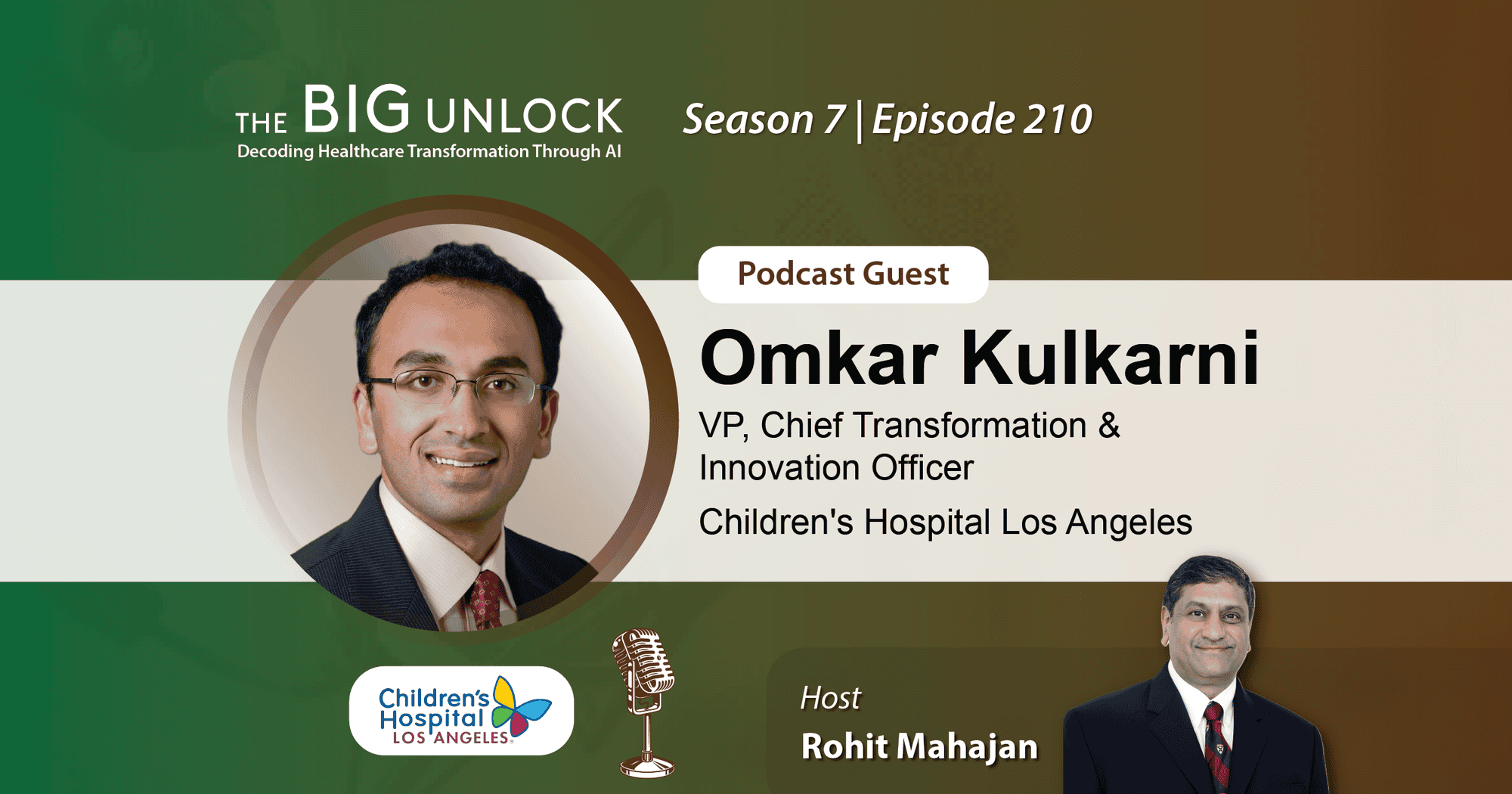
About the host

Paddy is the co-author of Healthcare Digital Transformation – How Consumerism, Technology and Pandemic are Accelerating the Future (Taylor & Francis, Aug 2020), along with Edward W. Marx. Paddy is also the author of the best-selling book The Big Unlock – Harnessing Data and Growing Digital Health Businesses in a Value-based Care Era (Archway Publishing, 2017). He is the host of the highly subscribed The Big Unlock podcast on digital transformation in healthcare featuring C-level executives from the healthcare and technology sectors. He is widely published and has a by-lined column in CIO Magazine and other respected industry publications.

About the Hosts

Rohit Mahajan is an entrepreneur and a leader in the information technology and software industry. His focus lies in the field of artificial intelligence and digital transformation. He has also written a book on Quantum Care, A Deep Dive into AI for Health Delivery and Research that has been published and has been trending #1 in several categories on Amazon.

Rohit is skilled in business and IT  strategy, M&A, Sales & Marketing and Global Delivery. He holds a bachelor’s degree in Electronics and Communications Engineering, is a  Wharton School Fellow and a graduate from the Harvard Business School. 

Rohit is the CEO of Damo, Managing Partner and CEO of BigRio, the President at Citadel Discovery, Advisor at CarTwin, Managing Partner at C2R Tech, and Founder at BetterLungs. He has previously also worked with IBM and Wipro. He completed his executive education programs in AI in Business and Healthcare from MIT Sloan, MIT CSAIL and Harvard School of Public Health. He has completed  the Global Healthcare Leaders Program from Harvard Medical School.

Ritu M. Uberoy has over twenty-five years of experience in the software and information technology industry in the United States and in India. She established Saviance Technologies in India and has been involved in the delivery of several successful software projects and products to clients in various industry segments.

Ritu completed AI for Health Care: Concepts and Applications from the Harvard T.H. Chan School of Public Health and Applied Generative AI for Digital Transformation from MIT Professional Education. She has successfully taught Gen AI concepts in a classroom setting in Houston and in workshop settings to C-Suite leaders in Boston and Cleveland. She attended HIMSS in March 2024 at Orlando and the Imagination in Action AI Summit at MIT in April 2024. She is also responsible for the GenAI Center of Excellence at BigRio and DigiMTM Digital Maturity Model and Assessment at Damo.

Ritu earned her Bachelor’s degree in Computer Science from Delhi Institute of Technology (now NSIT) and a Master’s degree in Computer Science from Santa Clara University in California. She has participated in the Fellow’s program at The Wharton School, University of Pennsylvania.

About the Legend

Paddy was the co-author of Healthcare Digital Transformation – How Consumerism, Technology and Pandemic are Accelerating the Future (Taylor &  Francis, Aug 2020), along with Edward W. Marx. Paddy was also the author of the best-selling book The Big Unlock – Harnessing Data and Growing Digital Health Businesses in a Value-based Care Era (Archway Publishing, 2017). He was the host of the highly subscribed The Big Unlock podcast on digital transformation in healthcare featuring C-level executives from the healthcare and technology sectors. He was widely published and had a by-lined column in CIO Magazine and other respected industry publications.

Scaling AI in Healthcare: Insights from Dr. Alvin Liu on Real-World Implementation and Governance

Scaling AI in Healthcare: Insights from Dr. Alvin Liu on Real-World Implementation and Governance

In a recent episode of The Big Unlock podcast, Dr. T.Y. Alvin Liu, Inaugural Director of the James P. Gills Jr. and Heather Gills AI Innovation Center at Johns Hopkins Medicine, shares his journey into artificial intelligence and how his work is transforming healthcare delivery. As a practicing retinal surgeon and AI governance leader, Dr. Liu offers a unique perspective at the intersection of clinical care, innovation, and enterprise AI strategy. His conversation with host Rohit Mahajan spans several key themes—from deploying autonomous AI for diabetic retinopathy screening to scaling generative AI for operational efficiency and building a robust AI governance framework for health systems.

From Ophthalmology to AI Leadership

Dr. Liu’s foray into AI began in the late 2010s during his clinical training, sparked by groundbreaking studies—particularly one from Google—that demonstrated the ability of AI models to predict cardiovascular risk factors from retinal images. This superhuman diagnostic capability was a turning point for him. As a retina specialist immersed in an image-rich field, Dr. Liu recognized the untapped potential of deep learning to transform how clinicians interpret complex visual data.

At Johns Hopkins, Dr. Liu leads the Gills AI Center—the first endowed AI initiative at the Johns Hopkins School of Medicine—while also maintaining an active clinical practice. He contributes across four pillars: AI development, implementation, governance, and scientific innovation, giving him a panoramic view of the opportunities and challenges in healthcare AI.

Autonomous AI in Primary Care: A Case Study in Diabetic Retinopathy Screening

One of the most compelling examples Dr. Liu shared was the deployment of an FDA-approved autonomous AI system to detect diabetic retinopathy in primary care settings. This system was the first of its kind to be approved for autonomous clinical use, and Johns Hopkins began implementing it in 2020.

Traditionally, patients needed to see a separate specialist to complete an annual retinal screening—an extra step that often led to missed appointments and lower screening rates. The AI system allows primary care physicians to take retinal images in their office, with AI analyzing them in real time. Patients receive immediate results, and only those with positive screenings are referred to an ophthalmologist.

The outcomes have been striking. Johns Hopkins observed a marked improvement in screening adherence, especially among underserved populations such as African Americans and Medicaid recipients. These results, published in Nature Digital Medicine, underscore how AI can help close gaps in preventive care—if implemented thoughtfully.

Generative AI for Revenue Cycle: From Clinical to Operational AI

AI’s impact at Johns Hopkins isn’t limited to the clinic. Dr. Liu described a pilot project using generative AI for revenue cycle management, specifically prior authorization. This is a high-friction area in healthcare, involving extensive paperwork and delays in care.

By leveraging large language models (LLMs), Johns Hopkins automated prior authorization workflows, reducing the time required and handling unstructured data far more effectively than traditional robotic process automation (RPA) methods. These results illustrate how AI can unlock value beyond clinical domains by streamlining healthcare operations and improving provider efficiency.

Startups and the Reality of Healthcare AI

Drawing from his experience working with numerous startups, Dr. Liu offered candid advice to AI entrepreneurs: understand reimbursement from day one. “I think one of the common mistakes that startup companies make in the healthcare AI space is not considering or not understanding their reimbursement issue from day one,” Dr. Liu added. Many startups make the mistake of focusing on building a great product without planning for how it will be paid for—especially in a field as complex and regulated as healthcare. 

He emphasized that FDA approval alone isn’t enough. Startups must also determine whether existing CPT codes apply to their solution, and if not, navigate the lengthy and uncertain process of obtaining new ones. Beyond regulatory hurdles, they must build business models that reflect the real-world economics of health systems.

Startups often underestimate the cost of this journey—$3 to $5 million for FDA approval is typical—and many don’t budget appropriately. Dr. Liu’s message was clear: clinical AI solutions need sound financial strategies as much as innovative technology.

Creating Enterprise-Ready AI: The Johns Hopkins Governance Model

To manage the influx of AI tools and ensure responsible adoption, Johns Hopkins established a robust AI governance framework. Dr. Liu is part of an eight-member enterprise leadership team that evaluates all AI-related initiatives across the health system.

This governance model is built around seven core principles: fairness, transparency, accountability, ethical data use, safety, evidence-based effectiveness, and sustainability. Any AI vendor seeking to partner with Johns Hopkins must complete a standardized intake process, provide detailed documentation on their tool’s safety, ROI, and evidence base, and undergo a rigorous review process.

The system categorizes tools based on their use case—clinical, operational, or imaging—and advances each proposal through specialized review committees. This ensures that tools align with Johns Hopkins’ mission, technical infrastructure, and patient care goals before they are deployed at scale.

This governance model could serve as a blueprint for other integrated health systems navigating a crowded and often chaotic AI vendor landscape.

Looking Ahead: Omics, Risk Prediction, and Scaling Innovation

Dr. Liu also shared his excitement about the emerging field of AI-driven “omics,” particularly using retinal biomarkers to predict systemic health conditions such as cardiovascular disease, kidney damage, and dementia. AI-enabled retinal screening programs in community settings could identify at-risk individuals years before symptoms emerge.

However, he was quick to point out that identifying risk is only part of the equation. Health systems must also build the care pathways to ensure those flagged by AI are connected to the appropriate subspecialists and receive timely follow-up care. Without that, the potential of predictive AI will remain unrealized.

A Call for Collaboration: Startups, VCs, and Health Systems

In his closing remarks, Dr. Liu highlighted a growing but still insufficient level of collaboration between AI startups, venture capitalists, and integrated health systems. Startups drive innovation and speed—but they often lack the domain knowledge and infrastructure to scale safely. Health systems, on the other hand, deliver the majority of care but tend to move slowly due to regulatory and operational constraints.

Bridging this gap, he argued, is essential for sustainable AI deployment. Startups need to understand the realities of clinical practice and reimbursement. Health systems need to improve agility and decision-making. And investors need to align their expectations with the long, complex arc of healthcare innovation.

Dr. Liu hopes to see more structured partnerships where these groups work together to solve real problems, share risk, and scale proven solutions responsibly. He believes that such collaboration is essential for delivering long-term value—and ultimately, for improving health outcomes.

AI is Here to Stay

As Dr. Liu puts it, “The train has left the station.” AI is already reshaping healthcare, and the focus must now shift to responsible scaling, thoughtful implementation, and real-world results.I think the vast majority of people will agree that AI will change medicine and society as we know it,” he adds. 

Whether through autonomous diagnostic tools, generative AI for operational efficiency, or predictive omics models, the future of healthcare will be defined by our ability to integrate AI into the fabric of care—ethically, equitably, and effectively.

This episode is a powerful reminder of what it really takes to turn promising AI into real-world results. For health systems, startups, and investors, Dr. Liu’s insights highlight why successful innovation depends as much on execution as on technology.

Advancing Pulmonology with AI and Functional Imaging

Season 6: Episode #169

Podcast with Vishisht Mehta MD, FCCP
Director, Interventional Pulmonology Comprehensive Cancer Centers of Nevada Department Chairman, Pulmonology
MountainView Hospital

Advancing Pulmonology with AI and Functional Imaging

To receive regular updates 

In this episode, Dr. Vishisht Mehta, Director of Interventional Pulmonology, Comprehensive Cancer Centers of Nevada and also the Department Chair of Pulmonology at MountainView Hospital, discusses his passion for clinical practice and emerging technologies like AI and telemedicine. 

Dr. Mehta shares how his interest in AI began through vendor outreach and evolved into a deeper exploration of its applications in pulmonology, particularly in early lung cancer detection and functional imaging. He highlights the persistent underutilization of lung cancer screenings, with only 5–6% of eligible patients getting screened, and notes AI’s role in identifying high-risk individuals and managing lung nodules. He also emphasizes the value of telemedicine in improving patient access and outcomes. 

Dr. Mehta has also created a resource hub – https://pulmonary.ai/ and produced educational videos to guide clinicians in understanding and adopting AI tools. He advises that physicians must gain foundational AI literacy to make informed technology decisions in an increasingly digital healthcare landscape. Take a listen.

Show Notes

01:14What interests you in the healthcare industry segment to become the CIO of a hospital system?
02:47How long have you been in the leadership position at UMC, where is it located, and what kind of population does it serve?
03:35You have done a lot of work from technology perspective to support the business needs of the hospital. You've done over 200 applications and transformed the EMR system. Would you like to share with the audience the thought process that drove those changes and what were some of those changes?
07:47What do you think about your digital transformation efforts? If you could describe a few of them which have had impact on the patient population.
08:30Please describe in your own, you know, way that what is digital transformation for provider systems such as yours? Where do you see it going? Some of the challenges that you might have faced and how did it actually end up impacting patients?
11:24 How did you manage to change the mindset of the people? How did they manage to change themselves? To adapt to this new world where technology, especially with AI and GenAI and other new technologies which are coming our way, how do you change mindsets and change behaviors and change culture over there?
13:00Would you like to provide one example of how the technologies which you were implementing, and you continue to be implementing in your hospital system are accessible and usable by a variety of users, including within the hospital and outside the hospital.
16:28How do you innovate? Do you involve external parties? Do you have some kind of a, you know, innovation focus department? Or is it part and parcel of everybody's, you know, kind of like daily life?
19:24What are your thoughts on new technologies, especially Gen AI? Have you been experimenting with any predictive analytics or large language models? What would be your advice or thoughts to any other healthcare leaders on how to go about this journey of exploration?
22:15Standing here now and looking back, if you were able to go back and change one or two things, what would you like to do differently or have done differently?

Video Podcast and Extracts

About Our Guest

Dr. Vishisht Mehta, is the Director of Interventional Pulmonology at the Lung Center of Nevada, a division of Comprehensive Cancer Centers and also the Department Chair of Pulmonology at MountainView Hospital, both in Las Vegas. He is a Clinical Assistant Professor at the Kirk Kerkorian School of Medicine in Las Vegas, NV. He is fellowship trained in Interventional Pulmonology, which specializes in the minimally invasive diagnosis and treatment of lung conditions.

Dr. Mehta has authored and reviewed various scholarly articles. At international conferences, he has been a presenter and moderator for numerous sessions. He has also received awards and grants for his research endeavors. He is a recipient of the prestigious Fellow of the College of Chest Physicians designation from CHEST (American College of Chest Physicians), is a Diplomate of the American Association of Bronchology & Interventional Pulmonology, Fellow of the American Thoracic Society, serves on the Nevada Leadership Board of the American Lung Association and the Executive Board of the Nevada Cancer Coalition and the American Lung Association’s Nevada chapter. He is also the Founder of the Nevada Lung Foundation and Pulmonary.ai, both of which are his personal projects to improve lung health and AI education respectively. He has been recognized by Vegas Inc. with its prestigious “40 Under 40” award in 2023.

His additional expertise lies in the application of artificial intelligence in pulmonology, especially in the early detection of lung cancer. He has been invited to speak on his expertise in AI in pulmonology at local, national and international meetings and events.

Dr. Mehta attended the Rajiv Gandhi Medical College and Chhatrapati Shivaji Maharaj Hospital in India, receiving a Bachelor of Medicine, Bachelor of Surgery degree in 2012. He completed a residency in Internal Medicine at the Creighton University School of Medicine in Omaha. He later completed fellowships in pulmonary and critical care at Memorial Sloan Kettering Cancer Center in New York City, and an Interventional Pulmonary fellowship at Henry Ford Hospital in Detroit.


Q: Hi Vishisht. Welcome to The Big Unlock podcast. Very happy to host you. You’re joining us from Nevada, and it’s such a fun place. I was recently there at HIMSS, and we got to chat a bit. I’m Rohit Mahajan, Managing Partner and CEO at Damo Consulting and BigRio, and the host of this podcast. Would you like to start with an introduction? 

Vishisht: Absolutely. Thanks for having me. It’s good to reconnect after our initial call.
My name is Vishisht Mehta. I’m an interventional pulmonologist based in Las Vegas, Nevada. I’m the Director of Interventional Pulmonary at Comprehensive Cancer Centers of Nevada, a community practice with a large oncology presence. My colleagues and I are the lung specialists within the organization. We see a wide range of conditions—COPD, asthma, lung cancer, infections, lung scarring, interstitial lung disease, and more.

I trained in New York City, and working in Las Vegas has been a very different professional environment. Since starting practice, I’ve become increasingly involved in digital health, pulmonology, and emerging technologies. It’s been very interesting to be part of that space.

Q: Yeah, of course. So Vishisht, tell us a little bit about when and how you got attracted to the tech side of things. I guess you still practice even today, right? So a large amount of your time is spent seeing patients, but on the other hand, you have this strong interest in new technologies and AI, which we’re going to talk about. So how did you get involved with that?

Vishisht: So as far as the AI thing, it started because one of the vendors reached out to kind of just talk about their product, and I found that technology interesting. This is about three, four years ago now, but it did not seem ready for prime time. The concept was definitely intriguing.

So I tried to educate myself more about: What is AI? Is AI here yet in medicine and pulmonology? Is this something that will be technically successful but may or may not actually do anything for my patients? And then, all different AI technologies are different. Even though they may look somewhat similar, some of it is patient-facing, some of it is not.

So that’s kind of how I got involved from the AI perspective. And then COVID happened, and we started doing a lot of telemedicine. So that was another exposure to digital aspects of medicine.

There are other technologies emerging, for example, functional imaging in lung diseases. Most of the normal imaging we do is static—as in, a patient takes a breath, holds the breath, and we take a picture—chest x-ray or CAT scan.

But functional imaging is new and emerging now, where we are able to see how different phases of breathing affect someone’s lung. That’s information we did not have.

So I try to expose myself to these things because we just need to know. And it’s also very interesting. This is very nascent. I’m early in my career. These technologies are early in their deployment, development, and adoption. So it’s something I think will be a part of medicine going forward—and a big part of how I’ll be involved in medicine. So that’s kind of the background.

Q: That’s very interesting—how you segued into AI and technology. You talked about telemedicine as well. Just curious to know, on the telemedicine side of things—obviously the number of visits has dropped—but are you still seeing a mix, Vishisht?

Vishisht: Definitely. Telemedicine is here to stay, and our patients like it. We like it. It works very well for the right scenario. Sometimes if a patient is coming back to follow up on some imaging or blood test, they don’t necessarily need to be in the office. We don’t need to be sitting across from each other. We can do it just like how we’re doing now—have a conversation, look at labs, blood work, images, and make a decision.

I’ve had patients do telemedicine appointments from the park, the playground, from home. A few have done it at the airport. Routinely, people do it during lunch breaks or at work. Now they don’t have to miss work. They don’t need someone to drive them. There’s so much time saved.

Because it’s easy, you can have visits more frequently. I’ve had patients with bad flare-ups of COPD or asthma. We do a telemedicine visit, I prescribe what they need, and they avoid going to the hospital. They don’t have to come in. If they have an infection, others aren’t exposed. So our patients are also safe. It just works. As a concept, I think it’s very useful, helpful, and definitely here to stay.

Q: That’s amazing. The other thing I wanted to ask is something you mentioned—functional medicine or functional imaging. Could you talk about that? Are the machines different and new? That must mean more data, right? How does that work? 

Vishisht: Functional imaging is very interesting. There are different parts to it. For example, we do a test called pulmonary function test—typically called a breathing test. A patient sits in a transparent box. The box is closed because we need to control the environment. They get coached and do a series of breathing maneuvers—deep breath in, deep breath out, blow hard, breathe normally.

These tests assess how the lungs are functioning. We can see if someone has asthma, COPD. We can measure lung size and the ability to extract oxygen. That’s very helpful information—but there are no pictures involved.

Also, for each outcome, we get a composite answer for both lungs combined. But that assumes the condition affects all parts of the lungs equally, which is not always true. Some patients have emphysema more in the upper lungs, or conditions that affect the edges or bottom parts.

These tests can’t tell that. The hope with functional imaging is that we’ll be able to image the lungs entirely and see if different areas function differently. That’s very promising and may change how we understand lung conditions.

You asked about hardware. Some technologies, like scanners using hyperpolarized xenon gas, do require additional hardware, capital investment, and training. But other imaging technologies use existing scans with different protocols. For example, we might do a scan after a deep breath in, then after a breath out, and compare.

So for those, we already have the technology—we just need different protocols and people who can interpret the results. The scan machine is the same; the protocol and interpretation differ. The leap to get there is small. These are just some examples of where things are going. I believe it will move in that direction, but we’ll have to see. It’s exciting to have new tools to offer our patients.

Q: Right. And let’s talk about AI. You mentioned it a couple of times. What kind of AI is applicable in your area of practice? What are you seeing?

Vishisht: AI in medicine—and in pulmonology—we’re seeing it show up in different areas. Most prominently, we’re seeing it in lung cancer. A lot of it is focused on early detection of lung cancer, or identifying spots or nodules on the lungs.

We know lung cancer is the most lethal cancer. But if caught early, survival is much better. In some cases, we’re talking about cure—not just management. So we want to screen high-risk patients.

AI helps by identifying high-risk patients, currently by looking at smoking history and pulling that information from the chart. It flags those patients for lung cancer screening discussions.

Another area is incidental findings. A patient might get a CT scan of the abdomen, and a small lung spot is seen in the lower lung—even though the scan wasn’t done for that reason. Same with scans of the neck or thyroid—you might see part of the upper lung.

AI software can identify these nodules, whether in the report or image, and generate a list for the hospital or doctors. It flags them so we can follow up and determine if they’re important.

We’re also seeing AI used to judge the risk of cancer in these spots. Many people have lung nodules, most of which are not concerning. But AI can analyze data we can’t see with our eyes—data that’s in the scan—and help us assess whether a spot is likely cancerous.

It’s not diagnosing cancer yet, but it helps assess risk. So that’s where we’re seeing AI most—in early detection and identification of nodules.

Q: That’s great. You mentioned lung cancer screening—I have a curious question. In your health system or nationwide, since you’re connected with physicians elsewhere, what is the current percentage of eligible people who actually get screened? Is there a gap? 

Vishisht: There is a massive gap. It’s probably the biggest gap between eligibility and screening for any cancer. Ballpark, we’re screening about 5–6% of eligible patients. That’s a huge miss compared to other cancers like colon or breast, where screening is around 70–80%. 

Q: Any thoughts on why that gap is smaller for those cancers and bigger here?

Vishisht: Yeah, you know, at some level, lung cancer screening recommendations have been out for a while, but for whatever reason, they seem to not have percolated as much. I think the true number of patients who get lung scans is probably a little higher than this because patients may be getting scans for reasons other than screening, which maybe are not being tracked. But there’s no doubt that the gap is there.

I think there’s a lot of stigma also. Because lung cancer, because of the association with smoking, has some amount of blame attached to it, unfortunately. We should not be blaming patients, certainly not for actions in the past. And if someone is eligible, we should have the discussion with them.

One of the things to think about, if you think about AI in this space, is AI is doing a lot of interesting things when we find the lung spot. But what about finding the patients who need to be screened? I think that’s another place where AI is going to help us.

And I will also say we have to keep in mind that maybe the answer is not AI to improve lung cancer screening. Maybe we just need resources, education, manpower. That’s another long discussion. But we should not be thinking that AI is going to fix it, and it could be many things that are likely to help move the deal.

Q: That brings me to the point we were talking about a little earlier—that you actually have a website and a video that you’ve put up for people to learn more about this. You mentioned pulmonary.ai. Also a video on YouTube, right? So would you like to tell us a little bit more about that?

Vishisht: Yeah, for sure. Again, like two-ish, maybe three years ago, when I was trying to get more details and get more involved, I said, let me go and find AI and pulmonology resources. So I went online and I went looking and looking and looking, and I could not find anything where all the stuff that I was interested in was in one place.

I had to go and pull this article from here, that article from there, this clip from here, to try and educate myself. And then I said, why don’t I try and make the place where I can post some of these articles? It’s not going to be everything—because it’s impossible to keep up. One-man army, sort of.

But to my surprise, pulmonary.ai, the domain was available, so I took it. And I have been trying to add different pieces of pulmonary and AI literature, research articles in different areas, so other people who are interested in this subject, like I am, don’t have to run around as much. At least they can go to this website and have a good start.

This is not meant to be exhaustive and cover every possible thing—again, it’s not possible. But at least as a starting point, they can go on the website. I maintain it myself. There’s no commercial, no ad, no sponsor. I pay for it myself. It’s just my personal hobby and effort to find like-minded people.

That effort helped me generate my first large lecture on this, which was AI in Pulmonary Nodule Management. I went on YouTube, I did that for the Society for Advanced Bronchoscopy, a wonderful medical society that I’m a part of. And a year later, the follow-up lecture, which is the one you’re referring to, was Which AI Should I Buy?

Because after the first one, we started to see so many different vendors show up in this lung nodule space. And the question that I kept getting asked was, “Okay, that’s fine. Which one?” And not only which one, but “How do I decide which one?”

So that led to the second one, Which AI Do I Buy? And that’s, of course, a very important discussion. Sometimes people ask, “Do I definitely need AI?” And right now, I’m saying—I don’t know if everyone definitely needs it, but I think the conversation should definitely be had.

Because there are many challenges—cost, integration, reimbursement. The other challenges are the physicians, administrators, or nurse navigators—do they know how to use the software? Do they understand the pros and cons?

We do not want to have a problem of round peg, square hole—trying to fit things where they’re not supposed to fit. That’s mostly what I speak about—how rather than what. Because it’s not for me to tell any one person this is better or that is better.

Q: So, what’s one or two nuggets from the Which AI Should I Buy? video that you’d like to share here?

Vishisht: That’s a very hard question. I think one thing that’s important, and I’ve realized this over time, is that physicians, administrators—whoever is interacting with the software or making purchasing decisions—need to have a basic level of understanding of what they’re interacting with.

Even when we routinely read research articles, we’ve not—and for obvious reasons, because AI wasn’t there—we’ve not been familiar with the terms needed to judge AI literature. So when you look at an AI paper, you have to look at or be familiar with terms like structured/unstructured data, unsupervised learning, what was the development, what was the deployment, internal validation, external validation.

So I think one takeaway would be to familiarize yourself with those kinds of things. Where can you go? Shameless plug—my lecture is one place someone can start, but that’s not the be-all and end-all. There are resources online. Some medical societies have material. MIT has a course on this—I’ve taken it. I think it’s a very good course. Stanford has one through Coursera. There are places where we should go.

So I guess the one takeaway would be—if people are considering these technologies, then just understand how they are different, so the right people can make the right decision for the right circumstance, if it is going to be some AI technology.

Q: That’s awesome. I think we’re almost coming to the end of the podcast today. I’m hoping we’ll have more conversations in the future. 

Vishisht: I appreciate the opportunity to talk to you and your audience. In closing, all I’d say is that healthcare is evolving, changing—probably faster in the digital space than we’ve seen before.

So I’d want my colleagues to go out there, educate themselves, listen to lectures, and follow folks like yourself. A lot of the new information may not come from traditional medical societies—just because of the speed. Things change faster than we’re used to.

And at the end of the day, being well-informed, as much as possible, is important with these newer developments. So that’s all I got. Thank you.

Subscribe to our podcast series at www.thebigunlock.com and write us at [email protected]  

Disclaimer: This Q&A has been derived from the podcast transcript and has been edited for readability and clarity.
About the host

Paddy is the co-author of Healthcare Digital Transformation – How Consumerism, Technology and Pandemic are Accelerating the Future (Taylor & Francis, Aug 2020), along with Edward W. Marx. Paddy is also the author of the best-selling book The Big Unlock – Harnessing Data and Growing Digital Health Businesses in a Value-based Care Era (Archway Publishing, 2017). He is the host of the highly subscribed The Big Unlock podcast on digital transformation in healthcare featuring C-level executives from the healthcare and technology sectors. He is widely published and has a by-lined column in CIO Magazine and other respected industry publications.

About the Host

Rohit Mahajan is an entrepreneur and a leader in the information technology and software industry. His focus lies in the field of artificial intelligence and digital transformation. He has also written a book on Quantum Care, A Deep Dive into AI for Health Delivery and Research that has been published and has been trending #1 in several categories on Amazon.

Rohit is skilled in business and IT  strategy, M&A, Sales & Marketing and Global Delivery. He holds a bachelor’s degree in Electronics and Communications Engineering, is a  Wharton School Fellow and a graduate from the Harvard Business School. 

Rohit is the CEO of Damo, Managing Partner and CEO of BigRio, the President at Citadel Discovery, Advisor at CarTwin, Managing Partner at C2R Tech, and Founder at BetterLungs. He has previously also worked with IBM and Wipro. He completed his executive education programs in AI in Business and Healthcare from MIT Sloan, MIT CSAIL and Harvard School of Public Health. He has completed  the Global Healthcare Leaders Program from Harvard Medical School.

About the Legend

Paddy was the co-author of Healthcare Digital Transformation – How Consumerism, Technology and Pandemic are Accelerating the Future (Taylor &  Francis, Aug 2020), along with Edward W. Marx. Paddy was also the author of the best-selling book The Big Unlock – Harnessing Data and Growing Digital Health Businesses in a Value-based Care Era (Archway Publishing, 2017). He was the host of the highly subscribed The Big Unlock podcast on digital transformation in healthcare featuring C-level executives from the healthcare and technology sectors. He was widely published and had a by-lined column in CIO Magazine and other respected industry publications.

Reimagining Healthcare From Meaningful Use of Data to AI-Driven Equity

Season 6: Episode #168

Podcast with Aneesh Chopra, Chief Strategy Officer, Arcadia

Reimagining Healthcare From Meaningful Use of Data to AI-Driven Equity

To receive regular updates 

In this episode, Aneesh Chopra, Chief Strategy Officer at Arcadia shares a bold vision for advancing healthcare equity through smarter data use, AI, and workflow innovation. He unpacks the journey from the early days of “meaningful use” to today’s AI-powered, value-based care landscape, highlighting how intelligent workflows can reach underserved populations and improve outcomes at scale.

Aneesh introduces the concept of a “healthcare information fiduciary,” a model where apps and platforms act solely in the patient’s best interest, free from institutional financial incentives. He discusses how this, combined with emerging AI capabilities and interoperability standards like CMS’s FHIR APIs, can empower consumers and scale high-impact care delivery.

With real-world success stories, from improved hospital ratings via conversational AI to national gains in ADT data coverage, this episode offers healthcare leaders a roadmap for driving innovation through public-private collaboration and patient-centered data strategy. Take a listen.

Show Notes

01:14What interests you in the healthcare industry segment to become the CIO of a hospital system?
02:47How long have you been in the leadership position at UMC, where is it located, and what kind of population does it serve?
03:35You have done a lot of work from technology perspective to support the business needs of the hospital. You've done over 200 applications and transformed the EMR system. Would you like to share with the audience the thought process that drove those changes and what were some of those changes?
07:47What do you think about your digital transformation efforts? If you could describe a few of them which have had impact on the patient population.
08:30Please describe in your own, you know, way that what is digital transformation for provider systems such as yours? Where do you see it going? Some of the challenges that you might have faced and how did it actually end up impacting patients?
11:24 How did you manage to change the mindset of the people? How did they manage to change themselves? To adapt to this new world where technology, especially with AI and GenAI and other new technologies which are coming our way, how do you change mindsets and change behaviors and change culture over there?
13:00Would you like to provide one example of how the technologies which you were implementing, and you continue to be implementing in your hospital system are accessible and usable by a variety of users, including within the hospital and outside the hospital.
16:28How do you innovate? Do you involve external parties? Do you have some kind of a, you know, innovation focus department? Or is it part and parcel of everybody's, you know, kind of like daily life?
19:24What are your thoughts on new technologies, especially Gen AI? Have you been experimenting with any predictive analytics or large language models? What would be your advice or thoughts to any other healthcare leaders on how to go about this journey of exploration?
22:15Standing here now and looking back, if you were able to go back and change one or two things, what would you like to do differently or have done differently?

Video Podcast and Extracts

About Our Guest

Aneesh Chopra is the Chief Strategy Officer at Arcadia, a healthcare data platform company, where he advocates for interoperability and data-driven approaches that help providers, payers, and employers make smarter decisions to succeed in the shift to value-based care.

Chopra’s influence and leadership in technology includes extensive experience in the public sector. He served as the first U.S. Chief Technology Officer under the Obama Administration, where he spearheaded initiatives to modernize the nation’s healthcare system using electronic health records and health information exchanges. Chopra also served as Virginia’s Secretary of Technology under Governor Tim Kaine.

As a public servant, Aneesh fostered better public-private collaboration, a theme central to his 2014 book, “Innovative State: How New Technologies Can Transform Government.” Chopra’s significant contributions to the fields of technology and healthcare have cemented his reputation as a forward-thinking leader committed to leveraging technology for the public good.

Chopra serves on the U.S. Department of Commerce’s National AI Advisory Committee. He also serves on the boards of Trimedx, IntegraConnect, Virginia Center for Health Innovation, and the George Mason Innovation Advisory Council. He earned his master’s degree in public policy from Harvard Kennedy School and holds a bachelor’s degree in health policy from Johns Hopkins University.


Q. Hi Aneesh, welcome to The Big Unlock podcast. Very happy to have you here. I’ll do a quick intro and hand it back to you. I’m Rohit Mahajan, Managing Partner and CEO at BigRio and Damo Consulting. It’s great to know that you’re already familiar with Damo from your previous interactions with Paddy. We’re continuing to build on The Big Unlock podcast that he started. We’re now in Season 6, so welcome, and over to you.

Aneesh: Thank you, Rohit. I’ll begin by saying how grateful I am that you’ve picked up the baton. Paddy was a larger-than-life individual with had a lot of fans, myself included. I’m grateful you’ve continued this.

By way of background, I’m Aneesh Chopra, currently Chief Strategy Officer at Arcadia. We’re a market leader in putting healthcare data to work in value-based care for payers and providers, with a focus on helping individuals get the best possible care at every step of their journey.

Personally, I’m passionate about improving collaboration between the public and private sectors. I served in the Obama administration as the first U.S. Chief Technology Officer—a position that has thankfully remained bipartisan. I’m grateful for the opportunity to demonstrate what’s possible when we apply technology, data, and innovation to some of the country’s biggest challenges.

Q. That’s great to know. Could you tell us what first attracted you to healthcare?

Aneesh: Like many things, it was about timing. I was an undergraduate at Johns Hopkins in the early ’90s when President Bill Clinton brought national attention to healthcare reform. I had the opportunity to get involved—first as a student, and then as an intern for a Maryland initiative aligned with what Clinton was advocating, led by the university’s president.

That experience gave me an insider’s view of what it could look like to shape the future of healthcare. I’ve always believed that the best outcomes come from collaboration between the public and private sectors. Healthcare, in particular, is one of the defining challenges of our generation.

Back then, I was passionate about the role of internet technologies in democratizing healthcare. Today, I feel even more energized about the potential of AI to do the same—lowering costs and improving outcomes for everyone.

Q. Absolutely. That’s great to know, Aneesh. That brings me to the comment we were discussing before the podcast—about making use meaningful again. That’s a great catchphrase. Can you explain your thought process behind it and what it means to health systems, patients, and the larger population?

Aneesh: Thank you so much. By way of background, your audience likely remembers the term meaningful use—two words Congress wrote into the HITECH Act that led us on the journey of accelerating health IT adoption starting around 2010 when subsidies kicked in.

There’s always been a trade-off. What does meaningful use really mean? If you go to Best Buy and purchase software like TurboTax, you expect it to help you file taxes. But in healthcare, just installing software doesn’t guarantee better patient care. It may only serve the back office for billing or administration, without clinical benefit.

So, Congress allowed us to define what it means to be a meaningful user. That sparked debate. Should we focus on maximizing productivity in a fee-for-service model—like seeing twice as many patients a day—or should we focus on outcomes?

In the Obama transition team, our vision was to shift toward outcome-based models that reward better care. If we fix how people get paid, and incentivize longitudinal care, then technology becomes essential—not just during visits, but also between them. It can remind us of care gaps or flag things like unfilled prescriptions that signal problems with adherence.

So, meaningful use for organizations focused on long-term outcomes differs from those operating under fee-for-service. Our original intent was to prepare for the future—“where the puck is heading,” to quote Gretzky. But the industry found that difficult. We ended up with a half-measured IT program—subsidizing tech mostly built for fee-for-service, with only partial support for value-based care.

Now, the Trump administration’s CMS-ONC RFI is a chance to finish what we started in 2009-2010.

Q. The RFI you’re referring to is the CMS-ONC RFI, right? Can you explain what this RFI is for those who may not be familiar? 

Aneesh: It’s a great opportunity for the private sector, nonprofits, providers, and plans to come together and say: here’s how we want healthcare IT to operate, how information should flow, how patients should access their data, and how clinicians and health plans can coordinate care to improve quality.

It’s an open invitation—across a dozen or more specific use cases—to help define the future we didn’t quite finish under meaningful use. It asks each stakeholder: What do you need? What do consumers want? How can physicians interact with data in real time? Historically, health plans were kept out of public health information networks—so how do we bring them in, and when?

It’s a short 30-day comment period. By the time this airs, it may be over—but that’s not the end. The executive branch will likely take action over the next year. I hope early adopters raise their hands and participate voluntarily before any formal regulation. That’s always been a hallmark of my work in government, and I’m grateful that the Trump administration carried that idea forward.

Q. That’s great to know, Aneesh. Thank you for sharing that. Based on your experience with the Obama administration or your current role, are there any success stories involving AI or interoperability that you’d like to share? 

Aneesh: Yes. We’re grateful to support over 150 health systems, health plans, and ACO networks. We serve as their core data platform to build the longitudinal patient record. The great news is, once you’ve done that work, you can apply use cases on that foundation to help people be more successful.

There are three areas some of our customers have been advancing. The most exciting is conversational AI. One challenge in population management is taking responsibility for individuals who may not come into your clinic regularly. You need to reach out—remind them to get flu vaccines, check blood pressure, manage diabetes.

One academic medical center, mostly a fee-for-service organization, had underperformed on longitudinal measures. They were scoring one or two stars in the Medicare Advantage program, where four stars or more are needed to earn incentives. Their enablement partner—our customer—brought in a conversational AI workflow. It used the physician’s office phone line, declared the automated agent was calling on behalf of their doctor, and helped close hundreds, if not thousands, of care gaps over a 90-day sprint. As a result, they went from a one or two star rating to a four-star rating across several MA contracts—earning over $6 million in bonuses they previously hadn’t qualified for. That’s an example of the co-pilot concept in care management.

Another use case is evidence-based medicine. There’s debate around health plans denying care via prior authorizations. But if you frame it as evidence-based decision support, it becomes more of a nudge. One of our large academic centers, with a library of approved guidelines, has started piloting an AI co-pilot to monitor whether the patient in front of the doctor is a good candidate for a certain treatment. This reduces the cognitive load on physicians and integrates reminders at the point of care. It’s promising.

Finally, interoperability. CMS rolled out a daily FHIR API for health networks in the ACO REACH program. It moved claims data from being available 60 days after service—useful mainly for actuaries—to more real-time use for care managers. One of our advanced primary care clients, focused on high-need senior populations, saw their ADT (admission-discharge-transfer) data coverage improve from about 40% to nearly real-time. It may not be real-time for every patient, but it’s now fast enough to take meaningful clinical action for many more patients.

Q. That’s great to know. And now, thinking a little bit into the future—before the podcast, we were talking about the idea behind healthcare information fiduciary. Could you explain more about your thoughts on that and where this concept might go? 

Aneesh: Yes. A little bit of history first. In the Obama administration, we proposed a fiduciary rule through the Department of Labor for self-insured employers managing 401(k) plans. At the time, there wasn’t much transparency. Many firms were charging 8–10% in fees, when it should have been less than 1%. That became a massive cost to employees’ retirement savings over time—estimated at nearly $3 trillion.

More importantly, brokers had incentives to sell products that paid them higher commissions, rather than products that met the individual’s risk profile or goals. So we proposed a fiduciary rule: if you trust me with your information in a complex domain like financial services, I must act in your best interest—not based on how I get paid.

That standard inspired me to carry the concept into healthcare. As we build health data hubs and consumers gain the right to control access to their information—or request and keep copies—we need to create a marketplace of apps that people can trust. These apps might use AI or other tools to help consumers not only aggregate records, but make better decisions at every step of the healthcare journey.

The key is that these apps must act in the patient’s best interest—not in the interest of a health plan pushing for lower-cost care, a hospital steering to more expensive services, or a pharma company promoting a branded drug when a generic might be better. So a healthcare information fiduciary is both a technical and ethical standard. It’s about creating a trusted ecosystem that organizes and activates personal health data responsibly, for the consumer’s benefit.

Q. Is this something already concrete and coming down the pike, or is it still just an idea? 

Aneesh: It’s a bit of both. I’m one of the co-founders of the CARIN Alliance—a bipartisan effort with Governor Mike Leavitt, Dr. David Blumenthal, and the original National Coordinator, Dr. David Brailer. The four of us conceived a program now led by Ryan Howells to create a category of consumer-facing apps that follow a voluntary code of conduct.

This code addresses one part of being a fiduciary: transparency in how my data is used so I can trust the app. It goes beyond HIPAA, requiring disclosure of even de-identified data use—something hospitals and insurance companies don’t typically do. So the CARIN code of conduct is a step toward a full healthcare fiduciary model, but we’re not there yet.

Combine that with data-sharing rights and an upcoming AI code of conduct, and we may soon see apps that say: “Share your lab results, and I’ll give you next steps”—as we’ve already seen with GPT-like tools.

Q. That’s great. Before we wrap up, I’d love to hear more about your book The Innovative State. It’s been a while since it was published, what lessons remain relevant today? 

Aneesh: I appreciate that. I was inspired by Sam Pitroda. Back in the ’80s, India had just 300,000 phone lines for 300 million people. Sam, after selling a business, returned to India with a symbolic salary and a bold goal: connect every remote village. He rejected both the public subsidy model and deregulation-only approach. Instead, he chose a third way: innovation.

He recruited hundreds of brilliant minds and built a digital-first telecom network. Within a decade, villages had STD booths and modern phone access.

That inspired my approach to public sector innovation—looking for that hidden “third way.” The heart of my book focuses on strategies that empower both government and private actors through handshakes and handoffs.

Innovation is often bipartisan. Washington can create the pathway, but it’s the private and nonprofit sectors that must execute. That includes opening government data, setting interoperability standards, introducing outcomes-based payments, and recruiting talent for “tours of duty” in government. These ideas are still highly relevant today.

Q. Absolutely. So. as we end the podcast, Aneesh, any parting thoughts or any final words for the audience that you would like to share? 

Aneesh: Yes. In the spirit of the conversations Patty used to lead—this is our moment to raise our hands. If you see the future and want to help build it, now’s the time. The Trump administration’s RFI will kick off a series of actions this summer, fall, and maybe winter.

If you’re ready to be an early adopter, we want to hear from you. Reach out to me or connect with Washington. Let’s organize the early adopters, test what works, and then scale it across the sector.

Q. Amazing. Thank you, Aneesh. This was a great conversation. Hope to have you back again soon. 

Aneesh: Thank you, Rohit. Appreciate you having me. 

Subscribe to our podcast series at www.thebigunlock.com and write us at [email protected] 

Disclaimer: This Q&A has been derived from the podcast transcript and has been edited for readability and clarity.

About the host

Paddy is the co-author of Healthcare Digital Transformation – How Consumerism, Technology and Pandemic are Accelerating the Future (Taylor & Francis, Aug 2020), along with Edward W. Marx. Paddy is also the author of the best-selling book The Big Unlock – Harnessing Data and Growing Digital Health Businesses in a Value-based Care Era (Archway Publishing, 2017). He is the host of the highly subscribed The Big Unlock podcast on digital transformation in healthcare featuring C-level executives from the healthcare and technology sectors. He is widely published and has a by-lined column in CIO Magazine and other respected industry publications.

About the Host

Rohit Mahajan is an entrepreneur and a leader in the information technology and software industry. His focus lies in the field of artificial intelligence and digital transformation. He has also written a book on Quantum Care, A Deep Dive into AI for Health Delivery and Research that has been published and has been trending #1 in several categories on Amazon.
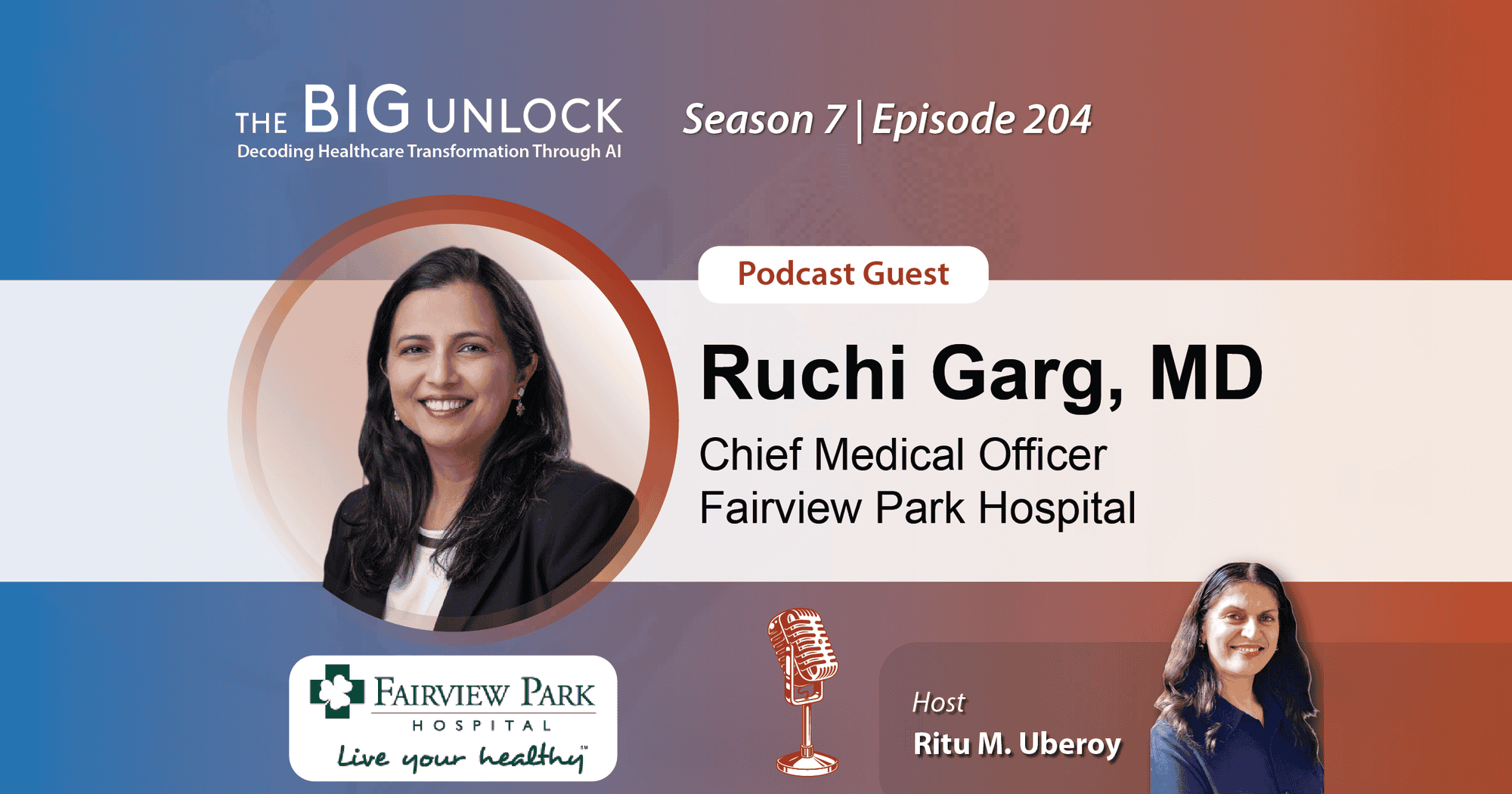
Rohit is skilled in business and IT  strategy, M&A, Sales & Marketing and Global Delivery. He holds a bachelor’s degree in Electronics and Communications Engineering, is a  Wharton School Fellow and a graduate from the Harvard Business School. 

Rohit is the CEO of Damo, Managing Partner and CEO of BigRio, the President at Citadel Discovery, Advisor at CarTwin, Managing Partner at C2R Tech, and Founder at BetterLungs. He has previously also worked with IBM and Wipro. He completed his executive education programs in AI in Business and Healthcare from MIT Sloan, MIT CSAIL and Harvard School of Public Health. He has completed  the Global Healthcare Leaders Program from Harvard Medical School.

About the Legend

Paddy was the co-author of Healthcare Digital Transformation – How Consumerism, Technology and Pandemic are Accelerating the Future (Taylor &  Francis, Aug 2020), along with Edward W. Marx. Paddy was also the author of the best-selling book The Big Unlock – Harnessing Data and Growing Digital Health Businesses in a Value-based Care Era (Archway Publishing, 2017). He was the host of the highly subscribed The Big Unlock podcast on digital transformation in healthcare featuring C-level executives from the healthcare and technology sectors. He was widely published and had a by-lined column in CIO Magazine and other respected industry publications.

Most Frequently Discussed Themes on The Big Unlock Podcast

Most Frequently Discussed Themes on The Big Unlock Podcast

Decoding Healthcare Transformation Through AI Top 5 Most Frequently Discussed Themes onThe Big Unlock Podcast Insights from Healthcare C-Suite Leaders on AI, Digital Health Innovations, Emerging Technologies (Insights extracted from 160+ episodes since 2018) Digital Transformation in Healthcare Patient Engagement and Experience Data Integration and Interoperability AI and Emerging Technologies in Healthcare