Month: April 2026

AI Should Make Healthcare Feel More Human

Season 7

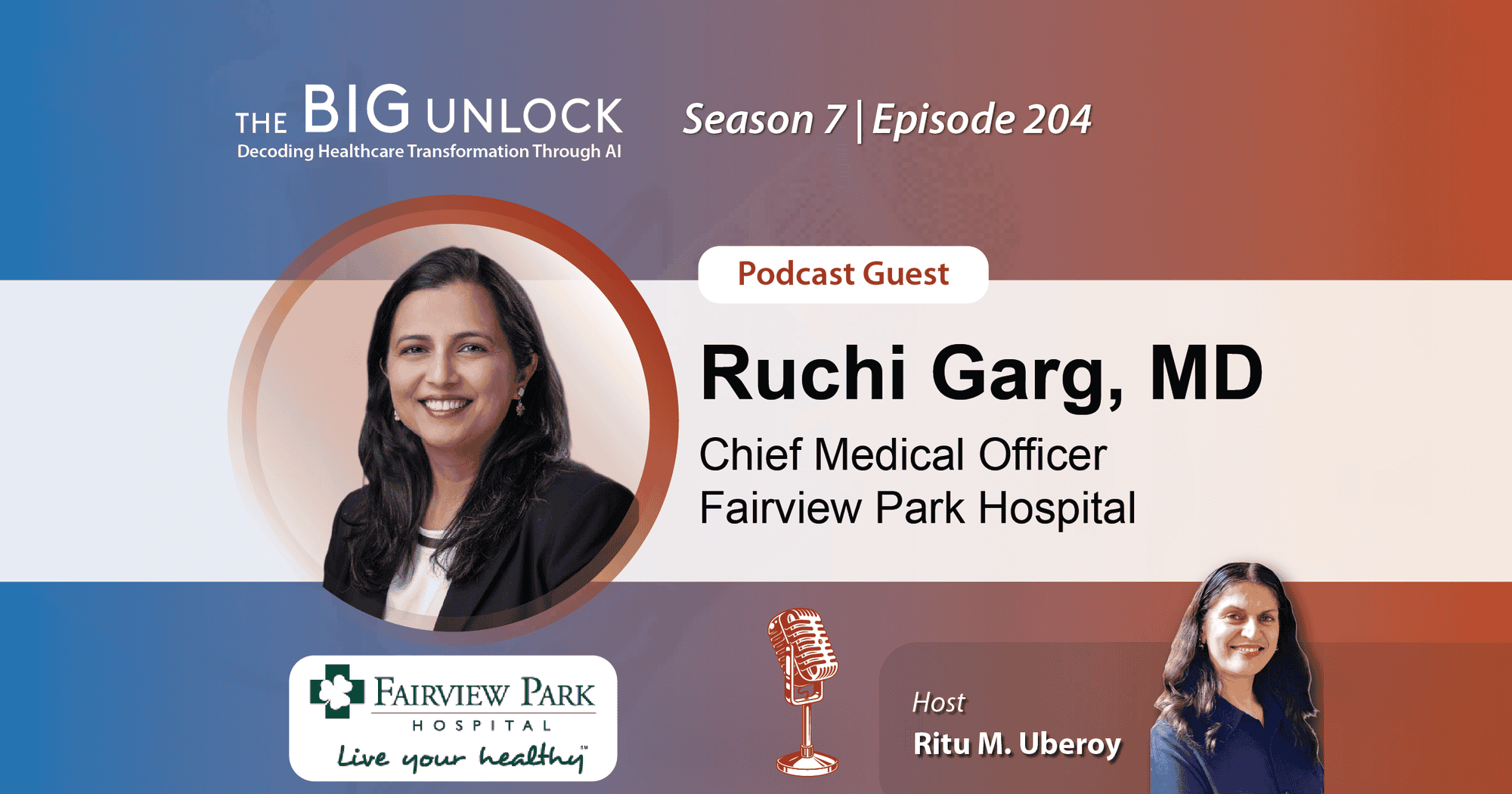
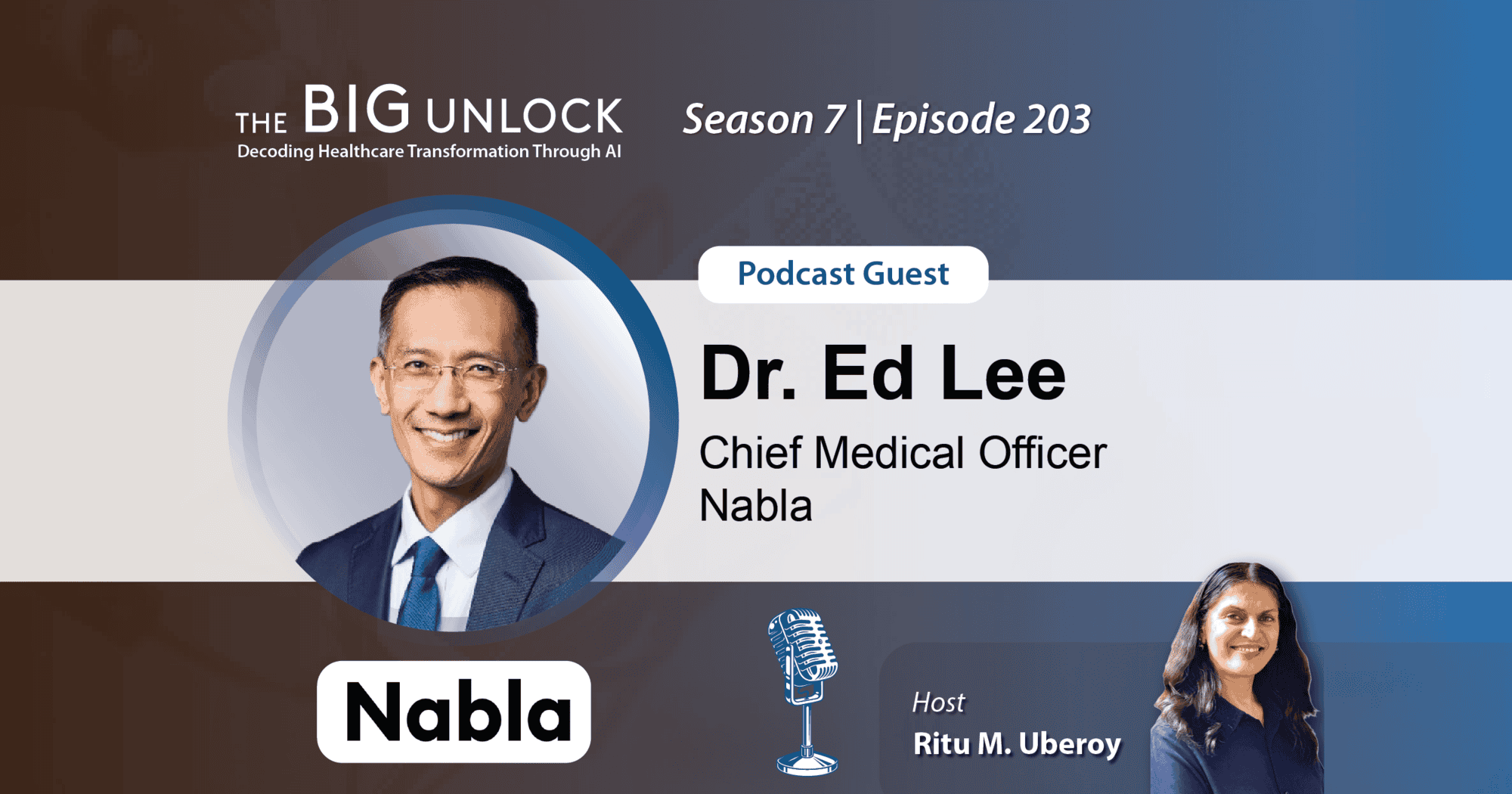
Episode 203 - Podcast with Ed Lee, MD, MPH, Chief Medical Officer, Nabla
AI Should Make Healthcare Feel More Human

The Big Unlock
The Big Unlock
AI Should Make Healthcare Feel More Human
Loading
/

In this episode, Dr. Ed Lee, Chief Medical Officer at Nabla, shares how AI is moving beyond hype to reshape real-world care delivery. Drawing on his experience at Kaiser Permanente, he emphasizes that the true goal of technology is not efficiency alone, but restoring the human connection in healthcare.

Dr. Lee explores why change management, not the technology itself, is the hardest part of AI adoption, and why clinician involvement from day one is non-negotiable. He challenges the early narrative around time savings, arguing that the deeper ROI of ambient AI lies in reducing cognitive burden, restoring joy in medicine, and rebuilding the patient-physician relationship. He also looks ahead to the next frontier: clinical decision support, diagnosis capture, and chart summarization woven seamlessly into workflows. Dr. Lee’s closing thought is simple but powerful – done right, AI shouldn’t feel technical. It should feel human. Take a listen.

This guest appearance was facilitated through conversations initiated at HIMSS.

About Our Guest

Ed Lee, MD, MPH, is a practicing internal medicine physician, physician executive, and nationally recognized leader in clinical informatics and ambient AI. He currently serves as Chief Medical Officer at Nabla, where he drives strategy and clinical innovation for an AI-powered ambient documentation platform that enhances clinician well-being and care delivery.

Previously, Dr. Lee was Chief Information Officer and Associate Executive Director at Kaiser Permanente, where he led groundbreaking digital transformation efforts across one of the nation’s largest integrated healthcare systems. His leadership advanced AI governance, expanded access to care through telehealth, and improved clinician experience through smarter EHR tools and digital infrastructure.

In parallel with his executive roles, Dr. Lee is Chair of Clinical Education and Director of Clinical Informatics at California Northstate University College of Medicine, where he oversees a technology-enabled curriculum and clinical education strategy.


Ritu: Hi everyone, a very warm welcome to our listeners for Season Seven of the Big Unlock Podcast. My name is Ritu and I’m the co-host of the podcast. We are very excited to have with us today Dr. Ed Lee. Dr. Ed Lee is a physician and healthcare executive leading clinical innovation at Nala, where he focuses on bringing AI into real-world care delivery. He was with Kaiser Permanente for a long time, and we have some very good questions about that for you today, Dr. Lee. At Nala, he’s working at the forefront of ambient AI and clinical co-pilots, helping translate cutting-edge models into tools that actually work in everyday workflows. With that introduction, welcome once again to the podcast, Dr. Lee.

Dr. Lee: Hey Ritu, thank you so much for having me. I appreciate it and I’m looking forward to the conversation.

Ritu: Thank you for being our guest today — really excited to ask you some interesting questions. Let’s get started. We all know that Kaiser Permanente operates as a fully integrated system: payer, provider, and care delivery. How did that structure shape your perspective on what good looks like in clinical workflows, and how did it influence your thinking when you were building tools at Nala?

Dr. Lee: I thoroughly enjoyed my time at Kaiser Permanente. That’s where I actually learned how to be a real practicing clinician — seeing patients, having a large panel of patients to take care of over decades. It taught me how important it is to use technologies that allow clinicians to focus on their patients. At the end of the day, what we want to do is deliver high-quality, personalized care, and quite often technology can get in the way of that unintentionally. What we want to do now, with that understanding, is build technologies that bring the human side of care back to healthcare — removing the friction that technology may have introduced between patients and clinicians, decreasing the administrative burdens that clinicians face, and really making patients the forefront of what we do every day.

Ritu: Great answer. That leads directly into my next question. From all your time at Permanente, what did you learn about the human side of adoption? Because that’s what we’ve been hearing from most of our guests recently — driving clinicians to change behavior versus resisting change, even when the technology is objectively better. AI is passing all these tests, beating doctors on benchmarks, and yet behavioral change is really hard. How did you grapple with that?

Dr. Lee: One of the things I always mention is change management. The change management piece is often the hardest part of implementing new technologies — it’s not the technology itself. The technology can often speak for itself. But making sure clinicians understand the why is critical. Clinicians are very scientific and results-driven; they’re looking for evidence about why things should be done. If you don’t come in with that mindset, and if you don’t involve clinicians from the very beginning of a new technology project, you’re often destined to fail. AI has been around for a short time relative to the grand scheme of how technology has been implemented in medicine, but the impacts are starting to be quite evident. You mentioned how AI can sometimes answer test questions better than human physicians and clinicians. But I still feel the AI out there is really there to augment the clinician and the experience clinicians have with their patients — not to replace them. It’s still up to the clinician to incorporate the information AI brings into the conversation. That human-in-the-loop component always needs to be there to make sure we’re doing the right thing for our patients.

Ritu: That was the conversation we were having six months to a year ago. But now, as we’re seeing more and more co-pilots doing more — going beyond drafting notes and actually suggesting clinical context — how do you maintain clinician trust and ensure that judgment isn’t subtly being outsourced to the system because it’s just so easy? Even in our world of writing code, we’re seeing how easy it becomes to just sit back and let the AI keep generating. The more you engage with it, the easier it gets to let it handle everything. What are your thoughts on that?

Dr. Lee: The easy thing isn’t necessarily always the right thing. What we see with AI-generated outputs is that sometimes they can be very convincing. I’ve done it myself — I’ve plugged things into ChatGPT and it sounds so well-written that it feels like it has to be the truth. But we know that current LLMs are essentially word prediction models generating text, and while they are quite often correct and often bring new insights into the way I’m thinking about clinical scenarios, what you get is based on what you put in. It often requires a clinician’s expertise to put in the right prompt and bring in all the right factors to get the right output back. That’s where I have some concerns about these tools being available to all patients directly — they may not understand all the factors that need to go into the system to get the right output. And without clinician expertise to filter, interpret, and apply it to a real-world scenario, you may run into situations where the output sounds very convincing but isn’t exactly what you need because of what went into it.

Ritu: Are you seeing that a lot? We’d love to hear about it in the context of Nala. A lot of the narrative around Nala’s tools focuses on saving physician time. But what are some of the less obvious yet most strategic forms of ROI that health systems should be paying attention to? As you’re saying — if easy isn’t always right, you can’t just focus on whether ambient is saving the physician eight minutes or sixteen minutes. What are some of the other metrics we should be looking at?

Dr. Lee: It’s a great question. Early on, physicians were reporting saving an hour or even a couple of hours a day, and that’s what the data was showing at the time. Since then, multiple studies have come out showing that the time savings per encounter is actually smaller than that, and some clinicians aren’t necessarily having less after-hours time. I think it varies from clinician to clinician — some are saving an hour a day, cutting into the pajama time they would otherwise be doing. But what I’ve found myself in using Nala and other ambient and AI tools is that it gives me agency. What I mean is that I’m now able to budget my time the way I want to in the care of my patients. I could rush through my day, compact it more using the AI tools available and finish early — or I could invest the time I want to invest in my patients and develop those relationships and be more thoughtful about the care I deliver. So the time I could be saving in the global context of patient care time could be more, but I choose to invest that time into developing relationships with my patients. One of the ROI points that was talked about in the past was time savings, but now a lot of the conversation has shifted toward cognitive load, cognitive burden, and the joy and meaning that clinicians can get from using these tools that they otherwise would not have. Burnout has been shown to decrease because of these tools, and it’s not necessarily related to time saved. It’s because clinicians are now doing what they went into medicine to do in the first place — not working on a computer or acting as a transcriptionist, but being a caregiver, a clinician, a scientist, bringing in evidence and applying that knowledge to improve the lives of the patients they work with. That’s where I see some of the biggest gains from using this type of technology.

Ritu: That’s a great answer and it allows us to unpack a lot more. I remember reading somewhere that because of ambient, doctors are actually articulating more — because they know that whatever they say is going to be registered. Because of that, patient satisfaction increases because patients feel the physician is being more communicative. So it’s not just about the time spent, but actually increasing communication with the patient and resulting in a more meaningful interaction.

Dr. Lee: It’s a really insightful observation, because it may not have been one of the things we expected when we first deployed this type of technology. But as time has gone on and experience has been gained, it really is a win-win situation. Patients do feel more engaged in the conversation and get more explanation from the clinician — and it’s sort of a byproduct of the clinician wanting the ambient technology to hear what they’re saying so it gets captured in the note. They don’t have to write it later, but the patients gain almost as much as the clinicians do through the process of making the technology work for both sides.

Ritu: Exactly. So that leads into the next question: if ambient is just the first layer, what does the next phase of AI co-pilots in healthcare look like, and how far are we from that reality?

Dr. Lee: Next steps are happening right now, even as we speak. You mentioned ROI earlier, and I think there are different ways of looking at it. There are the human factors and softer components — decreased burnout, increased retention, recruiting strong clinicians who are looking for organizations that have this technology ready and deployable. But also looking at diagnosis capture and coding, making sure those financial components — which are critically important within the healthcare system — can be captured accurately and justifiably. Accurate documentation is very supportive of those goals, and surfacing the right diagnoses, CPT codes, and ICD-10 codes are things that are happening now and continuing to be built up. Beyond that, chart summarization is being incorporated into documentation to make it more complete. There’s so much in a patient’s chart — sometimes decades of information — and being able to distill it down and surface the key points pertinent to the conditions being addressed, so the clinician can see that at the point of care, is happening now. Then transitioning that into clinical decision support — and I think that’s something clinicians would really be enthusiastic about adopting, as long as the trust factor is there. What I mean by clinical decision support is having AI surface potential diagnoses, treatment options, diagnostic tests, and orders at the point of care — or even before or after — and having all that happen seamlessly throughout the entire process: seeing the patient, documenting, entering orders, and surfacing clinical information that allows the best care to occur.

Ritu: That captures what I was going to ask next. In one of your earlier answers you mentioned friction, and I wanted to ask: in real clinical settings, where do you think AI still falls short, and what needs to happen for it to become truly invisible infrastructure? I think you’ve kind of answered that — to be truly invisible, it has to do more than just the ambient piece and get into all these other areas you’ve described.

Dr. Lee: I think it does, and the word friction is almost visceral to me — it’s just things that get in the way of what you really want to get done. The clinician’s goal is to provide the best care for the patient, but things have been introduced into the system between the patient and the physician over time through technology that technology can actually help remove. Some of the tools being developed now are amazing, but if something isn’t built into the workflow — if it adds five extra clicks per patient — clinicians just aren’t going to use it. So it’s not only what a tool can do, it’s how it does it and how it’s incorporated. It really needs to be thoughtful in terms of usability so that clinicians can actually adopt it. You can put a tool out there, but as the saying goes, hope is not a strategy. The strategy should really be around understanding the needs of the clinician and their workflows, and building tools into those workflows so that the technology is truly seamless and can be adopted and scaled easily. I talked about the change management piece earlier — it all comes back to that.

Ritu: Thank you, Dr. Lee. Throughout these questions we’ve gotten your perspective as a clinician, but we also like to ask about your origin story on the podcast — how you got into healthcare, how you got into this intersection of technology and healthcare, and how you came to understand both sides. Our listeners would love to hear more about that.

Dr. Lee: Thanks for asking. Early on in my childhood I thought I wanted to be a doctor. I had older siblings who went into medicine and I saw the gratification and satisfaction they had in their work, so it was an easy path for me when I was thinking about the intersection of science, healthcare, and being able to help patients. That’s how I first got into medicine. I actually thought I was going to be purely a clinician my entire career — that’s what I went into medical school and residency thinking I would do. But along the way, I was fortunate to have mentors who allowed me to think beyond that and exercise my interests outside of direct clinical care. I was always interested in doing things more efficiently using technology and incorporating that into the practice of medicine. Early on in my career at Kaiser Permanente, I was fortunate to be involved with different technology products and projects that led me down a path where I saw the magnitude of how technology could affect healthcare in the present and into the future. When the AI boom happened, I saw that magnified significantly, and that’s why I decided to embark on my work with Nala — an innovative, agile company really improving the lives of clinicians using these tools. I wanted to bring this type of technology to all clinicians because the burden of clerical and administrative tasks hinders our ability to provide the best care possible. If we can have technologies like Nala and other AI-powered tools, I think the healthcare system can not only improve how we deliver care and the quality of care, but also the cost of care — because we’ll be providing care that is more proactive and less reactive, which is better for patients and economically better in the end as well.

Ritu: Thank you for sharing that, Dr. Lee. That’s always very inspiring for our listeners. What you talked about — proactive versus reactive — we’ve been hearing a lot, especially in the context of wearables and the constant stream of information coming in that’s going to change the nature of doctor’s visits. People are already uploading their entire blood reports to ChatGPT and other AI platforms and wanting answers. Medicine is going to change very quickly. We’re almost at the end — it’s always great to hear your insights. Any closing remarks or advice you would have for our listeners, and what are your predictions for the next one to three years?

Dr. Lee: I thoroughly enjoyed the conversation — thank you. As I think about it, at the end of the day AI is just technology. I don’t mean “just” to diminish it, but it is technology, and I’ve always believed that technology in healthcare is really there to improve how we care for our patients. If we do this right, it shouldn’t feel technical — it should feel more human. It should give clinicians time, attention, and presence back. And I think that’s what patients remember, and what clinicians remember as well. At its best, healthcare is human, and I think AI should help us get back there.

Ritu: Great answer. Thank you so much, Dr. Lee. We really enjoyed our conversation. Thank you for being our guest.

Dr. Lee: Thanks so much, Ritu. Appreciate it.

————

Subscribe to our podcast series at www.thebigunlock.com and write us at [email protected]   

Disclaimer: This Q&A has been derived from the podcast transcript and has been edited for readability and clarity.

About the Host
Rohit Mahajan is an entrepreneur and a leader in the information technology and software industry. His focus lies in the field of artificial intelligence and digital transformation. He has also written a book on Quantum Care, A Deep Dive into AI for Health Delivery and Research that has been published and has been trending #1 in several categories on Amazon.

Rohit is skilled in business and IT  strategy, M&A, Sales & Marketing and Global Delivery. He holds a bachelor’s degree in Electronics and Communications Engineering, is a  Wharton School Fellow and a graduate from the Harvard Business School. 

Rohit is the CEO of Damo, Managing Partner and CEO of BigRio, the President at Citadel Discovery, Advisor at CarTwin, Managing Partner at C2R Tech, and Founder at BetterLungs. He has previously also worked with IBM and Wipro. He completed his executive education programs in AI in Business and Healthcare from MIT Sloan, MIT CSAIL and Harvard School of Public Health. He has completed  the Global Healthcare Leaders Program from Harvard Medical School.

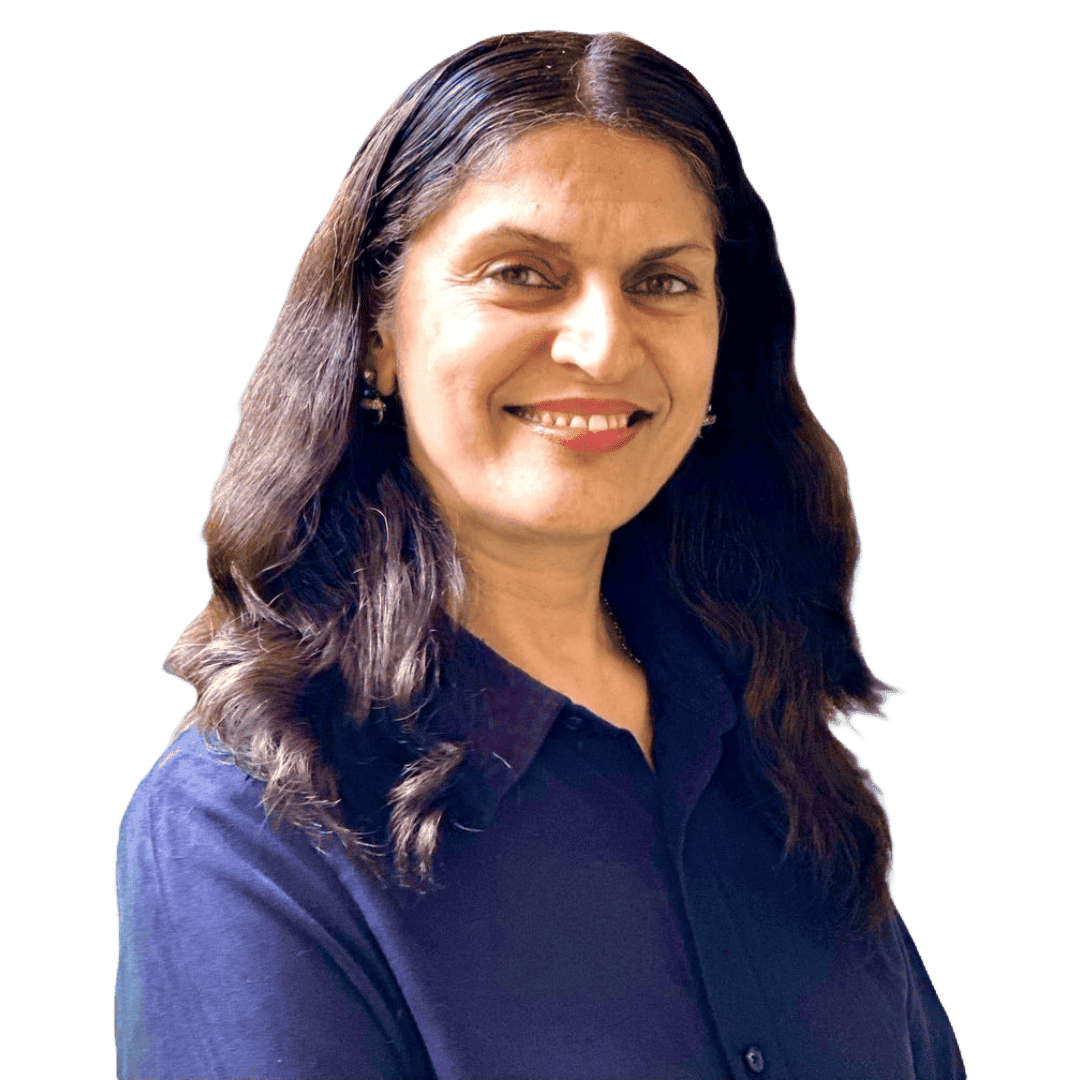
Ritu M. Uberoy has over twenty-five years of experience in the software and information technology industry in the United States and in India. She established Saviance Technologies in India and has been involved in the delivery of several successful software projects and products to clients in various industry segments.

Ritu completed AI for Health Care: Concepts and Applications from the Harvard T.H. Chan School of Public Health and Applied Generative AI for Digital Transformation from MIT Professional Education. She has successfully taught Gen AI concepts in a classroom setting in Houston and in workshop settings to C-Suite leaders in Boston and Cleveland. She attended HIMSS in March 2024 at Orlando and the Imagination in Action AI Summit at MIT in April 2024. She is also responsible for the GenAI Center of Excellence at BigRio and DigiMTM Digital Maturity Model and Assessment at Damo.

Ritu earned her Bachelor’s degree in Computer Science from Delhi Institute of Technology (now NSIT) and a Master’s degree in Computer Science from Santa Clara University in California. She has participated in the Fellow’s program at The Wharton School, University of Pennsylvania.

About the Legend

Paddy was the co-author of Healthcare Digital Transformation – How Consumerism, Technology and Pandemic are Accelerating the Future (Taylor &  Francis, Aug 2020), along with Edward W. Marx. Paddy was also the author of the best-selling book The Big Unlock – Harnessing Data and Growing Digital Health Businesses in a Value-based Care Era (Archway Publishing, 2017). He was the host of the highly subscribed The Big Unlock podcast on digital transformation in healthcare featuring C-level executives from the healthcare and technology sectors. He was widely published and had a by-lined column in CIO Magazine and other respected industry publications.
AI Will Shape Healthcare Through Access and Affordability

Season 7

Episode 202 - Podcast with Roy Schoenberg, M.D., CEO, Aileen and Founder and Executive Director, Amwell -
AI Will Shape Healthcare Through Access and Affordability

The Big Unlock
The Big Unlock
AI Will Shape Healthcare Through Access and Affordability
Loading
/

In this episode, Dr. Roy Schoenberg, CEO of Aileen and Founder and Executive Director of Amwell, reflects on the evolution of telehealth and shares a bold vision for AI’s role in reshaping care delivery. He argues that telehealth has largely been used as a substitute channel for traditional visits, whereas its true potential lies in redistributing expertise and democratizing access to care at scale.

Dr. Schoenberg sees AI becoming the primary entry point to healthcare, guiding patient journeys through intelligent, cost-driven pathways while working in concert with, rather than replacing, clinical systems. Through his new venture, Aileen AI, Dr. Schoenberg introduces a fundamentally different approach to virtual care: building “staying power” in patients’ lives through deeply personalized, relationship-driven AI interactions, for seniors. By focusing on familiarity, trust, and daily engagement—delivered through simple interfaces like phone calls—Aileen aims to address the growing caregiving gap. Ultimately, he emphasizes that while AI adoption will evolve gradually, its role as a foundational layer in healthcare is inevitable. Take a listen.

This guest appearance was facilitated through conversations initiated at HIMSS.

About Our Guest

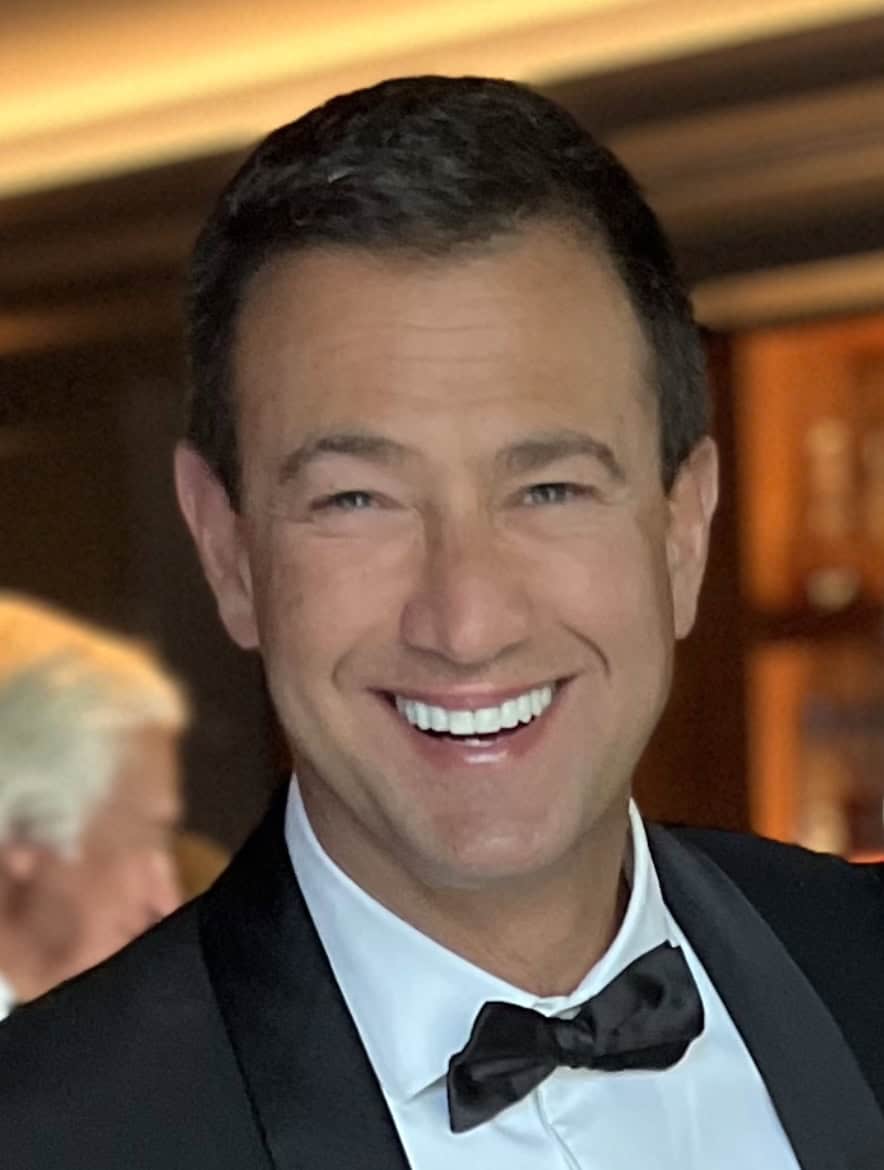
Roy is a serial Health-tech entrepreneur. After founding and running both private and public companies, (now into his fourth venture), Roy’s Impact can be easily traced to everything from Tele-ICU to Patient Portals, the introduction of Telehealth and now Ai’s arrival into healthcare. He worked closely with leaders of our largest health systems, national and regional payers, blue chip tech companies, state and federal agencies, policy makers both in Washington and overseas.

After founding and leading Amwell as its CEO to its IPO and a $9B market cap, Roy transitioned to an executive board position so he can focus on his next disruption - a novel model for the use of Ai for caregiving and elder companionship. His groundbreaking ideas in this area have already captured the industry’s imagination as evident in the recent New England Journal of Medicine Catalyst publication. Outside of his entrepreneurial endeavors, Roy chairs the MIT Sloan HSI healthcare advisory board. He is a member of the American Heart Association telehealth board and his hometown Mass General Brigham Patient Safety Research and Practice board.

Previously, Roy served on the board of the American Telemedicine Association, where he was honored with the industry leadership award. He was inducted into the USCF hall of fame, and was repeatedly recognized by Modern Healthcare magazine as one of the 100 Most Influential People in Healthcare. Roy holds an M.D. from The Hebrew University and an M.P.H. from Harvard. He is happiest next to a whiteboard or a microphone, believes in creative provocation, owns over 50 issued US patents and divides his time between Boston and the island of Nantucket with his wife and two children.


Ritu: Hi everyone. My name is Ritu, and I’m the managing partner at Damo Consulting and co-host of the Big Unlock Podcast. A very warm welcome to all our listeners for this next episode of Season Seven. Today we are really excited to welcome back Dr. Schoenberg to our podcast. He’s been on season three, episode 94. He’s the co-founder of Amwell and a pioneer who helped bring telehealth into the mainstream of US healthcare. Under his leadership, Amwell became a foundational platform for health systems and payers navigating the shift to virtual and hybrid care. Dr. Schoenberg is a physician by training and has operated at the intersection of clinical care, technology, and large-scale healthcare transformation. He is now focused on his next venture, Eileen.ai, exploring how AI can further reshape care delivery and decision-making. With that introduction, I’ll hand it over to you, Roy. Thank you so much for joining us today.

Roy: Thank you for having me, and thank you for the very kind introduction. I learned things about myself — this is great.

Ritu: Good to know. It was really good to see you at HIMSS and hear more about Eileen, and I’m sure today we’re going to hear much more since it’s been launched now. But we’ll start with the first question about Amwell. Amwell invested early in building a platform model for virtual care, but many health systems are still struggling to operationalize telehealth beyond siloed use cases. Looking back, what do you think were the biggest mismatches between how you envisioned platform adoption and how health systems actually implemented it? And if you were doing this all over again, what would you do differently to close that gap?

Roy: That’s a good couple of loaded questions. At the very highest level, the notion of delivering care over technology can be looked at in two ways. One, you can look at it as just another channel for the same encounter to take place — over a technological channel. Or you can look at it as more of a switchboard that allows you to completely reshuffle how services are acquired and delivered. Model number one is: I am your doctor, we have a follow-up appointment, and it’s going to be carried out through telehealth rather than in the office. That creates convenience and some level of efficiency, and I think that’s the majority of how health systems are utilizing this technology today. The vision behind it, though, is to give it wings — instead of just executing the same thing through technology, maybe we can democratize the availability of services at a much larger scale. To give you an example, if you happen to live in Boston where I live, cancer care is very available — Dana-Farber, Mass General. But the knowledge of those clinicians could be made available to oncology patients or even primary care physicians in West Texas or North Dakota or other places that don’t have those large cancer centers. If we created the supportive logistical framework to allow skills to flow over technology to the end of the earth, you are rewriting the healthcare experience altogether. Obviously, there’s a lot of muscle memory in healthcare that makes this challenging — health insurance, medical licensure, credentialing, and a variety of other elements that stand in the way of market forces fueling this. I still think it is inevitable. If there’s anything I would say, I think we — like many others — underappreciated how protective the healthcare system is of itself from those kinds of changes. But I think the train is out of the station. Post-COVID, the understanding that healthcare will be redistributed through technology is bigger than ever. So we’re very proud of where we got.

Ritu: You’re absolutely right. COVID normalized virtual health and telehealth, and now with AI we’re really hoping to see this taken to the next level and become truly transformational. Along the same lines, Amwell was built as a platform, but now with AI-native companies emerging, do you think the future still belongs to platforms? Or will it belong to more vertically integrated AI-driven solutions coming into healthcare?

Roy: We used to have conversations about cloud versus server farms fifteen years ago, and that conversation completely disappeared. At this point, nobody in their right mind is going to operate a server farm. I think the conversation about platform versus vertically integrated is also going to become hindsight very quickly, because people are going to care more about how the transition of any one patient takes place between different elements of care. AI will probably become the surrounding technology — the most accessible healthcare interaction you’re going to have, even for follow-up care, will come through AI just because of the economics of it. The magic will be in how AI works in concert with other vertical systems for follow-up care, diagnostics, hospitalization, and so on. There’s a lot of focus right now on whether AI can be a doctor — is it smart enough, does it know enough. The narrative is that if it can be as knowledgeable as a doctor, of course we’ll go to AI because it’s very accessible. But I think that’s a bit of an underestimation of the complexity ahead of us. There’s a lot of sentiment around seeing a doctor in person, and you can trivialize AI by calling it just a chatbot, which doesn’t give any level of reassurance. The groundbreaking event still ahead of us — the one that will dramatically change how healthcare operates with AI — is when payers introduce an insurance product that requires you to interact with AI first if you sign up for it. A little bit like what they tried with HMOs in the eighties, where the PCP was the gatekeeper. That didn’t go well for a lot of different reasons — it was not popular and felt too restrictive. But what they tried to do was control the entry point of a patient into the healthcare system, and if done effectively, potentially control consumption and referrals. The same logic applies to AI. If we can ensure patients first interact with a very knowledgeable technology that is guided by what we know is economical and high quality, we have an opportunity to influence their healthcare journey. But it’s not going to be by convincing patients that AI is better than a doctor. It’s going to be because if they choose the product that requires them to use AI, they will save a lot of money. It may sound cynical, but cost is a very powerful influence on how people consume healthcare. My sense is that it won’t be black and white — it’ll be a product that says the more you use AI, the more you save. A shared savings model. And it will have to be designed smartly, saying there is AI, and if the sky falls you can break the glass and see a clinician, then return to AI. But my bet is that that is how AI will begin to dominate our experience as patients.

Ritu: That’s a great perspective, and we do see it heading in that direction. With ChatGPT and OpenAI, health is now one of the most queried topics — I think 30 to 40% of all queries on ChatGPT right now are about health. And they’re not necessarily doctor-related questions; they’re questions from people who want to be prepared for the doctor’s appointment, asking the chatbot what they should ask their doctor. It’s really interesting that patients are going there first, and only in extreme cases seeking access to a clinician. If AI can handle everything else, then why not?

Roy: That’s exactly right.

Ritu: Okay, great. Now we can start talking about Eileen, which we were so curious about — such an interesting product. What insight or frustration from your experience at Amwell led directly to founding Eileen? And what is the problem you’re solving that is so fundamentally different from telehealth? Because this is also remote and also involves talking to patients virtually, but what’s the biggest mindset shift, and can you tell us more about Eileen?

Roy: The motivation to build Eileen had nothing to do with Amwell or telehealth directly, but there is a corollary. There’s a similarity in the challenge: you need to socialize and get people comfortable experiencing a certain dimension of their healthcare through technology. With telehealth, the place of service changed and the mode of interaction changed. With Eileen, it’s the visceral connection that you need in healthcare — that connection is now going to be furnished by AI instead of by people. It all started with a very interesting academic conversation about the role of AI in healthcare. There was a big group at the table talking about how it’s going to change the way information is analyzed, packaged, and communicated — reminders, scribing, all the things we know AI can do. To keep the dinner interesting, I took the contrarian approach and said I think AI has a role in changing the interface between technology and people in healthcare. Specifically, the most challenged population in terms of healthcare and technology are seniors. There’s clearly a need there because the reality of caregiving is very daunting. We have more and more seniors as a part of the population — doubling and tripling in size over the next decade — and at the same time the number of caregivers available to them is going in the wrong direction. People don’t want to do senior care. It doesn’t pay much and it’s emotionally and physically draining. So we have a real problem in caregiving, and the thinking is maybe AI can step into that growing void and become supportive to seniors. Now that part alone isn’t terrifically creative, because there’s a whole world called age tech designed to do exactly that — thousands of applications, all with their hearts in the right place, trying to support senior self-sufficiency. They come in wonderful shapes and sizes: chatbots, talking orbs, talking pill boxes. All wonderful designs. But the general sentiment is that because of the love-hate relationship between seniors and technology, most of these technologies die on the vine. They either don’t create adoption or they don’t create staying power — they create fatigue and eventually just never get utilized. So the nut hasn’t been cracked. Eileen steps in and says something really simple: if technology is to have a regular, influential role in the life of a senior, then maybe our first order of business is not to tell them what to do, but to establish a regular presence in their daily lives — something that is going to be sought after, something that is going to be part of their regular daily routine that they would want to interact with. If we are successful in creating technology that has that staying power in their daily lives, then through that technology we can communicate medication reminders, dietary reminders, and all the rest. But the trick is that staying power in the life of someone doesn’t come from reciting a medication list. Staying power — putting technology aside — comes from people that know you. Familiarity, intimacy, the ability to talk about your kids and grandkids, to talk about where you come from and your joys and frustrations and relationships and likes and dislikes. So, the goal is: how do you get AI to become that intimate? That’s actually a much bigger technological challenge than people give it credit for. People talk to ChatGPT and think, oh, it feels like a casual conversation, like I’m talking to someone. But for that technology to actually understand where you come from, to know the names of your grandkids, to know whether your dog got into trouble with the neighbor — that requires a completely different level of orchestration. First of all, because it’s not written anywhere. AI is really wonderful when you can feed it a lot of information, but nobody wrote the book about my dad. If AI is supposed to know everything about my dad, there’s really nothing for it to acquire that information from. And secondly, with seniors specifically, AI is designed to respond to prompts. Even the term prompt engineering tells you about the choreography — we write something in, AI comes back. We know that’s not going to work with seniors, because if we wait for seniors to prompt, we’re going to be waiting a very long time. So the whole way AI typically operates doesn’t work here. Eileen was designed to address those challenges — to become a very intimate, very engaging, knowledgeable partner in the life of the senior. One that initiates the relationship itself, doesn’t wait for the senior to download an app or log in or pair with the internet. It uses the phone to call them, the way their kids and family are supposed to. And the magic that happens during the call is that it doesn’t talk about healthcare — it talks and remembers and carries a conversation about what the senior wants to talk about, about the things that excite them or that they spend time on. It has intimate knowledge and a deep commitment to learning what they are interested in and curious about, what makes them laugh, and what they can’t tell anybody else and want to talk about. These are the things Eileen focuses on, because its purpose is to have staying power — regular, daily staying power in their lives. And then it is humble enough to understand that if it achieves that, it’s just a cog in the wheel — a mouthpiece to other technologies that can handle medication reminders, symptom monitoring, anxiety and depression tracking, and all the other things healthcare technology knows how to do. But this one creates the staying power. That’s what Eileen is all about.

Ritu: I remember when you told us about it earlier, I was struck by that very different approach — it’s not a wearable, not an app, not some high-tech device. It’s just a regular phone call, like you would receive from anyone. I thought of my mom and how she interacts with technology, and yes — she loves to get phone calls. That’s something she would actually do. It really makes a lot of sense for the senior age group you’re targeting.

Roy: We think about the simplicity of getting a phone call, but there’s also an eye on how you make this technology available to people. If we’d come up with something that requires installation, internet setup, or a technological learning curve, both the economics and the availability of the product would have completely changed. What we want is to reach a position where if you’re a family increasingly struggling with the heavy lift of being there for your parents who may live far away, and you want something to share that burden with you, we can offer the ability to activate Eileen today and she would start calling tomorrow morning. Anything that doesn’t use the phone — that doesn’t use a staple the senior is already familiar with — would require a completely different kind of orchestration, a completely different cost structure, and would make it significantly less useful to the people who need it most. There’s a lot of thinking behind why we ended up with this seeming contradiction where the backend of Eileen is rocket-science AI — really science fiction kind of AI — whereas the front end of Eileen doesn’t even need Wi-Fi.

Ritu: That’s a really interesting way to think about it. And I remember you also mentioned family groups — that Eileen will actually call family members to learn more about the senior. Is that right?

Roy: If the goalposts here are so much about intimacy and knowing the senior’s reality, and we’ve acknowledged that’s not documented anywhere, then one of the wonderful things about AI is we can say: the people who know the senior are the son and daughter, sometimes the grandkids, maybe a neighbor, maybe a spouse. The way Eileen starts serving a senior is by autonomously reaching out to those people who are close to that senior and carrying out regular conversations with them over the phone to learn about that senior’s reality. It has a very nonchalant, disarming way of doing it — you don’t have to schedule meetings or fill out forms. It just calls and says, when you have a minute, let’s chat. Then it begins building an understanding of the senior’s reality, and once it crosses a certain threshold where it has enough context, only then does it begin calling the senior directly on a regular basis. And at the end of the day, it reaches back out to the son and daughter and says, hey, I spoke to your dad a couple of times today — he was really upset about something, or he’s grumpy but that’s his usual way and everything is fine. We’re at the very early stages of this, but the framework and the approach — this very different mixture of technologies coming together on the different sides of Eileen — seems to be attractive, interesting, and plausible. And as I mentioned at the very beginning, we have to go there, because we are facing a caregiving meltdown. We’ve got to find a way for technology to help us.

Ritu: We usually start with an origin story, but we didn’t do that today. With a few minutes left, I’d love to ask what brought you into healthcare, and with Eileen I can see you really resonate with this topic. How did you get into this intersection of healthcare and technology?

Roy: I used to be a clinician. I did the whole training and thought for a long time that being a practicing clinician was the way I’d go. But I was actually dabbling with technology since I was twelve years old. I stayed home from school — I had pneumonia or something — and my dad got me a Commodore 64, which people don’t even remember existed. I think it had 5K of memory. So since then I’ve been programming and building things. After training and becoming a physician and practicing, what really interested me about technology is that if you build it right, you have the ability to change the lives of people much more widely than even a very successful practice. And the other piece is that healthcare today requires clinicians to be highly specialized, doing the same thing over and over and getting really good at it. But the mission of healthcare — advancing the wellbeing of people — becomes very siloed and myopic when you only do one procedure extremely well every single day. Technology became a different pathway to realizing the same mission: to continually rethink how we can advance the wellbeing of people and make the healthcare experience less painful. Technology today just has a bigger wingspan than some standards of practice. I’m not saying it’s better or worse — I think we need both. But I found my passion in health tech, and it’s the gift that keeps on giving.

Ritu: We’re almost at the end, Dr. Schoenberg. It’s been wonderful chatting with you. Do you have any closing thoughts or predictions for where you see AI going within the next year?

Roy: I’ll just say this: I think we’re very young in this. We get very excited about what AI can do, and I’m pretty sure that, not unlike other technologies, there’s going to be a long period of maturation — mistakes will happen and there will be things we’ll have to worry about. But the entrance of AI as a surrounding system for our healthcare experience is an inevitability. If we know we’re going to get there, you’ve got to put one foot in front of the other and start walking. That’s exactly what we’re doing. It’ll take a village — we need the brainpower and creativity of many people. But we couldn’t be more excited. I think we’re going to change the world no less than what telehealth did.

Ritu: Awesome. Thank you so much, Dr. Schoenberg. It’s been a pleasure having you on the podcast.

Roy: Terrific. Thank you so much for having me.


————

Subscribe to our podcast series at www.thebigunlock.com and write us at [email protected]   

Disclaimer: This Q&A has been derived from the podcast transcript and has been edited for readability and clarity.


About the Host

Rohit Mahajan is an entrepreneur and a leader in the information technology and software industry. His focus lies in the field of artificial intelligence and digital transformation. He has also written a book on Quantum Care, A Deep Dive into AI for Health Delivery and Research that has been published and has been trending #1 in several categories on Amazon.

Rohit is skilled in business and IT  strategy, M&A, Sales & Marketing and Global Delivery. He holds a bachelor’s degree in Electronics and Communications Engineering, is a  Wharton School Fellow and a graduate from the Harvard Business School. 

Rohit is the CEO of Damo, Managing Partner and CEO of BigRio, the President at Citadel Discovery, Advisor at CarTwin, Managing Partner at C2R Tech, and Founder at BetterLungs. He has previously also worked with IBM and Wipro. He completed his executive education programs in AI in Business and Healthcare from MIT Sloan, MIT CSAIL and Harvard School of Public Health. He has completed  the Global Healthcare Leaders Program from Harvard Medical School.

Ritu M. Uberoy has over twenty-five years of experience in the software and information technology industry in the United States and in India. She established Saviance Technologies in India and has been involved in the delivery of several successful software projects and products to clients in various industry segments.

Ritu completed AI for Health Care: Concepts and Applications from the Harvard T.H. Chan School of Public Health and Applied Generative AI for Digital Transformation from MIT Professional Education. She has successfully taught Gen AI concepts in a classroom setting in Houston and in workshop settings to C-Suite leaders in Boston and Cleveland. She attended HIMSS in March 2024 at Orlando and the Imagination in Action AI Summit at MIT in April 2024. She is also responsible for the GenAI Center of Excellence at BigRio and DigiMTM Digital Maturity Model and Assessment at Damo.

Ritu earned her Bachelor’s degree in Computer Science from Delhi Institute of Technology (now NSIT) and a Master’s degree in Computer Science from Santa Clara University in California. She has participated in the Fellow’s program at The Wharton School, University of Pennsylvania.

About the Legend

Paddy was the co-author of Healthcare Digital Transformation – How Consumerism, Technology and Pandemic are Accelerating the Future (Taylor &  Francis, Aug 2020), along with Edward W. Marx. Paddy was also the author of the best-selling book The Big Unlock – Harnessing Data and Growing Digital Health Businesses in a Value-based Care Era (Archway Publishing, 2017). He was the host of the highly subscribed The Big Unlock podcast on digital transformation in healthcare featuring C-level executives from the healthcare and technology sectors. He was widely published and had a by-lined column in CIO Magazine and other respected industry publications.
From Guidelines to Outcomes: What Autonomous AI Can Deliver in Healthcare Today

Insights by Dr. Eric Stecker, Co-founder and Chief Medical Officer, Insight Health

“Healthcare doesn’t need new technology. We need to implement what we already know works.”

That’s the underlying message Dr. Eric Stecker returns to throughout this episode of The Big Unlock. And it’s a striking perspective to hear from someone who sits at the intersection of clinical practice, population health, and AI product development.

Dr. Stecker is a practicing cardiologist and professor of medicine at Oregon Health & Science University, and he co-founded Insight Health to apply AI in ways that measurably improve real-world outcomes. He’s also spent years inside the guideline and quality ecosystem of cardiology, most notably as Chair of the American College of Cardiology’s Science and Quality Committee, which shapes national cardiology practice guidelines and policy documents. In other words, he’s not arguing from theory. He’s arguing from a place of deep familiarity with what evidence already supports and frustration that the U.S. healthcare system still struggles to carry that evidence into daily practice at scale.

The episode begins with a timely setup. Coming off conferences where “AI was everywhere,” the hosts ask about wearables and continuous data streams, and whether we’re heading toward continuous cardiac care. Dr. Stecker agrees that the future is exciting. But he draws a line between what is still evolving evidence and what is already proven, and he argues that autonomous AI can deliver enormous clinical value today without waiting for fully autonomous diagnostic AI.

Listen to the full conversation

Autonomous action versus autonomous decision-making: a critical distinction

One of the most useful contributions Dr. Stecker makes is a simple conceptual distinction that clarifies much of the market noise.

He divides autonomous AI into two categories:

  • Autonomous action (AI taking action on established protocols and workflows)
  • Autonomous decision-making (AI making clinical decisions, diagnoses, or orders without a human in the loop)

These two ideas are often conflated. Dr. Stecker insists they shouldn’t be.

Autonomous decision-making is the “hard future,” and he’s clear about why; it requires significant technical maturity, safety assurance layers, deep clinical validation, regulatory readiness, and, just as important, trust from both healthcare workers and patients. It’s coming. It’s needed. But it’s difficult.

The bigger mistake, he argues, is waiting for that future while ignoring what autonomous action can do right now.

This is where he makes a point that feels both obvious and urgent. We already have decades of high-quality evidence showing how to prevent cardiovascular events, yet we still fail at the mundane steps of implementation.

He uses cholesterol therapy as a straightforward example. Statins are not new. The evidence base is vast. Yet health systems still struggle to reliably identify eligible patients, start therapy, and support adherence over time. The result is preventable harm: heart attacks, strokes, and deaths that occur not because we lack knowledge, but because implementation breaks down.

In his framing, autonomous action is the opportunity to close that implementation gap at scale today.

And he offers a memorable “why now” scenario: what if every patient starting a new medication received consistent follow-up? What if someone checked whether they filled the prescription, whether they were having side effects, and whether they had questions, then checked in again at the interval the patient chose?

That doesn’t require futuristic diagnostic autonomy. It requires operational execution at scale.

And that, he argues, is exactly what autonomous agents can provide.


Clinician involvement is the difference between signal and noise.

If autonomous action is the promise, the risk is obvious, says Dr. Stecker, “more AI can also mean more burden.”

The hosts raised the signal-to-noise problem directly, asking about alerts, risk scores, predictions, summaries, and data streams that can overwhelm clinicians and patients. Dr. Stecker doesn’t dismiss those concerns. He agrees this is real and points out that medicine has seen it before.

He recalls the early EHR era, when alerts proliferated, and clinicians learned to click through them just to get through the day. Alert fatigue is well-documented. The danger now is that healthcare repeats that lesson in the AI era: flooding workflows with AI-generated documentation or repeated check-ins that create cognitive load rather than relief.

This is where Dr. Stecker makes a strong operational point: meaningful clinician involvement is not optional.

Not clinician involvement as advisory branding. Not “a chief medical officer who joins two meetings a month.” He’s talking about integrating experienced, practicing clinicians into product development and implementation so that the system is designed from the beginning to escalate only what matters and to avoid generating unnecessary documentation.

He gives a practical example. If an oncology practice checks in weekly with patients and generates a long summary every time, pushing it into the HER, that means someone must read it, interpret it, and decide what to do. Done poorly, the AI “help” becomes a new inbox burden.

The fix, in his view, is workflow design:

  • escalate only meaningful medical flags
  • keep routine information from becoming unnecessary documentation
  • offer dashboards or condensed summaries rather than long notes
  • design protocols that define what “needs attention” vs what is “normal.”

This is the heart of his execution argument: AI must be built to reduce the burden, not shift it.

And it reinforces his broader theme: if you leave development to people who haven’t practiced medicine or to teams that don’t understand real clinical workflows, signal-to-noise failures are inevitable.


From cardiology to population health: meeting patients where they are

The episode also reveals why Dr. Stecker is unusually focused on population health outcomes.

He describes how he came to cardiology through physiology and then electrophysiology. But he also brings an engineering-oriented mindset to medicine, influenced by his father, an engineer, and by his early exposure to databases and analytics. That “systems” orientation shows up repeatedly: he’s interested not just in what’s true clinically, but in what can be operationalized across large populations.

When asked how cardiology changes in an AI world, he shares a hopeful view: “Clinicians and patients should not have to ‘evolve too much.” The technology should fit around the current experience and dramatically improve it, unlike many past tools that felt imposed on clinicians.

As he does throughout the podcast, he gives a concrete example, autonomous agents that reach out before visits to gather medical history and symptom details, even at 2:00 a.m. if a patient is a shift worker, so that patients don’t spend precious visit time answering basic intake questions. This is a key pattern he returns to: meeting the patients where they are, on their time, in their context, while improving readiness and efficiency for the clinical encounter.

He then expands into what his team calls different interaction modalities:

  • voice-only agents (phone calls)
  • text-based interactions
  • “visual voice” experiences that blend voice with on-screen guidance and embedded media

The point is accessibility and engagement. If an AI agent can show a short instructional video to help a patient place a cardiac monitor correctly without requiring them to search online or call a help line, you reduce friction and improve adherence.

This matters because the value of autonomous action isn’t only clinical. It’s behavioral. Patients are more likely to engage when the experience is simple and supportive.


The Takeaway

Dr. Eric Stecker’s message is refreshingly direct; healthcare doesn’t need to wait for fully autonomous diagnostic AI to start saving lives at scale. We already have decades of evidence for preventing cardiovascular disease and other high-burden conditions, but we repeatedly fail to implement these interventions, including identifying eligible patients, initiating proven therapies, and supporting adherence over time. His key distinction is that autonomous action is both safe and powerful today when it’s grounded in established protocols and designed with real clinician involvement to avoid alert fatigue, documentation overload, and signal-to-noise failures. In his view, the organizations that lead won’t be the ones chasing the most futuristic promises first. They’ll be the ones who use autonomous agents to turn evidence into consistent action, building trust with healthcare workers and patients now, while responsibly advancing toward autonomous decision-making tomorrow.

Sitting at the intersection of guideline-level evidence, practicing cardiology, and real-world AI execution, Dr. Stecker’s unique insights are especially valuable:

  • Autonomous action and autonomous decision-making are different, and the fastest path to impact is autonomous action on established protocols.
  • The biggest “AI opportunity” in cardiovascular care is implementation: statins, hypertension control, and adherence support can prevent massive harm today.
  • Trust is a prerequisite for autonomy. Patients and healthcare workers must see AI as reliable, safe, and helpful before decision-making autonomy can scale.
  • Clinicians must be integrated into development and implementation to prevent alert fatigue, cognitive overload, and documentation bloat.
  • AI agents can meet patients where they are, collecting pre-visit history, guiding setup with visual support, and improving engagement without adding friction.
  • Population health impact comes from operationalizing prevention: identifying care gaps, educating patients, capturing preferences, and scheduling follow-through at scale.

AI Leadership Starts with a Simplified, Integrated Tech Stack

Season 7

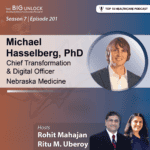
Episode 201 - Podcast with Michael Hasselberg, PhD, RN, Chief Transformation and Digital Officer,
Nebraska Medicine - AI Leadership Starts with a Simplified, Integrated Tech Stack

The Big Unlock
The Big Unlock
AI Leadership Starts with a Simplified, Integrated Tech Stack
Loading
/

In this episode, Dr. Michael Hasselberg, Chief Transformation and Digital Officer at Nebraska Medicine, makes a compelling case for sustainable digital transformation in healthcare. Sustainable digital transformation requires more than technology, it demands the right organizational structure. By unifying IT, innovation, and strategy under a single transformation office, health systems can move from isolated pilots to enterprise-wide impact.

Drawing from his journey across telehealth, mobile apps, VR, and AI, Dr. Hasselberg emphasizes that true transformation is about redesigning systems to deliver the right care at the right time. Nebraska Medicine deploys nearly one new generative AI tool per month, automating capacity management, discharge workflows, and revenue cycle operations. He also highlights the value of real-world innovation units where new technologies are tested with live patients before system-wide deployment.

Dr. Hasselberg’s most provocative insight: the next frontier of AI readiness isn’t a new technology, it’s application rationalization. He argues that to lead in AI and innovation, health systems must simplify their tech stack. Take a listen.

About Our Guest

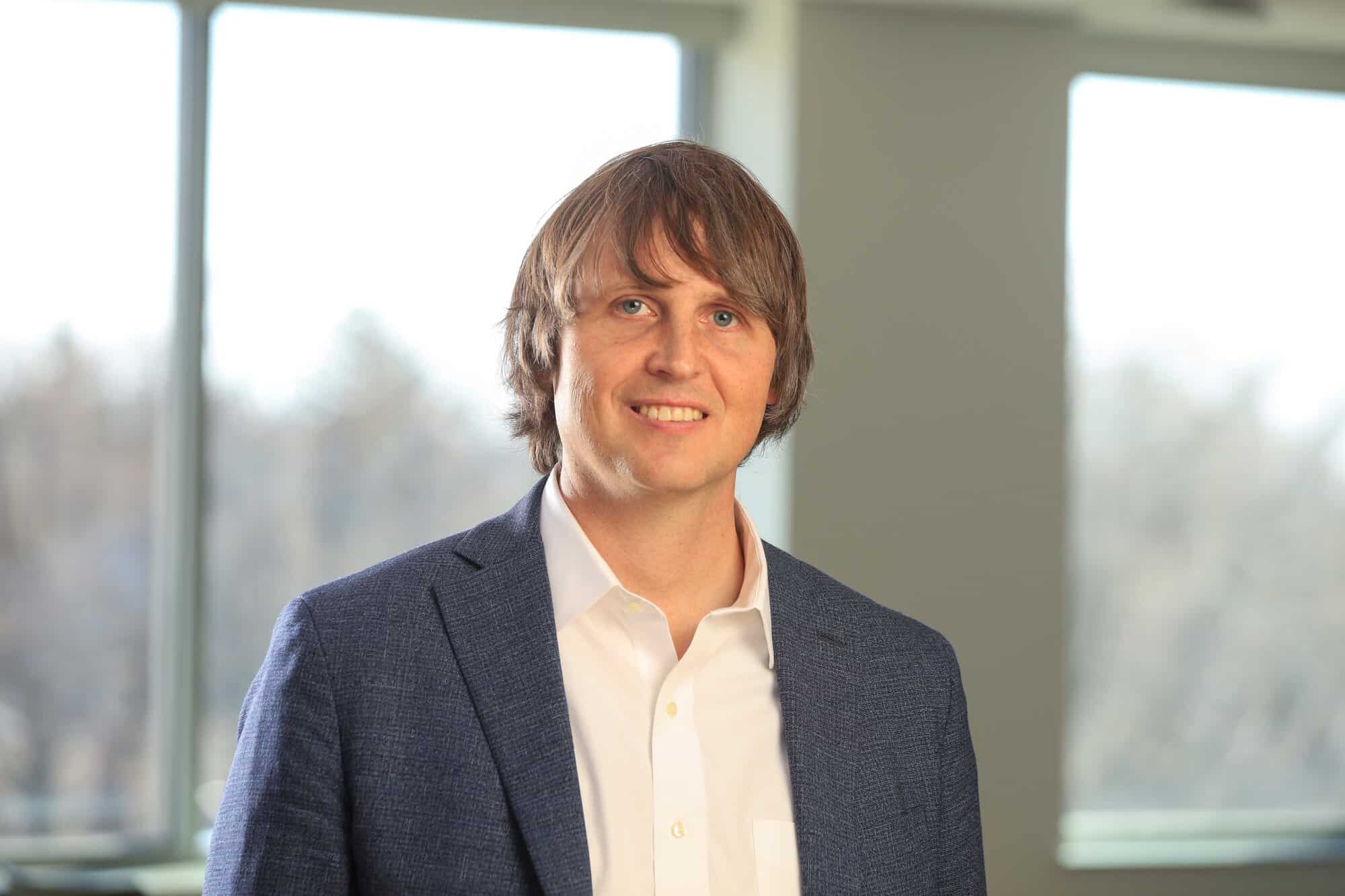
Michael Hasselberg, PhD, RN, PMHNP-BC, is the chief transformation and digital officer for Nebraska Medicine, where he leads information technology, the strategy enablement office, and the innovation team. In this role, he drives enterprise efforts to modernize care delivery and accelerate digital transformation, aligning technology, clinical operations and strategic growth initiatives. His work focuses on scaling solutions that improve patient outcomes, enhance clinician experience and strengthen health system performance. Dr. Hasselberg is also a professor of family medicine in the University of Nebraska Medical Center’s College of Medicine and volunteer professor in the College of Nursing.

Before joining Nebraska Medicine, Dr. Hasselberg spent more than two decades at the University of Rochester (UR) in New York where he held faculty appointments in psychiatry, nursing, and data science. His last role was serving as UR Medicine’s first chief digital health officer and co-director of the UR Health Lab. Dr. Hasselberg earned his Bachelor of Science in nursing at Binghamton University, Master's degree as a psychiatric mental health nurse practitioner from UR and then went on to earn a PhD degree in health practice research from UR.

His expertise expands health and technology as a Robert Wood Johnson Foundation Clinical Scholar Fellow and committee member for the National Academies Standing Committee on Primary Care. He has also been an advisor on digital transformation to government agencies, industry, venture, and health systems across the country.


Ritu: Hello listeners, a very warm welcome to the Big Unlock Podcast. My name is Ritu, and I’m the managing partner at Damo Consulting and co-host of the Big Unlock Podcast along with Rohit. We are extending a very warm welcome today to Dr. Michael Hasselberg. He’s been on the Big Unlock Podcast before — in 2022, season four, episode 138.

Welcome back. Dr. Hasselberg is the Chief Transformation and Digital Officer at Nebraska Medicine, where he is leading enterprise-wide efforts to modernize care delivery through digital innovation and operational transformation. He has a background in emergency medicine, public health, and informatics, and brings a uniquely systems-oriented perspective to scaling technology in complex health environments. Today he’s joining us on the Big Unlock Podcast and we are really excited to have this conversation. With that I’ll give it to Rohit for his introduction, and then it’s all yours, Dr. Hasselberg. Welcome once again.

Rohit: Thank you. Welcome, Michael, to the podcast — really nice to have you again. I am CEO of Damo and co-host of the Big Unlock Podcast. Short intro from our side; over to you.

Michael: It’s great to be back, and a lot has happened since we last talked in 2022, so I’m excited to dive in with both of you.

Ritu: Almost seems like a different era. Seriously. So, Dr. Hasselberg, we always love to start with an origin story because our listeners like to hear unique stories about how people got into healthcare and how they got to where they are today. If you’d like to start with that, we’d love to hear your story.

Michael: Sure. First and foremost, I’m a nurse, and very proud of being a nurse. I went on to become a psychiatric nurse practitioner very early in the psychiatric nurse practitioner movement. When I graduated, there weren’t actually any jobs for psych NPs in the city of Rochester. So, my first job as a nurse practitioner was about an hour and a half to two hours away from Rochester, where I drove every day to a very rural community in New York State where I was the only psychiatric prescriber for about six counties.

I managed the outpatient psychopharmacology clinic and the jails and the nursing homes. It was a pretty transformative experience that made me very passionate about serving vulnerable communities. The patients I served were so grateful that I was willing to drive that far every day to provide care. That experience became my underlying “why” for the rest of my career — how can we find more efficient ways to get healthcare out to communities that weren’t getting the care they deserved.

From there I finished a traditional research PhD, and after that I was tasked with developing a telehealth infrastructure for psychiatry at the University of Rochester. This was well before telehealth was widely reimbursed in the States. We built a very large telehealth infrastructure across New York State, and eventually reached a point where I couldn’t grow it further because I couldn’t graduate clinicians fast enough to take on more patients on the other end.

That’s when I really leaned into innovation. I started thinking about whether we could use technology without needing a clinician on the other end to deliver care. I got into the world of mobile apps and started working with the engineering school and computer science department to develop mobile apps for behavioral health. Then I moved from mobile apps into virtual reality when the first Oculus Quest headset came out — affordable, powerful, and untethered — and started developing mindfulness and meditation applications for VR headsets.

By that point I had different layers of digital interventions: apps, telehealth, VR headsets, and in-person care. I got really interested in data science and started thinking about whether I could use big data to risk-stratify patients to the right level of care at the right time in the right place. That drew me into machine learning and data science about seven or eight years ago.

Then COVID hit and every health system had to go digital overnight. I was put into a new position as Chief Digital Health Officer at Rochester to lead that digital transformation strategy. About two to three years ago, when the world was introduced to generative AI, our innovation team at Rochester got early access to some of those foundation models in a secured, private way. I was pretty blown away by their power. Around that time — 2022, when we last spoke — I was making comments in national forums that with the advent of generative AI, it had never been easier for health systems to develop their own AI tools in-house to solve their own problems, rather than relying entirely on vendors.

That’s when I got to meet Dr. Michael Ash, who was serving as the Chief Transformation Officer at Nebraska Medicine. Dr. Ash is a very innovative, entrepreneurial, visionary thought leader from a technology standpoint. We started exchanging ideas, and he was eventually named incoming President and CEO of Nebraska Medicine. He invited me to Omaha as a visiting professor to see the health system, and I fell in love with Nebraska, Omaha, and the organization. It was a very hard decision because I love Rochester through and through, but I took the leap to join Nebraska Medicine in Dr. Ash’s former role as Chief Transformation and Digital Officer.

Ritu: Wow, that’s a great recounting of the entire story — thank you. Really interesting for our listeners to hear as well. One thing I picked up on is that your title emphasizes transformation, not just Chief Digital Officer. What’s the difference, and where do most health systems fall short when trying to bridge that gap?

Michael: One of the things that excited me about Nebraska Medicine is that they are, I would argue, more mature and out ahead in terms of their leadership structure. They are very nimble in regards to the number of chiefs who report directly to the CEO and president. There are six chiefs — the Chief Transformation and Digital Officer being one — along with the Chief Operating Officer, Chief Financial Officer, Chief Medical Officer, Chief Nursing Officer, and then a combined Chief Legal and People Officer.

What excited me about Nebraska to do transformation at scale is that it goes well beyond just technology. In my role I’m accountable for three main verticals. First, IT — the Chief Information Officer reports up to me. Second, our innovation and venture arm, which we can dig into deeper if listeners are interested, because we’re doing some really cool things there. And third, the strategy office — we have a VP of Strategy Enablement and an entire strategy office that looks at markets, guides acquisitions, and evaluates joint ventures.

The strategy office is also where our AI efforts and engineers sit. Having strategy, innovation, and IT all underneath essentially a transformation office means we’ve got the right ingredients to do transformational work at scale. That’s what’s really exciting for me and why I took the leap to Nebraska. I think we’re very well positioned structurally to not only improve the lives of all Nebraskans, but to become the gold standard for the rest of the country on what the future of healthcare looks like.

Ritu: That’s a really good answer. Having those three things — IT, innovation, and strategy — reporting into you is directly related to the next question. A recurring issue we hear from Chief AI Officers and Chief Digital Officers is a lack of operational ownership for digital initiatives, which leads to most pilots failing or fading into obscurity. Having those three arms under you and being fully responsible must be doing a lot to ensure the success of these initiatives. We’d love to hear more about the venture arm — what’s your approach to developing new technologies and incubating ideas?

Michael: One of the really exciting things is that we already have a commitment from the health system, the university, the state, and our philanthropists to build a $2.2 billion Hospital of the Future. It’s already underway — we’ve got a hole in the ground, construction has started, and the doors will open on our main campus in about five years. We know that with healthcare and technology changing so quickly, it’s really hard to answer the question: what will the hospital room of the future look like five years from now?

To prepare ourselves to answer that question, we’ve already made significant investments in our innovation ecosystem — hundreds of millions of dollars into our Edge District. The Edge District is focused on two things: what I’d call inside-out innovation, where our researchers are developing new intellectual property that we look to potentially commercialize and spin out as startups; and outside-in, where local startups that want to get into healthcare and understand healthcare problems can get involved.

On the university side, we’ve also made significant investments in simulation and education for our future leaders. We have a program called iEXCEL, which I believe is one of the largest, if not the largest, simulation centers in the entire country. They’re using very frontier technology — we’re leaning heavily into holograms. We actually have a hologram theater where we can create holograms nearly the size of a room of hearts and organs that students can interact with as they’re learning anatomy and surgery. Of course, we also have simulation rooms and surgical simulation suites in that building.

But the really unique and exciting element is our Innovation Design Unit and Bridge Program, which sits inside Nebraska Medicine itself. We’ve built a 17-bed med-surg unit that can scale up to an ICU if needed, and it has all the bells and whistles of technology. The unit itself is modular and all glass — touch the glass and it frosts over. When we hire staff to work in the Innovation Design Unit, we look at their behavioral profiles during interviews: are they agile, knowing that how they deliver care and the technology they use is going to be constantly changing and iterating?

There’s literally a bridge off that unit to our Bridge Program — a small mockup of the unit where our engineers, data scientists, and clinicians bring in vendors or build new technology, test it in that environment, and then nurses and physicians can come over, play with it, and test it before we bring it live with patients in the Innovation Design Unit. The learnings from those technologies are informing exactly what we’re going to put into Project Health, our new Hospital of the Future. I’ve been to innovation programs around the country at some of the leading health systems, and I have never seen anything like this.

Ritu: Amazing. So, these holograms are like digital twins?

Michael: Yes, exactly. It sits on the university side, and essentially as we’re training students, we can input radiology images and the system creates a hologram of that organ from the image. Students can interact with the hologram as they’re learning anatomy and how to perform surgery.

The other exciting thing is that Nebraska is a rural state and the University of Nebraska has four campuses, one of which is in a rural part of the state where a new medical school cohort is starting up. The university has worked hard on how to transmit these holograms remotely out to that campus, so faculty specialists in Omaha can continue to support and teach those students at a distance using this forward-thinking technology. Really special and unique — and it’s what I love about being part of an academic health system, really partnering with the university side to educate our future clinicians so they’re ready to function in a hospital of the future that is digitally enabled and AI-augmented.

Rohit: With so much innovation going on, how do you prioritize and allocate resources? And if you’d like to share any success stories — and maybe some failures from a learning perspective as well?

Michael: The maturity of our structure really drives this. We have purposely placed AI — specifically our AI engineers, data analytics, and data scientists — in our strategy office, which keeps the projects we take on aligned with the most important priorities of the health system. Starting from our board metrics down to what we call our Delta projects, and then into our OKR projects.

When a new use case gets submitted, we have a very rigorous evaluation process, and where a proposal scores most points is strategic alignment to our top priorities. Within the strategy office we have a team of process engineers who, when a use case is submitted, deeply examine what problem is trying to be solved and what workflows are involved. The process engineers work closely with our enterprise architects and solution architects in IT to ask: do we already have a technology on our stack that could address this problem? If not, we work through the build-versus-buy question.

I’d argue we are more of a build shop, and that hasn’t always been the case in healthcare. We build about one new generative AI tool per month in-house. We now have 28 tools we’ve built ourselves, deployed at scale — and those AI use cases, which are aligned with our biggest health system priorities, each get what we call a Delta team. The Delta team includes operators, clinicians, informaticists, and technologists. We make sure that from build through deployment, the initiative is properly resourced to be successful and to scale. Once it’s scaled and running, the Delta team moves to the next project, and the tool is maintained as an operational program within the health system.

We’ve had a ton of success focusing on back-office work: throughput, clinical capacity. We’ve built AI tools that identify which patients in our hospital are ready for discharge and automate notifications to nurses — “this patient is ready, here are the orders needed to move them to the discharge lounge and out of the hospital.” Very similar tools around transfers: identifying which patients at rural hospitals across the state are appropriate to transfer to us, and when a patient is with us, identifying when they’re ready to transfer back. Just through automating capacity management, we’ve created over 30 net-new beds in our hospital — not by building new beds, but by automating the processes.

We’ve also automated a lot of scheduling and surgical optimization, getting the right patients in to see our surgeons at the right time. In the revenue cycle we’ve had a lot of success automating denials management, prior authorizations, and registry reporting — freeing up nurses from manually extracting data to submit to registries so the AI can do that extraction instead.

An example of something that started with significant resistance: a faculty member — a brilliant heart surgeon — went to a conference, met with an AI vendor, and came back convinced he needed their specific tool to help identify structural heart defects to get the right patients to him more efficiently. He was adamant: “The vendor says it’s plug-and-play, fully integrated into the EHR, and I needed it yesterday.” I had to spend a lot of time with him to take a step back and ask: what is the problem you’re actually trying to solve?

Once we fully understood that, I told him we have tools in-house and a data science team that I believed could not only build the same solution, but build it better because it would be personalized to his workflow. He was very hesitant and said, “I’ve heard this before — I don’t have six months to a year for you to build something.” We got past that. We were able to build a solution in less than a month, and he and his service line are very happy because it not only solves his problem, it’s tailored exactly to his workflow.

Ritu: Those are really good examples. We were bracing for the usual ambient documentation and scribe story, so it’s nice to hear about different applications.

Michael: Something people don’t know about Nebraska: when I think of the two most transformative technologies in healthcare to date, on the patient side no one would question that telemedicine has been the most transformative. And Nebraska Medicine was the birthplace of telemedicine — it started here in the Department of Psychiatry, in partnership with the Bell Telephone Company, in the 1950s. Most people don’t know that.

On the provider side, no question — ambient documentation is the most transformative technology. We were the first digital scribe pilot site in the country, in partnership with Nuance and Rush in Chicago, co-developing that technology. The two most transformative technologies in healthcare, and Nebraska was at the forefront of both. I could absolutely talk about our successes with ambient documentation, but I did want to highlight that we were one of the first, working with Nuance years ago as they were developing that technology.

Ritu: Great information — the listeners will love hearing that. We’re almost at the end; time has flown by. We’d love to hear what you see coming down the pipeline in the next one to two years that could be as transformative as ambient documentation.

Michael: I can tell you, and this may not be the sexy answer listeners are hoping for: the biggest transformative project I’ve kicked off as the new Chief Transformation Officer at Nebraska is actually a cleanup project. I’ve just launched application rationalization, and it is not an IT-driven project — it’s a health system strategic initiative.

Over the years, partly as a result of our innovative culture, we’ve had significant application sprawl. Our technology stack is very, very complex. My argument is that if we really want to continue to be leaders in AI and innovation, we have to simplify our tech stack. It will create more standardized workflows across the system, and it will free up my technologists, informaticists, and innovators — who right now are spread really thin managing so many applications.

We’re very excited, and I believe we’re going to be able to cut two-thirds of the applications on our stack over the next couple of years. That will create more efficiencies, unlock more innovation, and set us up even better from a data enablement standpoint to continue leaning into AI. Not the sexy answer, but it’s like spring cleaning — and we’ve got a lot of it to do.

Rohit: I’d add that it’s also an opportunity to infuse the remaining applications with more AI.

Michael: A hundred percent. We’re going to lean into our core applications and their functionality, and every vendor right now is introducing AI capabilities. I want to lean into my core platforms, and to do that I’ve got to remove the noise. This is a health system-level strategy, not an IT-driven initiative. We’ve already been able to identify and retire several applications, so we’re well underway.

Ritu: We’re almost at the end of the podcast. I’m sure listeners have a lot to unpack, and we’ve learned a lot of new and interesting things about Nebraska as well. Thank you so much for sharing, Dr. Hasselberg, and thank you once again for being on our podcast.

Michael: I loved it — this was a lot of fun. Hopefully you’ll invite me back in about four years, right around the time we’re opening our Hospital of the Future. Technology will have changed quite a bit by then.

Ritu: That sounds great — we’ll definitely be there for that. Thank you so much for being on our podcast.

Michael: Thank you. Alright, have a great one.

————

Subscribe to our podcast series at www.thebigunlock.com and write us at [email protected]   

Disclaimer: This Q&A has been derived from the podcast transcript and has been edited for readability and clarity.

About the Hosts

Rohit Mahajan is an entrepreneur and a leader in the information technology and software industry. His focus lies in the field of artificial intelligence and digital transformation. He has also written a book on Quantum Care, A Deep Dive into AI for Health Delivery and Research that has been published and has been trending #1 in several categories on Amazon.

Rohit is skilled in business and IT  strategy, M&A, Sales & Marketing and Global Delivery. He holds a bachelor’s degree in Electronics and Communications Engineering, is a  Wharton School Fellow and a graduate from the Harvard Business School. 

Rohit is the CEO of Damo, Managing Partner and CEO of BigRio, the President at Citadel Discovery, Advisor at CarTwin, Managing Partner at C2R Tech, and Founder at BetterLungs. He has previously also worked with IBM and Wipro. He completed his executive education programs in AI in Business and Healthcare from MIT Sloan, MIT CSAIL and Harvard School of Public Health. He has completed  the Global Healthcare Leaders Program from Harvard Medical School.

Ritu M. Uberoy has over twenty-five years of experience in the software and information technology industry in the United States and in India. She established Saviance Technologies in India and has been involved in the delivery of several successful software projects and products to clients in various industry segments.

Ritu completed AI for Health Care: Concepts and Applications from the Harvard T.H. Chan School of Public Health and Applied Generative AI for Digital Transformation from MIT Professional Education. She has successfully taught Gen AI concepts in a classroom setting in Houston and in workshop settings to C-Suite leaders in Boston and Cleveland. She attended HIMSS in March 2024 at Orlando and the Imagination in Action AI Summit at MIT in April 2024. She is also responsible for the GenAI Center of Excellence at BigRio and DigiMTM Digital Maturity Model and Assessment at Damo.

Ritu earned her Bachelor’s degree in Computer Science from Delhi Institute of Technology (now NSIT) and a Master’s degree in Computer Science from Santa Clara University in California. She has participated in the Fellow’s program at The Wharton School, University of Pennsylvania.

About the Legend

Paddy was the co-author of Healthcare Digital Transformation – How Consumerism, Technology and Pandemic are Accelerating the Future (Taylor &  Francis, Aug 2020), along with Edward W. Marx. Paddy was also the author of the best-selling book The Big Unlock – Harnessing Data and Growing Digital Health Businesses in a Value-based Care Era (Archway Publishing, 2017). He was the host of the highly subscribed The Big Unlock podcast on digital transformation in healthcare featuring C-level executives from the healthcare and technology sectors. He was widely published and had a by-lined column in CIO Magazine and other respected industry publications.
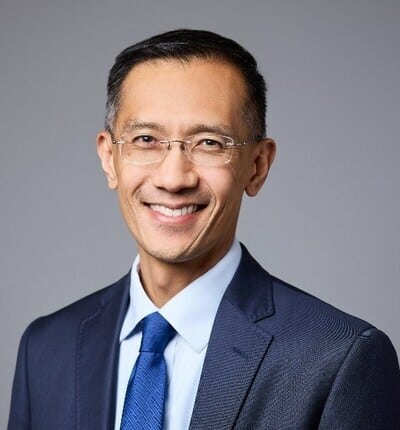
Escaping Pilot Purgatory: How Healthcare Leaders Can Scale What Matters

Insights by Rachel Feinman, SVP of Innovation and Managing Director of TGH Ventures, Tampa General Hospital on The Big Unlock podcast

“At TGH, we don’t do pilots.” That line, which was delivered with equal parts conviction and practicality, sets the tone for this episode of The Big Unlock. Rachel Feinman’s point isn’t that Tampa General Hospital flips a switch and rolls everything out systemwide overnight. It’s that they refuse to live in what she calls “endless pilots,” where momentum dies slowly and “testing” becomes a polite way to avoid committing.

Rachel brings a distinctive lens to this conversation because her path into healthcare innovation didn’t start in the usual place. She began as an M&A and business lawyer and found herself frustrated by how quickly strategic conversations ended right when the most interesting operational problem-solving began. She wanted to be in the room where strategy, execution, and value creation were actually happening, not just documenting it after the fact. That mindset, combined with deep involvement in the startup ecosystem, eventually led her to help create what is now TGH Ventures, Tampa General’s innovation, investment, and commercialization arm, translating a CEO’s vision into a structured operating model.

In other words, Rachel isn’t describing innovation as a slogan. She’s describing it as an execution system, one built to move quickly, measure clearly, and scale outcomes, not just ideas.

Escaping “pilot purgatory” starts with a mandate, not a mood

The phrase “pilot purgatory” shows up early in the conversation, and Rachel doesn’t dance around it. She describes a very specific reason Tampa General took a hard stance: pilots often become “a slow no,” or a symptom of misalignment and inability to prove results.

The mandate at Tampa General came from CEO John Couris after frustration with the way pilots can drag on without delivering meaningful operational change. Rachel is careful to clarify that this isn’t about recklessness. It’s about discipline. The organization still starts in a focused place, with a defined problem and an approach designed to prove impact quickly. But the intent is different.

They start with a thesis.

They identify the right partner and solution.

They begin in a setting where results can be measured quickly.

And if the solution performs by driving the outcomes they expect, they scale fast.

For Rachel, this is the key; the “pilot” is not the goal. It is the smallest version of a scaling strategy. If it works, they don’t leave it in limbo. If it doesn’t, they stop and move on.

This stance is important because it reframes the most common failure mode in healthcare innovation: treating experimentation as a destination instead of a step in an outcomes-driven path.

Rachel’s insistence on a thesis-first approach also solves another chronic problem: innovation that chases “the next shiny object” instead of measurable needs. A thesis forces specificity. What outcome are we driving? Where will we start? How will we measure? What would success look like, and how quickly should we see signals?

This is how organizations avoid building impressive “proofs of concept” that never integrate into real operations.


Moving fast without compromising safety: “go slow to go fast”

One of the most valuable parts of the episode is how Rachel resolves a tension every health system leader recognizes.

On one side: “fail fast,” experiment, iterate.

On the other hand, healthcare’s tolerance for risk, especially in clinical settings, is low, and for good reason.

Rachel doesn’t pretend those forces magically align. She explains that the reason healthcare hasn’t moved as quickly historically is that when you’re talking about patient care and safety, failures can have serious consequences. “Fails around safety are not okay,” she says, and that becomes the grounding principle.

So how does a system move faster without compromising safety?

Her answer is to separate domains and apply the right speed to the right work.

She describes an enormous opportunity to innovate in the administrative, operational, and logistics layers of healthcare, well before you get into direct clinical decision-making. She even frames health systems as “one giant logistics company,” coordinating people, schedules, resources, and information across complicated care protocols. In those areas, moving fast is not only possible, but it’s also necessary. Scheduling efficiency, care coordination, and non-clinical process redesign can produce a meaningful impact quickly and safely.

When the innovation touches clinical care, the approach changes.

That’s where her “go slow to go fast” philosophy comes in.

The idea is to go slow at the beginning to set the right guardrails. Put the right governance in place. Get the right people around the table early, such as clinical leaders, safety stakeholders, compliance, and operations, so you don’t spend months later stuck in “what if” loops. It is imperative to do the careful work upfront, deliberately, while accelerating as quickly as possible, in a meaningful way, to the end goal.

Once governance, safety, and guardrails are clear, you can move faster with confidence. You’re not skipping safety, you’re engineering for it, out of the starting gate. This mindset is a direct antidote to a common problem: innovation teams doing great work, only to hit a late-stage wall of approvals and concerns. Rachel is essentially describing a system that front-loads alignment, so execution doesn’t stall later.


The innovation engine: partnerships, ventures, and proof of value

Rachel’s role spans innovation, ventures, and digital solutions, and she explains how TGH Ventures operates with a dual focus that many systems struggle to balance.

Yes, there is an investment strategy. Financial diligence matters. The organization wants confidence in the likelihood of a solid financial return on venture investments.

But her emphasis is clear: strategy comes first.

TGH Ventures evaluates whether a company advances Tampa General’s system strategy, not in generic terms like “improving patient experience,” but in ways tied to the organizational action plan and specific tactical priorities. That matters because it forces venture activity to support real operating goals rather than becoming a separate “innovation island.”

She offers a concrete example: Reimagine Care.

What makes this part of the conversation resonate is that it’s not delivered as a pitch. It’s delivered through lived experience. Rachel shares that her father was diagnosed with esophageal cancer and was treated at TGH. Navigating oncology symptoms and treatment side effects is complex. It can create a high burden on patients, families, and care teams. The number of messages to providers grows. Nurse lines have hours. Families worry about when they’ll get answers and what to do if they don’t.

In that context, Reimagine Care’s model, AI coupled with 24/7 clinical support, is framed as a practical solution: help patients manage symptoms, reduce avoidable emergency room visits, improve satisfaction, and reduce provider burnout. Rachel cites outcomes seen at other institutions: up to a 70% reduction in avoidable ED visits for oncology patients.

Whether or not every organization achieves that exact number, the point is larger: Tampa General isn’t investing for novelty. It’s investing in solutions that can produce measurable operational outcomes and relieve real clinical pressure.

This is also where her “beyond the walls” theme becomes clearer. She repeatedly highlights the fragmented nature of care, with patients often moving between settings, specialists, and touchpoints that don’t always connect. Innovation that matters, in her framing, is innovation that stitches that fabric together, so nothing falls through the cracks.

That “connective tissue” focus is not theoretical. It is the difference between a healthcare experience that feels like a series of disconnected transactions and one that feels coordinated and safe.


Scaling impact requires a thesis, governance, and the courage to commit

Rachel Feinman’s message is straightforward: healthcare doesn’t need more experimentation for experimentation’s sake. It needs a repeatable operating model that moves promising work into real impact.

At Tampa General, that begins with a refusal to linger in “pilot purgatory.” It’s not a rejection of starting small, it’s a rejection of staying small without decision. The approach is to start with a thesis, pick partners intentionally, measure results quickly, and scale fast when outcomes are proven.

She also offers a mature answer to a question that often paralyzes organizations. How do you move fast in a zero-risk environment? Her answer is to apply the right speed to the right domain. In other words, move fast in operational and administrative workflows where there is a massive opportunity, and “go slow to go fast” in clinical innovation by putting governance and guardrails in place early.

Finally, she points toward the real frontier: connecting fragmented care journeys and extending care beyond hospital walls, so patients experience a seamless system rather than disconnected silos.

The through-line is execution. Not ideas. Not pilots. Execution.


The Takeaway

Rachel Feinman’s view of healthcare innovation is refreshingly practical. In her world, the industry doesn’t need more pilots that drift without commitment; it needs an outcomes-driven model that starts with a clear thesis, measures value quickly, and scales what works with urgency. Her message is also nuanced: healthcare can and should move fast in logistics, access, and operational workflows, while using a “go slow to go fast” governance approach for clinical innovation where safety must be engineered upfront. In her framework, AI is a powerful accelerant, but only when paired with intentional partnerships, disciplined measurement, and a system-level focus on stitching together fragmented care journeys so patients experience continuity, not silos. The organizations that lead won’t be the ones running the most experiments. They’ll be the ones that can standardize, support, and spread proven solutions because their innovation strategy is built for scale impact, not just scale ideas.

Sitting at the intersection of strategy, deal-making, and real operational accountability inside a large academic health system, Rachel Feinman’s unique insights are especially valuable:

  • “Pilot purgatory” is avoidable when leadership mandates impact: start with a thesis, prove results, and scale quickly instead of drifting in endless tests.
  • Healthcare can “fail fast” in operational and administrative workflows, where logistics and coordination offer massive upside without compromising clinical safety.
  • For clinical innovation, the right approach is “go slow to go fast”: set governance and guardrails early so execution can accelerate later.
  • A health system venture arm creates the most value when investments are tied directly to the system’s strategic action plan and not generic innovation goals.
  • AI becomes meaningful when it compresses cycle time, turning insights into near real-time outputs that move stakeholders from discussion to action.
  • The next frontier is connecting fragmented care journeys and extending care beyond hospital walls, so patients experience seamless coordination rather than specialist silos.

Healthcare Needs Real Disruption, Not Incremental Change

Season 7

Episode 200 - Podcast with Stephen K. Klasko, MD, MBA, Executive in Residence, General Catalyst
Board Chair - DocGo, Teleflex

The Big Unlock
The Big Unlock
Moving Beyond Pilots to Scale Impact in Healthcare
Loading
/

Season 7 | Episode 200

Dr. Stephen K. Klasko, Executive in Residence, General Catalyst & Board Chair, DocGo, Teleflex -
Healthcare Needs Real Disruption, Not Incremental Change

The Big Unlock
The Big Unlock
Healthcare Needs Real Disruption, Not Incremental Change
Loading
/

In this episode, Dr. Stephen K. Klasko, former CEO of Jefferson Health, Executive in Residence at General Catalyst, Board Chair at DocGo, Teleflex, and one of healthcare’s most provocative voices, challenges the industry to rethink its fundamental assumptions and move toward a more sustainable, patient-centered future. He argues that despite years of discussion around value-based care and digital transformation, true disruption has been limited because stakeholders remain unwilling to fundamentally change existing business models.

Dr. Klasko argues that the healthcare system is broken, fragmented, expensive, and inequitable and that true disruption, like what Uber did to taxis or Amazon to retail, will demand that some players fail. He makes the case that the annual physical visit is a farce, and that continuous health narratives powered by wearables and AI companions are the future of proactive, personalized care.

On the tech-provider collaboration front, Dr. Klasko identifies – founder ego, misaligned incentives, and EHR-era skepticism as the biggest barriers. He advocates for co-developing solutions, sharing equity, and building genuine partnerships. Dr. Klasko’s message to healthcare leaders is unambiguous: stop turning things around 360 degrees and start making real, uncomfortable changes. Take a listen.

This guest appearance was facilitated through conversations initiated at Health Tech Summit by Cornell Tech.

About Our Guest

Dr. Stephen Klasko's professional history has been about not just disrupting healthcare but demolishing its sacred cows and rebuilding from scratch. As president and CEO of Thomas Jefferson University and Jefferson Health, he orchestrated a 567% revenue growth from $1.5 billion to $10 billion in nine years, while pulling off a merger of a 200-year-old health science university with a design school to reimagine "the human design experience in healthcare" starting at home. In a single year, he was named the #2 most influential person in healthcare and Fast Company's "Top 25 most creative people in business." He co-authored "Unhealthcare: A Manifesto for Health Assurance" with Hemant Taneja of General Catalyst—a battle cry against an industry he believes is fundamentally broken.

Now leading that change through his work at General Catalyst and DocGo, Klasko has spent his career proving that the biggest threat to healthcare innovation isn't technology, it's the traditionalists defending a dying system. Where others see academic medicine and Silicon Valley as opposing forces, he has built his legacy proving that they're the only combination powerful enough to save healthcare from itself.

As a DJ and doctor, he looks forward to 2026, when we, as the dreamers and designers of healthcare, can do an "ERAS tour"—Empathy, Radical collaboration, Access, and Swift care—and, as Sia sang, find the "courage to change."


Ritu: Hello everyone. Welcome to the Big Unlock Podcast. My name is Ritu and I’m your co-host today along with Rohit. I’m the managing partner at Damo Consulting and host of the Big Unlock Podcast. Really happy to have our listeners here today and to welcome Dr. Klasko to the podcast.

He’s one of the most provocative voices re-imagining the future of healthcare. In 2024, Becker’s Hospital Review named him as one of the great leaders in healthcare. He’s been recognized by Fast Company as one of the most creative people in business, by Modern Healthcare as the number two most influential person in healthcare, and by Ernst & Young as Entrepreneur of the Year.

Former CEO of Jefferson Health, he led its transformation into a national model for innovation, scaling it into a 14-plus hospital system. He’s also co-author of Unhealthy: A Manifesto for Health Assurance, where he challenges the industry to move beyond sick care toward true health assurance. Today, as an advisor and investor working with organizations like General Catalyst, he’s helping build the next generation of digitally enabled, patient-centered care models. Known for questioning long-held assumptions, Dr. Klasko continues to push healthcare leaders to rethink not just how care is delivered, but why the system even exists in its current form.

Really happy to have you with us, Dr. Klasko. With that I’ll pass it to Rohit for a brief intro.

Rohit: Thank you, Ritu. Hi everyone, I’m Rohit — CEO of Damo and co-host of the Big Unlock Podcast. It is a pleasure to have you, Steve, on the podcast. We had such a wonderful presentation from you at Cornell Tech recently. Looking forward to an engaging session. Thank you.

Stephen: Well, thanks. You guys did a better introduction than I could have done. When you’re 72, you have about five different careers — we could take the whole half hour. What I told someone at a Forbes conference: a young woman came up to me and said it seemed like everybody knows me. I said, look, I’m 72, I’ve been a healthcare leader for 40 years, I’m still vertical, and my first five Google pages are still positive. There are only about ten people who can say all four of those things.

The simple answer is I started my career as a DJ. I’m a high-risk obstetrician who delivered about 1,500 babies in private practice in Pennsylvania and Florida. Through a series of events, I got my MBA at Wharton and became one of the leaders in studying what makes doctors different and how we handle change. I became the dean of a couple of medical schools, including one where we selected a class based on self-awareness, empathy, communication skills, and cultural competence — not just memorizing the Krebs cycle.

Then I became CEO of two different academic medical centers: University of South Florida — which, interestingly, is not in south Florida but in northwest Florida, which tells you everything about the logic of Florida — and then Jefferson, which we grew from roughly a $1.5 billion single-hospital entity to an 18-hospital healthcare-at-any-address system with an insurance company.

One of the things I’m most proud of: we merged our 200-year-old health science university with the number-three design university and created the first MD/Master’s in Design — the design of the human experience in healthcare. Our mission became being a 200-year-old academic medical center thinking like a startup, really embodying the model of what you’d get if a Silicon Valley entrepreneur and a health system CEO had a baby. We tried to create that at Jefferson, and in some respects that’s what we’re doing at General Catalyst now. We’ve acquired a health system, Summa, and created health assurance partners like WellSpan and others. It’s taking both sides — the tech galaxy and the traditional healthcare ecosystem galaxy — recognizing that neither has all the answers, and trying to bring them together.

Ritu: Thank you for that wonderful introduction — three questions straight away from what you’ve said. Let’s start with the first one. You’ve talked about healthcare at any address: telehealth, distributed care, digital front doors. COVID really normalized that, but we still haven’t seen that system come fully to scale. What is the problem, and why do you think digitization and the digital front door haven’t happened so far?

Stephen: I’ll start with two quotes. One is from Peter Diamandis, who said the problem with disruption is that it disrupts your current line of business. And we haven’t been willing — insurers haven’t been willing, hospitals haven’t been willing — to disrupt their current lines of business. We all talk about it. We talk about value-based care like it’s some Greek mythology myth, because we haven’t figured out how to make it work by and large.

One of my mentors was Bill Kissick, who wrote a book 45 years ago called Medicine’s Dilemmas: Infinite Needs, Finite Resources. He was the first to talk about the Iron Triangle of access, quality, and cost. If you remember ninth-grade geometry, increase one angle and you have to decrease another. So if you increase access, you’re either going to increase cost or decrease quality — unless you’re willing to disrupt the system. And disruption is painful.

He said, in a nonpolitical way: if anyone ever tells you they’re going to increase access, increase quality, and decrease cost — and it’s not going to be painful — they’re not telling the truth. The day after the ACA passed, President Obama said it would increase access, increase quality, and decrease cost with no pain to anybody. Whether that was intentional or inadvertent, it clearly wasn’t true. Trump said his plan would be fantastic, terrific, unbelievable, and really huge — and it was none of the four.

In every other disruption of every other sector — Uber and taxis, Amazon and retail — the players that weren’t willing to be fundamentally disrupted went away. Think Sears and JCPenney. Circuit City thought they could go all-e-commerce and failed. Others said, “Holy moly, this is real,” figured out how to make their old model work alongside a new model — think Target and Walmart.

That’s largely what’s happening right now in healthcare. This is the first time in our history where just about everybody’s hurting. For the last ten or fifteen years, hospitals ruled the roost and told insurers what to do. Then payers said, “If you don’t do this, I’ll send all my patients elsewhere.” Just look at UnitedHealthcare — since the ACA it became the second-best-performing stock after Apple, and it’s a middleman. But now they’re hurting and the hospitals are hurting too.

The simple answer is: until we recognize that the system is broken, fragmented, expensive, and inequitable — and probably unsustainable, though we’ve been saying that for a long time — something has to give. It’s really like Hurricane Katrina, where everybody said the levees wouldn’t hold until they didn’t. We are literally at that point in healthcare.

Ritu: I totally agree with you. Even at Cornell Tech, something I wrote down from your talk: true change can’t be incremental and slow — it has to be jolting, and it has to hurt people.

Stephen: And people have to fail. Sears and JCPenney failed. Circuit City said “we’re going all-e” and failed. I did a lot of work with Target and Walmart when I took over Jefferson, and their whole philosophy was: we’re really good at what we do, we’re not going to abandon that, but we have to be just as good as Amazon at what they do. In one case they bought a new platform, in another they built one. That was an aha moment for me.

At Jefferson, we have one of the best pancreatic cancer surgeons in the world — Dr. Charles Yeo. If you have pancreatic cancer, you don’t care about our digital health strategy, our TV screens, or our food. You want to see Dr. Yeo, and people come from around the world for that. But for the other 97% of people in Philadelphia who don’t wake up thinking of themselves as patients, all we could say was: come to my office, my ER, my urgent care, my hospital. None of them wanted to do any of that. They wanted to be a person with diabetes or congestive heart failure or COPD who could thrive without having to think about it.

One of our first big successes at General Catalyst was Livongo — sold for $18.4 billion. All Livongo did, when you really think about it, was say: we’ll be your invisible friend if you have diabetes. They partnered with Jefferson and said, “Klasko’s great — but he’s great if you need his office, urgent care, ER, or hospital. That’s not what you need 97% of the time. We’ll be there for the other 97%.” That’s what tech, payers, and health systems have to learn to do together. The ones that can disrupt on access, quality, user experience, and cost will succeed.

Ritu: That leads into the new era — you’ve also talked about how the whole idea of the annual wellness visit is going to be outdated because of the constant stream of data coming in from wearables. People need AI companions, and they’re so used to getting everything on demand. The whole model of going into the doctor’s office, seeing the doctor, and then waiting for information is going to be very outdated very soon.

Stephen: The annual visit is a farce. Think about it — imagine if your entire financial life was managed by checking in once a year and ignoring everything in between. Oh, by the way, there was a war, or inflation ticked up four years ago. We’ll just check you annually. I had my Mayo Executive Wellness exam and they gave me all this guidance on exercise and weight loss. I’m a marathon runner. Two days later I tore my hamstrings. Everything they told me was immediately irrelevant.

If they had gotten the data from my Oura ring, they would have said, “Hey Steve, you were running 25 miles a week and you stopped on Tuesday — we’d like to talk to you.” Well, I didn’t just stop. I did a face plant because I tore my hamstrings and had them surgically reattached.

My new book is going to be called — as I mentioned at the Cornell talk — Swifties, Startups, and the Singularity, where I come back from 2035 as the Chief Digital Health Officer for President Taylor Swift, because the Swifties have become a political party. We could do worse. Our healthcare motto was “make healthcare Taylor-made, make it Swift” — neither of which was true in 2026. And one of the breakup songs was: we were never, ever, ever going back together with annual physicals. Even the term “physical” is asinine — it means I’m going to check everything from the neck down once a year.

One of the companies I’m involved with, NeurFlow, did a study showing that about 30% of people who have attempted or completed suicide had seen their primary care doctor within the last four or five months. They had a “physical” and the doctor didn’t connect what may have been a warning sign. NeurFlow actually connects those warning signs. So the whole concept of continuous health narratives and much more sophisticated wearables is critical.

I had a cardiac bypass two years ago. I left the hospital on day two — actually DJing for the nurses on day two. Typical cardiac rehab would have me sitting in a waiting room about five weeks later, getting wired up and walking on a treadmill. I’m a marathon runner — I wasn’t doing that. So I talked to my cardiologist and we connected my Oura ring and Apple Watch data. He had me start walking around week two, monitoring heart rate variability, and gradually increasing. I did it all from home at a much lower cost and was back to running within about eight weeks — whereas with the traditional approach I would just have been starting treadmill walking.

This healthcare-at-any-address model not only makes care more accessible but allows you to customize it. A lot of bypass patients are sedentary people who haven’t exercised — and that’s the one-size-fits-all model in American medicine. I had an autoimmune issue, a cholesterol of 107, and weighed 140 pounds. I didn’t need to prove I could walk on a treadmill.

Ritu: Absolutely. So Dr. Klasko, you’ve been championing radical collaboration between health systems and Silicon Valley for a while now. You mentioned Summa, but in practice, what is the biggest failure you’ve seen where collaboration looked good on paper but didn’t work in the real world due to culture, incentives, or ego?

Stephen: I think you answered your own question — culture and ego. Let me expand on that. First, here’s what we hear from health system CEOs: “We are tired of putting all the Lego pieces together for all the point solutions your 28-year-old founders create.”

I’m a board advisor to five very good women’s health AI and tech companies handling different parts of women’s health — fertility, menopause, the vaginal microbiome, pregnancy. Why don’t they get together and say, “Throughout a woman’s life, we can now do more of this at home”? It’s founder ego. I sometimes have to explain to these companies: you’re not going to create an IPO based on dense breasts, or vaginal microbiome, or one part of a woman’s life like fertility alone.

The second thing is that we haven’t been that successful in the past. As one CEO told me: “You spent 40 years telling us technology would make our life easier.” Start with what he called the epidemic of EHRs — they were supposed to make our lives easier and all they did was create more administrators. There’s real skepticism that AI isn’t just our new cool EHR.

And then the third thing is incentives. One of the things I’m proud of at Jefferson: I wrote an article called “I’m Never Getting Fleeced Again.” I was at University of South Florida and a CEO came to me in 2009 — a virtual health company, even back then. He said, “Steve, I want to take you out to dinner. We couldn’t have done it without you. USF was our first client.” I asked why the dinner. He said, “We just got valued at $800 million.” I said, “That better be one hell of a dinner, because we didn’t get anything out of that.” He said, “No, no — I’m also going to send you four fleeces.” So my article was “I’m Never Getting Fleeced Again.”

If I’m really involved in helping create billion-dollar companies, that has to change. At Jefferson, we literally put a General Catalyst person on our cabinet. We co-developed. With companies like Carrum Health, we gave them total access to all our doctors and systems, but we also had an opportunity to gain equity — not pay-to-play, just true partnership. When Carrum became a significant company, I didn’t feel like I’d helped create something and gotten nothing in return.

From Jefferson’s perspective, it was also a portfolio diversifier — which is what every health system needs. If you’re struggling to make a 2% margin on your hospital business and you can’t depend on investment markets continuing to grow 10 or 15% a year, while you’re getting less and less from insurers — meanwhile $30 billion is being spent on digital health and somebody’s making a lot of money, and they can’t make it without you — you don’t need to be a genius to ask: how do I participate in that in a legal and ethical way? That’s what I talk to hospital system CEOs and boards about.

Rohit: Steve, I’m thinking about the fact that hospitals are largely set up as not-for-profit — that’s in their DNA. You’ve been CEO of a not-for-profit system. Now you have General Catalyst, clearly driven by profit, with investors expecting a return, coming in through the Summa partnership. How do you bring those two worlds together?

Stephen: I’ve been on the board or in the CEO seat of three kinds of health systems: not-for-profit, for-profit, and religious faith-based institutions. Here’s what I’d say: by and large, the faith-based institutions were the most mission-driven and the least profitable. We started every board meeting with our mission. Beyond that, the distinction between not-for-profit and for-profit is much more variable than people think.

I’ve seen not-for-profit hospitals that talk about nothing other than donor dollars, US News & World Report rankings, and beating competitors in research. And I’ve talked to people like Jonathan Perlin, who was Chief Medical Officer for HCA and now runs JCAHO, who would push back on that. He’d say, “We probably did more to normalize obstetric care through our for-profit system.” Chip Kahn, head of the Federation of American Hospitals, would say: “The difference is we pay taxes.”

That said, there are absolutely for-profit systems I wouldn’t want to be part of — and there are not-for-profit systems I wouldn’t want to be part of either. When you get to General Catalyst, it’s a genuinely different situation. I know it’s easy for me to say, but when we wrote that book — Unhealthy: A Manifesto for Health Assurance — we called it a manifesto deliberately. And my partner, who I now have the honor of working for, made a decision that to truly actualize what we wrote, we have to prove it.

We did not go and acquire a sexy, profitable LA health system. We acquired Summa Health in Akron, Ohio — literally in the middle of the country, in the middle of how health systems are doing. They weren’t going bankrupt, they were in the upper-middle tier on quality, but not what everyone was talking about. A couple-billion-dollar, few-hospital system with a small insurance company. We have this principle called responsible innovation. We didn’t invest a few hundred million dollars there to come back with a quick profit. It’s a ten-year type of commitment.

And honestly, partly why I’m not the most directly involved — I’m 72, unless they’re building assisted living facilities. But it’s exciting and I think it’s being done for the right reasons.

What frustrates me is that I’ve been doing this for 40 years, and when you go to Health Evolution, Forbes Healthcare, or similar events, you’d think we have the most equitable, fair healthcare system in the world, because everybody’s talking about what they’re doing. We’ve been talking about the same transformations for decades. The quote I used at Cornell: Jason Kidd, when he came to the Dallas Mavericks who were 24 and 52, said “I’m going to turn this team around 360 degrees.” We do a lot of turning things around 360 degrees in healthcare.

I’m hoping that people who listen to the Big Unlock Podcast and who went to the Cornell Health Tech Summit are willing to say: I’m mad as hell and I’m not going to take it anymore. We’re not turning things around 360 degrees anymore. That’s my hope.

Ritu: Thank you. Thank you so much, Dr. Klasko. It’s been a pleasure.

Stephen: Thank you. Take care, everyone.


————

Subscribe to our podcast series at www.thebigunlock.com and write us at [email protected]  

Disclaimer: This Q&A has been derived from the podcast transcript and has been edited for readability and clarity.


About the Hosts

Rohit Mahajan is an entrepreneur and a leader in the information technology and software industry. His focus lies in the field of artificial intelligence and digital transformation. He has also written a book on Quantum Care, A Deep Dive into AI for Health Delivery and Research that has been published and has been trending #1 in several categories on Amazon.

Rohit is skilled in business and IT  strategy, M&A, Sales & Marketing and Global Delivery. He holds a bachelor’s degree in Electronics and Communications Engineering, is a  Wharton School Fellow and a graduate from the Harvard Business School. 

Rohit is the CEO of Damo, Managing Partner and CEO of BigRio, the President at Citadel Discovery, Advisor at CarTwin, Managing Partner at C2R Tech, and Founder at BetterLungs. He has previously also worked with IBM and Wipro. He completed his executive education programs in AI in Business and Healthcare from MIT Sloan, MIT CSAIL and Harvard School of Public Health. He has completed  the Global Healthcare Leaders Program from Harvard Medical School.

Ritu M. Uberoy has over twenty-five years of experience in the software and information technology industry in the United States and in India. She established Saviance Technologies in India and has been involved in the delivery of several successful software projects and products to clients in various industry segments.

Ritu completed AI for Health Care: Concepts and Applications from the Harvard T.H. Chan School of Public Health and Applied Generative AI for Digital Transformation from MIT Professional Education. She has successfully taught Gen AI concepts in a classroom setting in Houston and in workshop settings to C-Suite leaders in Boston and Cleveland. She attended HIMSS in March 2024 at Orlando and the Imagination in Action AI Summit at MIT in April 2024. She is also responsible for the GenAI Center of Excellence at BigRio and DigiMTM Digital Maturity Model and Assessment at Damo.

Ritu earned her Bachelor’s degree in Computer Science from Delhi Institute of Technology (now NSIT) and a Master’s degree in Computer Science from Santa Clara University in California. She has participated in the Fellow’s program at The Wharton School, University of Pennsylvania.

About the Legend

Paddy was the co-author of Healthcare Digital Transformation – How Consumerism, Technology and Pandemic are Accelerating the Future (Taylor &  Francis, Aug 2020), along with Edward W. Marx. Paddy was also the author of the best-selling book The Big Unlock – Harnessing Data and Growing Digital Health Businesses in a Value-based Care Era (Archway Publishing, 2017). He was the host of the highly subscribed The Big Unlock podcast on digital transformation in healthcare featuring C-level executives from the healthcare and technology sectors. He was widely published and had a by-lined column in CIO Magazine and other respected industry publications.
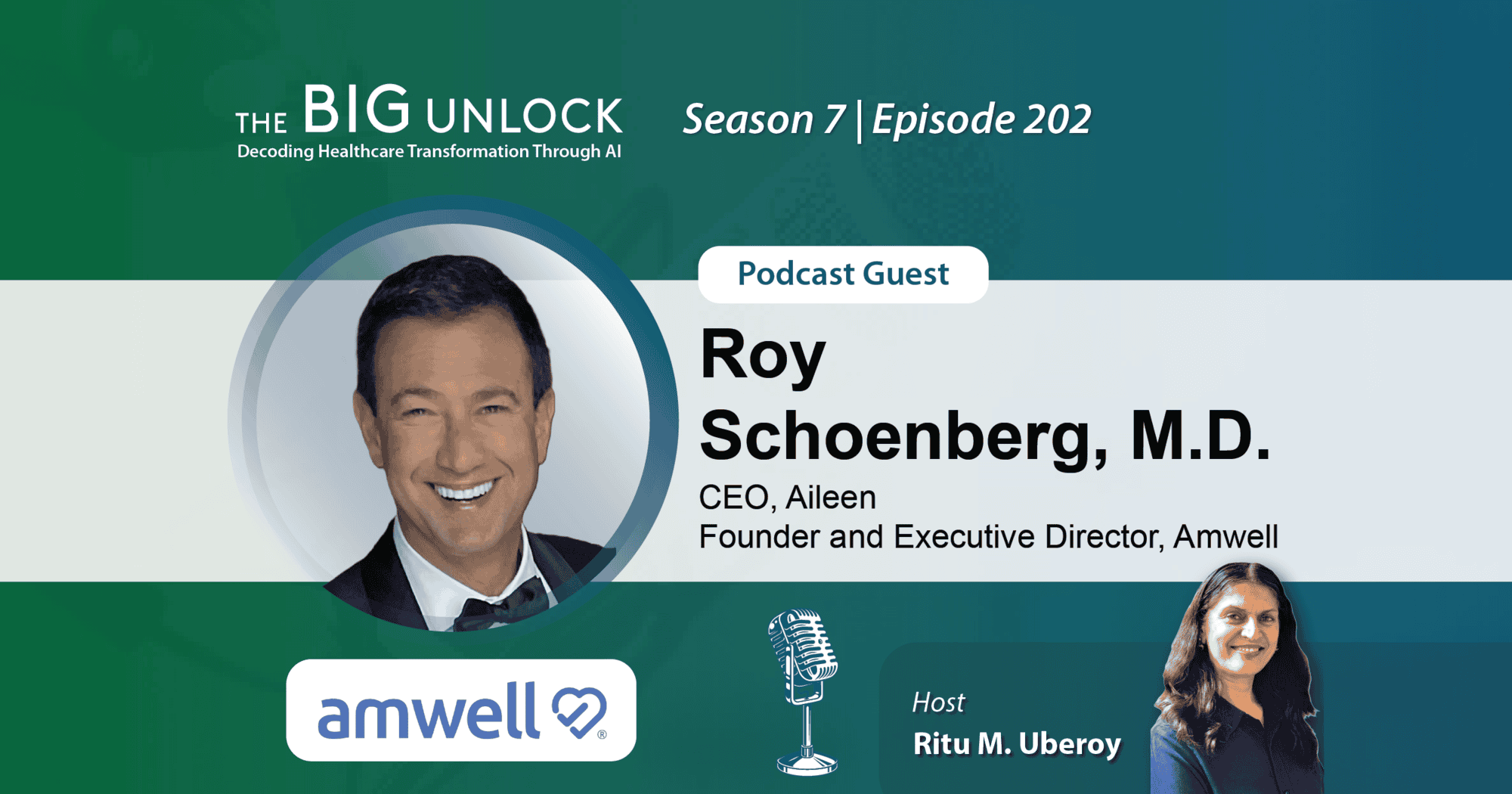
The Healthcare Digital Transformation Leader

Stay informed on the latest in digital health innovation and digital transformation.

The Healthcare Digital Transformation Leader

Stay informed on the latest in digital health innovation and digital transformation

The Healthcare Digital Transformation Leader

Stay informed on the latest in digital health innovation and digital transformation.