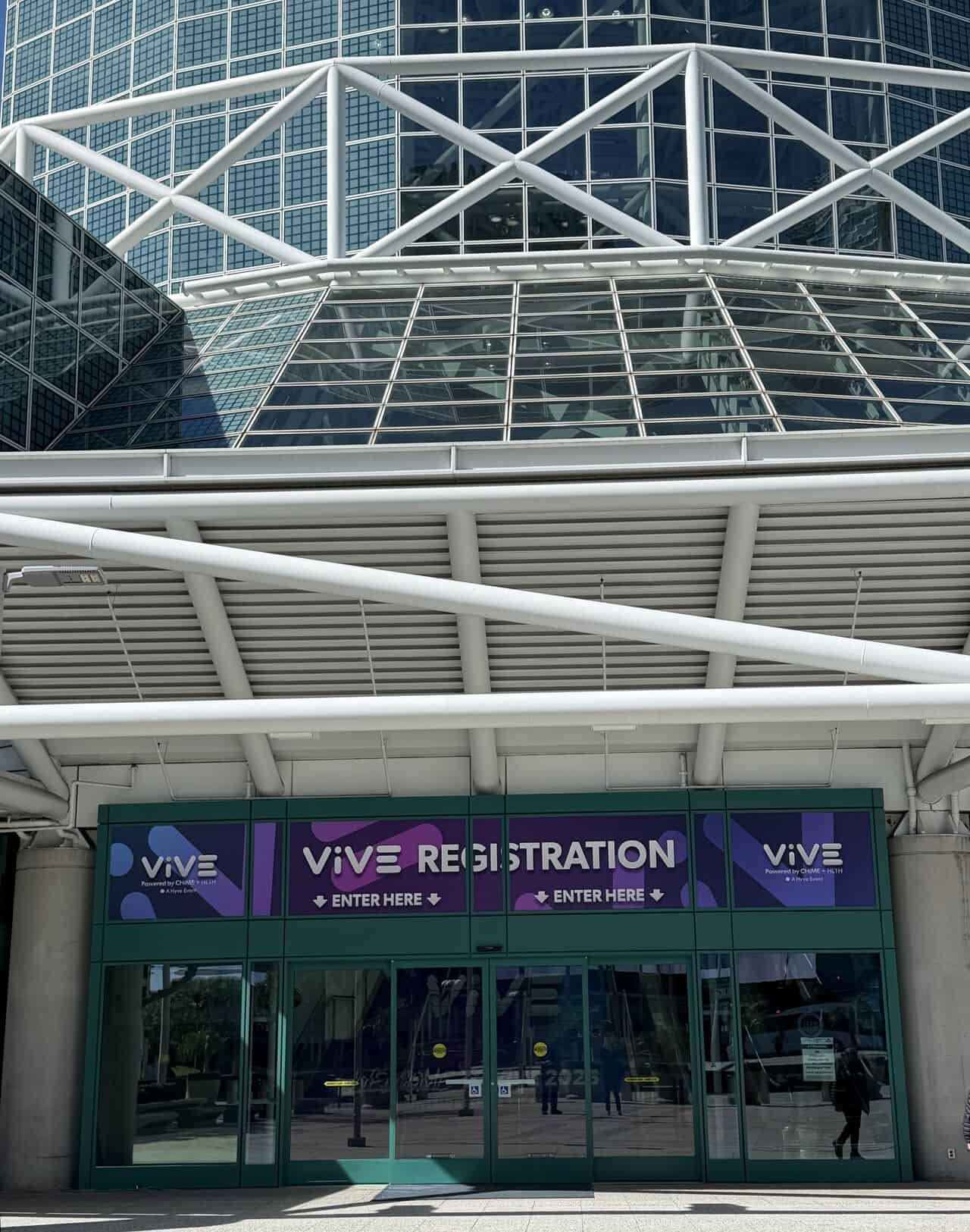
Month: February 2026

Day 3 at ViVE 2026: Conversations That Carry Forward

Day 3 at ViVE 2026: Conversations That Carry Forward

Day 3 at ViVE 2026: Conversations That Carry Forward

By Ritu M. Uberoy

Co-Host, The Big Unlock Podcast

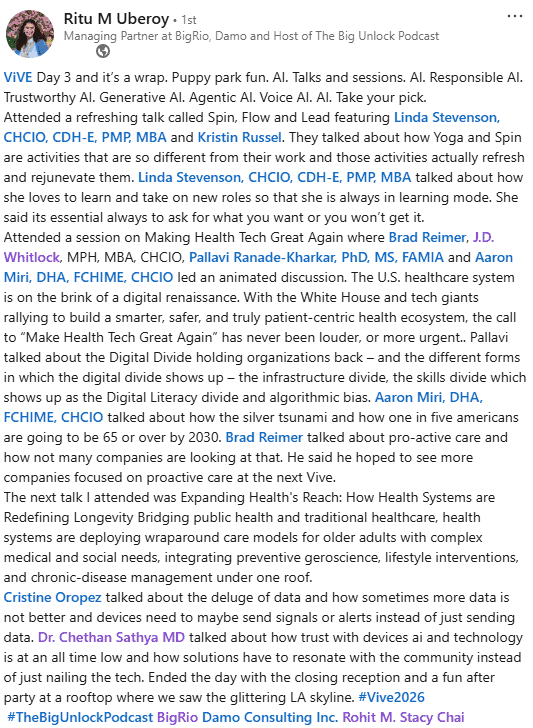
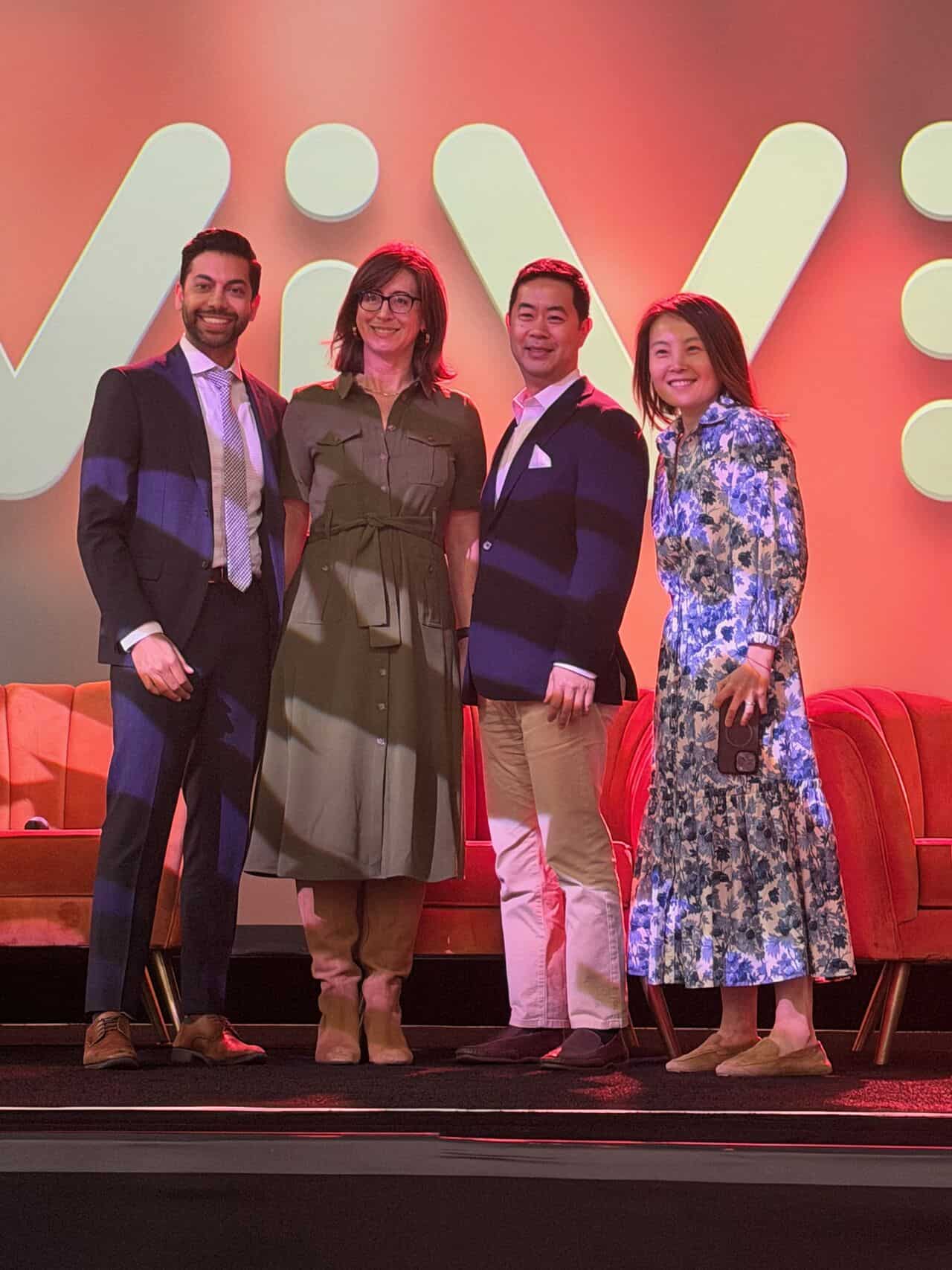
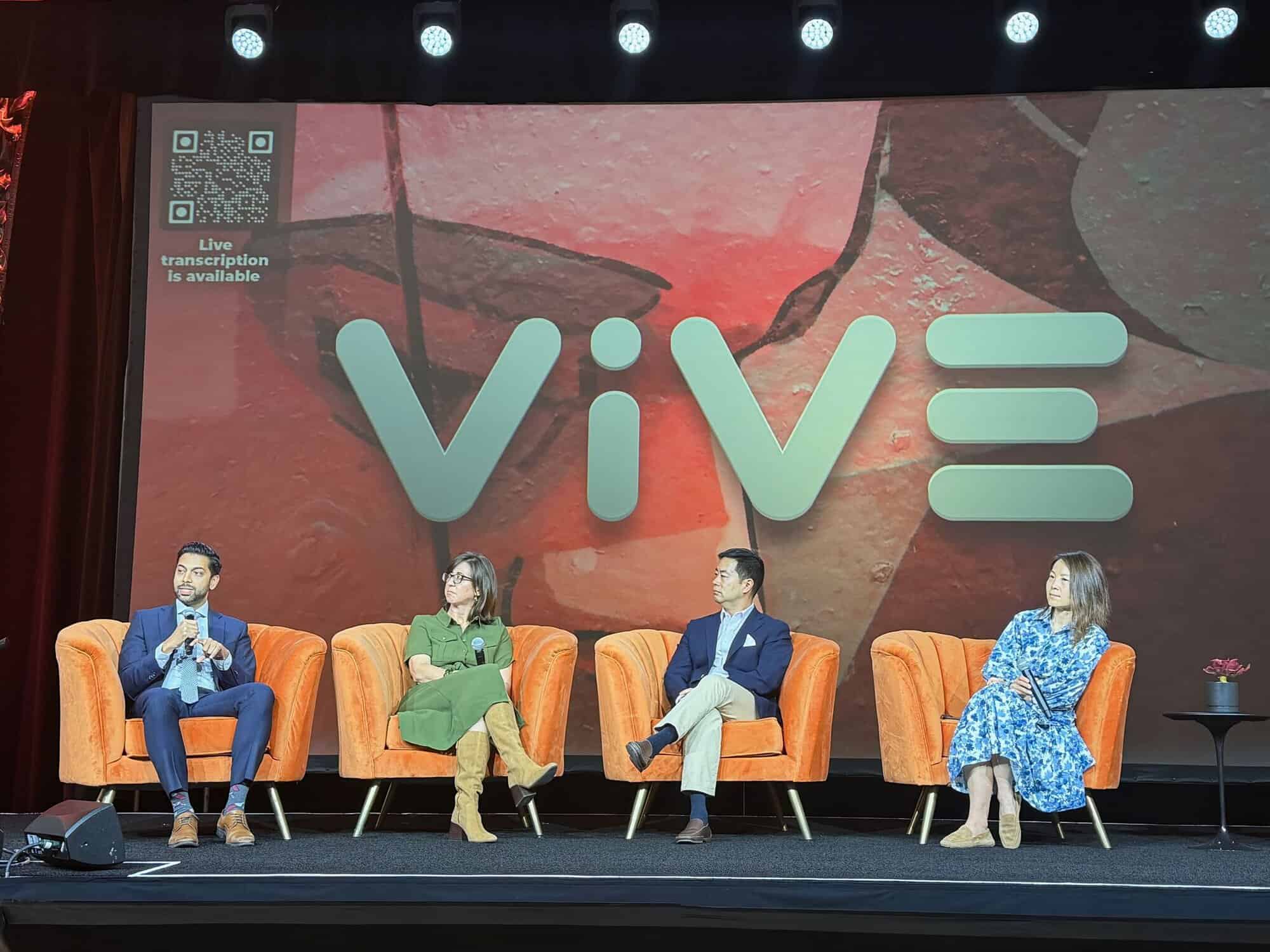
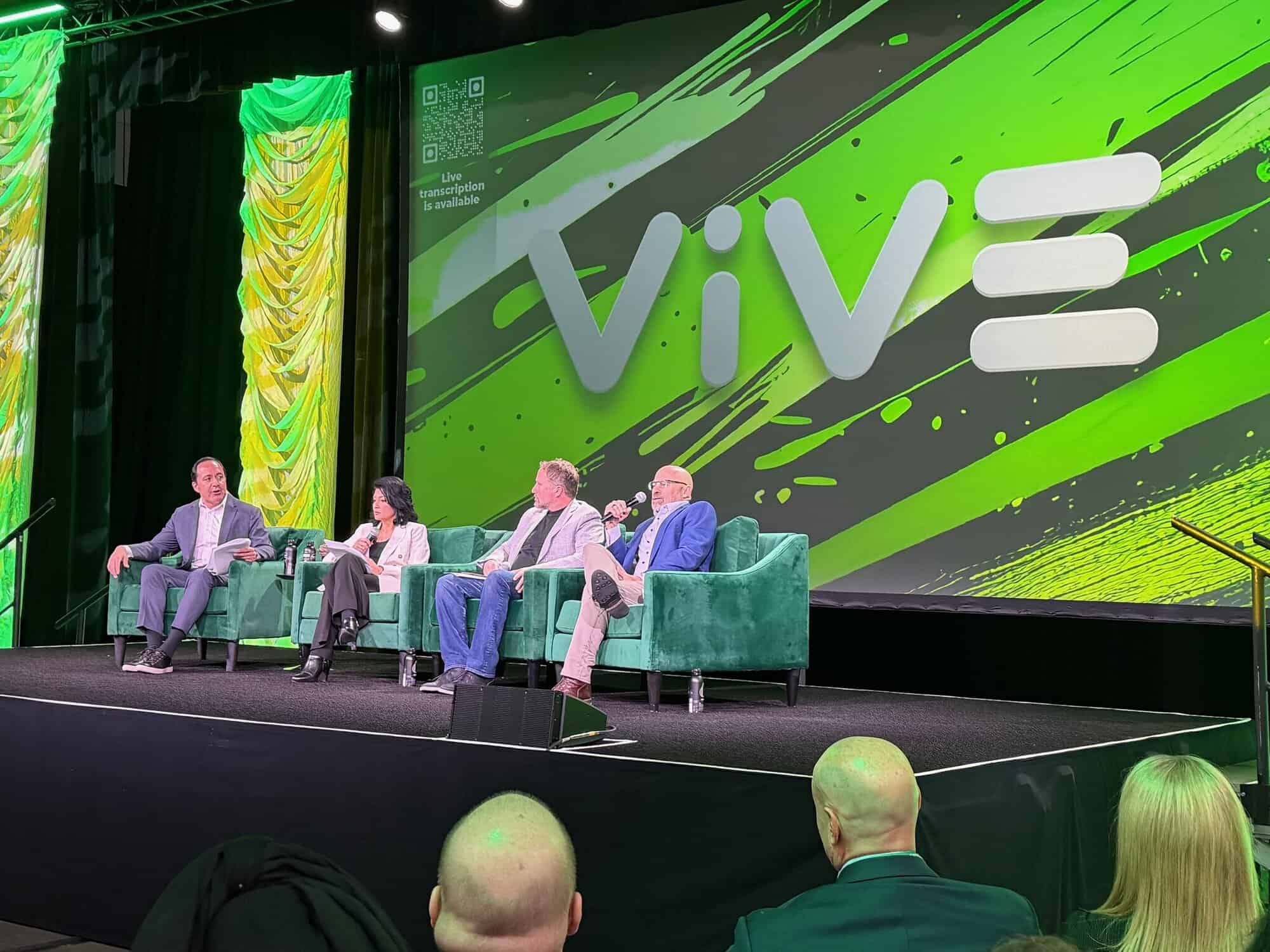
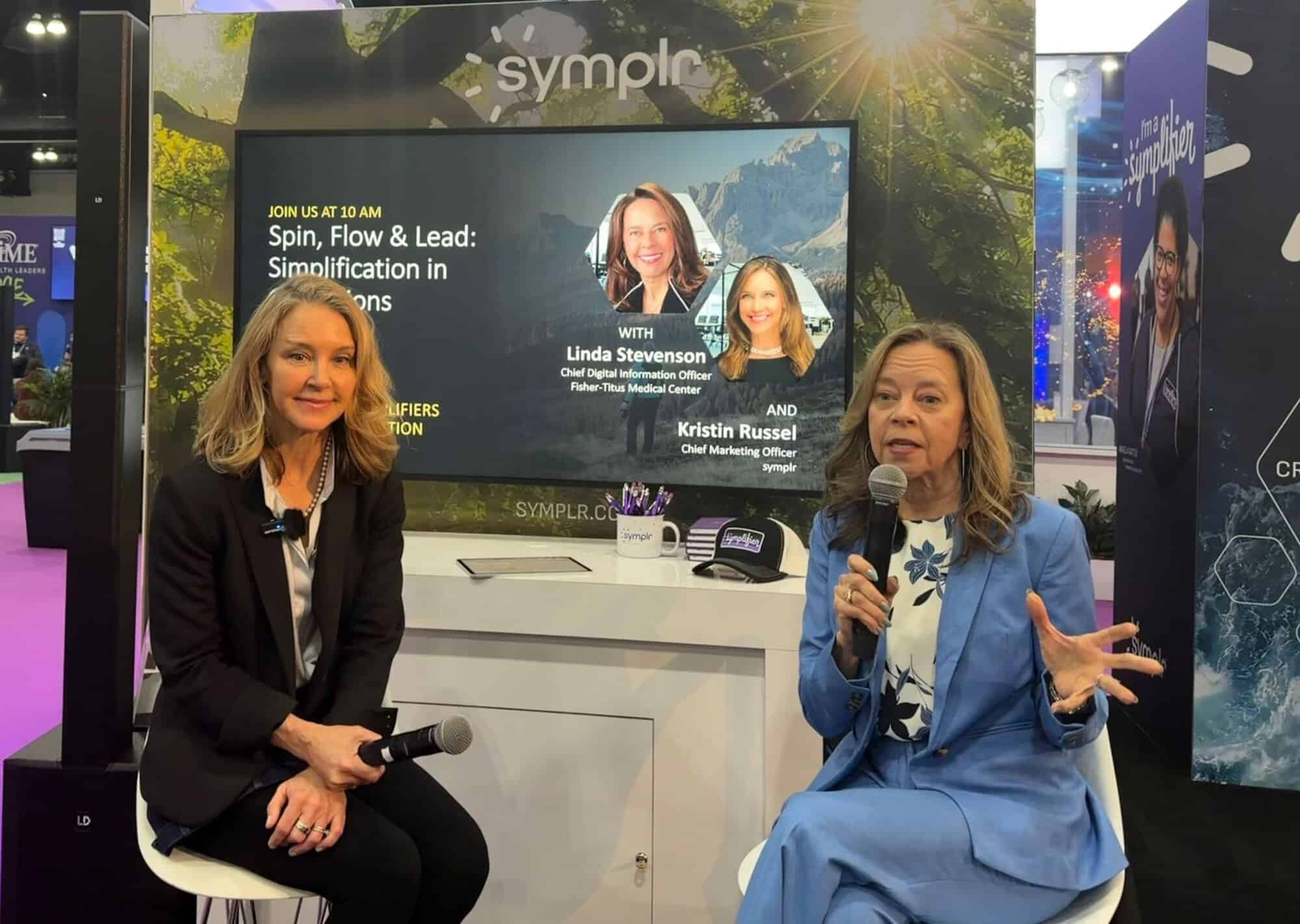
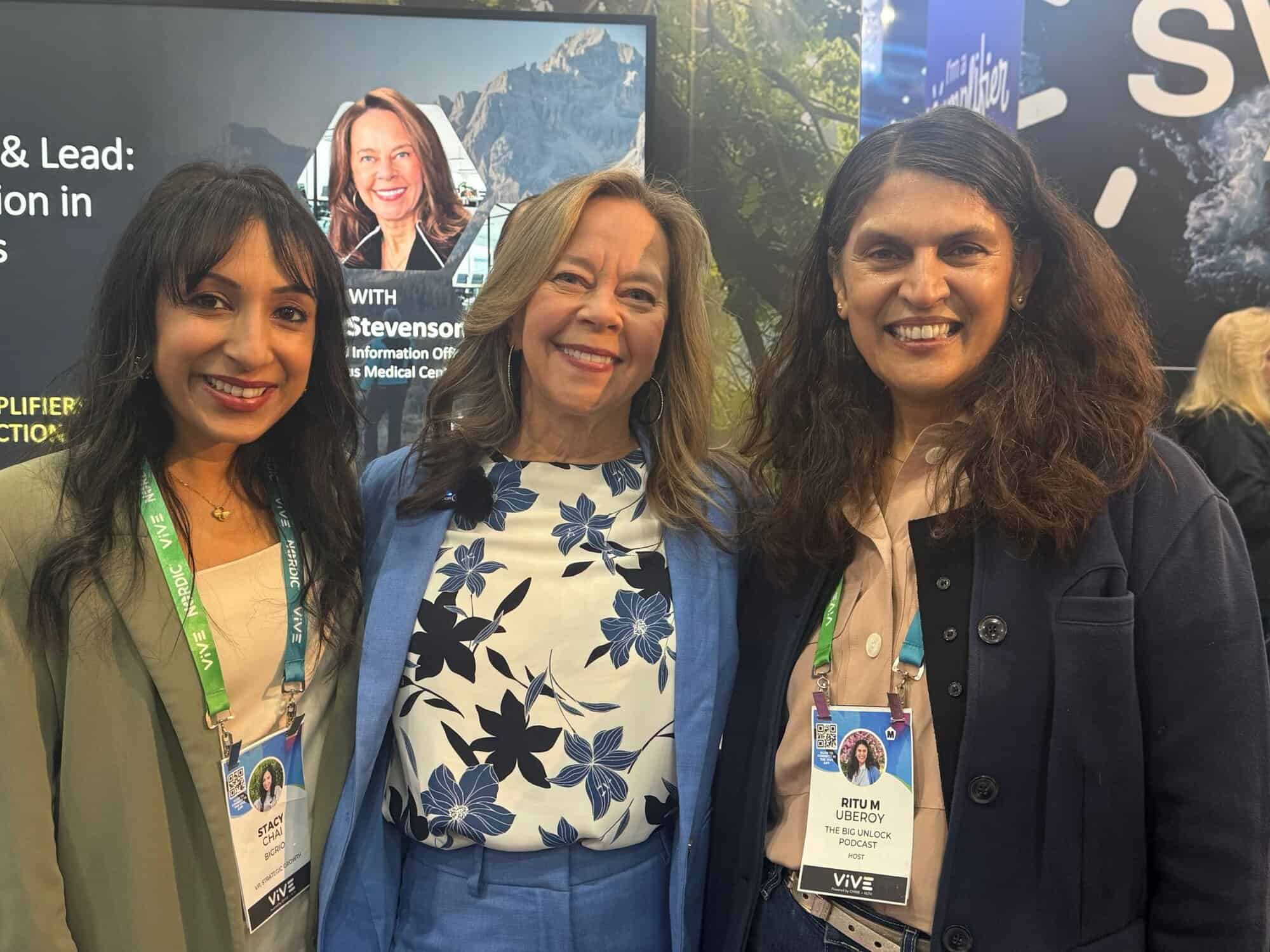
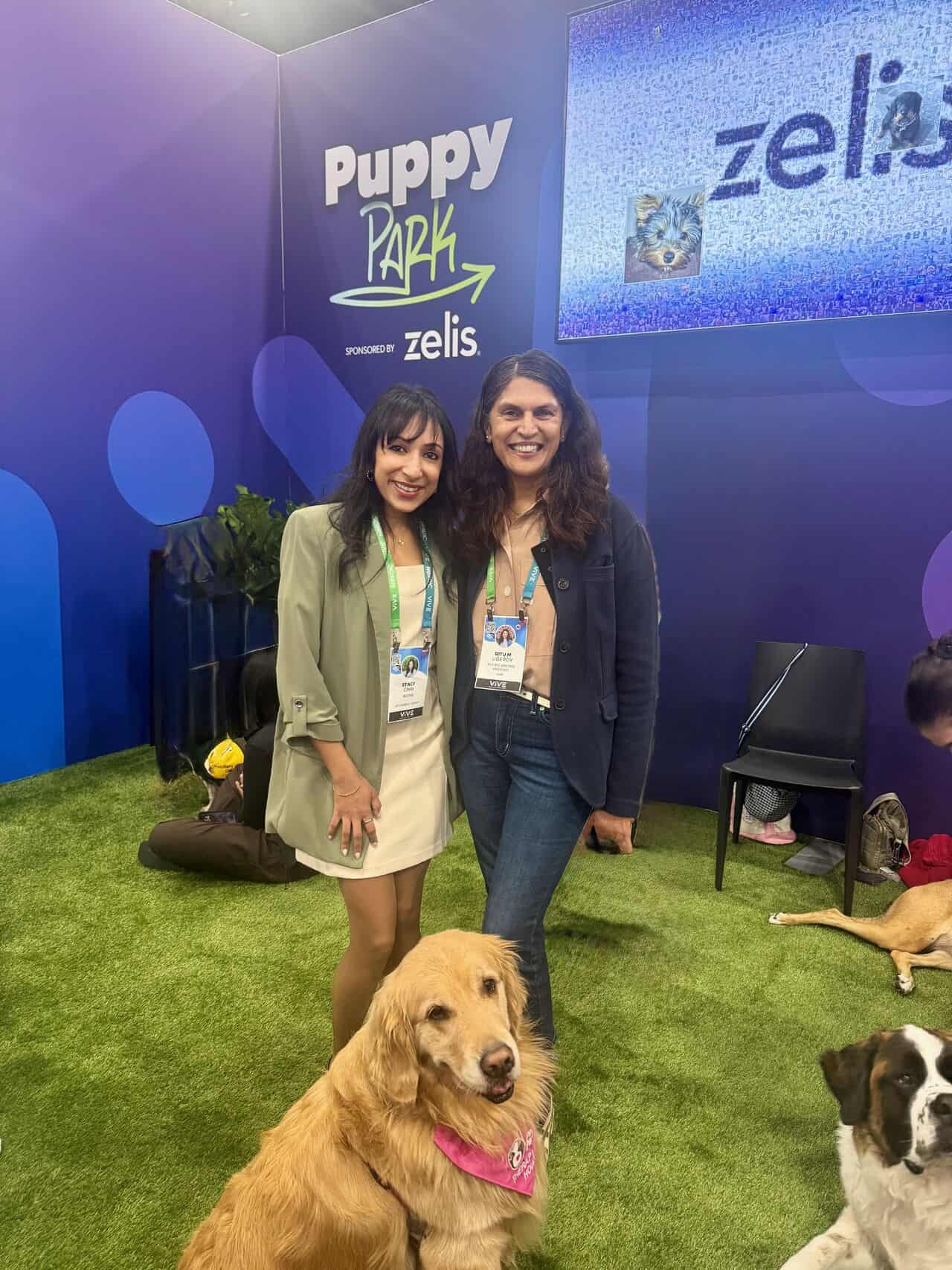
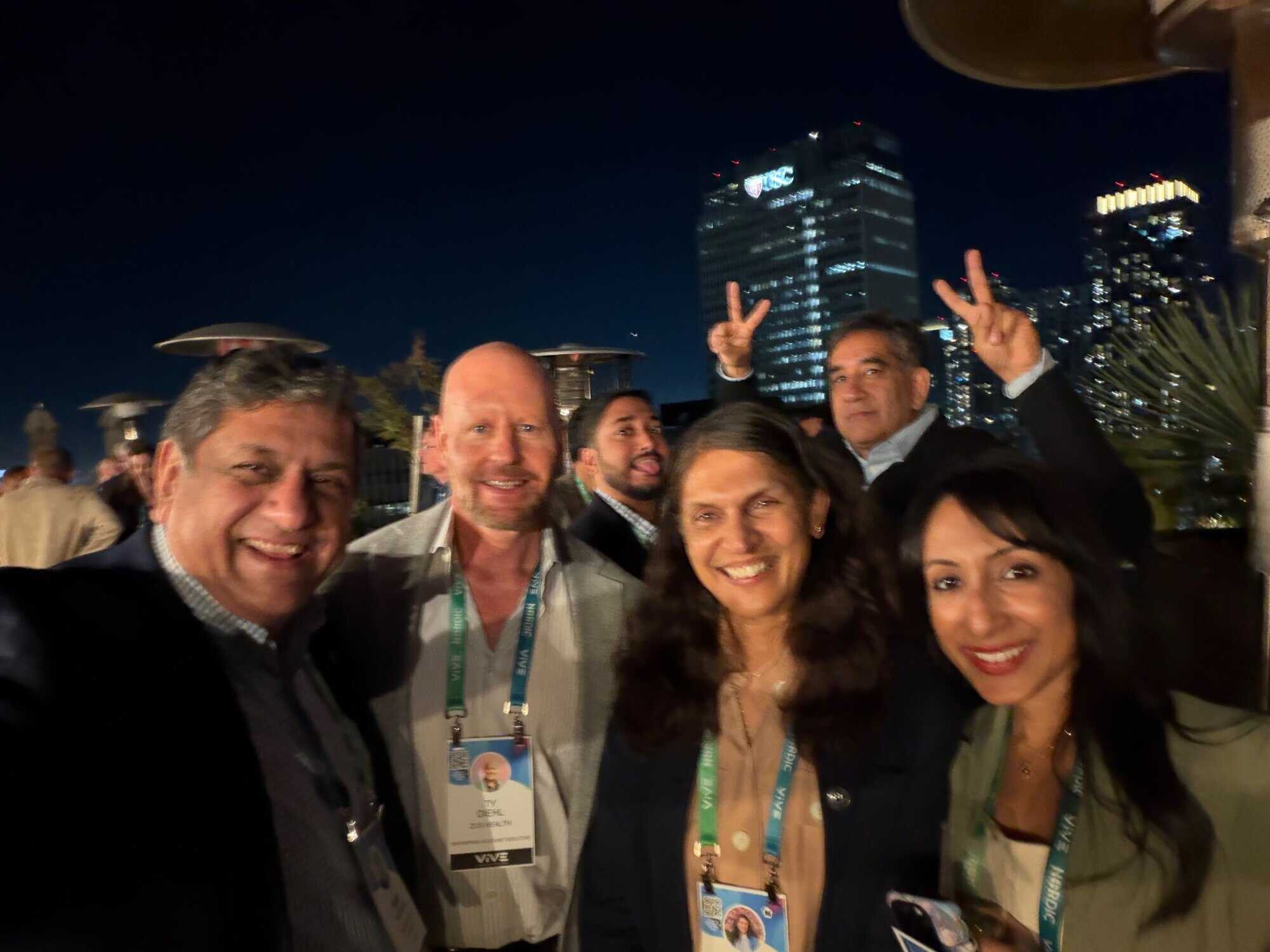
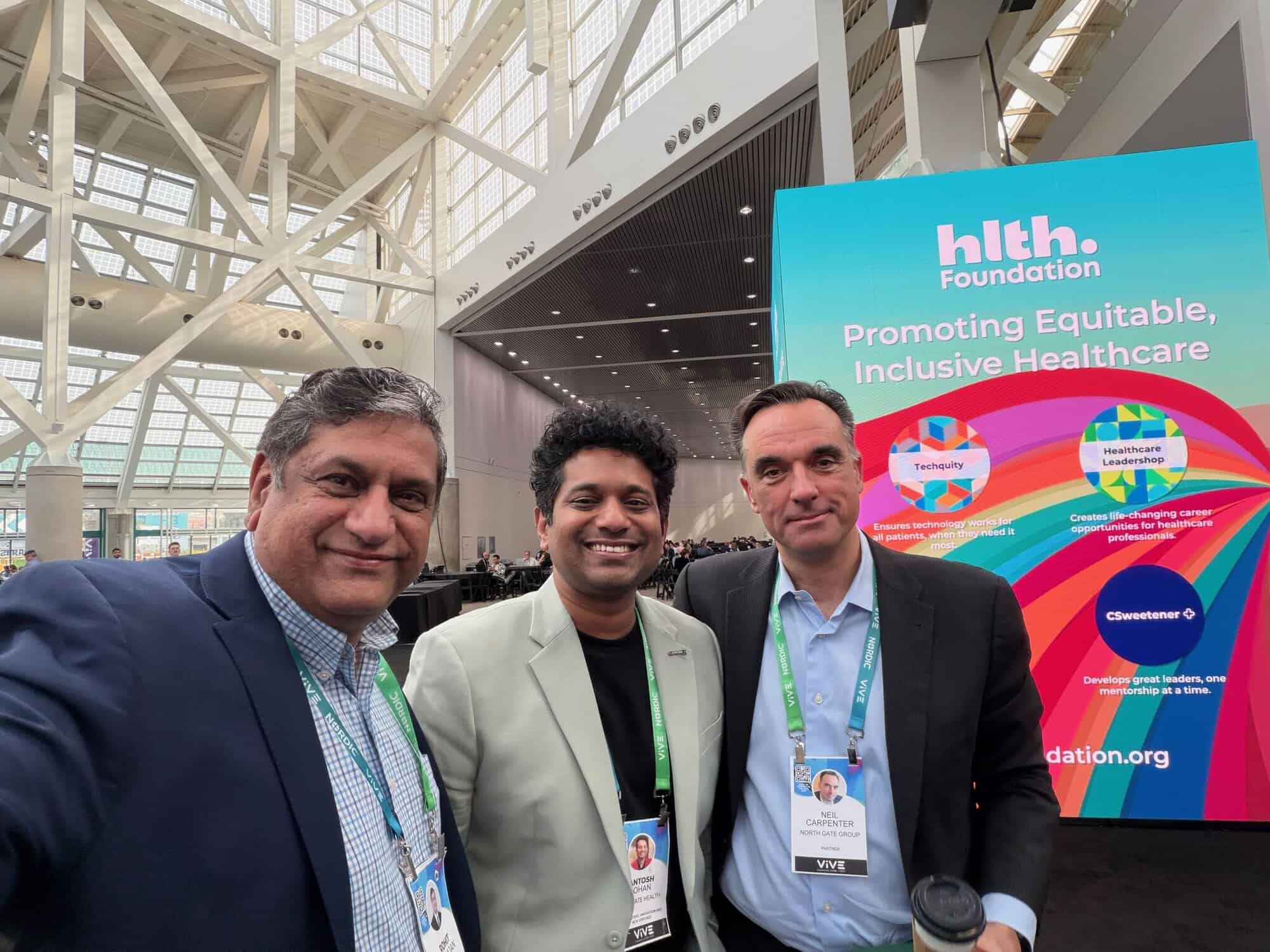
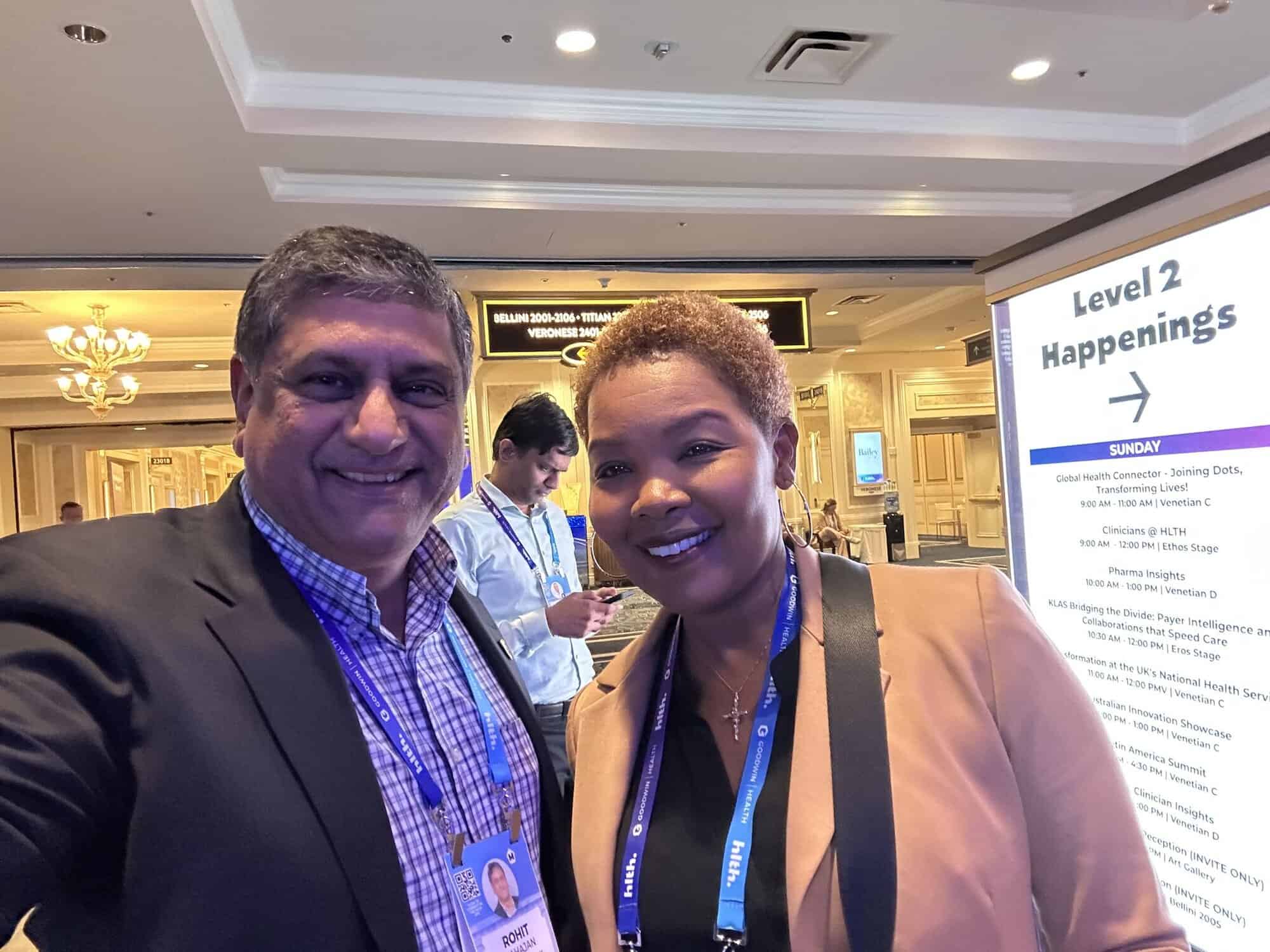
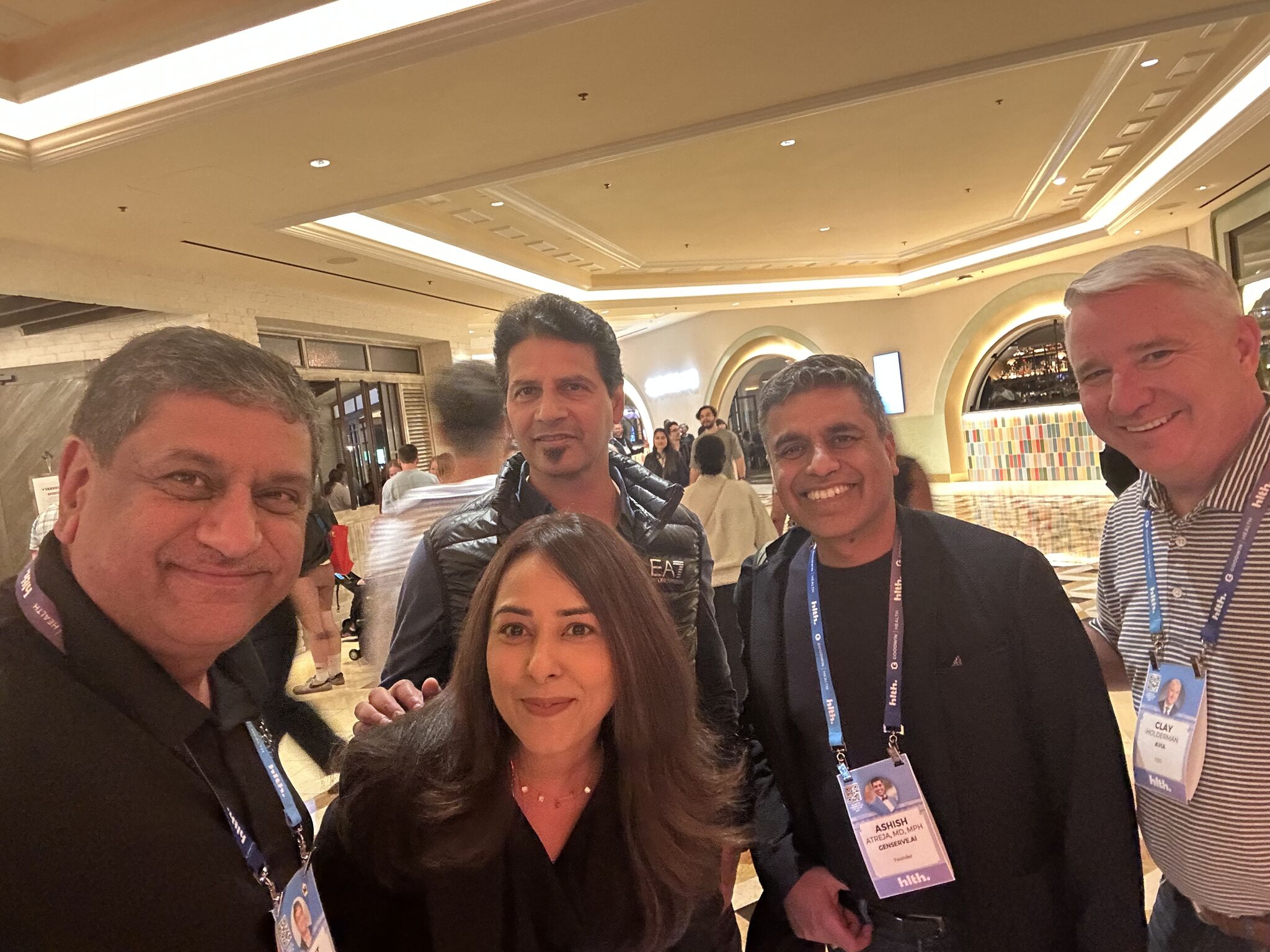
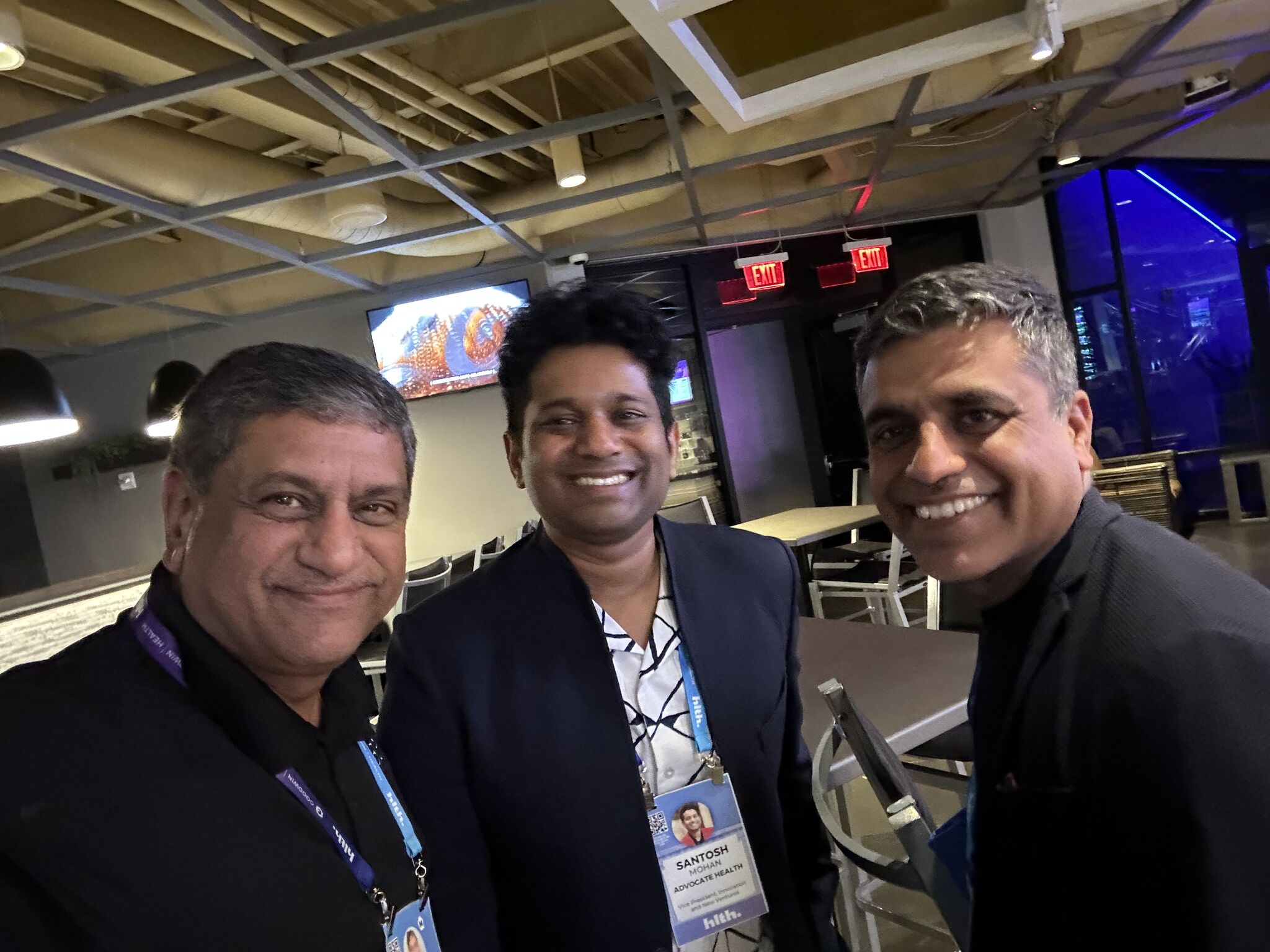
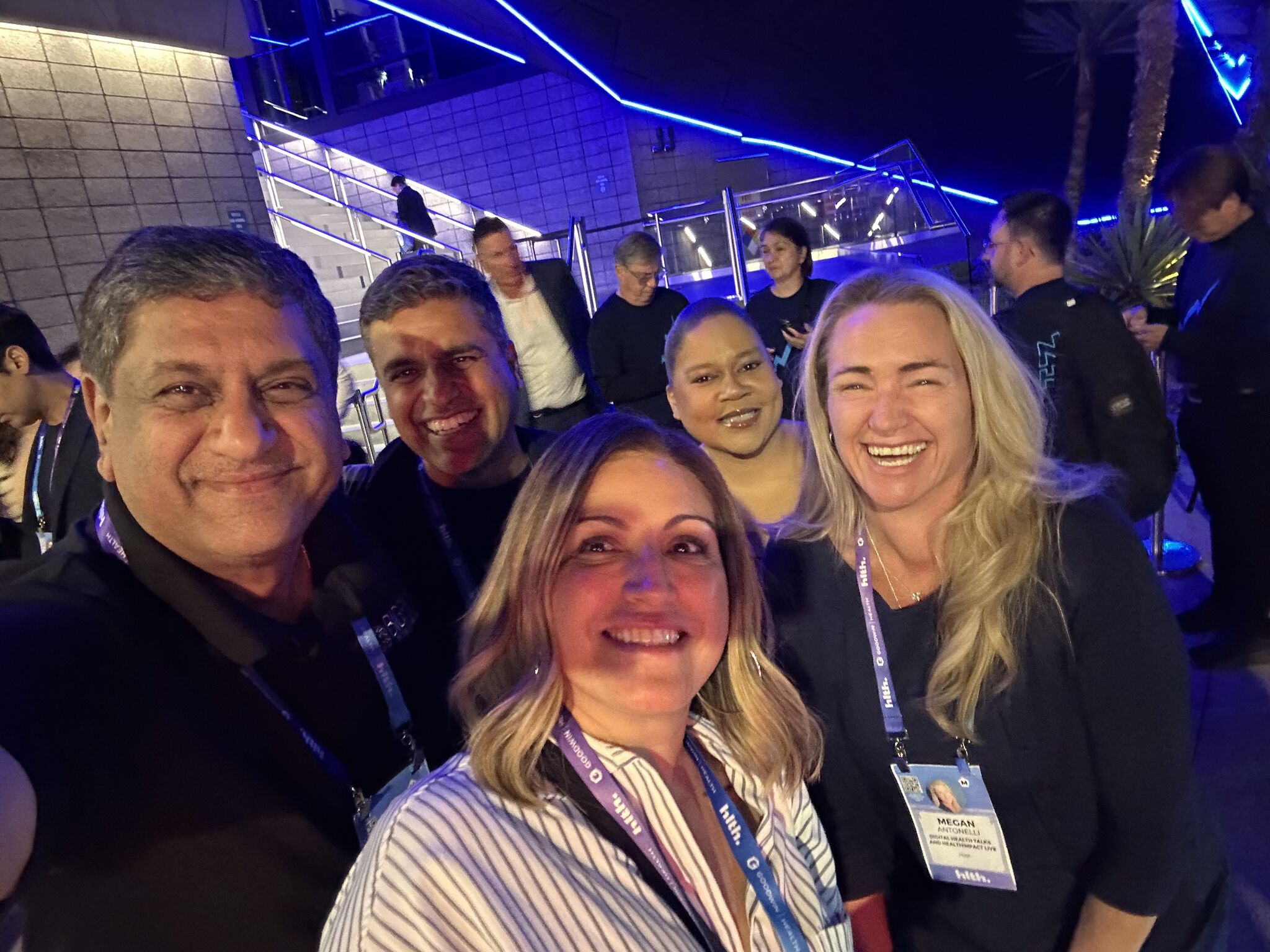
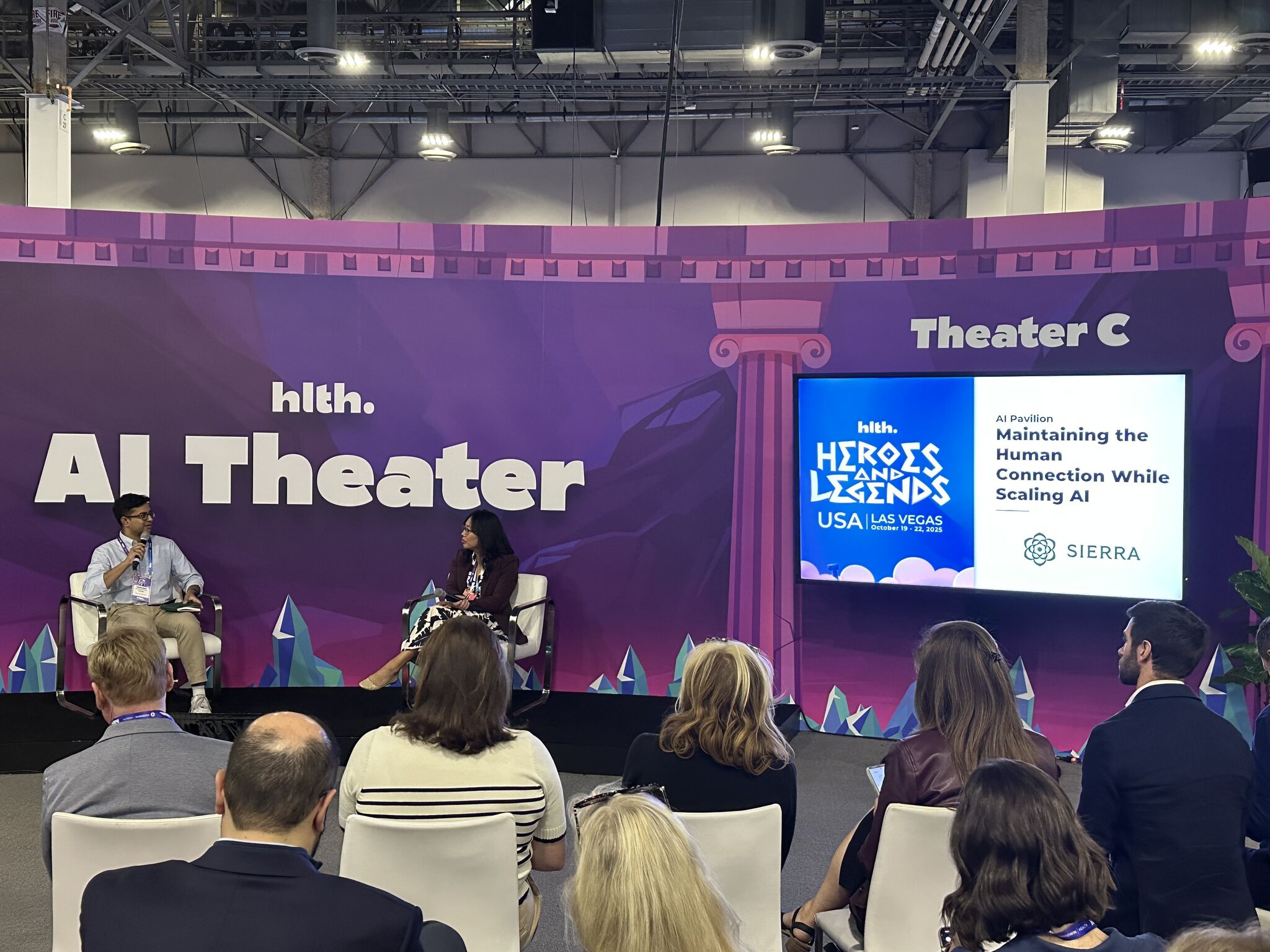
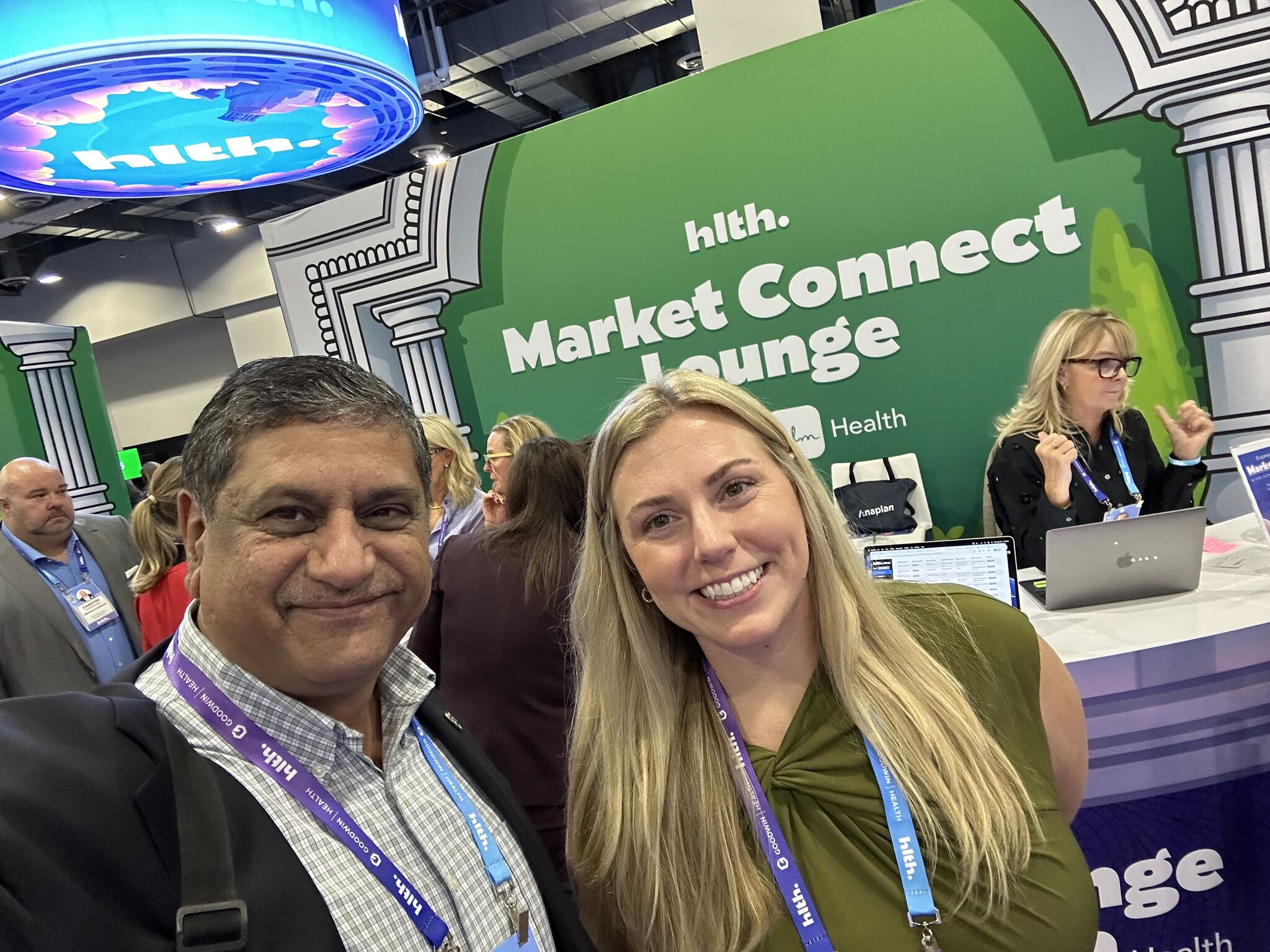
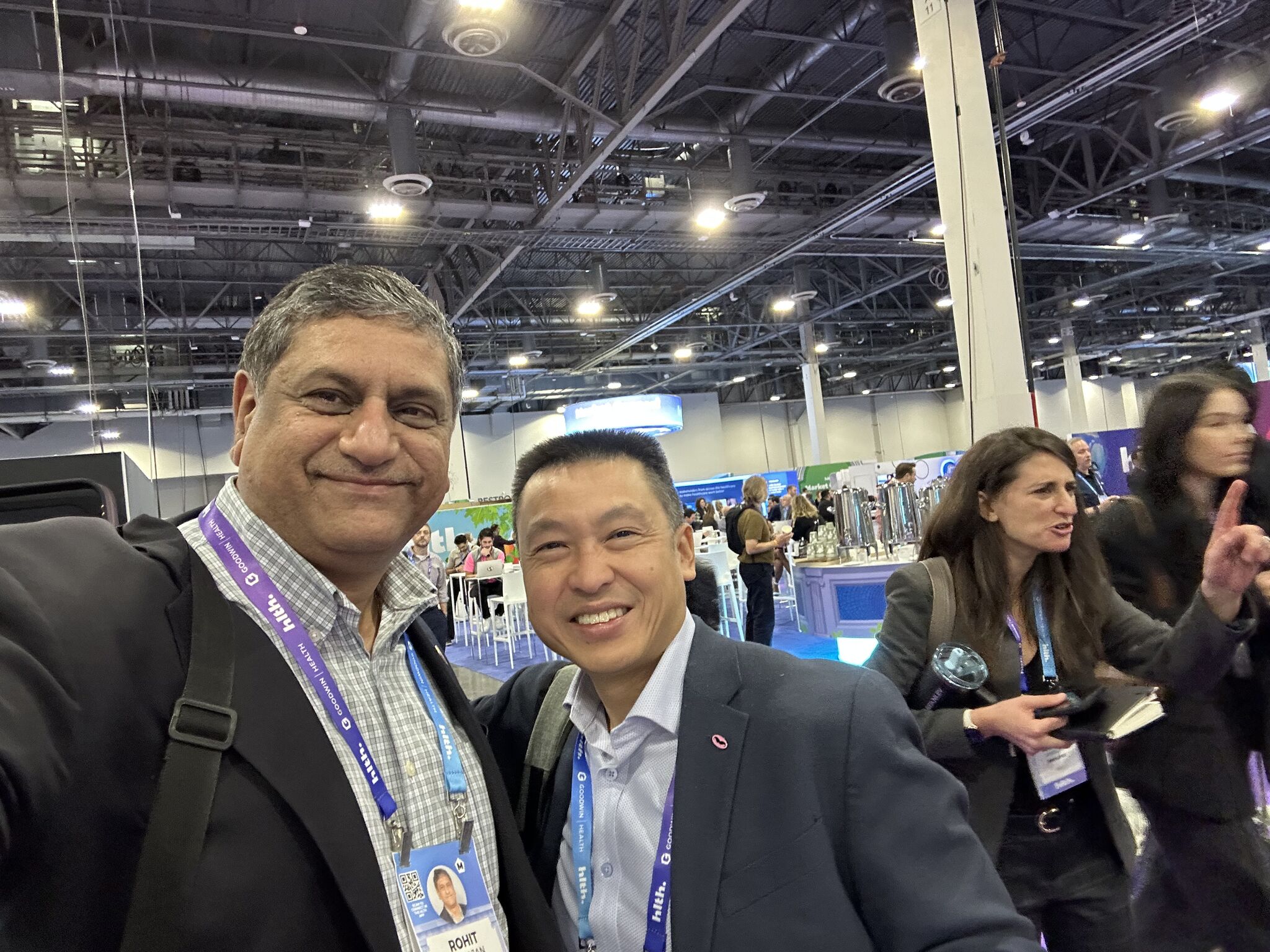
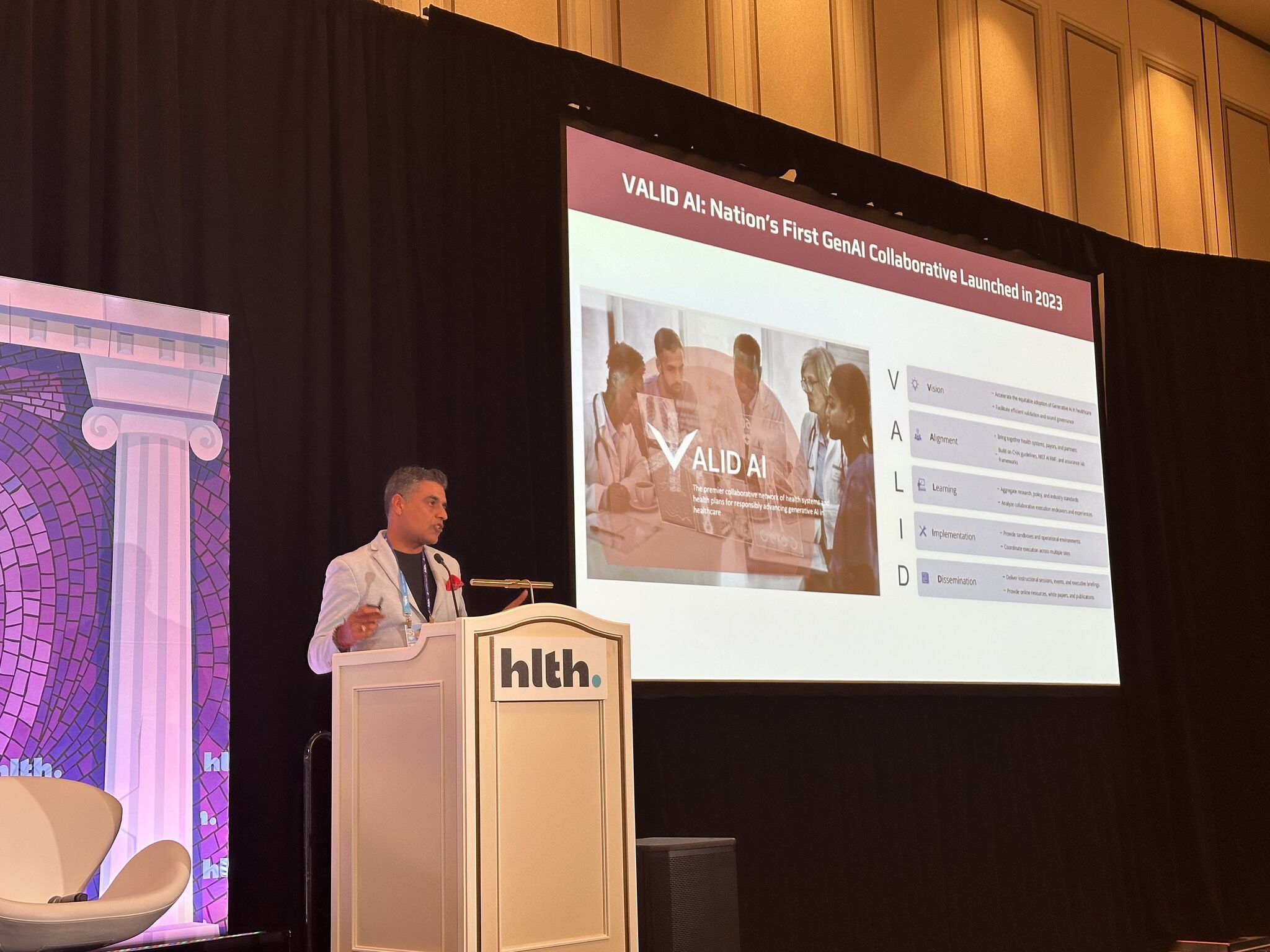
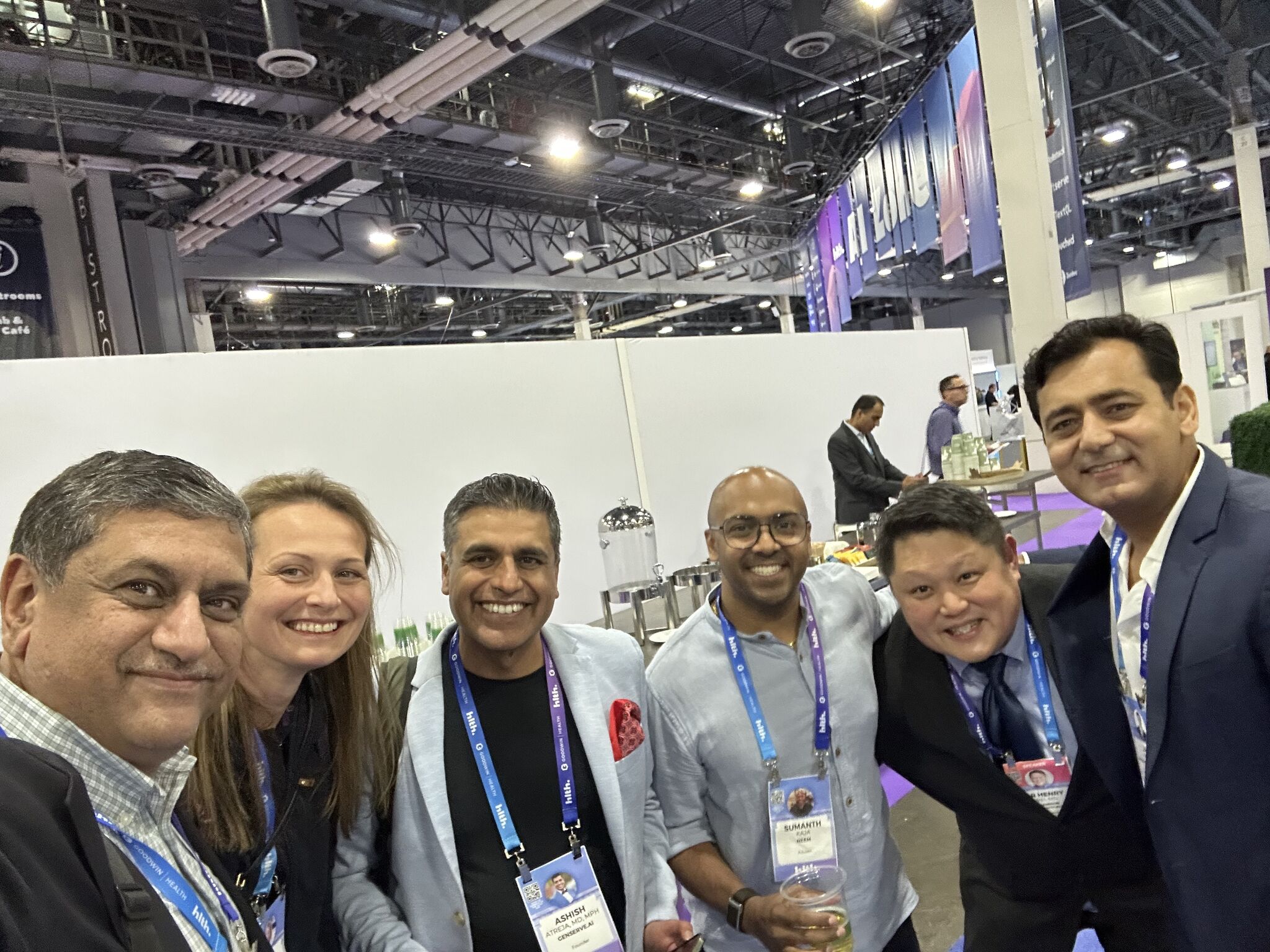
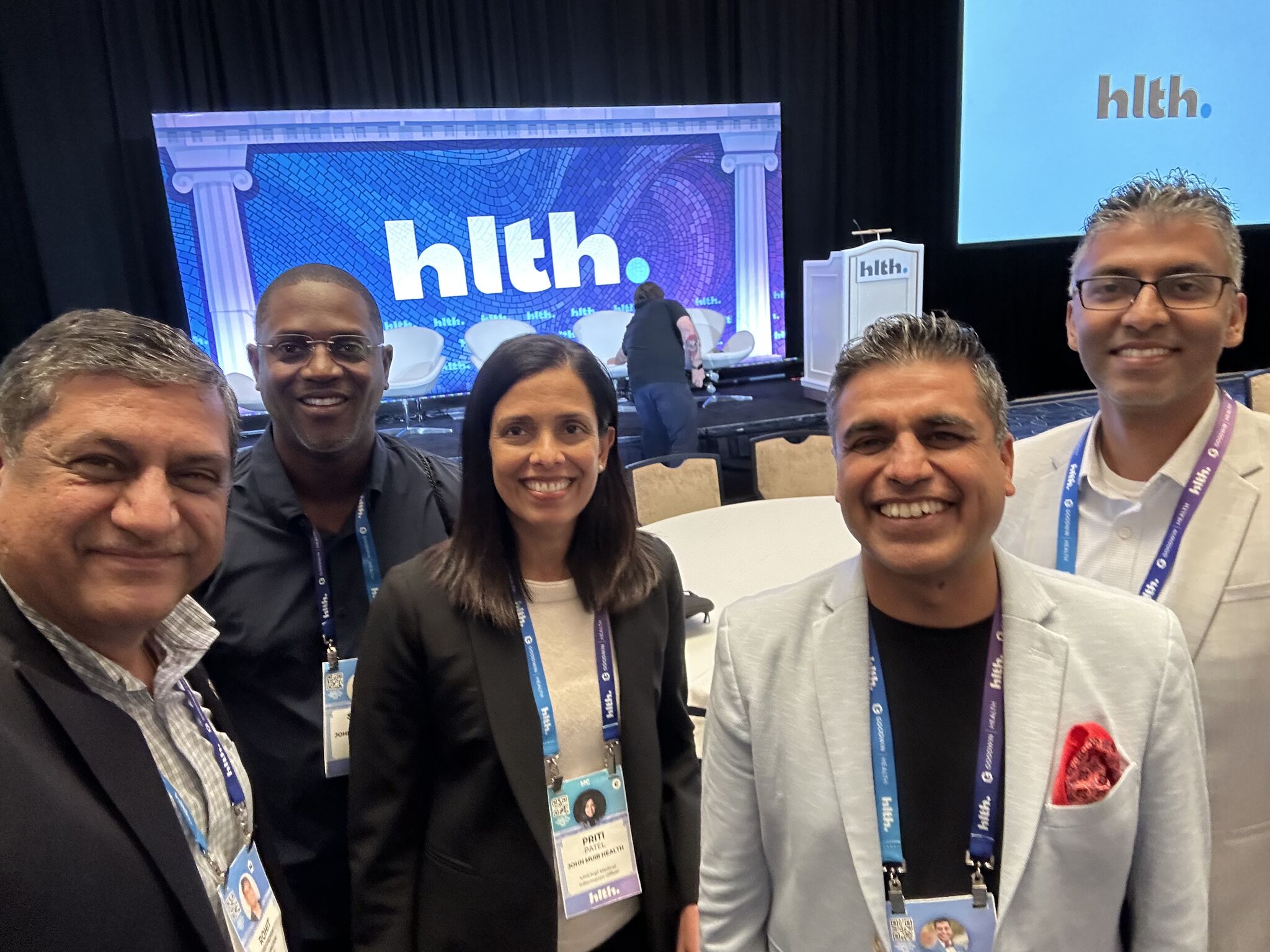
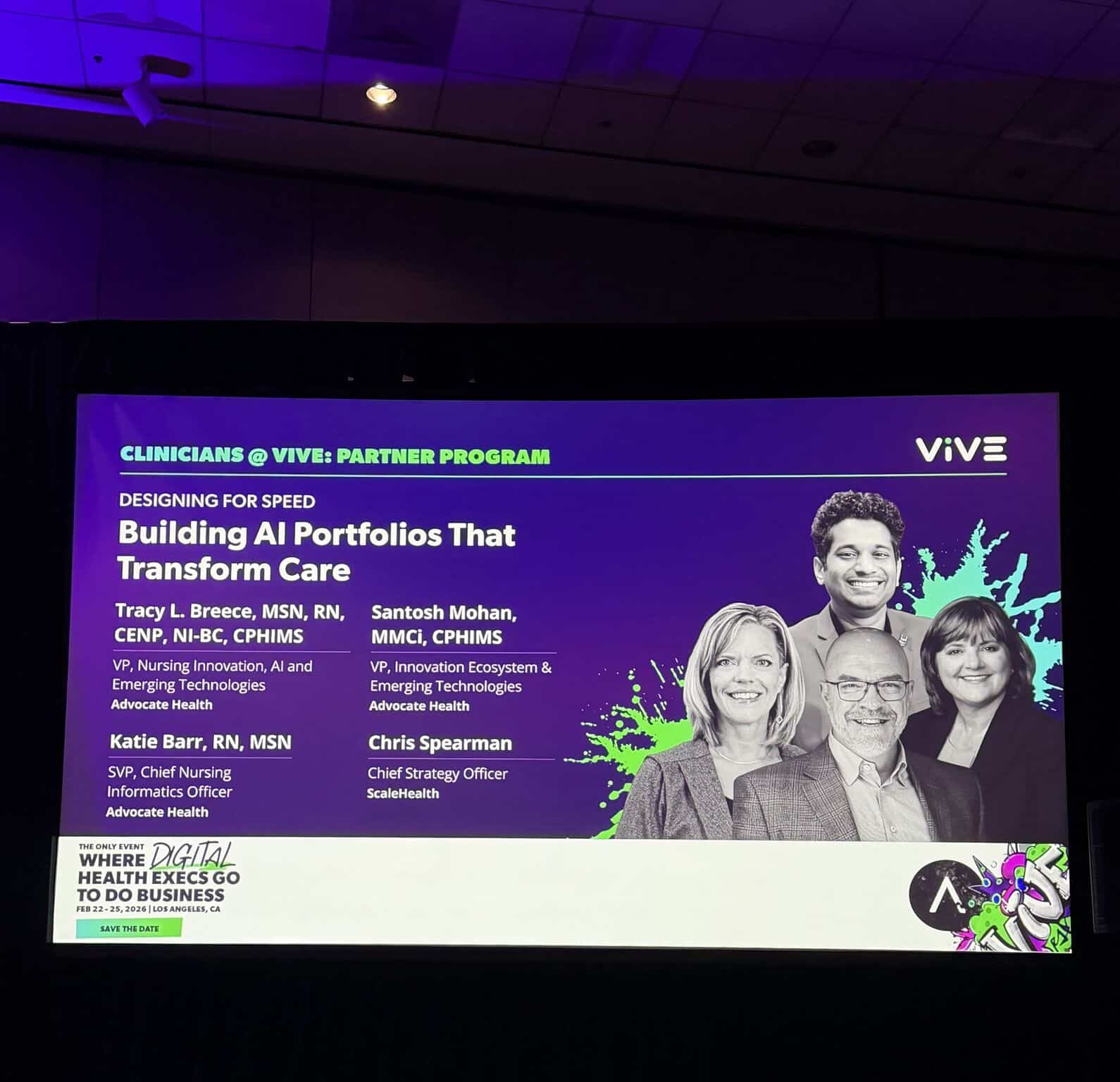
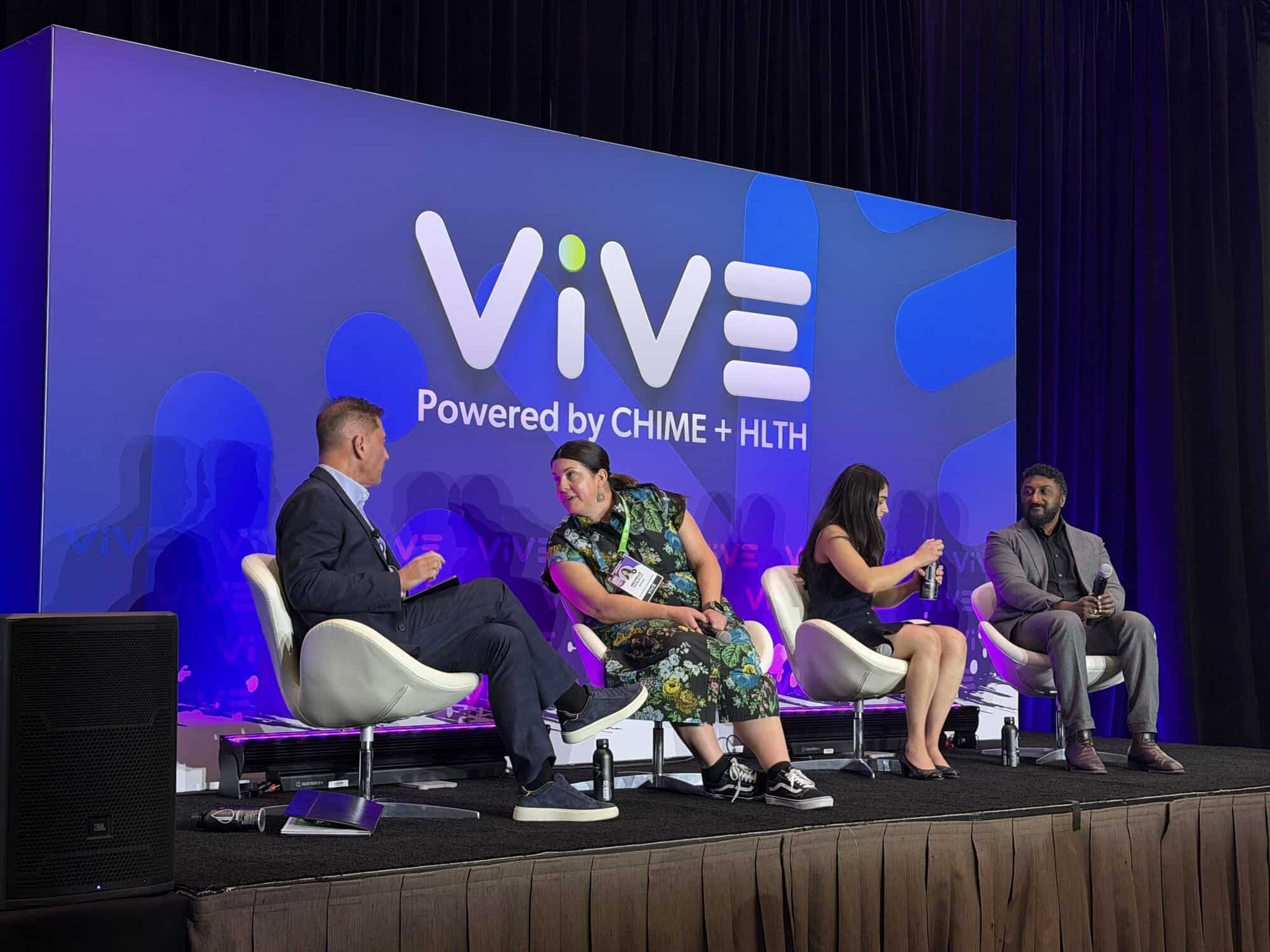
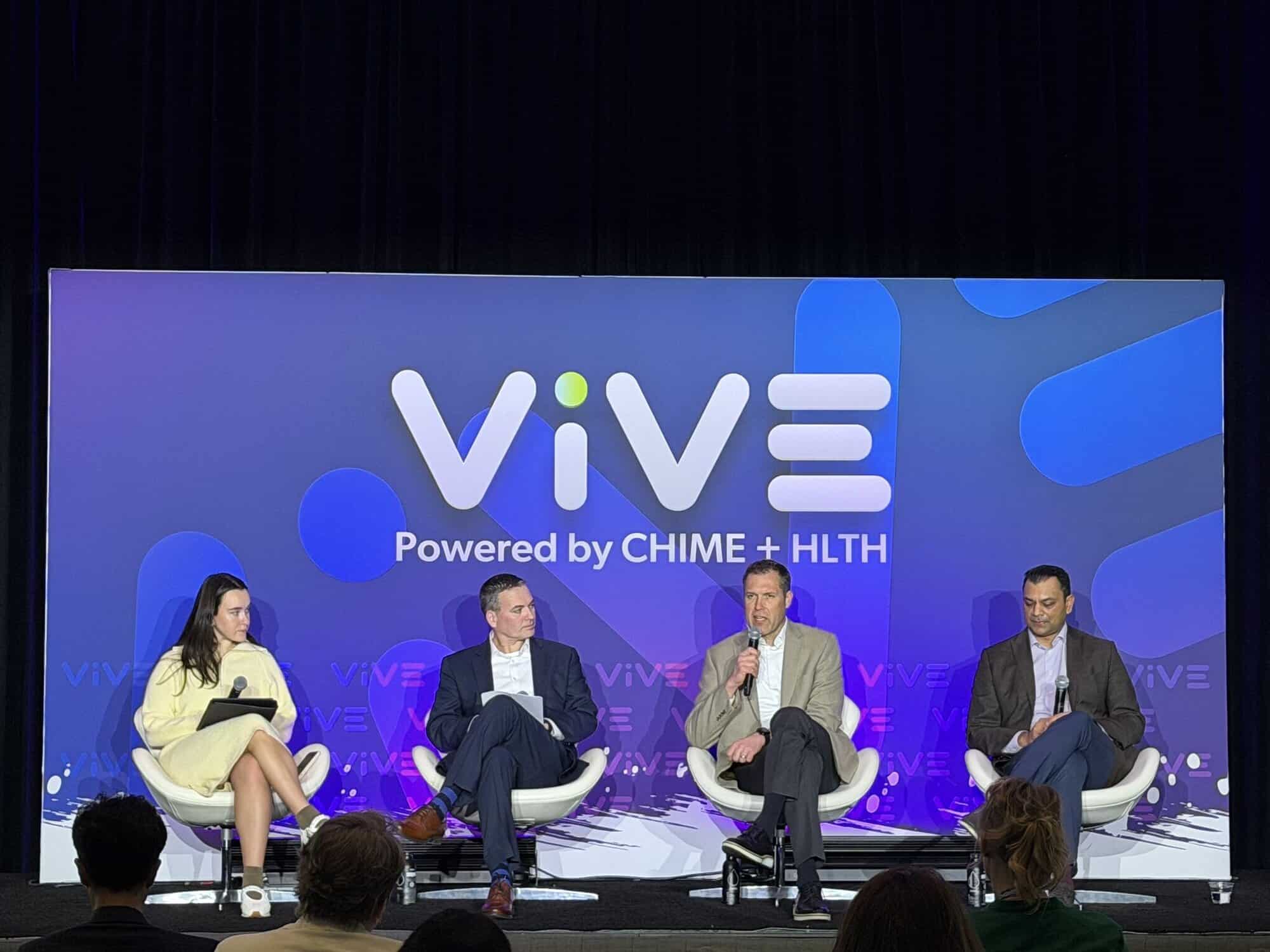
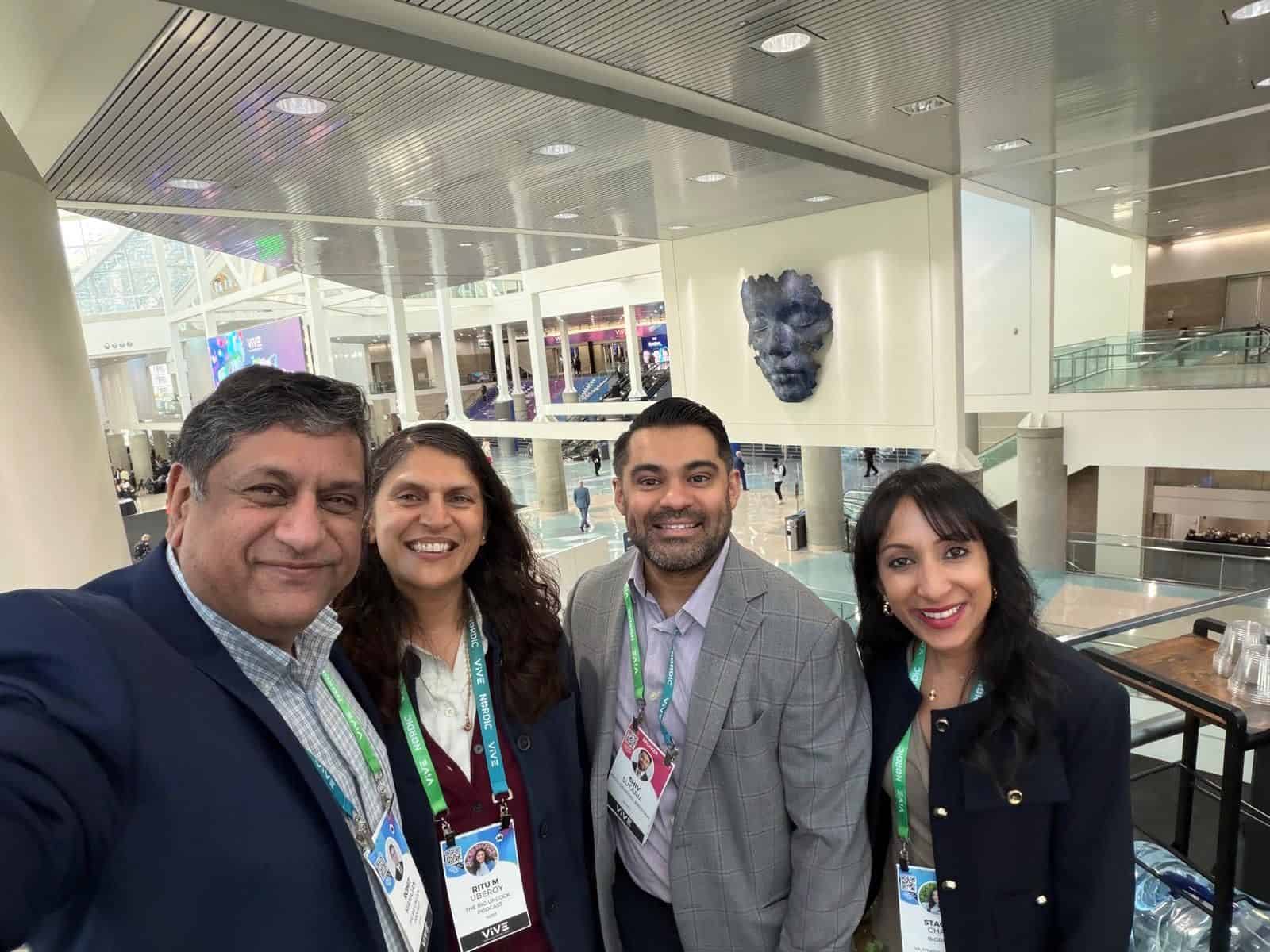
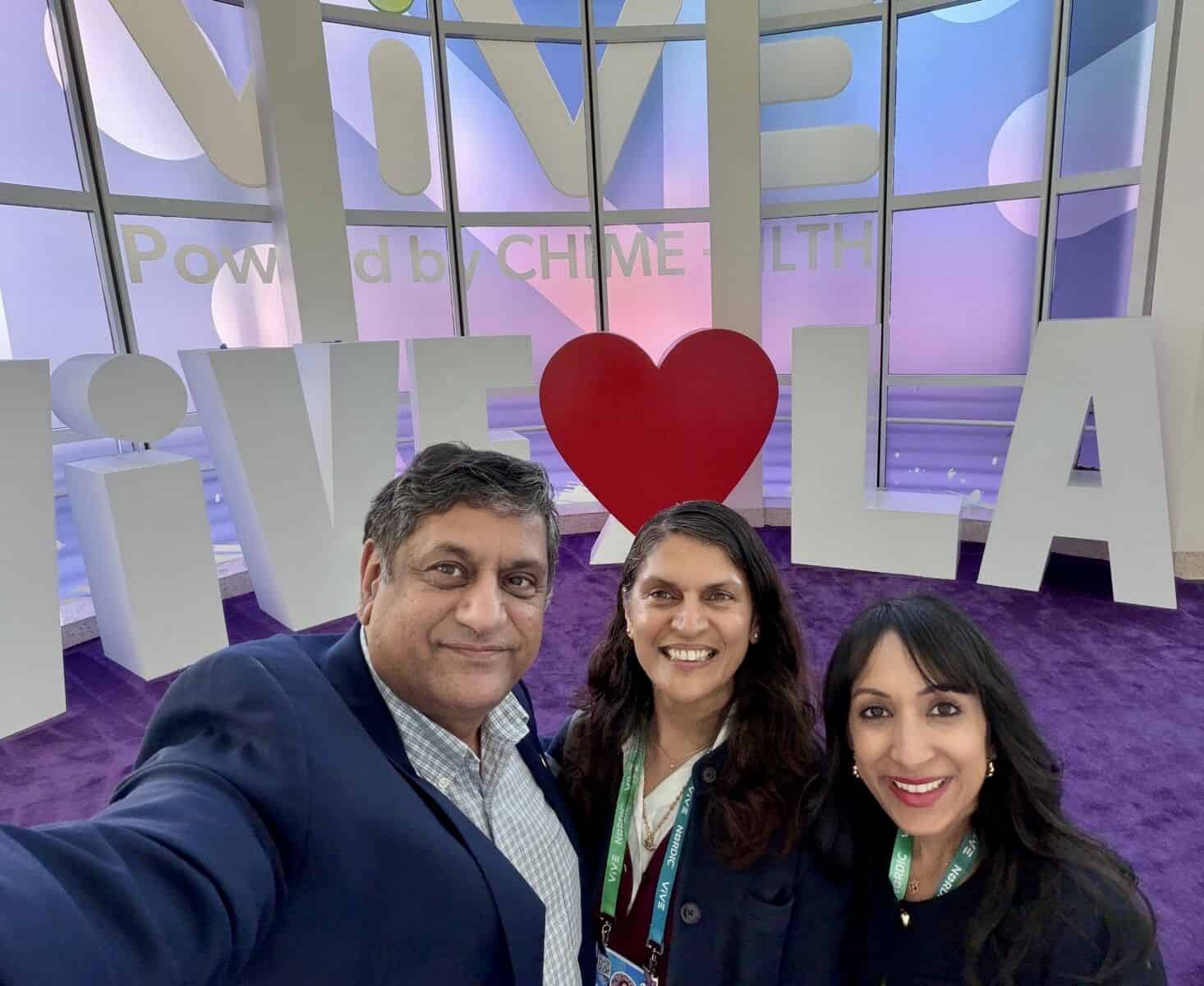
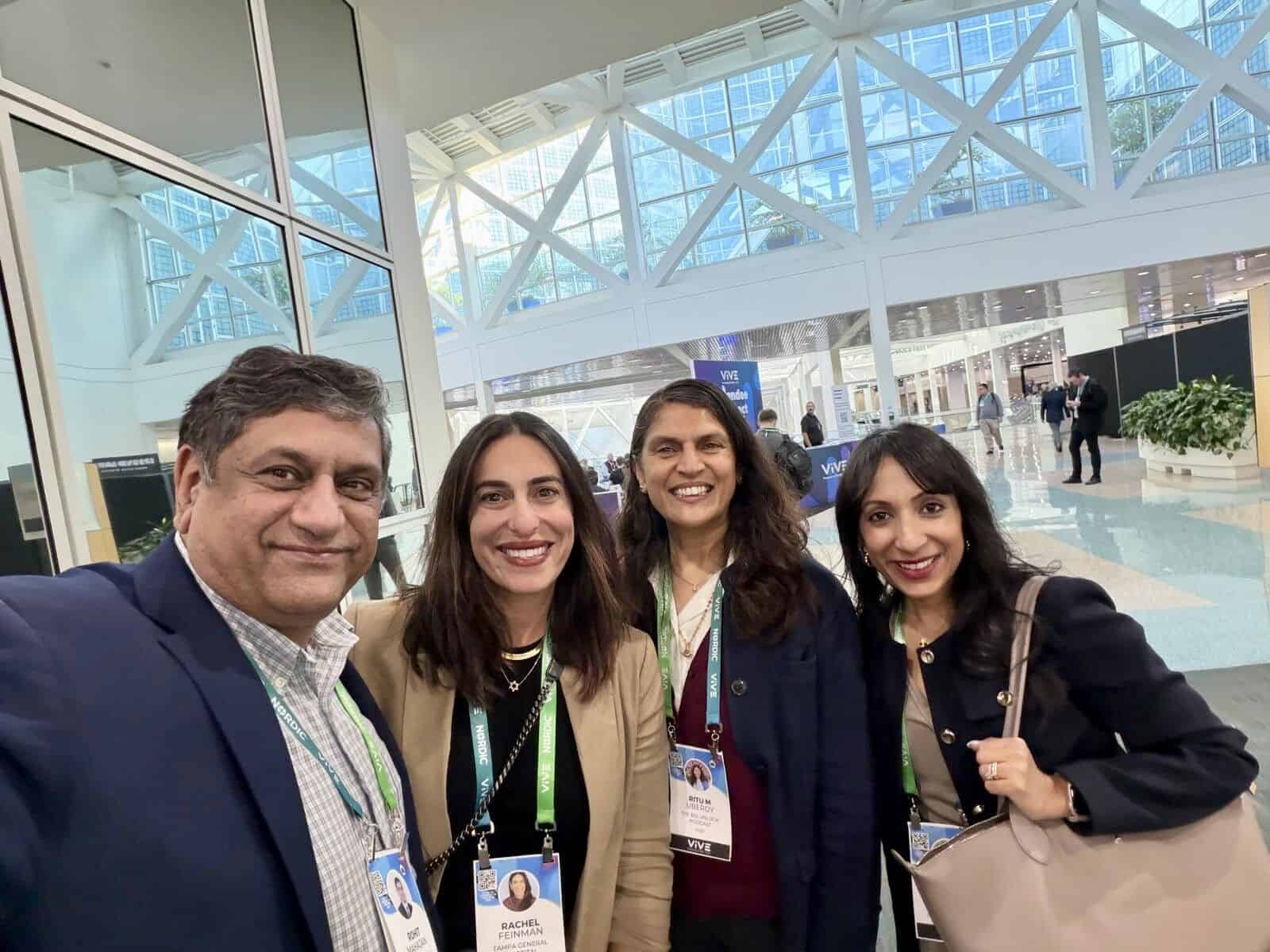
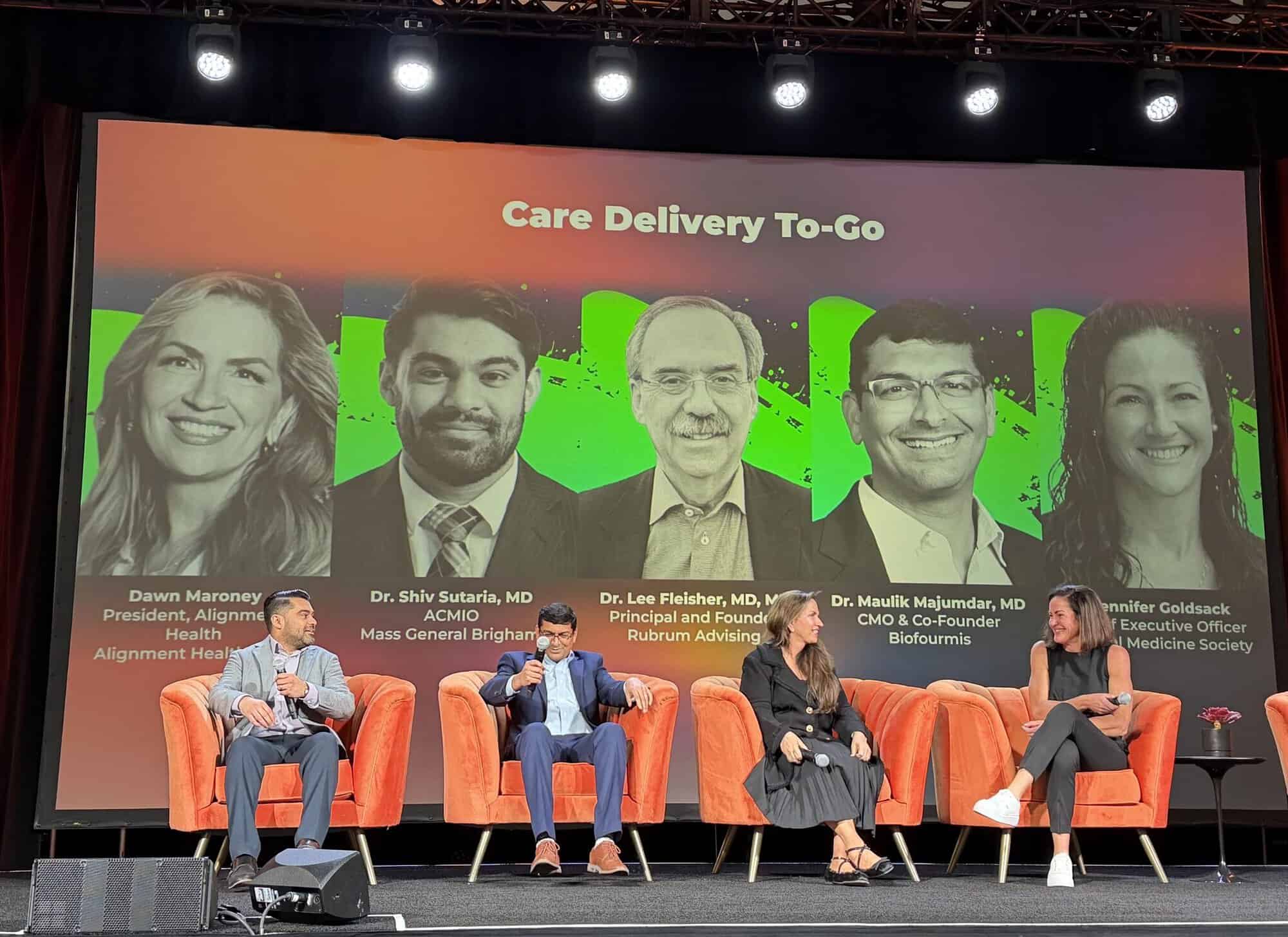
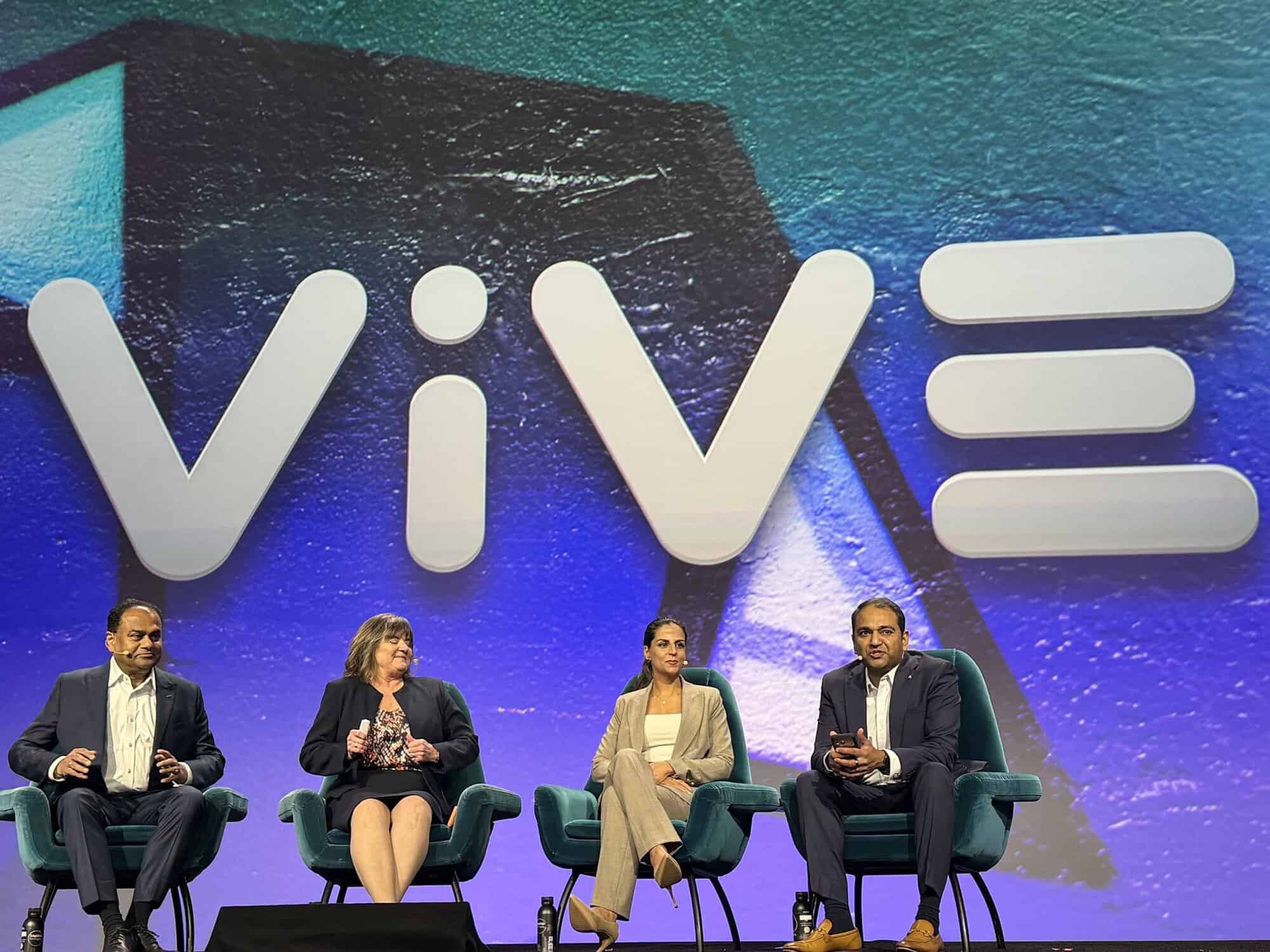
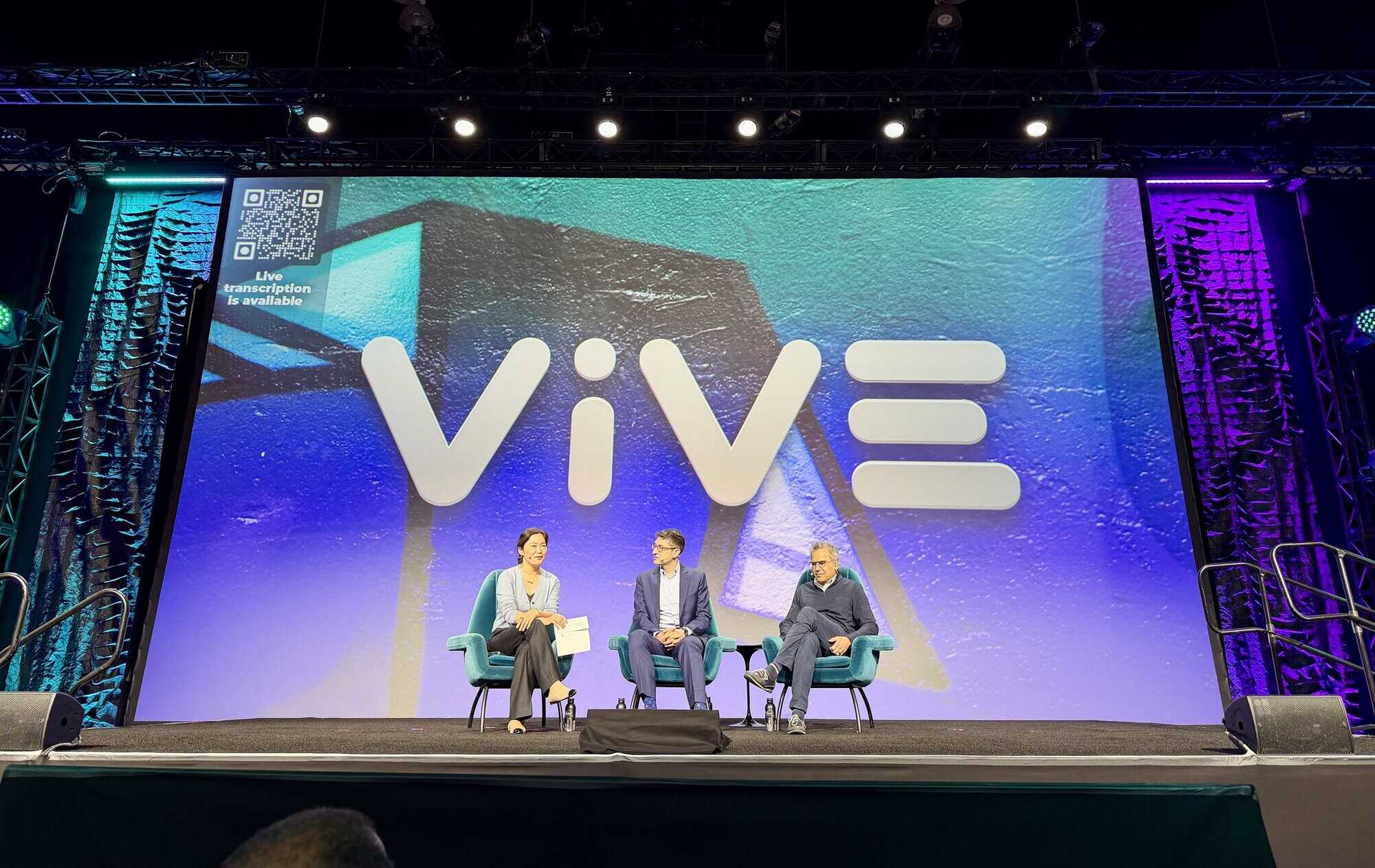
Day 3 at ViVE 2026 in Los Angeles was a powerful close to four days of learning, sharing, and connection. What stood out most wasn’t just the innovations on display or the sessions we attended, but the quality of conversations and the real-world perspectives shared by peers, leaders, and innovators across healthcare

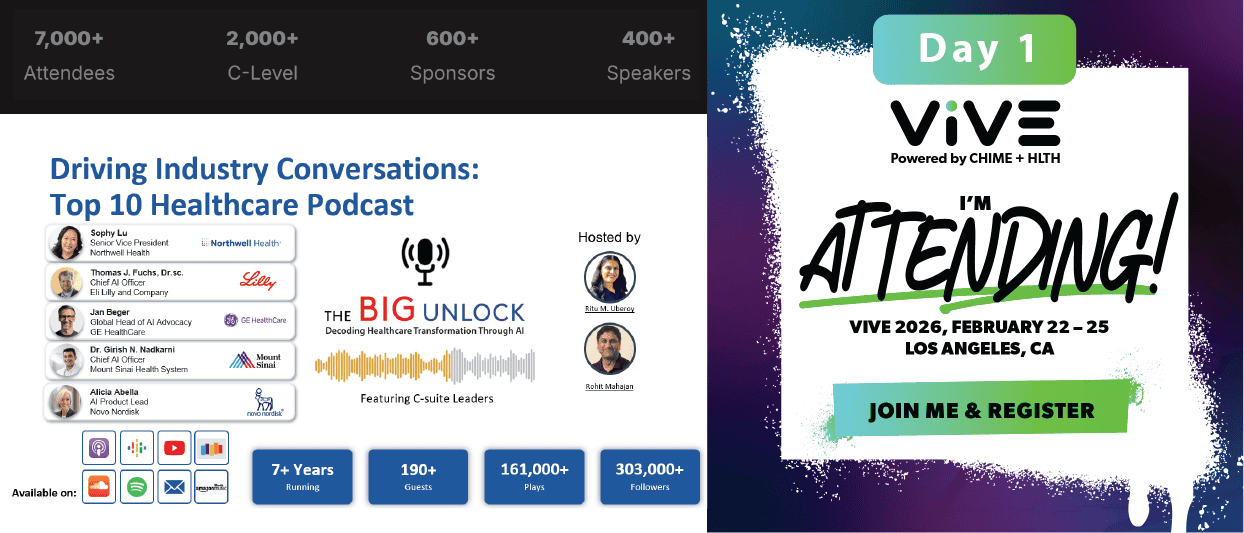
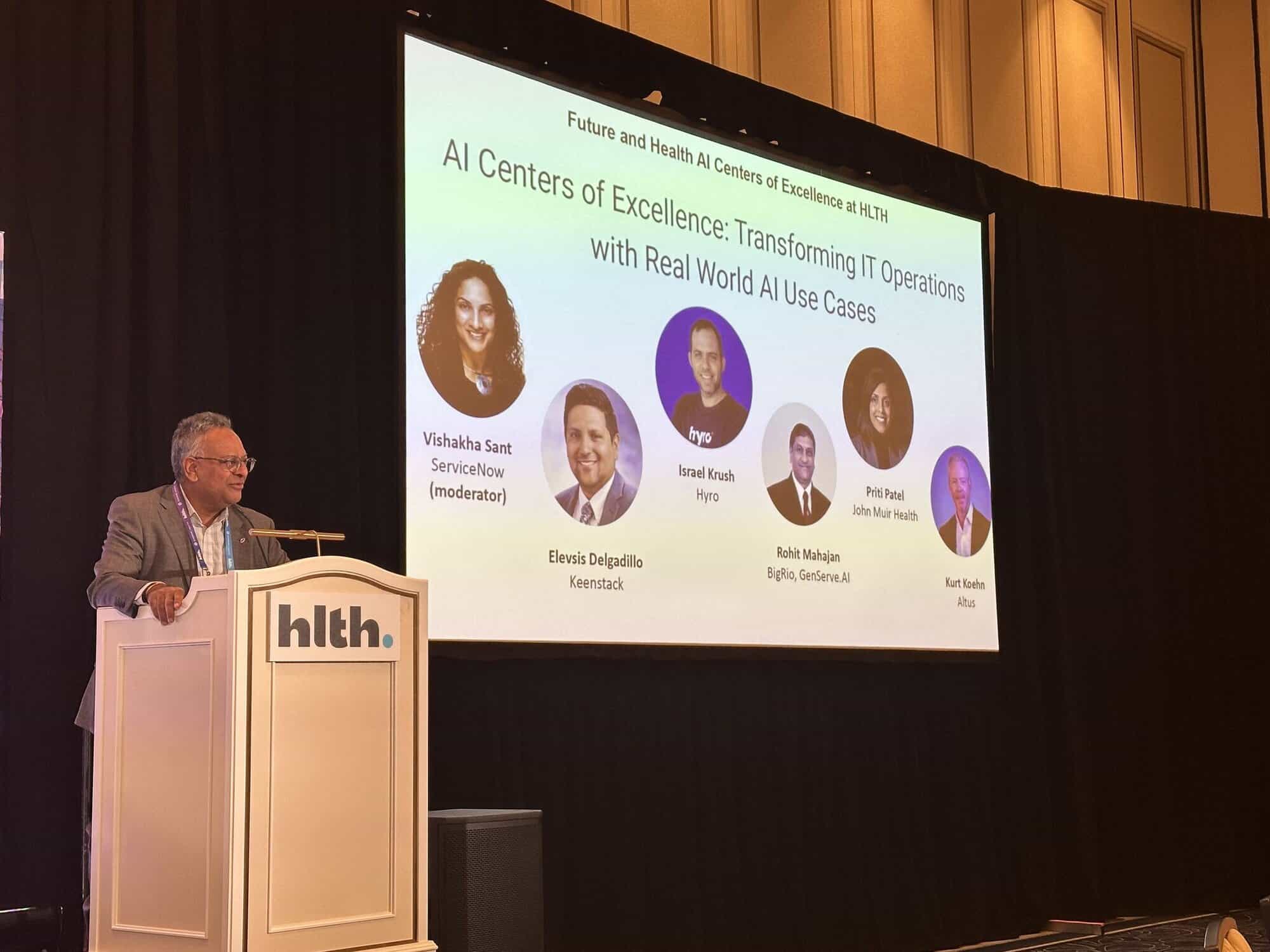
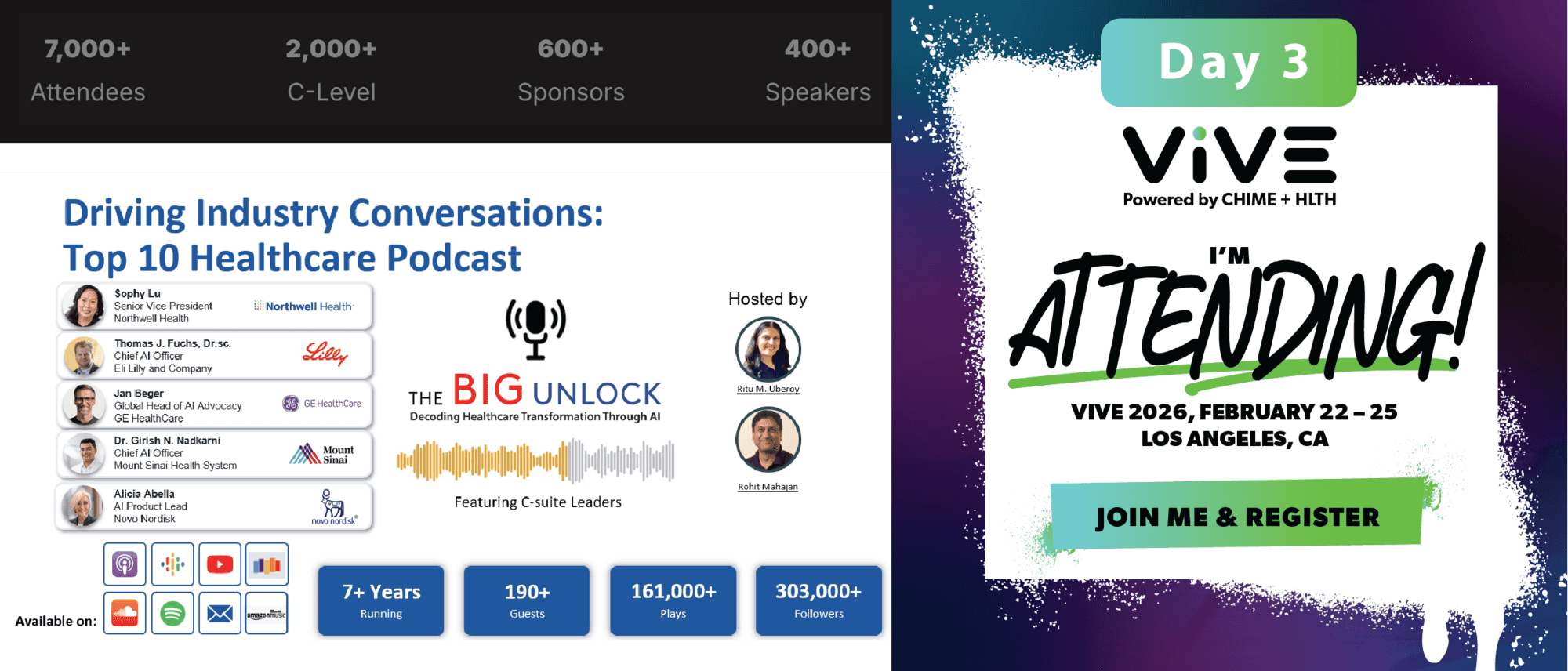
One of the highlights of today for me was the opportunity to showcase insights from The Big Unlock Podcast — a space where we’ve been exploring how healthcare leaders are actually operationalizing digital transformation, AI, and workflow change to deliver measurable impact. It was energizing to see how many people at ViVE are thinking deeply about what works, not just what’s new

Wrapping Up with Purpose

Day 3 wasn’t just the final day — it was a moment to reflect on how ideas shared earlier in the week are being translated into action:

The Big Unlock stories on stage and off
Today’s interactions reminded me why we started the podcast: to amplify honest conversations about how leaders are tackling complexity with clarity — whether that’s embedding AI into clinical workflows, improving patient experience, or enabling teams with practical tools and strategies. Hearing people at ViVE talk about these insights or referencing real-world examples was deeply rewarding. 

Meaningful hallway and roundtable discussions
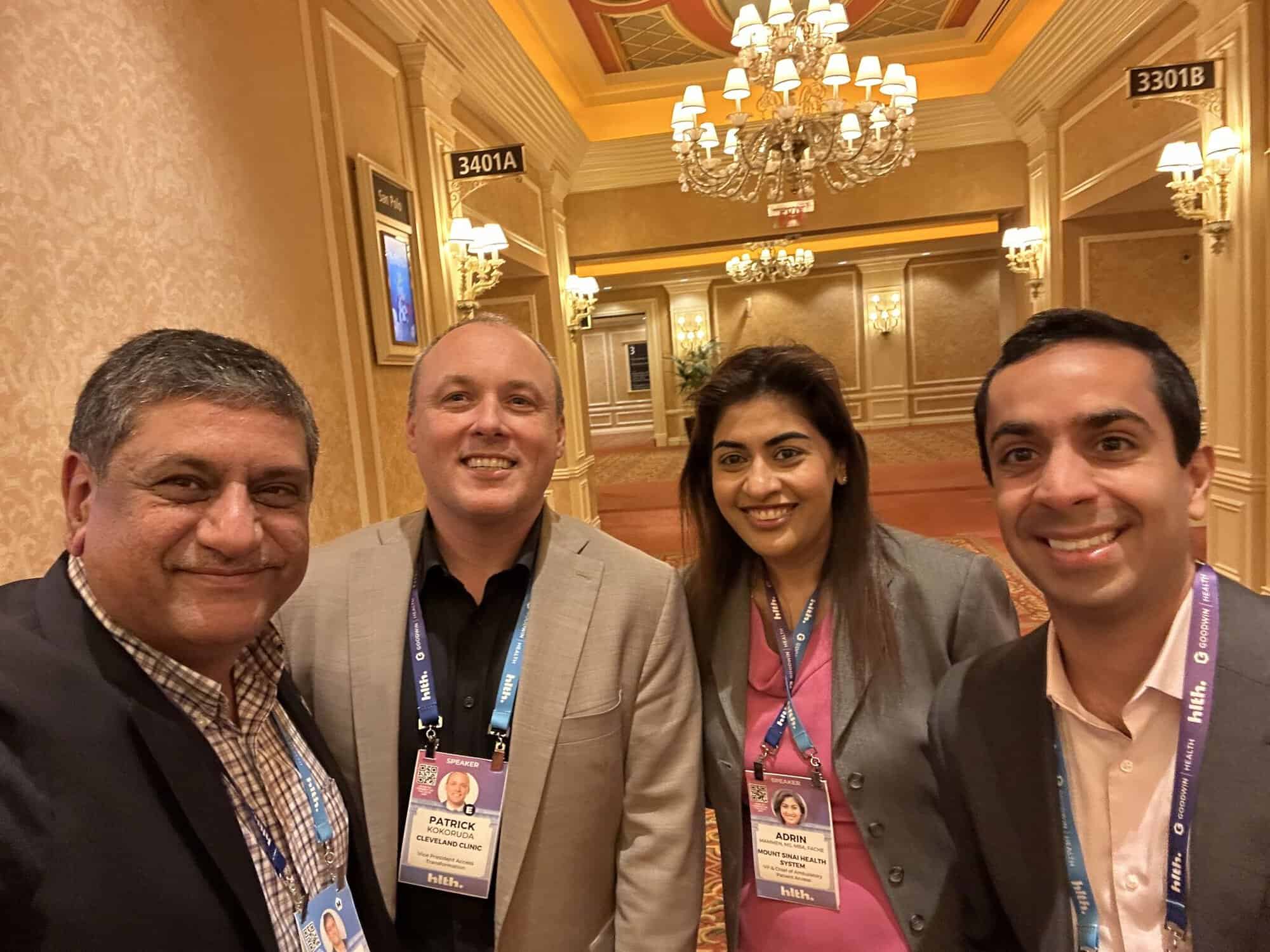
ViVE’s unique mix of structured sessions and open dialogue continues to be its greatest strength. Day 3 was a testament to the power of connection — from impromptu discussions about workflow integration to deeper exchanges on governance, trust, and the human dimensions of technology adoption. 

What’s emerging — beyond the buzz
Across the final conversations of the event, a few themes stood out:

  • AI with purpose — not just innovation for its own sake, but AI that helps clinicians, supports judgment, and reduces friction
  • Workforce-centered design — solutions that meet teams where they work and help amplify their impact rather than replace it. 
  • Collaboration over competition — genuine partnerships between health systems, startups, payers, and technology partners that seek shared, measurable outcomes. 

Closing Thoughts

As ViVE 2026 comes to a close, what stays with me most isn’t a single demo or a single session — it’s the collective sense of urgency and purpose in the community. Leaders here aren’t just talking about transformation — they’re making it happen, even when the path is complex and the stakes are high. 

If you were here too, thank you for the conversations, the curiosity, and the commitment to what’s next in healthcare. And for those who couldn’t make it — let’s keep the dialogue going. There’s momentum to carry forward, and real work to be done.

Here’s to turning insight into impact — now, and throughout the year ahead. For continued conversations, connect with me on LinkedIn.

“HLTH brings together the brightest minds in healthcare to drive real-world transformation through AI, data, and workflow innovation. The energy, collaboration, and actionable insights here are truly reshaping the future of care at scale.”

– Rohit Mahajan, Co-host of The Big Unlock Podcast

Through The Big Unlock Podcast, I will be interviewing many of these incredible minds on-site, gathering firsthand stories about the challenges, successes, and breakthroughs shaping the AI-powered future.

Event Gallery

Day 2 at ViVE 2026: From Insight to Action

Day 2 at ViVE 2026: From Insight to Action

Day 2 at ViVE 2026: From Insight to Action

By Ritu M. Uberoy

Co-Host, The Big Unlock Podcast

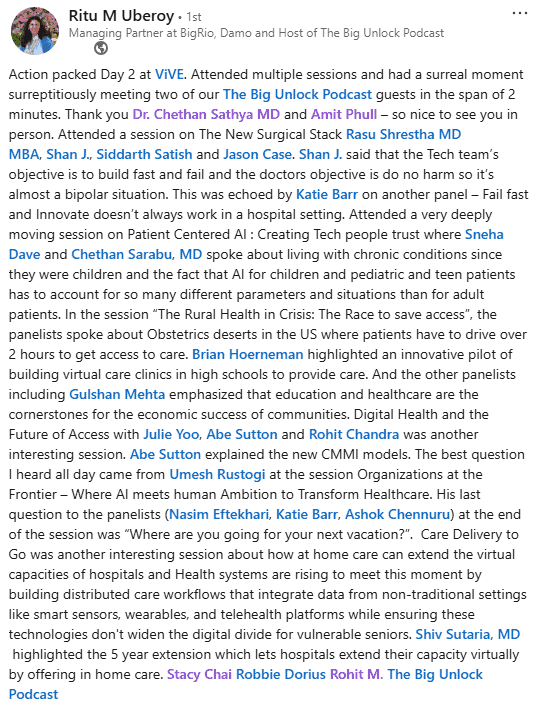
Day 2 at ViVE 2026 in Los Angeles was packed with energy, ideas, and accelerated conversations about the real work of healthcare transformation. After an inspiring opening day, today was all about digging deeper — exploring concrete approaches to emerging challenges, connecting with fresh perspectives, and prioritizing how we move from concept to measurable action.

The exhibit halls, session rooms, and networking spaces were buzzing with dialogue — not just about “what’s next,” but about how leaders are getting done what matters most in care delivery, workforce enablement, and intelligent technology adoption. 

Conversations That Matter: Workforce, Nurses, and Tech

One of the themes that stood out for me today was the focus on the healthcare workforce as an essential partner in innovation, particularly how technology can support clinicians rather than sideline them. From sessions exploring nursing’s evolving role in a tech-enabled future to practitioner stories about adoption barriers, the message was clear: technology must be designed with people at the center. 

This shift, from technology for technology’s sake to technology that solves real problems, is not just rhetoric. It was reflected in the questions attendees asked, the solutions showcased on the floor, and the collaborations forming in the hallways.

Practical Insights from Sessions and Demos

Day 2 brought a slew of engaging discussions and demos that underscored the practical side of healthcare innovation:

🔹 Operationalizing AI with Purpose
AI was everywhere; not just as a buzzword, but as a tool leaders are actively deploying to improve workflows, enhance patient experience, and support clinical decision-making. Conversations went beyond theory into use cases that reduce administrative burden and elevate care delivery.

🔹 Security, Trust, and Responsible Innovation
In a landscape where data powers everything from predictive insights to real-time clinical support, several thought leaders reiterated how security and trust aren’t optional — they’re foundational to sustainable transformation. 

🔹 Human-Centered Design in Action
The best sessions weren’t simply about “what tech can do,” they were about how organizations bring nurses, physicians, and patients into design conversations. That alignment is critical to creating solutions that people will actually use and benefit from. 

Meaningful Meetings That Extend the Day

Beyond the formal agenda, Day 2 was rich with curated and serendipitous conversations with health system leaders, innovators, and fellow practitioners. Whether we explored AI adoption strategies or debated how to reimagine patient-facing digital experiences, these exchanges reinforced a simple truth: transformation thrives at the intersection of diverse perspectives, deep expertise, and practical curiosity.

Looking Ahead with Momentum

As we wrap Day 2 and look toward the final day of ViVE 2026, the urgency to translate insight into impact is stronger than ever. We’re seeing more healthcare organizations that aren’t waiting for the perfect moment, they’re building it. They’re operationalizing solutions, elevating clinicians through technology, and centering real user needs in every conversation. 

If you’re at ViVE as well, I’d love to connect. We’re exploring AI in action, talking workforce empowerment, or simply capturing the momentum this community is creating. There’s so much opportunity for meaningful progress ahead. If you want to connect after the event because your calendar is full, feel free to drop me a note on LinkedIn.

“HLTH brings together the brightest minds in healthcare to drive real-world transformation through AI, data, and workflow innovation. The energy, collaboration, and actionable insights here are truly reshaping the future of care at scale.”

– Rohit Mahajan, Co-host of The Big Unlock Podcast

Through The Big Unlock Podcast, I will be interviewing many of these incredible minds on-site, gathering firsthand stories about the challenges, successes, and breakthroughs shaping the AI-powered future.

Event Gallery

Day 1 at ViVE 2026: Energized, Inspired, and Focused on What’s Next

Day 1 at ViVE 2026: Energized, Inspired, and Focused on What’s Next

Day 1 at ViVE 2026: Energized, Inspired, and Focused on What’s Next

By Ritu M. Uberoy

Co-Host, The Big Unlock Podcast

Day 1 of ViVE 2026 in Los Angeles did not disappoint. I couldn’t be more excited about what’s unfolding at this incredible intersection of healthcare leadership, innovation, and digital transformation.

We kicked off the day with a bright, sunny California morning that matched the energy and optimism in the halls of ViVE. From the moment I stepped onto the event floor, with sessions underway, conversations buzzing, and new ideas in motion, it was clear that this year’s ViVE is a convergence of purpose and possibility.

Seeing Healthcare Innovation in Action

ViVE brings together health system and payer leaders, technology innovators, investors, and solution partners, all focused on transforming healthcare, not in theory, but in practice. This is where strategy meets execution, where real-world challenges get real-world solutions.

One of the highlights for me today was seeing how AI and digital technologies are being mobilized across the care continuum. From patient experience to clinical workflows, the narrative has shifted from “what might be possible” to “what’s already happening.” In the AI and digital health conversations I’ve engaged in, the focus is deeply anchored in augmenting people, improving outcomes, and removing friction from care delivery.

Connecting Through The Big Unlock Podcast

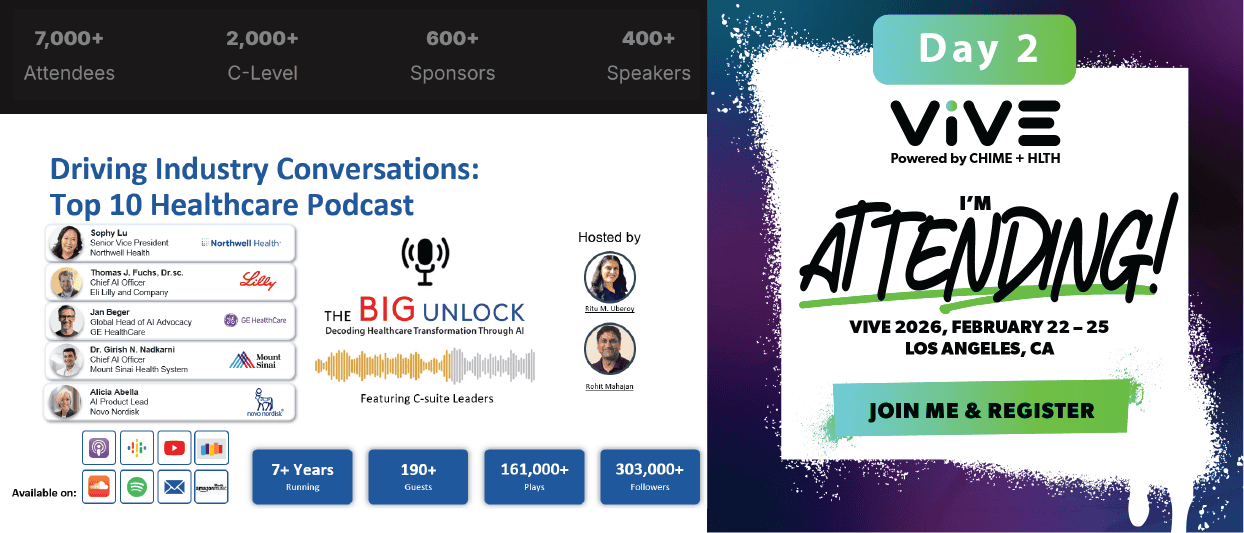
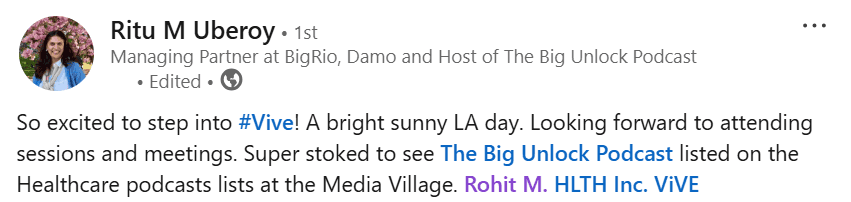
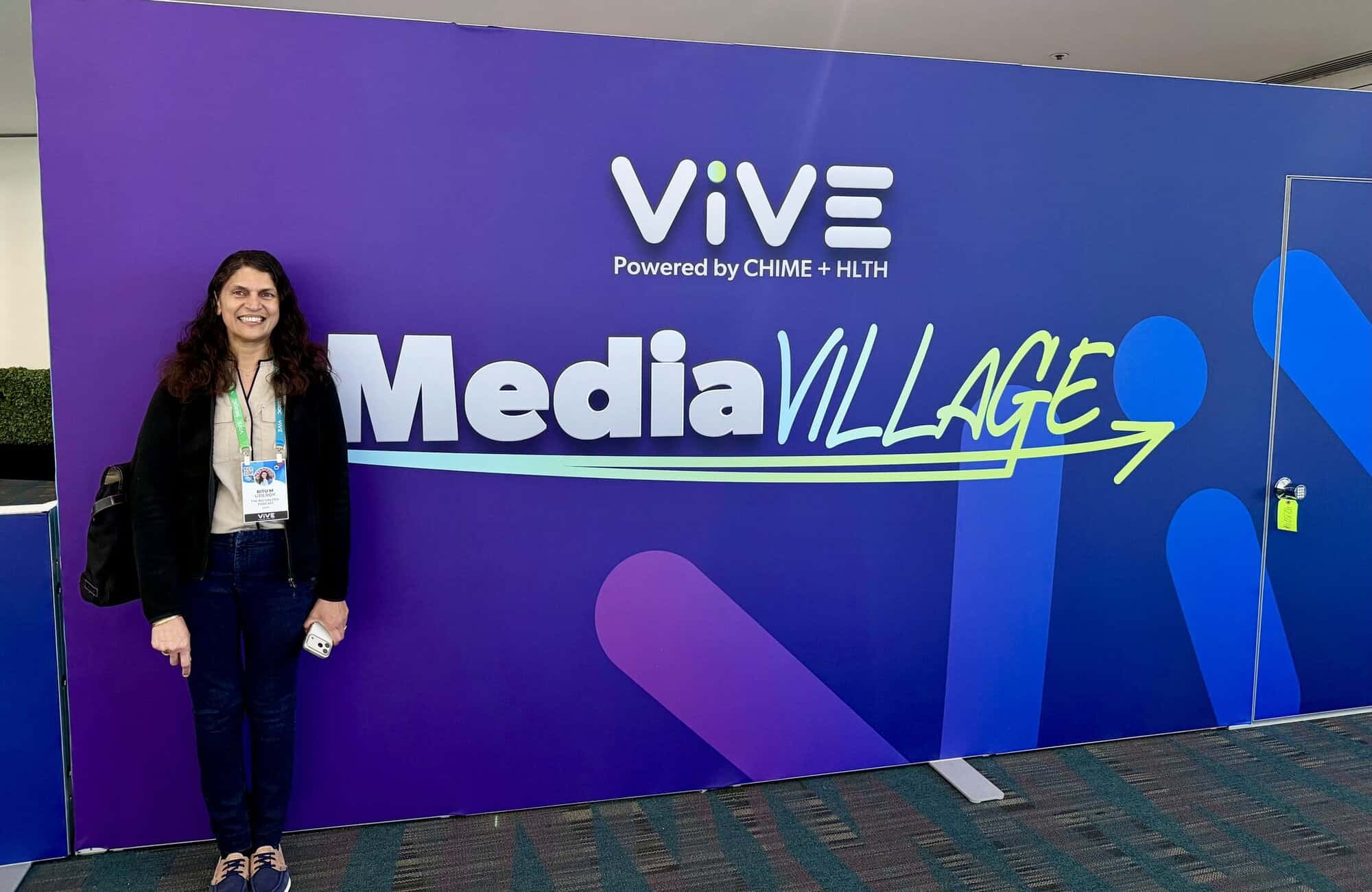
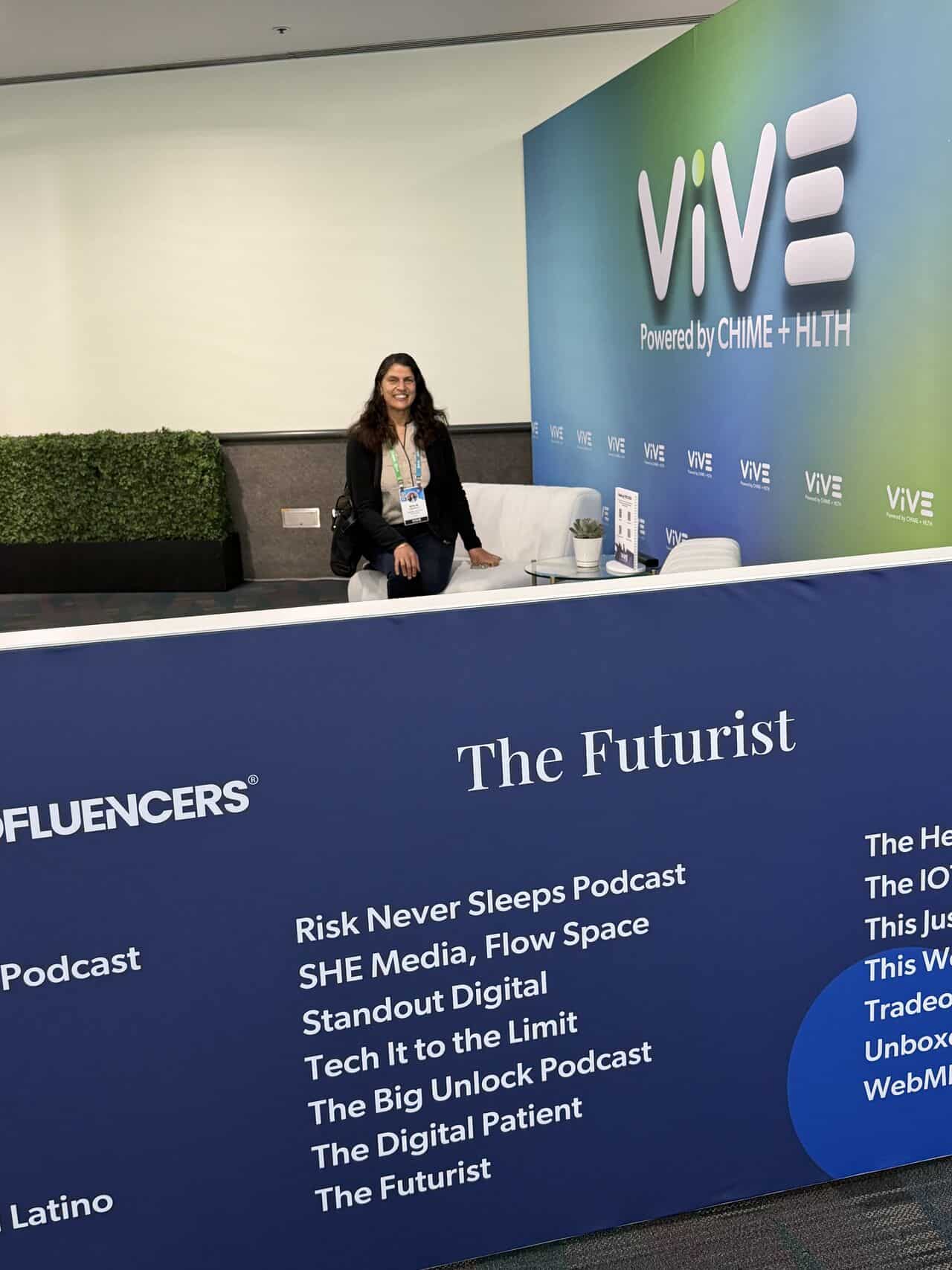
I’m also delighted to share that The Big Unlock Podcast continues to be featured in the ViVE Healthcare Podcast lists at the Media Village — a welcome acknowledgment of the meaningful dialogues we’ve been fostering with health system and industry leaders. Roaming the exhibit floor and seeing peers engage with the podcast’s themes — from workflow-first AI adoption to clinician-centric innovation — reminds me why we started this journey in the first place.

These aren’t abstract discussions. These are conversations about how AI and digital technologies can tangibly improve access, efficiency, and outcomes in care, grounded in the realities health leaders face every day.

What’s Been Top of Mind on Day 1

Here’s what’s stood out today:

🔹 AI Isn’t Just a Trend, It’s Becoming the Backbone of Healthcare Innovation
Across sessions and hallway conversations, AI is being talked about in terms of productivity, clinician support, and patient impact, and not just hype. There’s a palpable excitement around solutions that deliver measurable value and integrate seamlessly into how care teams operate. 

🔹 Digital Transformation Conversations Are More Practical and Immediate
Leaders are focusing on where technology intersects with workflow and culture, not only what it can do in the future. This practical lens, rooted in real operational and clinical needs, signals that the next phase of digital innovation is here.

🔹 Connection, Collaboration, and Community Matter
ViVE is a reminder that transformation doesn’t happen in isolation. It happens through shared insight, honest conversation, and bridging perspectives across the healthcare ecosystem.

Looking Ahead

As I reflect on Day 1, I’m energized by the momentum and the commitment I’ve seen from leaders across organizations. Whether we’re talking about AI that augments clinician judgment, digital tools that streamline patient access, or frameworks that support responsible technology adoption, the theme is clear: healthcare’s future is being built now, here at ViVE.

I look forward to more conversations, more insights, and more breakthroughs as the event continues. If you’re here too, let’s connect. There’s so much more to explore together.

“HLTH brings together the brightest minds in healthcare to drive real-world transformation through AI, data, and workflow innovation. The energy, collaboration, and actionable insights here are truly reshaping the future of care at scale.”

– Rohit Mahajan, Co-host of The Big Unlock Podcast

Through The Big Unlock Podcast, I will be interviewing many of these incredible minds on-site, gathering firsthand stories about the challenges, successes, and breakthroughs shaping the AI-powered future.

Event Gallery

What Does Responsible AI Adoption in Healthcare Really Look Like?

What Does Responsible AI Adoption in Healthcare Really Look Like

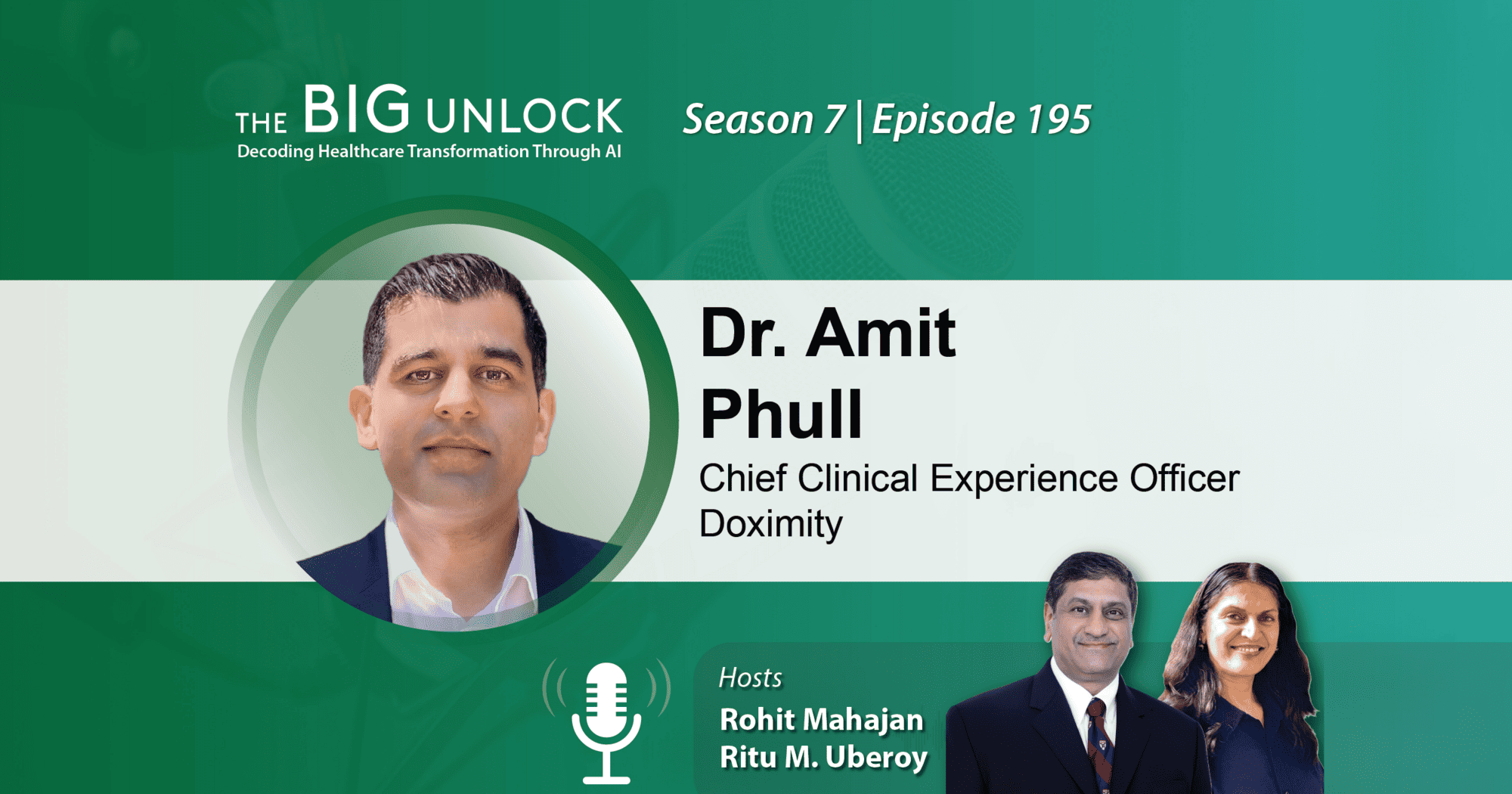
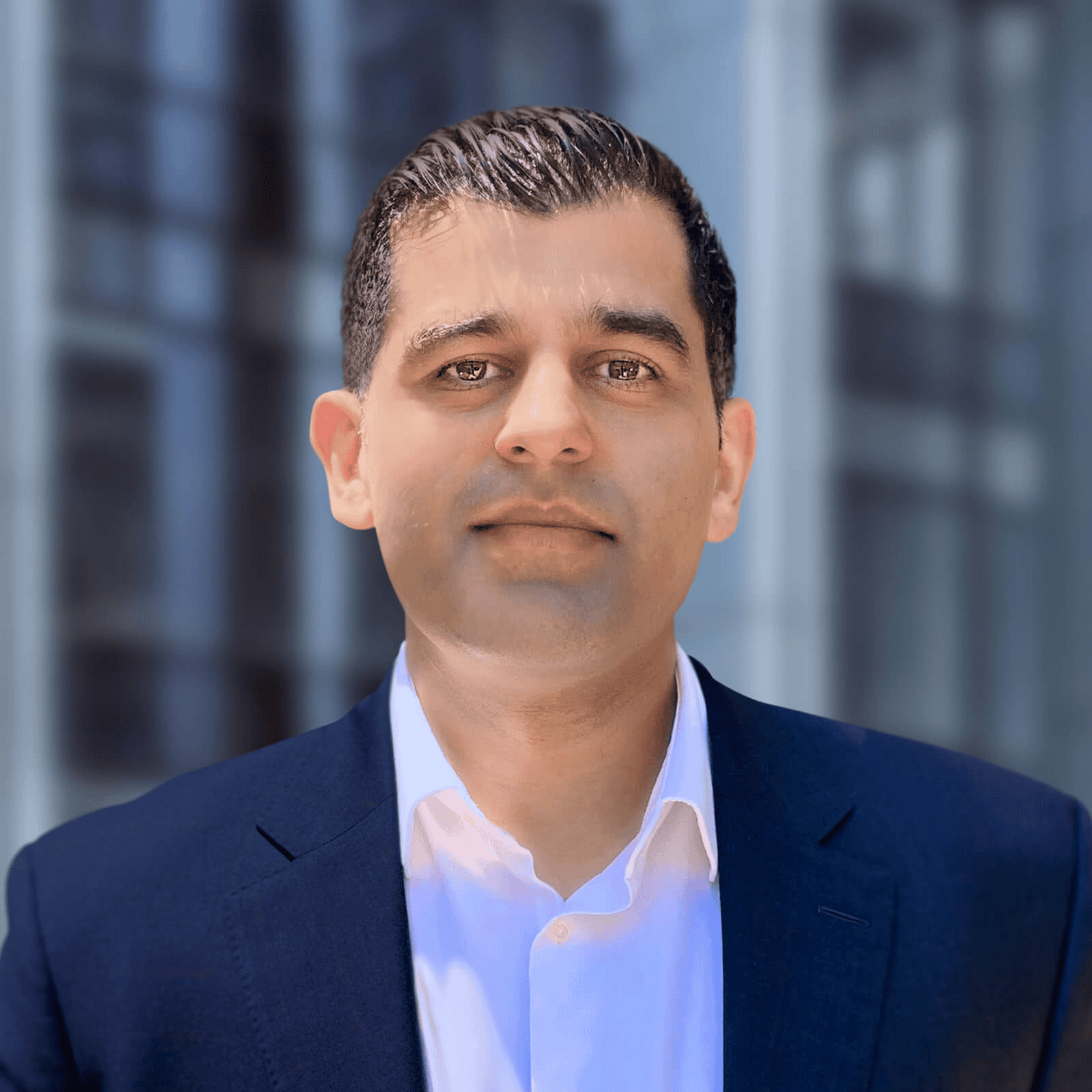
Insights by Dr. Amit Phull, Chief Clinical Experience Officer, Doximity

In a recent episode of The Big Unlock podcast, Dr. Amit Phull, Chief Clinical Experience Officer at Doximity sat down with hosts Rohit Mahajan, and Ritu M Uberoy, both Managing Partners at BigRio and Damo, to answer a question that’s becoming harder and more urgent every day, “What does responsible AI adoption in healthcare really look like when you move beyond the hype and headlines?”

Dr. Phull’s perspective is grounded in the realities of clinical work. He’s an emergency medicine physician, with academic roles at Northwestern and George Washington University. He has also spent the last decade-plus building technology with one of the most clinician-centered platforms in healthcare.

What makes the conversation valuable is that it doesn’t treat “responsible AI” as an abstract principle. It treats it as an implementation discipline.

Throughout the podcast, Dr. Phull repeatedly returns to a simple pragmatic truth, clinicians adopt what helps them, trust what they can verify, and reject anything that feels like “one more thing.”

As he explained to Ritu “From the clinician perspective, ease of use is paramount… Being able to trust the technology is paramount as well… If they can’t trust the output… or god forbid it adds time to their day… it’s going to be very, very difficult to compel those clinicians to actually pick up that piece of software and leverage it.”

That one statement is basically a responsible adoption blueprint.

Let’s break down what Dr. Phull says responsible AI adoption looks like through the lens of workflow, trust, education, and the coming shift toward Agentic AI.

A Clinician-First Origin Story: “Build with Us” Is the Operating Model

Dr. Phull shared a helpful origin story, not just about himself, but about how Doximity’s approach evolved. He explained that Doximity was founded in 2010 with an initial mission to “rewire healthcare,” specifically by building tools that help physicians be more productive so they can provide better care. He noted that Doximity’s CEO and co-founder Jeff Tanney previously built Epocrates, which helped anchor the company in practical clinician utility from day one.

Dr. Phull’s own path mirrors that bridge between domains. He describes a “prior life” as a computer engineer, and how he’s spent his career living at the intersection of medicine and technology. That intersection is the key implementation detail to how Doximity builds successful AI tools – with physician involvement.

He explained how he first joined the company through a Physician Advisory Panel, where clinicians volunteer time to beta test tools and provide direct feedback on what should be built next. That same model continues to this day, including their upcoming 2026 medical advisory board, where clinician input shapes product direction.

This matters because according to Dr. Phull, responsible AI adoption isn’t just about “what the model can do,” it’s about whether clinicians see themselves in the design, and whether the tool feels like it understands the realities of care delivery.


In Healthcare, Adoption Starts With Ease of Use and Dies with Added Time

A core theme of the conversation is that clinicians are not resistant to innovation, they are resistant to burden. Dr. Phull explains that if a tool is difficult to use, or worse, if it adds time to the day, that added burden makes adoption nearly impossible.

This is where he makes a sharp comparison to EHRs.

“I would view EHRs as an interesting counter example. If EHRs were deployed not as they were, as part of a government rollout with mandates, I think there would’ve been an extreme increase in the amount of difficulty that it took all of us to adopt that sort of technology.”

Even today, after years of implementation, many clinicians still experience EHRs as a workflow tax. So, when Dr. Phull talks about AI adoption metrics, he points to signals that reflect real-world use:

  • recurrent use
  • increased use
  • time savings
  • burnout (as a proxy for clinician welfare)

And he pairs those “hard metrics” with the lived outcomes that actually motivate adoption.

“Just by being able to go home for that additional hour… doctors… can have dinner with their families or be a little bit more human outside of the practice of medicine.”

That is an operational definition of value.

Responsible AI adoption, in this framing, is not about novelty, It’s about time returned to clinicians, and friction removed from the day.


Medical Education Can Use AI—But It Must Protect Clinical Reasoning

Dr. Phull also speaks as a faculty member, and his comments here are especially relevant to “responsible AI adoption” because adoption isn’t only about today’s clinicians.

It’s about the next generation. He describes AI as a “double-edged sword” in training environments. AI can empower young clinicians, but it can also allow them to “skip a step,” bypassing the hard work of developing critical thinking.

The most memorable line in this section is his emphasis on maintaining a “spidey sense,” or the value of human intuition.

“It’s very important that clinicians still develop and maintain a ‘spidey sense.’ We do not want to reduce clinicians to being messenger pigeons in terms of looking up information and then kind of handing that off to their patients in regards to advancing their care.”

So, what’s the responsible approach in training?

He describes allowing use of tools (including Doximity GPT) but requiring trainees to justify their thinking in real time.

“Medicine cannot be reduced to… a book report… You actually have to demonstrate an understanding of the validity and the context…”

This is a key insight for leaders building responsible AI programs inside health systems:

For Dr. Phull, AI literacy isn’t just “how to use the tool,” It’s how to interrogate outputs, apply judgment, and sustain clinical reasoning.


AI Could Actually Return Humanity to the Practice of Medicine

He concludes in an interesting way, “In a very paradoxical way, the [AI robots] actually reintroduce humanity to the practice of medicine.”

He describes the emotional frustration clinicians express through a common phrase:

“I didn’t go to medical school to be a data entry clerk…”

Then he paints a picture of what responsible adoption could enable; “When I enter a patient’s room, I can shake their hand, look them straight in the eye, put my hands on my patient… while the documentation, the coding… is taken care of.”


The Takeaway

Dr. Amit Phull’s view of responsible AI adoption is practical and clinician centered. His message is clear; healthcare doesn’t need more AI excitement or “one-off” pilots that never stick. It needs tools clinicians can actually trust and use; tools that reduce friction, return time, and protect clinical judgment rather than replace it. In his framing, responsible adoption happens when AI is built with clinician input, grounded in security and verifiability, and supported by human review where it matters most. The organizations that lead won’t be the ones chasing the newest model. They’ll be the ones that make AI dependable in the real world because their workflows, safeguards, and adoption strategy are designed for trust at scale.

Dr. Phull brings a clinician-operator lens to responsible AI adoption. His insights are especially useful because they translate “responsible AI” from principle into practice:

  • Ease of use is the gateway to adoption—clinicians won’t tolerate tools that add steps, context switching, or time.
  • Trust is built through verifiability: HIPAA compliance, rigorous security, and AI outputs anchored in citations.
  • Human clinical review can be a product feature, not just a governance afterthought—Peer Check is a concrete model.
  • Medical education must protect clinical reasoning—trainees can use AI, but they must justify thinking and build a real “spidey sense.”
  • The most realistic future is a middle path: AI that augments clinicians, reduces burnout, and expands access to care.
  • The best version of Agentic AI may be paradoxical: by removing admin burden, it can “reintroduce humanity” to medicine.

Heading to ViVE 2026 in Los Angeles

Heading to ViVE 2026 in Los Angeles

Heading to ViVE 2026 in Los Angeles

“HLTH brings together the brightest minds in healthcare to drive real-world transformation through AI, data, and workflow innovation. The energy, collaboration, and actionable insights here are truly reshaping the future of care at scale.”

– Rohit Mahajan, Co-host of The Big Unlock Podcast

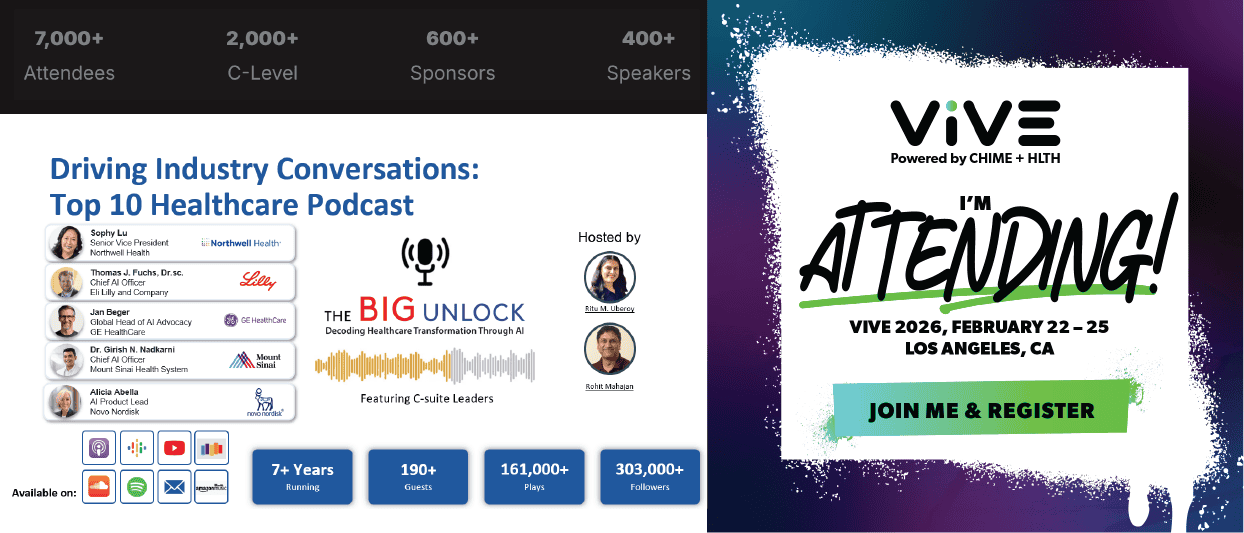
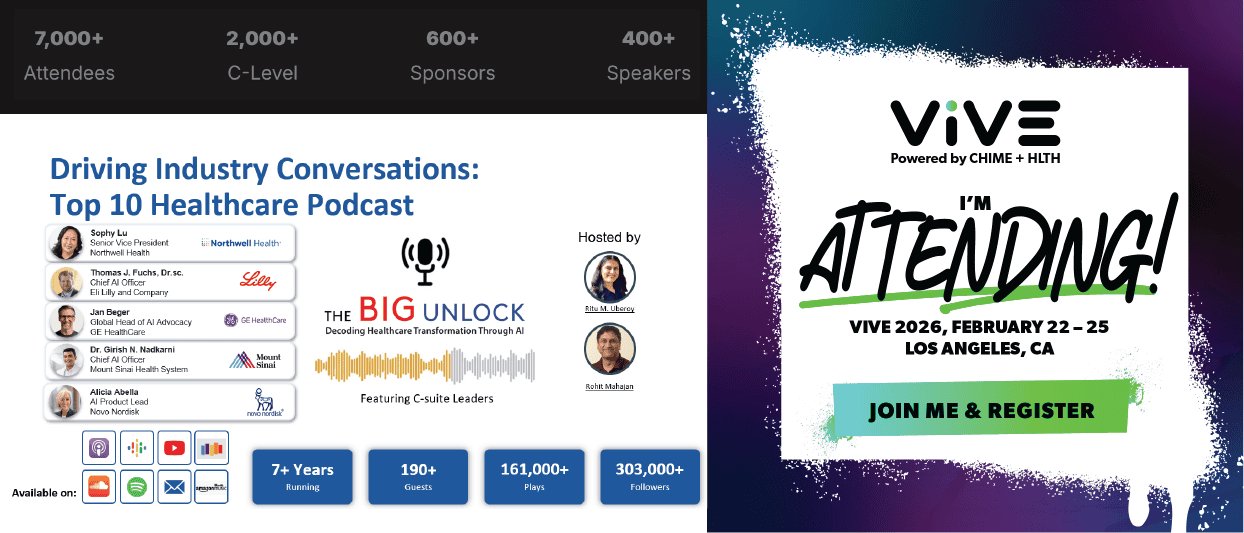
I’m heading to ViVE 2026 in Los Angeles (Feb. 22–25) — one of the largest gatherings of health systems and payer organizations — and I’m truly looking forward to it.

Every year, ViVE brings together leaders who are shaping the future of healthcare — from health system executives and payer innovators to digital health founders and investors. It’s a unique opportunity to step away from day-to-day demands and focus on what’s ahead: AI, digital transformation, interoperability, value-based care, and the evolving patient experience.

What excites me most is the chance to learn. I’m looking forward to attending sessions that go beyond theory and focus on practical implementation — what it really takes to move from pilot programs to enterprise scale. Healthcare is at an inflection point. AI and automation are no longer experimental; they are becoming embedded in access, operations, and care delivery. The question is not whether we adopt these technologies — but how we do so responsibly and effectively.

As Co-Host of The Big Unlock Podcast, I’m also excited to connect with leaders who are willing to share candid insights. My focus is always on practical insight: how healthcare leaders are navigating innovation, scaling technologies like AI and GenAI responsibly, and driving measurable outcomes within their organizations. These are the kinds of conversations that move our industry forward, beyond hype, and into real, sustainable impact. The most valuable conversations are often the honest ones: the lessons learned, the challenges faced, and the strategies that drive measurable impact.

And of course, I’m looking forward to reconnecting with long-time colleagues and forming new relationships. Healthcare transformation is a team effort, and gatherings like this remind us that progress happens through collaboration.

If you’re attending #ViVEvent, let’s connect. Whether it’s between sessions or over coffee, I’d love to meet, exchange perspectives, and continue building toward a smarter, more connected healthcare ecosystem.

Looking forward to learning, listening, and building together.

Through The Big Unlock Podcast, I will be interviewing many of these incredible minds on-site, gathering firsthand stories about the challenges, successes, and breakthroughs shaping the AI-powered future.

Event Gallery

Day 1 at ViVE 2026: Energized, Inspired, and Focused on What’s Next

Day 1 at ViVE 2026: Energized, Inspired, and Focused on What’s Next

By Ritu M. Uberoy

Co-Host, The Big Unlock Podcast

Day 1 of ViVE 2026 in Los Angeles did not disappoint. I couldn’t be more excited about what’s unfolding at this incredible intersection of healthcare leadership, innovation, and digital transformation.

We kicked off the day with a bright, sunny California morning that matched the energy and optimism in the halls of ViVE. From the moment I stepped onto the event floor, with sessions underway, conversations buzzing, and new ideas in motion, it was clear that this year’s ViVE is a convergence of purpose and possibility.

Seeing Healthcare Innovation in Action

ViVE brings together health system and payer leaders, technology innovators, investors, and solution partners, all focused on transforming healthcare, not in theory, but in practice. This is where strategy meets execution, where real-world challenges get real-world solutions.

One of the highlights for me today was seeing how AI and digital technologies are being mobilized across the care continuum. From patient experience to clinical workflows, the narrative has shifted from “what might be possible” to “what’s already happening.” In the AI and digital health conversations I’ve engaged in, the focus is deeply anchored in augmenting people, improving outcomes, and removing friction from care delivery.

Connecting Through The Big Unlock Podcast

I’m also delighted to share that The Big Unlock Podcast continues to be featured in the ViVE Healthcare Podcast lists at the Media Village — a welcome acknowledgment of the meaningful dialogues we’ve been fostering with health system and industry leaders. Roaming the exhibit floor and seeing peers engage with the podcast’s themes — from workflow-first AI adoption to clinician-centric innovation — reminds me why we started this journey in the first place.

These aren’t abstract discussions. These are conversations about how AI and digital technologies can tangibly improve access, efficiency, and outcomes in care, grounded in the realities health leaders face every day.

What’s Been Top of Mind on Day 1

Here’s what’s stood out today:

🔹 AI Isn’t Just a Trend, It’s Becoming the Backbone of Healthcare Innovation
Across sessions and hallway conversations, AI is being talked about in terms of productivity, clinician support, and patient impact, and not just hype. There’s a palpable excitement around solutions that deliver measurable value and integrate seamlessly into how care teams operate. 

🔹 Digital Transformation Conversations Are More Practical and Immediate
Leaders are focusing on where technology intersects with workflow and culture, not only what it can do in the future. This practical lens, rooted in real operational and clinical needs, signals that the next phase of digital innovation is here.

🔹 Connection, Collaboration, and Community Matter
ViVE is a reminder that transformation doesn’t happen in isolation. It happens through shared insight, honest conversation, and bridging perspectives across the healthcare ecosystem.

Looking Ahead

As I reflect on Day 1, I’m energized by the momentum and the commitment I’ve seen from leaders across organizations. Whether we’re talking about AI that augments clinician judgment, digital tools that streamline patient access, or frameworks that support responsible technology adoption, the theme is clear: healthcare’s future is being built now, here at ViVE.

I look forward to more conversations, more insights, and more breakthroughs as the event continues. If you’re here too, let’s connect. There’s so much more to explore together.

“HLTH brings together the brightest minds in healthcare to drive real-world transformation through AI, data, and workflow innovation. The energy, collaboration, and actionable insights here are truly reshaping the future of care at scale.”

– Rohit Mahajan, Co-host of The Big Unlock Podcast

Through The Big Unlock Podcast, I will be interviewing many of these incredible minds on-site, gathering firsthand stories about the challenges, successes, and breakthroughs shaping the AI-powered future.

Event Gallery

Day 2 at ViVE 2026: From Insight to Action

Day 2 at ViVE 2026: From Insight to Action

By Ritu M. Uberoy

Co-Host, The Big Unlock Podcast

Day 2 at ViVE 2026 in Los Angeles was packed with energy, ideas, and accelerated conversations about the real work of healthcare transformation. After an inspiring opening day, today was all about digging deeper — exploring concrete approaches to emerging challenges, connecting with fresh perspectives, and prioritizing how we move from concept to measurable action.

The exhibit halls, session rooms, and networking spaces were buzzing with dialogue — not just about “what’s next,” but about how leaders are getting done what matters most in care delivery, workforce enablement, and intelligent technology adoption. 

Conversations That Matter: Workforce, Nurses, and Tech

One of the themes that stood out for me today was the focus on the healthcare workforce as an essential partner in innovation, particularly how technology can support clinicians rather than sideline them. From sessions exploring nursing’s evolving role in a tech-enabled future to practitioner stories about adoption barriers, the message was clear: technology must be designed with people at the center. 

This shift, from technology for technology’s sake to technology that solves real problems, is not just rhetoric. It was reflected in the questions attendees asked, the solutions showcased on the floor, and the collaborations forming in the hallways.

Practical Insights from Sessions and Demos

Day 2 brought a slew of engaging discussions and demos that underscored the practical side of healthcare innovation:

🔹 Operationalizing AI with Purpose
AI was everywhere; not just as a buzzword, but as a tool leaders are actively deploying to improve workflows, enhance patient experience, and support clinical decision-making. Conversations went beyond theory into use cases that reduce administrative burden and elevate care delivery.

🔹 Security, Trust, and Responsible Innovation
In a landscape where data powers everything from predictive insights to real-time clinical support, several thought leaders reiterated how security and trust aren’t optional — they’re foundational to sustainable transformation. 

🔹 Human-Centered Design in Action
The best sessions weren’t simply about “what tech can do,” they were about how organizations bring nurses, physicians, and patients into design conversations. That alignment is critical to creating solutions that people will actually use and benefit from. 

Meaningful Meetings That Extend the Day

Beyond the formal agenda, Day 2 was rich with curated and serendipitous conversations with health system leaders, innovators, and fellow practitioners. Whether we explored AI adoption strategies or debated how to reimagine patient-facing digital experiences, these exchanges reinforced a simple truth: transformation thrives at the intersection of diverse perspectives, deep expertise, and practical curiosity.

Looking Ahead with Momentum

As we wrap Day 2 and look toward the final day of ViVE 2026, the urgency to translate insight into impact is stronger than ever. We’re seeing more healthcare organizations that aren’t waiting for the perfect moment, they’re building it. They’re operationalizing solutions, elevating clinicians through technology, and centering real user needs in every conversation. 

If you’re at ViVE as well, I’d love to connect. We’re exploring AI in action, talking workforce empowerment, or simply capturing the momentum this community is creating. There’s so much opportunity for meaningful progress ahead. If you want to connect after the event because your calendar is full, feel free to drop me a note on LinkedIn.

“HLTH brings together the brightest minds in healthcare to drive real-world transformation through AI, data, and workflow innovation. The energy, collaboration, and actionable insights here are truly reshaping the future of care at scale.”

– Rohit Mahajan, Co-host of The Big Unlock Podcast

Through The Big Unlock Podcast, I will be interviewing many of these incredible minds on-site, gathering firsthand stories about the challenges, successes, and breakthroughs shaping the AI-powered future.

Event Gallery

Day 3 at ViVE 2026: Conversations That Carry Forward

Day 3 at ViVE 2026: Conversations That Carry Forward

By Ritu M. Uberoy

Co-Host, The Big Unlock Podcast

Day 3 at ViVE 2026 in Los Angeles was a powerful close to four days of learning, sharing, and connection. What stood out most wasn’t just the innovations on display or the sessions we attended, but the quality of conversations and the real-world perspectives shared by peers, leaders, and innovators across healthcare

One of the highlights of today for me was the opportunity to showcase insights from The Big Unlock Podcast — a space where we’ve been exploring how healthcare leaders are actually operationalizing digital transformation, AI, and workflow change to deliver measurable impact. It was energizing to see how many people at ViVE are thinking deeply about what works, not just what’s new

Wrapping Up with Purpose

Day 3 wasn’t just the final day — it was a moment to reflect on how ideas shared earlier in the week are being translated into action:

The Big Unlock stories on stage and off
Today’s interactions reminded me why we started the podcast: to amplify honest conversations about how leaders are tackling complexity with clarity — whether that’s embedding AI into clinical workflows, improving patient experience, or enabling teams with practical tools and strategies. Hearing people at ViVE talk about these insights or referencing real-world examples was deeply rewarding. 

Meaningful hallway and roundtable discussions
ViVE’s unique mix of structured sessions and open dialogue continues to be its greatest strength. Day 3 was a testament to the power of connection — from impromptu discussions about workflow integration to deeper exchanges on governance, trust, and the human dimensions of technology adoption. 

What’s emerging — beyond the buzz
Across the final conversations of the event, a few themes stood out:

  • AI with purpose — not just innovation for its own sake, but AI that helps clinicians, supports judgment, and reduces friction
  • Workforce-centered design — solutions that meet teams where they work and help amplify their impact rather than replace it. 
  • Collaboration over competition — genuine partnerships between health systems, startups, payers, and technology partners that seek shared, measurable outcomes. 

Closing Thoughts

As ViVE 2026 comes to a close, what stays with me most isn’t a single demo or a single session — it’s the collective sense of urgency and purpose in the community. Leaders here aren’t just talking about transformation — they’re making it happen, even when the path is complex and the stakes are high. 

If you were here too, thank you for the conversations, the curiosity, and the commitment to what’s next in healthcare. And for those who couldn’t make it — let’s keep the dialogue going. There’s momentum to carry forward, and real work to be done.

Here’s to turning insight into impact — now, and throughout the year ahead. For continued conversations, connect with me on LinkedIn.

“HLTH brings together the brightest minds in healthcare to drive real-world transformation through AI, data, and workflow innovation. The energy, collaboration, and actionable insights here are truly reshaping the future of care at scale.”

– Rohit Mahajan, Co-host of The Big Unlock Podcast

Through The Big Unlock Podcast, I will be interviewing many of these incredible minds on-site, gathering firsthand stories about the challenges, successes, and breakthroughs shaping the AI-powered future.

Event Gallery

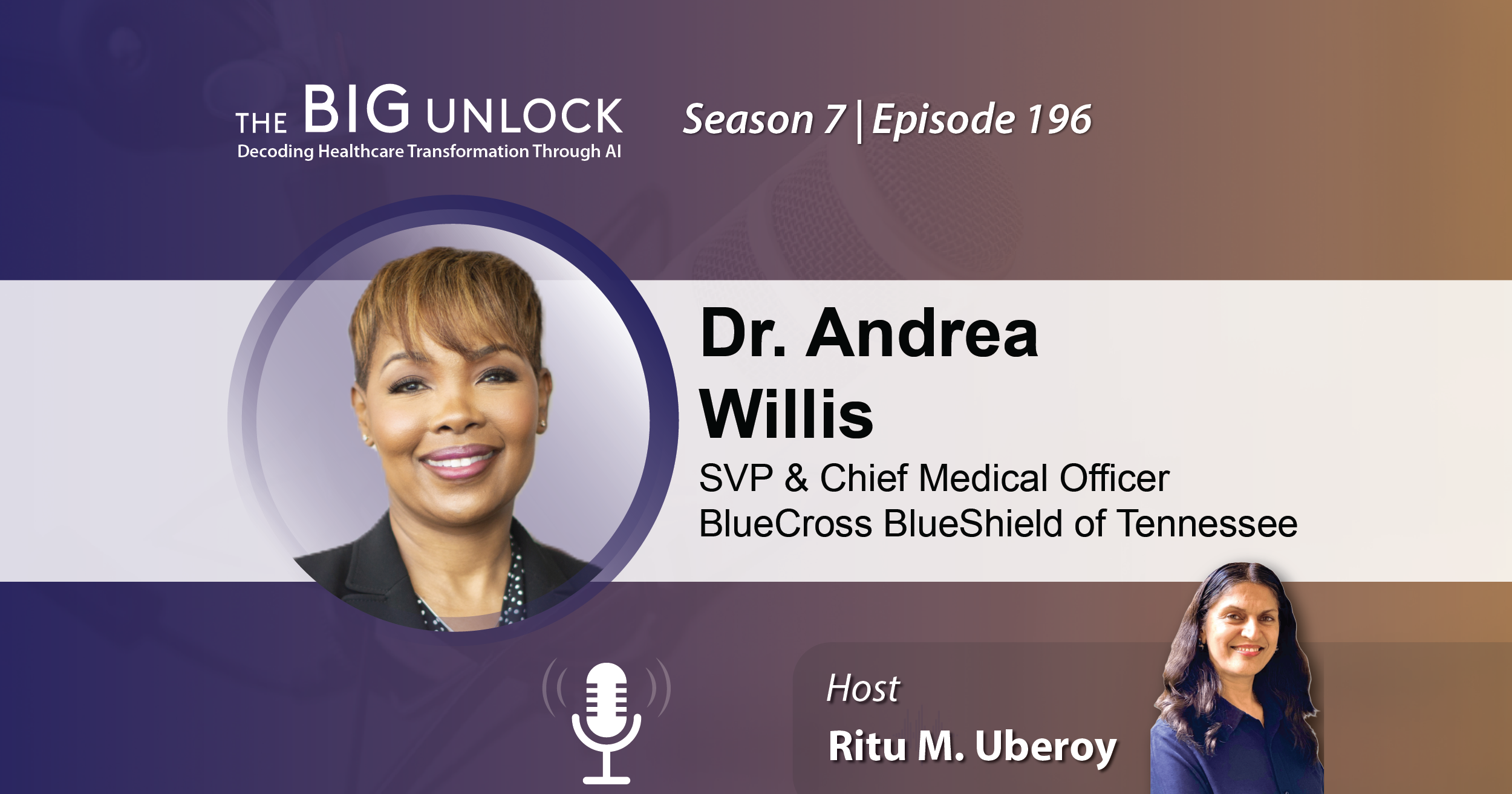
Augmenting Care and Strengthening Trust with AI

Season 7

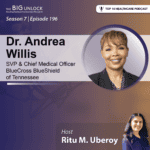
Episode 196 - Podcast with Dr. Andrea Willis, SVP & Chief Medical Officer, BlueCross BlueShield of Tennessee - Augmenting Care and Strengthening Trust with AI

The Big Unlock
The Big Unlock
Augmenting Care and Strengthening Trust with AI
Loading
/

In this episode, Dr. Andrea Willis, SVP and Chief Medical Officer at BlueCross BlueShield of Tennessee, shares how payers can harness AI to advance affordable, accessible, and more human-centered care.

From her clinical roots to leading population health, quality, and health equity initiatives, Dr. Willis brings a deeply personal commitment to service. She describes how AI is being deployed across care management and utilization management, not to replace clinicians or deny care, but to augment teams, accelerate evidence-based decisions, and close gaps in care. In care management, AI-powered summarization and prompting help staff stay fully present with members while improving engagement and measurable outcomes. In utilization management, transparency, evidence-based criteria, and clear documentation remain foundational to rebuilding provider trust. She also highlights that relevance matters more than data volume, and that guided self-service must balance automation with timely human escalation.

Dr. Willis emphasizes transparency in prior authorization, cross-functional governance, AI literacy goals across the enterprise, and strong PHI protections. For her, scaling AI responsibly – through interoperability, collaboration, and measurable impact – is key to rebuilding trust and transforming the healthcare experience. Take a listen.

About Our Guest

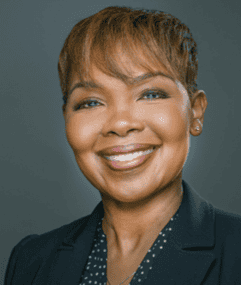
Dr. Andrea Willis is senior vice president and chief medical officer for BlueCross BlueShield of Tennessee, which has more than 6,500 employees and serves more than 3.3 million members throughout the state and across the country. She oversees total health management and pharmacy management and is responsible for achieving and maintaining clinical quality excellence, optimizing member care and medical management functions, oversight of clinical risk management and collaboration with the provider community.

Willis previously served as medical director of the BlueCross CHOICES Long-Term Services and Supports (LTSS) program. She also served as medical director for BlueCare Tennessee and Cover Tennessee.

Before joining BlueCross, Willis was director of the CoverKids program and was responsible for developing Tennessee’s federally approved State Children’s Health Insurance Program (SCHIP). She also previously served as deputy commissioner for the Tennessee Department of Health.

Willis is a fellow with the American Academy of Pediatrics. She earned a Master of Public Health from Johns Hopkins Bloomberg School of Public Health and a Doctor of Medicine from Georgetown University School of Medicine. She received her Bachelor of Science degree from the University of Alabama at Birmingham.

She was recognized by Modern Healthcare as one of its Women Leaders of 2024. Additional past honors from the magazine include her being named as one of its Top 25 Minority Executives in Healthcare and one of the 50 Most Influential Clinical Executives. Johns Hopkins Alumni Association honored her with a Distinguished Alumna Award. Becker’s Hospital Review named her as an African-American Leader in Healthcare to Know. She received the inaugural Champion of Healthcare Award in Diversity, Equity and Inclusion awarded by the Chattanooga Times-Free Press in 2021.

Willis has testified in front of the U.S. Senate Committee on Health, Education, Labor, and Pensions. She served as a member of the Health Advisory Board for the Johns Hopkins Bloomberg School of Public Health and the Nashville Health Care Council. She is currently President of the Board for the Middle Tennessee Chapter of the American Heart Association.


Charles: I am Chuck Christian. I’m the Vice President of Technology and CTO for Franciscan Health. Franciscan is a 12 or 13 hospital system, depending on how you count them. We cover a swath of the Midwest from just south of Indianapolis all the way to Chicago, basically following the I-65 corridor.

We have between 350 and 400 locations, including physician practices, imaging centers, lab draws, urgent cares, and oncology centers. It’s a pretty large organization. We have about 29,000 team members, both employees and contractors, at Franciscan Health.

We are truly mission focused. We are a Catholic healthcare system with a big C. We are owned by the Sisters of St. Francis of Perpetual Adoration. That means there are two sisters in the chapel praying for whatever they deem important and anything we ask them to pray for, 24 hours a day, seven days a week, 365 days a year. That’s where the “perpetual adoration” comes in.

We are a mission-driven organization. I believe in that. A lot of our hospitals are smaller and in underserved places, and we take care of that patient population. I think we’re really good at it.

I’ve known this organization almost 40 years. The CIO previous to Charles, who is our current COO, was a good friend of mine. I was CIO of a hospital in Southern Indiana for 24 years, and Bill and I ran a similar software stack. I watched Bill and learned a lot from him as far as how he ran this large organization.

I’ve been here for six years. I joined in April of 2019, so in dog years that’s like 35 years or more. We are very busy. I’m very blessed to have an outstanding team that manages all this, and I get to stand in awe and watch everything we accomplish every day.

Rohit: That’s fabulous. Thank you, Chuck for that intro.

Ritu: My name is Ritu Roy, and I’m the Managing Partner here at Damo and BigRio, and also the co-host of The Big Unlock podcast with Rohit. Thank you for being our guest today, Chuck. We are looking forward to an engaging and insightful conversation. With that, we can dive right in and get started.

Charles: Thank you.

Rohit: Hi Chuck. I’m Rohit Mahajan. I’m the Managing Partner and CEO at BigRio and Damo Consulting. It’s great to have you on the podcast. Like Ritu said, we’re looking forward to an engaging discussion. I’d like to start with the first thought on my mind. You’re in a mission-driven organization, and you’ve been a healthcare leader for many years. What started you on this journey? Tell us how you got started in healthcare, what attracted you, and what you’re passionate about.

Charles: Well, it depends on how far back you want to go. I’m an X-ray tech, radiologic technologist if you want to use the term. The first 14 years of my career were in radiology.

I stepped out of high school on June sixth in 1971, and on June seventh I stepped into the hospital, and I haven’t left since. Interesting enough, I did a lot of things in the radiology department and became part of the management team of that department. I guess if the chief tech had not been just a few years older than me, I’d still be there, because that was the role I wanted. But Roy just retired a few years ago, and I wasn’t going to wait that long.

I’m a geek, I’m a nerd. I was a nerd in high school. It wasn’t cool to be a nerd in high school back then, but it’s cool to be a nerd now. I did a lot of programming classes on the old System Threes with punch cards. Then I learned how to code for Z80 processors.

When we started automating hospitals back in the mid-eighties, I got chosen to run the ambulatory implementation of order management after we had put in patient management. I realized I liked it, and I knew that was where healthcare was going. Radiology has been a high-tech department in hospitals for a long time. I was trying to automate the patient record in radiology, but it was so expensive I couldn’t get any funding for it.

So I jumped ship and moved over to the vendors for about five years. Eventually I was asked to move to either an implementation manager role or the director of an outsourced IT department in southern Indiana. I did that. I had four daughters at the time, and it was the right thing to do because it was a great place to raise my girls.

I spent 24 years there. It was during the time the role of a healthcare CIO was defined. When I left that job, I was Vice President and CIO. I moved to Georgia to a health system there as Vice President and Chief Information Officer. Then I came back to Indiana and worked at the Indiana Health Information Exchange, which is now the only exchange in Indiana. I had been involved with it since 2005. I worked there for a little over four years, and then I took this role here. That’s my stint in healthcare, which has spanned over 50 years.

Rohit: That’s awesome, Chuck. You’ve been there, done it, and seen it as well. I was curious because a few days ago, when we were chatting, you were talking about being either back from UGM or about to go there.

We all know it’s a week-long affair, people go deep, and there are so many things to cover. We were wondering if you could share some of your experiences or a heads-up on topics you see coming our way.

Charles: Sure. I came home with a great deal of anxiety because of trying to figure out how we’re going to do everything and where healthcare is going. The nice thing about Epic is they now cover the entire gambit. I remember when Epic started; they were only in the ambulatory space and then only in large academic medical centers. They cover quite a scope of product these days.

Now that they have grown the applications, they have de-identified shared data, which I think is going to be a plus. The two-letter acronym was everywhere, AI, and how it’s going to be leveraged and used. They did a nice job showing scenarios of how it could be used and how organizations are using it.

We’re a risk-averse organization. We’re taking a more moderated approach. We’re getting our governance in place first. We already have a few things going through the AI mill, and we will have more. We split it into two pieces, one on the clinical side and one on the operational side. Epic has both, and I think they’re well positioned to do that work. They partner with Microsoft, and they continue to do so.

They announced they are working on their own ambient listening. They have business partners already, but they are creating their own product. I assume it will be predicated on the Microsoft stack, but they didn’t say, so I don’t know.

They also mentioned they are working on their own ERP and starting with workforce management. That makes sense because the workforce is in Epic all the time. Nursing staffing, scheduling, shifts, and how all that ties together. It’s an interesting leap.

Years ago, when Lawson, before being purchased by Infor, said they would create a patient accounting platform, I was in a CHIME focus group. When they mentioned that, a bunch of CIOs in the room asked why they would do that. You need to get your ERP right first. But I think the way Epic is approaching it makes sense.

It was great. I was there for about four days and spent most of the time listening to presentations. Judy did a great job with a big screen about what’s next and what’s coming. The rest of her team did a great job showing what you can do now and what’s coming. They do a good job setting expectations around timelines. They release quarterly. We do two a year, so we’re current from their perspective but behind. We don’t have the wherewithal to immediately adopt everything when they release it, so we have to plan accordingly.

Ritu: Yeah. So Chuck, when I was reading about the UGM, it was interesting because they said their unique proposition with AI is the de-identified patient records they have in Epic Cosmos, which is more than 15 billion patient records. They said that for the first time, it can actually move toward healthcare rather than sick care because doctors can predict trends. And I think they released two new things called Emmy and Penny, which will help doctors see the trajectory of what is going to happen with patients.

So I was curious about your thoughts because you’ve been in this industry for such a long time. Do you think that this USP—this huge bank of patient records—is really going to set them on a differentiating path compared to all the other AI startups trying to do the same thing?

Charles: I think that having the data is huge, honestly. It reminded me a lot of—if you remember years ago—they had a thing called PatientsLikeMe, where people with unique and rare diseases could find others and compare notes and treatment approaches. Working at the Indiana Health Information Exchange, I know they have about 30 years of data. Not all of it is discrete, but the majority is.

One question I asked the CEO, who is a friend of mine—and a lot of researchers use that de-identified data—is that when you create an AI model and just let it learn, there are all kinds of interesting determinations you can make once you have the data. So I think it’s going to be a game changer. Epic is also trying to outdo themselves. Given the market of EHR vendors, there aren’t many left standing. There are three or four. Others are creating similar repositories, but I’m not sure they have the long-term vision or the wherewithal to get it done. Knowing the talent Judy has pulled together, I think it will be very interesting to see what comes down the pike.

Ritu: Thank you.

Rohit: Chuck, you mentioned you’re taking a conservative approach to AI adoption and setting governance before taking major steps. How do you think about innovation or typical problem-solving—for example, reducing cognitive load across the organization? How do you balance this conservative approach with the fast-paced changes happening in the marketplace?

Charles: I think we have to be very clear about what problem we’re trying to solve. There are so many solutions being thrown at us—“Hey, we can do this, we can do that”—but often it’s not a problem we actually have. So we’re trying to pick and choose which targets to shoot at.

I’m married to a critical care nurse, so I’m very careful about getting in the way of the nursing staff. She’s retired, but for me, technology needs to be invisible. If it gets in the way of people being able to do their job, then it’s a problem.

If you think about it for a minute—and I’ll give you Chuck’s opinion—we don’t really have electronic medical record systems for documenting the care of the patient. What we have are electronic systems that capture information required for billing. That’s part of the problem. We have all these required elements clinicians have to document—physicians have to dot all the i’s and cross all the t’s—to get the appropriate words in so it can be translated into billing codes, ICD-10 codes, HPS codes, and so on. It truly gets in the way of taking care of patients.

But once we get that discrete data, we can use AI and other tools to help determine a better course of treatment. You’re never going to hear me say that we should depend solely upon AI. It has to be moderated and reviewed by someone with clinical training. Physicians have shown me I’ve been wrong more times than you can imagine. Working together and having good data aggregation is important.

One thing I learned early on when implementing the first physician order entry and clinical documentation systems was that physicians said: “Don’t tell me what I already know. Tell me what I don’t know. Better yet, tell me what I need to know about the patient in front of me right now.” There are things they don’t know. That’s where data aggregation from health information exchanges helps, because patients don’t get care in one location or from one physician.

I’m living proof of that. I get care in two—actually three—health systems because that’s where my specialists are. My primary care doctor wants to know what my orthopedist did or what my cardiologist’s course of treatment is, because he’s managing my diabetes and a few other things. Having access to information—recent labs, imaging studies—is extremely important.

We talked about interoperability, and that’s where it comes into play. Most hospitals in Indianapolis are on Epic, so you can get data easily. From non-Epic systems, there are mechanisms too. When I see my cardiologist—who uses a different system—and he already knows what my medications are because they were recently changed by another physician, that’s positive. I don’t have to list everything. When they know my latest labs, that’s positive too, because we’re not hunting for information.

It’s about providing information that is important to the treatment at that moment.

I had the privilege of sitting in a presentation—maybe eight or nine years ago—at Scripps Institute. They showed a demo of what a patient encounter could be. It was very Star Trek–like. The computer or AI interacted with the physician and patient appropriately. It listened in the background and captured information about the encounter. When the physician said, “We need to order a CT scan of your lower abdomen,” it was already getting that scheduled. When the patient was ready to leave, everything was set. It was also checking for recent labs and reminding the physician if the patient—say a diabetic—was due for an eye exam or foot check.

I think it’s about having access to the information so we can inform—not determine but inform—the physicians. Because at the end of the day, physicians are accountable for the outcomes. They have to be in control, not the AI.

Ritu: Yeah,

Charles: we’re not ready for Skynet yet.

Ritu: I think you described a multi-agent system where the agents are off doing things and then bringing it all back for the physician to review. With that being said, we all know that AgTech is one of the top trends everyone’s talking about these days. What are your thoughts on voice agents? Where is Franciscan with that? Have you had exposure to or tried voice agents in the hospital?

Charles: Yeah, we’ve got a trial. We’ve got over 200 physicians working on those. Is it going to be the end-all, be-all? I don’t know. The physicians seem to like it. It assists them; it helps with their pajama time.

I’ve listened to conversations from other health systems that were early adopters, and I have to go back in time to when we were looking at automating physician practices in Southern Indiana. We visited a group of 14 family practice doctors. The husband and wife who started the practice mostly did OB and family medicine. Their use of computers was minimal—they were still mostly on paper. But they had other physicians who, I think, slept with their laptops.

The interesting thing was that depending on how well a physician adopted the computer system and molded it to how they practiced, they got to take advantage of it. I think it’s going to be the same with AI and voice agents. If they allow it to help and figure out how to incorporate it into how they think and practice, they’ll see the benefit. The systems are pliable enough now that it’s easier to do.

When I was in Georgia, we needed to automate a lot of OB practices on the same platform. One OB had been practicing almost 30 years and already had a solution he had customized. He told me I would tear it out of his cold, dead fingers. So we worked with him. The new system was more flexible and pliable than his old one, and he became a champion because he was willing to take the time to understand how he could use the technology to help him practice.

I think that’s the key. If you’re resistant to it, that’s fine—that’s perfectly okay. But people who write software often think all physicians think the same way. They’re absolutely wrong. It depends on where they trained. I learned that when implementing emergency room electronic medical records. The physicians who helped design the software were trained with a very different approach to critical thinking than our physicians. We had to relearn and figure out ways to adjust, because once clinicians are trained a certain way, it’s hard to change those habits and the way they gather and maintain information.

Ritu: Thank you. Great answer.

Rohit: Chuck, I’d like to ask your thoughts about the innovation process. How do you approach it, and what are some of the things you do to foster innovation?

Charles: One of the things we did was stand up a Tech Innovation Lab. Honestly, it was a selfish move because people were just bringing technology into the organization. All the enterprise architects report to me, and we work together to understand what will work in our environment and what won’t. We try to standardize as much as we can.

So I created the Innovation Lab to bring these innovations into a controlled environment and try them there. It’s a walled garden. It’s not connected to the rest of the network. It has its own connections to the internet. So if we blow something up, it only blows up in the lab. That’s why we did it.

What we’re able to do is bring ideas in and fail fast—figure out what works and what doesn’t. We’ve done that several times. Virtual nursing is something we’ve worked on a lot. There were all kinds of interesting opportunities brought to us. One facility went ahead and put a solution into a live patient population, and we found out quickly that’s not how you do it. You don’t test that kind of thing in a live environment. It frustrates the staff and patients, and it leaves leadership thinking, “We already tried that—it doesn’t work.”

Well, you tried what doesn’t work. Let me show you what will work.

We needed the opportunity to rapidly figure out what would work. One issue with that failed experiment was that the people who built the carts didn’t understand our environment. They put a wireless access point in the cart that was incompatible with our network. Once we got the cart, we figured it out quickly. We re-engineered it, and it works fine now—but we’re not using that cart because it was over-engineered and very expensive.

We’re trying to use standard components that can be supported and replaced quickly. The idea is to generate a lot of ideas and figure out how to use them appropriately without getting in the way.

You also have to think about the aesthetics of the equipment you’re bringing in. The first cart had a big five-wheel base—kind of a star shape. In some patient rooms, it was in the way. Nursing quickly said, “That’s not going to work.”

So we found an iPad holder that hangs on the patient’s bedroom wall when not in use. It’s out of the way, easy to access, and uses magnetic connectors so if someone snags it, it just comes apart. No trip hazard.

You must consider not only the technology but how it fits in patient rooms.

Originally, the idea was that the Innovation Lab would review the technology, understand how it fits together, and then install it in our SIM labs. We have two—one north, one south. Then the simulation teams would put it in a physician office or patient room and see how it fits before we use it in live care. That’s our next step with virtual nursing.

We also have a lot of conversations with organizations that have fully rolled out these solutions. We learn from their experiences. A mistake is only a mistake if you don’t learn from it. If you do, then it’s experience. We leverage their experience so we don’t repeat the same things, and so we can move quicker.

Rohit: That’s awesome. As we are approaching the end of the podcast, I would like to ask if you would touch on the mentorship program.

Ritu: Yes, I would really like to hear more about that, Chuck, because it’s something unique and I think it would be interesting for our listeners as well.

Charles: Just making sure we’re talking about the virtual mentoring program. After COVID, we were bringing on a lot of new nurse graduates. When you bring someone into that role, they need a more experienced nurse for a procedure they may have never done before. That usually means waiting for that nurse to come to them.

We had a couple of nursing staff in the mentorship program who came up with a way to use technology for an on-screen virtual visit with the new nurse. The experienced nurse could walk them through the procedure and be there with them, or if the new nurse had a question, they could step out into the hall, ask it, and go back in. It improved speed to delivery of care more than anything else.

It also gave seasoned nurses a chance to step away from what they were doing instead of traveling to another location. If they need to go in person, they still do, but this gave us another option. We got great feedback from both the new nurses and our more mature nursing staff, and we rolled it out through the enterprise. I haven’t checked in on it recently, but I assume it’s still running. I only hear when things break, and if it’s not broken, I’m not going to fix it. I assume the technology is still working and paying dividends.

Ritu: Thank you so much.

Rohit: So, Chuck, as we come to the end of the podcast, any closing remarks or thoughts you’d like to share before we finish?

Charles: I’ve been in healthcare a long time. Healthcare is a target rich environment for creativity and innovation. But we’re still taking care of patients the same way we did, and it’s about the human touch and caring for people.

When I first started in radiology years ago, I was taken aback that people weren’t always treated as people. They were exams. Do this gallbladder in this room, do this hip nailing in that room. I was reminded they’re people. They could be my family. They could be my children. That’s why I’m passionate about making sure the technology works and doesn’t get in the way.

Have we reached the pinnacle? No. Is it better? I think it is. But we’re still trying to figure it out every day. As long as we have great people passionate about providing outstanding care and we understand where that ability comes from, we’ll keep moving forward.

We’re a Catholic healthcare system, and our rule is we start most meetings with prayer. We are called to love one another as God loves us, and we need to remember that every day. That’s why I keep doing what I’m doing.

Rohit: Awesome.

Ritu: Thank you so much, Chuck.

Rohit: Really appreciate it.

Charles: Okay. Thanks for the opportunity to share.

————

Subscribe to our podcast series at www.thebigunlock.com and write us at [email protected]   

Disclaimer: This Q&A has been derived from the podcast transcript and has been edited for readability and clarity.
About the Host

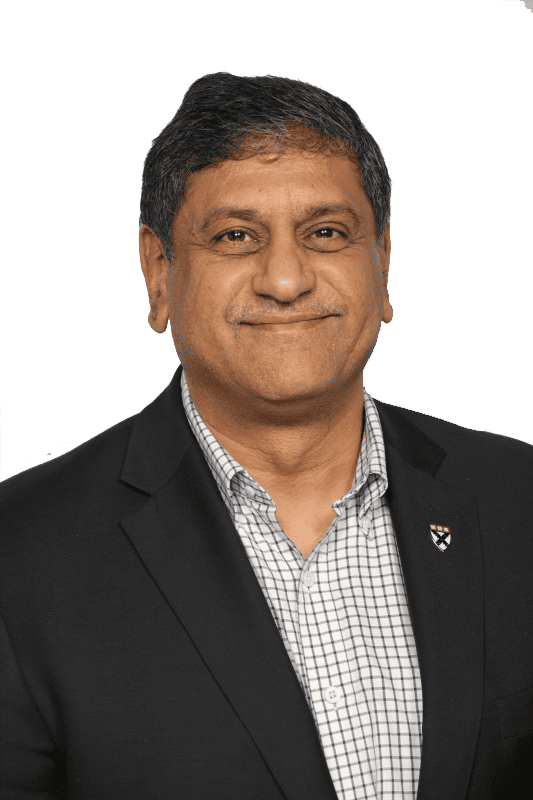
Rohit Mahajan is an entrepreneur and a leader in the information technology and software industry. His focus lies in the field of artificial intelligence and digital transformation. He has also written a book on Quantum Care, A Deep Dive into AI for Health Delivery and Research that has been published and has been trending #1 in several categories on Amazon.

Rohit is skilled in business and IT  strategy, M&A, Sales & Marketing and Global Delivery. He holds a bachelor’s degree in Electronics and Communications Engineering, is a  Wharton School Fellow and a graduate from the Harvard Business School. 

Rohit is the CEO of Damo, Managing Partner and CEO of BigRio, the President at Citadel Discovery, Advisor at CarTwin, Managing Partner at C2R Tech, and Founder at BetterLungs. He has previously also worked with IBM and Wipro. He completed his executive education programs in AI in Business and Healthcare from MIT Sloan, MIT CSAIL and Harvard School of Public Health. He has completed  the Global Healthcare Leaders Program from Harvard Medical School.

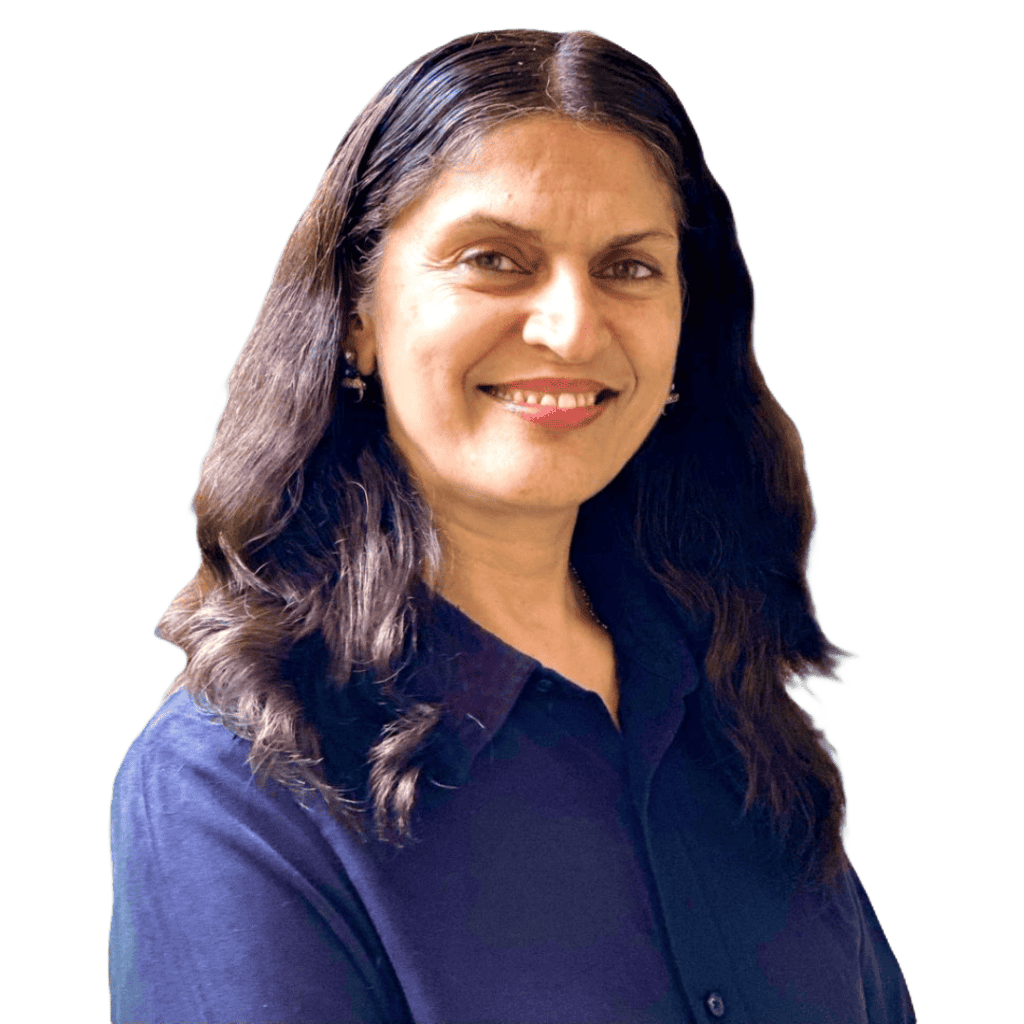
Ritu M. Uberoy has over twenty-five years of experience in the software and information technology industry in the United States and in India. She established Saviance Technologies in India and has been involved in the delivery of several successful software projects and products to clients in various industry segments.

Ritu completed AI for Health Care: Concepts and Applications from the Harvard T.H. Chan School of Public Health and Applied Generative AI for Digital Transformation from MIT Professional Education. She has successfully taught Gen AI concepts in a classroom setting in Houston and in workshop settings to C-Suite leaders in Boston and Cleveland. She attended HIMSS in March 2024 at Orlando and the Imagination in Action AI Summit at MIT in April 2024. She is also responsible for the GenAI Center of Excellence at BigRio and DigiMTM Digital Maturity Model and Assessment at Damo.

Ritu earned her Bachelor’s degree in Computer Science from Delhi Institute of Technology (now NSIT) and a Master’s degree in Computer Science from Santa Clara University in California. She has participated in the Fellow’s program at The Wharton School, University of Pennsylvania.

About the Legend

Paddy was the co-author of Healthcare Digital Transformation – How Consumerism, Technology and Pandemic are Accelerating the Future (Taylor &  Francis, Aug 2020), along with Edward W. Marx. Paddy was also the author of the best-selling book The Big Unlock – Harnessing Data and Growing Digital Health Businesses in a Value-based Care Era (Archway Publishing, 2017). He was the host of the highly subscribed The Big Unlock podcast on digital transformation in healthcare featuring C-level executives from the healthcare and technology sectors. He was widely published and had a by-lined column in CIO Magazine and other respected industry publications.

How Is AI Transforming Clinical Trials and Drug Discovery

AI is having a transformative impact on the pharmaceutical industry. The use of AI tools is dramatically accelerating clinical trials the drug discovery process by drastically cutting time and costs through predictive modeling, virtual screening, automated labs, identifying novel targets, predicting compound properties and even repurposing existing drugs, making the process faster, more efficient, and personalized by analyzing vast biological datasets to find better candidates and pathways.

On a recent episode of The Big Unlock podcast Gregory Goldmacher, M.D., Associate Vice President in Clinical Research, and Head of Clinical Imaging & Pathology at Merck Research Laboratories sat down with host Rohit Mahajan, Managing Partner at BigRio and Damo to discuss how AI is improving drug discovery and the challenges that still remain.

Dr. Goldmacher first discussed how we all know that clinical trials are very expensive and time-consuming and how there are many ways that AI can reduce both of those burdens. “AI essentially improves efficiency, which means it can accelerate every aspect of a clinical trial. In the preclinical phase, AI is being used for things like genome searches and for target identification. When it comes to drug design it can help assess molecular protein interactions and things of that nature, and in the clinical space there’s a lot of use of AI to support clinical operations. That includes things like creating documents, protocols, clinical study reports, informed consent forms, reports of various kinds.”

He went on to discuss that in every clinical trial there is a massive amount of data that gets collected and manual review of all that data is extremely labor intensive. He explained to Rohit that both “traditional AI” and newly introduced “AI agents” can absolutely help sort through this enormous amount of data for targeted analysis.

AI, Drug Discovery and Endpoints

Dr. Goldmacher described endpoints as the core of every clinical trial, since they determine whether a therapy is safe or effective.  As he told Rohit, “Endpoints are measurements. Drug trials require accurate measurements to make decisions. AI allows us to make better measurements for better decisions. He went on to illustrate with an example from his own background in medical imaging.

“Let’s take cancer as an example. The traditional way of assessing whether a cancer drug is working in a clinical trial is that you do a scan, let’s say a CT scan before treatment starts. You identify the tumors, and you pick out a few of them that you’re going to measure. Imaging continues over the course of the trial, and if the measurements shrink, that’s called a response. That’s good if they increase, that’s called progression, which is bad. What you do at each assessment point is apply a mathematical algorithm to each tumor you are tracking to determine if you are getting a complete response, a partial response or no response or progression. Then you look at all those responses, and you extract an endpoint such as objective response rate or progression-free survival based on established criteria.”

He then discussed where AI comes in, particularly when it comes to medical imaging. He explained to Rohit that in those initial scans, there is a lot of information that isn’t immediately visible to the naked eye. AI models can see patterns, pixel patterns that indicate a lot more than just how big a tumor is, but its microbiology, such as invasive vascularity or necrosis, any number of things that are not appreciable with the eye, but can be measured by a model and tracked via AI that can look for those patterns and assess a drugs specific effectiveness on a specific immuno-oncology response and not merely if a tumor has grown or not.

“In that initial scan traditionally, you are only measuring size and using that as your endpoint. There is so much more info there that could make for a more efficient trial, however human analysis of those scans to determine the tumor microenvironment is extremely expensive and time consuming -for radiologists — but not for AI.”


What the Future Holds for AI and Drug Discovery

Despite the obvious increases in efficiency that AI tools can bring to clinical trials, Dr. Goldmacher cautioned that challenges remain, mostly surrounding Big Data and privacy issues.

He stressed that drug development still depends on huge volumes of data spread across legacy systems. Without strong data standardization, even the most sophisticated AI tools cannot deliver reliable results. As he concluded his interview with Rohit, Greg pointed to the FDA’s evolving guidance on AI and emphasized the need for rigorous validation before using AI-derived measurements for all regulatory decisions, but underscored that with thoughtful adoption, AI can support better decisions in clinical development and improve outcomes for patients. Take a listen to the entire podcast here.

True AI Scalability in Healthcare Requires Integration and Cooperation

Insights by Dr. Chethan Sathya, Vice President of Strategic Initiatives at Northwell Health

If you are a regular listener to “The Big Unlock” podcast, you will notice a bit of a pattern in our conversations about “AI in healthcare.” Many episodes are heavy on ambition, light on execution. They celebrate breakthroughs, but they skip the messy middle: the place where promising tools either become part of daily care or quietly fade out after a pilot.

That is what makes this recent episode where hosts Rohit Mahajan and Ritu M Uberoy, both Managing Partners at BigRio and Damo, sat down with Dr. Chethan Sathya, Vice President of Strategic Initiatives at Northwell Health, worth a listen!

The episode is not built around hype, demos, or speculative futurism. It is built around the operating truth that healthcare is not short on ideas. It is short on integration, adoption, and scalable implementation. Dr. Sathya’s ubique “center of gravity” is implementation. He explicitly frames himself as an implementation scientist who focuses on making ideas usable in real-world clinical environments, and he’s clear that this is where healthcare innovation succeeds or fails. 

The conversation stays anchored to what real clinicians will tolerate, what real systems can absorb, and what leaders must do to move beyond experimentation into repeatable operational value.

The Real Scalability Problem Isn’t the Model

The primary message that Dr. Sathya had was this, scalability is not primarily a model-performance question. It’s an implementation question. He explained, “Many organizations can find smart tools. Many can run pilots. Many can produce dashboards that look promising. But healthcare is a high-friction environment. The clinical day is full. The operational machine is complex.” He then added “one more thing is, it’s not neutral—it’s costly.

That’s why Dr. Sathya emphasizes a core scaling truth, “If it’s not built for clinicians… it’s not going to work. If AI isn’t designed for clinicians and doesn’t fit their workflow, it will fail to integrate and won’t scale.”

He went on to describe how “integration” and “scalability” are less about preference and more about physics. A tool that requires extra steps, extra context switching, or extra training becomes another load on already overloaded teams.


Integration Beats “Innovation Theater”

One of the most refreshing parts of the conversation is how plainly Dr. Sathya talks about integration. He describes a common failure pattern that many healthcare leaders will recognize immediately: a new tool arrives that requires clinicians to take on another app, another login, another workflow, another tab, another mental shift.

Even if it’s “good AI,” it’s still friction. As he said to Ritu, “If I have to download another app… it’s not integrated into my workflow.”

Dr. Sathya then explained that from his perspective and experience, the barrier is not just inconvenience. The barrier is that healthcare workflows are already dense, and clinicians are already managing multiple systems, constraints, and interruptions. An extra step doesn’t feel like “an extra step.” It feels like something that competes with patient care.


Ambient Documentation is a Proof Point for Scalable AI

As the conversation continued, Dr. Sathya offered ambient documentation as a good concrete example. Why? Because ambient documentation represents a category of AI that is scaling for a very clear reason, it solves a daily pain point and fits the natural flow of care.

He notes that ambient documentation can replace scribes for many clinicians. That matters operationally because scribes are often viewed as a practical relief valve for documentation load. If a tool can reduce that burden, the value is immediately understandable.

“Ambient listening is a great example of what I have been talking about. It works, it’s easy to use, it’s succeeding right now because it’s integrated into a lot of our workflows and that’s why it’s replacing scribes for a lot of clinicians.” 

Springboarding from this example, he went on to describe what scalable AI looks like in healthcare:

  • It removes a task clinicians already want removed.
  • It works in the background.
  • It fits the normal visit experience.
  • It produces value without requiring clinicians to become tool operators.

There’s also a lesson here for strategy. Dr. Sathya explained how many AI efforts target “advanced” clinical tasks first. But the fastest scaling opportunities are often the basic burdens—documentation, routing, scheduling, triage, and administrative work that eats time every day.


Scalability Requires Cooperation, Not Just “Buy-in”

Dr. Sathya also said that “cooperation” has to be a cornerstone of effective implementation and scalability. He explained to Rohit that even when a tool is effective, scaling it across a large health system requires alignment across multiple groups:

  • clinicians and clinical leadership
  • operations and workflow owners
  • IT, security, and infrastructure teams
  • compliance and governance
  • training and change management
  • sometimes revenue cycle and finance

A lack of cooperation produces predictable outcomes:

  • “local wins” that never spread
  • inconsistent practices
  • tool sprawl
  • duplication of effort
  • fragile adoption that fades when champions move on

In contrast, cooperation enables standardization: the ability to take what works in one place and make it repeatable across many sites.

This is why “AI scalability” is not only a technology initiative. It is an operating model initiative.

“If you want AI to scale, you need cooperation that is structural, not personal,” Dr. Sathya said. “Without cross-functional cooperation, the default outcome is fragmentation: pockets of use, inconsistent practices, and tool sprawl. With cooperation, AI becomes an operational asset rather than an IT experiment.”


The Next Wave: Agentic AI Will Raise the Stakes

As the interview drew to a close, Dr. Sathya predicts that more autonomous, “AI agents” AI will begin to take off, and he links that to workforce and operational implications.

“Agentic AI is going to take off, and I think that will significantly enhance our jobs. But it will also lead to some workforce disruptions that we will have to expect and be prepared for. How we train people and adapt to this next phase is going to be what this year is all about.”  

This is a key point for scale-minded leaders. The more autonomous the system becomes, the more important it becomes to define – what the system is allowed to do, where it must ask for approval, how it escalates exceptions, who monitors quality over time, and how accountability is assigned. 

Agentic AI will not scale safely through enthusiasm alone. It will scale where governance is mature, workflows are clear, and cooperation is strong.


The Takeaway – Scaling What Actually Works

Dr. Sathya’s message is refreshingly practical: healthcare doesn’t need more AI demos. It needs more integrated tools and more cooperative operating models. The organizations that win won’t be the ones with the most pilots. They’ll be the ones that can standardize, support, and spread what works—because their workflows, teams, and governance are built for scale. Dr. Sathya’s strong focus on practical innovation leaves you with a practical checklist based on his unique implementation lens.


  • AI doesn’t scale as an add-on. If it requires extra apps, extra steps, or extra friction, adoption fades fast.
  • “Built for clinicians” is the scaling requirement. Usability and workflow fit are not optional if you want sustained adoption.
  • Time saved drives adoption. In the real world, clinicians adopt what reduces burden and is easy to use.
  • Ambient documentation is a model example of scalable AI. It removes daily work and fits the natural visit flow.
  • AI can help solve evidence overload. It can reduce the burden of staying current by surfacing and digesting clinical information at scale.
  • Agentic AI will raise the bar for governance and workforce readiness. More autonomy means more need for clear boundaries, accountability, and cross-team alignment.

AI Must Strengthen a Clinician’s “Spidey Sense,” Not Replace It

Season 7

Episode 195 - Podcast with Dr. Amit Phull, Chief Clinical Experience Officer, Doximity - AI Must Strengthen a Clinician’s “Spidey Sense,” Not Replace It

The Big Unlock
The Big Unlock
AI Must Strengthen a Clinician’s “Spidey Sense,” Not Replace It
Loading
/

In this episode, Dr. Amit Phull discusses what responsible AI adoption in healthcare really looks like, starting with trust, usability, and preserving clinician judgment. He emphasizes that ease of use and confidence in outputs are non-negotiable for clinician adoption, especially in already time-constrained workflows.

The discussion also explores why AI must be built with clinicians, not simply deployed for them, and how poorly integrated tools risk adding friction instead of value. Dr. Phull also talks about preserving a clinician’s “spidey sense”—the intuition developed through experience—while using AI to augment, not override, clinical judgment. The conversation also touches on how success should be measured beyond dashboards, including recurrent use, time savings, and reductions in burnout.

Dr. Phull states that AI, when designed thoughtfully, can help clinicians reclaim time, sharpen expertise, and focus more fully on patient care, without losing the human edge that defines great medicine. Take a listen.

About Our Guest

Dr. Amit Phull is Chief Clinical Experience Officer at Doximity, where he has helped shape the company’s physician-first strategy since 2014. A board-certified emergency medicine physician with a background in computer science, Dr. Phull brings a rare dual perspective: he is both a practicing clinician and a digital health executive leading AI product development at one of the most widely used platforms in U.S. medicine.

With decades of experience at the intersection of care delivery and technology, Dr. Phull plays a critical role in bridging the gap between clinical practice and product innovation. He has a front-row view of today’s healthcare AI arms race, and a hands-on role in building tools that deliver real clinical value. At Doximity, he works closely with engineers, data scientists, and fellow physicians to test, validate, and scale AI solutions that help care teams reclaim time, reduce burnout, and stay focused on what matters most: their patients.

Dr. Phull was instrumental in the development of Doximity’s telehealth platform during the COVID-19 pandemic, and today leads clinical strategy for the company’s growing suite of AI-powered tools, including its ambient scribe tool and evidence-based clinical reference DoxGPT. A longtime champion of Doximity’s “docs and dorks” mindset, he ensures that every innovation enhances – not disrupts – clinical workflows.

Dr. Phull holds an M.D. and a B.S. in Computer Science from the University of Virginia. He completed his emergency medicine residency at Northwestern University in Chicago, where he currently serves as adjunct faculty. He also holds a faculty appointment at the George Washington University School of Medicine and Health Sciences. Prior to his role at Doximity, Dr. Phull also worked at Bain & Company.


Charles: I am Chuck Christian. I’m the Vice President of Technology and CTO for Franciscan Health. Franciscan is a 12 or 13 hospital system, depending on how you count them. We cover a swath of the Midwest from just south of Indianapolis all the way to Chicago, basically following the I-65 corridor.

We have between 350 and 400 locations, including physician practices, imaging centers, lab draws, urgent cares, and oncology centers. It’s a pretty large organization. We have about 29,000 team members, both employees and contractors, at Franciscan Health.

We are truly mission focused. We are a Catholic healthcare system with a big C. We are owned by the Sisters of St. Francis of Perpetual Adoration. That means there are two sisters in the chapel praying for whatever they deem important and anything we ask them to pray for, 24 hours a day, seven days a week, 365 days a year. That’s where the “perpetual adoration” comes in.

We are a mission-driven organization. I believe in that. A lot of our hospitals are smaller and in underserved places, and we take care of that patient population. I think we’re really good at it.

I’ve known this organization almost 40 years. The CIO previous to Charles, who is our current COO, was a good friend of mine. I was CIO of a hospital in Southern Indiana for 24 years, and Bill and I ran a similar software stack. I watched Bill and learned a lot from him as far as how he ran this large organization.

I’ve been here for six years. I joined in April of 2019, so in dog years that’s like 35 years or more. We are very busy. I’m very blessed to have an outstanding team that manages all this, and I get to stand in awe and watch everything we accomplish every day.

Rohit: That’s fabulous. Thank you, Chuck for that intro.

Ritu: My name is Ritu Roy, and I’m the Managing Partner here at Damo and BigRio, and also the co-host of The Big Unlock podcast with Rohit. Thank you for being our guest today, Chuck. We are looking forward to an engaging and insightful conversation. With that, we can dive right in and get started.

Charles: Thank you.

Rohit: Hi Chuck. I’m Rohit Mahajan. I’m the Managing Partner and CEO at BigRio and Damo Consulting. It’s great to have you on the podcast. Like Ritu said, we’re looking forward to an engaging discussion. I’d like to start with the first thought on my mind. You’re in a mission-driven organization, and you’ve been a healthcare leader for many years. What started you on this journey? Tell us how you got started in healthcare, what attracted you, and what you’re passionate about.

Charles: Well, it depends on how far back you want to go. I’m an X-ray tech, radiologic technologist if you want to use the term. The first 14 years of my career were in radiology.

I stepped out of high school on June sixth in 1971, and on June seventh I stepped into the hospital, and I haven’t left since. Interesting enough, I did a lot of things in the radiology department and became part of the management team of that department. I guess if the chief tech had not been just a few years older than me, I’d still be there, because that was the role I wanted. But Roy just retired a few years ago, and I wasn’t going to wait that long.

I’m a geek, I’m a nerd. I was a nerd in high school. It wasn’t cool to be a nerd in high school back then, but it’s cool to be a nerd now. I did a lot of programming classes on the old System Threes with punch cards. Then I learned how to code for Z80 processors.

When we started automating hospitals back in the mid-eighties, I got chosen to run the ambulatory implementation of order management after we had put in patient management. I realized I liked it, and I knew that was where healthcare was going. Radiology has been a high-tech department in hospitals for a long time. I was trying to automate the patient record in radiology, but it was so expensive I couldn’t get any funding for it.

So I jumped ship and moved over to the vendors for about five years. Eventually I was asked to move to either an implementation manager role or the director of an outsourced IT department in southern Indiana. I did that. I had four daughters at the time, and it was the right thing to do because it was a great place to raise my girls.

I spent 24 years there. It was during the time the role of a healthcare CIO was defined. When I left that job, I was Vice President and CIO. I moved to Georgia to a health system there as Vice President and Chief Information Officer. Then I came back to Indiana and worked at the Indiana Health Information Exchange, which is now the only exchange in Indiana. I had been involved with it since 2005. I worked there for a little over four years, and then I took this role here. That’s my stint in healthcare, which has spanned over 50 years.

Rohit: That’s awesome, Chuck. You’ve been there, done it, and seen it as well. I was curious because a few days ago, when we were chatting, you were talking about being either back from UGM or about to go there.

We all know it’s a week-long affair, people go deep, and there are so many things to cover. We were wondering if you could share some of your experiences or a heads-up on topics you see coming our way.

Charles: Sure. I came home with a great deal of anxiety because of trying to figure out how we’re going to do everything and where healthcare is going. The nice thing about Epic is they now cover the entire gambit. I remember when Epic started; they were only in the ambulatory space and then only in large academic medical centers. They cover quite a scope of product these days.

Now that they have grown the applications, they have de-identified shared data, which I think is going to be a plus. The two-letter acronym was everywhere, AI, and how it’s going to be leveraged and used. They did a nice job showing scenarios of how it could be used and how organizations are using it.

We’re a risk-averse organization. We’re taking a more moderated approach. We’re getting our governance in place first. We already have a few things going through the AI mill, and we will have more. We split it into two pieces, one on the clinical side and one on the operational side. Epic has both, and I think they’re well positioned to do that work. They partner with Microsoft, and they continue to do so.

They announced they are working on their own ambient listening. They have business partners already, but they are creating their own product. I assume it will be predicated on the Microsoft stack, but they didn’t say, so I don’t know.

They also mentioned they are working on their own ERP and starting with workforce management. That makes sense because the workforce is in Epic all the time. Nursing staffing, scheduling, shifts, and how all that ties together. It’s an interesting leap.

Years ago, when Lawson, before being purchased by Infor, said they would create a patient accounting platform, I was in a CHIME focus group. When they mentioned that, a bunch of CIOs in the room asked why they would do that. You need to get your ERP right first. But I think the way Epic is approaching it makes sense.

It was great. I was there for about four days and spent most of the time listening to presentations. Judy did a great job with a big screen about what’s next and what’s coming. The rest of her team did a great job showing what you can do now and what’s coming. They do a good job setting expectations around timelines. They release quarterly. We do two a year, so we’re current from their perspective but behind. We don’t have the wherewithal to immediately adopt everything when they release it, so we have to plan accordingly.

Ritu: Yeah. So Chuck, when I was reading about the UGM, it was interesting because they said their unique proposition with AI is the de-identified patient records they have in Epic Cosmos, which is more than 15 billion patient records. They said that for the first time, it can actually move toward healthcare rather than sick care because doctors can predict trends. And I think they released two new things called Emmy and Penny, which will help doctors see the trajectory of what is going to happen with patients.

So I was curious about your thoughts because you’ve been in this industry for such a long time. Do you think that this USP—this huge bank of patient records—is really going to set them on a differentiating path compared to all the other AI startups trying to do the same thing?

Charles: I think that having the data is huge, honestly. It reminded me a lot of—if you remember years ago—they had a thing called PatientsLikeMe, where people with unique and rare diseases could find others and compare notes and treatment approaches. Working at the Indiana Health Information Exchange, I know they have about 30 years of data. Not all of it is discrete, but the majority is.

One question I asked the CEO, who is a friend of mine—and a lot of researchers use that de-identified data—is that when you create an AI model and just let it learn, there are all kinds of interesting determinations you can make once you have the data. So I think it’s going to be a game changer. Epic is also trying to outdo themselves. Given the market of EHR vendors, there aren’t many left standing. There are three or four. Others are creating similar repositories, but I’m not sure they have the long-term vision or the wherewithal to get it done. Knowing the talent Judy has pulled together, I think it will be very interesting to see what comes down the pike.

Ritu: Thank you.

Rohit: Chuck, you mentioned you’re taking a conservative approach to AI adoption and setting governance before taking major steps. How do you think about innovation or typical problem-solving—for example, reducing cognitive load across the organization? How do you balance this conservative approach with the fast-paced changes happening in the marketplace?

Charles: I think we have to be very clear about what problem we’re trying to solve. There are so many solutions being thrown at us—“Hey, we can do this, we can do that”—but often it’s not a problem we actually have. So we’re trying to pick and choose which targets to shoot at.

I’m married to a critical care nurse, so I’m very careful about getting in the way of the nursing staff. She’s retired, but for me, technology needs to be invisible. If it gets in the way of people being able to do their job, then it’s a problem.

If you think about it for a minute—and I’ll give you Chuck’s opinion—we don’t really have electronic medical record systems for documenting the care of the patient. What we have are electronic systems that capture information required for billing. That’s part of the problem. We have all these required elements clinicians have to document—physicians have to dot all the i’s and cross all the t’s—to get the appropriate words in so it can be translated into billing codes, ICD-10 codes, HPS codes, and so on. It truly gets in the way of taking care of patients.

But once we get that discrete data, we can use AI and other tools to help determine a better course of treatment. You’re never going to hear me say that we should depend solely upon AI. It has to be moderated and reviewed by someone with clinical training. Physicians have shown me I’ve been wrong more times than you can imagine. Working together and having good data aggregation is important.

One thing I learned early on when implementing the first physician order entry and clinical documentation systems was that physicians said: “Don’t tell me what I already know. Tell me what I don’t know. Better yet, tell me what I need to know about the patient in front of me right now.” There are things they don’t know. That’s where data aggregation from health information exchanges helps, because patients don’t get care in one location or from one physician.

I’m living proof of that. I get care in two—actually three—health systems because that’s where my specialists are. My primary care doctor wants to know what my orthopedist did or what my cardiologist’s course of treatment is, because he’s managing my diabetes and a few other things. Having access to information—recent labs, imaging studies—is extremely important.

We talked about interoperability, and that’s where it comes into play. Most hospitals in Indianapolis are on Epic, so you can get data easily. From non-Epic systems, there are mechanisms too. When I see my cardiologist—who uses a different system—and he already knows what my medications are because they were recently changed by another physician, that’s positive. I don’t have to list everything. When they know my latest labs, that’s positive too, because we’re not hunting for information.

It’s about providing information that is important to the treatment at that moment.

I had the privilege of sitting in a presentation—maybe eight or nine years ago—at Scripps Institute. They showed a demo of what a patient encounter could be. It was very Star Trek–like. The computer or AI interacted with the physician and patient appropriately. It listened in the background and captured information about the encounter. When the physician said, “We need to order a CT scan of your lower abdomen,” it was already getting that scheduled. When the patient was ready to leave, everything was set. It was also checking for recent labs and reminding the physician if the patient—say a diabetic—was due for an eye exam or foot check.

I think it’s about having access to the information so we can inform—not determine but inform—the physicians. Because at the end of the day, physicians are accountable for the outcomes. They have to be in control, not the AI.

Ritu: Yeah,

Charles: we’re not ready for Skynet yet.

Ritu: I think you described a multi-agent system where the agents are off doing things and then bringing it all back for the physician to review. With that being said, we all know that AgTech is one of the top trends everyone’s talking about these days. What are your thoughts on voice agents? Where is Franciscan with that? Have you had exposure to or tried voice agents in the hospital?

Charles: Yeah, we’ve got a trial. We’ve got over 200 physicians working on those. Is it going to be the end-all, be-all? I don’t know. The physicians seem to like it. It assists them; it helps with their pajama time.

I’ve listened to conversations from other health systems that were early adopters, and I have to go back in time to when we were looking at automating physician practices in Southern Indiana. We visited a group of 14 family practice doctors. The husband and wife who started the practice mostly did OB and family medicine. Their use of computers was minimal—they were still mostly on paper. But they had other physicians who, I think, slept with their laptops.

The interesting thing was that depending on how well a physician adopted the computer system and molded it to how they practiced, they got to take advantage of it. I think it’s going to be the same with AI and voice agents. If they allow it to help and figure out how to incorporate it into how they think and practice, they’ll see the benefit. The systems are pliable enough now that it’s easier to do.

When I was in Georgia, we needed to automate a lot of OB practices on the same platform. One OB had been practicing almost 30 years and already had a solution he had customized. He told me I would tear it out of his cold, dead fingers. So we worked with him. The new system was more flexible and pliable than his old one, and he became a champion because he was willing to take the time to understand how he could use the technology to help him practice.

I think that’s the key. If you’re resistant to it, that’s fine—that’s perfectly okay. But people who write software often think all physicians think the same way. They’re absolutely wrong. It depends on where they trained. I learned that when implementing emergency room electronic medical records. The physicians who helped design the software were trained with a very different approach to critical thinking than our physicians. We had to relearn and figure out ways to adjust, because once clinicians are trained a certain way, it’s hard to change those habits and the way they gather and maintain information.

Ritu: Thank you. Great answer.

Rohit: Chuck, I’d like to ask your thoughts about the innovation process. How do you approach it, and what are some of the things you do to foster innovation?

Charles: One of the things we did was stand up a Tech Innovation Lab. Honestly, it was a selfish move because people were just bringing technology into the organization. All the enterprise architects report to me, and we work together to understand what will work in our environment and what won’t. We try to standardize as much as we can.

So I created the Innovation Lab to bring these innovations into a controlled environment and try them there. It’s a walled garden. It’s not connected to the rest of the network. It has its own connections to the internet. So if we blow something up, it only blows up in the lab. That’s why we did it.

What we’re able to do is bring ideas in and fail fast—figure out what works and what doesn’t. We’ve done that several times. Virtual nursing is something we’ve worked on a lot. There were all kinds of interesting opportunities brought to us. One facility went ahead and put a solution into a live patient population, and we found out quickly that’s not how you do it. You don’t test that kind of thing in a live environment. It frustrates the staff and patients, and it leaves leadership thinking, “We already tried that—it doesn’t work.”

Well, you tried what doesn’t work. Let me show you what will work.

We needed the opportunity to rapidly figure out what would work. One issue with that failed experiment was that the people who built the carts didn’t understand our environment. They put a wireless access point in the cart that was incompatible with our network. Once we got the cart, we figured it out quickly. We re-engineered it, and it works fine now—but we’re not using that cart because it was over-engineered and very expensive.

We’re trying to use standard components that can be supported and replaced quickly. The idea is to generate a lot of ideas and figure out how to use them appropriately without getting in the way.

You also have to think about the aesthetics of the equipment you’re bringing in. The first cart had a big five-wheel base—kind of a star shape. In some patient rooms, it was in the way. Nursing quickly said, “That’s not going to work.”

So we found an iPad holder that hangs on the patient’s bedroom wall when not in use. It’s out of the way, easy to access, and uses magnetic connectors so if someone snags it, it just comes apart. No trip hazard.

You must consider not only the technology but how it fits in patient rooms.

Originally, the idea was that the Innovation Lab would review the technology, understand how it fits together, and then install it in our SIM labs. We have two—one north, one south. Then the simulation teams would put it in a physician office or patient room and see how it fits before we use it in live care. That’s our next step with virtual nursing.

We also have a lot of conversations with organizations that have fully rolled out these solutions. We learn from their experiences. A mistake is only a mistake if you don’t learn from it. If you do, then it’s experience. We leverage their experience so we don’t repeat the same things, and so we can move quicker.

Rohit: That’s awesome. As we are approaching the end of the podcast, I would like to ask if you would touch on the mentorship program.

Ritu: Yes, I would really like to hear more about that, Chuck, because it’s something unique and I think it would be interesting for our listeners as well.

Charles: Just making sure we’re talking about the virtual mentoring program. After COVID, we were bringing on a lot of new nurse graduates. When you bring someone into that role, they need a more experienced nurse for a procedure they may have never done before. That usually means waiting for that nurse to come to them.

We had a couple of nursing staff in the mentorship program who came up with a way to use technology for an on-screen virtual visit with the new nurse. The experienced nurse could walk them through the procedure and be there with them, or if the new nurse had a question, they could step out into the hall, ask it, and go back in. It improved speed to delivery of care more than anything else.

It also gave seasoned nurses a chance to step away from what they were doing instead of traveling to another location. If they need to go in person, they still do, but this gave us another option. We got great feedback from both the new nurses and our more mature nursing staff, and we rolled it out through the enterprise. I haven’t checked in on it recently, but I assume it’s still running. I only hear when things break, and if it’s not broken, I’m not going to fix it. I assume the technology is still working and paying dividends.

Ritu: Thank you so much.

Rohit: So, Chuck, as we come to the end of the podcast, any closing remarks or thoughts you’d like to share before we finish?

Charles: I’ve been in healthcare a long time. Healthcare is a target rich environment for creativity and innovation. But we’re still taking care of patients the same way we did, and it’s about the human touch and caring for people.

When I first started in radiology years ago, I was taken aback that people weren’t always treated as people. They were exams. Do this gallbladder in this room, do this hip nailing in that room. I was reminded they’re people. They could be my family. They could be my children. That’s why I’m passionate about making sure the technology works and doesn’t get in the way.

Have we reached the pinnacle? No. Is it better? I think it is. But we’re still trying to figure it out every day. As long as we have great people passionate about providing outstanding care and we understand where that ability comes from, we’ll keep moving forward.

We’re a Catholic healthcare system, and our rule is we start most meetings with prayer. We are called to love one another as God loves us, and we need to remember that every day. That’s why I keep doing what I’m doing.

Rohit: Awesome.

Ritu: Thank you so much, Chuck.

Rohit: Really appreciate it.

Charles: Okay. Thanks for the opportunity to share.

————

Subscribe to our podcast series at www.thebigunlock.com and write us at [email protected]   

Disclaimer: This Q&A has been derived from the podcast transcript and has been edited for readability and clarity.
About the Hosts

Rohit Mahajan is an entrepreneur and a leader in the information technology and software industry. His focus lies in the field of artificial intelligence and digital transformation. He has also written a book on Quantum Care, A Deep Dive into AI for Health Delivery and Research that has been published and has been trending #1 in several categories on Amazon.
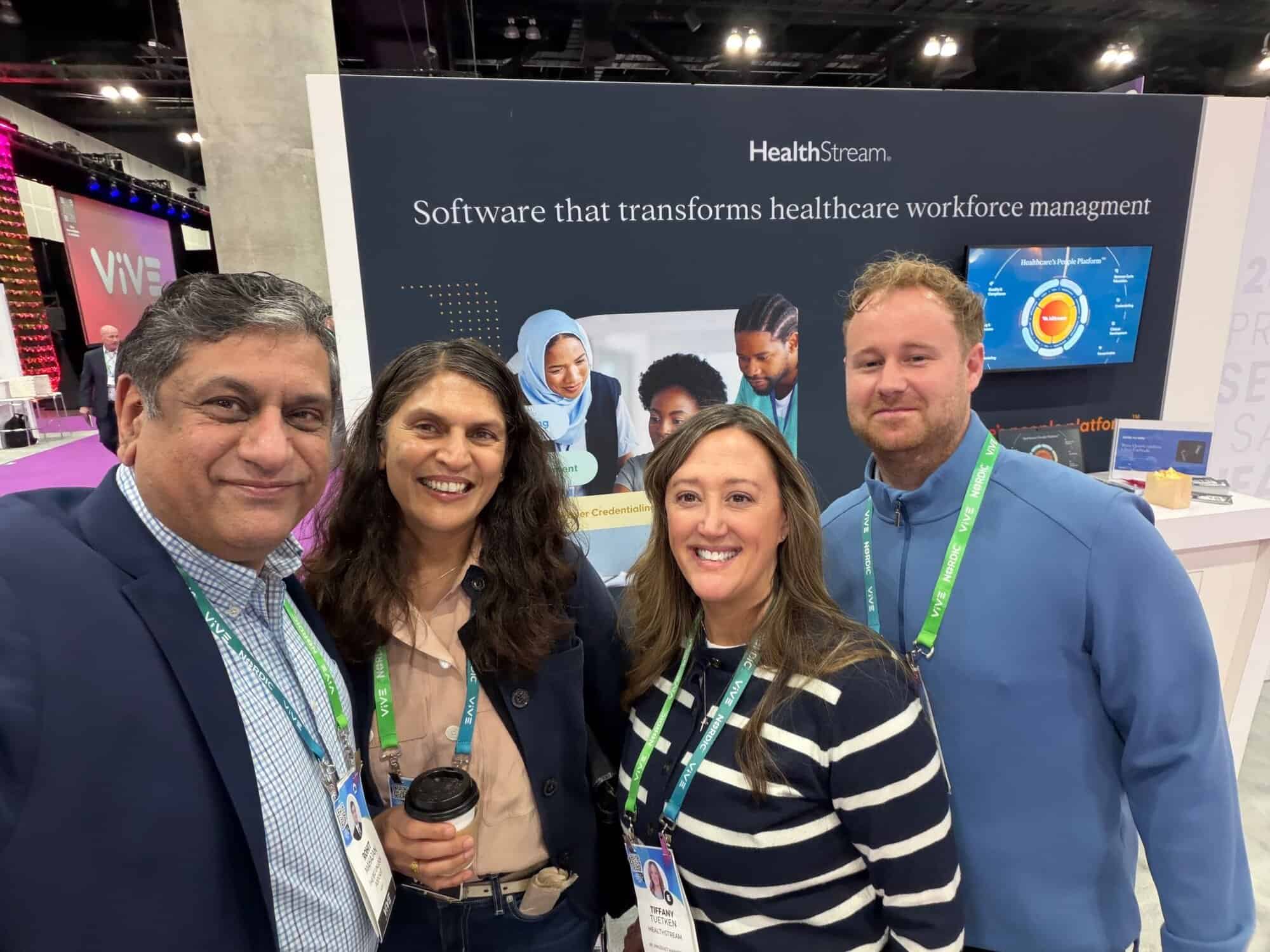
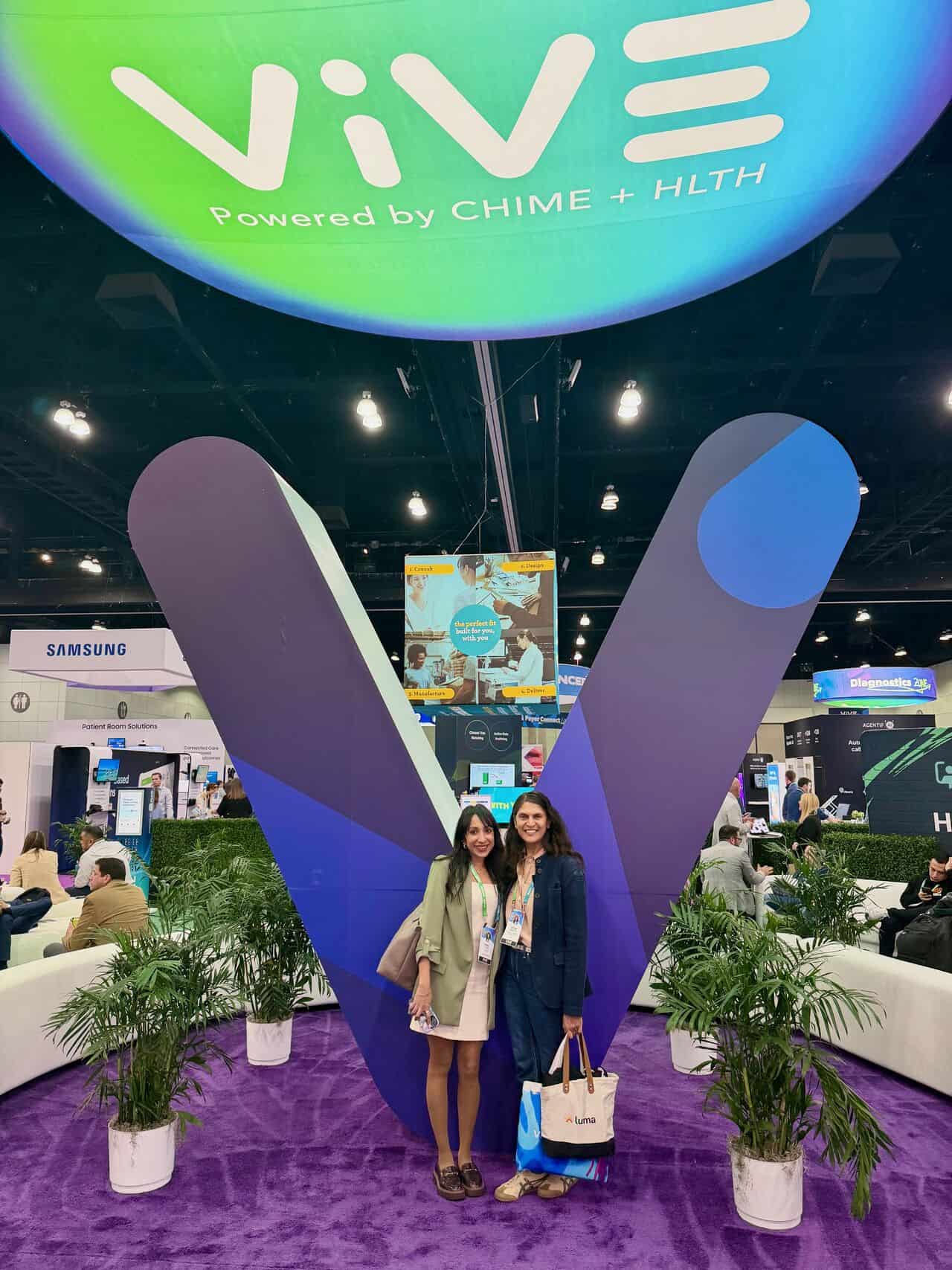
Rohit is skilled in business and IT  strategy, M&A, Sales & Marketing and Global Delivery. He holds a bachelor’s degree in Electronics and Communications Engineering, is a  Wharton School Fellow and a graduate from the Harvard Business School. 

Rohit is the CEO of Damo, Managing Partner and CEO of BigRio, the President at Citadel Discovery, Advisor at CarTwin, Managing Partner at C2R Tech, and Founder at BetterLungs. He has previously also worked with IBM and Wipro. He completed his executive education programs in AI in Business and Healthcare from MIT Sloan, MIT CSAIL and Harvard School of Public Health. He has completed  the Global Healthcare Leaders Program from Harvard Medical School.

Ritu M. Uberoy has over twenty-five years of experience in the software and information technology industry in the United States and in India. She established Saviance Technologies in India and has been involved in the delivery of several successful software projects and products to clients in various industry segments.

Ritu completed AI for Health Care: Concepts and Applications from the Harvard T.H. Chan School of Public Health and Applied Generative AI for Digital Transformation from MIT Professional Education. She has successfully taught Gen AI concepts in a classroom setting in Houston and in workshop settings to C-Suite leaders in Boston and Cleveland. She attended HIMSS in March 2024 at Orlando and the Imagination in Action AI Summit at MIT in April 2024. She is also responsible for the GenAI Center of Excellence at BigRio and DigiMTM Digital Maturity Model and Assessment at Damo.

Ritu earned her Bachelor’s degree in Computer Science from Delhi Institute of Technology (now NSIT) and a Master’s degree in Computer Science from Santa Clara University in California. She has participated in the Fellow’s program at The Wharton School, University of Pennsylvania.

About the Legend

Paddy was the co-author of Healthcare Digital Transformation – How Consumerism, Technology and Pandemic are Accelerating the Future (Taylor &  Francis, Aug 2020), along with Edward W. Marx. Paddy was also the author of the best-selling book The Big Unlock – Harnessing Data and Growing Digital Health Businesses in a Value-based Care Era (Archway Publishing, 2017). He was the host of the highly subscribed The Big Unlock podcast on digital transformation in healthcare featuring C-level executives from the healthcare and technology sectors. He was widely published and had a by-lined column in CIO Magazine and other respected industry publications.

What is the “Healthcare Trilemma” and How Can it Be Solved With AI?

The healthcare trilemma, sometimes also referred to as the “Iron Triangle,” describes the inherent trade-off between three core goals: Cost, Quality, and Access, first coined by William Kissick, the late University of Pennsylvania Wharton School Professor of Economics. The decades long dilemma has been that while it can be relatively easy to improve one or two aspects, it often comes at the expense of the third. For example, increasing access or quality often raises costs, while cutting costs can reduce quality or access, making it difficult to achieve all three simultaneously in a perfect system. Modern variations also include a fourth goal like health outcomes making it a “Quadruple Aim.”

But no matter what you call it, on a recent episode of The Big Unlock podcast Matthew Blosl, CEO of DexCare, sat down with hosts Rohit Mahajan, Managing Partner and CEO at BigRio and Damo, and Ritu M. Uberoy, Managing Partner at BigRio and Damo to share his insights on how focus, co-innovation and AI can be used to finally address this age-old issue.

A Culture of Co-Innovation

Solving all three legs of the Iron Triangle requires a certain amount of “co-innovation” particular when it comes to developing IT solutions for healthcare, however, as Matt explained, that is something that over the course of his career he saw as somewhat lacking. As he told Ritu, “Customization was often seen as a negative, particularly when you were dealing with SaaS solutions for healthcare. You created something, and it was just supposed to a ‘set and forget it’ kind of solution. But I found that kind of one size fits all approach just really could not work for the large healthcare systems I was working with.”  He went on to explain that you simply cannot adoption at scale nor reap the benefits that AI can bring, without customization and co-innovation.

“[Our job is to] innovate for a given health system. They all have different priorities. They all have different workflows. They all have different system and data capabilities, and so we look at innovation on an individual basis. We’re coming in and we’re helping innovate using obviously our core platform but making it specifically applicable to the environment in which we’re implementing it.


The Role of AI and the Challenge of Staying Focused

As our regular readers and listeners to our podcast know, healthcare is certainly at a nexus when it comes to AI, and Matt would certainly agree.

 “We are at a technological inflection point regarding AI implementation in healthcare.  It’s arguably the largest one we’ve seen. It’s the one that’s evolving at an unprecedented pace. Yet, what I find most interesting is that especially within healthcare, at first, there’s still a lot of apprehension around AI. Even though AI enables us to do things that we’ve never done before. It’s going to take a little bit of time to get health systems and healthcare in general comfortable with the risk associated with it.”

He then restated how “co-innovation,” again is the answer to overcoming such hesitations

“AI can deliver a lot of great things, but we really need to partner with our clients to help them understand how to do this. Getting healthcare to adopt new technologies has always been difficult and complex. There needs to be some level of empathy going beyond simply what the technology can provide.”

Yet, he admits that because AI has the power to do so many things well, it can cause companies like his to actually lose focus and try to use it to do too much.   

“There is so much that we can do to innovate within the AI space that it’s very easy for us to go outside of our lane very quickly. What we’re really trying to do at DexCare is stay focused, to simply do what we do, but use AI to do it that much better and thereby take our core strength – care orchestration – to a level that we and our clients in the industry never thought was possible.”


Solving the Healthcare Trilemma

Though similar in its challenges, Matt’s description of the healthcare trilemma as DexCare perceives it departs somewhat from Professor Kissick’s classic definition. For him, the legs of the triangle are: more patients, fewer practitioners, and smaller margins.

Interestingly enough, Matt believes that it may take a combination of three things to solve the trilemma: co-innovation, AI and focus.

He explained how solving the trilemma, basically how to do more for more patients with less staff and lower revenue, is the starting point of every conversation they have with a client.

“It starts with that empathy I mentioned earlier. We understand you have  a staffing issue, whether that be actual physicians, or nurses, and at the same time,  we see you are strained economically, and from there it’s very easy to apply co-innovation to look at the Dex Care platform and focus on how we can help.”

The Healthcare Digital Transformation Leader

Stay informed on the latest in digital health innovation and digital transformation.

The Healthcare Digital Transformation Leader

Stay informed on the latest in digital health innovation and digital transformation

The Healthcare Digital Transformation Leader

Stay informed on the latest in digital health innovation and digital transformation.