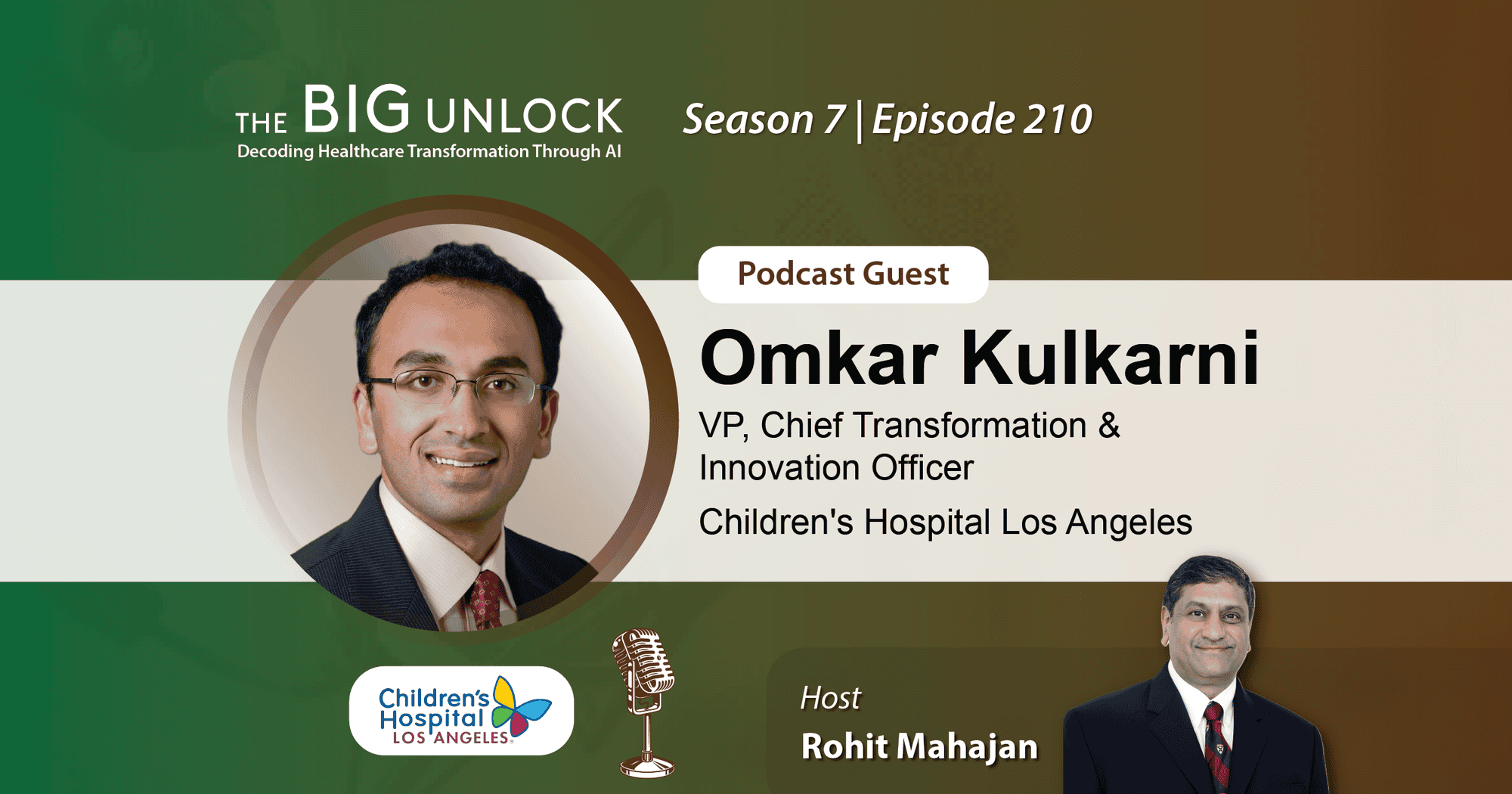
Rohit: Hi, Omkar. Welcome to The Big Unlock podcast. It is, great to have you here with us today.
Omkar: Thanks, Rohit. Nice to be here.
Rohit: Likewise. How are you doing?
Omkar: I’m good. It’s getting into springtime and lots of, uh, opportunities everywhere, so it’s nice.
Rohit: Great. So happy to share that we’ve crossed the 200 mark on the podcast Omkar, so it’s fantastic. So I’m Rohit Mahajan. I’m the CEO and, Managing Partner for BigRio and also the co-host of the Big Unlock podcast. The credit of starting this goes to Paddy Padmanabhan, who was the founder of Damo and he was very deeply loved by the audience and the podcast guests as well. So with that, I will ask you and request you for your intro, Omkar. So Omkar, tell us a little bit more first about KidX and the Children’s Hospital at LA And then would love to learn also about how you got attracted into the healthcare industry segment and what was your journey so far.
Omkar: That’s amazing. Sure. So listeners love to hear that. Yeah. So there are about one hundred children’s hospitals in the country. CHLA, Children’s Hospital Los Angeles, is one of the largest ones. And as the name suggests, it’s in Los Angeles, but specifically it is an academic medical center taking care of all sorts of very complex and sick kids, honestly, who require procedures, treatment. We have a very busy emergency department, very impressive and historic research organization, largely collaborating with the University of Southern California, USC. Our faculty are all faculty physicians at USC. Great teaching tradition there as well, so we have residents and fellows, both from the physician standpoint, but also from a nursing standpoint. Incredible clinical care. We have been ranked in the US News top ten honor roll for many, many, many years and continue to be in that ranking. And then what’s really unique is we are proudly a safety net hospital, so we actually take care of a very large proportion of kids on Medicaid, which I think a lot of people don’t realize this, and we may talk about this soon, but a lot of kids in this country, more than half of the kids who are hospitalized in this country, are covered by Medicaid. It’s a really important part of the equation. Actually about forty percent of Medicaid, I believe, is children. So it’s, it’s a big chunk of the puzzle. Yeah. And we take care about, of about seventy to seventy, seventy to seventy-five percent of our inpatient discharges are typically kids covered with Medicaid. And so we’re really proud of the safety net element of our hospital, the great clinical care, the great research tradition, and the great teaching academic tradition as well. So we just celebrated our hundred and twenty-fifth birthday as a hospital a few weeks ago, actually.
Rohit: Congratulations.
Omkar: Yeah. It is. Yeah. That’s amazing. It’s a big deal. It’s, it’s hard to do anything for a hundred and twenty-five years and let alone do it so well, so this place is really successful. So that’s that. KidsX, really briefly, so you know when I came to CHLA in twenty eighteen, I quickly realized that there was an opportunity for children’s hospitals to come together to work together to drive digital innovation. And large part of that is because children’s hospitals don’t compete nearly as fiercely as adult health systems do. Most of them have geographic regions that they cover that don’t necessarily overlap. Pediatricians are also highly collaborative in nature, and there’s a need for collaboration. Uh, the populations are heterogeneous, they’re small, and innovation requires large populations and scale at some point. And so the opportunity for collaboration was great. I was lucky enough to get to know and collaborate with many children’s hospital innovation leaders in my first few years at CHLA, and in 2019, we built this consortium called KidsX, which we run here in Los Angeles out of CHLA, and it’s driven around driving pediatric innovation. So we’ve been live for six years. That’s amazing. We’ve helped launch over 85 innovation projects in children’s hospitals across the country in that time period and are still going on very strong, so very proud of that work.
Rohit: Amazing, amazing journey, Omkar, and please share with us that what motivated you to join into the healthcare industry segment and basically your origin story so far.
Omkar: So I’ll share that growing up, my dad worked in the pharmaceutical industry. I had lots of family and friends who went into medicine, nursing, pharmaceuticals, something in healthcare. So I feel like I was always surrounded by it, and for me, though, I was not a science guy. Like, I love science, but I didn’t excel perhaps in biology or science or any of those things. Instead, I was more of a business leader. I went to school for business. I went to school for management, et cetera, and at some point after my undergraduate studies, I was in a job in a hospital in New Jersey, and my boss at the time told me, “You know, you can actually make a profession out of this. You can actually go be a hospital administrator,” which is really a role I never thought about, somebody who’s non-clinical who can still do work in healthcare. And at the same time, I learned about this whole field of public health, and I really fell in love with public health. I thought it was a really interesting concept about keeping populations healthy and how can we create systems as simple as fluoride in the water, or seat belts, or making sure kids are safe, people are safe where they go. All these different things to keep communities safe and prevent things from happening. So that’s what got me into this space, and then over time, I think a big part of my story is being lucky to have opportunities offered to me, and then being discerning about which opportunities to take. And so I’ve been able to build skills in Lean and Six Sigma. I’ve been able to work in health systems from New York to Los Angeles and have been able to see front hand how decisions are made in healthcare. And what I’ve really come to realize is that a lot of healthcare, innovation, whatever you wanna call it, is really about relationships. It’s about trust that you can build with doctors and nurses and executives and administrators. ‘Cause at the end of the day, this work that we do where we’re trying to change healthcare, whether it’s through technology or process change or anything, it involves trust. You have to get people who are taking care of patients every day to trust that this new thing that you want to bring to them is going to work, that it’s going to make their lives easier, and that it’s going to ultimately create a benefit. And that’s the core of what I’ve learned, and I’ve been lucky to kind of go through this journey over the past few decades that’s gotten me to where I am today.
Rohit: That’s great, Omkar. So please tell us a little bit about, you said children’s hospitals are different from the general hospitals, even in terms of the location like you were describing it, and it is great that, you know, you have this consortium which is KidsX. So what is so special about pediatrics patients? Could you tell us a bit more about this aspect of it?
Omkar: Sure. Thank you. So I didn’t know a lot of this when I came into pediatrics, to be fair. So I don’t think, I think there’s even a lot of executives and leaders in innovation don’t realize the differences that exist. Some things that may seem obvious once I describe them, but it’s important, right? So the end user, if it’s a consumer-facing technology, typically for an adult, is the patient themselves. Maybe it’s, you know, a loved one, but typically it’s the patient. For pediatrics, it’s not. Typically pediatric patients are under the age of 7 or under the age of 12. If you look at the cohort of people who are in children’s hospitals, they’re typically young children. There are teenagers and adolescents, but the bulk are under the age of 12. And so typically you’re dealing with the end user being the parent, and that’s one big thing to think about. So you’ve gotta design a solution for a caregiver, not necessarily for the person experiencing the healthcare. That’s interesting. Children’s hospitals are also not taking care of the parents, right? Those parents don’t have MRIs. They don’t have accounts with that hospital. Those hospitals are actually taking care of the kids. That’s challenging. One thing I like to remind people, if you look at the demographic spread of the United States, the youngest Americans or people who live in this country are the most ethnically and linguistically and culturally diverse. So if you look at people age zero to 18 in this country, which is the pediatric population, and even if you include their parents, which would go up to whatever age you wanna think about, that’s a much more diverse population than 70 to 80-year-olds. And so when you think about language, when you think about culture, when you think about ethnicity and considerations, you’ve gotta build that in. You need a solution that’s gonna be English, Spanish, a lot of things that are culturally relevant, so that’s another thing. But from a privacy standpoint, another thing that’s important, I use the number 12, the age 12 deliberately. So children, once they’re over the age of 12, but before they’re 18, they have rights in this country to be able to request that their health information be kept private from their parents. Right? So the teenage girl who doesn’t want parents to know that she’s on birth control, that’s an example, but there’s many examples of that. And so as you develop a digital solution, whether it’s parent-facing or child-facing, you’ve gotta create different privacy provisions for that, you know, 12 cutoff. This impacts things like patient portals, appointment scheduling, text message reminders. You don’t wanna send a 13-year-old’s parent a reminder about their upcoming visit if that patient has chosen for that parent to be kept out of the loop. I mean, little things like that you’ve gotta think about because those, those children have rights. And then the other big one, if you’re developing anything that has any physical size to it, right? Like a device or, or anything that, like a, a sensor. Such a diverse population, right? So if you look at adults, generally adults are all the same size, generally. I mean, yes, there’s different size variations, but generally the same size. You look at a little baby that’s born in the neonatology NICU area and you compare that to a three-year-old, and you compare that to an elementary school-aged kid to a teenager and then a 17-year-old. These are all pediatric patients, right? Yes. But the size of these people, their physiology, it’s very different. Uh, so lots of things to consider. And then, uh, and then, you know, engagement with this audience is constantly changing. When I started CHLA, social media meant one thing. Today it means something different. And how to engage audiences using different technology means different things. And there’s so many, there’s so many more things we can talk about as well, different regulatory considerations as well. The other thing that’s really important to me, and to lots of us, is information security. Yeah. You do not want the identity of these patients to be compromised. Yes. Because imagine, like um, I’ve got young children. I would hate for any of their identities to be compromised. Yeah. Somebody opens a credit card in their account. All of a sudden now you know, they’re 18 and their credit is ruined. As a health system, we have to be extremely careful about the identity of these patients and making sure that it’s very protected. So lots of things, but you know, people don’t necessarily think about that. Now despite that, one thing I’ll say, pediatric patients make up 20% of the population, right? If you think about children 0 to 18, it’s about 20% of the US population. Yet, when you look at investments made in digital health, innovation, it’s less than 1% goes to pediatrics. So there’s a huge discrepancy in terms of how much money we invest into pediatric innovation, and that’s part of the motivation of KidsX, is we need to really create a place where these innovations can excel and scale.
Rohit: Yes. Great, great thoughts and insights here, Omkar. Let me ask you the next question, which is coming to my mind, is that since you mentioned this whole innovation ecosystem, what are some of the innovations that you are seeing in the pipeline or the problems that needs to be solving from your vantage point?
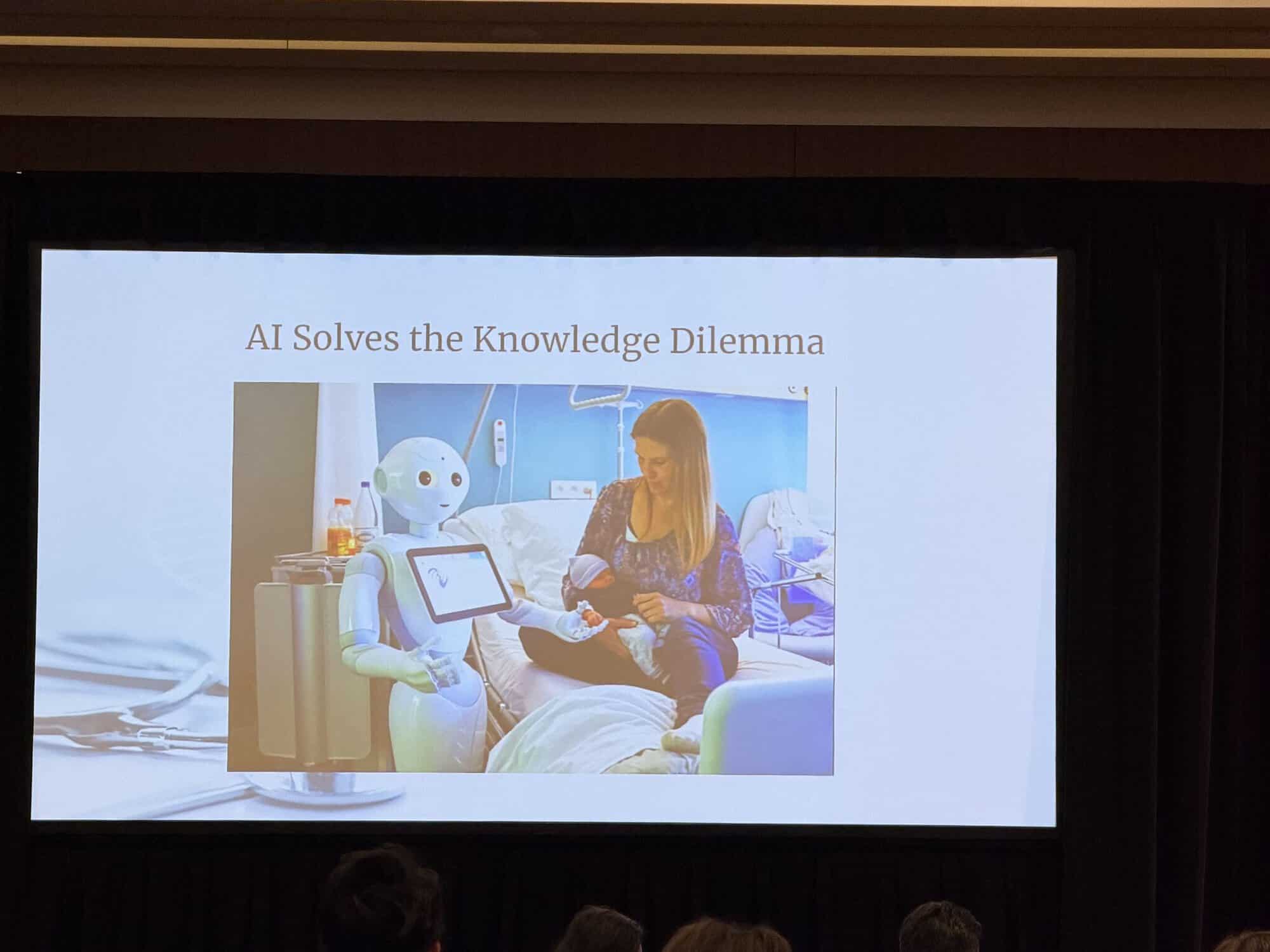
Omkar: Rohit, there’s so many. Yeah. Thank you for that question. So one of the biggest crises that’s happening to our children right now is around mental and behavioral health. I think there’s always been a challenge with kids as they’re growing up having to figure out how to navigate and manage their emotions and their mental health. But with the pandemic and post-pandemic period, it’s been exacerbated. So I think there is so much unmet need in this country as it relates to pediatric mental health. And what I’m seeing more recently is data showing that elementary school-aged kids, there are suicides being attempted amongst these children. There are mental health crises that are happening with third graders, fourth graders, fifth graders. And sometimes those things, if they’re unchecked, lead to much bigger problems when they’re teenagers. So how do we screen and diagnose and treat mental health conditions for anyone, maybe even in kindergarten and above? How can we do that? That’s an unmet need. And it’s unmet because we don’t have enough providers to do that work. Yes. We cannot rely on old care models where you have one-on-one synchronous face-to-face meetings. The wait lists for these providers across the country are very long, especially if you’re on Medicaid, which as we talked about, is about half the population. So we need new ways to screen these patients. We need new ways to engage with them and then treat them. So that’s one big area. Another one that’s growing, and it’s a great thing, many children, so if you look 50 years ago, 60 years ago, children diagnosed with some chronic conditions, those conditions were terminal back then. So take diabetes. I was actually talking to my father-in-law, and he said when he started practice 50 years ago as an endocrinologist, that when a child was diagnosed with diabetes, often that meant that we didn’t expect that child to live into adulthood. But today, people live well into adulthood, maybe even a full lifespan, managing diabetes that’s diagnosed, Type 1 diabetes that’s diagnosed in childhood. So how do you develop chronic care management tools for children that translate into adulthood, so things that the kids can manage and translate? I was talking to this innovator in Vancouver who is doing some really cool things because the Canadian health system, they care quite a bit about longitudinal care. So she’s thinking about how to build a digital solution that you introduce to a child when they’re in elementary school or middle school. They keep using it, and then when they’re an adult, they keep using it. So now this is something that goes with them. So longitudinal chronic care management is another really big area that I think is really interesting. And then the last one that I would just point out that I think is an unmet opportunity is around access to… I think there’s an opportunity for us to leverage a lot of these artificial intelligence gen AI tools to equip parents with getting answers to questions that they have that they otherwise just don’t ask or they look online and don’t get the right answer to, right? As we sometimes say, when you bring home a child from the hospital when they’re born, no one gives you an instruction manual, right? No one tells you how to raise that child. You ask your parents, you ask your grandparents, your neighbors, your friends. That’s how we rely on this. But we’re living in twenty twenty-six, we have so many validated clinical… so much information around how best to raise a child, what things to look for, what symptoms, what signs. And right now, the only tools that patients have are Google or their social connections, or they’ve gotta wait to see a doctor, which often comes with a co-pay and often comes with the struggle of accessing that person. Can we use consumer-facing AI tools to enable parents to get access to information that they need at the moment they need it, that we can believe is validated and accurate? We’re already seeing, and I’m sure you’ve seen the studies, that so many consumers, adults and pediatrics, are going to ChatGPT, and they’re going to Gemini to ask these questions. Let’s figure out how we can get the right answers that’ll reduce your urgent care visits, reduce your same-day appointments, and it’ll hopefully allow for better health outcomes.
Rohit: Absolutely. That actually leads us nicely into the next question, Omkar, which I’m curious about, is that would you like to describe any gen AI initiatives or AI initiatives that you are seeing being implemented either at CHLA or other places that you know about, you know, which are kind of in this domain of children’s hospitals? And then we were talking earlier about secrets for startups. So kind of in that direction, what are your thoughts?
Omkar: So I do think there’s some early work happening around how we can equip patients with information either about a chronic condition, so we’re thinking about diabetes and asthma and some of these chronic conditions, so that we can provide the knowledge base with really clinically validated content so that they’re only getting information from sources we trust. That they’re able to engage with it as a chatbot or as you would with a ChatGPT. So that’s something that I’m seeing and we’re working on and others are working on as well. I really hope that becomes a solution that is available to people, because I think that what we’re seeing on the flip end is, you know, what does a parent do? They pick up the phone and they call, and they call somebody, and let’s give them answers twenty four/seven that we feel good about. The other thing I’m seeing, I think, in the gen AI space that I think is very interesting is around synthesis of information. So pediatrics more than anything else, a pediatric patient at a children’s hospital is likely to have been seen by or will be seen by many different specialists and doctors, right? Because they’re typically very sick. So they’re seen by, they’re being seen by lots of consultants, and many times they’re in the hospital multiple times. And so they’ve had previous consultants, hospitals, so many different people who’ve engaged in their care. And so what does a doctor do who’s taking care of them, or a resident do who’s taking care of them? They’ve got to read all these notes, all these historical documents to make sure they don’t miss anything so they can be well informed about this, about this patient in their hospitalization now. So what I’m excited about is seeing some of these synthesis tools, including some that the EHRs are working on, that are going to be able to synthesize information from past notes to be able to generate summaries so that not only is it a time savings, but you can really make sure that you capture the information so that the provider can really take care of the patient that is there today. Now again, lots of questions around accuracy, validity of that summary and synthesis, but again, as we think innovation, that’s a huge opportunity for pediatrics because it is such a specialty oriented profession and space, children’s hospital, that having that synthesis from multiple sources is going to be crucial as we think about efficiency, scaling, and things like that. Which I guess dovetails nicely into your question about kind of secrets of working with startups. So I’ve had the amazing luxury of being able to work with lots and lots of startups over the last decade, and I think as we are in this new AI space, I think a couple things come to mind. One, be really specific and careful about what you’re going to promise in terms of the efficacy of your product and the outcomes that it’ll deliver, right? Hospitals are very discerning, and they should be, particularly as you think about AI, about when you say your product can do X, what does that actually mean? Is that in one pilot study that you did with one unique place, or is this across many different clients you had? And particularly as we think about tools that are part of clinical decision-making, that’s gonna be really valuable. Having not only evidence, which has always been a goal, but deep evidence, evidence that has large sample sizes and perhaps heterogeneous populations, right? You didn’t just work with one hospital in Pittsburgh. You worked with hospitals all over the country with lots of different populations and care models, and through that you were able to reduce errors in clinical decision-making by 10%. Great. That’s what you need. So getting there is going to be important. Now, the challenge of that is it takes a long time to get to that point. So making sure we have the right funding vehicles to support companies in early stage that are particularly building these AI tools so that we can get to a place where these tools have validity before they are scaled across the country is gonna be really crucial. Another really important one is around business model. I cannot describe how many times I’ve heard of a great solution that is solving a real problem but has no viable business model that’s going to, you know, scale across all the different types of healthcare settings that are out there, meaning I can’t think of who’s gonna pay for it and why they would pay for it. So that’s another one. The other just general thing I worry about, when you’re coming to pitch something, your best bet as a startup is not to get some sort of grant-funded pilot. Your best bet is to get a commercially funded engagement because that tells me, that tells you as the startup, hey, there’s some real value that people are imagining here. And the final thing I would say is humility. I think nobody expects that your solution is going to completely change decades of healthcare practice. Admit what you can do, talk about what you’re focused on, but be humble about it. And I think, I’m sure, you know, if you listen to the hundred and ninety-nine other podcast episodes that you’ve had on this show, you’re gonna see the same thing, right? Ultimately, this is going to be about partnership between people. And humility is such a key part of developing trust.
Rohit: That is amazing you say that. I think it goes such a long way, Omkar. Yeah. So now that we are coming towards the end of our conversation for this time, what are some of your predictions for the future or any other parting thoughts that you would like to share with the audience?
Omkar: Predictions for the future, that’s very interesting. So I think that there is still a tremendous amount of work to do as we think about tech-enabled services. There’s a lot of work we have to do around not only making healthcare more efficient and more cost-effective and faster, but also about how we can reach more patients. I think one of the best ways of doing that is by enabling those who are providing services with technology that’s gonna help make them create better outcomes and see more patients in a timely manner. I firmly believe, and I may be in the minority here, but AI replacing humans in healthcare is not the way I like to think about it. I think healthcare is a very human-to-human process. I think when people are sick, they wanna talk to somebody, even if it’s somebody on the phone. Because they care about… they want someone to be able to comfort them and talk to them, et cetera. I don’t think people want an end-to-end transaction for many of their, you know, more complex needs that are entirely technology oriented. Perhaps, sure, if you need eye drops, you can do that through a chatbot. But if you’re sick and you need an MRI, and you want someone to talk to you about your MRI results, a lot of people are gonna wanna talk to a human. Now, how can we enable that person who you’re going to talk to so that they can talk to 10 times as many people, or five times as many people, whatever the case may be. Let’s help them become more efficient and better at their job. Let’s not talk about replacing humans with all these bots and whatever. Again, some instances it may make sense, but I do think that, and lots of consumer behavior shows this, people still want to talk to somebody. And my thinking and prediction is that we will still have humans in healthcare five to 10 years from now, lots of them. They will just be doing work that is much more top of license. They will be empathizing and talking more to patients, and letting the AI and the technology do a lot of the routine, manual administrative stuff. That’s my hope for where we go, because I think that if it’s my kid or my parents that need healthcare, or myself that needs healthcare, I’d like to talk to somebody and engage with a human. So that’s my prediction.
Rohit: That’s awesome. So with that note, Omkar, thank you so much. This was a wonderful conversation, and I’m hoping that we will have you back on the podcast sometime soon for a follow-on meeting.
Omkar: Thanks, Rohit. Thanks for having me, and always happy to come on the show.